
Rubix Code empowers healthtech and medtech scale-ups to unlock the value in their biosignal data - transforming raw physiological signals into action
Joined February 2026
- Tweets 58
- Following 14
- Followers 4
- Likes 256
1 Photos and videos

Jun 12
A domain-specific medical AI model just outperformed OpenAI and Anthropic by more than 25% on clinical accuracy benchmarks.
Not a coincidence. A pattern.
Here's why specialized beats general in healthcare AI.
#HealthcareAI #MedTech
1
2
3
15
Jun 12
This is why biosignal AI can't be a wrapper around a general model.
EMG processing. CTG analysis. Biometric monitoring.
Each requires architecture built around the specific signal, the specific noise profile, and the specific clinical output.
1
1
3
12
Jun 12
In healthcare, the winning AI isn't the biggest model.
It's the one built for exactly this signal, this patient, this decision.
That's what we build at Rubix Code.
rubixcode.ai/
2
3
12
Jun 11
Medical device AI in Europe now has to satisfy both the EU AI Act and the MDR.
Industry called it "an unnecessary layer of complexity."
But for teams that built their MDR documentation as a living system - not a one-time exercise - the overlap is manageable.
The complexity isn't the problem. The shortcuts are.
#HealthcareAI #MedTech
1
1
3
15
May 28
Apple Watch detects signs of hypertension. FDA cleared. 100,000 study participants.
Then it tells you to use a cuff and see a doctor.
That's not a limitation. That's the correct design choice.
Detecting a pattern is one problem. Measuring a clinical value is another.
Know which one you're building before you start.
#HealthcareAI #MedTech
1
2
20
May 22
FDA just made it easier to ship low-risk AI health tools.
That clarity cuts both ways.
If your product influences a clinical decision - diagnoses, treats, or prevents disease - you're fully in medical device territory.
No grey area. No enforcement discretion.
Build accordingly.
#HealthcareAI #MedTech
2
3
67
May 20
Most medtech teams building for the US market know FDA 510(k).
Fewer know that as of February 2026, the FDA's quality management requirements formally align with ISO 13485.
If you're building for both US and EU - your quality management system can now be built on a single framework.
That's not a documentation update. That's an architecture decision.
#MedTech #HealthcareAI
2
3
14
May 15
Most medtech teams building for the US market know FDA 510(k).
Fewer know that as of February 2026, the FDA's quality management requirements formally align with ISO13485.
If you're building for both US and EU - your quality management system can now be built on a single framework.
That's not a documentation update. That's an architecture decision.
#HealthcareAI #MedTech
2
3
15
Apr 30
"Production-ready" doesn't mean your model hit 95% accuracy in testing.
It means it works on real patients, in a real workflow, under regulatory scrutiny - consistently.
Those are two completely different problems.
#HealthcareAI #MedTech
2
3
13
Apr 17
Building AI for real-time medical use is a different problem than building AI for accuracy.
Most teams find this out too late.
Here's what we've learned building real-time AI for rehabilitation and labor monitoring.
#HealthcareAI #MedTech
1
2
3
29
Apr 17
Lesson 4: Speed and accuracy are both requirements.
Not a tradeoff.
In labor monitoring, seconds matter. In rehabilitation, real-time feedback is the product.
If your architecture can't deliver both, it's the wrong architecture.
1
3
12
Apr 17
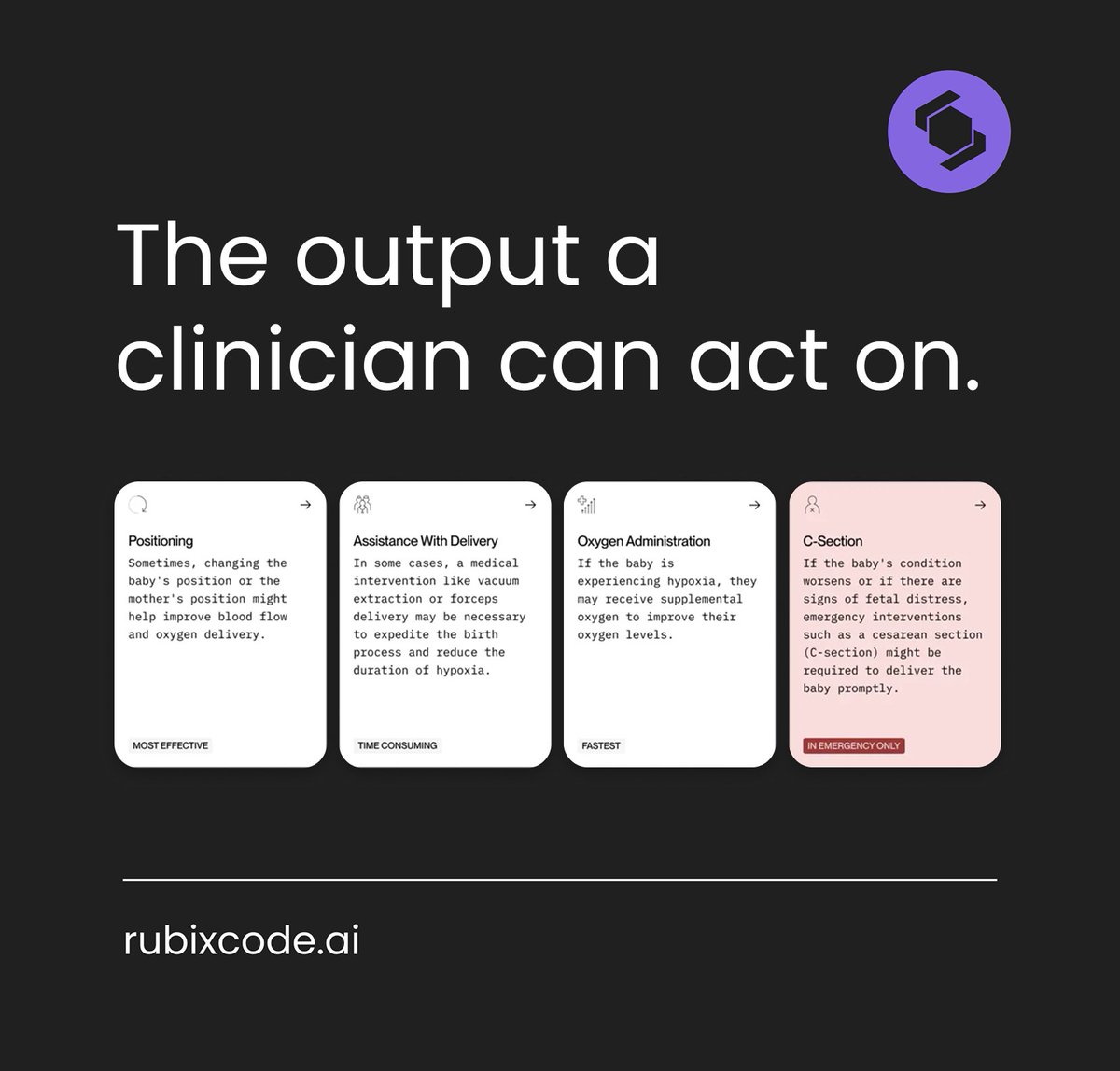
Lesson 5: The output is the product.
Not the model. Not the accuracy benchmark.
The output a clinician can act on, in the workflow they already use, in the time they actually have.
That's what we build. rubixcode.ai/
2
3
15
Apr 15
The same CTG reading means something different at 32 weeks than it does at 40.
An AI that analyzes fetal heart rate in isolation isn't doing clinical analysis.
It's pattern matching.
Real clinical AI doesn't just read the signal. It reads the signal in context.
#HealthcareAI #MedTech
2
3
22