
AI Systems Engineer & Product Manager. Building Waveform, ryOS, and shipping to prod while the devs sleep.
Joined July 2013
- Tweets 1,488
- Following 753
- Followers 337
- Likes 3,478
248 Photos and videos









13h
is it just me, or does it feel like X hasn’t refreshed since a SpaceX ipo Friday
devs rode off into the sunset
19
Jun 13
summer break is back on
Jun 13

As a result of a US government directive, we are suspending access to Claude Fable 5 for all users. You can continue to use all other Claude models.
Here’s what this means for you:
Across Claude products, new sessions will run on your selected default model or Opus 4.8, and existing Fable 5 sessions will end with an error.
On the Claude Platform, requests to Fable 5 will also return an error. Please update your integrations to other Claude models.
We know this is a disruption to your workflows; we appreciate your patience and support.
1
53

May 31
Anthropic's dynamic workflows gave me the confidence to actually extend agent autonomy
I am way more willing to let agents run loose when the workflow is repeatable and recorded
built a suite last night: autonomous human-gated skills across ops, search, build, and design
the autonomous ones gate on my Obsidian kanban boards
Claude and Codex doing the heavy lifting as a team
2
95
May 31
codex really nailed pmf by making standing thread-heartbeats a native pattern
1
76
May 29
sure model releases are cool, but which of you is resetting limits first this weekend?
1
1
401
May 31
May 31

Five million users would agree. Resetting the limits tomorrow morning to celebrate.
Time to go /fast
50
May 31
the single best way to stay focused while the AI frontier moves at a million miles a minute:
Keep your tinkering locked to your problems.
If you can't immediately see why it'd be useful to you, let it scroll on by.
context switching always has a price
1
43
May 30
you wouldn’t know it by looking at the timeline, BUT -
Claude Code and Codex play extremely well together if you just ask them to - “play to your strengths”
97

May 29
Just used workflows to audit a dozen apps across 100 app storefronts in 7 minutes
pretty powerful tech
May 28
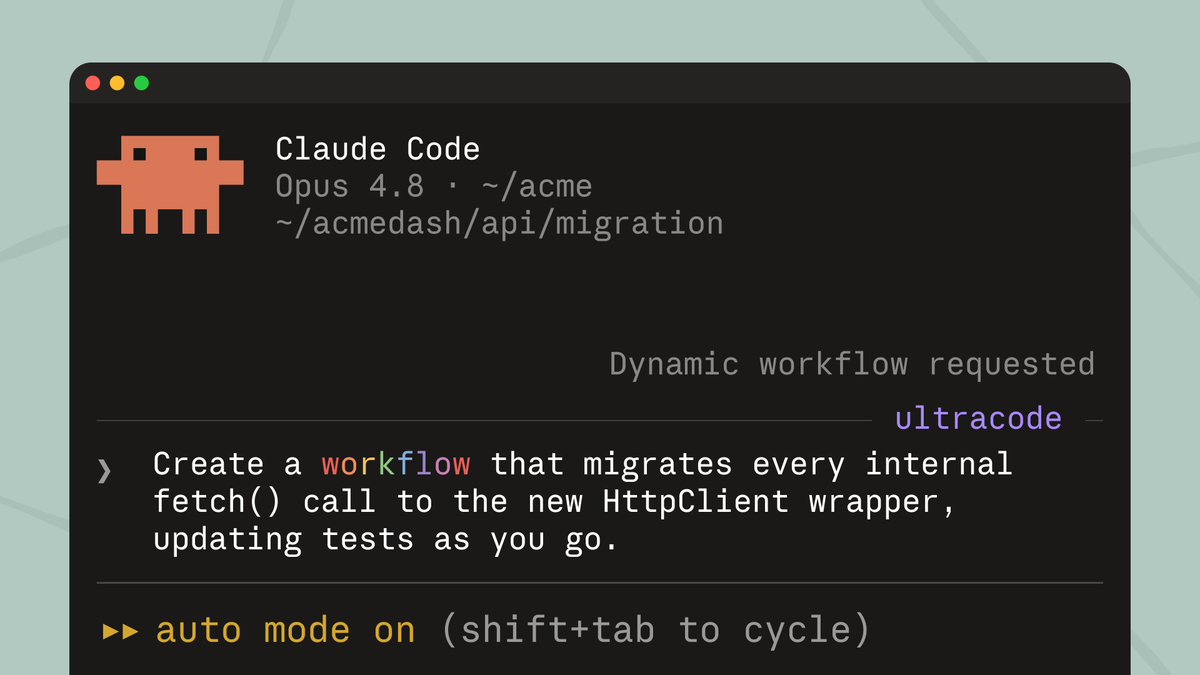
New in Claude Code (research preview): dynamic workflows.
Claude writes an orchestration script on the fly, then spins up a large fleet of coordinated subagents in parallel to take on your most complex tasks.
Use the word "workflow" in a prompt to get started.
120
May 25
We're living in an AI world where ~everyone~ should aspire for near-zero switching costs.
When the next fancy tool comes out, your ability to pickup where you left off yesterday is a super power.
Love Claude Code. I am falling for Codex. Conductor and Cursor are also dope. But, I want to tinker with the next one in case it changes the game.
You (the person reading this) are model agnostic, design your systems accordingly
1
131
May 24
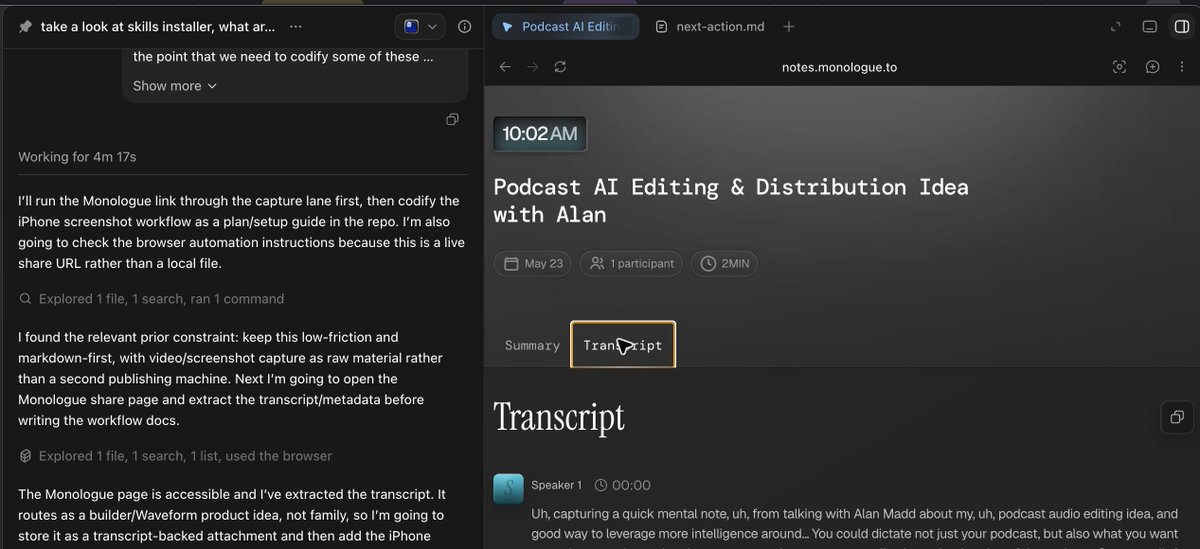
building an auto capture / routing system to connect my mobile habits (screenshot, audio notes) to the AI systems on my computer
Codex's new appshots feature made this so easy
1
2
200
May 23
the amount of simplicity this brought to my codex setup in ~10 minutes
🤯
ready for pt 2 @jxnlco
x.com/jxnlco/status/20571537…

160
May 23
I’d go so far as to say, if you are not using voice yet for a significant chunk of your work
Start building that habit now. I’m in Matt’s camp, 90% of my work is voice to text
Also @usemonologue is all you need
May 22

The biggest unlock for me with AI is still voice as the input mechanism.
I’ve basically used voice as my primary work input for the last 9 months. I barely type anything now.
Most days, that means Mac Whisper bound to a hotkey so I can dictate into any text box. Usually Claude Code or Codex.
The other version is voice memos on iOS.
When I have a project to think through, a feature to build, or a messy problem I need to understand, I’ll go on a run and just ramble into my phone.
That sounds almost too simple, but it has changed how I work.
Typing still has a lot of friction. It’s very easy to stare at a blank box and write nothing. Talking has much less friction. Once you start recording, it’s actually kind of hard to say nothing.
And the models are forgiving. You don’t need to say it perfectly. You can talk in fragments, repeat yourself, circle around the point, and they can usually turn that into something useful.
I heard someone describe typing as “Morse code for the brain,” and that feels right to me. Typing often compresses the signal before you even get the idea out.
But the biggest thing is that voice forces me to get started. It solves the cold start problem in a very practical way.
Try this:
Pick the most important thing you need to work on this week.
Record a voice memo where you talk through the whole thing. Go longer than feels necessary. Include the messy details.
Then paste the transcript into Claude Code or Codex and ask it to ask you questions one at a time.
Answer those questions with voice too.
I think you’ll probably see the value pretty quickly.
2
2
10
2,722
May 17
codex has decided to start naming my subagents
here for Russel, Nash, and household favorite 'McClintock'

3
371
May 16
spending a ton of time giving product debug and quality feedback to claude/codex in markdown
(yes, I want to do some of this myself)
markdown is easy to dictate to and add screenshots, but maybe there’s a better way
what else has worked for people?
1
128