
Believer, dreamer, mother, wife, friend, overt feminist, passionate, confirmed foodie, emotional and a lawyer. Views firmly and solely personal!
Joined July 2009
- Tweets 3,431
- Following 590
- Followers 103
- Likes 13,144
13 Photos and videos





Sandhya Vishal retweeted

Jun 15
The cringe circus continues in Slovakia. Only 9200 people of Indian origin live in Slovakia. I have not seen such events organised for Americans in other countries when Trump visits. Politicians are not celebrities. They have taken this image management too far.
622
1,147
5,807
325,548
Sandhya Vishal retweeted

Jun 14
My family runs a homestay in the hills of Darjeeling and it goes without saying that we have to deal with all kinds of people. However, we have noticed some things that seem to be uniform behaviour for all Indians:
a) They will dirty the room, and not spare even the pillows,
316
363
5,068
1,326,987

Jun 12
Monsters

TNM has accessed a chilling 16-minute audio. Weeks before 20-month-old Arshith was tortured to death in Kerala, his grandma called the Child Protection office with clear warning. She was dismissed.
@harithajohn1, @AzeefaFathima on how the system failed
thenewsminute.com/kerala/aud…
11
Sandhya Vishal retweeted

Jun 11
A 39-year-old jogger underwent surgery after being bitten in the genital area by a pet Rottweiler during a morning run on Carter Road Promenade, prompting Khar Police to register an FIR against both the dog's handler and owner. (1/5)

39
68
183
36,632
Sandhya Vishal retweeted

Jun 9
8 years and 248 crore rupees later, the BMC has handed Mumbaikars a crumbling joke. The newly opened Mrinaltai Flyover is already falling apart with uneven surfaces, and shameful patchwork that exposes the dark reality of this project. Your hard-earned tax money has been shamelessly looted while those in power from the BJP and Shivsena stay completely silent on this disaster. Mumbaikars deserve world-class infrastructure, not a dangerous, substandard mess built on corruption and utter incompetence.
youtu.be/G5OLsAnCYzI?si=pyRo…
56
666
1,576
25,062
Jun 4
Heartbreaking 💔
Jun 4

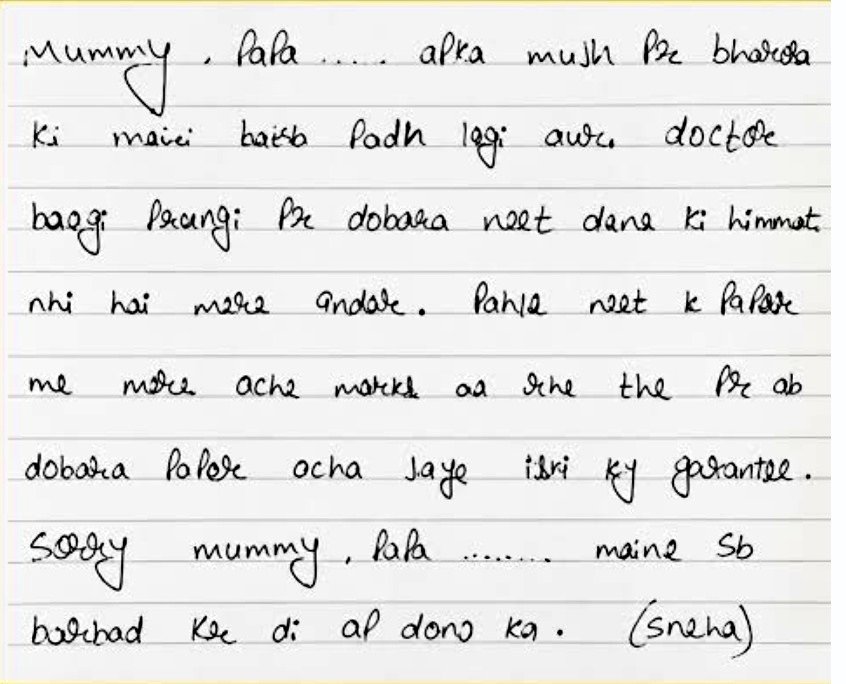
मध्य प्रदेश की NEET छात्रा आकांक्षा चतुर्वेदी ने 20 मई को नागपुर में फंसी लगाकर जान दे दी। अब उसका सुसाइड नोट सामने आया है।
आकांक्षा ने लिखा – "मम्मी, पापा आपका मुझ पर भरोसा था कि मेरी बेटी पढ़ लिखकर डॉक्टर बन जाएगी। पर दोबारा NEET देने की हिम्मत नहीं है मेरे अंदर। पहले NEET के पेपर में मेरे अच्छे मार्क्स आ रहे थे, पर दोबारा पेपर अच्छा जाए, इसकी क्या गारंटी है। सॉरी मम्मी पापा। मैंने सब बर्बाद कर दिया आप दोनों का"

8
Sandhya Vishal retweeted

#DelhiMalviyaNagarFire - is it plausible for any hotel or anybody to make 22 rooms instead of 6 permitted WITHOUT officials' involvement? Impossible. They charge "tributes" even from under construction buildings. They are aware of even a wall not as per rule. Don't allow any whitwashing please @gupta_rekha ji
124
421
1,335
48,280
Sandhya Vishal retweeted

May 31
PM Modi's #MannKiBaat came & went without a mention of the NEET, CBSE & CUET mess.
Let's not pretend this is beneath the Prime Minister's attention. We have seen the full communication apparatus mobilised over far smaller matters. Photo ops, speeches, tweets & inaugurations for projects of purely local significance.
When millions of students are affected, however, the country is expected to accept silence.
Strange priorities for a nation that calls its youth its greatest asset.
164
911
3,711
86,918
Jun 1
One hundred percent true … all this Mann ki Baat is a gimmick if you do not address this… what a shame
May 31

Education is the ONLY honest route available to Indians to improve their economic status. Exams are life & death situations for millions. The casual zamindar style attitude displayed by the PM is his lowest moment in his 12 year rule.
21
Sandhya Vishal retweeted

May 31
Indian children and youth from lower and working classes, who toil day and night, must be fully aware that there is no real meritocracy in India and no great opportunities for you. All politicians, irrespective of political party, and all bureaucrats, irrespective of affiliation, are going to lie to you about a great future — but it is not happening for you. Don’t trust their rhetoric. Look around—India is one of the most unequal nations in the world, marked by extreme inequality and discrimination. There is no fairness or justice. Your parents, who are grinding themselves down to educate you in schools and colleges, are wasting their time, effort, and resources. You are all on your own. India missed the bus 40 years ago. The ruling elite (Left, Right, Center) of this country have had no plans for you.
159
437
1,795
81,128
Sandhya Vishal retweeted

May 29
Every social media post and news about Twisha Sharma and her Ex- Judge mother - in law - Giribala Singh, makes me wonder why does the society discuss a woman’s character instead of discussing what happened to her.
Her WhatsApp messages are being questioned.
Her mental health has been brought up.
Her relationship with plants is being discussed. 😊
Her “liberal views” have became a subject of debate.
At every step, the spotlight has moved away from accountability and toward her character.
This is not accidental.
Character assassination has always been one of society’s favourite ways of dealing with uncomfortable questions. If you cannot defend what happened, make people question who it happened to.
And what struck me most was not just the comments from Giribala Singh. It was the fact that Twisha’s own parents did not support her enough - “ignore it”
Imagine that.
Everyone has become an investigator of a person’s character, while the search for truth has quietly slipped into the background.
Patriarchy is rarely as simple as men versus women. Sometimes women become its strongest gatekeepers. The “ideal woman” must be agreeable, traditional, self-sacrificing, family-oriented, emotionally contained, and endlessly accommodating.
The moment a woman steps outside that script, her credibility becomes negotiable.
What Giribala Singh’s statements reveal is not merely a family dispute. They reveal a societal instinct: before asking whether a woman was wronged, we first ask whether she was worthy.
Did she pray enough?
Was she respectful enough?
Was she traditional enough?
Did her parents raise her correctly?
These questions are not seeking truth. They are deciding eligibility for empathy.
And that is what disturbs me most. I have personally been at the receiving end of my own family members who haven’t spoken to me for 20 years because I decided to step away from their script of a good daughter.
Justice cannot depend on whether we approve of someone’s personality, lifestyle, beliefs, messages, or choices.
The question is never whether Twisha was perfect.
The question is whether we are willing to look beyond our biases long enough to see humanity and accept people.
16
18
56
3,907
Sandhya Vishal retweeted

May 28
Indian Army taking over NEET exam logistics is not something to celebrate. It's reflection of how badly civilian agencies have failed.
Army picks up the NEET papers from printing centres
Bulletproof vehicles transport them to centre.
Army exists for national security, border protection, and defence. The fact that they now have to handle exam papers shows how police and other agencies have failed to control paper leak gangs.
A country should not need military-level logistics just to conduct a student exam fairly. Sad state of affairs.
417
1,609
6,887
160,444
Sandhya Vishal retweeted

May 28
Yogendra Yadav is to politics what Audrey T is to history.
131
515
3,509
119,544
Sandhya Vishal retweeted

CEOs are quietly realizing the AI replacement plan has a problem.
Two problems, actually.
One: the token costs for running AI agents are now exceeding what they were paying the employees they fired.
Two: when the tokens run out, the AI stops. Just stops. No continuity. No workaround. Just a spinning wheel where your workforce used to be.
You fired humans to save money and bought a subscription that bills you into a corner.
The employees you let go knew what to do when things broke.
The AI just invoices you for the outage.
And then there’s the permission problem nobody wants to talk about.
To do its job, the AI agent needs access. Full access. Your systems, your patents, your contracts, your future plans. Everything you spent years building, handed over to a process that has no loyalty, no discretion, and no skin in the game.
You didn’t hire a replacement.
You gave a stranger with no soul the keys to everything you own.
Enjoy.
1,397
13,714
53,462
3,303,813
May 28
Can someone tag each one of these idiots so that others are spared the cruel stares and jibes when we travel!
May 28

Vietnamese are still putting up with these antics. But the nerves are frayed. Their patience is wearing thin. The whispers within the industry circles will only get louder.
1
46
May 28
❤️❤️❤️❤️

Hundreds of devotees gather outside the Sunni Masjid near Bandra West railway station, transforming one of Mumbai's busiest transit hubs into a serene canvas of collective devotion. Vivid blue prayer mats stretch across the road in perfect geometric rows as the city pauses for Eid al-Adha.
In a city that rarely stands still, this is a rare and moving sight, thousands united in quiet faith, shoulder to shoulder, embodying the discipline and communal warmth that define Mumbai's spirit. Eid Mubarak to all those celebrating.
1
43
Sandhya Vishal retweeted

May 27
x.com/ndtvindia/status/20595… Just outrageous! This case was so heartbreaking, 2 young techies both, killed, because this man enabled his son, to drink and drive around in a Porsche. Then they did everything to cover it up, including switching blood samples. Imagine the bereft families now seeing this #PunePorsche
13
60
180
6,236
Sandhya Vishal retweeted

May 27
Porsche's value is Rs 4 crores. The 2 lives killed by Vedant Agarwal is priceless. The video of his family celebrating the bail would enrage anyone. Despite very senior journalists in the country pursuing the case, the killer family's money and power are protecting them. This tragic event was pursued by many channels for months together in prime time. If elites are immune to law, what faith a common man would have on the system?
186
1,812
8,533
242,919
May 19
RT @sarayupani: An interview like this should be grounds for cancelling her anticipatory bail at once - she’s demonstrating exactly how sh…
520