
Converging TradFi and DeFi to revolutionize financial markets worldwide │ Hybrid Finance | Dev'ing @hbh_nft, @token_liquidity
Joined September 2022
- Tweets 983
- Following 177
- Followers 223
- Likes 746
152 Photos and videos







Pinned Tweet

28 Aug 2023
Fully automated luxury smart contract
1
3
1,054
scalelabs.eth 🦇🔊 retweeted

6 Nov 2024
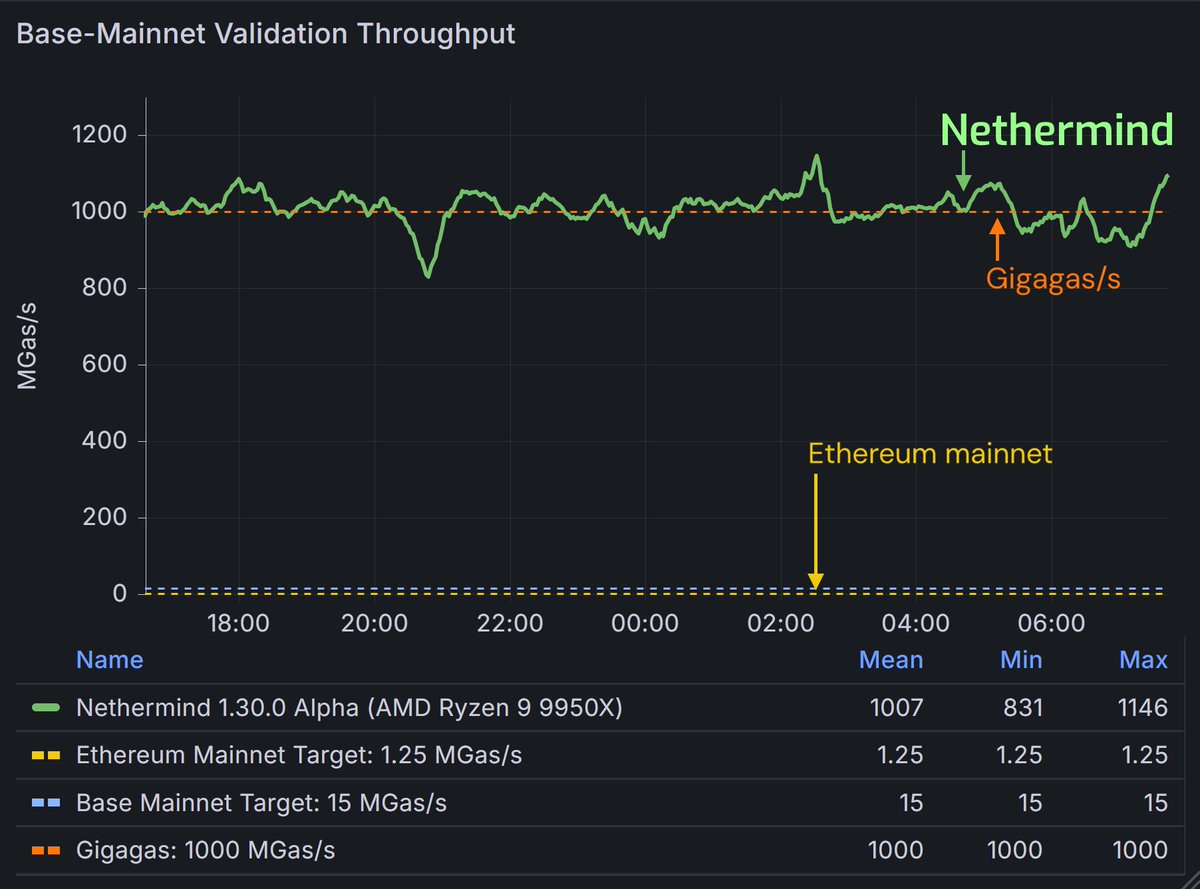
Designed for builders, devs & autonomous agents to push the boundaries of @Ethereum's performance, Surge Rollup is built on @TaikoXYZ stack and will be:
- Stage 2 at launch
- Based & ultra sound using $ETH for gas
- Gigagas, leveraging the Nethermind Client’s performance
- & more
3
6
67
9,942
scalelabs.eth 🦇🔊 retweeted
6 Nov 2024
⚡️Supercharging @ethereum while keeping it decentralized, secure & stable.
Introducing Surge Rollup, an ULTRABASED rollup for builders, devs & agents to push Ethereum’s limits-
& Surge Power-Ups, open source upgrades for based rollups.
Learn more: Surge.WTF or 👇
53
123
540
123,681
scalelabs.eth 🦇🔊 retweeted

14 Oct 2024
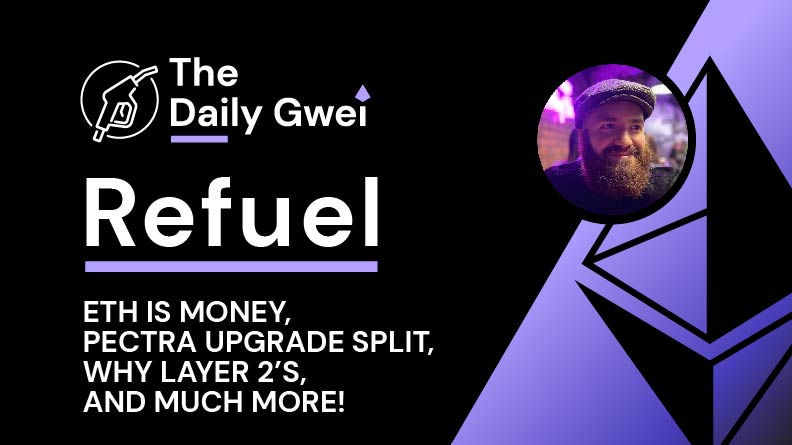
The latest @thedailygwei Refuel is ready for your consumption! ⛽
Today's topics:
- ETH is money 💸
- Pectra upgrade split 🪓
- Why layer 2's 🤔
- and much more ➕
Watch 👇
youtu.be/LdyXcxrsuuU
28
41
216
10,894
scalelabs.eth 🦇🔊 retweeted

2 Sep 2024
EOF (EVM Object Format): Full Guide
Everything you need to know as a Web3 Builder in 30 mins:
➡️ (0:00) Intro
➡️ (0:41) Why EOF
➡️ (2:20) Current EVM vs EOF EVM
➡️ (4:31) EOF example
➡️ (10:53) Stack too Deep Error Solved
➡️ (13:21) EOF Advantages
➡️ (24:50) Disadvantages
➡️ (26:48) Community Against EOF
➡️ (29:18) Conclusion
Like & RT ❤️
21
84
481
84,557
scalelabs.eth 🦇🔊 retweeted

21 Aug 2024
I have been told that I need to "do less philosophizing and do more ethereum bullposting". Hence, here is an ethereum bullpost, courtesy of stable diffusion 3 inpainting gimp.

3,540
3,737
24,966
3,841,387

Happy 9th birthday Ethereum!!
Our @ethereumfilm documentary team released a short film “Community.eth” to celebrate
100% of mint proceeds go to @protocolguild to support Ethereum R&D maintainers
zora.co/collect/base:0x8bbce…
25
148
630
188,534

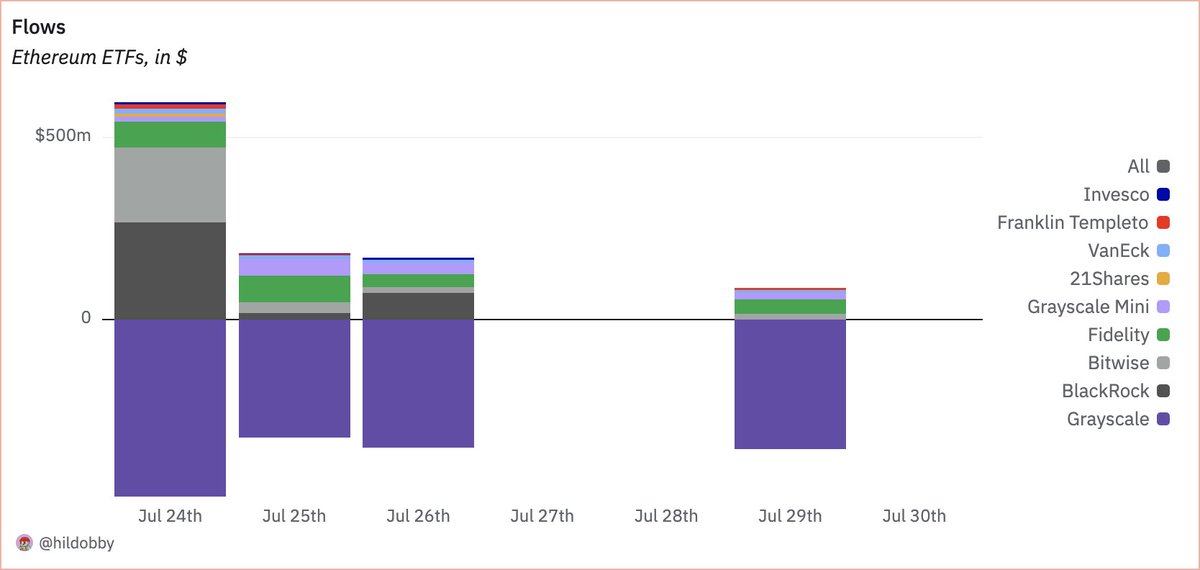
1/ You can now find all Ethereum ETF onchain flows here 🫡
dashboard: dune.com/hildobby/eth-etfs
24
106
476
56,251
scalelabs.eth 🦇🔊 retweeted
28 Jul 2024
The goal is to replace the current Merkle Patricia state tree (MPT), because the current MPT is *very* unfriendly to stateless clients: a worst-case stateless proof for an Ethereum block is ~300 MB (think: spam reads on 24kB contracts), and even the average case sucks because the tree is width-16. It's also very SNARK-unfriendly.
The alternative we've looked at so far is Verkle trees vitalik.eth.limo/general/202… , which use elliptic curves and IPA-based proofs; with verkle trees and associated gas cost changes ( eips.ethereum.org/EIPS/eip-4… ) the theoretical worst-case proof size drops to ~32 bytes * depth 6 * 15789 accesses = 3 MB; the average case is a few hundred kB.
The other alternative is binary trees. But raw binary proofs are a little too large (average case ~1 MB, worst case ~12 MB), and so we want to wrap them in a STARK. But the challenge with STARKs historically has been proving time.
Recently, @StarkWareLtd folks have had a series of breakthroughs proving over 500k hashes/sec on a high-end Macbook (!!), meaning that even in a theoretical worst case, they would be able to generate a STARK for a block stateless witness within one second. But this is based on the Poseidon hash function, which is relatively new and untested, and so many consider it too immature for L1 today.
The more conservative approach would be to use SHA256 (or rather, the SHA256 compression function), which is very safe, but also very complex, and much slower to prove (specifically, ~20-50x slower). But there has been work on improving modern proving systems even further, and it looks like proving "conservative" hash functions might be closer to viable than we thought!
Binius is particularly adaptable to this, because you can do all kinds of binary operations directly without needing lookup arguments, and there have recently been great improvements to its proof size ( irreducible.com/posts/better… ), but there has been great process with circle STARKs too.
A totally different conservative approach that we started talking about last week, is using lattice-based hash functions, which Ajtai's is one example of. These are arithmetically simple, making them quite prover-friendly, but they also derive their security from lattice hardness assumptions. And it turns out that they are actually more compact than I expected: there's a "conservative" option that's a mere 64 bytes long (compared to 32 bytes for all the other hashes) alonrosen.net/PAPERS/lattice… , and we're starting to explore more aggressive options that are 32 bytes long. These are very prover-friendly, my napkin estimate is that they are only ~2-4x worse than Poseidon.
29
61
455
70,510
scalelabs.eth 🦇🔊 retweeted
28 Jul 2024
The last week of Ethereum state tree research be like...

439
291
2,217
357,256
scalelabs.eth 🦇🔊 retweeted

27 Jul 2024
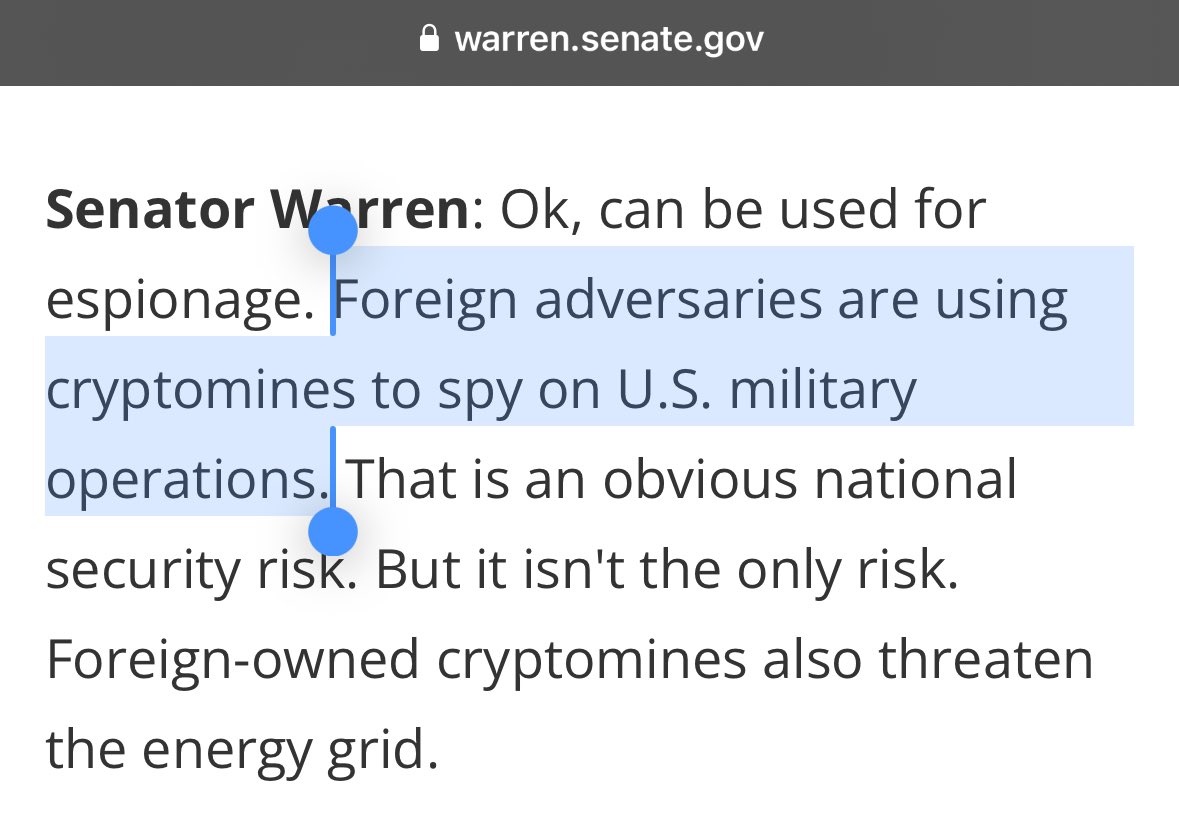
This is possibly the dumbest crypto FUD I’ve ever read
77
122
1,188
91,369
scalelabs.eth 🦇🔊 retweeted

23 Jul 2024
Why is my feed full of people pretending like over a billion in day 1 ETF volume is not a big deal
7
2
31
3,126

scalelabs.eth 🦇🔊 retweeted
11 Jul 2024
Introducing Clear: the complete framework for interactive theorem proving in web3.
A formal verification tool for @solidity_lang smart contracts that expresses any on-paper verification into mechanized proofs.
🖇 medium.com/nethermind-eth/cl…

4
41
145
16,921
scalelabs.eth 🦇🔊 retweeted

10 Jul 2024
Two big things people and media get wrong.
1. "crypto mining is using too much energy."
correction. #Bitcoin is using too much energy.
2. "crypto will allow tokenization of real world assets."
correction. #Ethereum will allow tokenization of real world assets.
1
5
87
scalelabs.eth 🦇🔊 retweeted
3 Jul 2024
The latest @thedailygwei Refuel is ready for your consumption! ⛽
Today's topics:
- EthStaker survey results 🥩
- Obol Charon v1 live 👍
- Here for the culture ✊
- and much more ➕
Watch 👇
youtu.be/9TM00XTugtQ
3
14
63
5,289
scalelabs.eth 🦇🔊 retweeted

24 Jun 2024
The tech has improved!
Kudos: @URozmej @ben_a_adams
24 Jun 2024

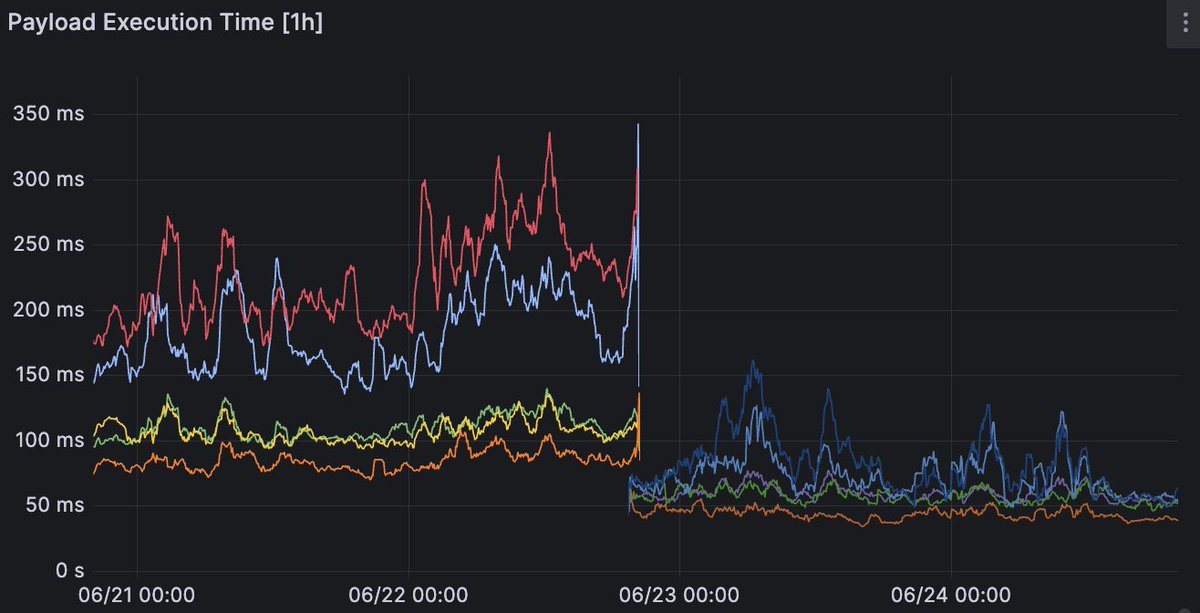
For the past two weeks, we’ve been testing @nethermind's latest release, 1.27, which features significantly reduced block processing times. A picture is worth a thousand words - here’s a screenshot from our dashboard showing the improvements:
5
19
2,092
scalelabs.eth 🦇🔊 retweeted

24 Jun 2024
For the past two weeks, we’ve been testing @nethermind's latest release, 1.27, which features significantly reduced block processing times. A picture is worth a thousand words - here’s a screenshot from our dashboard showing the improvements:
2
8
24
2,489
scalelabs.eth 🦇🔊 retweeted
24 Jun 2024
The latest @thedailygwei Refuel is ready for your consumption! ⛽
Today's topics:
- Ethereum H2 tailwinds 🚀
- The Burn research 🔥
- Protocol Guild chat 🤔
- and much more ➕
Watch 👇
youtu.be/u0E9d4BbG3U
4
15
83
7,304
scalelabs.eth 🦇🔊 retweeted

22 Jun 2024
Introducing state "compression" in #Ethereum (aka, Verkle trie) where you only need the current state root of the chain, and you can run a stateless validator not needing to store any state (blocks come with the witness of state changes).
You think I am done?
Introducing Block History "compression" (aka EIP-4444) where you dont need to store historical blocks of ethereum anymore. They are accessible from portal network and era files hosted on multiple servers and torrent. All you need to know is the hash of the finalized block provided to you by the CL client. This solves increasing storage requirements of validators on ethereum.

Introducing "Workforce Compression"
It's HR scaling without offshoring.
We compressed our employees by firing the ones we have here and hiring new ones in India. They used to require a whole cubicle of space, now they fit in my pocket as I can reach them from my phone.
This changes everything you thought you knew about HR.
1
12
669