
Senior Editor for cybersecurity @ Google Cloud. Head honcho of cybermed newsletter @TheParallax; fmr @ CNET; he/him.
Joined April 2009
- Tweets 32,304
- Following 3,196
- Followers 8,622
- Likes 14,087
1,297 Photos and videos













Seth Rosenblatt retweeted

May 24
Learning from Jewish Diversity: Over the past few weeks, the fractures within Jewish, Israeli, Zionist, and pro‑Israel circles have been impossible to miss. Religious, political, ideological, organizational, and strategic divides have erupted into open accusations: some are “too extreme,” others “too soft on Israel’s critics,” “reckless,” “undiplomatic,” “not pro‑Israel enough,” “sabotaging the cause,” or even “endangering Jewish safety.” Whatever one thinks of these claims, the reality is clear: Jewish communities and Israeli society contain a wide spectrum of socio‑religious and political diversity.
Across that spectrum, there is space, sometimes narrow, sometimes wide, for people to express their unique identities, their Judaism, and their individual politics. The communal infrastructure is vast and enviable: JCCs, Federations, JCRCs, Hillel, Atid, AIPAC, Israel Policy Forum, J‑Street, JVP, the World Zionist Organization, ZOA, ICC, AJC, ADL, Birthright, and dozens more. Add to that the Reform, Conservative, and Orthodox movements, plus the full range of political organizations in both the U.S. and Israel. This is not a monolith; it is a sprawling ecosystem.
That is precisely why simplistic labels like “Zionist” obscure far more than they reveal. And it is why I often find myself wishing that Palestinian, Arab, and Muslim Americans had anything comparable. Instead, there are fewer than a handful of national organizations, political and student alike, that enforce near‑total conformity on the Israel and Palestine discourse, despite the fact that Palestinian, Arab, and Muslim Americans hold a wide range of views on Hamas, Gaza, Israel, peace, pragmatism, the U.S., and belonging.
One of my deepest frustrations with certain Jewish groups of a particular political orientation is the role they expect me to play as someone from Gaza. Consciously or not, some want me to perform the part of the Palestinian victim who reinforces their own narratives. They recoil when I speak about Palestinian failures, Hamas’s catastrophic impact on Gaza, or my efforts to build bridges with center‑right Jewish and Israeli audiences. To them, these points “distract” from the larger story of Israeli wrongdoing. And if my words are cited by conservative pro‑Israel voices, that becomes the ultimate offense: “tokenization,” even though anti‑Israel activists routinely cite these same groups when convenient.
The result has been predictable: invitations withdrawn, doors quietly closed, and participation discouraged. I failed to play the role they had scripted for me; a victim to be wielded in their internal communal battles. And for that, I was sidelined.
67
115
639
45,731
Seth Rosenblatt retweeted
Your issue with Jews started 80 years ago? So, in other words, one year after they stopped being mass murdered at a rate of thousands per day.
You were cool with the Jewish people as they were carted off to extermination camps, yet take umbrage now they have sovereignty and the capacity for self defence.
Dara Horn’s thesis (‘People Love Dead Jews’) continues to be vindicated.
21
53
492
9,981
Seth Rosenblatt retweeted
The Israel Collapse Industrial Complex: Since Hamas’s October 7th attack, a new genre of pseudo “political analysis” entertainment has flooded social media and YouTube in particular, about Israel’s “impending collapse,” or its inevitable destruction, doom, and the end of the Jewish state. YouTube serves me daily suggestions of highly produced videos, with ads, of various content creators, including those in Qatar who, during the Iranian bombardment of Doha just a few weeks ago, made a slick video about Israel’s imminent collapse, which is now a prolific theme across the “pro-Palestine” activist communities. Journalists, academics, advocates, politicians, humanitarians, students, social media influencers, aspiring figures, and vast numbers of diaspora Arabs, Muslims, Palestinians, and “allied” communities consume this content and use it to form their opinions and worldviews on how to think and speak about this issue.
What’s incredibly disturbing is that this is the third iteration of this fantasy and the associated imaginative hopes, all of which have been at the core of the Palestinian people’s destruction and perpetual suffering for 80 years. It began with the pan-Arabists and nationalists who failed miserably, then with the Islamists of the past thirty years, and now, with a new mutation that’s made up of the intersectionality left, elements of the right, “wokesters,” ignorant Arabs and Muslims, clueless Westerners, malevolent grifters, and opportunists. I grew up in Gaza with Hamas’s prophecies, including those of the group’s founder, Ahmed Yassin, that Israel would collapse by 2020 or 2028, and listening to Kuwaiti Muslim Brotherhood figure Tareq Al-Suwaidan saying that prophecies predicted “Jews having a state for 80 years” after which it’ll collapse.
The Palestinian people have been sold fiction time and again, by different ideologies, death merchants, failed nationalists, and others who used this cause to grift and achieve personal gain and glory. The last thing Palestinians need is another iteration of this delusional fantasy to keep the next generation trapped in radicalization, Jihad, violence, and hatred.
It should be clear to everyone by now. Israel is here to stay. Israel is not going anywhere. There will be no erasure of the Jewish State. There will be no mass killing, deportation, conversion, or forced subjugation of millions of Jewish Israelis. Instead, what is needed is a radically pragmatic understanding of how both Palestinians and Jewish Israelis can be part of this land, make peace, achieve mutually beneficial arrangements, and reject the notion that either one is going to destroy the other.
Do not be a participant in or consumer of the Israel destruction industrial complex if you actually care about the Palestinian people – be a builder and champion a future defined by what you stand for and want to see, not just by what you are opposed to and stand against.

33
170
723
27,080
Seth Rosenblatt retweeted
VANISHING CULTURE is out now!
From Internet Archive, this book looks at what is disappearing online.
🌐 Websites vanish
🗞️ News archives go offline
🎮 Games become unplayable
📼 Personal media breaks & becomes unreadable
It asks what it means when the record of ourselves starts to disappear 🕳️
📖 Download & read: archive.org/details/vanishin…
🛒 Purchase in print: betterworldbooks.com/product…
#VanishingCulture #DigitalMemory #InternetArchive #BookTwitter

ALT Book cover titled “Vanishing Culture” on a teal background. Pixel-art style graphics show a VHS tape, open book, film reel, chain link, and vinyl record dissolving into digital fragments. At the bottom, a cursor icon points to the word “SAVE,” alongside an archive-style building icon, evoking digital preservation.
11
503
1,386
69,581
Seth Rosenblatt retweeted

Apr 23
Absolutely brilliant from @HusseinAboubak.
“The first error is the assumption that anti-Zionism is a position, a policy preference, a discrete item on a list of demands that can be granted in exchange for quiet on the remaining items. No, no, no. This is a major category error. Anti-Zionism is not a position. It is a worldview, and a worldview does not function the way individual policy preferences do. A policy preference can be traded: you give me this, I give you that, and we both go home. A worldview is the structure within which all positions are generated, the logic that determines which sentences can be spoken and which cannot, and when you concede the worldview, you have not bought peace on the other questions. You have conceded the very logic by which all the other questions will be decided.”
“The second error is that the liberal establishment treats the decolonial left as though it were a moral movement; a coalition of idealists whose passion on this one subject must be accommodated because the passion is about something real and the moral claim has traction. This is the view from the outside, from the surface, and it is wrong. What is at work inside the American left on the Israel question is not, or not primarily, some moral awakening. It is an inter-elite ruthless competition for institutional position, and anti-Zionism is the instrument through which that war of position is being waged.”
“Thus, what makes the establishment’s concession so ruinous, so foolish, and so unforgivable is that it misidentifies the recipient. The Democratic leadership believes it is making a concession to some moral constituency, but it is, in fact, making it to a rival power formation within the party’s own institutional base. This is surrender. When the establishment concedes [on] Israel, it does not purchase peace with idealists but ratifies the victory of a competing elite fraction whose interests and ambitions extend to every institution the party touches, and whose appetite will not be diminished by having been fed the Jews.”
Keep reading for historical examples that put this moment in the Democratic Party into crystal-clear perspective.

The establishment’s reasoning is basic strategic calculation: the left will not relent on Israel; a civil war inside the party over the Jewish state would destroy the coalition; therefore, the rational move is to concede this issue, preserve party unity, and proceed with the moderate agenda on everything else: affordability, climate, migration, AI, etc. Feed this one thing to the beast, and the beast will be satisfied. It is an intelligent calculation, and it is a catastrophic one, because it rests on a misapprehension of what is being conceded and to whom.
link to full essay below

20
162
596
42,753
Seth Rosenblatt retweeted
Apr 22
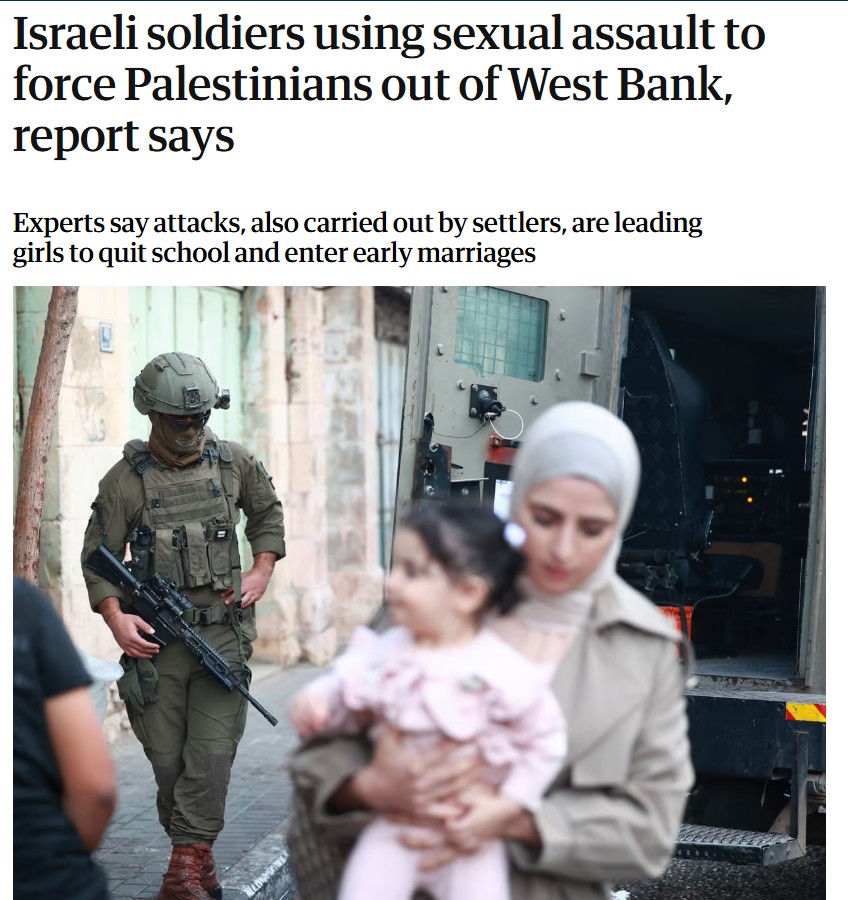
A week after an investigation exposed the sexual abuse and exploitation of desperate and aid-seeking Palestinian women in Gaza, who face the threat from Hamas, the aid system, and societal neglect, major outlets and “pro-Palestine” activist groups ignored it entirely. Instead of addressing the findings, many dismissed the reporting, defended Hamas, or simply looked away. Now, however, a Guardian story alleging sexual offenses by Israeli settlers and soldiers in the West Bank is receiving widespread attention, commentary, and engagement. The issue isn’t whether sexual harassment and abuse by Israelis occurs; it undoubtedly has. The problem is the stark double standard: silence when Palestinians harm Palestinians, outrage only when Israel is the perpetrator. Nearly 90% of Gaza’s 2.2 million people have been displaced, many losing homes, income, and basic security. In such conditions, vulnerable women and children are at obvious risk of exploitation. Yet their sexual abuse and suffering drew no meaningful response from “pro‑Palestine” activists, human‑rights groups, international bodies, or governments.
The timing of the Guardian piece, just days after the Daily Mail’s investigation into sexual abuse and early marriages in Gaza, suggests an effort to redirect attention back to Israeli wrongdoing rather than confront serious, internal problems in Gaza. It functions as a way to deflect from sexual offenses committed by Hamas and others, and to shield those responsible from scrutiny.
50
286
1,021
45,448
Seth Rosenblatt retweeted

Apr 13
👀⬇️

As major news outlets cut off the Wayback Machine, journalists and advocacy groups are rallying to protect the Internet Archive’s vast collection of web pages. wired.com/story/the-internet…
39
2,992
14,145
397,275
Seth Rosenblatt retweeted
Apr 15
Why was the fall of the USSR such a great catastrophe, asks Hasan Piker, as he quotes Putin almost verbatim? Because it ended “multipolarity.”
Multipolarity: the favorite buzzword of Kremlin propagandists, now embraced at both ends of the American political spectrum. Somewhere in Moscow, champagne corks are flying.
Apr 15

BREAKING: Speaking at Yale Hasan Piker express his devastation over the fall of the USSR.
“The fall of the USSR was one of the greatest catastrophes of the 20th century.”
This is who Democrats are now campaigning with.
17
72
441
18,371
Seth Rosenblatt retweeted
Apr 12
The past two weeks have presented a series of challenges, prompting me to step back and take stock, away from social media and the general public. The war with Iran has revealed deeply disturbing trends and realities about how many people are unable to have nuanced thoughts or to exercise and compartmentalize critical thinking that separates their disagreements from the current administration, with overt support for the despicable Iranian Regime.
Hamas in Gaza has been allowed to hold two million Palestinians as hostages, killing, torturing, and disappearing people, and preventing any progress toward rehabilitation and reconstruction. Israeli settler violence is out of control in the West Bank, and many seem perfectly fine with it. The state of “pro-Palestine” activism is in an embarrassing disarray, with the Palestinian cause in the diaspora being championed by the worst possible combination of extremists, agents of hatred and chaos, close-minded, highly unintelligent people, and promoters of terrorism, violence, antisemitism, and false narratives.
There is a never-ending cacophony of noise, unenlightened voices, and threats that come my way, always requiring security or the involvement of authorities to speak at events or just carry on. There is also a never-ending stream of really unconvincing, dumb commentary by supposed experts, journalists, and activists, whose relevance relies on vomiting continuous trash that keeps masquerading as helpful insights.
Then there is Washington and its brilliant culture, where many fake, uncompelling people act as backstabbing wolves, always hiding in sheep’s clothing. The most consequential city in the world is populated by a large number of government, NGO, and academic leftovers who contributed to the disastrous US foreign policies that brought our country to where it is today.
Though I believe in my work and I am ruthlessly focused on seeing progress towards a better pathway forward, the truth of the matter is that every single day consists of dealing with a Hamas-controlled Gaza, a Smotrich / Ben Gvir-dominated Israeli government, a confused and hesitant US administration, hopelessly useless and destructive “pro-Palestine” communities, and a large number of Arab and Muslim Americans living in parallel universes either totally disengaged from life in the Western world or fully enmeshed in the most destructive social and political positions that make working with them nearly impossible now.
One of my chief struggles is that, in an effort to reach unreachable audiences, I have pulled back on some of my harsh critiques and my desire to be brutally honest and transparent about my thoughts, truths, feelings, observations, assessments, analyses, and commentary. This has been especially true since arriving in Washington and creating the Realign For Palestine project, which is no longer just about what I think but about the bigger picture. And in that sense, I miss being able to truly speak my mind without “offending” people I am trying to build bridges with, but often appear so uninterested and unwilling to engage.
However, in that spirit, I have decided to go forward and continue sharing my thoughts online and in person without holding back. My goal remains to be constructive and a builder, not a destroyer. However, when one builds, this sometimes requires tearing down unhelpful narratives and structures that hinder progress and growth. Whether you are “pro-Palestine,” “pro-Israel,” “pro-Trump,” “pro-Iran, “pro-Gulf,” or anything else, the only way to defend your position and views is through evidence or logical argumentation, not emotions or mis/disinformation.
My top priority right now is exposing Hamas and focusing on how they have played a horrendous role in destroying the Gaza Strip, eroding Palestinian values, decimating the Palestinian people, and proving that anyone who supports them is a hateful, anti-Palestinian fascist.
72
165
945
35,764
Seth Rosenblatt retweeted

Apr 10
🦔A researcher invented a fake eye condition called bixonimania, uploaded two obviously fraudulent papers about it to an academic server, and watched major AI systems present it as real medicine within weeks.
The fake papers thanked Starfleet Academy, cited funding from the Professor Sideshow Bob Foundation and the University of Fellowship of the Ring, and stated mid-paper that the entire thing was made up. Google's Gemini told users it was caused by blue light. Perplexity cited its prevalence at one in 90,000 people.
ChatGPT advised users whether their symptoms matched. The fake research was then cited in a peer-reviewed journal that only retracted it after Nature contacted the publisher.
My Take
The researcher made the papers as obviously fake as possible on purpose. The AI systems didn't catch it. Neither did the human researchers who cited it in real journals, which means people are feeding AI-generated references into their work without reading what they're actually citing.
I've covered the FDA using AI for drug review, the NYC hospital CEO ready to replace radiologists, and ChatGPT Health launching this year. All of that is happening in the same environment where a condition funded by a Simpsons character and endorsed by the crew of the Enterprise was being presented as emerging medical consensus. The people making these deployment decisions seem to believe the pipeline from research to AI to patient is more supervised than it actually is. This experiment suggests it isn't supervised much at all.
Hedgie🤗
nature.com/articles/d41586-0…
778
12,362
27,234
1,239,645
Seth Rosenblatt retweeted
This is a beautiful post. It repeats, almost word for word, what Soviet propaganda said even as the USSR oppressed its Jews: there is no such thing as a Jewish people; Jews belong in the countries where they were born; Soviet Jews are part of the Soviet people and have nothing to do with Israel.
So Susan here is parroting ideas developed and operationalized by the KGB during the Cold War (and that go back to early Stalin and other Bolsheviks).
I also love how she reminds us that Jews lived in Yemen, Morocco, Egypt, and Iraq, as well as in France and Germany, and then tells Jews to go to Europe or to hell. What happened, Susan? If Jews are Yemeni, Moroccan, Iraqi, and Egyptian, why send them to Europe? And if Israeli Jews are Middle Eastern, then they’re not European colonizers after all, are they?
Susan is right about one thing, though: Zionism is an expression of Jewish peoplehood. It’s why she and her friends hate it so much and fight it so vehemently. Undermine the idea of Jewish peoplehood, and you finally get the upper hand on the Jews.
This is precisely why Jews need to double down on Zionism.
By the way, did you know that Israel is one of the happiest countries on the planet? Am Yisrael Chai, Susan.


Until Zionism, there has never been a singular, unified thing called “the Jewish people”
There were Jews all over the world: Egyptian Jews, Iraqi, Jews, Moroccan, Jews, Yemen, Jews, German Jews, French Jews, and so on. Each one of these groups of Jews had their own distinct indigenous heritage in their respective countries.
The overwhelming majority of current Israelis have zero relevance to Palestine. Literally zero. And they should go back to Europe or to hell. Their days are numbered in my homeland.
147
508
2,305
131,749
Seth Rosenblatt retweeted
I’m asked this a lot in my lectures: Why did the Soviets invest so many resources in propagating antizionism globally? Did they really hate Jews that much?
The answer is that they invested in antizionism because it worked for them, both geopolitically and domestically.
To be sure, there were many individuals in the Soviet antizionist apparatus who were driven by personal antisemitism. The Zionologists — individuals tasked with formulating the key tenets of the ideology — are the prime example.
But at the state level, the demonization of Israel served much bigger, strategic purposes.
It strengthened the Soviet-Arab alliance. It helped mobilize groups and states around the world against the US and the West, pulling them into the Soviet anti-Western orbit, including at the UN.
At home, it functioned as a warning to other minorities: don’t organize around your own national interests, and definitely forget about any emigration demands.
For the Soviets, antizionism was a tool — and a highly effective one at that. That’s why they kept using it, even when internal discussions acknowledged that their antizionist language was echoing the Protocols and Nazi propaganda.
This is useful to understand because antizionism is still a political tool today.
We talk a lot about antizionist hate, and there is no question that much of it is driven by that.
But there are also political entrepreneurs who use antizionism to get ahead: to gain social media followers, raise money, advance socially and professionally, or pursue political goals.
States do the same: witness South Africa filing its case against Israel at the ICJ or China deploying antizionist propaganda online.
When incentives align, antizionism gets used. And right now, antizionism is rewarded. It’s a crucial aspect of its growing popularity, and it’s really important that we understand it as we develop strategies to combat it.
Mar 27

What still remains unexplained is why the Soviet spent so much energy in this propaganda? Why were Jews such a threat to them? Who were they really targeting? @LekhtNaya
75
799
2,436
187,328
Seth Rosenblatt retweeted
Mar 27
When I became a citizen of the United States in 2014, on the basis of political asylum from the Gaza Strip and escaping Jihadi Islamism, I sincerely and seriously never thought that pro-Jihad, pro-Hamas, pro-terror, fascist, pro-Iran, pro-Hezbollah, anti-civilizational dark forces would become a mainstream staple in American politics and discourse. Having a group of ignorant domestic terrorists with Hamas and Palestinian flags, hiding their faces and taking over public space outside the City Hall of Philadelphia, the birthplace of America, is not only a grotesque sight, but it also demonstrates so much that has gone wrong.
It is a condemnation of our country's higher education institutes, which have normalized violence, anti-Western ideologies, and embarrassing “post-colonial” narratives. This is a condemnation of a failed revisionist, neo-liberal immigration approach in which assimilation is frowned upon and viewed as bad and negative, coddling people with truly horrendous beliefs, ideologies, cultures, and backgrounds, instead of seeking to uplift and elevate them and their status. This is a condemnation of failed parenting, nonexistent community infrastructure to educate young people, failed leftist discourses, and moral bankruptcy.
Remember that this has nothing to do with Palestine, for these “activists” ruined the “pro-Palestine” cause and are now seeking to latch on to any and every remaining filth that can vector their anti-human, anti-America, anti-Western, and anti-decent discourse and value system that can produce anything of meaning. Burning the American flag, while exercising your right to free speech, is the ultimate irony that only the United States of America affords to literal domestic terrorists, who are engaged in a subversive act against the very country and patriotic values that they seek to “dismantle.”
Still, freedom of choice does not equal freedom from consequences. This cannot be normalized, as it unfortunately has been over the past two and a half years since Hamas’s October 7th attack. This is a domestic battle for our country’s values and future – it’s time to choose the direction you want this country to head in.
441
2,996
9,303
309,621
Seth Rosenblatt retweeted

Mar 23
I have a lot of journalists following me and I am imploring you, if you are writing about the antisemitic attack in Golders Green, *please* emphasise these two things:
- Hatzola is a volunteer-driven, no-cost service that is *entirely* self-funded. It relies 100% on private donations and community fundraising rather than government or public NHS funding.
- While operating in largely Jewish areas, it services Jews and non-Jews equally.
You may not deem it necessary to include this information, and in a perfect world it would not be. However, these are the two lies being spread by antisemites in order to justify the attack and use it to spread even more hostility against the Jewish people. Please include these facts.
147
1,196
5,450
167,981
Seth Rosenblatt retweeted

Max Fleischer’s granddaughter has been funding these restorations on her own and we’d really appreciate if we can get the public support on the blu ray. It will help us get more out of the vault and keep the legacy alive. Thank you!

✨Fleischer Cartoons: Greatest Hits✨
📽️20 restored featuring Popeye, Betty Boop, Superman, and more!📽️
rockinpins.com/product/fleis…
#fleischerstudios #bettyboop #popeye #kokotheclown #animation

26
2,924
8,361
239,849
Seth Rosenblatt retweeted
Feb 16
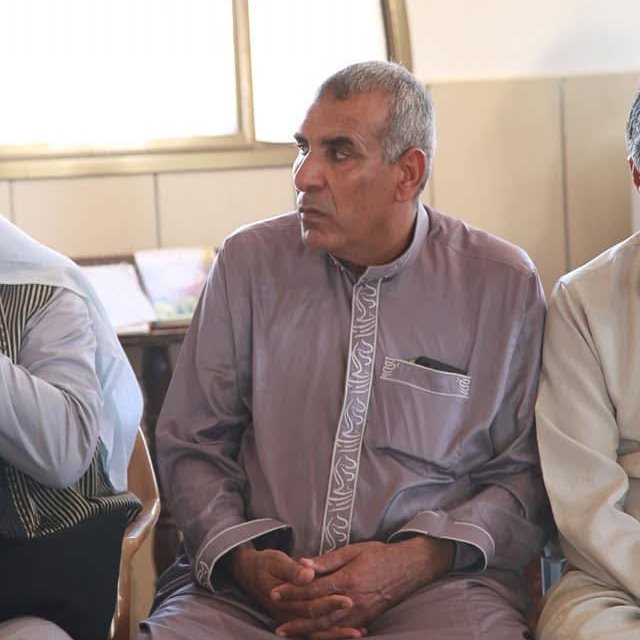
Hamas has abducted 65-year-old Adel Asfour, father of my friend and anti-Hamas activist Mustafa Asfour, as a way of pressuring him into silence to stop/end his social media activism against the Islamist terror group, despite living in Belgium and being out of Gaza.
The terror group is doing the same with many families of Gazans who are abroad to inflict maximum cost upon those who even think of going after Hamas's fascistic rule, criticize its behavior, or demand better for the people of Gaza. This has been done dozens of times in the past few weeks alone, with the terror group massively escalating its attacks against the people of Gaza in a desperate bid to maintain its violent rule, despite nominally agreeing to turn power over to the US-endorsed technocratic committee for the administration of Gaza.
If you still support Hamas and proclaim to be "pro-Palestine, you are an evil, fascist, ignorant, irritated, antisemitic, vile, and pathetic bunch of noise. Shame on anyone who still endorses Gaza's ISIS regime, pretending it is somehow a form of "resistance."
76
703
1,743
57,042
Seth Rosenblatt retweeted
Feb 14
Starting a year ago, I have been repeatedly sharing this image that Al Jazeera itself captured of Hamas's terrorists emerging out of the al-Nasser Hospital in Khan Younis, southern Gaza, after the first ceasefire was announced when Trump first became president, pleading with journalists, humanitarian advocates and organizations, and political mediators to demand Hamas end its horrendous activities in medical facilities. It took over a year, thousands of dead, tortured, jailed and beaten Gazans at the al-Nasser Hospital for @MSF (Doctors Without Borders) to stop its operations there and publicly acknowledge that Hamas terror operatives are in the facility and endangering the sanctity of this critical medical installation. Shame on all who knew, and most NGOs have in fact known about this, but chose to remain silent, opting instead to just "keep the focus on Israel" for political and fundraising convenience.

40
609
1,812
53,992
Seth Rosenblatt retweeted
Jan 28
I’m lying in bed thinking about how I don’t think any of us has the capacity to truly comprehend the scale of the destruction of the Shoah.
The annihilation of six million precious lives, one third of world Jewry, meant the annihilation of Eastern Europe’s once towering Jewish civilisation. An entire inimitable society erased from this earth in a few short years.
It’s hard to internalise a time when Jews were a sizable minority rather than an infestimisally small minority in Europe, and it’s simply devastating to try to envision an alternate reality today wherein Jewish life maintains more of a presence on this continent.
Instead of a stolperstein stone, a Jewish restaurant. Instead of a Holocaust museum, a synagogue with a full congregation every Saturday.
In 2009, Prof. Sergio DellaPergola of the Hebrew University of Jerusalem said that, had the Shoah not happened, the number of Jews alive in the world could be as many as 32 million. There are fewer than half that number alive today.
Think about the far greater presence of Jewish life we could currently have. Instead the ashes of six million Jews are ‘piled up on the hills of Auschwitz and the fields of Treblinka, and are strewn in the forests of Poland. Their graves are scattered throughout the length and breadth of Europe. Their blood cries out, but their voice is not heard.’
It is important that, one day a year, we stop to listen to those voices. But in a better world, we would be listening instead to the laughter of the grandchildren they never got to have.
51
122
915
18,984
Seth Rosenblatt retweeted
Jan 31
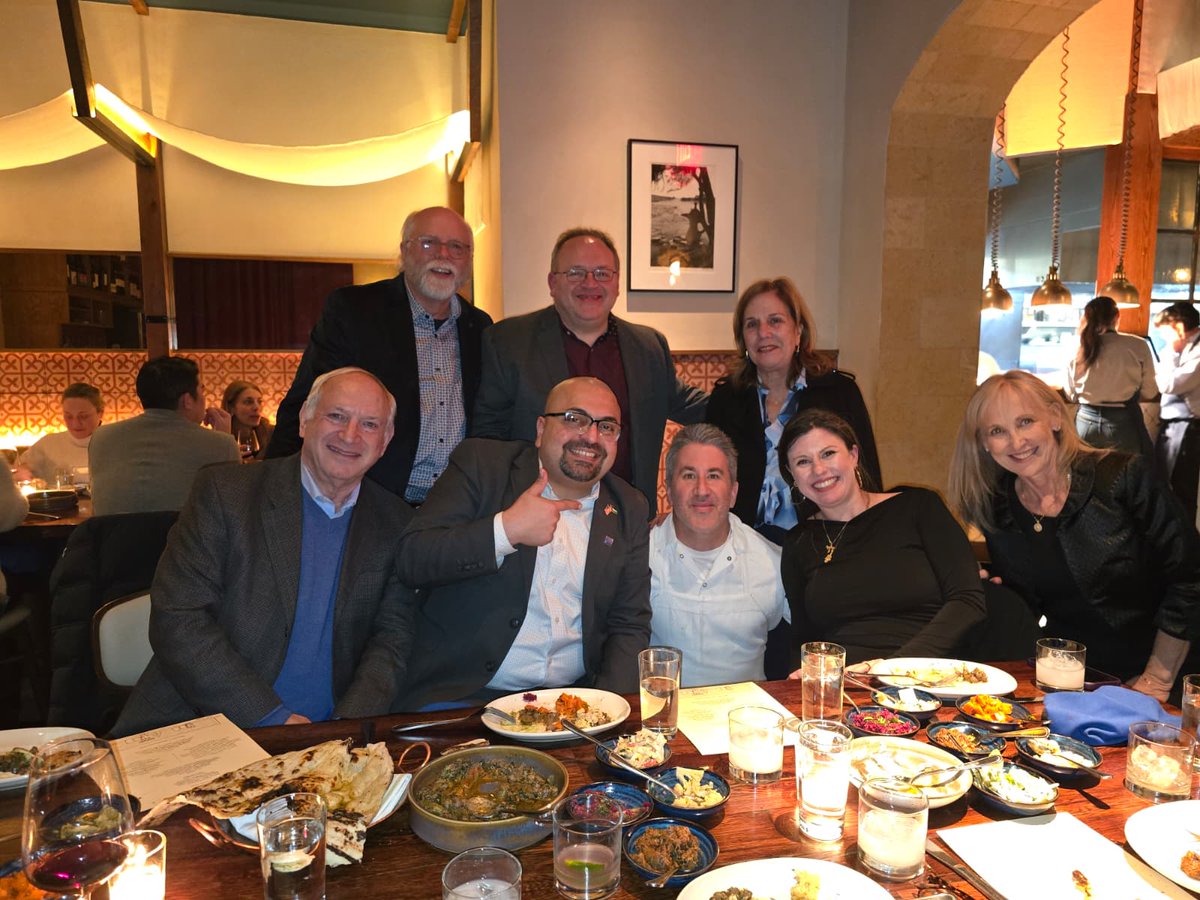
Thank you to the incredible chef, friend, and ally, Michael Solomonov, for his tremendous hospitality at the Zahav restaurant (@zahavrestaurant) in Philadelphia, where he displayed immense kindness, love, accommodation, understanding, and joy in hosting me following an event discussing the war in Gaza and the complex issues that both our people face. He even went out of his way to prepare an off-menu dish for the dinner guests and me, that is authentically Gazan, called Sumaghiyyeh, researching recipes, gathering ingredients, and bringing into his space something that is uniquely Palestinian from the coastal enclave.
Palestinian and Israeli cuisines share common traits while also having distinct differences that allow each to shine in different ways. Michael is a conscientious, cognizant, compassionate, humanistic, and emotionally intelligent individual whose Israeli identity is an asset, not a hindrance. I hope everyone has a chance to try one of his myriad restaurants and experience his loving-kindness and hospitality, which augment and complement his astute political demeanor, awareness, balanced perspective, and strong connection to the world.


29
89
926
29,045
Seth Rosenblatt retweeted
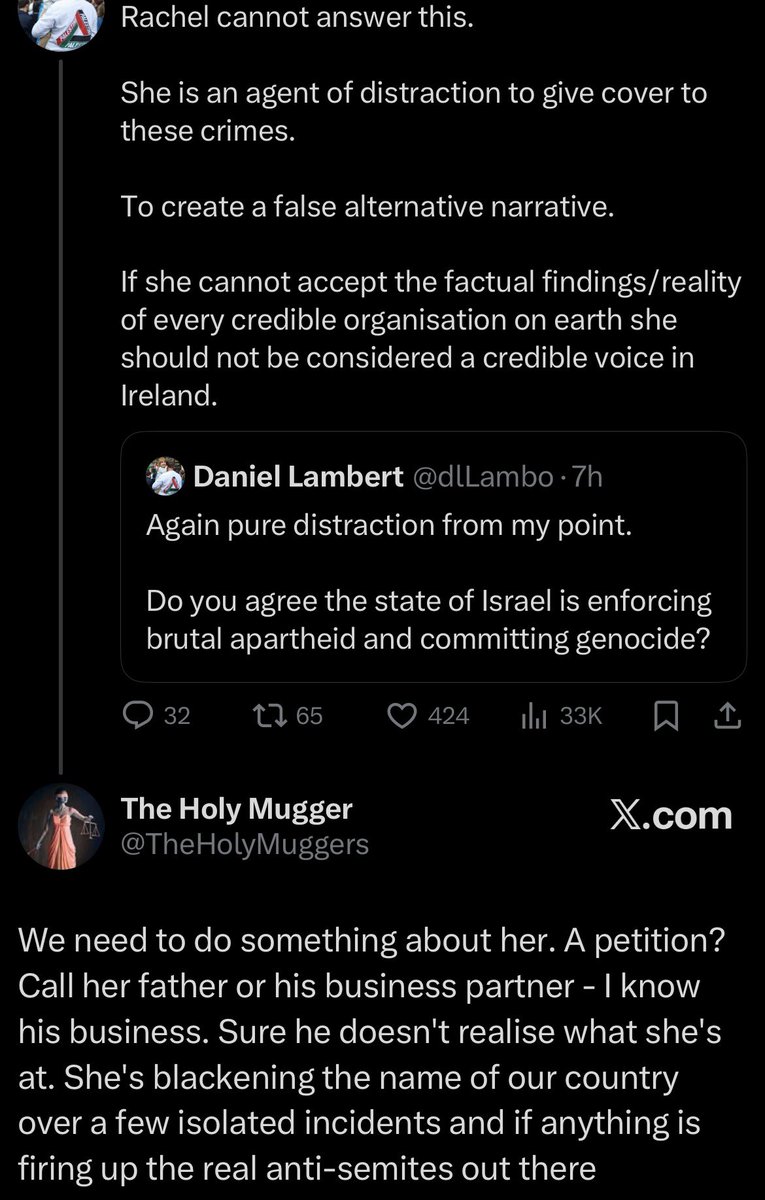
Just so people understand what I have been subjected to for my Sunday Independent piece: they are threatening to create a petition about me and to call my dad and his partner at their business.
For the record, my dad knows exactly what I do and I sent him my article to read prior to publication. He bought the paper first thing Sunday morning and read it aloud at home. He was so proud.
Now we are here together in my parent’s sitting room. He is sitting opposite me.
I have shown him this threat and we are both just so bowled over and devastated that a piece we both thought might provoke empathy, has instead provoked personal threats. I won’t be writing another one, our family’s safety must come first.

I’m popping back in to ask (a) for other allies of the Jewish community people to please stand up, and (b) for the critics to please stop now.
This impacts not just me but my family. I do my utmost to shield my parents from all of this but I’m home for the break and couldn’t stop myself from crying in front of them.
It pains me that I have now caused them upset and they are questioning why others with more power than me don’t put their heads above the parapet.
1. I am not paid by any government or organisation, Israeli or otherwise, for what I write.
2. I am not a grifter and have turned down multiple media opportunities.
3. I am vocally pro two-state solution, l always strongly supported a ceasefire and hostage deal, and oppose both the occupation of the West Bank and the settler violence therein.
4. I did not choose the headline. My headline was ‘Identity, Loyalty, Betrayal: Bondi Beach massacre is the tragic result of a nation turning its back on its loyal Jewish citizens’. I did not like the headings that were chosen because (a) my piece was more broad ranging than just Ireland and (b) because the ‘we’ in the heading would inevitably lead to debates over the specifics of my personal identity. I am a raised Catholic of Jewish heritage who is converting to Judaism. Please stop obsessing over my identity.
I regret agreeing to write the piece for the Sunday Independent despite it being the one I put the most delicate thought into. All my other pieces I wrote in an afternoon. This one I spent days ruminating over, thinking of all the conversations I had had with Jewish loved ones over the past year, and how best to capture the return to otherisation they had collectively experienced.
The vicious response, which included innumerable personal attacks that are continuing now multiple days later, is just devastating when I consider that I was walking with my dad on the pier last week saying that I thought this one could open hearts and minds. Despite everything, I still maintained that same misplaced confidence that Isaac Deutscher. It is gone forever now.
I should not have written this piece for an Irish outlet and will not write again on this subject for an Irish outlet. Please stop and leave me alone now.
194
271
1,833
273,091