
Joined July 2014
- Tweets 2,169
- Following 243
- Followers 397
- Likes 5,637
170 Photos and videos















Pinned Tweet

Jan 24
I am very proud of the plan for InterChain this year!
For this year, at Crypto Factor, we have divided a set of great focus areas, and all of them bring exciting new tech to the space.
Jan 23

InterChain Fees Optimization and Node Operations
It has been a while since we last shared a development update, but like everyone else, we have been busy clearing our backlog at the year's end.
As part of the focus areas for the year at Crypto Factor, we want to share some upcoming changes planned for InterChain, as well as address recent changes affecting InterChain fees.
One of our main focuses in the evolution of InterChain is the long-term optimization of fees, the expansion of node operations, and initial steps toward decentralizing the network. We plan to implement a series of steps divided into two phases by the end of this year.
Phase 1 - Extend InterChain Mesh Layer (Execution Layer)
1. Implement support for multi-chain state validation and risk evaluation modules. This will enable protocols to choose where to deploy their master state and risk modules, thus lowering fees for executing cross-chain transactions.
2. Introduce time-based block confirmation to reinforce expected execution and reduce the deviation between block mints and finalization.
3. Integrate mempool commitment proof validation into the node consensus layer to lower the costs of mempool merge operations.
Phase 2 - Extend InterChain Node Consensus Layer
1. Enhance the current peer-to-peer block propagation protocol and the masterchain storage to decrease block storage and L1 transaction costs.
2. Update the node consensus layer to a high-performance BFT consensus engine focused on cost efficiency, stability, and higher transactions per second (TPS), while facilitating further decentralization of node operations.
3. Implement block signing as part of the node consensus layer to promote further decentralization and reduce transaction costs.
4. Expand the network by adding new node operators to enhance the stability, availability, and security of the blockchain.
These steps aim to ensure lower fees, faster execution, and greater stability for InterChain in the long run. Due to recent changes on the Partisia Blockchain and the adjustment of wMPC GAS, fees on InterChain have increased to cover additional costs. This situation requires a short-term resolution until our previously mentioned plan is implemented to provide a smooth user experience on InterChain.
To address the high fees in the short term, we are implementing a new system that will allow us to subsidize a portion of the fees for executing IC transactions, helping to bring the costs closer to previous levels. We expect this system to restore normal levels of usage for InterChain until further changes can effectively lower costs in the long term.
The new system is expected to be deployed in the coming weeks, and we look forward to an exciting year for Crypto Factor and InterChain.
As always, we will see you on-chain!
4
16
454
May 12
A solid point from @QuickswapDEX.
It aligns with my long-standing view that CEX listings for tokens are often unnecessary or even discouraged.

1
3
118
Mar 30
Over the last few weeks, the team achieved:
- CFR and IC on AVAX
- First v2 services on AVAX and v2 subscriptions (CFR payments)
- New protocol infrastructure for two projects' MVPs
Mar 29
GM Avalanche
For over a month, the team at Crypto Factor Labs has been focused on Avalanche. This includes enhancing the new version of our execution layer, deploying InterChain, and progressing with new protocol developments. While Crypto Factor has already shared some information, this post will provide an overview of the key technical details.
AVAX and InterChain Mainnet
We have successfully deployed a partial chain on @avax, connecting it to the Crypto Factor InterChain mainnet. Running an InterChain partial chain allows us to deploy and integrate our infrastructure while extending existing ecosystems.
Avalanche is the fourth blockchain connected via InterChain and the first added after the Anchor fork. This fork enabled lighter, faster confirmations, allowing InterChain to scale more effectively with a greater number of partial chains. Consequently, the AVAX partial chain manages its state independently of the rest of the InterChain network and benefits from low-cost, rapid transactions.
Following the Anchor update, we also halved the target block time and block confirmation times, resulting in 30-minute blocks with 15-minute confirmation times when fully saturated.
CFR and CFEL v2 on AVAX
After successfully deploying the partial chain on Avalanche, we began implementing the Crypto Factor Execution Layer. AVAX is the first blockchain where the v2 infrastructure is being deployed on the mainnet, starting with the token and distributor templates necessary for CFR token deployment.
Some improvements made to the simple token ecosystem template in v2 include:
- Tokenomics that no longer require external state calls, reducing gas usage and eliminating the need for external call management.
- Like all v2 templates, tokens now offer metrics and state interfaces for easy backend indexing and real-time analytics.
- A focus on distributor-based tokenomics, simplifying transfers and lowering token transfer costs.
Notable improvements to the simple distributor template introduced in v2 include:
- Distribution now occurs with a single smart contract call, eliminating partial states and simplifying management.
- The distribution process is now structured as an execution tree, where each node forwards or consumes the payload. This can all be audited on-chain, resulting in a more transparent and stable process.
- The Distributor service is now a subscription service running on the Crypto Factor relay protocol, with operational fees covered by CFR.
With the first set of v2 services implemented on AVAX, we successfully deployed the CFR token, which is now awaiting the token bridge's public launch. This will enable InterChain transfers, and we expect to make the bridge available to the public in the next 1-2 weeks.
New Protocols
Crypto Factor has announced the development of two new protocols focused on real-world assets (RWA), which will be deployed on AVAX using v2 infrastructure: one for building lifecycle-based digital assets and another for managing tokenized assets, such as carbon credits.
We will provide more detailed technical information about both protocols in separate posts in the coming days.
As always, we look forward to seeing you all on-chain.
1
1
11
95
Mar 14
Anchor is one of the updates I have been most excited about.
It is time for InterChain to ramp up speed and lower the cost of cross-chain execution.
Mar 13
Introducing Anchor
Last week, we shared the exciting "Anchor" fork with you, and this week, we are back with more details on the changes coming to InterChain.
Here's a quick summary; you can find the full details in the article below.
InterChain before Anchor
The fee model behind InterChain comprises three main components: masterchain consensus fees, partial-chain consensus fees, and transaction execution and mempool fees.
The largest contributor to the overall fee is the masterchain consensus fees, paid in wMPC on the Partisia Blockchain. The size of the fee and wMPC gas properties directly affect InterChain execution and transaction fees.
Masterchain consensus fees cover on-chain execution of multi-chain block proposals, state validation, and the full signing and publishing lifecycle. The subsidy introduced earlier this year temporarily reduced fees; block signing and publishing remain the main fee contributors.
Currently, confirmation of blocks is part of the block publish execution. After the set confirmation time passes, the next minted block confirms past master blocks, leading to variable transaction finality times depending on the blockchain's usage.
"Anchor" fork
Let's look over "Anchor" in greater detail and showcase how the fork makes InterChain faster, cheaper, and more scalable.
Off-chain block signing
As a first step towards greater balance in off-chain and on-chain masterchain consensus execution, "Anchor" introduces off-chain block signing.
The change splits the current block lifecycle, removing the on-chain trigger for block signing and replacing it with an off-chain process that uses the already available p2p protocol.
The consensus changes eliminate unnecessary on-chain event registration overhead, resulting in a faster, cheaper signing process.
Independent confirmation
"Anchor" introduces independent block confirmations. The change decouples confirmation from the block publish lifecycle and introduces an independent step in the master and partial block lifecycles.
As a result, an independent block confirmation step is added to the partial block lifecycle. Once partial block confirmation is completed, all scheduled transactions in the block are executed and cannot be reverted, achieving finality.
Conclusion
The changes introduced by "Anchor" are the first step towards the bigger goals set for 2026: lowering the fees for masterchain consensus and transaction execution, and achieving predictable execution time.
To see the full details, check out our article - links below.
As always, we will see you all on-chain.
4
13
136
Mar 9
To be honest, v2 is a game-changer for us - reshapes the whole business model for Crypto Factor:
- More flexible services
- Greater possibilities for protocols
- Subscriptions, smarter deployment, and service fees.
- A lot more....
Mar 8
Avalanche, Crypto Factor Execution Layer v2, and InterChain Anchor Update
At Crypto Factor Labs, we are in the midst of a busy Q1, and as we approach Q2, we want to share some exciting news with everyone over the next few weeks.
Avalanche
As previously announced, we are deploying our infrastructure on Avalanche, which is now our next supported blockchain. Some reasons for this choice include its cost-effectiveness and fast execution, the target user base, and its unique technical features that enhance our infrastructure offerings.
To start, we have deployed some components of the Crypto Factor Execution Layer (CFEL) on the C-Chain testnet and have begun developing a new set of services and protocols. As part of this deployment, we have also launched an InterChain partial chain on Fuji and successfully integrated it into the IC testnet. CFR is now flowing seamlessly between the Polygon and Avalanche testnets as we conduct extensive testing before the mainnet deployment.
There is much more innovative technology to come on Avalanche from Crypto Factor, so stay tuned for our updates.
Crypto Factor Execution Layer
For over two years, we have maintained the codebase for the Crypto Factor Execution Layer (CFEL), originally known as the decentralized SaaS engine (ODA). The execution layer comprises a set of on-chain SaaS/IaaS components and services that form the foundation of our token ecosystem deployments.
The execution layer has supported the Crypto Factor Ecosystem and notable client ecosystems on DeFiChain and Polygon. While it has served us well, the evolution of Crypto Factor, our clients, and the products we are developing has outgrown the capabilities of the original execution layer. As a result, we are now introducing the next iteration: CFEL v2.
The v2 of the execution layer has been redesigned; it will function as a library of flexible and extendable on-chain and off-chain components, establishing it as a foundation for protocol building rather than predefined template deployments. Token ecosystems will be just one type of protocol built on top of v2; CFEL can also be utilized to develop fixed-income products, tokenization protocols, marketplaces, and much more, by us or others using the on-chain components.
The new Crypto Factor Execution Layer is currently being developed on the Avalanche C-Chain Testnet and will initially launch there, where the first set of protocols based on v2 is also being created. Once deployed on the C-Chain mainnet, it will later be extended to all supported chains.
InterChain "Anchor" Fork
We are excited to announce the first-ever fork for the Crypto Factor InterChain mainnet, codenamed "Anchor."
The updates and significance of "Anchor" deserve a dedicated post, which we will share next week. For now, we wanted to give you a heads up—it will involve improvements in block and execution speeds, along with changes to fees.
We are looking forward to an exciting 2026 and will keep you informed with our upcoming updates. As always, we look forward to meeting you all on-chain.
1
1
11
120
Mar 4
Looking forward to stepping onto C-Chain with some CFR through InterChain. We have many opportunities to build specialized protocols by adding Avalanche to our toolkit.
Mar 3

Network Expansion - Introducing Avalanche 🔺
We’re pleased to share that Crypto Factor will integrate the Avalanche Partial chain into Interchain and expand operations to the Avalanche blockchain. @avax @AvalancheFDN
This is not a reaction to trend. It is a planned and deliberate step in the evolution of our infrastructure.
We are expanding the surface area of Crypto Factor - carefully, strategically - to support new categories of tokenised assets and commercial deployments, while continuing to strengthen the network integrations that already power our ecosystem.
Why Avalanche?
Avalanche combines high throughput with near-instant finality through its multi-chain architecture. For tokenisation at scale, performance is not a feature - it is a fresh foundation.
Its subnet model enables sovereign, purpose-built layer-1 environments. This allows projects building on our infrastructure to operate within tailored execution contexts, while remaining connected to the wider ecosystem through Interchain.
Avalanche has also emerged as a serious environment for real-world asset tokenisation. Strong tooling, flexible asset issuance and native cross-chain capability make it well suited to structured, long-term deployment models.
And sustainability matters.
Independent benchmarking places Avalanche among the most energy-efficient major proof-of-stake networks. For infrastructure that aims to support responsibly aligned markets, that characteristic is not incidental - it is intentional.
A Complementary Expansion.
This move does not replace or compete with our existing partner chains.
Partisia Blockchain, DeFiChain and Polygon remain foundational to Crypto Factor’s strategy.
- @partisiampc - @defichain - @0xPolygon
Avalanche extends our reach. It strengthens Interchain. It broadens what we can build - for who, with confident intent.
Labs will be sharing more on what this unlocks and technically entails very soon! @cfr_labs
1
8
82
Feb 3
A swift response from our team - InterChain is back up to speed with lower fees. 🫡
Feb 2
We are pleased to report that the first set of measures was successfully deployed yesterday via a soft fork of the master mempool contract on Partisia Blockchain.
The operational cost of the upgraded master mempool is now approximately 20% lower overall, and most of the remaining costs can now be derived from integrated subsidy contracts that allow for Crypto Factor GAS reserves to maintain sustainability in the short term.
These updates significantly reduce InterChain transaction fees by about 70% in the mid-term as we continue to implement the remaining measures planned for this year.
Thank you all for your patience, and we look forward to seeing you on-chain.
1
9
136
Jan 26
The short-term measures are deployed on InterChain testnet!
Results are promised and a soft fork of mainnet is being planned for later this week.
Jan 23
InterChain Fees Optimization and Node Operations
It has been a while since we last shared a development update, but like everyone else, we have been busy clearing our backlog at the year's end.
As part of the focus areas for the year at Crypto Factor, we want to share some upcoming changes planned for InterChain, as well as address recent changes affecting InterChain fees.
One of our main focuses in the evolution of InterChain is the long-term optimization of fees, the expansion of node operations, and initial steps toward decentralizing the network. We plan to implement a series of steps divided into two phases by the end of this year.
Phase 1 - Extend InterChain Mesh Layer (Execution Layer)
1. Implement support for multi-chain state validation and risk evaluation modules. This will enable protocols to choose where to deploy their master state and risk modules, thus lowering fees for executing cross-chain transactions.
2. Introduce time-based block confirmation to reinforce expected execution and reduce the deviation between block mints and finalization.
3. Integrate mempool commitment proof validation into the node consensus layer to lower the costs of mempool merge operations.
Phase 2 - Extend InterChain Node Consensus Layer
1. Enhance the current peer-to-peer block propagation protocol and the masterchain storage to decrease block storage and L1 transaction costs.
2. Update the node consensus layer to a high-performance BFT consensus engine focused on cost efficiency, stability, and higher transactions per second (TPS), while facilitating further decentralization of node operations.
3. Implement block signing as part of the node consensus layer to promote further decentralization and reduce transaction costs.
4. Expand the network by adding new node operators to enhance the stability, availability, and security of the blockchain.
These steps aim to ensure lower fees, faster execution, and greater stability for InterChain in the long run. Due to recent changes on the Partisia Blockchain and the adjustment of wMPC GAS, fees on InterChain have increased to cover additional costs. This situation requires a short-term resolution until our previously mentioned plan is implemented to provide a smooth user experience on InterChain.
To address the high fees in the short term, we are implementing a new system that will allow us to subsidize a portion of the fees for executing IC transactions, helping to bring the costs closer to previous levels. We expect this system to restore normal levels of usage for InterChain until further changes can effectively lower costs in the long term.
The new system is expected to be deployed in the coming weeks, and we look forward to an exciting year for Crypto Factor and InterChain.
As always, we will see you on-chain!
1
11
170
21 Oct 2025
InterChain now connects to Partisia on mainnet!
We now support cross-chain execution for three blockchains! @_Crypto_Factor
21 Oct 2025
GM Partisia, IC Expansion, CFEL
It has been a while since we posted a developer update, but our team continues to follow our release schedule, and we want to share the latest news with you.
Good morning, @partisiampc!
We are excited to announce that our team has successfully deployed a partial chain on the Partisia Mainnet, connecting it to the Crypto Factor Interchain. This marks an essential first step in expanding the Crypto Factor ecosystem onto Partisia and in preparing for the upcoming deployment of the Crypto Factor Execution Layer (CFEL) on PBC.
With the partial chain now deployed, we have also configured the CFR bridge on PBC. This allows for the movement of the CFR token between three chains: Partisia, DeFiChain, and Polygon PoS. We have already conducted initial tests and successfully transferred CFR in and out of PBC using the InterChain.
We are currently getting ready to launch the updated dApp in our beta phase, where our testing community can begin the closed testing phase. Additionally, we are preparing to bootstrap liquidity on zkCross, which is necessary for the CFEL expansion and services.
InterChain Expansion
With the deployed partial chain, the Crypto Factor InterChain connects three blockchains, enabling cross-chain execution, state synchronization, and liquidity flow.
With the expansion of InterChain and increased usage of we continue to monitor the performance of the blockchain, which helps us plan additional improvements and extensions to it - making it faster and more flexible.
Here’s a preview of upcoming changes to the InterChain:
- Separation of block minting and confirmation pipelines, resulting in faster block confirmations and more predictable execution times.
- Optimization of on-chain state validation, leading to reduced transaction costs for users.
- Reworking of block space to accommodate more transactions per block, increasing the transactions per second (TPS) for the InterChain.
- And much more!
CFEL on Polygon PoS
After months of testing, the Crypto Factor Execution Layer on @0xPolygon is now ready for client use. The team is actively working to onboard CFR client tokens onto both Polygon and Partisia.
The first complete client ecosystem is currently being deployed and tested on the Polygon PoS, and bridging will soon be enabled—fully supported by CFEL and the InterChain.
The team is also developing extensions for the CFEL that will include project infrastructure for NFTs, marketplaces, subscriptions, and much more, making our infrastructure accessible for projects.
As always, we look forward to meeting you all on-chain!
3
19
157
9 Oct 2025
Thank you, @QuickswapDEX, for the warm welcome!
9 Oct 2025

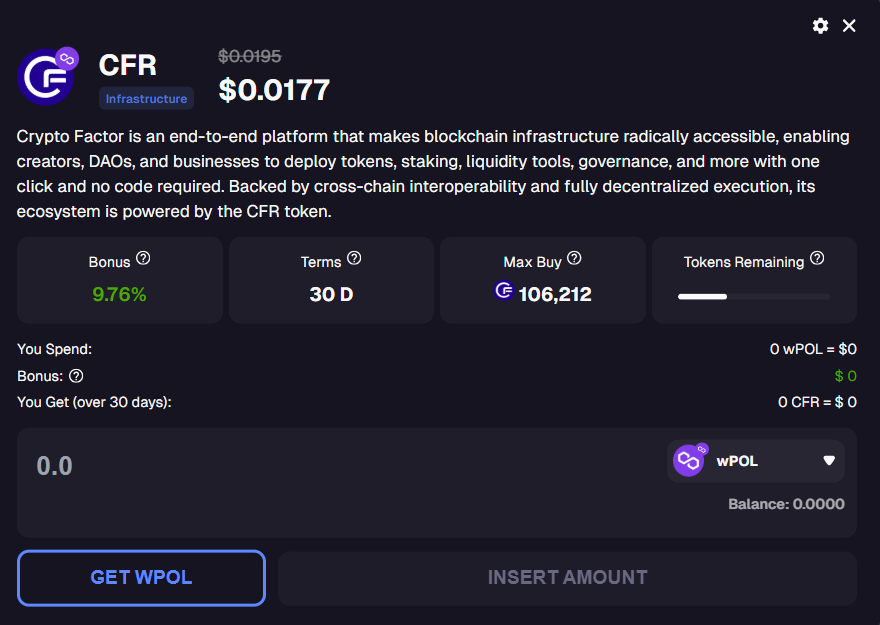
Welcoming Crypto Factor to the @0xPolygon ecosystem 👋
Purchase the $CFR token for a 9.76% bonus now through QuickSwap Bonds.
Time to ramp things up...
4
13
174
ShadowsCrypto retweeted

8 Oct 2025
Crypto Factor is live on Polygon.
Backed by grants from Polygon Labs (Season 2) and the Partisia Blockchain Foundation, we’re building the Infra Protocol that connects token ecosystems, chains, and liquidity - the machinery of Web3.
10
25
52
7,911
5 Oct 2025
Crypto Factor InterChain and cAssets will be the foundation of our upcoming cross-chain protocols. 👀
5 Oct 2025
Extending IC - Lower Fees and cAssets on Mainnet
In recent weeks, we’ve experienced significant updates, ecosystem expansions, and new releases. We would like to share some highlights in this post.
Cheaper IC Transactions
Since the introduction of our closed-beta phase, we’ve identified specific modules for optimization that will lead to lower GAS fees for InterChain (IC) usage. We have since optimized and reworked several of these modules. The public release of Crypto Factor’s InterChain has resulted in cheaper transactions compared to the beta phase, allowing new users to benefit from reduced costs for cross-chain execution.
While we’ve made progress, there is still more work to be done to optimize the efficient use of generated fees. Building routes to distribute these fees through cAssets liquidity is essential for further reducing costs.
Once we optimize the cost and maintenance processes for fee distribution, we will collaborate with the community to involve InterChain node operators, thereby decentralizing the blockchain.
cAssets on Mainnet
Just a few days ago, we celebrated the official launch of the new Crypto Factor cAssets decentralized application (dApp), which features cDFI and cUSDC. Both cAssets were developed to function as cross-chain assets, strengthening the connection between Polygon and DeFiChain and facilitating smoother liquidity flow.
The purpose of cAssets within the Crypto Factor ecosystem extends beyond merely providing liquidity for specific blockchains. They are designed to simplify access to liquidity and support cross-chain movement across all blockchains. By building liquidity depth with cAssets, we aim to scale InterChain into a faster and more secure blockchain through decentralization.
The ongoing development of the broader cAssets dApp and protocol will also equip users with essential tools for cross-chain movement, exchanges, and decentralized finance.
InterChain on Partisia
Our next focus is extending InterChain to @partisiampc, where the master chain currently operates. We will deploy our partial chain stack onto PBC, allowing us to bridge CFR and extend access to cAssets on Partisia and zkCross.
This step marks the beginning of our broader plan for PBC adoption within the Crypto Factor ecosystem. We will soon deploy the complete Crypto Factor Execution Layer and begin bootstrapping CFR operations on-chain.
As always, we look forward to seeing you all on-chain!
6
14
145
24 Sep 2025
A lot of progress was made by our team over the last few weeks, but the release schedule is not getting any lighter - keep an eye on Crypto Factor Labs.
24 Sep 2025
CFR, cDFI, and IC Mainnet Development Update
It has been a while since our last development update, and we are excited to share that we have made significant progress in the past few weeks. Here are the highlights:
Multi-Chain CFR
During our closed beta testing phase, we successfully introduced CFR on @0xPolygon. Our testers have extensively used it over the past month, bridging it from DMC and operating within our closed beta dApp ecosystem.
This week, we stealth-updated the official Crypto Factor dApp, which now features multi-chain connectivity. This update includes multi-chain components for the essential tools of our ecosystem, now available for CFR holders on DeFiChain and Polygon. The CFR bridge is a new feature in this release and will be formally introduced in the official dApp soon—more details to follow.
While CFR has been available on the Polygon PoS for some time, we are also pleased to announce that CFR has officially landed on @partisiampc as well! The smart contract has been successfully deployed and is now ready to interact with the zkCross DEX once we integrate IC with PBC—more information on that below.
cDFI and cAssets dApp Beta Testing
Last week, we deployed a new cAssets dApp and introduced it to our beta testers. This new dApp includes cDFI, which is now also available on Polygon PoS. We have deployed a new cDFI bridge on the InterChain Mainnet, enabling the transfer of cDFI between DMC and Polygon. cDFI is now part of the multi-chain family of assets in the Crypto Factor ecosystem.
cDFI is the first multi-chain cAsset introduced in our ecosystem, and we are already working on mapping cUSDC on Polygon and introducing it on DMC once the cAssets dApp exits the beta-testing phase.
New cDFI liquidity pools on Polygon are also available in the CFR dApp, and the public release of the cAssets dApp extension is coming next week.
InterChain Mainnet Public Release
After more than a month of testing the IC mainnet, we are thrilled to announce that we will conclude the closed beta phase this week!
With this release, we will remove the whitelisting requirement for interacting with InterChain, allowing for public use of the blockchain. We will also introduce the bridging functionality for CFR in both the official dApp and the cAssets dApp upon the public release.
The technical capabilities of InterChain enable the development of cross-chain executables, and the introduction of these bridges is just the first step toward wider adoption of the technology within the CFR ecosystem.
Partisia Blockchain IC Partial Chain
With the introduction of CFR on PBC, we have begun the process of bootstrapping a partial chain on the Partisia Blockchain.
In the coming days, we will deploy the partial mempool, operator hub, and partial registries to mint the genesis block of the PBC IC Partial Chain. Once we have a functioning chain on PBC, we will deploy the CFR Bridge and grant access to our beta testers.
During the beta phase of PBC IC, we will also deploy and bootstrap the zkCross pool of CFR to test and enhance our DEX interaction on Partisia.
As always, we look forward to seeing you all on-chain!
4
16
213
9 Sep 2025
Great job, guys!
9 Sep 2025
This morning, a report was released about a compromised NPM account that published new malicious versions of popular libraries.
To address this, we have taken several steps:
- We reviewed the dependencies for the live versions of our dApps and infrastructure to ensure no app uses any malicious package versions.
- We confirmed that our strict dependency version control policy is fully enforced and operational as usual.
- We added overrides for the newly identified malicious package versions on all TypeScript and JavaScript apps for future builds.
As always, our focus remains on providing a stable, secure, and scalable infrastructure.
14
101
29 Aug 2025
I am proud of our achievements so far with InterChai, but we have a lot more work to do - multi-chain cAssets are coming!
28 Aug 2025
IC Beta, cGAS, cAssets
A full week has passed since we officially launched the beta version of the InterChain mainnet. It has been a week filled with excitement, surprises, and hard work. In this update, we want to share our experiences with you.
First Week of InterChain Beta I
After the initial minting of the genesis block and our internal testing, we enabled access to the InterChain Consensus Layer through the CFR bridge for our beta testers. During this beta phase, we aim to gather user feedback on user experience (UX), fees, and user interface (UI), as well as metrics and real-time data on the blockchain's stability.
The first week has provided us with a wealth of information and positive news. With over 40 blocks minted, the Consensus Layer on PBC has proven to be stable and economically sustainable, even with lower usage levels. However, our analysis of on-chain activities has revealed gas inefficiencies in our on-chain estimations, highlighting areas for further improvement. This will ultimately lead to lower costs for participants and for maintenance.
We plan to address these inefficiencies in the upcoming soft fork of the InterChain Blockchain before the public release. We are excited to enhance the IC experience at even lower costs, making it accessible to a wider range of users. Lower IC fees can contribute to increased usage, resulting in more BYOC rewards for @partisiampc node operators and the CFR ecosystem.
cGAS Model Implementation
A crucial aspect of InterChain is the cGAS Model. This model ensures the economic well-being of InterChain and is built into the IC Oracle Nodes as an equation system. The cGAS model aims to balance the cost and execution fees required for transactions across all affected partial chains, as well as the PBC Consensus Layer.
Additionally, the model includes a revenue component that collects fees for the CFR ecosystem, ensuring the economic viability of InterChain maintenance and operations.
During the first week of beta testing, we reviewed the flow of fees and on-chain execution. In doing so, we identified a weakness in the model that led to an underestimation of Consensus Layer fees, resulting in a negative balance between fees paid and fees required for block cycles.
We have corrected this issue, and the balance has been restored. The blockchain is now operating with a positive balance even at lower usage levels, and fees will decrease for every user as block space usage increases.
cAssets on Testnet
As we announced previously, the next significant development in the IC ecosystem is cAssets. cAssets are not only a vital component of the CFR ecosystem stack but also an integral part of the IC cGAS Ecosystem.
Once fully implemented, cAssets will facilitate cross-chain GAS transfers for InterChain operations. As a first step, we are working on bringing the cAssets Bridge to life. Currently, we are focusing on deploying cDFI on the testnet over Polygon Amoy.
Building the cAssets bridge on the testnet will help us establish a timeline for the mainnet launch of cDFI and the introduction of the first Polygon-sourced cAssets.
As always, we look forward to seeing you all on-chain.
3
19
174
22 Aug 2025
The progress over the last few weeks has been amazing.
Almost a year ago, we conceived the vision for a blockchain focused on cross-chain execution, and today it is already live on the mainnet.
As a participant in the beta phase, it is exciting!
21 Aug 2025
InterChain, CFR, and cAssets
A lot has happened since our last development update, and our team has worked tirelessly since the inception of the InterChain mainnet. In this week's update, we will walk you through the latest developments.
InterChain Mainnet
Since the minting of the genesis block, the Crypto Factor InterChain mainnet has become capable of processing transactions.
Over the weekend, we deployed InterChain oracle nodes across several deployment zones. These nodes have demonstrated stable oracle consensus and high availability by segregating RPC access points.
Currently, the target block time is set to 1 hour, and the finalization target time is 3 hours. During this beta phase, the blockchain is configured to avoid minting empty blocks and requires actual activity to create new ones. This measure is necessary due to low activity from whitelisted access. Consequently, block and finalization times may vary based on the usage of InterChain.
As of today, the InterChain mainnet is fully operational in closed beta mode and is ready for the first participants!
Crypto Factor Bridge
At the beginning of this week, we started bootstrapping the Crypto Factor Token Bridge using the InterChain mainnet. This is the first protocol to operate on top of the blockchain. The bridge enables bidirectional transfers of CFR tokens between DeFiChain and @0xPolygon.
Since the bridge's deployment, we have initiated several transactions, and we are pleased to announce that the first blocks of the InterChain mainnet, which include CFR bridge transactions, have been minted! Additionally, the first small amount of CFR tokens has officially been transferred to Polygon using the CFR Bridge.
We will continue testing the IC mainnet with the CFR Bridge during this beta phase and will collect feedback from the closed beta participants.
cAssets
With the successful launch of the CFR Bridge and the ongoing beta phase of InterChain, we recognize the importance of diversifying access to liquidity through the connection established between Polygon and DeFiChain via InterChain.
We are allocating resources to develop the next protocol to join the InterChain family: cAssets. We can leverage what we've learned from the development of the CFR Token Bridge to create a common cAsset bridge, facilitating the movement of current and forthcoming cAssets between chains connected through InterChain.
This solution will introduce cDFI to Polygon and allow for a new set of cAssets, wrapped on Polygon, for building liquidity and new protocols. These new cAssets will be accessible to DeFiChain through InterChain and the built cAsset bridge. We will announce the rollout of specific cAssets through our social media and official channels.
We are committed to building technology that addresses real problems and provides practical tools for developing protocols.
We utilize these same tools to create protocols and pave the way forward.
We will meet you all on-chain.
7
24
343
16 Aug 2025
The battle of the mainnet is over, the battle for the first CFR cross-chain transfer has begins 🫡
15 Aug 2025
⛓️ INTERCHAIN MAINNET - LIVE ⛓️
Genesis Block Minted on Partisia Mainnet
Today marks a defining moment for Crypto Factor - the Genesis Block of InterChain has been minted on @partisiampc mainnet, opening a new chapter in our journey toward seamless cross-chain interoperability.
Over the past 10 months, design, planning, and engineering have brought us to this milestone. Immense credit goes to the Crypto Factor Labs team for their monumental efforts and foundational achievement. @cfr_labs
We extend our thanks to our base chain partner Partisia Blockchain and to Polygon Labs, whose support and grant funding have helped make this new layer of digital engineering possible. @0xPolygon
For the next 48 hours, we’ll be in internal monitoring mode, preparing for the private beta phase - where a select group of testers will put InterChain through its paces.
This mainnet launch is more than a milestone; it’s a strategically vital piece of the Crypto Factor puzzle - enabling client token and data ecosystems to operate across chains, and introducing a new suite of InterChain-native cAssets.
The future of interoperability has begun. 💙
1
3
23
505
13 Aug 2025
The week for Crypto Factor already started strong but deployment of IC mainnet is going to be epic!
Great job by our team!
13 Aug 2025
GM Polygon, Mainnet Rollout, Closed Beta
The Crypto Factor Labs team has been hard at work over the past few weeks and has remained silent, but this update is what we have been preparing for. Let's dive in.
Good Morning @0xPolygon
And it is indeed a good morning—Crypto Factor has arrived! Our team has been busy over the weekend, and we are excited to share that the Crypto Factor Execution Layer (CFEL) has been successfully deployed and configured on Polygon PoS. This marks a significant milestone in our expansion on Polygon and the beginning of our on-chain operations. The CFEL is currently operating in beta mode, eagerly awaiting the upcoming IC launch and SSP development.
The deployment has come with its challenges. We have noticed that off-chain infrastructure scaling is facing difficulties due to the fast pace of Polygon PoS. Some of our indexing services will need adjustments, but our team is already addressing these issues in preparation for SSP.
We could not just arrive with infrastructure; as of this morning, the Crypto Factor Token (CFR) has made its debut on Polygon as well. The supply intended for the CFR Bridge is now ready for the further deployment of the IC mainnet. Congratulations to the Crypto Factor team and community for this achievement—CFR is now a multi-chain token!
InterChain Mainnet Launch
As many of you may already know, August is the month! @partisiampc has beaten us to the announcement, but we want to confirm and provide more details regarding the launch of the InterChain mainnet. We have conducted a variety of tests and confirmed that IC is ready for the next phase—the closed beta mainnet. We have spent the last few weeks preparing for this moment, and we are now ready to execute the launch.
In the coming days, we will gradually deploy the IC infrastructure, beginning with the InterChain Consensus Layer on Partisia, followed by the deployment of the InterChain Interpolation Layer on DeFiChain DMC and Polygon PoS. The genesis block of the InterChain mainnet is expected to be minted this Friday, August 15, 2025. This marks the beginning of a new journey for both us and Crypto Factor.
InterChain Closed Beta
After successfully bootstrapping IC, we will closely monitor the chain's performance and stability over the weekend and also deploy the bridge connecting CFR on Polygon and DMC. Initially, the bridge will be available solely for internal testing. Once we confirm that it is functioning as expected, we will open the IC and the bridge to the whitelisted beta participants.
We anticipate running the closed beta for the next 1-2 weeks, focusing on monitoring and improving the experience while also developing cAssets.
We want to thank everyone who is part of this development journey with us, and we look forward to seeing you all on-chain!
8
27
515
22 Jul 2025
Mainnet incoming....
Nothing stops this train.
Crypto Factor Labs team is legendary.
22 Jul 2025
Optimizations, dApps, Beta Phase
The latest testnet rollout has been a great success, marking the beginning of the next phase for Crypto Factor InterChain. After months of testing, improvements, and achieving a stable runtime, we are confident in progressing with the IC deployment to the mainnet. Here’s an overview of our ongoing preparations and rollout plan.
GAS Optimizations
Currently, on the testnet, InterChain is operating with transaction fees in the range of $3 to $5 for executing multi-chain transactions across three separate blockchains. This cost is acceptable for the upcoming closed beta phase for the mainnet, but our goals for scalability, usability, and transactions per second (TPS) require us to optimize this further.
The primary expense for IC fees at this stage comes from running the master chain on Partisia Blockchain. This design is intentional because the InterChain architecture goes beyond typical Layer 2 blockchains, with most consensus processes occurring on-chain while off-chain nodes handle transport and oracle tasks.
While this architectural design offers numerous advantages, one significant drawback is the increased gas costs. As previously mentioned, we utilize a complex on-chain gas evaluation protocol that allows us to manage gas surplus and deficits effectively. We are confident that with further fine-tuning, we can reduce the master chain running costs by at least 20-30%, subsequently lowering usage costs for our users. As usage increases post-beta phase, fees are expected to decrease even more.
Our team will conduct necessary tests and optimize gas fees throughout this week, and during the closed beta phase, to reduce fees for the official public launch.
Crypto Factor dApp
During the forthcoming beta phase, participants will have access to a beta version of the CFR dApp, which will facilitate interaction with the IC bridge for the CFR token. Our team is actively integrating the dApp with the new operator protocol for InterChain, ensuring that users are monitored and notified regarding transaction changes and executions.
We aim to finalize the dApp's integration with these changes before the mainnet rollout, and we will conduct final UI/UX tests on the testnet over the upcoming week and throughout the beta phase.
If there are still community members interested in participating in the closed beta phase for IC, please contact the Crypto Factor team through our official channels.
Mainnet Rollout and Closed Beta Phase
We are excited to announce that we are ready to roll out the InterChain mainnet during our closed beta phase. The mainnet will connect DeFiChain's DMC, Polygon's PoS, and Partisia Blockchain. The rollout is set to commence as soon as we complete the necessary preparations, and it is expected to occur before the end of this month.
Yes, you read that right. By the end of this month, we anticipate that InterChain blocks will start counting towards the future of cross-chain interoperability.
Following the minting of the mainnet's genesis block, the Crypto Factor dApp will serve as an entry point, enabling the flow of CFR across three blockchains through the integrated bridge. This is a significant advancement for both DeFiChain and Partisia Blockchain, allowing for greater flexibility in asset movement alongside the existing native solutions on both chains.
During the rollout, new contracts for CFR on both PBC and POL will be shared through our official channels for the community to monitor and use as future references. Please be cautious of scams and always verify information from official sources.
In our next update, we will provide the exact dates for the launch of the beta phase, as well as additional information regarding public access to InterChain.
Our team is thrilled to be part of this journey, and we look forward to seeing you all on-chain!
2
10
27
434