
Incoming Washington bureau chief, The Economist. Formerly defence editor. Signal: shashank.96
Joined November 2008
- Tweets 364
- Following 1,715
- Followers 233,734
- Likes 36,761
18 Photos and videos




Yes. A deeply unserious take.

3
5
70
13,388
Shashank Joshi retweeted

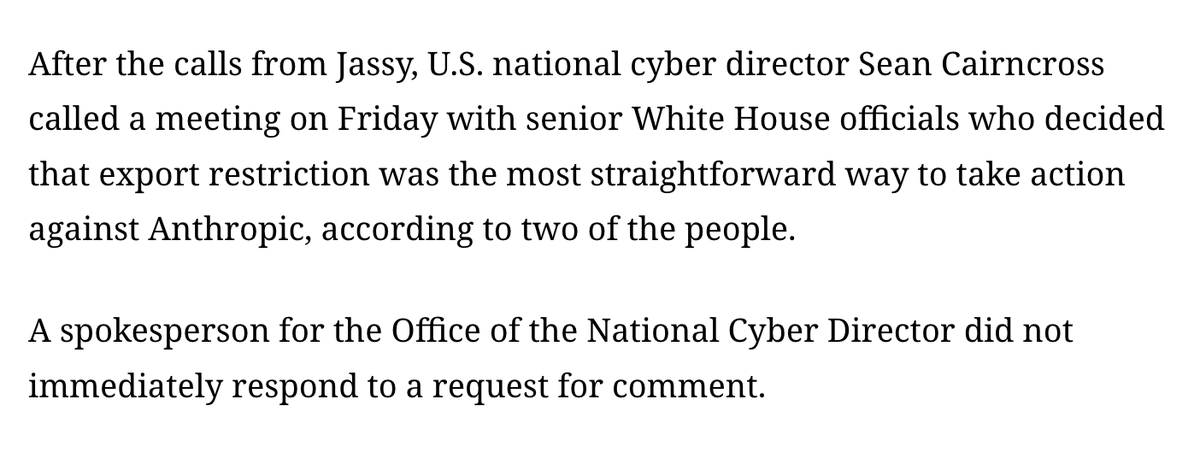
Sounds like Sean Cairncross was a lead decision maker here: theinformation.com/articles/…
1
2
41
9,193
Shashank Joshi retweeted

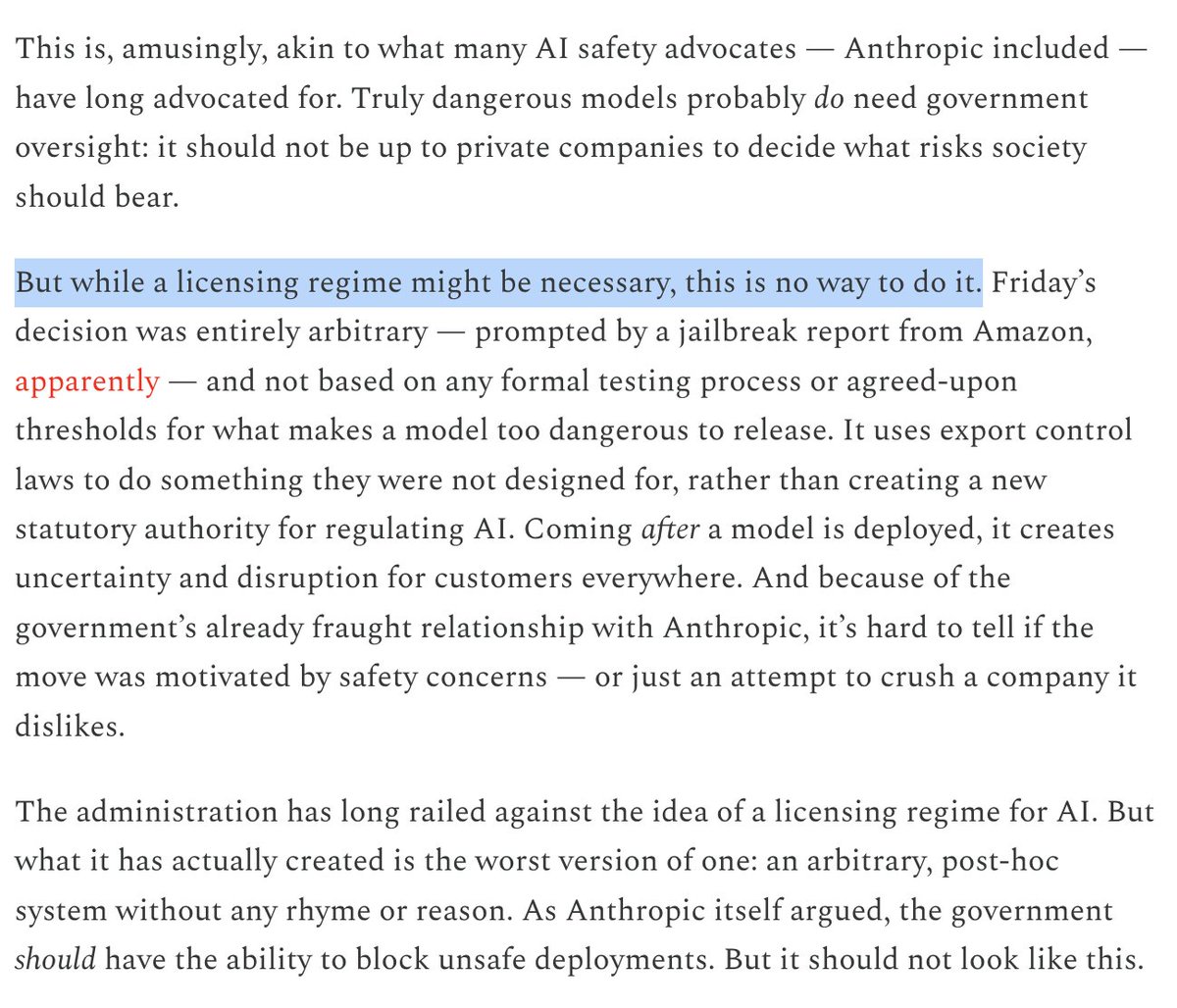
Lots of people have criticized Anthropic for calling for regulations, and now complaining that it’s getting regulated.
You might say instead that the Fable situation vindicates Anthropic. It knew that strong regulations would be needed, and so it called for a clear, reasoned process for making such decisions — precisely to *avoid* the situation we’re now in.
3
11
106
7,858
Shashank Joshi retweeted

It's going to be a very interesting set of decisions if labs know that trying to release your model to the world can cause you to lose access to it internally...

Unless this changes, OpenAI researchers on visas need to plan for the fact they’ll probably lose access to internal models, and therefore their ability to do their jobs moving forward, sometime in the next couple months.
I hope the company acts to prevent that.
11
35
515
35,932
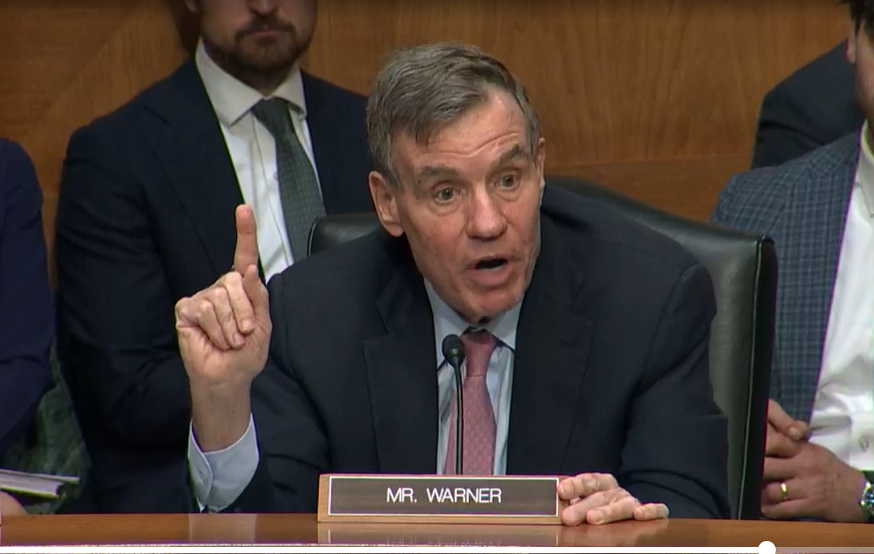
Remarkable line from vice chair of senate intel committee, even if it’s an exaggeration.
Jun 11

On Mythos, from @MarkWarner in this morning's Senate Banking hearing: "the head of the NSA and Cyber Command came and said this tool broke into almost all of our classified systems, not in weeks, but in hours"; I had not seen that mentioned elsewhere?
4
45
199
49,489
All sensible. “What would have helped in this case? It's not clear that even a European model would really have.”

The Fable decision is fundamentally a domestic US policy mess, and it seems likely to resolve itself, albeit chaotically. For middle powers, it's a tempting starting point for ill-conceived 'sovereign' AI takes, but I think the right move is to let it blow over and buy more time.
The decision itself seems counterintuitively domestic in scope. USG got worried about the prospect of a jailbreak, didn't feel like it had a particularly precise and effective way to tackle that risk, and defaulted to limiting access in an obvious and available way. The easy way to do this was also a way to make Anthropic uncomfortable and annoy allies, but these seem like secondary considerations at best.
That's still relevant information for middle powers--it goes to show that there is no immediately effective and legible reason for USG or American developers to consider their interests in making access decisions. As for middle powers' posture in reacting to this: I think nothing good comes from wading into a politically charged AI policy environment, solidarising with Anthropic and drawing the continued ire of the Trump administration. Right now, middle powers are collateral damage, and acting hastily risks making them parties to the conflict.
What would have helped in this case? It's not clear that even a European model would really have. Imagine you had the absolute best case European sovereignty in place, up and running since 2024. would it have a Fable-class model by now? or would it 'only' be at the level of Opus 4.8 - a near-frontier model in its own right that remains available today? you'd have to be quite confident that the European champion would not just be 2 months behind the curve, but at the absolute bleeding edge of frontier development, to make a difference to this particular scenario. Not even the most bullish views of the domestic project makes that kind of outcome particularly likely, so this really is not a particularly incisive wake-up call on European frontier models specifically.
But even if you disagree, what would it actually *mean* for this to be a wake-up call for European sovereignty? Are you going to build your own model now? What are you going to do in the--generously--three years between announcing this project and reaping the frontier models it would build: are you willing to give up frontier access in the meantime? Because the resources required for building this frontier model directly trade off against the resources you could invest into guaranteeing access instead (most notably through compute); and the political fallout from announcing an attempt to build the very kind of model capability the US is attempting to restrict would also make future access negotiations harder.
Let's say you're willing to bear that delay: do you think a Trump administration that just refused to give you access to Fable is going to let you buy enough frontier chips to train an unrestricted Fable clone yourself? Are you willing to go the mat on semiconductor chokepoints, even if it comes with sky-high costs in Ukraine and trade policy? I don't actually think so. Look into the details of what would be required for a big European push right now, and you'll see the leverage for 'waking up' and divorcing from the US ecosystem simply is not feasible in the current technological or geopolitical environment. I regret that this is the case, but that doesn't make it the case any less!
What, then, is the alternative?
First, I think it's worth noting that this is fundamentally a very good version of a very bad thing. In a fortuitous turn of events, the Trump administration has picked the most ill-conceived version of access restrictions you could possibly come up with. It's legally fraught, so domestically impactful that it will lead to massive internal pushback, and likely extremely economically harmful. As a result, it will likely go down in flames eventually. The U.S. is not yet in the spot to actually go through with long-term cut off: international markets are still too important, the security situation is not yet sufficiently dire, and so on. So the first live fire exercise of cutting off the rest of the world is going to fail, which means labs and the admin are going to be much more wary of subsequent attempts to do the same, even if they end up more sophisticated.
Second, I think the access recipe is fundamentally the same as it was yesterday: build leverage on the margins that makes cut-offs like these even less attractive, for instance through access-for-compute deals and by creating deep economic integrations that are economically central to US labs and strategically central to the US supply chain--create a lobby to push back harder against attempts like this in the future. In the future, we can use the resources and capacities that gives us to sprint toward our own frontier project if we must, but right now we neither have the political will nor the relative power to get even close to trying that.
Third, and somewhat trivially, we should start thinking about what we want to do the next time this happens. I suspect any analyses that assess whether you can use ASML or any semiconductor chokepoint to avert this will come up short, but there's still value in analysing and then credibly precommitting to threats. Right now, USG did this operating under the assumption there would be absolutely no reaction from middle powers at all. Any plan in the drawer that suggests there is a non-negliblie cost for the US to act like this in the future would be helpful. There's little use in deploying it reactively now; there's lots of value in precommitting to it for the next iteration. That's different than actually going to the mat; the goal here is to play chicken a bit, increase uncertainty and latent risk for the administration in making these decisions to tilt the calculus toward integration, not to go all out on a highly costly tradewar.
Fourth, I think this clarifies the specific concerns that could motivate access restrictions. Security concerns, both on misuse as well as distillation and model theft, fundamentally make the US more likely to restrict model access; this time around, it was concerns around reducing surface area for unmonitored jailbreak attempts. That is, in principle, fixable--middle power governments can and should engage with labs to create security conditions that create permission structure for exports and model sharing. Make your infrastructure as secure as they want it to be, and you reduce the risk they consider exporting to you a security vulnerability. Again, I understand if this sounds submissive and uncomfortable to you---but again, all this is necessary even if you go for the maximal sovereignty playbook at the same time, because you will need frontier access in the meantime.
Instead of these reasonable responses, I worry that the low-resolution view on this whole affair is to think this should shake middle powers into the wrong kind of action. Realising how important and contingent frontier AI access is quickly leads down the path of wanting to build your own; realising how capricious the American ecosystem is makes you want to divorce from it faster.
But for better or for worse, the central implication of this episode is the opposite: as evidenced by this episode being possible at all, middle powers currently do not have the leverage to do much about any of this, and building up this leverage is almost impossible to do in an openly adversarial relationship to the US. In that sense, waking up is not a matter of loud yelling, decisive action or pivotal decisions. For all the internal urgency with which I think we should precommit to some leverage and shore up our security concerns, I still think the optimal strategy is one of public restraint and progress on the margins of the current playbook. I'm just not sure there's that much to wake up from - this is just what life is like for now.
3
1
46
16,958
You say you want regulation, but when I do some mad regulation you say that it’s bad. I am very clever.
1
7
65
9,716
A transparent process would explain the basis on which a model gets banned so people could see whether this applied equally to equivalent model capabilities. Instead we have chest-thumping tweets from DoD.
Jun 13

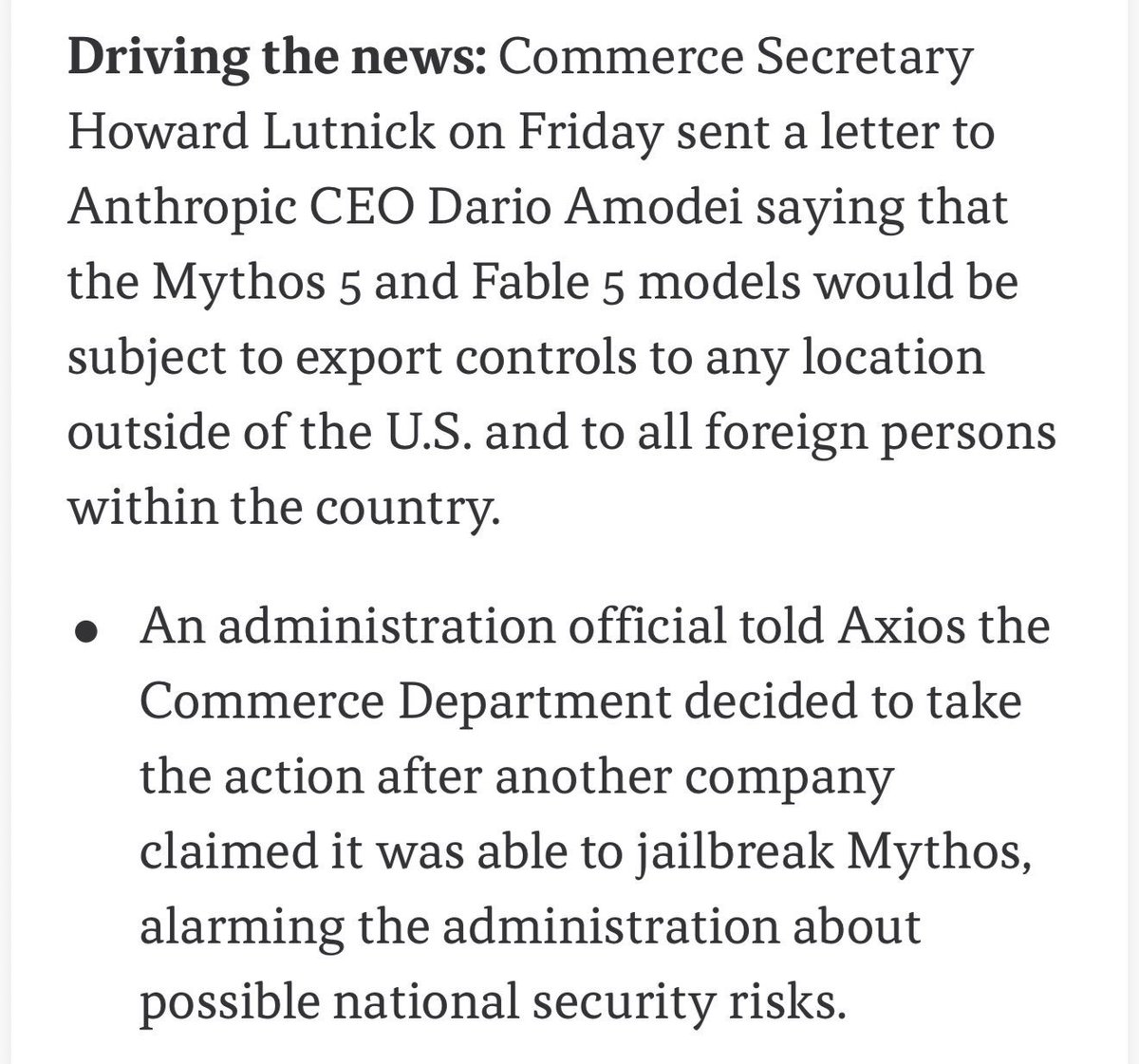
Are they specifically trying to fuck with Anthropic or is the idea to apply this to any comparably powerful models from competitors?
4
22
139
27,749
Shashank Joshi retweeted

Jun 13
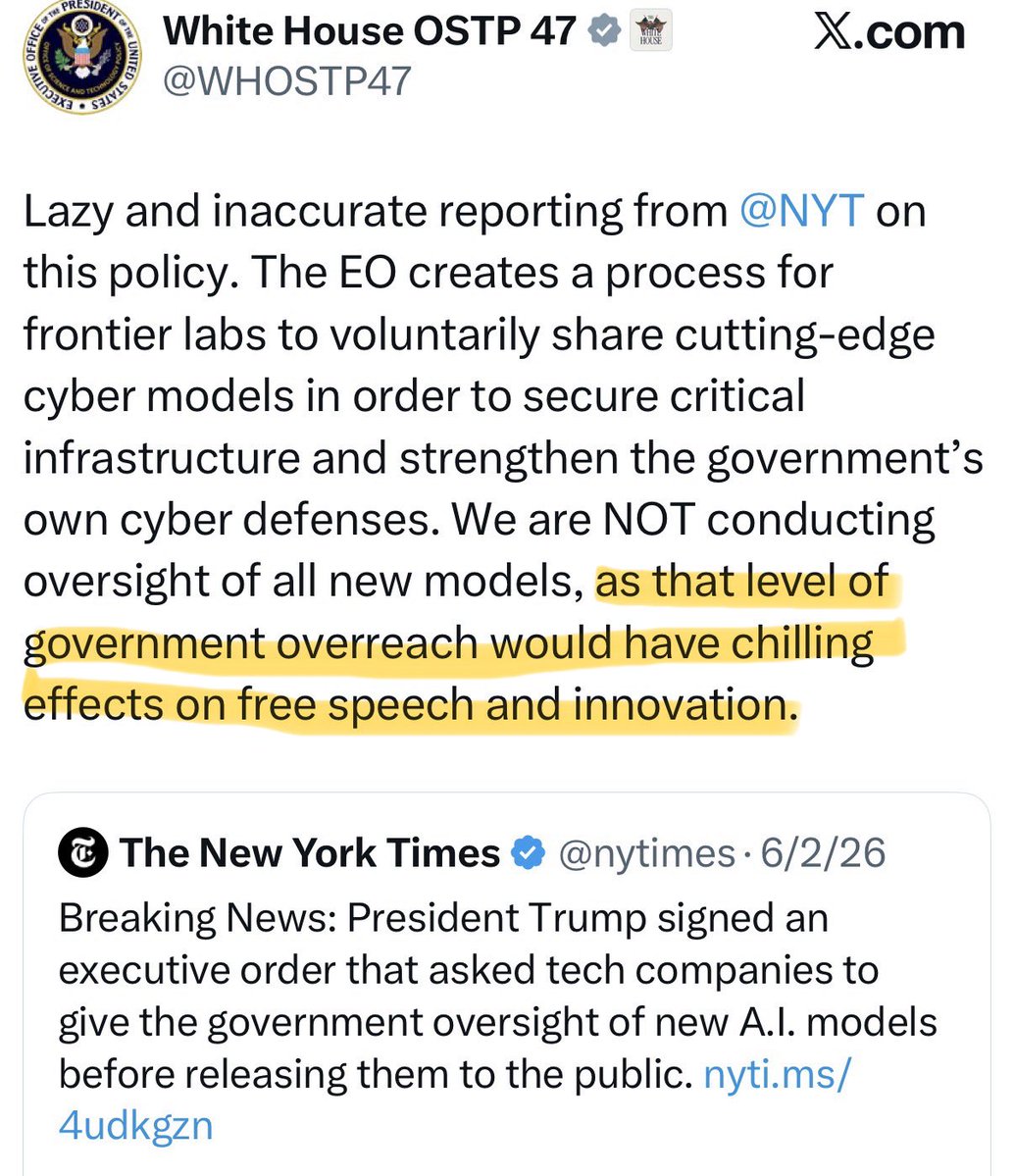
life comes at you fast I guess
5
60
640
53,681
Shashank Joshi retweeted

Jun 13
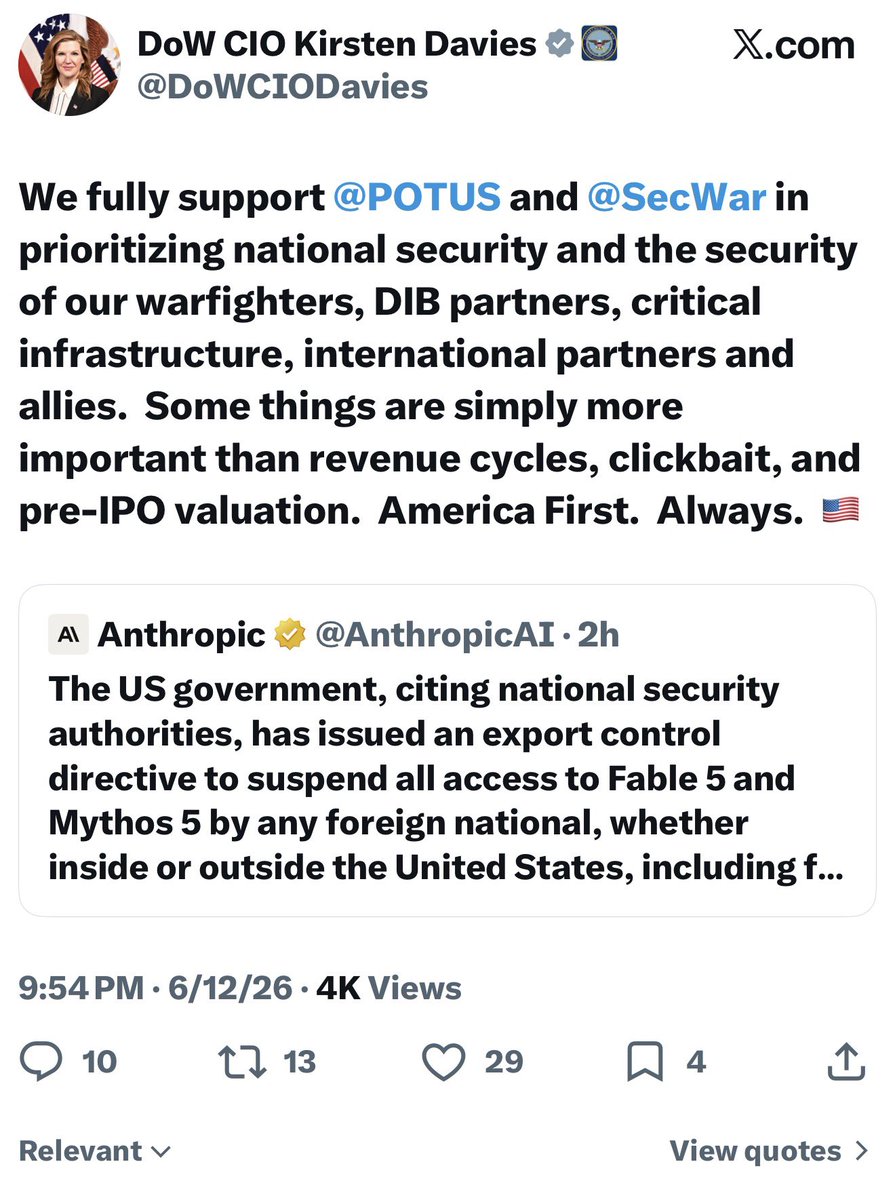
Statement from DoW CIO confirming the announcement from Anthropic on pulling Fable. “Some things are more important than revenue cycles, clickbait, and pre-IPO valuation”
Also seems to attribute the decision to Secretary of War Hegseth.

2
7
82
22,562
Shashank Joshi retweeted

Jun 13
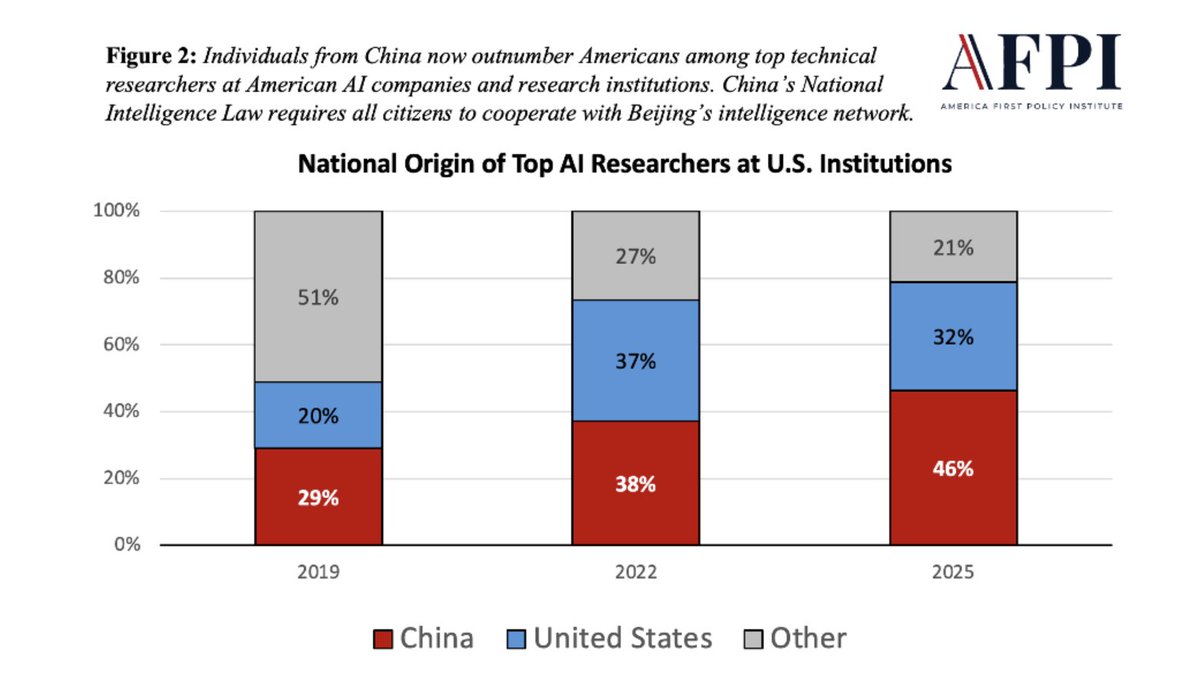
The US government just ordered Anthropic to suspend all foreign-national access to Fable 5 and Mythos 5, inside or outside the US.
As a reminder, huge percentages of technical employees at all the frontier AI labs (including Anthropic) are likely foreign nationals.
4
20
77
8,535
Worth thinking about the crypto wars precedent, when the US government tried to place strong cryptosystems - which could even be written down and published as books - under export controls. That policy eventually broke down though some restrictions still exist. It doesn’t mean frontier models will have the same dynamic, because the US lead over others could prove to be unassailable, given recursive self improvement & access to compute.
6
37
8,622
Shashank Joshi retweeted

22h
Much like international companies have token CCP officials embedded in their Chinese operations, Western companies will need to have token Americans embedded in theirs for Anthropic access.
Jun 13

The US government, citing national security authorities, has issued an export control directive to suspend all access to Fable 5 and Mythos 5 by any foreign national, whether inside or outside the United States, including foreign national Anthropic employees.
The net effect of this order is that we must abruptly disable Fable 5 and Mythos 5 for all our customers to ensure compliance.
Access to all other Claude models is not affected.
We apologize for this disruption to our customers. We believe this is a misunderstanding and are working to restore access as soon as possible.
Read our full statement: anthropic.com/news/fable-myt…
1
3
23
7,286
Shashank Joshi retweeted

Jun 13
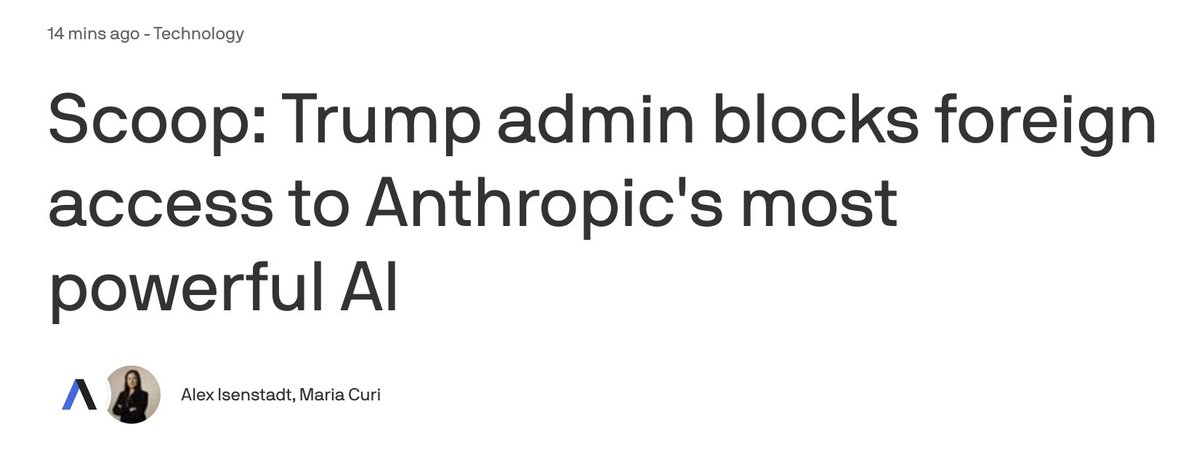
If this is true, it is just baffling. An administration whose posture is that we *should* export advanced AI chips to China, which also wants to ban… Britain (and every other non-American on Earth)… from using our best models? I have no words.
Jun 13

Oh whoa, this Anthropic news is insane. The Commerce Department is placing both Mythos 5 and Fable 5 under the guise of US export controls, blocking access outside the US and foreign persons in the US.
68
157
1,614
236,424
Shashank Joshi retweeted

Jun 13
Fascinating how quickly Commerce can move on unsubstantiated Anthropic jailbreak claims, while taking forever to deal with well-documented NVIDIA chip smuggling
18
102
1,298
63,687

Under this order, Andrej Karpathy (not a US citizen) is barred from using Mythos/Fable but for example a felon with 55 violent crimes on his record who was recently let back on the streets would be, as long as he was born in America.
Yeah… seems like the wrong criterion.
Jun 13
The US government, citing national security authorities, has issued an export control directive to suspend all access to Fable 5 and Mythos 5 by any foreign national, whether inside or outside the United States, including foreign national Anthropic employees.
The net effect of this order is that we must abruptly disable Fable 5 and Mythos 5 for all our customers to ensure compliance.
Access to all other Claude models is not affected.
We apologize for this disruption to our customers. We believe this is a misunderstanding and are working to restore access as soon as possible.
Read our full statement: anthropic.com/news/fable-myt…
172
132
1,802
105,229
Shashank Joshi retweeted

Jun 13
If I'd known it was my last go I wouldn't have used Fable for that chicken soup recipe
Jun 13
The US government, citing national security authorities, has issued an export control directive to suspend all access to Fable 5 and Mythos 5 by any foreign national, whether inside or outside the United States, including foreign national Anthropic employees.
The net effect of this order is that we must abruptly disable Fable 5 and Mythos 5 for all our customers to ensure compliance.
Access to all other Claude models is not affected.
We apologize for this disruption to our customers. We believe this is a misunderstanding and are working to restore access as soon as possible.
Read our full statement: anthropic.com/news/fable-myt…
9
35
936
43,247
‘Anthropic said it thinks the government became aware of a method of so-called jailbreaking before Friday’s action. “We reviewed a demonstration of this specific technique being used to identify a small number of previously known, minor vulnerabilities. These vulnerabilities all appear relatively simple, and we have found that other publicly available models are able to discover them as well without requiring a bypass,” the company said.’ wsj.com/tech/ai/anthropic-ha…
1
18
86
17,156
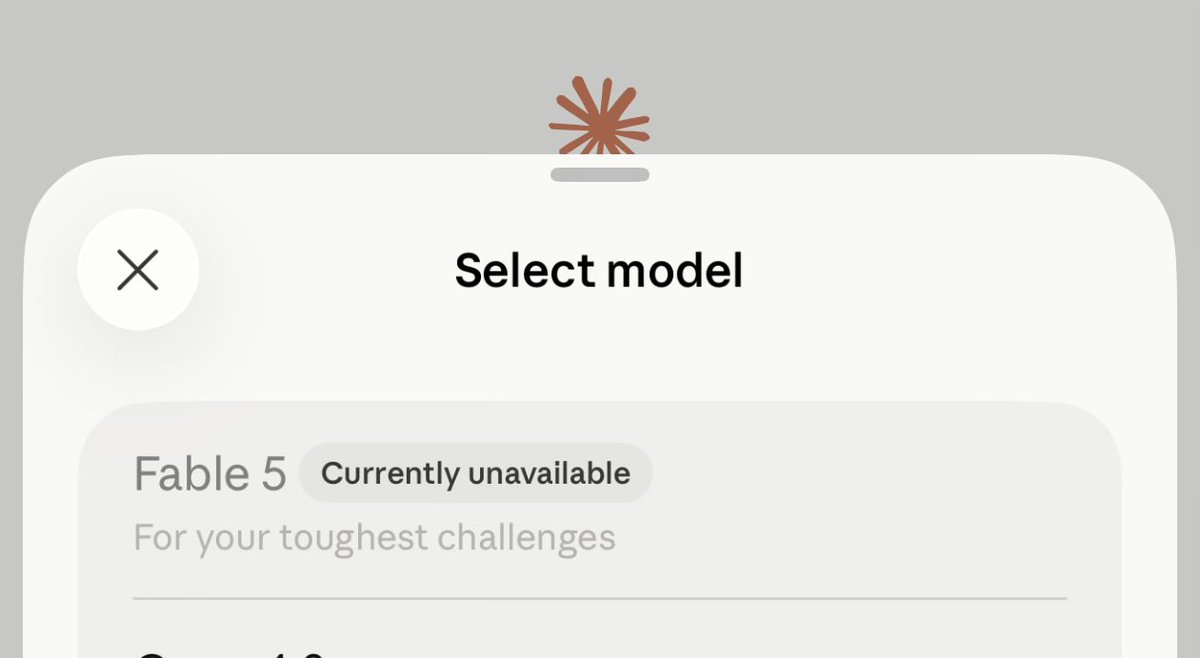
Totally bonkers move. US orders Anthropic to strip foreign national access to Fable 5.
Jun 13
The US government, citing national security authorities, has issued an export control directive to suspend all access to Fable 5 and Mythos 5 by any foreign national, whether inside or outside the United States, including foreign national Anthropic employees.
The net effect of this order is that we must abruptly disable Fable 5 and Mythos 5 for all our customers to ensure compliance.
Access to all other Claude models is not affected.
We apologize for this disruption to our customers. We believe this is a misunderstanding and are working to restore access as soon as possible.
Read our full statement: anthropic.com/news/fable-myt…
21
30
231
40,405