
Founder/CEO @intempt. Previously at Intel, Adobe & UC Berkeley. I post about entrepreneurship and life on the road
Joined August 2008
- Tweets 1,669
- Following 433
- Followers 484
- Likes 116
176 Photos and videos





Jun 10
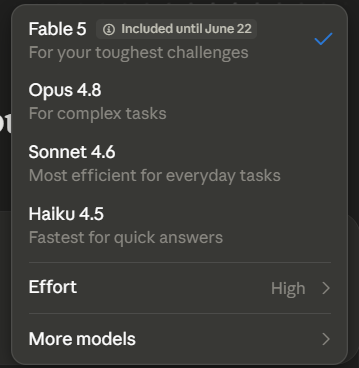
Anthropic just released Fable 5. The benchmark table is not the story.
The line Anthropic buried in the announcement: "the longer and more complex the task, the larger Fable 5's lead."
Read that again. The model's edge isn't in answering your question. It's in not falling apart over six hours of work.
Single-prompt quality is COOKED. Every lab is within spitting distance of every other on a clean, isolated task. That race ended and nobody won.
You cannot build a moat on a capability your competitor matches next update.
The frontier quietly moved from quality to duration.
Stripe ran a codebase-wide migration on 50 million lines of Ruby in a day. A team would've spent two months on that by hand. Giving the model persistent memory improved its performance three times more than it did for Opus. Same trick. Triple the payoff. Because the model can hold a long thread without losing the plot.
Most founders are still building for the old model. Chunking everything into tiny calls. Babysitting every step. Guardrails everywhere because the model forgets what it was doing.
That weakness is evaporating faster than your roadmap can account for it.
The companies that win the next 18 months won't be the ones with the cleverest prompt. They'll be the ones who assumed the model could run an entire workflow end to end, and built the product that way.
Duration is the moat. Full announcement here: anthropic.com/news/claude-fa…
1
39
Sid Chaudhary retweeted
Jun 3
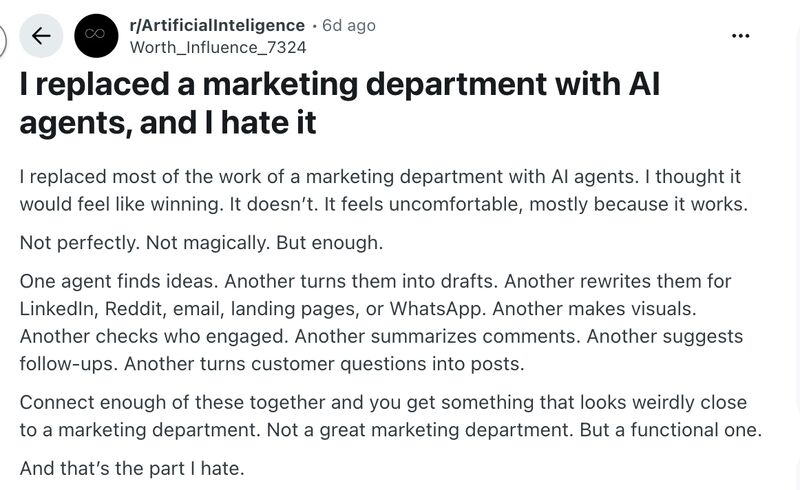
Replacing your marketing team with AI agents is nonsense.
Not just from an efficiency standpoint. From a spiritual one.
You chose to be an entrepreneur. You put your hand up and said you wanted to make a dent in the world. Nobody put you here. This was voluntary.
So why would you want to build something remarkable with a room full of workflows instead of people?
Anyone who has ever built something material wanted to build a team. A go-to-market unit.
People who are bought in, who care, who argue about the strategy. That is not overhead. That is the entire point of building a company.
What reputable companies are actually doing is replacing discombobulated marketing. The media guy with no idea what the SEO guy is running. The inbound team with zero visibility into what outbound is doing.
That fragmentation is the real problem. AI fixes that by making you a full-stack marketer. That is it.
And then there is brand. Brand is not a conversion rate. Brand is a feeling. Its the people behind it. People have associated themselves with companies whose marketers they respected for years.
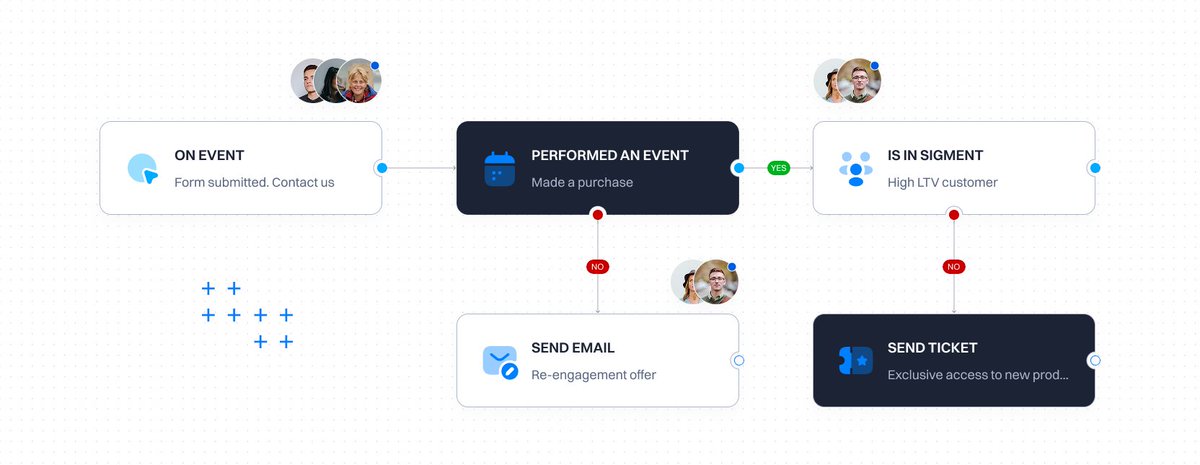
Replace that team with a workflow diagram and you have polished output with no real identity.
We are building go-to-market units at Intempt. Full-stack marketers who use AI as an extension of themselves.
1
1
23
Sid Chaudhary retweeted
Jun 6
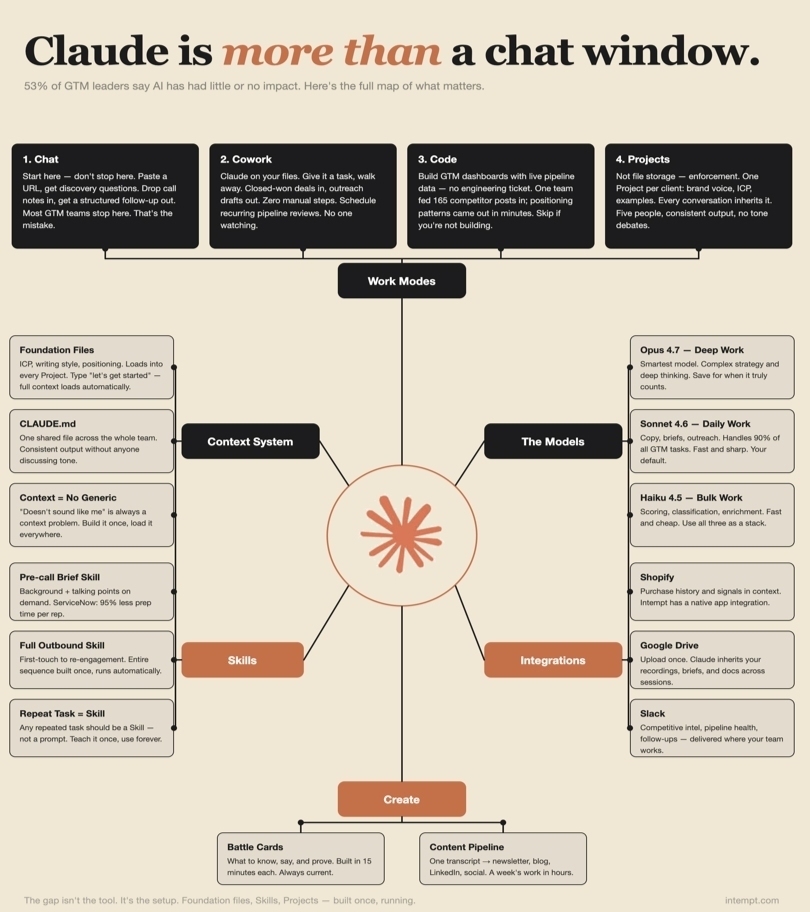
53% of GTM leaders say AI has had little or no impact on their work.
I'd guess most of those teams are using it like a Google search.
Claude is more than that... Here's the full map with what matters for GTM teams.
1. Chat → Start here. Don't stop here.
☑ Use it for pre-call research. Paste their URL, get tailored discovery questions.
☑ Drop raw call notes in after a call, get a structured follow-up out.
☑ Most teams stop here. The other 8 are where it gets interesting.
2. Cowork → Claude on your files, not a browser tab
☑ Think of this as Claude on your computer. Give it a task, walk away. It runs.
☑ One team runs it weekly: closed-won deals in, outreach drafts out. Zero manual steps.
☑ Schedule recurring work: pipeline reviews, competitive scans. No one is watching.
3. Code → Skip if you're not building. But if you are...
☑ Build GTM dashboards: live pipeline data, interactive output. No engineering ticket.
☑ One team fed 165 competitor posts into its positioning patterns in minutes.
4. Projects → Not file storage. Enforcement.
☑ Set up one Project per client: brand voice, ICP, examples. Every conversation inherits it.
☑ Shared Projects: five people, consistent output, no one discussing tone.
☑ The moment it has your context, it stops being generic. That's the point.
5. The Models → Pick the right brain
☑ Use Sonnet 4.6 for daily work: copy, briefs, outreach. Handles 90% of GTM tasks.
☑ Use Haiku 4.5 for bulk work: scoring, classification, enrichment. Fast and cheap.
☑ Save Opus 4.7 for deep work. Use all three as a stack.
6. Context System → How Claude learns your business
☑ Build foundation files: ICP, writing style, positioning. Load into every Project.
☑ A CLAUDE.md the whole team shares. Type "let's get started," full context loads.
☑ "It doesn't sound like me" is almost always a context problem.
7. Skills → Teach it once, use it forever
☑ Build a pre-call brief Skill. Background, talking points. ServiceNow: 95% less prep.
☑ Build a full outbound Skill: first-touch, follow-up, breakup, re-engagement. Automated.
☑ Any task you repeat should be a Skill, not a prompt.
8. Integrations → Where it shows up in your workflow
☑ Connect Shopify: purchase history and signals in context. Intempt has a native app for this.
☑ Upload to Google Drive once. Claude inherits your recordings, briefs, and docs.
☑ Connect Slack: competitive intel, pipeline health, follow-ups after calls.
9. Create → What it actually builds
☑ Build battle cards: what to know, what to say, how to prove it. 15 minutes each.
☑ Drop one transcript in, newsletter, blog, LinkedIn, social cuts out. A week's work, hours.
1
1
2
185
Jun 8
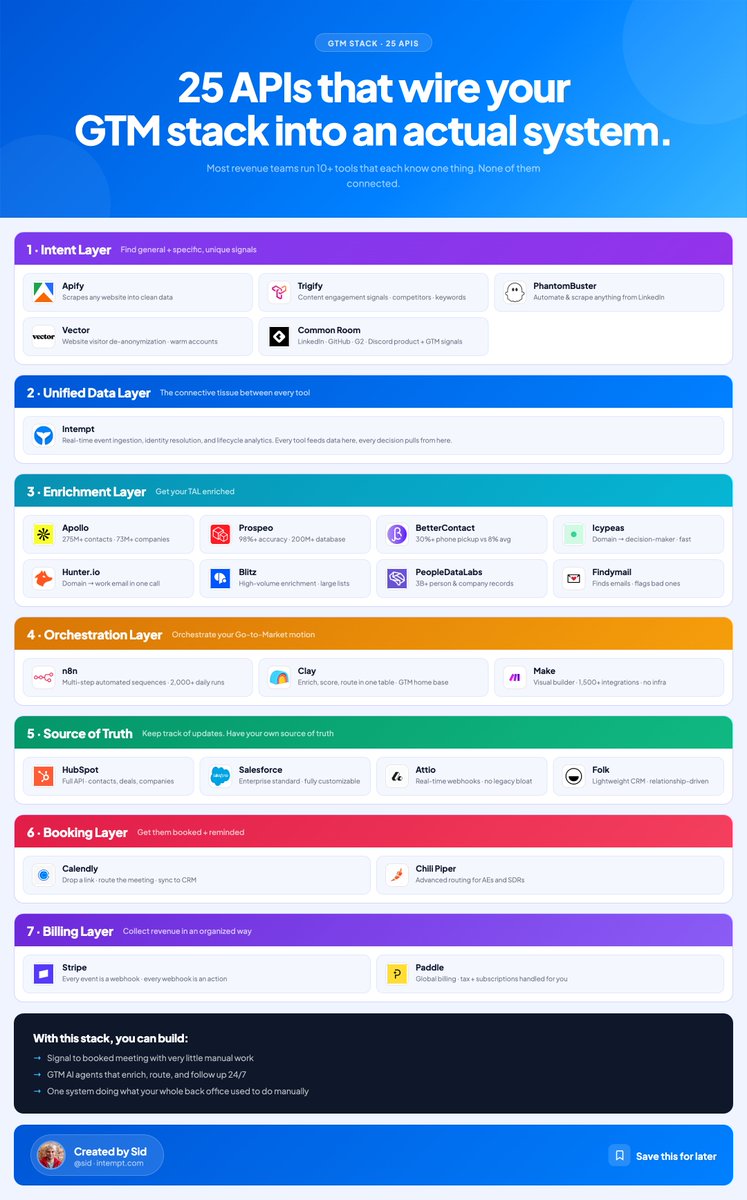
25 APIs that wire your GTM stack into an actual system.
Most revenue teams run 10 tools that each know one thing. None of them connected.
Here are the 25 worth connecting:
2
2
26
Jun 8
None of these tools works alone. Connect them, and something changes your data flows, your context compounds, and your team stops being the integration layer.
Which one would you connect first?
1
4
Jun 8
6. Booking layer
↳ Calendly: drop a link, route the meeting, sync to CRM. Done.
↳ Chili Piper: more advanced routing for AEs and SDRs.
1
1
14
Jun 8
Connect them, and your data flows, your context compounds, and your team stops being the integration layer.
Which one would you connect first?
1
1
10
Jun 7
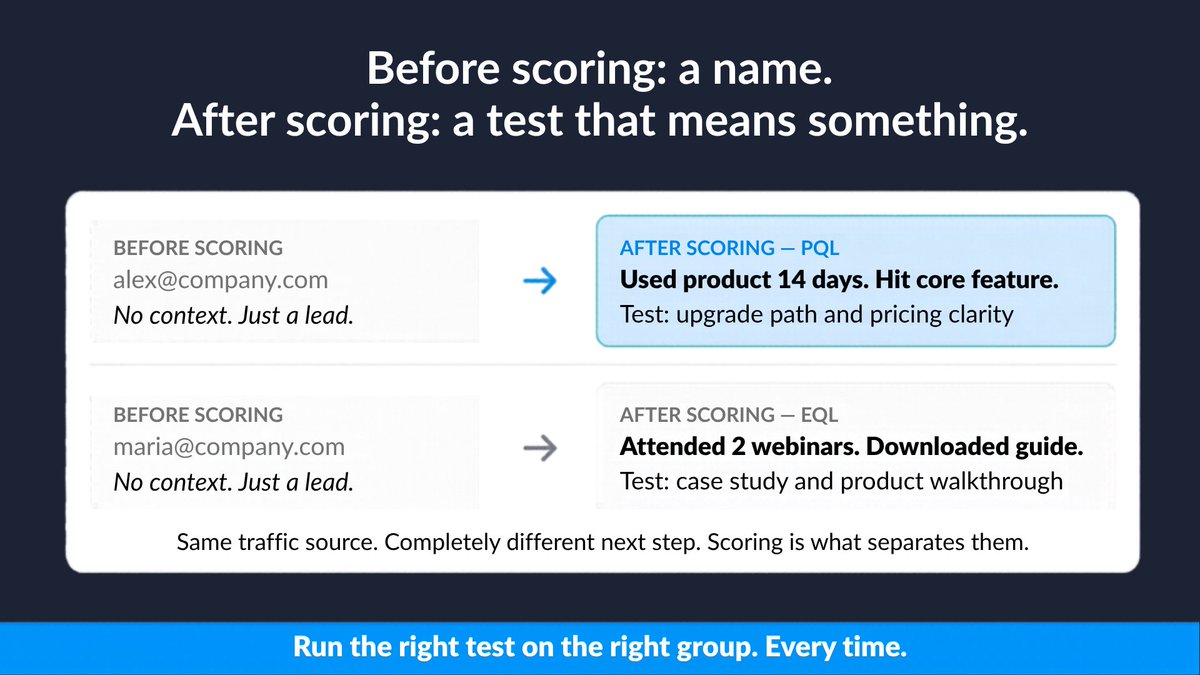
A product-qualified lead and an engagement-qualified lead are not the same person. Most growth teams test them as if they are.
3
1
28
Jun 7
A lead scoring model assigns each lead a category based on what they have actually done: product actions, engagement history, pipeline stage. That is the foundation for running separate experiments on separate groups:
1. PQL gets tested on upgrade paths: clearer pricing, fewer steps to the next plan, better in-product prompts
2. EQL gets tested on conviction: case studies, social proof, product walkthroughs
Both tests produce results that actually mean something, because both groups have similar intent and a similar next step.
1
1
20
Jun 7
If you don't have a scoring model, you can tag leads by pipeline stage, but you're still putting someone ready to buy in the same experiment as someone who has never seen the product. The tag is different. The experiment isn't.
The question isn't what variant to test. It's whether the group you're testing is actually one group.
1
3
Jun 5
Contact-based pricing is ransom.
You built the audience. You did the work. Now you pay monthly whether you email them or not.
Send one campaign and get charged for 54,000 contacts sitting idly.
Infrastructure cost to deliver those emails: under $10.
Mailchimp invoice: around $600
That gap is not product value. That is a switching cost business model.
We charge on sends at Intempt. Not contacts or subscribers or even monthly active users.
Audiences store for free.
Don't send, don't pay.
Send, and the rate is some of the lowest in the industry.
More you send, less you pay per send.
Advanced targeting. Journey building. Transactional campaigns. Trigger-based campaigns. LLM-based email and image creation. Email, SMS, push notification.
All on sends.
Come on over.
1
1
20