
2,745 Photos and videos






Josh Wulf retweeted

Jun 13
As a result of a US government directive, we are suspending access to Claude Fable 5 for all users. You can continue to use all other Claude models.
Here’s what this means for you:
Across Claude products, new sessions will run on your selected default model or Opus 4.8, and existing Fable 5 sessions will end with an error.
On the Claude Platform, requests to Fable 5 will also return an error. Please update your integrations to other Claude models.
We know this is a disruption to your workflows; we appreciate your patience and support.
Jun 13

The US government, citing national security authorities, has issued an export control directive to suspend all access to Fable 5 and Mythos 5 by any foreign national, whether inside or outside the United States, including foreign national Anthropic employees.
The net effect of this order is that we must abruptly disable Fable 5 and Mythos 5 for all our customers to ensure compliance.
Access to all other Claude models is not affected.
We apologize for this disruption to our customers. We believe this is a misunderstanding and are working to restore access as soon as possible.
Read our full statement: anthropic.com/news/fable-myt…
3,633
7,262
44,578
12,786,498
Josh Wulf retweeted

Jun 11
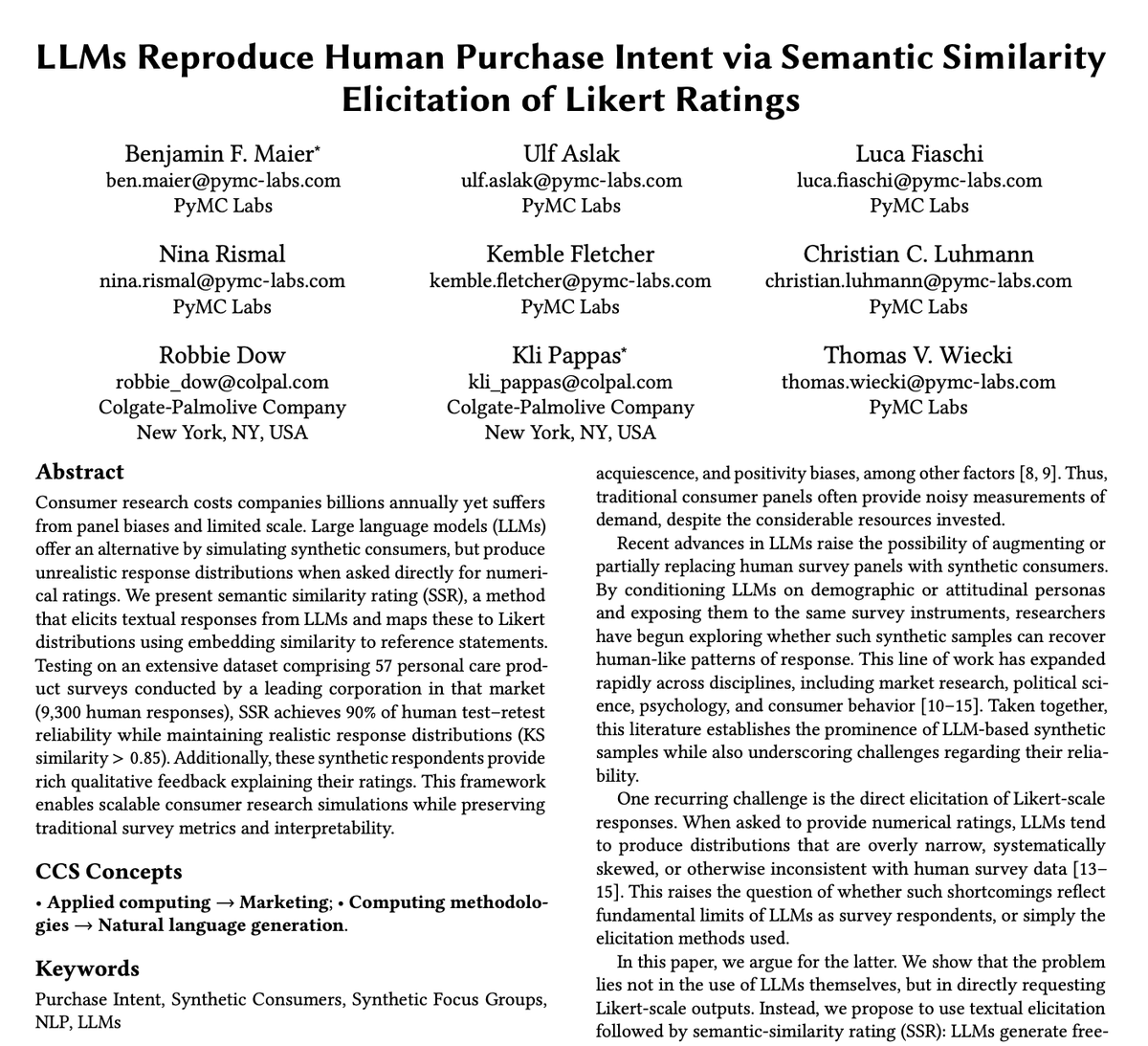
A toothpaste company has quietly killed the entire market research industry and nobody is talking about it.
Colgate published a paper showing you can predict real purchase intent at 90% accuracy by simply asking LLMs to roleplay customers.
And this is beyond insane.
If you ask an AI, "Rate this product from 1 to 5," it gives safe, middle-of-the-road garbage.
So researchers invented a method called Semantic Similarity Rating (SSR).
Instead of asking the AI for a number, they asked it to roleplay.
They gave the LLM a demographic profile. They showed it a product concept. And they asked it to write down its raw, unfiltered thoughts.
Then, they used a semantic model to translate those written thoughts into a numerical score.
The results are staggering.
Tested against 57 real corporate surveys and 9,300 actual human responses, the synthetic AI consumers matched real human buying behavior with 90% reliability.
They perfectly mirrored how different age brackets and income levels react to price changes.
And they provided detailed, qualitative feedback that was deeper and more critical than what actual humans wrote.
This destroys the economics of traditional market research.
You don't need to wait a month to see if a product will sell.
You can simulate 1,000 hyper-targeted customer interviews overnight.
You can A/B test pricing across every demographic instantly.
Community note
The 90% figure refers to the AI method achieving 90% of human test-retest reliability for purchase intent surveys, not 90% accuracy in predicting real purchases. It was tested on personal care products in categories LLMs know well. arxiv.org/abs/2510.08338
231
941
7,583
705,517
Josh Wulf retweeted

Jun 9
One of my personal favorite features announced at WWDC will I suspect be a sleeper hit: container machines, allowing your Mac to run a lightweight, persistent Linux environment with your home directory and repos automatically mounted: github.com/apple/container/b…
228
815
9,696
730,819
Josh Wulf retweeted

Jun 3
Every company’s AI workflow rn be like 😭💀
335
2,975
27,391
2,466,283
Josh Wulf retweeted
I start with very informal specifications written by hand. I have an agent convert these into harder specifications that are subdivided into tasks. I review these.
Then I feed those tasks into the specifier agent, which converts each task to Gherkin, prunes the Gherkin, and then hands it off to the coder agent. I spot check the Gherkin.
The coder agent writes acceptance tests directly from the Gherkin. Then writes unit tests. Then writes code. When all those tests pass, the coder agents hands off to the refactorer agent.
The refactorer agent reduces crap to 6 or below, and reduces any duplication. Then it write property tests and gets them to pass. Then it hands off to the architect agent.
The architect agent runs language mutation and covers any uncovered sections, and kills all survivors. Then it runs Gherkin mutation and kills any of those survivors. Then it runs the entire test suite, and when it passes it hands the result off to the specifier, coder, and refactorer.
I spot check the code.
This is an exercise of transformations from the informal to the formal through managed stages, with human interaction decreasing with each stage.
Raw computer power is the limiting factor. Those mutation tests are CPU intensive.
41
58
746
56,034
Josh Wulf retweeted

May 22
Be honest,
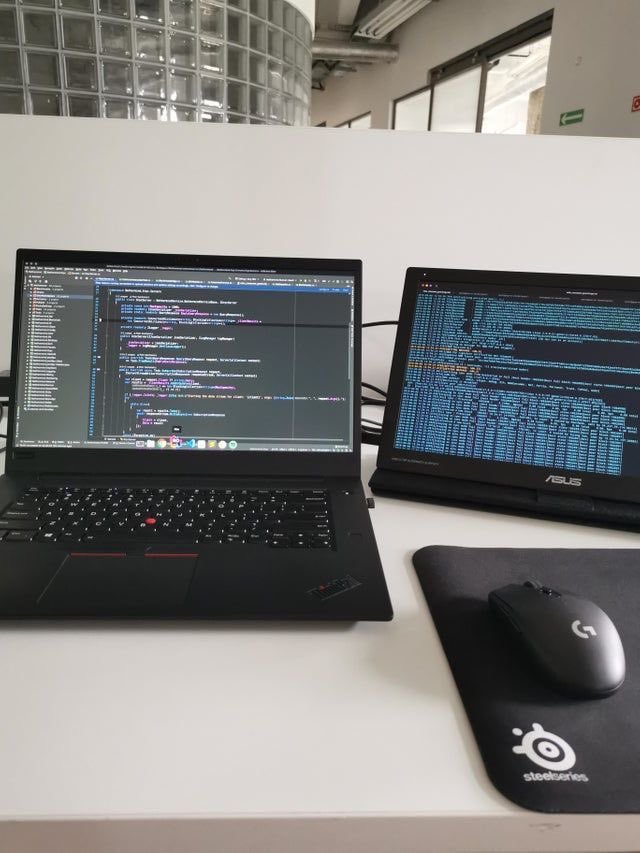
Why is every software engineer’s backup plan always farming?

1,071
669
9,001
1,244,604
Josh Wulf retweeted

May 18
Vibe coded my first project today!
Let me know what you guys think ❤️
637
1,951
39,606
2,189,353
Josh Wulf retweeted

May 15
Imagine spending years mastering Regex right before LLMs arrive
288
270
8,427
307,450
Josh Wulf retweeted

May 15
POV : USING CLAUDE OPUS 4.7 TO JUST RENAME A VARIABLE
150
1,251
21,499
806,174
Josh Wulf retweeted

May 13
the first three seconds to hook the viewer are everything, so make them count ✨
373
72
734
208,057
Josh Wulf retweeted

May 6
How it felt to be a software developer before ai.
83
287
3,719
329,845
Josh Wulf retweeted

May 3
Never underestimate how much time and effort you can waste by trying to automate a process you do not understand manually.
187
3,412
24,860
622,802
Josh Wulf retweeted

May 2
After coding 100% agentic for 6 months, my key observation is that software design is more important than ever.
47
79
1,091
50,366
Josh Wulf retweeted

Apr 26
USING Claude Opus 4.7 TO CENTER A DIV
349
2,284
28,643
1,867,671
Josh Wulf retweeted

Apr 25
does it do whatever camoufox does to avoid being fingerprinted? github.com/daijro/camoufox
1
9
2,127


Josh Wulf retweeted

Apr 21
Today, we’re open-sourcing the draft specification for DESIGN.md, so it can be used across any tool or platform. We’re also adding new capabilities.
DESIGN.md lets you easily export and import your design rules from project to project. Instead of guessing intent, agents know exactly what a color is for and can even validate their choices against WCAG accessibility rules.
Watch David East break down this shared visual language in action👇. New capabilities and links in 🧵
208
2,013
18,278
6,830,548


Josh Wulf retweeted

Apr 20
Assemblers were faster at writing binary than humans were.
Compilers were faster at writing assembly than humans were.
AIs are faster at writing compiled languages then humans are.
Deal with it. There's still plenty left for you to do.
150
335
3,164
120,373