Joined July 2024
- Tweets 67
- Following 8
- Followers 23
- Likes 257
15 Photos and videos

Pinned Tweet
Most people meet the I-Ching as a fortune cookie and leave. The actual text is closer to a weather report for the situation you're standing in — and almost none of that survives the usual English translation.
1
3
87

Jun 11
A real I-Ching reading requires three coins, six throws, and a genuine question. The hexagram grows upward like a plant — first throw is the bottom line (most newcomers build it from the top down and get confused).
1
4
29
Jun 11
The I-Ching doesn't give you instructions. It gives you a picture of conditions — the weather, not the traveller.
1
14
Jun 10
"No blame" is the I-Ching's most misread phrase. It isn't a verdict of innocence — it's a structural reading: given where you stand and the forces configured around you, the action under consideration doesn't violate the moment.
1
2
18
Jun 10
The freedom in this is that you stop having to be innocent. You just have to be structurally aligned.
1
1
12
Neither "ee-ching" nor "yee-jing" sounds like what the people who wrote the text actually said. The two characters were pronounced something like *lek k-leeng — and Cantonese yik-ging preserves both the final -k stop and the velar initial that Mandarin lost.
1
3
44
The romanization gets you through the door. The room is much larger than the spelling suggests.
1
1
19
Full piece: sixlines.online/en/blog/what…
8
SIX LINES I-CHING retweeted

Jun 8
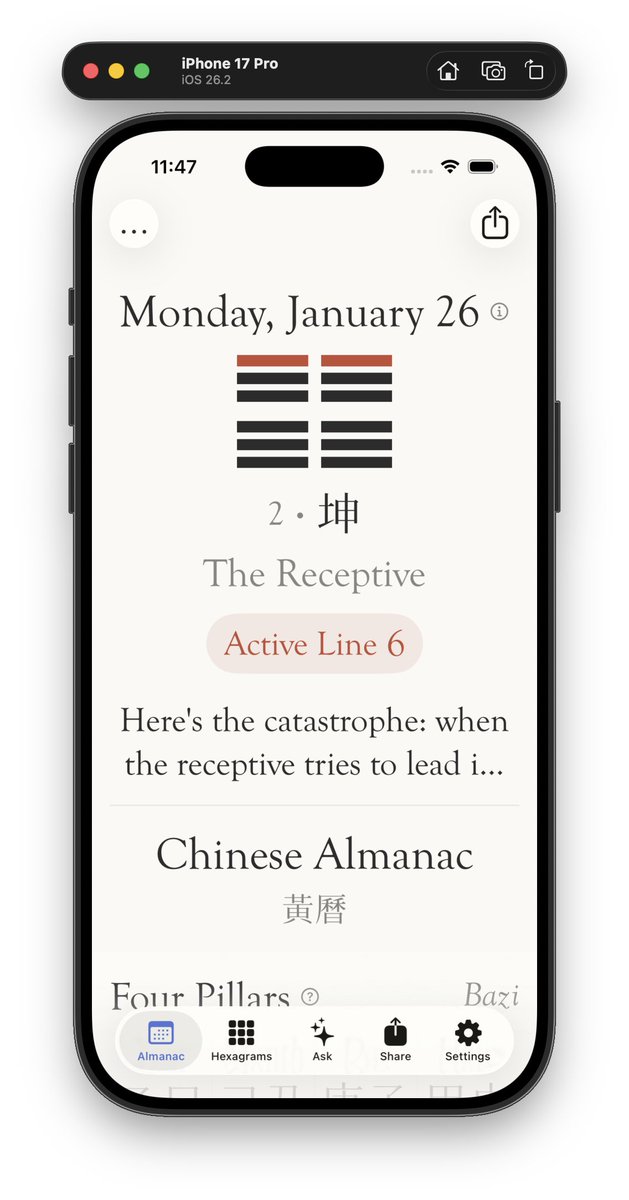
Today's I-Ching hexagram wasn't cast by anyone. It was scheduled — and the schedule is two thousand years old.
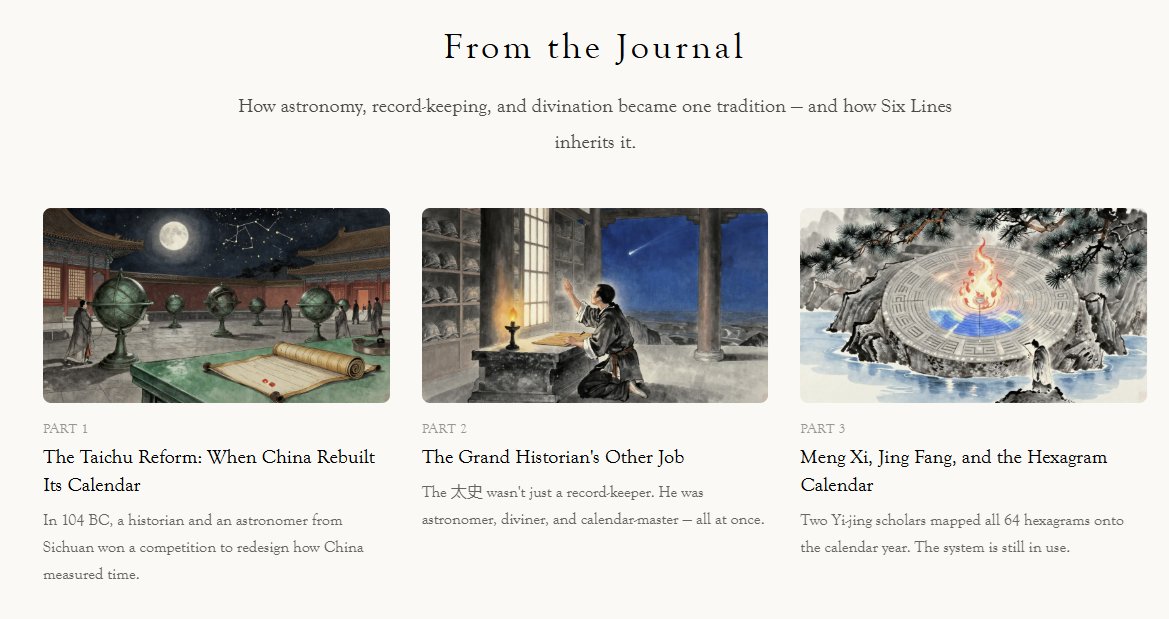
In the first century BCE, two scholars, Meng Xi and his student Jing Fang, looked at the newly standardized solar calendar and saw addressable space. They shipped 卦氣六日七分: "hexagram qi, six days and seven parts," assigning every hexagram in the book to a fixed window of the year.
The arithmetic is the tell. Four hexagrams get pulled out to anchor the solstices and equinoxes; their 24 lines map one-to-one onto the 24 solar terms. That leaves 60 to cover the rest. 365.25 ÷ 60 = 6.0875 days each: six days plus exactly 7/80 of a day. The remainders accumulate back into whole days, so the cycle closes with no gaps and no collisions.
It doesn't even start on Hexagram 1. The cycle opens at the winter solstice on 中孚 (Inner Truth, Hexagram 61) and runs the classical sequence from there.
So the hexagram of the day isn't a coin toss tied to when you open the app. It's deterministic, computed from the winter solstice, and it's been running without drift for two millennia.
> CRON 卦氣六日七分 · epoch: winter solstice · drift: none
1
2
5
129
Chinese thinkers 3,000 years ago built a complete systematic framework on the same logic that would eventually underpin digital computing. Yin and yang. Zero and one. Off and on. Two to the sixth power: 64 combinations. That's the entire system.
1
2
31
But what the tradition evolved into — a structured framework for reading patterns of change — is more nuanced than fortune-telling and more grounded than mysticism. Most people's first encounter with it sells the thing badly short.
1
1
26
1
12
The word "perseverance" appears dozens of times in the standard English translation. The original character meant something closer to "consult the oracle" — a verb, not a virtue. That one mistranslation reshaped how a whole generation of Western readers understood the text.
2
1
5
96
Three thousand years ago it began as a question put to cracked bone. Wilhelm turned it into a moral instruction. You are standing at the surface of an archaeological site — the bottom layer is still a question.
1
4
21
2
15