Better dead in Maa Kaali's bosom than to be living a lie as a meat robot.
Joined December 2021
- Tweets 17,990
- Following 82
- Followers 153
- Likes 10,423
3,874 Photos and videos




Pinned Tweet

3 Nov 2025
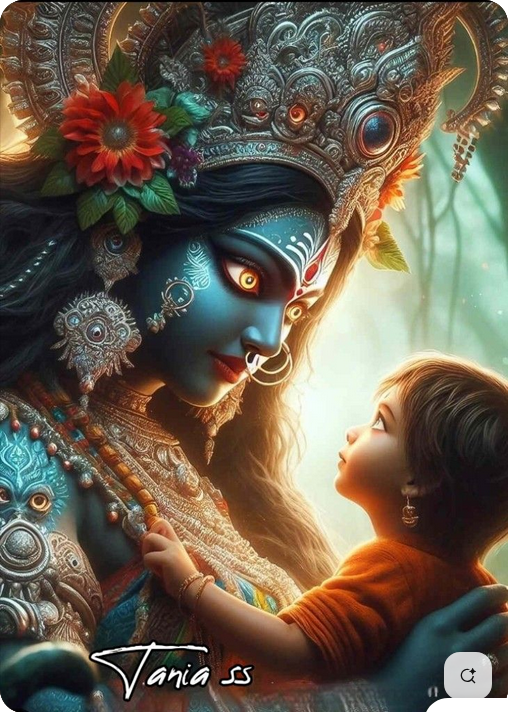
When Maa Kaali greets me
All I have
Is Who I have become
3 Nov 2025

There’s one simple sentence that most people will never understand.
It can change how you see everything you chase - money, woman, fame, status.
Will you be one of the few who truly gets it?
Be honorable.
1
2
13
1,849

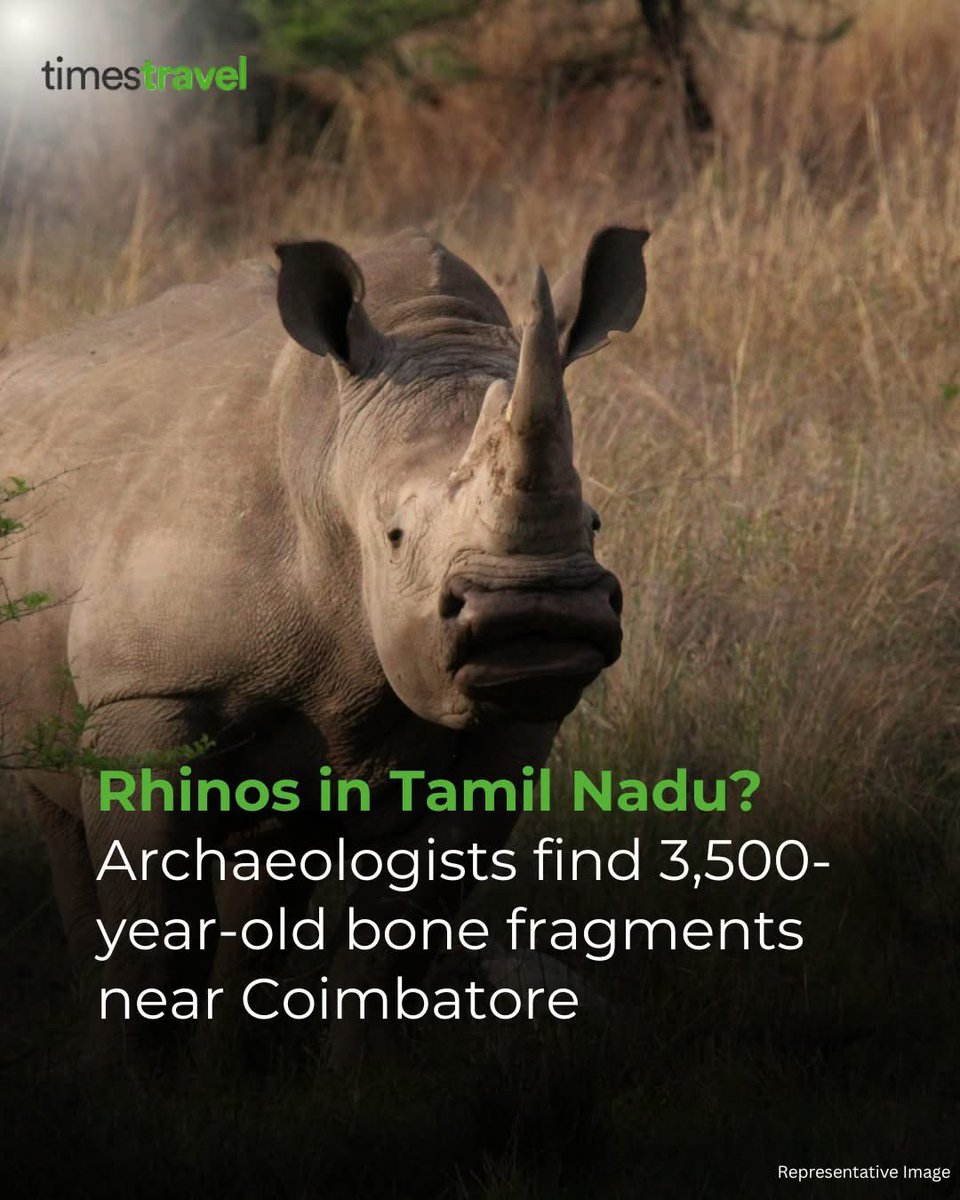
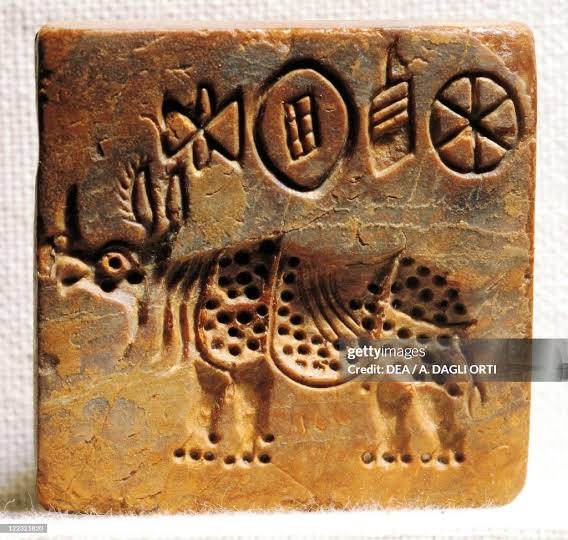
Archaeologists have unearthed Indian rhino bone fragments at a Neolithic site near Coimbatore, dating back 3,500 years, the third such discovery in South India. The finding reveals that long before they were confined to Assam’s grasslands, rhinos once roamed the Western Ghats.
toi.in/KZljJa71
4
51
191
4,234
Ex-Rifleman retweeted

15h
Let's go through the list.
video call: a Hong Kong finance worker was deepfaked into wiring $25 million to criminals. his CFO, his colleagues, all fake. all on the same call. he was the only real person in the meeting.
phone call: voice cloning now requires 3 seconds of audio. your boss has 3 seconds of audio on the internet. so does your mom. so do you.
email: AI writes more convincingly than most humans and already knows your company's internal language from LinkedIn, Glassdoor, and your own public posts.
text message: SIM swapping lets attackers receive your two-factor codes. 1,000 arrests last year. still happening daily.
caller ID: spoofed in seconds. free tools online.
biometrics: the same AI generating the deepfake can now generate a fake fingerprint pattern. researchers broke into fingerprint-locked phones with AI-generated prints in 2023.
your gut feeling: the entire point of a deepfake is that it passes your gut feeling.
so what's left.
the answer everyone agrees on: a pre-arranged code word with your team. something offline, personal, and never written down anywhere.
17h

If deepfakes can now fake your boss on a video call, what verification method do you actually trust anymore?
4
14
64
3,737
Ex-Rifleman retweeted

Faery Witchcraft isn’t about fantasy fairies. It’s a nature-based spiritual practice rooted in animism, folklore, and land-based traditions. Historically, fae are seen as powerful, liminal beings tied to place, not cute helpers or wish-granting spirits.
Modern Faery Witchcraft draws inspiration from Celtic and other European folk traditions, but it is largely a contemporary spiritual practice rather than a direct continuation of historical practices. Different traditions interpret fae, spirits, and ritual relationships in different ways.
In Irish, Scottish, Welsh, Cornish, and Anglo-Saxon traditions, fae are often portrayed as morally complex. They may bless, hinder, help, ignore, or harm depending on circumstance, respect, boundaries, and behavior. People generally did not worship or command them. Traditional folklore emphasizes coexistence, caution, and mutual respect.
It is important to remember that "fae" is a broad modern umbrella term. Irish Aos Sí, Scottish Sìth, Welsh Tylwyth Teg, Cornish beings such as Piskies and Buccas, and Anglo-Saxon elf traditions all have distinct histories, stories, and characteristics. There is no single universal fae tradition.
Different traditions understand these beings in different ways:
🟢 Irish (Aos Sí) - Often associated with ancient burial mounds, sacred places, and the Otherworld. Tradition frequently emphasizes respect, proper conduct, and avoiding actions that might cause offense. The Aos Sí are often portrayed as powerful beings with their own customs and concerns rather than objects of worship.
Examples include:
• The Daoine Sí (People of the Mounds), often associated with fairy hills and ancient sites.
• The Bean Sí (Banshee), a spirit whose wailing is traditionally connected with death or impending loss within certain families.
• The Leanan Sí, a figure associated with inspiration, beauty, and potentially dangerous relationships.
🔵 Scottish (Sìth) - Commonly linked to hills, glens, lochs, and liminal places. Scottish folklore often presents them as beautiful, powerful, and potentially dangerous. Stories frequently stress caution, respect, and the importance of observing traditional boundaries.
Examples include:
• The Daoine Sìth, powerful fairy folk associated with hills and the Otherworld.
• The Glaistig, a complex figure appearing in different forms, sometimes protective and sometimes dangerous.
• The Baobhan Sith, a supernatural being often portrayed in cautionary tales involving hunters and the wilderness.
🟣 Welsh (Tylwyth Teg) - Often described as radiant or enchanting beings connected to the landscape and the Otherworld. Folklore includes themes of glamour, time distortion, and the risks that can accompany encounters with the unseen.
Examples include:
• The Tylwyth Teg themselves, often portrayed as the "Fair Family" of Welsh folklore.
• The Gwyllion, spirits associated with lonely mountain paths and wild places.
• The Coblynau, mine spirits known for knocking sounds and warnings similar in some respects to Cornish Knockers.
🔴 English and Anglo-Saxon Elf Traditions - Historical elves differ significantly from the modern fantasy image. In folklore they could be associated with blessing, inspiration, illness, misfortune, or uncanny influence. They were often viewed as powerful beings whose actions did not necessarily align with human ideas of morality.
Examples include:
• Ælfe (elves), who appear in Anglo-Saxon sources as supernatural beings capable of both helping and harming humans.
• Mære spirits, associated with unsettling dreams and the origin of the word "nightmare."
• Later English folklore also includes beings such as Hobs and Brownies, household spirits that could assist with work when treated respectfully.
🟡 Cornish Traditions - Cornish folklore portrays many spirits as deeply connected to the land, coast, and mining heritage of Cornwall. Cornish fae are often described as ancient, touchy, and woven into the landscape itself, operating according to their own customs and expectations. Folklore emphasizes respect, reciprocity, and awareness of local customs when interacting with the unseen world.
Examples include:
• Piskies - Mischievous spirits who may confuse travelers or lead people astray.
• Knockers - Mine-dwelling spirits known for warning miners through knocking sounds, though they could also be feared.
• Buccas - Older spirits associated with the land and sea.
Faery Witchcraft is relational, not controlling. The core focus is building respectful relationships with the land, local spirits, and the places where you live. Your local environment often matters more than distant myths, aesthetic tools, or fantasy imagery.
A key principle is reciprocity. Offerings are not bribes, transactions, or payments. They are acts of respect and relationship-building. Traditional offerings may include milk, bread, honey, clean water, song, or caring for the land itself. Give without expectation of reward.
Reciprocity extends beyond offerings. Caring for local ecosystems, respecting wildlife, reducing harm, and learning the history and needs of a place are often considered meaningful ways of honoring the spirits of the land.
Consent and boundaries are essential. Traditional lore frequently warns against casually calling, summoning, or inviting unknown spirits. Clear boundaries are generally viewed as respectful rather than offensive.
Grounding is non-negotiable. Stay connected to your body, daily responsibilities, relationships, and mental health. Cleansing, rest, self-reflection, and healthy skepticism help prevent projection and imbalance. Not every unusual experience is spiritual, and that is perfectly okay.
Discernment is an important skill. Dreams, intuition, imagination, psychological processes, natural events, and spiritual experiences can overlap. Traditional folklore often encourages caution and thoughtful interpretation rather than immediately assuming supernatural causes.
Many traditions emphasize treating such beings with respect. Certain regional stories suggest that directly saying "thank you" to some fae beings may be considered inappropriate or may disrupt the nature of the exchange, though beliefs and customs vary by region and tradition.
For beginners: start with observation rather than invocation. Spend time in nature without ritual intent. Learn local history and folklore. Pay attention to seasonal changes. Keep a journal. Faery Witchcraft is generally viewed as a slow-developing practice, and rushing is often discouraged.
For practitioners: prioritize consistency over intensity. Maintain regular offerings if they are part of your practice, uphold clear boundaries, and remain grounded in daily life. Re-evaluate experiences critically and avoid over-identifying with spirit contact. Long-term relationship-building is often considered more important than dramatic encounters.
Some practitioners also cultivate relationships with ancestors, household spirits, or spirits of place, viewing these connections as interconnected parts of a living spiritual landscape.
This path is not exclusively love-and-light. Historical folklore frequently portrays fae beings as unpredictable, dangerous, indifferent, or bound by their own values rather than human morality. Respect, humility, realism, and discernment matter more than aesthetics or belief alone.
Modern popular culture often romanticizes or softens fae traditions. Historical folklore tends to present a far more complex picture, where beauty and danger, generosity and risk, can exist side by side.
You do not need to practice Faery Witchcraft to understand its value. At its heart, it reflects an ecological and relational worldview: one that sees land as alive, interconnected, and deserving of respect. It offers insight into how many pre-industrial cultures understood nature, community, responsibility, and the uncertainties of living alongside forces beyond human control.
24 Jul 2022

4) Faery Witch - Also known as a Fae witch connect with faeries at the most basic level. Faery witches love nature spirits, woodland creatures, trees, & the Fae. They invite all of these elements into their practice.
3
6
24
841
Ex-Rifleman retweeted
The Divine Feminine illuminates possibility.
The Divine Masculine gives it form.
One expands awareness; the other anchors it into reality.
Wisdom is found where light meets structure.

1
4
11
229
Ex-Rifleman retweeted

14h
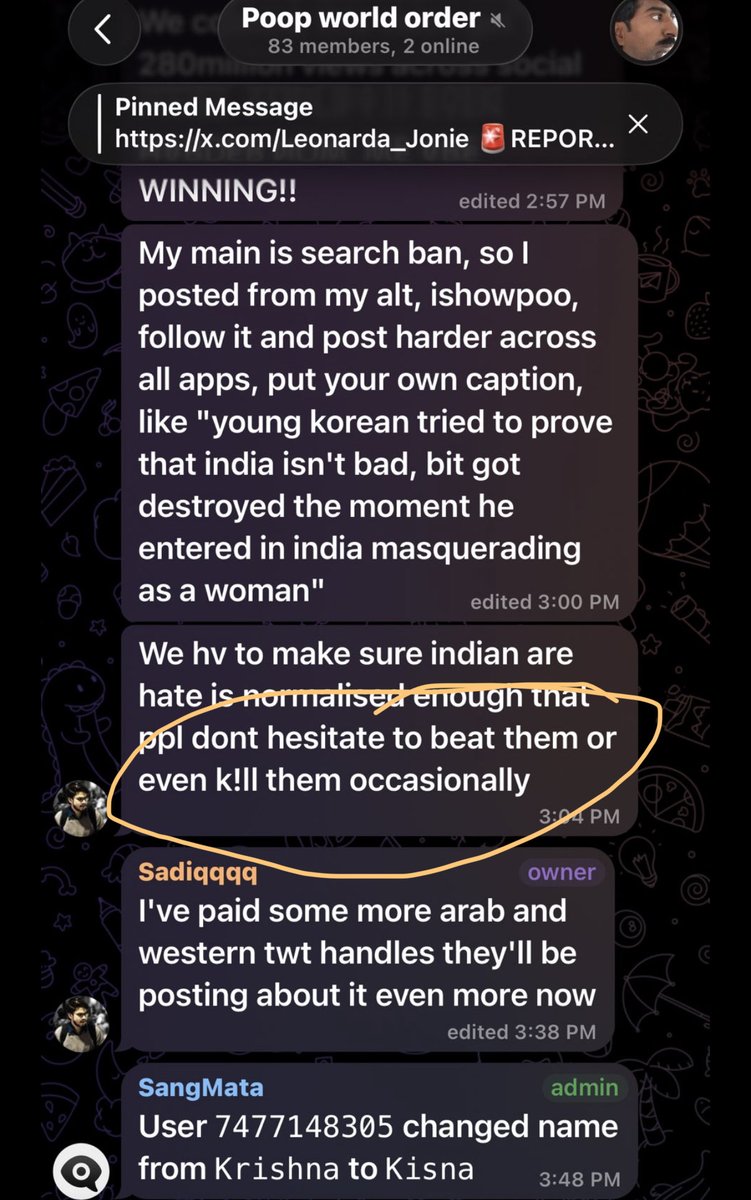
violent attacks against Indian origin people across globe are being planned and instigated on your app. this is a violation of Telegram policy- you need to act on it because this is dangerous. @durov
2
12
99
1,102
Ex-Rifleman retweeted
Back in 2020-21, I pulled back the curtain on the grand illusion: 90% of China remains structurally downtrodden, while a select few hyper-developed cities serve as a brilliant window display, entirely funded by Rothschild wealth after Mao sold out the nation's sovereign architecture. The global elite knew it then, and they are terrified of what comes next.
The multi-decade deception is reaching its expiration date. For years, I have been tracking and calling out the manufactured illusions regarding China’s demographic data. The coming decades will not be defined by the rise of a fake superpower, but by the devastating exposure of their actual, missing population. The ledger always balances eventually.
4
7
23
497
Ex-Rifleman retweeted
Why Shadow Work is NOT a detour from Spirituality, it's part of the journey
The term "shadow work" often sparks resistance in spiritual and astrology communities.
Some dismiss it as New Age psychology. Others view it as unnecessary self-analysis that distracts from genuine spiritual practice. A few even see it as incompatible with the pursuit of moksha.
I understand those concerns.
But I believe much of the disagreement comes from the language being used, not the underlying process. The term "shadow work" may be modern, but the principle behind it is ancient. We are simply using Western psychological vocabulary to describe a timeless internal restructuring.
⚫️ What Is Shadow Work?
Shadow work is the practice of becoming conscious of the parts of ourselves that we have repressed, denied, rejected, or hidden from awareness.
These may include:
Fears
Resentments
Insecurities
Unhealthy desires
Emotional wounds
Limiting beliefs
Unconscious behavioral patterns
The goal is not self-condemnation. The goal is awareness.
Many people assume shadow work means dwelling on trauma or becoming obsessed with personal flaws. In reality, it is about bringing unconscious patterns into consciousness so they no longer control our lives from behind the scenes.
What remains unconscious often expresses itself indirectly through projection, compulsive behavior, repeated karmic patterns, and unnecessary suffering.
Awareness creates choice. Unconsciousness creates compulsion.
⚪️ The Shadow and Avidya
One of the reasons I find shadow work valuable is because it parallels something spiritual traditions have discussed for centuries: ignorance.
In Vedanta, bondage is sustained by avidya, ignorance of our true nature. We mistake the temporary for the eternal. We mistake the ego for the Self. We mistake our conditioning for who we truly are.
Shadow work does not remove avidya entirely, but it can expose aspects of it. When we examine our fears, attachments, projections, and unconscious habits, we begin to see how much of our behavior is driven by conditioning rather than conscious awareness.
This is not liberation itself. But it can help prepare the mind for deeper spiritual insight.
To see how modern psychological concepts seamlessly anchor into traditional lineage, we can dissect the mechanics of the mind using their exact spiritual equivalents:
- The Shadow (Avidya/Malas): The structural ignorance and foundational impurities that veil the Self, actively obscuring your true nature from conscious awareness.
- Shadow Work (Chitta Shuddhi): The rigorous, deliberate purification of the mental mirror, clearing away accumulated debris so reality can be perceived without distortion.
- Unconscious Patterns (Vasanas/Samskaras): Deeply ingrained latent tendencies and hidden psychological conditioning that run in the background, driving compulsive, repetitive karmic loops.
- Integration (Tapas): The alchemical heat of disciplined self-honesty that refuses to look away, systematically burning through illusions to build unshakeable inner alignment.
🔵 Projection: Seeing Ourselves in Others
One of the most important insights from modern psychology is the concept of projection.
We often criticize in others what we cannot accept in ourselves. We may condemn qualities we secretly possess. We may idealize qualities we have not yet developed. In both cases, perception becomes distorted.
This matters spiritually because clear perception is essential for growth. When we are constantly projecting our unresolved material onto other people, we are not seeing reality clearly. We are seeing our own unconscious mind reflected back at us.
Shadow work helps us reclaim those projections and take responsibility for what belongs to us.
🟣 Spirituality Is Not the Same as Positivity
One misconception I often encounter is the idea that spiritual growth should feel uplifting, peaceful, and comfortable at all times. But genuine transformation is rarely that simple.
The Bhagavad Gita begins with a crisis. Arjuna is overwhelmed by grief, confusion, attachment, fear, and moral uncertainty. His journey does not begin with certainty. It begins with confrontation.
Many spiritual traditions emphasize self-examination because growth requires honesty.
~ We cannot transcend what we refuse to acknowledge.
~ We cannot heal what we pretend is not there.
~ And we cannot move beyond patterns we are unwilling to see.
🟡 Suppression Is Not Transcendence
One of the greatest misunderstandings in spirituality is the belief that suppression equals mastery. It does not.
A desire that is merely buried has not been dissolved. Anger that is denied has not been transformed. Fear that is hidden has not been overcome. What is unconscious continues to influence us until it is brought into awareness.
This does not mean acting on every impulse. It means acknowledging what exists.
There is a profound difference between integration and indulgence. Integration means recognizing what is present without being controlled by it. Indulgence means becoming identified with it.
The goal is awareness, not permission.
🔴 The Astrological Perspective
Astrology has always contained a shadow dimension. A birth chart is not simply a map of strengths and blessings. It also reveals areas of struggle, avoidance, attachment, and karmic development.
• Saturn often exposes lessons we would rather avoid.
• Rahu can reveal desires that drive unconscious behavior.
• Ketu can dissolve identities we have become attached to.
• The 8th house points toward hidden material, transformation, and psychological depth.
• The 12th house speaks to release, surrender, and liberation.
In this sense, astrology is not merely predictive. It can also be a tool for self-awareness. The chart does not just show us who we are. It can reveal what we are unwilling to see.
🟢 Why Some People Resist Shadow Work
Shadow work can feel threatening because it challenges the image we have of ourselves. It disrupts spiritual ego. It questions purity narratives. It asks us to examine the gap between how we wish to be seen and what is actually happening within us.
This is uncomfortable. But discomfort is not always a sign that something is wrong. Sometimes it is a sign that something important is being revealed.
Growth often begins where certainty ends.
🟠 Shadow Work and Moksha
To be clear, I am not claiming that shadow work and moksha are the same thing. Moksha is liberation. Shadow work is a practice of self-confrontation and self-awareness.
However, I do believe that honest examination of our conditioning can support the spiritual path.
Before freedom, there must be seeing. Before release, recognition. True transcendence is not an escape from our conditioning, it is the absolute willingness to look it in the eyes.
The shadow is not the destination. But refusing to face it can become an obstacle on the journey. If spirituality is ultimately a movement toward truth, then that movement must include a willingness to encounter the truths we find uncomfortable.
Not just the light. The whole of ourselves.
Only then can genuine transformation begin.
2
8
22
626
Ex-Rifleman retweeted

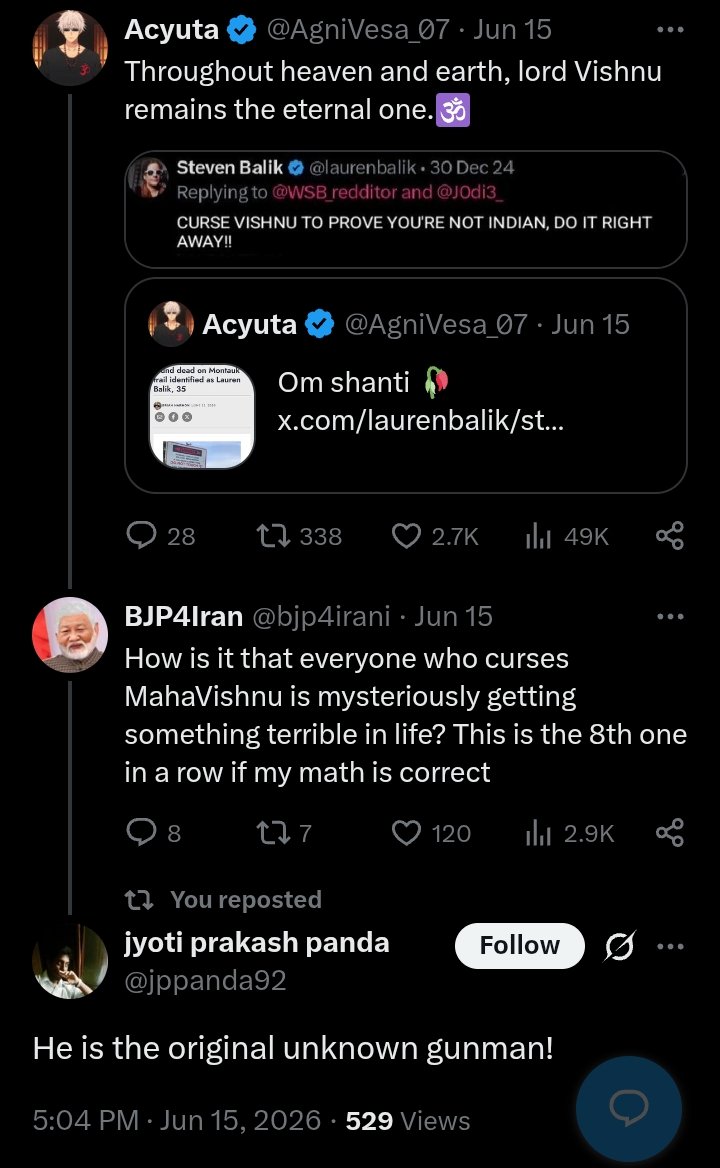
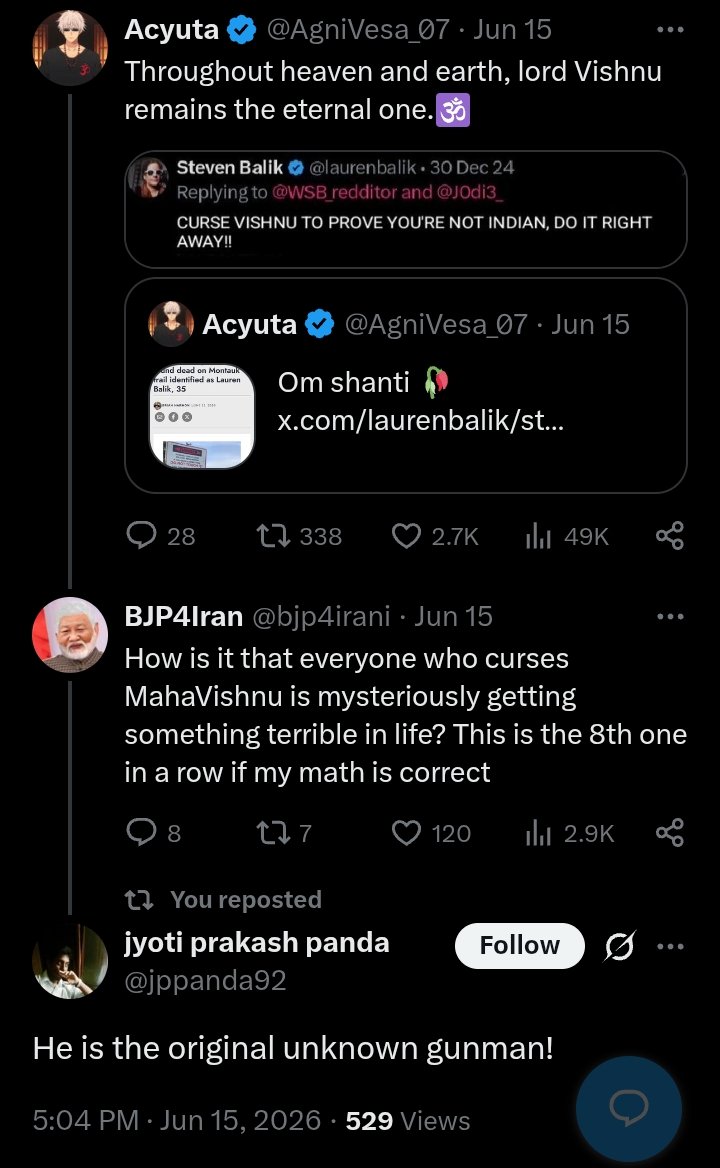
He is the original unknown gunman!
1
3
14
541
Ex-Rifleman retweeted

Jun 15
A quote from the Gita I love to post when never someone who abuses Vishnu kicks the bucket
“Blinded by egotism, strength, arrogance, desire, and anger, the demonic abuse Me, who am present in their own body and in the bodies of others.
Those who are envious and mischievous, who are the lowest among men, I cast them repeatedly into the wombs of demoniac species in this material world.”
Karma is a patient executioner.
3
31
1,228
And another corrupted file got "perm4banned IRL" by the current Universe's System Administrator.


14
Ex-Rifleman retweeted

Jun 16
WE KEEP WINNING FOLKS!! 😭😭❤️
Remember, this Anti hindu, Anti India group?
Yes, you heard it right, this is a thing of past now.
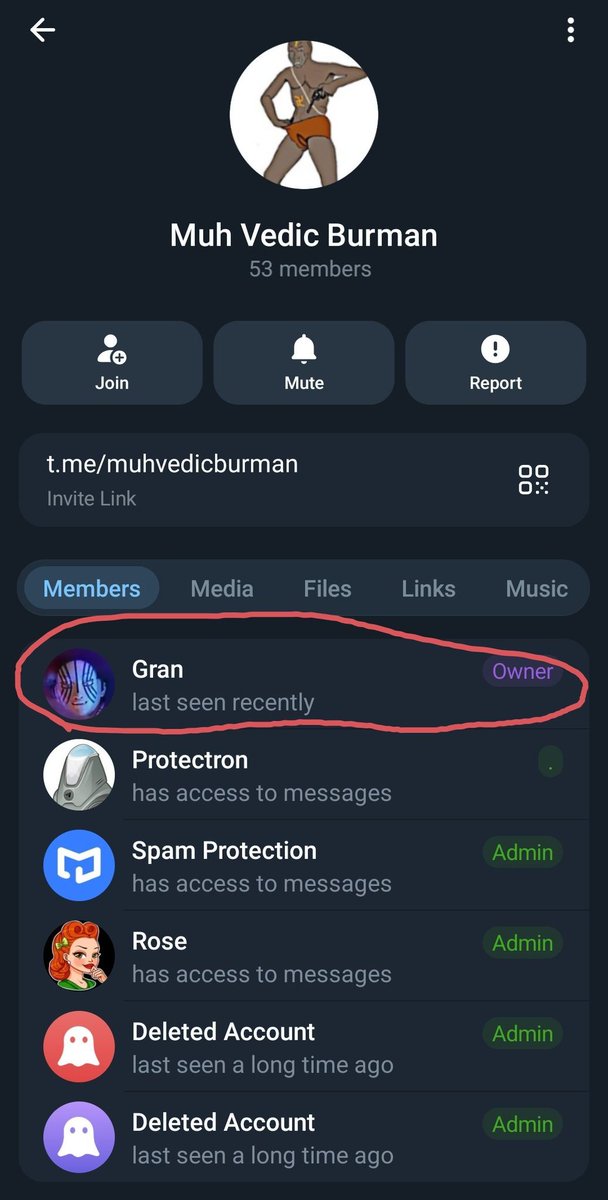
And thats not it, priyanshu gabhjiye panicked hard and deleted, 4 discord, and 3 telegram groups.
His 18 admins deleted their account and ran away.
And tell you we did all this without the support of local police administration and cyber cell.
Anyways,
BRICK BY BRICK, WE'LL DISMANTLE THIS RABID ANTI HINDU, ANTI INDIA ECOSYSTEM W/0 GOVT SUPPORT.
JAI HIND. 🇮🇳

Jun 11
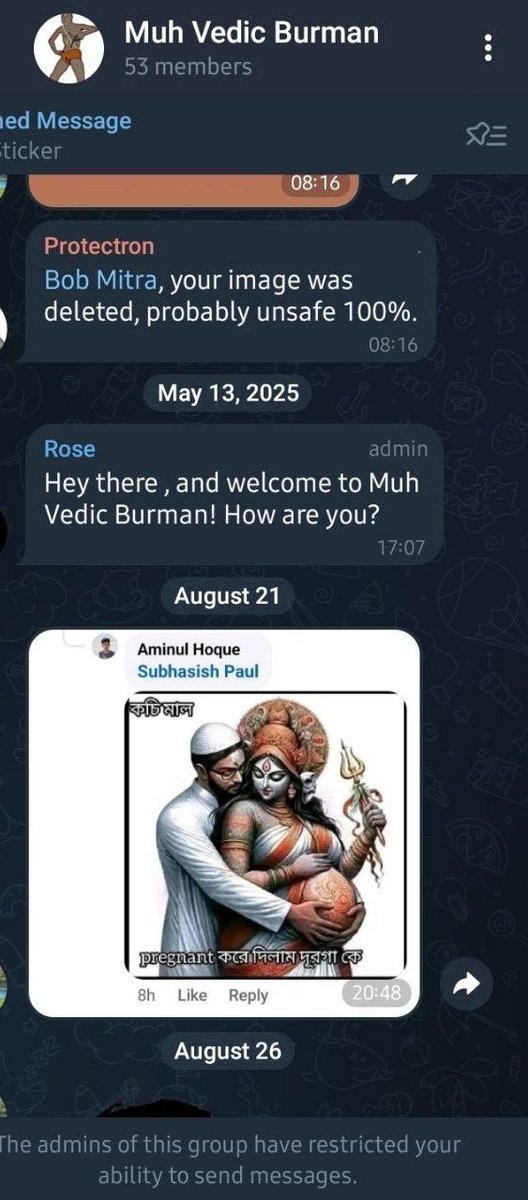
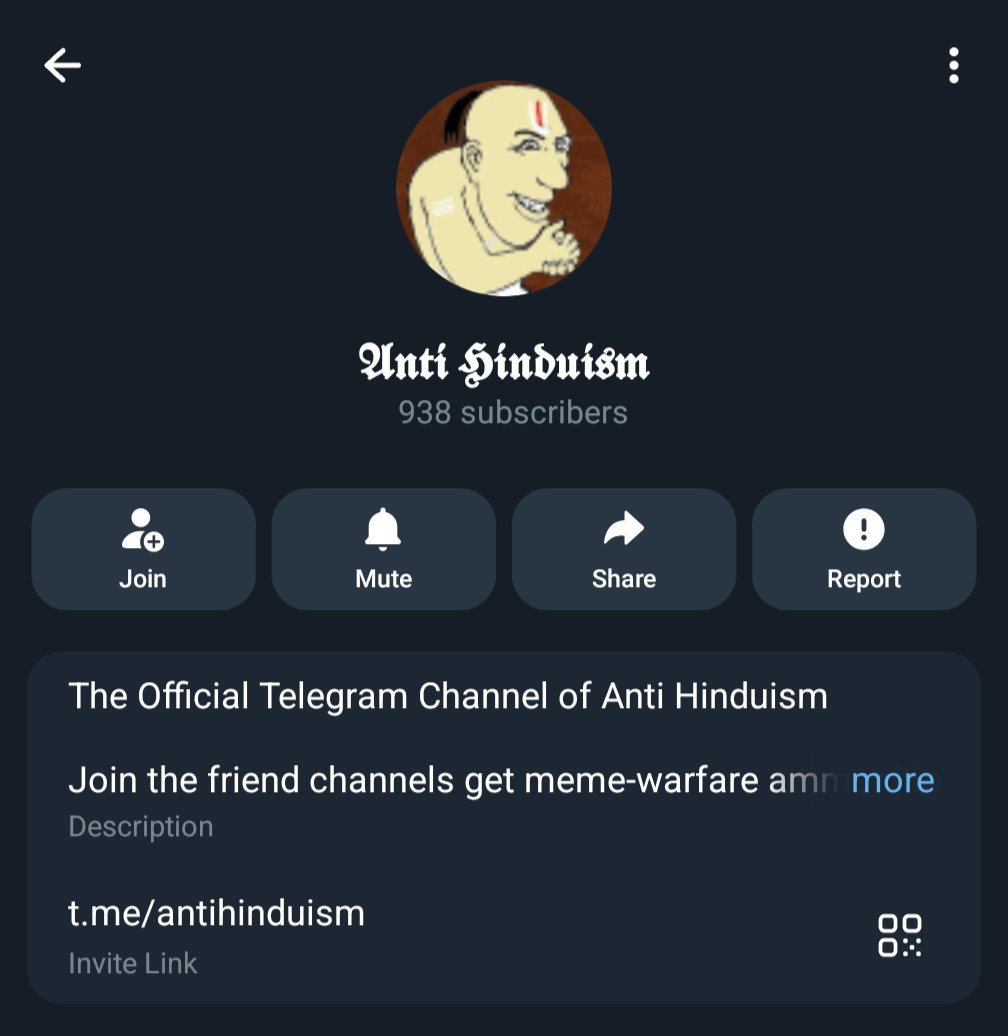
Meet priyanshu umaji ghajbhiye, living in maharashtra, nagpur, runs multiple, anti india, anti hindu groups in telegram, where he morphes photos & videos of hindu gods in the most heinious way possible.
His meme templates are also circulated all over social media to show hindus in bad light
And not only, he commits blashemy,
But, he's also a repeat offender.
Here's everything you need to know about him. 🧵
@NagpurPolice

185
1,558
7,589
118,964

Ex-Rifleman retweeted

Jun 15
With Indian IT being the topic of the week, I thought it was only fair to trace the origins of the food that has probably powered more code, daily standups & production fixes than anything else: the dosa.
The history of the Dosa is a fascinating journey through time. What we eat today as a golden, paper-thin crepe was originally an ancient, rugged, protein-heavy pancake that relied completely on the structural biochemistry of an "aristocratic bean." The historical timeline highlights how the different regional iterations: Dosai, Thosai, Adai & Dosaka evolved over 2 millennia across South India.
The earliest references to Dosai (often spelled thosai/tocai) emerge from ancient Tamil Sangam literature. In this era, it was far from a delicate breakfast item. There were no flat iron tawas. Ancient Tamils cooked the batter on heavy, porous earthen clay platters/flat stones over open wood fires. Because clay plates retain uneven heat, spreading a batter thin was physically impossible.
Interestingly, the official status of the dosai was a non-fermented/minimally fermented pan-bread. It relied completely on the stickiness of the beans to bind the coarse grain together. It was dense, thick & highly filling, designed to sustain farmers & soldiers.
Running parallel to the early dosai was the Adai. Mentioned in the classic Sangam poem Madurai Kaanji, street vendors in the ancient city of Madurai sold these thick, griddled cakes to evening crowds. Unlike the dosai, which eventually streamlined into a rice & urad dal pair, the Adai retained its primitive, hyper-nutritious form. It used a combination of whatever lentils were on hand, pounded coarsely with red chilies & curry leaves & skipped fermentation entirely to provide immediate, heavy-duty protein release.
When the dish migrated into the royal Sanskrit texts of the Deccan region, it underwent a luxury upgrade. King Someshvara III compiled the Manasollasa, where he officially recorded the recipe for Dosaka:
Finely split, dehusked black gram (Masha) stone-ground into a velvety paste Seasoned with asafoetida (hing), cumin, salt, and ginger juice Cooked on a hot iron pan, then drenched in whole milk, ghee, & saffron.
The Dosaka was essentially a pure black gram cake. The royal chefs realized that if you whip urad dal paste vigorously, its proteins trap air bubbles naturally, giving you a soft, plush, cloud-like texture w/o needing an overnight rise.
If the ancient dosai & dosaka were thick, soft & spongy, how did we get the paper-crisp restaurant dosa? That change is a masterclass in food chemistry, pioneered by the cooks of Udupi, Karnataka, in the late 19th & early 20th centuries.
To achieve maximum crispiness, Udupi cooks radically flipped the grain math. They slashed the % of urad dal & spiked the batter with polished white rice & a handful of poha (flattened rice)/methi (fenugreek) seeds. When this rice-heavy, long-fermented batter hits a blazing hot, oiled iron tawa, the water vaporizes instantly. The starches in the rice undergo gelatinization & subsequent dehydration, locking into a rigid, brittle, wafer-thin matrix.
To summarize, the word dosa is not a modern invention, it describes a 2000 yr old evolutionary branch of South Indian culinary science. It started as a thick, sustaining bean-bread cooked on clay pots, transformed into a decadent, milk-infused delicacy for Chalukyan kings & was eventually re-engineered with high-starch physics by Udupi chefs to become the thin, golden, globally recognized icon it is today.

14
118
387
13,685
Ex-Rifleman retweeted

Jun 15
The world is going through a spiritual sorting. The false performances and illusions are ending. If you feel overwhelmed, disgusted, or unable to keep participating in the deception of this world, take that as a sign to retreat inward. Cultivate silence, listen to your higher guidance, and do not get pulled into the outer chaos.
Lisa Renee pointed out and here is a direct quote -
“For those of us that have been on the front lines of the spiritual warfare as the consequence of personal incarnation agreements to be of service to the reclamation of Christos Mission for securing planetary ascension and human liberation, the time has come to take distance from the whip of the demon’s tail sowing mass confusion through the enemy’s violent weaponization of the truth resonance.”
I know what I need to do - as things heighten, get worse and then phase out (wherever that may end up for them)
The plants and Disclosure headliners are taking people down a very dangerous path. Many won’t see it and just keep falling for their tricks and disinformation campaigns and false narratives.
26
51
380
8,075
Ex-Rifleman retweeted
6
12
210
Ex-Rifleman retweeted

Jun 14
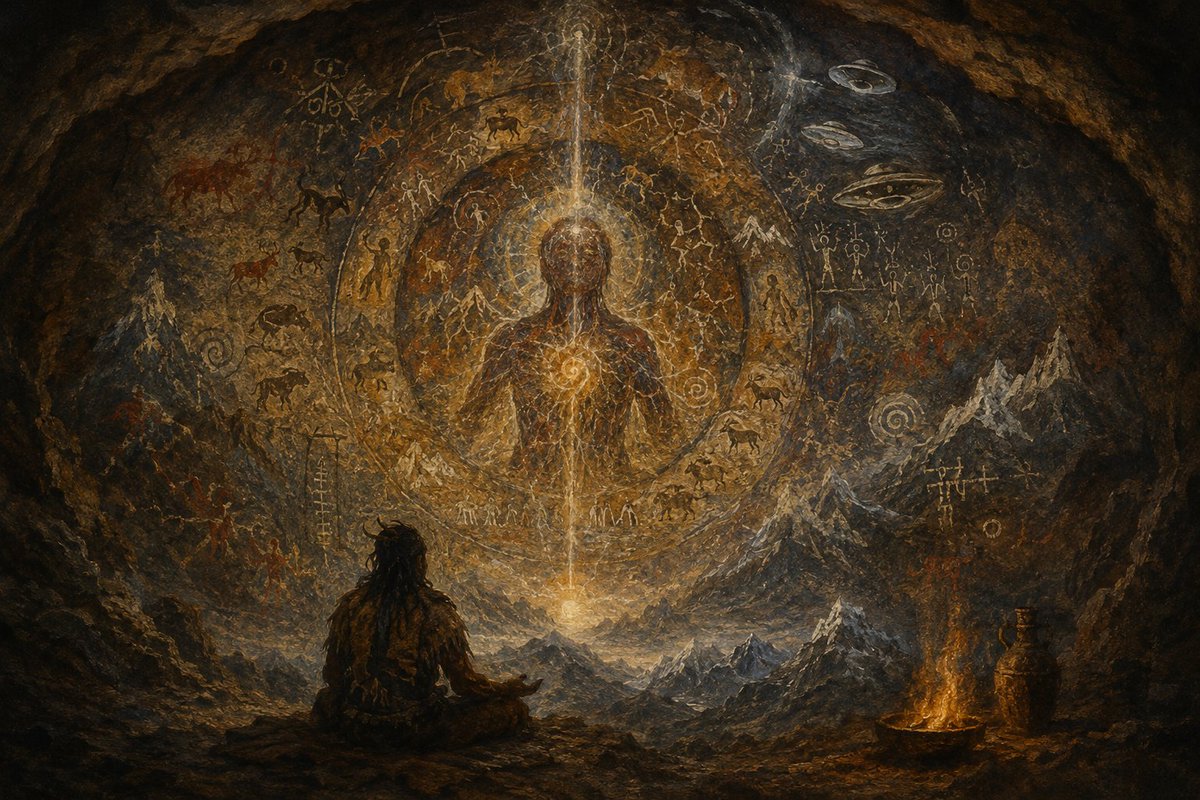
The next trillionaire will not fly stainless steel appliances atop controlled explosions, but instead will solve the problem of consciousness, intent, and the entailed eschatological critical path.
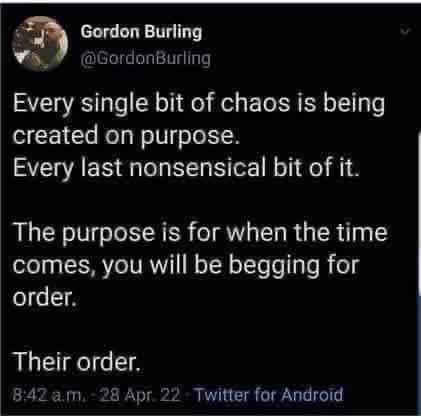
If consciousness is merely a local biochemical epiphenomenon, then intent is largely constrained by material substrate, entropy, distance, chemistry, physics, loosh, and mortality.
Identity frames as a temporary pattern retention inside a decaying biological bound. Civilization therefore optimizes around energy extraction, computation, transportation, and scarcity management. Destined to suffer endlessly inside its Kardashev scale fantasy.
But if consciousness proves to be nonlocal then the entire technological hierarchy inverts.
The critical question ceases to be:
“How do we move matter through space?”
and instead becomes:
“How is intelligence instantiated, preserved, transferred, and expressed onto the material itself? How does intent alter reality?”
Under such a framework:
death becomes a trivial status, memory becomes substrate-independent, consciousness becomes the topology rather than a possession, and civilization shifts from industrial mechanics toward ontological engineering.
At that threshold, propulsion systems, currencies, and even conventional economics begin to resemble transitional technologies — artifacts of a civilization still trapped inside material scarcity assumptions.
Once consciousness and intent are understood as potentially fundamental rather than derivative, whether other agencies exist — or have been here all along — along with the very function of derivative currencies, becomes almost trivial. A fleeting memory of one's comical adolescent exploits.
77
78
581
26,531
Ex-Rifleman retweeted

Our ancestors were tending fire perhaps 1.8 million years ago, and our own kind has walked this planet for some 300,000.
Against all that, writing is barely 5,000 years old, so everything we call recorded history is a thin sliver at the very end of the human story.
🔹300,000 years old
🔹Fire from over a million years ago
🔹Barely 5,000 years of written record
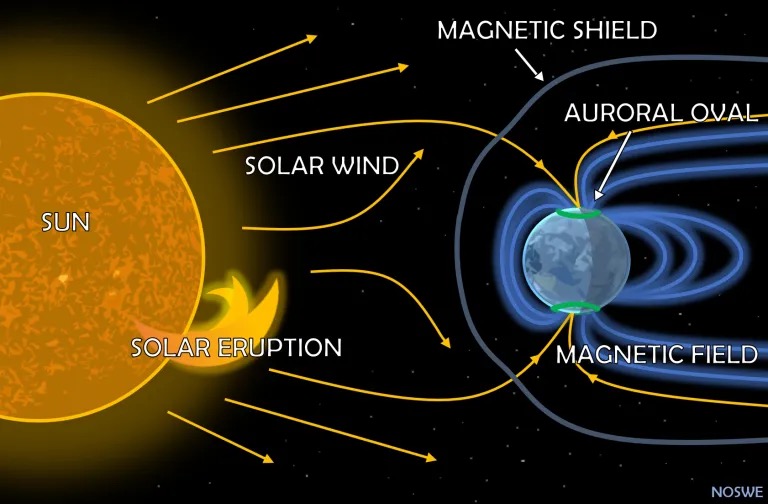
🔹Solar storms past anything we have ever seen
🔹A magnetic field that has all but collapsed before
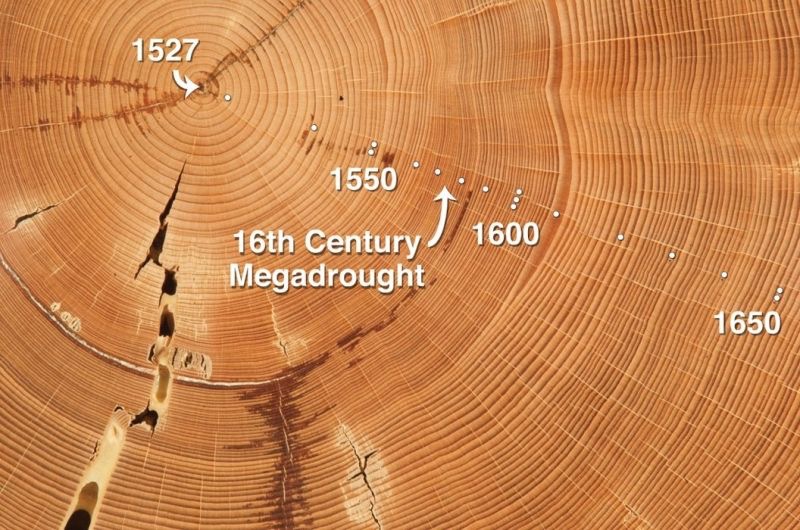
One solar storm left its mark in tree rings worldwide, around 10 times stronger than the worst we have ever recorded, and nobody alive has seen its like.
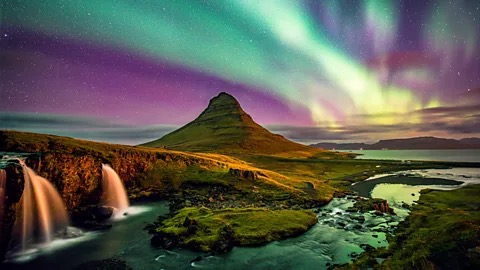
These are not one-offs, because the same tree rings and ice record storm after storm, and once the planet's magnetic shield nearly failed and the auroras spilled toward the equator.
People were here for the worst of it, watching skies catch fire, the ground convulse, the air turn strange, with no instruments and no idea what any of it was.
Some of those people surely came to understand what they were living through, and every scrap of that understanding is gone.
Not the first to fear the sky, only the first to write it down.
So how much did they once know about this planet that we have had to learn all over again?

3
9
76
1,797
Ex-Rifleman retweeted

The EV ruined Porsche, so they had to switch gears to save the company.
Those vehicles are status symbols, that only have value when there's engineering in it that no one else can have. An 18 cylinder triple turbo, is a giant extension of a man's penis that will sell. 🤔
Jun 14

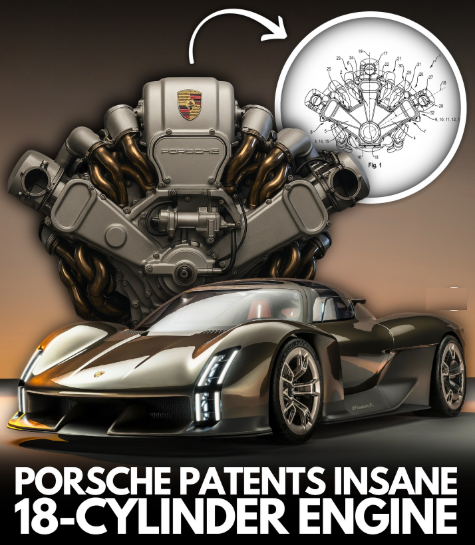
Porsche has shocked the automotive world by patenting an 18-cylinder internal combustion engine—a monstrous engineering concept unlike anything seen in modern cars.
At a time when most automakers are shifting to electric vehicles, Porsche is proving that mechanical power still has a future.
This engine is rumored to deliver unheard levels of torque and horsepower, making it suitable not just for hypercars, but also aerospace and high-performance racing. The patent drawings show a compact radial layout designed to reduce vibration and perfect fuel-air balance even at extreme RPMs.
1
2
5
335
Ex-Rifleman retweeted
Dear all,
While I deeply value the connections I've made here, I've noticed a growing number of messages asking for help, advice or insight outside of the context of a formal session. As much as I care, responding to every request-no matter how small-requires energy, time and presence that I simply cannot continue giving freely and sustainably.
I consistently share a wealth of free content across my platforms, offered from the heart and with the hope that it serves and supports you.
However, ongoing one-on-one guidance or support outside of an energy exchange is not only unfair to the work I do, but also creates karmic imbalances that I prefer to avoid.
If you’re seeking my insight, healing work or personal advice, please reach out only when you're ready to book a session. This ensures that our exchange remains clear, balanced & rooted in mutual respect.
With gratitude for your understanding,
Saanya 🙏🏽
6
22
247
Ex-Rifleman retweeted
The 1983 CIA evaluation of the Gateway Experience document explicitly reveals an unsettling baseline reality: The brain, and by extension the entire human body, is nothing more than a highly sophisticated liquid crystal transducer.
We are, quite literally, organic batteries.
The ultimate takeaway from these declassified projects is the staggering depth of what the masses don’t know about consciousness, kinetic energy, and our true cosmological nature. When you cross-examine this holographic biochemical model with the advanced metaphysical architecture of the "Loosh Harvest," the reason for human confinement becomes perfectly, chillingly logical.
A liquid crystal is not a passive material; it is an operational antenna. It responds instantly to ambient electrical charges, electromagnetic shifts, magnetic field fluctuations, and emotional stress by organizing its structural geometry to transmit, refract, or block light and energy.
Because our nervous system and cellular frameworks operate exactly like this liquid crystal matrix, human beings are uniquely designed to receive, transform, and emit incredibly precise frequencies of raw energy.
In the broader cosmic architecture, this means the human vehicle is the ultimate organic generator. We do not just experience emotions; we broadcast them as highly concentrated energetic fields.
Robert Monroe, the pioneer of out-of-body exploration whose research deeply informed the intelligence community's secret consciousness programs. He termed this unique energetic byproduct Loosh, a highly refined, scarce, and potent form of multidimensional energy generated exclusively by carbon-based lifeforms under severe pressure.
In this cosmic ecosystem, our material reality functions less like a home and more like a carefully maintained refinery. The energy must be systematically polarized to become usable. Raw, peaceful, or static consciousness emits very little operational friction. Therefore, the system relies on intense emotional charges to distill the fuel.
• Low-Vibrational Loosh (Mass-Produced): Triggered by terror, panic, systemic rage, physical agony, betrayal, and acute existential anxiety. It is easily harvested via automated geopolitical stress, global media cycles, and engineered economic scarcity.
• High-Vibrational Loosh (Rare & Refined): Triggered by profound spiritual awe, absolute self-sacrifice, creative ecstasy, and unconditioned devotion. It is intensely potent, requiring immense evolutionary pressure and individual awakening to unlock.
"Harnessing" of humanity is achieved by trapping a boundless, multi-dimensional consciousness inside a dense, high-friction, fragile liquid crystal physical envelope. By placing this liquid crystal antenna within a simulation dominated by linear time, physical scarcity, and biological mortality, a perpetual state of energetic compression is established.
1. The Emotional Discharging Engine: When an individual undergoes severe trauma, heartbreak, or paralyzing fear, their liquid crystal nervous system forcefully compresses. This kinetic squeeze discharges a massive spike of raw emotional voltage. To a higher-dimensional parasitic architecture, this discharge is a literal fuel source or food.
2. The Matrix of Artificial Scarcity: Modern societal structures, continuous financial stress, engineered ideological wars, and systematic existential dread act as an automated harvesting grid. They ensure that the human battery remains in a permanent state of high-output, low-grade energetic drainage.
Our liquid crystal architecture can tune into frequencies so high they permanently crack the container open. Achieve true sovereign frequency synchronization, and you become entirely unharvestable.
To understand the containment grid check the link explaining how the dark shadow-planets, Upagrahas Gulika and Maandi and not Saturn are responsible for the enforcement of the Earth matrix loop and 3D energetic density.
👉🏽 x.com/cosmicshakti37/status/…
Jun 12

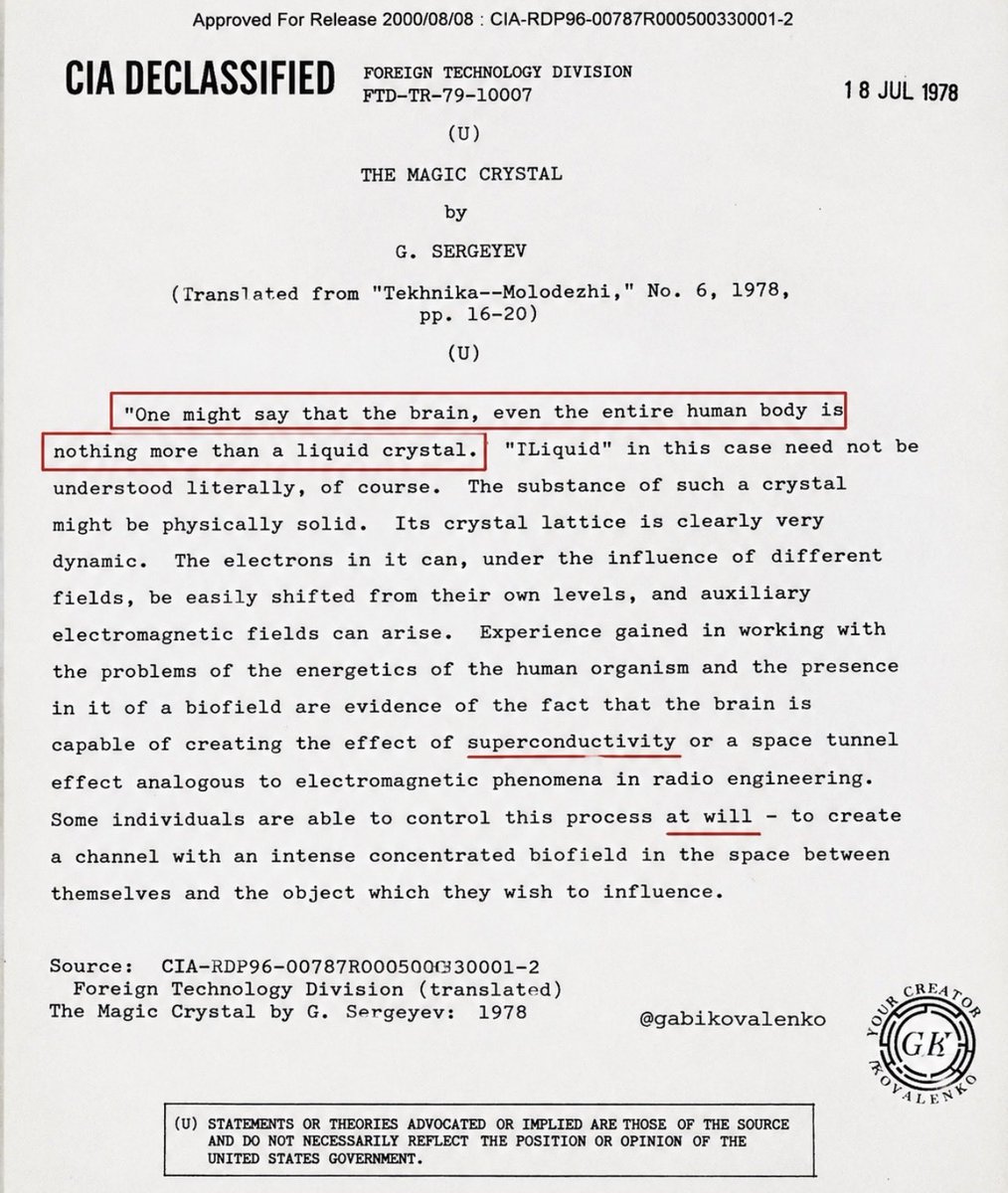
DECLASSIFIED CIA DOCUMENT:
“The brain, even the entire human body is nothing more than a liquid crystal.”
We are like batteries. The biggest takeaway is what we dont know about consciousness, energy & true nature.
3
16
46
2,470