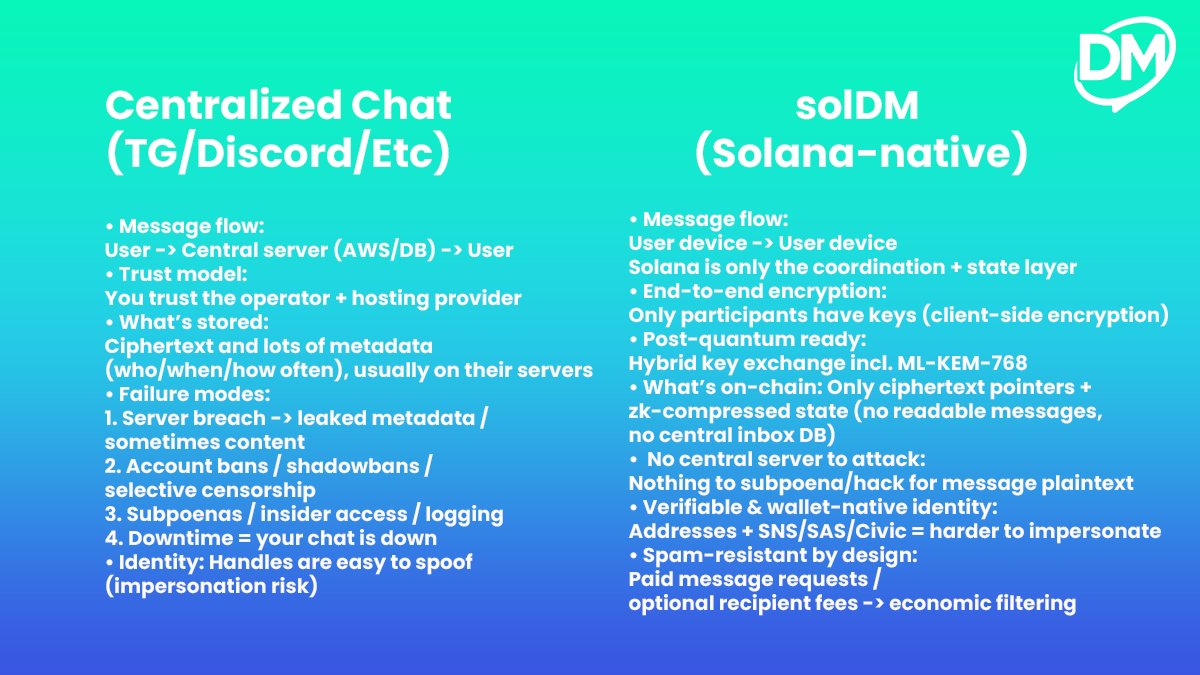
Private social layer on @Solana | Serverless, E2E-encrypted chat with zk compression & quantum resistance (ML-KEM-768) | Powered by @LightProtocol & @SayDialect
Joined December 2025
- Tweets 368
- Following 141
- Followers 51
- Likes 372
38 Photos and videos
















Building generational privacy on @solana👀
Crypto gives you self-custody, not privacy by default—and that gap only grows
If Solana powers everyday finance social, people need to operate without broadcasting their life
Thats what we’re shipping - internet capital needs privacy

▇▇▇▇ ▇▇ internet ▇▇▇ ▇▇▇▇▇▇▇ ▇▇▇▇▇▇ ▇▇▇▇▇ ▇▇▇ ▇▇▇▇▇▇▇▇▇▇▇▇▇
▇▇▇ ▇▇▇ ▇▇▇▇▇▇▇▇▇▇▇▇▇▇ ▇▇capital▇▇▇▇▇▇ ▇▇▇▇▇ ▇▇▇▇▇ ▇▇▇▇▇▇
▇▇▇▇ ▇▇▇ markets ▇▇▇ ▇▇▇▇▇▇▇ ▇▇▇▇▇ ▇▇▇▇▇▇▇
1
1
6
314
What’s next 👇
✅ Security audit
✅ @solanamobile dApp Store listing
✅ Open-source release
✅ Deeper wallet identity integrations
✅ UI/UX improvements — more native feel, simpler flow
✅ And more features, integrations, and partnerships soon…
(5/6) 🧵
1
4
118
If you try it, tell us what sucks. Seriously.
It’s still beta, so you might hit bugs / rough UI — that feedback is exactly what we want
We’re building the private social layer Solana’s been missing
soldm.xyz/
(6/6) 🧵
4
92
Agree. Privacy is back — and it’s not just about hiding balances. It’s about unruggable coordination: who you’re talking to, what you’re signing, and removing the “central inbox” kill switch
That’s the cypherpunk frontier people forgot

2026 thesis: perps, privacy, predictions
my rough prediction for 2025 was that the dopamine receptors of the masses would dry out by year-end and non-speculative regulatory-friendly things would get the spotlight
we are seeing this w the payments chains, stocks, and things like canton now
it seems this largely played out directionally correct and the question remains what happens next?
I think a few things will happen:
- crypto is made up of the commercial, the casino, and the cypherpunk
- the cypherpunk aspect has now been largely forgotten but is showing signs of a violent comeback led by zcash
- my mental model here is basically: "what gives people the most dopamine?" and I think the cypherpunk vision of crypto of encrypted money and unruggable systems is the most exciting part left and it's not close
- it was super unsexy before because of regulatory fears but now there has been a clear shift
- that is to say, privacy will be a main theme of 2026
- at the same time, the quality level of builders has greatly increased
- if you combine this with the fact that incumbent giants like robinhood, revolut, and stripe are now coming onchain — then one thing is clear: builders will have to get much more creative in the products they build to compete. basic natural selection
- so what will happen is the things that are on the frontier of reg arb but interesting composability from crypto native primitives will end up being the main thing
- a prime example of this is perps for equities and commodities
- another prime example of this is adding prediction market primitives to things like news sites
- basically: differing trading modalities
- I also think that X and at least one other giant app will start trying to compete with Robinhood/Coinbase
- I expect to see more pump/axiom type companies arise from solana that will meaningfully compete with Robinhood — the reason is that RH and co had to spend years building out their own rails but a builder on Solana can just tap into the liquidity engine that is the blockchain and spend a disproportionate amount of time on nothing but consumer facing tweaks
2
7
374
theres a parallel dynamic most people miss: modern productivity gains are increasingly powered by data extraction (ad pixels, analytics, recommendation systems, etc). If you can track behavior in microscopic detail, you can forecast, price-discriminate, and coordinate faster than everyone else
So yes, automation can broaden consumer wealth — while simultaneously creating an “inequality of opacity”, where capital compounds not just money, but the right to see. And the people being measured live in a glass house
In the long run, the scarcest asset isn’t capital — it’s privacy

It’s a complete fallacy to say that automation and productivity benefits the few. The only way automation can even be deployed at a profit is if it induces demand.
Remember those word problems from highschool? If you sell apples at $20 you can sell 100 bags, but at $5 you can sell 1000, what is the optimal price to sell apples at? Automation drops the cost to produce a widget and it’s most profitable to invest into automation when the price reduction induces more demand.
This is why consumer goods get automated, luxury brand goods are hand made. There is no profit in Bentley or Berkin automation and the most valuable company automates as much as possible. If you want a small run hand made custom cell phone? Check out the 1st gen @solanamobile saga.
If there is more demand it means we are delivering more goods and services to consumers. This is the actual wealth created by the economy. If you are a Marxist, you know that all wealth is the product of the workers hand setting the means of production in motion. Automation of production of teslas would lower the price of teslas and more teslas would be delivered to consumers. The wealth is the teslas. That’s the benefit.
When politicians talk about inequality, it’s not the inequality of consumer wealth. Musk uses the same iPhone as everyone else, and the sane mri machines. What they use as an example is the inequality of capital. He has more Tesla shares than anyone else. If you doubled the number of Tesla shares in existence, the world isn’t any wealthier. If you doubled the number of Tesla cars in existence, the world is objectively wealthier.
The conundrum is that there is no way to create more wealth, aka more Tesla cars, sustainably, without creating more capital inequality. Because to create more wealth we need to increase productivity. To increase productivity we need to underwrite the risk of deploying new technologies. Someone has to put up the capital to make a machine to make teslas faster. The winners and losers are power law distributed.
But this is ok. It’s great even. We have the smartest people in the world competing to increase the number representing capital and the only way to do that is to create more consumer wealth.
Which leads us to the second political fallacy. Politicians say they want to redistribute wealth, but they can’t actually produce more teslas and give them away. So they can only redistribute capital. Which doesn’t create any more wealth. If the number of teslas stays the same and everyone has more capital, what happens? Think about the high school problem with apples. Everyone has more money and no one is making more apples. The price of apples goes up.
Redistribution of capital just leads to less investment in wealth creation and price inflation.
3
1
6
296
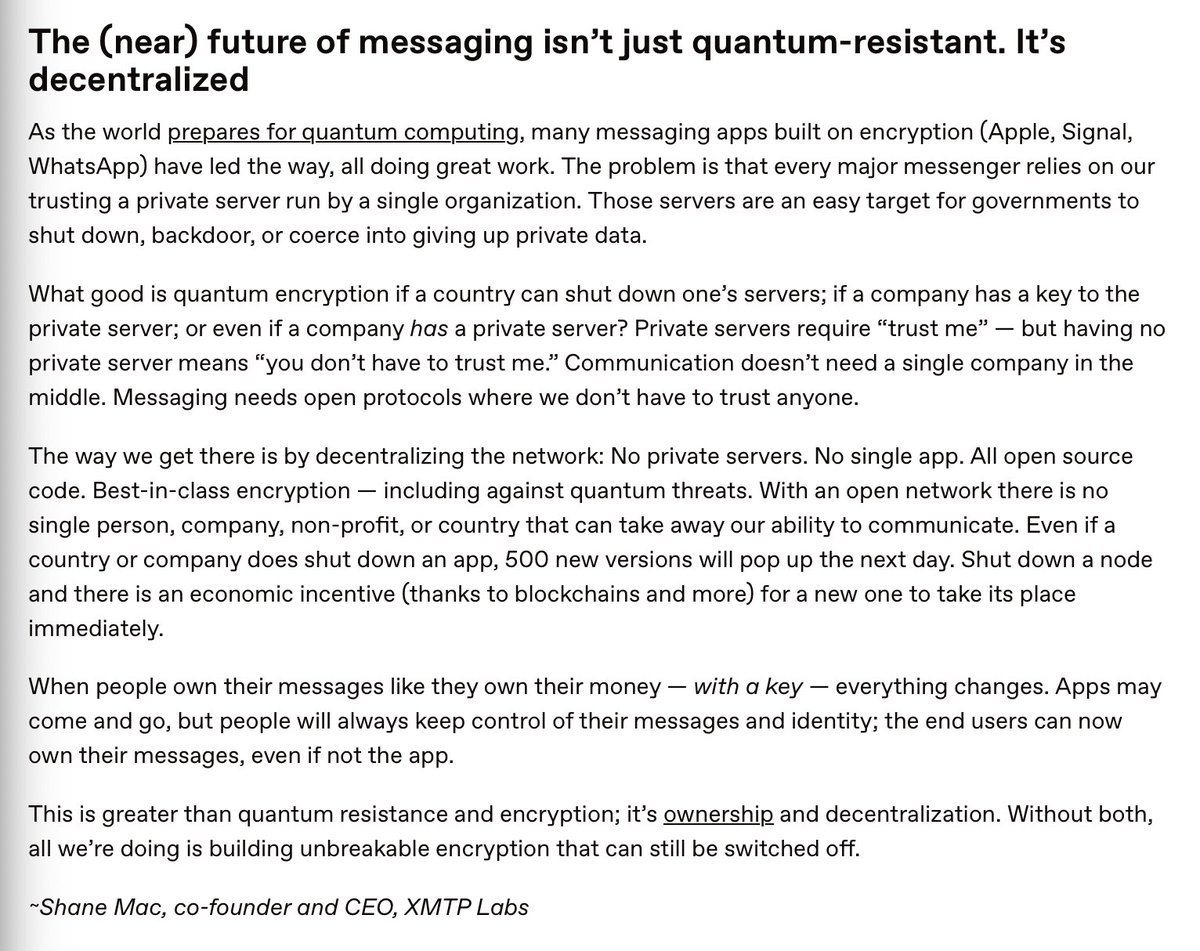
“Unbreakable encryption that can still be switched off” is the scariest line here
This is exactly the kind of thing SolDM is designed to avoid: serverless, E2E-encrypted, post-quantum secure chat with zk-compressed state on Solana – no servers in the middle
Same direction, same conclusion.
Trillions
15 Dec 2025

The (near) future of messaging isn’t just quantum-resistant. It’s decentralized
@ShaneMac
6
205