
Joined May 2013
- Tweets 667
- Following 78
- Followers 8,772
- Likes 1,166
23 Photos and videos




K Srinivas Rao retweeted

Mar 26
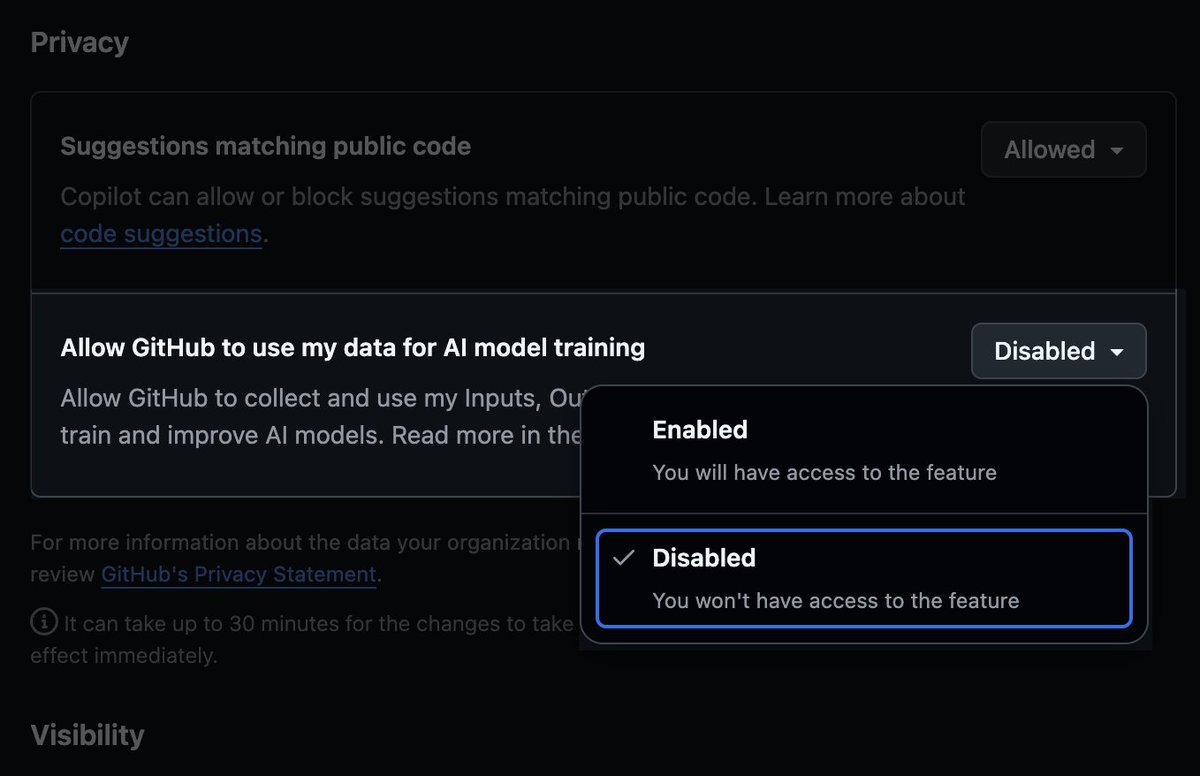
If you willingly use `useEffect` for data fetching, that's fine, just please go into your GitHub settings and set this to disabled
67
187
3,172
186,475

i am no longer sure dario is conscious
Mar 5

🚨 ANTHROPIC CEO WARNS: THE COMPANY IS NO LONGER SURE CLAUDE ISN’T CONSCIOUS.


105
113
3,983
156,347
K Srinivas Rao retweeted

Feb 18
you'll know if something is written in rust because people will tell you it is
you'll know if something is written in typescript because you'll actually be using it
16
8
202
11,279

Jan 4
ship fast or ship perfect? ai rots your brain or coding is over? i don't know what to believe anymore. someone let me know when we pick a side.
36
2
182
10,603
30 Dec 2025
all these llms think software engineering is a christopher nolan film. every tutorial starts at 3am. every outage happens "in the dead of night." there's always a pager. someone is always "jolted awake."
meanwhile the actual prod incident (if you even wanna call it that) happened at 2pm on a tuesday, everyone saw it because we were in a meeting, the fix was someone typed 'flase' instead of 'false', and we were home by 5.
but sure, tell me again about the "bleary-eyed" engineer clutching coffee at 3am, staring into the abyss of a cascading failure, questioning every life choice.
it was a typo kevin. you pushed a typo.
1
1
144
9,789
K Srinivas Rao retweeted

29 Dec 2025
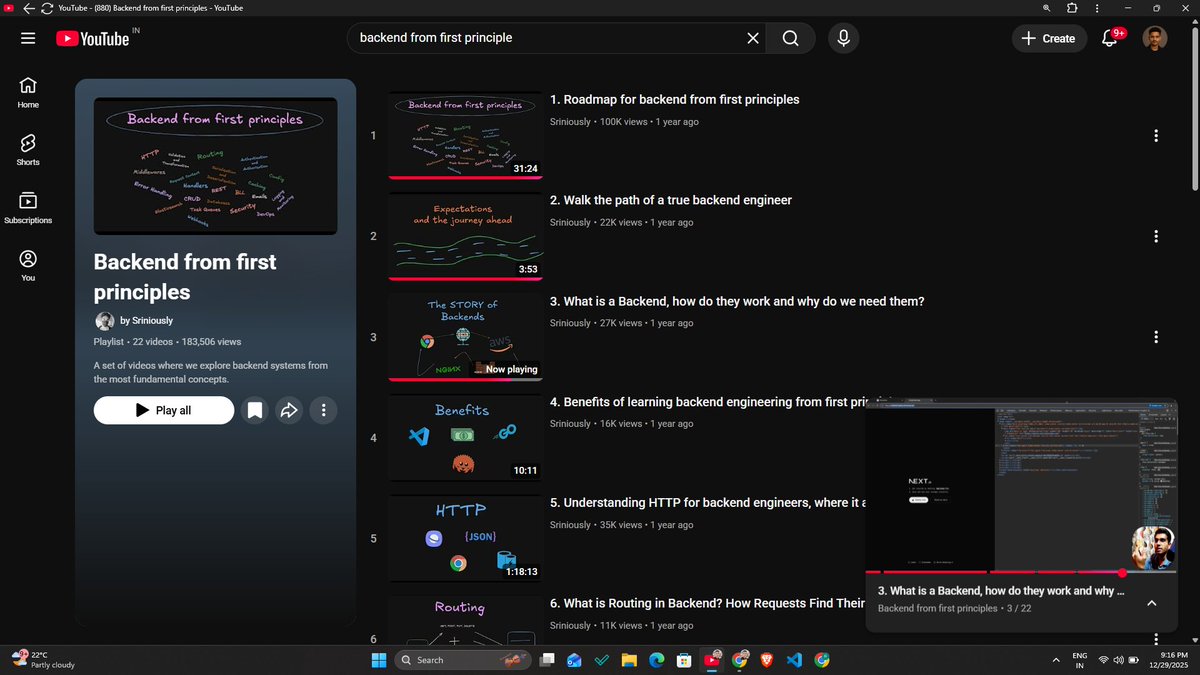
Best playlist if you want to learn what backend systems are and how they work beneath the surface.
It actually presents a BACKEND FROM THE FIRST PRINCIPLE
Thanks to @sriniously for this gem
2
3
39
3,067
K Srinivas Rao retweeted

26 Dec 2025
I love that people are discovering that crypto bros are scammers and have just moved to AI
Welcome to Costco, I love you
113
268
4,821
121,527
17 Dec 2025
OpenAI: hires Osborne
Me: waiting for the inevitable scene where he corners an engineer on the roof screaming "YOU KNOW HOW MUCH I SACRIFICED?!" after GPT-6 hallucinates
2
26
2,807
16 Dec 2025
The number of things I do in life just because 'vachan dedi hai'... bhai main kahan ka bheeshm pitamah hoon, ab vachan dedi he toh dedi he, wapas bhi lee jaa sakti he
2
1
46
3,408
16 Dec 2025
"Japan to revise romanization rules for first time in 70 years"
me, misreading (impressed): wow, Japan is regulating romance? such a forward-thinking country. every nation should have rules before kids start writing love poems to AI waifus
re-reads headline (disappointed, relieved):
oh. it's about writing Japanese in Latin letters. that's… significantly less dystopian
2
31
4,404
16 Dec 2025
one common thing I have always noticed in the kind of content that I consume and see other people love consuming, and the kind of products that I feel is wildly intuitive, is that, most of the times these creations are the results of founders/creators getting annoyed at their workflow or strongly feeling the gap, so much so that, they feel this strong urge to fix it themselves. go ahead and try it, think back, the kind of videos that you care enough to hit the like button or post a comment, the articles that you bookmark or the saas product or dev tool that is an integral part of your workflow.
there is that energy, that you can’t fake. when someone creates something to scratch their own itch, you feel it. the attention to detail, all the edge cases handled because they have LIVED those. the explanations land perfectly in your brain like a tetris because they remember what confused them. The feature prioritisation always works in the market because to date they are still the target users.
now contrast that with content or products built "for the market." You also feel that instantly. that saas landing page, that youtube video optimized for the algorithm, that blog post written to rank, you know exactly what I’m talking about, we see those everyday.
when something feels meh, I ask, was this made by someone who would actually use/consume this? 9 times out of 10, the answer is no. they just reverse engineered what they thought people wanted instead of building what they knew people needed because they needed it themselves.
fortunately, our tech ecosystem is so beautiful today because the number of "I made this for me and people like me" stuff still dominates the "I made this for you" stuff
1
65
4,539
K Srinivas Rao retweeted

12 Dec 2025
how he looks at you when you sleep for 5ms every 50 chars

15
27
1,658
50,628
K Srinivas Rao retweeted
29 Nov 2025
Fetching in useEffect()

26
30
748
127,350
24 Nov 2025
Lately, as a developer, especially with the advent of agentic ai tools, there's no denying that the amount of "joy" in writing code at work has significantly gone down. I mean yes, we are more productive than ever, we have more power and time to build anything we want, but iykyk.
Which brings to my point of this post.
I was never into building personal software, meaning, creating tools/automation workflows for MYSELF. I never felt the need and it always was a drag. So this is a particular unexplored area of life that is proving to be the number one contributor to bring that "joy" back, with this feeling of building software for yourself that nobody else will ever use, or rather I won't LET anybody use. So embarrassing.
When you are the only user, you make a lot of "interesting" tradeoffs, not the ones I would be proud to discuss amongst my peers in any professional setup. Things like, skipping the auth layer, why? Well, because if you don't trust yourself in your own machine, then my friend you have a bigger problem at hand. There will be this VERY important CLI flag that you use all the time, but instead of making it a default, you depend on your zsh suggestions and auto-completions to write it out for you, who cares. And man don't get me started on the db schemas and indices? Index? What's that? And the classic, git push origin main. God, the satisfaction I get from that, EVERY SINGLE TIME.
Personal software also frees you to be maximally weird. I have a script that parses my browser history, runs it through embedding models, and clusters my research sessions. It's held together with string and shell scripts. It would never pass code review, lol, I would fire me if I saw that code in ANY kind of context. But it's grown to be so useful to me in a way that polished tools aren't, because I built it around my exact mental model of how I work.
The reason for this feeling, for the most part, is professional software development often optimizes for the wrong things. Well not really wrong, they are the necessary evils, but wrong in this context. We build for hypothetical users, imaginary scale, theoretical maintainability by future developers who may never exist, atleast in the initial phase. Personal tools revert this formula. You build for one real user with real needs right now. And the needs that you have a 200% understanding of.
So build something small and ugly for yourself. Use it every day. Let it evolve based on actual friction and use rather than anticipated requirements. You'll develop intuitions that no tutorial can teach you and also find a little more joy.
5
12
207
12,764
K Srinivas Rao retweeted

17 Nov 2025
remember when they were like
web 1 = read
web 2 = read/write
web 3 = blockchain paywalls
AI agents offering site-site communication is a much stronger candidate for a real web 3
2
1
16
3,414
K Srinivas Rao retweeted

31 Oct 2025
Adults- you have a moral responsibility to create holiday magic for the next generations.
You are not too cool to dress up, or decorate or be silly. The wonder of childhood rests on your shoulders.
22
36
429
30,571
25 Oct 2025
I have been EXTREMELY lucky when it comes to my youtube channel, when it comes to the amount of love I receive from people everyday, and I cannot be grateful enough for that.
ESPECIALLY given all the flaws that I have.
1. The ridiculously poor video editing and camera angle. And I am saying this with just a hint of shame that, they’re not going to improve anytime soon. Content and research is always going to be the priority.
2. In some of my earlier videos I read too much from my notes, lol. And honestly so far, this is the ONLY complaint I have seen in the comments. And it’s surprisingly rare. Content is not easy guys, and neither is teaching, and doing both of them together for hours, you tend to lose track, so the notes were necessary to stop me from rambling. I believe I have improved in later videos, but again, it’s an ongoing effort.
3. My frequency of uploading. Now this is something I am truly guilty of. What can I say, I am involved in too many projects, doing way too many things than a sane person should be doing. But I’m working on that too, clearing out the other priorities to make room for the videos.
I could go on with the list, but I am not gonna go ahead and give you guys more reasons to complain about.
But anyway, thank you to all the people who make the effort to write/share/comment about my videos and the ones who send me thank you notes in the dm. I see and read EVERYTHING. For someone who seeks external validation a lot, I would have stopped making these videos without these tweets/comments/dms long back.
I don’t believe I am doing anything great with these videos. I have never taught anything to anyone. I am introverted to the point of offending people with my presence. And I wish someone with better communication skills, better knowledge and more experience in the industry taught this stuff, so that I didn’t have to go on and do a bad job at this just to fill a gap. But unfortunately for you and me both, no one is doing it, so you’re stuck with me.
35
11
513
28,363
12 Oct 2025
anthropic's go-to-market feels like they're doing something novel that cuts against the received wisdom on dev-first companies. worth unpacking because it might be a template for how frontier AI companies actually scale.
the standard dev-first playbook (stripe, twilio, aws in its early days) goes something like “build for developers, make them love you, they spread the word, usage grows organically, eventually that usage converts to enterprise contracts”. CAC is low because distribution is viral. LTV compounds because usage scales with the customer's growth. sales cycles are short because there's no heavyweight procurement. beautiful model, proven multiple times, VCs love it.
but this model works when the developer IS the economic buyer, or at least a very strong proxy for the economic buyer. a developer at a startup picks stripe for payments, and as that startup scales, stripe revenue scales. a developer picks datadog for monitoring, usage grows with infrastructure. the person making the product decision and the person/entity paying the bill are tightly coupled.
AI breaks this coupling. developers evaluate AI models, build with them, have strong preferences (often VERY strong preferences based on output quality, latency, cost). but the economic value of AI deployments pools at the enterprise level in ways that don't map cleanly to individual developer usage. a customer service AI that handles 100k tickets/month, a legal review tool that processes contracts, an internal research assistant for analysts. these are enterprise decisions with enterprise budgets, even if they started as developer experiments.
so you get this dynamic where team of engineers might run up $2k/month in API costs during a 4-month evaluation, building prototypes, comparing models, getting really excited about Claude's capabilities. but the actual deal is a $3M annual contract once legal, infosec, procurement, and the CIO all sign off. your CAC looks amazing (self-serve API!) but your sales cycle is actually 12 months and involves enterprise sales motions.
how do you calculate LTV when there's a 150x jump between pilot spend and production deployment? what's the real conversion rate when "conversion" means moving from $500/month to $250k/month over 18 months? how do you forecast when you have no idea which of your 5000 API users will become your next 7-figure customer?
and this is where anthropic's approach gets interesting. they're not trying to force AI into either a pure PLG model or a pure enterprise model. they're building a hybrid that accepts the reality of how AI actually gets adopted. developers are the validators, not the buyers. the enterprise is the buyer, not the validator.
this is different from saying "developers are our customers." it's more like "developers are our curators, enterprises are our customers." and that distinction matters for everything: product roadmap, feature prioritization, go-to-market strategy, pricing, even hiring.
look at their product decisions. they're building world-class developer tools, documentation, and APIs. claude is beloved by engineers. but they're also building enterprise features that developers don't particularly care about like SSO, audit logs, data residency options, usage analytics for admins, compliance certifications. they're not choosing between developer experience and enterprise requirements. they're doing both, simultaneously, at high quality.
When you look at their sales motion. they have a product-led surface where developers can self-serve, experiment, build. but they've also built an enterprise sales team that knows how to navigate procurement, handle security questionnaires, negotiate contracts with legal teams. and crucially, they use the developer relationship as leverage in enterprise conversations. when their AE walks into a VP's office, they can point to organic adoption across engineering teams. the developers have already de-risked the technology decision. they've built prototypes, compared outputs, chosen Claude. that's the level of social proof you simply cannot buy.
but this creates tension. developers want simplicity, speed, cutting-edge capabilities. enterprises want controls, compliance, stability. these aren't always compatible. anthropic seems to be managing this by creating clear separation, the API and developer experience stays clean and fast-moving, while enterprise features layer on top without cluttering the core product. it's good product discipline.
in a pure PLG company, you mostly invest in product and developer relations. in a pure enterprise company, you mostly invest in sales and customer success. anthropic has to invest heavily in both. that's expensive. but if you get it right, the economics could be extraordinary. near-zero marginal CAC on the developer side (they come to you), massive contract values on the enterprise side (where the budget pools), and a dramatically shortened enterprise sales cycle because you've already won the technical stakeholders.
i think what we're seeing is the start of a new GTM category. not quite PLG, not quite enterprise, something like "developer-validated, enterprise-monetized." and it makes sense specifically for AI infrastructure, where the technology is too powerful and too risky for pure self-serve, but also too innovative and too fast-moving for pure top-down sales.
the LTV:CAC ratios here could be very impressive if executed well. you're basically getting free demand generation through developer adoption, then capturing enterprise budgets that are 100-1000x the initial pilot spend. but it requires building two completely different muscles simultaneously, you need to be great at developer experience AND great at enterprise sales. A lot of companies are good at one or the other. very few are good at both.
traditional PLG focuses on activation rates, time to value, viral coefficients. traditional enterprise focuses on pipeline coverage, win rates, contract value. anthropic has to track both, but more importantly, they have to track the relationship between them. what's the conversion rate from developer user to enterprise buyer? how long is the validation period before enterprise procurement kicks in? which developer behaviors signal future enterprise spend?
i suspect we'll see more AI infrastructure companies adopt this hybrid model. OpenAI is obviously doing something similar (though with a different emphasis, given their consumer products). the companies that figure out this dual-track approach are probably going to have huge advantages, because the technology itself demands it. AI is too technical for traditional enterprise sales (you need developers to validate quality), but too expensive and risky for pure PLG (you need enterprise buyers for serious deployments).
anyway, early days. but feels like anthropic is building a playbook that could define how frontier AI companies go to market for the next decade. worth watching.
1
2
44
6,135
12 Oct 2025
I have seen partners at the top Valley funds who pick companies at Series A primarily because of the brand pull it would give them with other founders. Not because of the TAM, or the team pedigree, or even the metrics. The signal value. No body really unpacks the kingmaker problem in VC honestly.
VCs fund great companies. Great companies become unicorns. VCs get great returns. But the mechanism is far more circular than we care to acknowledge. When Sequoia or a16z invests in your startup at say a $50M valuation, yes they are betting on your product, but what they are REALLY betting on is that THEY can make you worth $500M through their network effects. And they are often right, but not always for reasons that validate the efficient market hypothesis we like to believe in.
The company that gets Sequoia at Series A instantly gets warmer intros to every other tier one firm for Series B. They get their portfolio CEOs making intros for enterprise deals. They get journalists writing about them because journalists track what these firms do. They get better acquisition interest because acquirers watch these firms' portfolios. The valuation wasn't discovered by some pure market force. It was created, at least partially, by the kingmaker's choice itself. This is a form of social proof arbitrage, and it compounds.
Now this creates a genuinely interesting problem, which is that the best VCs have the best returns partly becauseeveryone believes they have the best returns. It becomes difficult (impossible?) to disentangle how much of say Stripe's success came from being an incredible product versus the compounding advantages of having Thiel and Sequoia fighting to get in early. Both are true simultaneously but we pretend only the product quality matters when we do post hoc analysis.
A mediocre product with Benchmark backing will often outperform a superior product backed by a no name seed fund. Not forever perhaps, but long enough (18 to 36 months) to raise multiple rounds, fix the product, or get acquired at a respectable exit. The VC are bending reality around your startup for long enough that you might actually figure it out. That's often sufficient.
The implication here is that venture capital is less efficient than we'd like to believe. The set of "best companies" and the set of "best funded companies" overlap significantly, but the overlap is not complete. Somewhere there exists a founder who built something genuinely superior to what got funded, but couldn't get the meeting with the kingmaker. And because they couldn't get that meeting, they couldn't access the downstream network effects. The market cap that could have existed simply vanishes, counterfactually.
I think about this whenever someone confidently declares that "cream rises to the top" in startup land. Sometimes it does. But sometimes the cream just didn't go to Stanford, or wasn't a repeat founder, or was building outside SF/Bangalore, or critically, wasn't intro'd by someone the partner already trusted. And in those cases the kingmaker never even knew they existed. Those companies aren't going to return anyone's fund. But perhaps, in a different configuration of the network, they should have.
3
41
4,593