
Joined September 2022
- Tweets 1,838
- Following 61
- Followers 10,301
- Likes 2,578
165 Photos and videos






May 27
75% of Hyperliquid perps traders are unprofitable
99.9% of Hyperliquid spot hodloors are profitable
Apr 10

75% of Hyperliquid addresses are net unprofitable.
When you see a trader-KOL with smart face on your feed, there is roughly a 3/4 chance that it lost money on perps. Once you understand how financial markets work, you will quit all discretional trading.
Most .hl accounts you see in your feed are net unprofitable (go check their addresses) and the only ones profitable were either quantitatives (like @0xLoris) or were on the positive side of variance, i.e., luck (e.g., @NMTD8)
p.s., if you solely rely on 'gut feeling' (luck), mathematically less painful for you would be playing a casino.
A core reason discretionary traders suffer losses is market efficiency. In highly liquid and informationally dense markets, like commodities, large-cap cryptocurrencies, equities, and major indices, new information is priced into mark prices at remarkable speed. The news you just read? Already priced in. The technical indicator you rely on? Also priced in.
Quantitative firms and exchanges operate with superior infrastructure, data access, and execution capabilities, making it exceptionally difficult (almost impossible) for manual traders to sustain an edge.
Mathematically, the structure of these markets favor makers and systematic participants, while takers, particularly uninformed discretionary ones, face a persistent negative expected value, with the narrow exception of non-directional strategies with minimized costs, such as points farming.
If you're an uniformed discretional trader (99.9% of readers), the most EV course of action may be counterintuitive but is well-supported by the data:
1) Delete all trading apps (esp. mobile ones)
2) Quit all trading
3) Be on the side of the profitable exchanges (i.e., get exposure to them via their coinized shares, such as $HYPE, $LIT, $BNB)
4) Become a maker (p.s., providing exit liquidity through AMMs or retail tools like treadfi is extremely negative expected value for you)
Hyperliquid
3
17
53
7,610
Apr 13
Jeff’s close friend at university was Vlad’s co-founder at Lunchclub
The world is not that big

Apr 13

This is the story of Hyperliquid, the most profitable startup per employee on earth, told from a guarded office in Singapore.
Last year, its team of 11 generated $900 million in profit. It's 3 years old, has never taken a dollar of venture capital, and is beginning to change how century-old markets work.
Its founder, Jeffrey Yan (@chameleon_jeff), had never taken a physics class when he picked up a textbook at 16. Two years later, he won gold at the International Physics Olympiad. In 2019, he started trading with $10,000 from a living room in Puerto Rico—working off a television because he didn't own a monitor.
Within 3 years, he was running one of the largest anonymous crypto trading firms.
Then he shut it down. Yan was rich and free, but he had spent years inside crypto, watching it betray itself. Bitcoin's central premise was decentralization. Yet the biggest exchanges were centralized. Crypto kept reintroducing the dependence on trust it was built to eliminate. He set out to create what should have existed.
Hyperliquid is a blockchain with a trading exchange on top, and anyone can build on it. Yan's vision is to house all of finance. In 3 years, it has done over $4 trillion in volume. And in the past few months, it has begun to outgrow crypto.
Markets for oil, silver, and the S&P 500 now trade on Hyperliquid around the clock, weekends included, and are growing roughly 40% week on week. When the US and Israel bombed Iran on a Saturday in February, Hyperliquid was the venue traders turned to.
Hyperliquid's success has cost Yan his freedom. He works out of a secret office in Singapore and cannot travel without two bodyguards. Even the team's housekeeper doesn't know what they do.
In January, @domcooke spent a week at their office. Read his profile on Yan and @HyperliquidX below.

4
3
75
18,849
Apr 10
75% of Hyperliquid addresses are net unprofitable.
When you see a trader-KOL with smart face on your feed, there is roughly a 3/4 chance that it lost money on perps. Once you understand how financial markets work, you will quit all discretional trading.
Most .hl accounts you see in your feed are net unprofitable (go check their addresses) and the only ones profitable were either quantitatives (like @0xLoris) or were on the positive side of variance, i.e., luck (e.g., @NMTD8)
p.s., if you solely rely on 'gut feeling' (luck), mathematically less painful for you would be playing a casino.
A core reason discretionary traders suffer losses is market efficiency. In highly liquid and informationally dense markets, like commodities, large-cap cryptocurrencies, equities, and major indices, new information is priced into mark prices at remarkable speed. The news you just read? Already priced in. The technical indicator you rely on? Also priced in.
Quantitative firms and exchanges operate with superior infrastructure, data access, and execution capabilities, making it exceptionally difficult (almost impossible) for manual traders to sustain an edge.
Mathematically, the structure of these markets favor makers and systematic participants, while takers, particularly uninformed discretionary ones, face a persistent negative expected value, with the narrow exception of non-directional strategies with minimized costs, such as points farming.
If you're an uniformed discretional trader (99.9% of readers), the most EV course of action may be counterintuitive but is well-supported by the data:
1) Delete all trading apps (esp. mobile ones)
2) Quit all trading
3) Be on the side of the profitable exchanges (i.e., get exposure to them via their coinized shares, such as $HYPE, $LIT, $BNB)
4) Become a maker (p.s., providing exit liquidity through AMMs or retail tools like treadfi is extremely negative expected value for you)
Hyperliquid

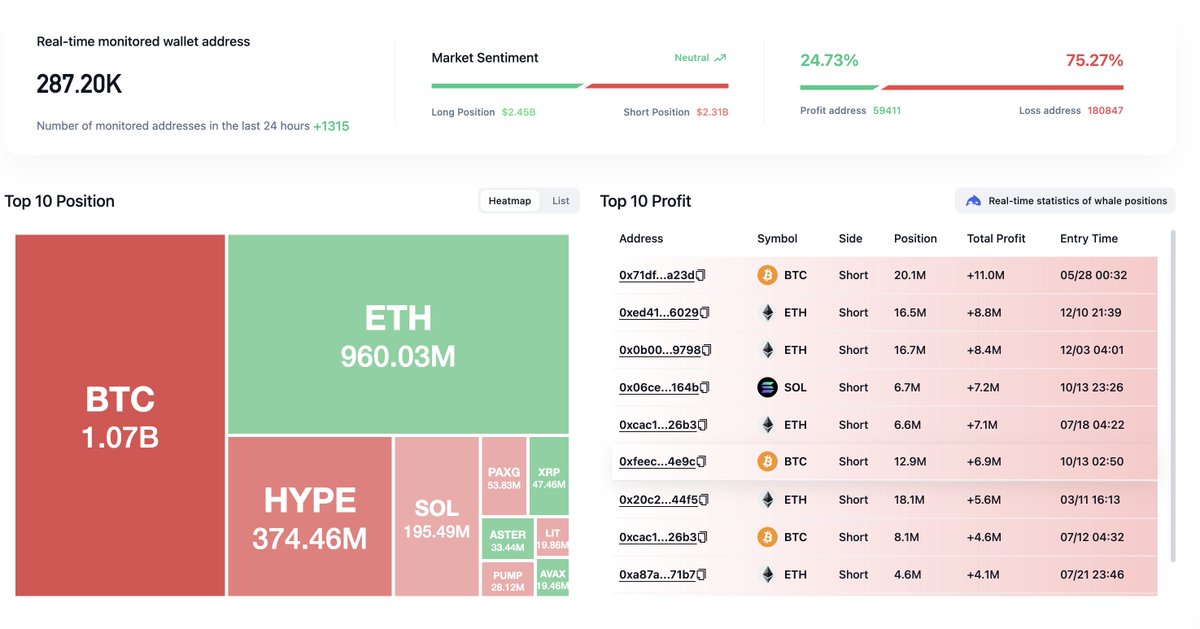
📊According to the data from #CoinAnk's Hyperliquid Wallet Data, monitoring 287,190 addresses:
Profitable addresses: 59,411
Unprofitable addresses: 180,846
Percentage of unprofitable addresses: 75.27%
The overall long/short positions of CoinAnk’s monitored wallets are currently roughly neutral.
🔗:coinank.com/hyperliquid/wall…
13
3
93
27,116
Apr 5
About six months after the USDH proposal, Native Markets’ $USDH supply stands at $154.79 million across HyperEVM and HyperCore.
Over the same period, Paxos-issued $USDG circulating supply has reached $1.862 billion, an increase of about $1.3 billion since the USDH proposal.
Paxos USDG supply has grown by 8.4x more than Native Markets USDH during that timeframe.
10
6
115
18,528
Mar 31
Which Hyperliquid frontend do you use?
85%
hl.xyz / trade.xyz
15%
Other (Explain Why)
144 votes • Final results
16
10
26
4,331
Mar 24
There is a correlation between personal psychology and “edge” in discretionary trading.
Many people are too subjective in financial markets and build parallels between their personal real-life convictions and their trading behavior.
For example, a person who values loyalty, such as loyalty to family, homeland, or beliefs, may also project these patterns onto their trading. Such a person may value “diamond hands,” hate selling or seeing others sell, treat their positions as part of their identity, and feel personally insulted when their positions are criticized.
The reason over-subjective trading is long-term negative EV for you is that the market does not care about anything, including anyone’s opinions. Financial markets are highly complex machines that, in the end, transfer money from 'takers' to 'makers', from those who over-consume value to those who create and add value capital efficiently. Pure capitalism.
That is why there are only three types of profitable traders:
1. Quantitative traders, with zero subjectivity, who solve inefficiencies.
2. Lucky traders, where variance has created a lucky streak during their trading.
3. Discretionary traders who minimize emotional subjectivity. These are basically a subtype of quants, but without complex algorithms and big data.
The secret to being a profitable trader is either to be extremely lucky, which is almost impossible and statistically negative EV to rely on, or to be an observer who identifies inefficiencies and efficiently sells to takers. Remember: the market does not care what you think.
Many people are simply better traders when they trade on paper because PnL, account balances, and holding positions introduce subjectivity and destroy their judgment. They start overthinking and asking themselves questions like, “What if I get liquidated?” which pushes them into becoming 'takers' and taking bad positions.
Hyperliquid.
2
16
29
3,174
Mar 22
Resolv hack is one of the reasons why CeDeFi protocols are not good places to park your inventory for <10% APR, a small yield would not cover your exposure to hacks.
8 Aug 2025
It appears that Kinetiq also has a 4/7 multisig to operate. Their docs doesn’t mention this.
kHYPE uses upgradable smart-contracts, which are controlled by the 4/7 multisig—all multisig signers are the Kinetiq’s contributors.
This means that Kinetiq’s team has an administrative control over the protocol and can make any changes simply by upgrading the smart contracts:
From legitimate security updates to potentially malicious actions, such as withdrawing all HYPE staked through smart contract update or minting an unlimited supply of kHYPE.
Additionally, if 4 out of the 7 multisig signers get compromised, the entire protocol could be at risk. Similar to the incident happened with Bybit's ETH multisig wallet hack back in February.
This structure is common in early-stage or evolving protocols for flexibility, but calling kHYPE “decentralized” or “trustless” is technically wrong.
Ultimately, kHYPE is not decentralized and is not a trustless LST as most people think.
Staking HYPE through Kinetiq requires placing trust in their team and security.
All tech-related info was shared by @0xOmnia. Stay safe.
2
12
37
7,237
Mar 13
Lighter DAO will be the first tokenized Board of Directors. We will make sure to be part of it before the Bull Market starts!
Mar 12

Poorly functioning DAOs have materially harmed many promising projects.
We launched $LIT directly from our corporate entity in the US, aligning the protocol's long-term success with the ecosystem. Value generated across the ecosystem flows back to the token.
2
19
59
7,758
Mar 11
most of the people fudding Lighter are those who discovered $HYPE at >$40. Lesson in here.
all smart .hls I know are peacefully building. Not emotional because not underwater 🙃
6
78
7,447
Mar 8
Were pretty early to Unit/XYZ farming, but now I'm 90% sure that it would *not* launch the token.
Generate fees & buy $HYPE may be the best approach any Hyperliquid-native project shall do, and Unit shows the standards, again. You don't need a token.
Many sub-Himalayan (and .**) accounts are now hyping the hip-3 farming while sharing treadfi reflinks. However, one of the main principles of positive EV money management is to buy uncertainty and sell consensus. This approach may be unpopular and 'hated' (don't give a fuck about tards in comments), but you would always laugh last.
Glad that we didn't touch anything except for publicly shorting the market since late Nov.
26 Jun 2025
22. Unit airdrop farming is underrated.
12
8
88
16,142
Mar 4
$HYPE and other buyback tokens have large allocations for “future growth / community”, which may be used for incentives, aka reinvesting into business’ growth.
There is no economical reason to incentivize anything in crypto, for now. So the best decision you can do with revenue is buyback own token and accumulate liquidity for future incentives
(which eventually would bring more buybacks, if done smart!)
Do you want Hyperliquid to buy Super Bowl ads and burn cash? Everybooody
Mar 4

Everyone loves this because it makes $HYPE go up
but does it make Hyperliquid a better business long term?
$1b in cash to improve and grow the business could have gone a very long way in growing into new opportunities, acquiring businesses, etc.
very non traditional route..
7
17
59
10,326
Feb 26
X algorithm promotes being wrong and punishes being early.
to get likes and engagement, thus the algo boost, you have to be aligned with hot narratives. This means you have to bullpost at the top, be emotional when everyone is emotional, not being the countertrader, i.e. being the exit liquidity.
i've created my Telegram Channel (always free, always no promotions), from where I would continue sharing my neutral, narratives-less views and market opportunities. My Lighter Public Pool (which I launched in stealth) is top 1 Public Pool on Lighter by sharpe ratio, even above the LLP.
the posts will be harder, as I still filtered most of my tweets to not getting cancelled (and still a lot of .hls unfollowed just for being bullish on Lighter as a platform 😂)
link below
2
13
14
1,863
Feb 18
What type of crypto B2C business doesn't make money by illegally raping retail? I don't know of any.
Only aggregators (incl. data aggs) come to my mind!

yeah idk man i'm pretty sure i'm the only one who gives a shit about volume authenticity so, whatever. probably means i am at least partially wrong
the end result is of course inevitable
thousands of retail traders will end up angry, having incinerated real funds they earned working hard at actual jobs, for ultimately ~worthless perp dex points, in bot apps that douple-dip incentivized them with worthless bot app points
but what else is new. tale as old as crypto
and frankly who am i to judge. people should be able to spend their money however they want. maybe i'm just getting soft
it's better than outright fraud (i think?) which also regularly occurs in this space. and it's probably not *legally* wash trading even though it has no economic substance
but then again it *might be* fraud, it's a gray area ofc (not legal advice)
legality aside (as is tradition), there's a case to be made for artificially pumping volume for the sake of maintaining external appearances of real economic activity - the means justifying ends argument - so that we feel relevant because we are in WSJ headines sometimes
but god damn
we have collectively set the bar pretty fking low this cycle!
2
14
18
4,051
Feb 15
I feel a lot of unprofessional retail will get rekt (always has been) on Pair Trading.
1) You are trying to trade incomparable type of assets. In ideal world, long productive (“SPX”) and short economically worthless (“BTC”) should have always worked, but it is obviously not.
History showed many times that a performant asset in a specific (“short”) period of time doesn’t have to be more productive to the less performant assets. An asset grows in price when it has demand, not when its value goes up.
I see it is becoming popular to Pair Trade productive crypto like HYPE against “worthless” ones like MON, SOL, etc
While the traders trading this setup may be generally right about fundamentals, or even right in a specific period of time (especially during the Bear Market, when cryptocurrencies have a tendency of repricing to their fair value) the remaining common mistake is trading Value against Speculation.
You are trying to trade Fair Value, same time betting on Price with leverage. Price is often ≠ Fair Value. The arbitrage in it is what you call Investment. This arbitrage can play against you in a short period of time, especially with leverage.
Crypto market is very dumb and inefficient, and it is only a matter of time when Fair Value and Price are becoming misaligned, again. You would get liquidated while being fundamentally right. You may be profitable during the trend of Price -> Fair Value repricing, until it’s not.
2) Non-linear vs Linear exposure. Pair Trading, in its current form, is a scam. When you’re longing BTC, and shorting SOL, your overall position is not BTC/SOL. It is mathematically incorrect and your true exposure would be (BTC/USD)*contract_size_BTC-(SOL/USD)*contract_size_SOL, which is fundamentally different (linear when SOL/USD going down) curve from BTC/SOL (which is non-linear during SOL/USD going down)
In other words, if SOL/USD decreases by 80% and BTC/USD stays at the same price, your "BTC/SOL" pair trade wouldn’t be worth 1/0.2=5x ( 400% PNL), but only 80% PNL. Same time the frontend would show you the Price Action of 400% growth for BTC/SOL. You thought you would get 5x on your trade, but it’s only 80%, a 5 times difference in this example.
——
If you think that an asset A and asset B have a negative value correlation against each other, probably the most financially efficient decision for you would be:
1) Not putting them in one trade. Use different risk-management and price both of them against the Medium-Of-Exchange, not against each other.
2) Go with Put Options for the Asset B. Perps are great during strong short-term trends or short-term volatility events, but if you strongly believe that an asset B would have a trend of repricing to its “Fair Value”, aka “ZEROO”, buying options would be a better financial instrument for you.
Don’t be exit liquidity for misleading builders and KOLs promoting them for shekels.
8
5
60
6,906

Say you sit 88,000 monkeys in front of a keyboard and a brokerage account and let them buy and sell stocks for 10 years. When it’s over, you look at the results and, surprise, one monkey crushed it. Never lost more than 3%. Exposed every rally, dodged every crash. Looks like a genius.
But he’s not a genius. He’s just the luckiest monkey out of 88,000. If you hand that monkey real money tomorrow, it has no idea what it’s doing. It never did. It’s a coincidence wearing a lab coat.
Feb 13

i let an AI test 88,000 trading strategies over 10 years of market data.
the winner made money every single year. never lost more than 3% from peak.
today i'm putting it in the ring with real markets for the first time.
paper trading starts now. if it holds up, real money is next.
i'll document the whole thing here.
57
185
7,666
471,529
Feb 8
I believe Retail Volume is the best metric for comparing perp exchanges.
Orderbook Depth isn’t very useful because most exchanges don’t prioritize order-cancellation.
As a result, market makers often don’t provide their full liquidity at once, as they keep size hidden to avoid getting taken by informed taker flow (toxic flow). So the displayed depth can be misleading vs the unrealized liquidity the venue really has
On top of that, cancellation priority is very pro–market maker, as during flash crashes (like 10/10), MMs can pull bids, repost lower, and effectively make liquidations more expensive for traders.
(The reason why Hyperliquid had the biggest candle for BTC on 10/10)
Execution Cost has a similar issue. It’s basically “orderbook depth fees,” so if the depth is not representative, adding fees doesn’t make it a reliable comparison metric either
Open Interest is heavily influenced by delta-neutral positions, while a directional trader comparing perp venues usually doesn’t care how much DN inventory is sitting on the exchange
(At most, it might make ADL slightly less aggressive, but ADL is rare, so it’s not a very weightful factor)
That’s why I mainly use Retail Volume (volume executed away from the oracle mid, i.e., not at Oracle Price, divided by 2) and maker fees when deciding which exchange to use for execution
With high Retail Volume, I have higher chance that my maker order will be executed at fair or even better than the fair price (big EV on long distance)
If an exchange has low retail volume, my maker order would simply be taken by an arbitrage bot and my maker order will be executed at worse price than current Oracle Price
(would you short BTC at $70,000 when its price on other exchanges is $70,100?)
Hyperliquid

Last few months we've been testing a few algorithms to remove washtrading from perp dex volume
Idea: orderbook depth is the hardest metric to manipulate so let's normalize volume based on that
Long form: gist.github.com/0xngmi/f5863…
Simulation: defillama.github.io/perp-com…
thoughts?
3
24
40
9,183