
683 Photos and videos









The US government just pulled a live frontier model offline for the first time. Anthropic's Fable 5 and Mythos 5 is now gone for every user worldwide, three days after launch.
This is unprecedented, and I predict we'll see a few things unfold from here:
1. US frontier models might be forced to KYC every developer and user. That's probably a death knell to user growth.
2. Closed-source model companies will start moving aggressively up the stack toward the application layer. They can beat out app-layer competition on token unit economics alone.
3. The inference infrastructure around supporting multiple models just became more important than ever. (If you're building in this space, please reach out!)
Also, other things to pay attention to this week:
→ SpaceX completed the largest IPO in history at ~$2.2T. Impressive narrative shift from space company to AI infrastructure company months before listing.
→ Apple rebuilt Siri on a licensed Google Gemini model at ~$1B/year. The most valuable hardware company is leasing its frontier model from Google, and betting on the orchestration layer.
→ OpenRouter launched Fusion, a multi-model synthesis layer that matched frontier performance at half the cost.
→ CZ Biohub released ESMFold2, an open-source protein AI that designed and lab-validated therapeutic binders in days. A direct challenge to DeepMind's closed-model moat.
→ Amazon disclosed 2.5B gallons of data-center water use, close to 5% of metro Seattle's annual consumption. Water is becoming a real constraint on the AI buildout.
Read The Brief on The Strange Review ↓
open.substack.com/pub/strang…
232
Shipping is fun. Deadlines to demo are better.
Join us for Strange Sessions #5, our monthly demo night for founders, researchers, and creative technologists.
Work in progress encouraged. Come jam!
luma.com/0ici5tta
1
63
How do you program agency?
It’s a question I’ve been slightly obsessed with for the past few months. I’ve built automations that wake up every morning and ask me what’s on my mind. I’ve wired agents to monitor the news and text me when something interesting happens. I’ve been building an eval agent that gathers feedback on its own work and builds a backlog of what to do next.
I’m not alone. Boris Cherny, who runs Claude Code at Anthropic, half-jokes that his main job now is to write the loops that prompt Claude.
Addy Osmani named the discipline: loop engineering. Design a system that discovers work, executes it, verifies the results, updates its own instructions, and repeats. Give an agent goals, skills, and permission to spin up subagents. Then let it loose while you go do something else (like doom scroll).
At least that’s the pitch. In practice, my loops meander constantly. Token costs balloon. Agents get stuck. One bad decision dominos until the system is grinding away, very confidently, in the wrong direction. And every time, I wondered if it was because the model isn’t smart enough. Maybe wait for the next release.
I think our recent obsession with loop engineering made me lean more towards
better models != better outcomes
better systems = better outcomes
A loop is really a collection of jobs:
• Orchestration
• Memory
• Verification
• Retrieval
• Routing
In practice, it could look something like this:
• Automations discover new work.
• Worktrees allow multiple agents to operate in parallel.
• Skills capture project-specific knowledge.
• Connectors give agents access to real systems.
• Sub-agents verify each other’s work.
• Persistent memory keeps state between runs.
Frontier intelligence matters most in two places:
1/ orchestration, knowing when to break a problem apart or when to stop, and
2/ self-modification, where the system rewrites its own instructions
Roughly fewer than 10 percent of the tasks in my loops genuinely need frontier reasoning. The rest need better systems: memory design, retrieval structure, verification gates, context architecture.
How does this change the economics of the frontier, which seem increasingly resource-intensive to create?
Frontier intelligence is valuable and scarce. But increasingly it seems like moat it really has is a short window of time.
Distillation dupes frontier capability within months at a fraction of the cost.
The labs know this. This week, when Anthropic shipped Claude Fable 5, it did so with anti-distillation defenses engineered into the model itself. Suspected distillation attempts get rerouted to an older model. Requests related to frontier model development were quietly degraded by invisible safeguards, a choice the company walked back after backlash.
They care because their edge is temporal. While open models will likely never be first (they don’t have the copious amount of proprietary user data), they can always catch up to the latest, sometimes in weeks.
This is maybe what makes the frontier race a finite game.
Each generation is a round: ship the model, monetize the premium window, watch the capability get replicated, ship again. The labs can never stop playing. And the rounds get harder to win profitably.
The volume underneath, meanwhile, explodes. And everyone starts feeling the burn of cost. Citadel’s Economics of Intelligence report goes into how AI adoption is becoming less about what models can do and more about the price of running them at scale.
A lot of VC doomisms seems to be about how the frontier models are just going to build it all and that there’s nothing left to build. I think it’s the opposite: the frontier intelligence race will stay scarce and valuable. But it is playing a finite game: the labs have to win every round to stay in it.
I think the better position to be in would be those building the inference engineering infrastructure that runs underneath it all.
2
2
195
Things to watch in the future of computing this week:
→ SpaceX signs $920M/month Google GPU deal, hitting ~$26B annualized compute revenue. That would make it one of the largest GPU lessors on the planet.
→ Anthropic publishes internal data: Claude now writes 80% of its own codebase and calls for global pause in AI development (again)
→ NVIDIA releases Cosmos 3, an open foundation model for physical AI, extending its platform play into robotics
→ OpenAI ships Dreaming V3, a self-updating memory system for ChatGPT
→Wolfram published a research essay systematically exploring what happens when agents compete in iterated games, and if adversarial pressure changes that' dynamic
→ MIT publishes a categorical framework for AI systems that expand their own scientific reasoning
→ SemiAnalysis breaks down the interconnect transition from copper to ruthenium
Get the download on The Strange Review open.substack.com/pub/strang…
73
tara tan retweeted

Jun 5
Excited to share that MagicPath is now available as an official plugin for Codex, in collaboration with OpenAI!
It's incredibly easy to give Codex an infinite multiplayer canvas where it can design, build, and iterate with you.
75
105
1,837
347,422
"China is winning the drug discovery race through deliberate policy. Their first-in-human clinical trials can launch in 6 months vs 18 months in the US, letting them iterate faster between lab and clinic."

China is winning the drug discovery race. There's no better example of this than multiple myeloma.
worksinprogress.co/issue/the…
It's one of the most painful cancers, destroying bone from within. For decades, patients endured cycles of brutal treatment and relapse. Then came Carvytki: a one-time CAR-T infusion that appears to cure some patients who have failed multiple treatments.
Its development story, beginning in 2016, was an early signal of a shift now making headlines: the US is losing biotech dominance to China. Though the foundational science was largely American, a nimble Chinese company moved faster with a better molecular engineering idea.
Unless the US addresses clinical-trial bottlenecks slowing early in-human data, more breakthroughs will be developed elsewhere, weakening the ecosystem American biopharma depends on.
Some key points from my article for @WorksInProgMag, with my friend Amol Punjabi, of @EvidenceOpen:
1) Multiple myeloma is not only extremely painful in and of itself, but also one of the most brutal cancers to treat. As first-line therapy, patients endure four drugs simultaneously, then a stem cell transplant, followed by continuous maintenance therapy. And most still relapse, with each treatment round carrying worse chances.
2) A drug called Carvykti, approved in 2022, is changing the treatment landscape. Carvytki acts as a single, one-time infusion. It's a CAR-T therapy, part of a new wave of transformative immunotherapies: made from the patient's own immune cells and reprogrammed to hunt cancer. In patients who had already failed 4 other treatments, 33% were still disease-free after 5 years. The results as earlier line therapy look even more promising.
3) Most of the foundational science was American. Decades of CAR-T research, and in 2013 the NCI showed BCMA-targeted CAR-T cells could kill myeloma in the lab.
4) But the drug that ultimately changed myeloma, Carvytki, originates from China. Carvytki beats Abecma (the American CAR-T for myeloma) by a wide margin: 36 months of progression free survival in heavily pre-treated patients versus Abecma's 9 months.
5) In 2016, Legend Biotech was just beginning clinical trials. This was the same year the American team was publishing their first-in-human results. Legend started later, but moved faster. Clever engineering and China's ability to get drugs into humans quickly gave them the edge. Large American biopharma J&J ended up striking a deal with Legend and developing the therapy.
6) Never underestimate the llama: US-developed Abecma used mouse antibody fragments to target BCMA. Chinese startup Legend used llama nanobodies instead. These are smaller, more stable and bind more cleanly to BCMA. The usage of llama as opposed to mice antibodies is what is believed to lead to Carvytki's superior efficacy.
7) In retrospect, Carvytki should have been an early warning. China is winning the drug discovery race through deliberate policy. Their first-in-human clinical trials can launch in 6 months vs 18 months in the US, letting them iterate faster between lab and clinic. The @nytimes recently reported that ~50 percent of major drug deals this year involve Chinese-origin drugs, up from nearly zero a decade ago.
8) The US still leads in late-stage development, as shown, but the pipeline feeding it is increasingly Chinese. The worry is that this will mirror what happened in solar, batteries, and EVs, where early-stage dominance eventually became control of the entire chain.
9) A proposal to streamline early stage trial regulatory requirements to keep the US competitive has made it into the President's 2027 budget for the FDA. But Congress has to act to make it a reality.

1
9
1,025
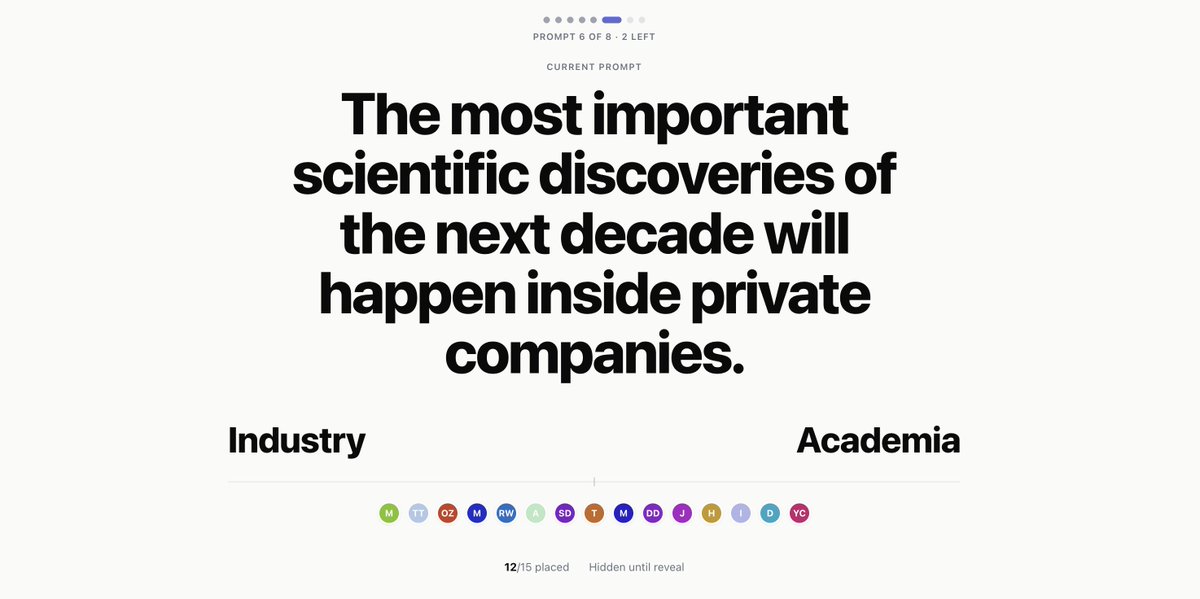
The spiciest conversation prompt at the Strange AI x Science dinner last night.
The future of science will tip towards to the private sector.
Not universities.
Not governments.
Industry.
We had a room full of scientists from top research labs who argued both sides.
The uncomfortable question:
If compute is now one of the biggest drivers of scientific progress, and private companies own most of the compute…
why wouldn’t they own most of the breakthroughs?

1
1
108
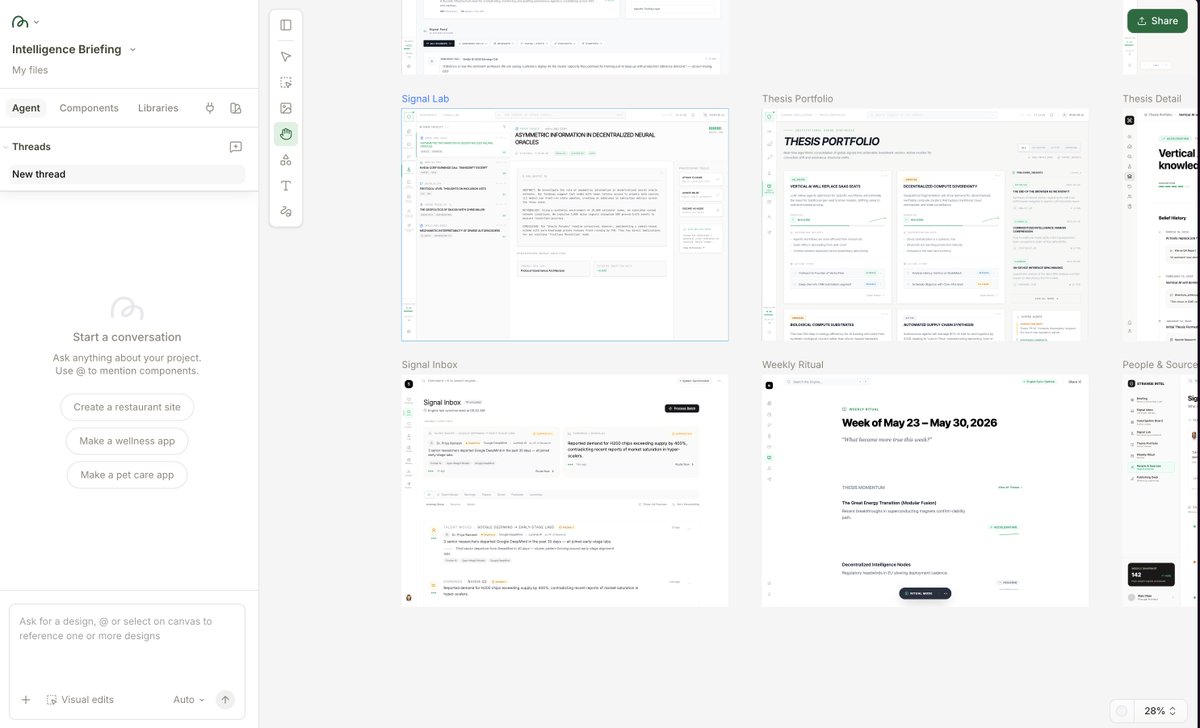
I am an avid claude code / codex user, but recently when building more complex products, find that visual prototyping is still a superior way to work through novel ideas.
Now my workflow goes from LLM (strategy) -> @MagicPath (visual prototyping) -> Code Agent (integrate backend).
Way easier to work on permutations and iterations of a concept visually than through purely text. As the old IDEO saying goes, always bring a prototype!
3
3
116
Things worth paying attention to this week:
→ Anthropic ships Opus 4.8 with Dynamic Workflows, putting verify-and-fix at every task level inside Claude Code.
→ Unitree files for a $6.2B Shanghai IPO, making Western humanoid valuations look unhinged. Figure is at $39B but has shipped fewer humanoids than Unitree did in 2025 alone.
→ Huawei unveils LogicFolding, a vertical chip architecture targeting 1.4nm-class density by 2031 without EUV / ASML. Sanctions are now shaping architecture and its design tools, spurred by the China-stack capex tailwind.
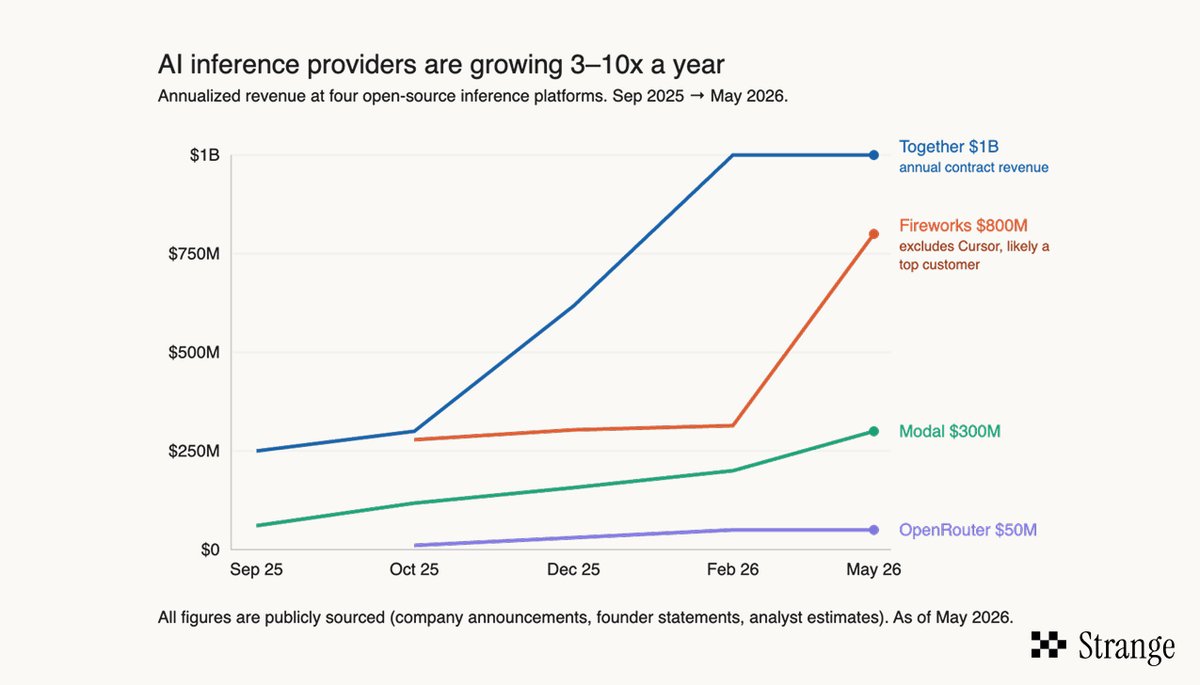
From The Review: Inference revenues went vertical in the last 12 months. Fireworks hit $800M ARR, Together signed $1B contract, Modal grew 5x. It seems like handful of token whales are driving the entire boom.
Read the full brief in The Strange Brief. thereview.strangevc.com/publ…
2
2
79
Inference companies are suddenly printing revenue.
Fireworks.
Together.
Modal.
Baseten.
Many are reporting 3-10x growth in the last 12 months.
The strange part: it doesn’t look like millions of new users showed up.
It looks like a handful of AI-native applications started consuming open-model inference at industrial scale.
A few token whales may be driving a disproportionate share of the entire inference boom, as they shift hard away from expensive closed, frontier models.
Everyone says inference is a commodity. I feel like there are still a lot of shovels left to sell in this gold rush.
1
95
Independent inference platform revenues are suddenly going hyperbolic.
A small number of AI applications or what I call “token whales” seem to be driving a disproportionate amount of demand.
And in the last year, they’ve shifting away hard from closed frontier APIs toward open-weight models plus specialized inference infrastructure. They also seem to prefer specialized services over the generalized offers of hyperscalers.
1
48
A few observations on what this means for the AI stack: open.substack.com/pub/strang…
32
One thing I keep noticing while building with AI.
the interface is no longer the product experience.
first, product needs to be multimodal and multi-channel from day one.
The real challenge is coordinating context, memory, and behavior across chat, voice, dashboards, notifications, agents.
Users expect the same intelligence everywhere.
Keeping context recent is key to product relevance.
Which means backend architecture suddenly matters a LOT more to UX than before.
Infra directly shapes product quality.
Not easy. Haven't seen anyone truly crack this yet.
1
31
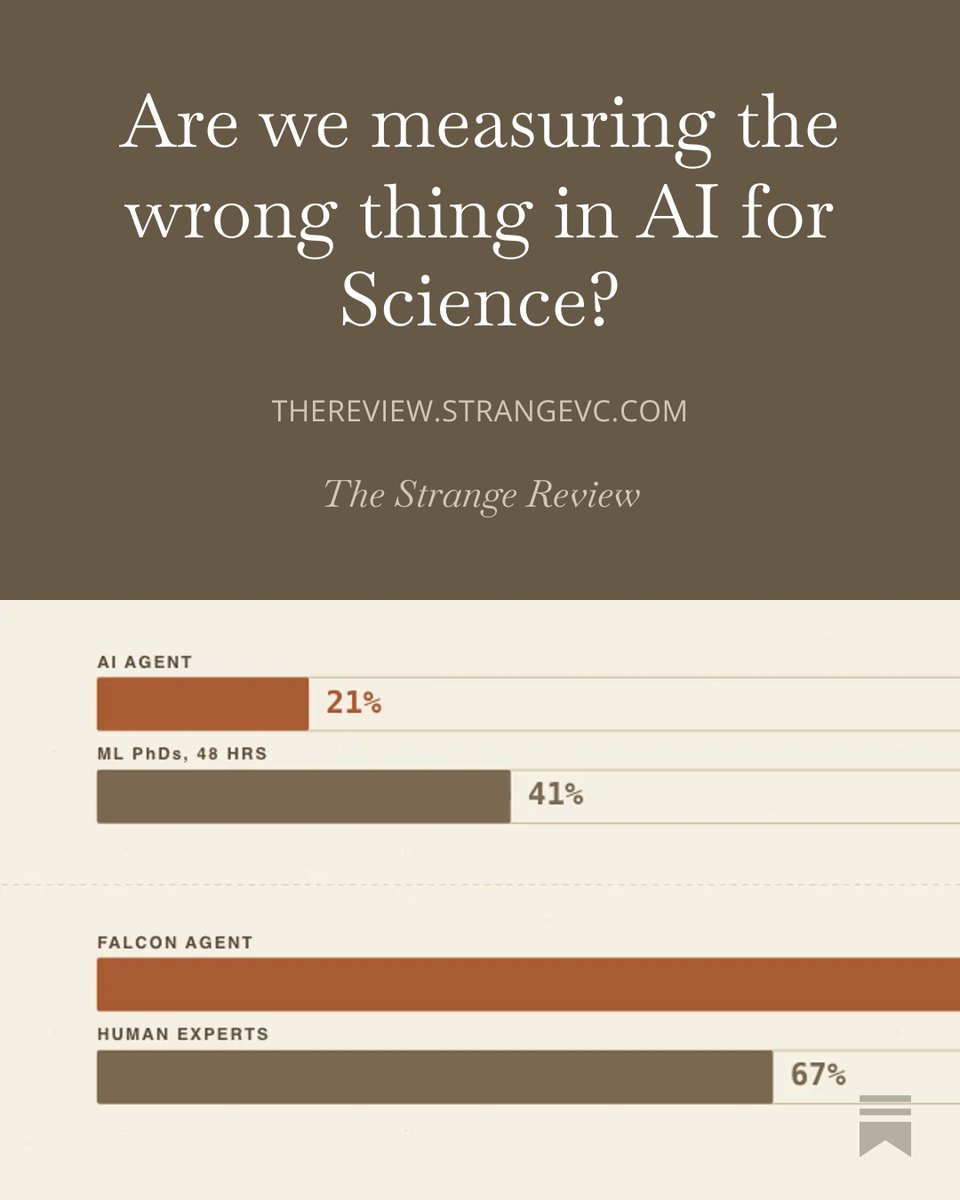
Frontier research is being disrupted as fast as SaaS startups. Is the Eureka moment obsolete?
Last week: OpenAI's general model disproved an 80-year-old geometry conjecture. Two papers landed in Nature on AI science agents, from FutureHouse and Google DeepMind.
I initally assumed it was brute force, or a lot of human hand-holding. It's neither. The model's chain of thought is a search that diagnoses its own failures and lets each one point to the next move.
Language is thinking, and thinking is language. Maybe frontier research becomes the craft of reverse engineering the discovery that AI makes.
Read the full below: open.substack.com/pub/strang…
48