
801 Photos and videos
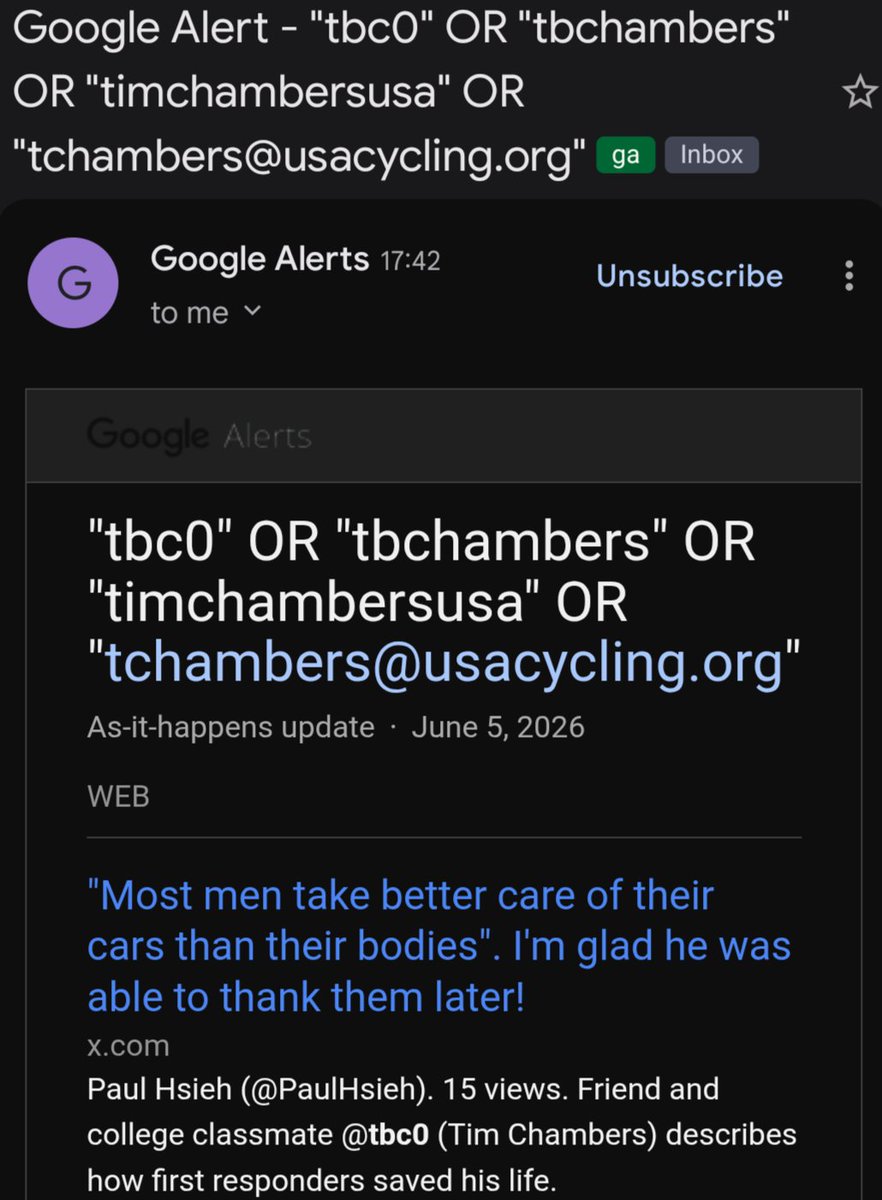










Men take better care of their cars than their own bodies. Men! Care for your bodies! Decide how these car maintenance metaphors play out for yourself. Do you wash your car? Change the oil? Replace bald tires?
Jun 4

Friend and college classmate @tbc0 (Tim Chambers) describes how first responders saved his life. Tim notes: "Most men take better care of their cars than their bodies". I'm glad he was able to thank them later!
koaa.com/news/local-news/in-…
1
2
148
Sparky retweeted

This useful feature in #handwiki is called "Publish First, Get Reviewed Later".

Unlike @wikipedia, HandWiki handwiki.org/wiki/ now implements author-owned articles with possibility of expert reviews. #handwiki #encyclopedia
29
Sparky retweeted

Jun 12
SATAN’S SUBTLETIES
Ever wonder if Demons still exist? Are they just the stuff of nightmares, or merely ancient Biblical lore now of no relevance in the age of science? The answer goes beyond a simple yes or no and does need a bit of explanation. But it also might surprise you.
In her recent First Things article Thomophobia, Mary Harrington writes this:
"To be born at all, then, the modern world had to bury Aristotle and Aquinas. To be ‘modern’ meant … discarding … act and potency, substance and accident, formal and final cause. From a stance of studied agnosticism … we would learn whatever there was to learn about the world through observation, analysis, measurement, and experiment.
“The writer Yuval Noah Harari described ... the effects of this move: ‘Modernity is a surprisingly simple deal ...[in which] humans agree to give up meaning in exchange for power’ ... Discarding … [the] older metaphysics shifted the purpose of human activity, especially of intellectual inquiry, away from the contemplation of God in his creation, toward the control and instrumentalization of that creation” (First Things, May 12, 2026).
Just for clarification, “Thomophobia” is a reference to the Aristotelian-influenced Thomas Aquinas’ classical, foundational thought/metaphysics now shunned by modernity’s rejection of pre-modern metaphysics.
The fact that the wisdom of the ages, any idea that has stood the test of time, must be dismissed as less than that which has been hatched in the last nano-second—that tried and true is necessarily less than what is new—is one of the great tragedies of our time. But is it perhaps not an accident, but rather a strategy?
Again, from her article: “Modernity is a surprisingly simple deal . . . [in which] humans agree to give up meaning in exchange for power.” The idea is that modern humanity is more focused on power than understanding foundational essences, truths, and meaning. We live in a time where what is Right and Wrong don’t matter; power and control do.
That power and control have taken center stage makes perfect sense when viewed inside the context of our culture that replaces God with science and teaches that what matters in life is self—my life is all about me; I am the center of my own universe; I am empowered and in control. Modernity has replaced the Christian Trinitarian God of Father, Son and Holy Ghost with I, Me, and Mine.
Again, accident or strategy?
Harrington’s article laments the fact that humanity has moved from a focus on metaphysics, the essence of meaning or what the world is, to a focus on power and control of the world. But what does the Bible tell us our focus should be?
We’ll need to look to the Book of Genesis, the first book of the Bible and the story of creation. In it God created Adam and Eve, humanity, in his own image as described in Genesis 1:27. In the very next verse God gives Adam and Eve their purpose; from Genesis 1:28, “… fill the earth and subdue it and have dominion over … every living thing that moves on the earth.” Subdue and have dominion over; isn’t that exactly the same thing as the power and control idea that Harrington is questioning?
No. Not even close. And here’s why.
Our place in God’s creation is that we were created to serve, and to do so out of love. Importantly, that is not love of self, but love of others. From the gospel of Matthew “And he [Jesus] said to him, “You shall love the Lord your God with all your heart and with all your soul and with all your mind. This is the great and first commandment. And a second is like it: You shall love your neighbor as yourself. On these two commandments depend all the Law and the Prophets” (Matthew 22:37-40). It could not be more clear. It’s not about power. It’s not about control. And it’s not about us.
What it is about is our responsibility to God, his creation, and our neighbor, which means all the rest of humanity. Please take note, love God and our neighbors—there is no mention of self-love in that list. That makes each of us third in a two-dog race.
The third piece of the Two Great Commandments equation—yes, we Christians love to our lists of three—is called the Great Commission: “And Jesus came and said to them, ‘All authority in heaven and on earth has been given to me. Go therefore and make disciples of all nations, baptizing them in the name of the Father and of the Son and of the Holy Spirit, teaching them to observe all that I have commanded you. And behold, I am with you always, to the end of the age’” (Matthew 28:18-20). Making disciples of all nations is about loving God above all else, living out that love of God by loving our neighbor, and sharing that love with everyone we can. Again, love is not about self, and it is never self-serving.
The modern focus on power and control rather than service to, and the cultural idea that love begins with love of self are just two examples of the ever so subtle distortion and twisting of Truth that is one of Satan’s great weapons. They are all examples of Satan's subtle strategies, effective exactly because they do not come from some wild demonic apparition of horror.
Another example is when Satan promised Adam and Eve that if only they would do what Satan told them, he would make them just like God, “… when you eat of it your eyes will be opened, and you will be like God” (Genesis 3:5). The biblical truth is that Adam and Eve, created by God in his own image, already were like God!
Satan’s Subtleties distract, distort, and destroy. And their target is never just the blink of an eye that is our mortal life, but where and with whom we will spend Eternity. So please be wary of Satan’s Subtleties and remember this:
It's not about this blink of an eye
Where we struggle so to survive
But about endless time at his side
Where forever we will thrive.
Amen
1
2
4
144


Sparky retweeted

In response to growing secular ideologies, @McCormickProf launched Fidelity Month, a time to recenter our lives on God, family, country, and community. I encourage you to take time this month to give thanks to God for His many blessings and discern ways to invest in your marriage and family, and ways in which you can support your local community.

7
26
108
7,783
Rest in peace, @UltraRob koaa.com/news/local-news/mou…
Support the family! gofundme.com/f/support-robs-…
I worked @ViaviSolutions with Rob. I was just getting to know him through his photography. His life ended too soon. Man knows not his time, indeed.
1
32
Sparky retweeted
Imagine rolling a die over and over but never seeing a 6. A natural explanation would be that the die is systematically distorted, making 6 an unusually unlikely outcome. Something similar happened at the #LHC at #CERN: So far it did not observe 4.5-sigma signals that would be expected from pure statistical fluctuations. In this note we explore this: arxiv.org/abs/2605.24441
1
71
Kudos @Copilot for aging my avatar so well. Original image is by a talented human: cartoonist Fred Eyer fredeyer.net.
17
President Said to Be Backing Off Plans for $1.8 Billion Fund After Backlash nytimes.com/live/2026/06/01/…
1
11
Now following @FidelityMonth fidelitymonth.com #FidelityMonth, not to be confused with @Fidelity or @FidelityChrtbl. I'm pleased that @JBStonestreet & @McCormickProf reminded me this morning pca.st/episode/a9a261a4-b1e1…
40
Sparky retweeted

May 26
Journalists don't even have to quote anonymous sources to engage in partisan slagging. They can partially quote you, taking you out of context and misinterpreting you.
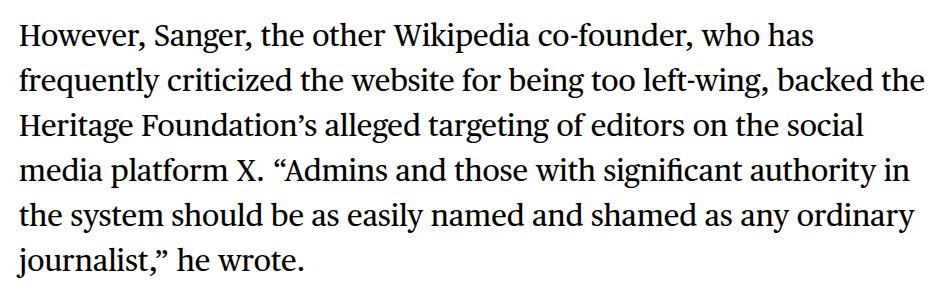
In fact, Wikipedia refused to correct their ridiculously misleading statement about me (en.wikipedia.org/wiki/Larry_…; that I "expressed support for a proposal by the conservative think tank Heritage Foundation to dox and 'target' Wikipedia editors they consider to be anti-Semitic"). In my microblog, I did not say (sangerfeed.org/6097) that anybody should be doxxed, nor did I say that just anybody on Wikipedia should be outed. I said: "There does, of course, need to be some accountability for Wikipedia editors. For one thing, admins and those with significant authority in the system should be as easily named and shamed as any ordinary journalist."
This is not the same as saying I support doxxing anybody, let alone any old editor. It is simply to endorse the same point I made later in Thesis 6 of my Nine Theses (larrysanger.org/nine-theses/).
So why did Wikipedians ignore my request for correction? Because some random journalist had declared what I meant, and—being a more "reliable source" than the person who made the statement, LOL—her analysis was used by Wikipedians who agreed with her bias. See the Bloomsbury News quote below. The irony is that she attributed my statement to "the social media platform X" when in fact I made the statement on my self-owned microblog, sangerfeed.com. That objective error shows how unreliable her analysis was. But no matter.
That's a good little microcosm of how media bias and poor reporting is amplified by Wikipedia and resists correction even by the ultimate sources themselves.
May 25

Got exposed to another funny Wikipedia trick:
A journalist can quote an anonymous source saying you said something completely absurd
Thus, Wikipedia can say you actually said the completely absurd thing
Even though this should discredit the journalist and their source, not you
8
4
40
2,169
Still biting, but makes your point. You left in one "hairless apes." We are creatures. I suppose we could call our brains "processors." They are, it seems to me, thinking apparatuses for minds / souls. My brain was injured. I am healing. I am convinced that we are not our brains.
2
1
18
Sparky retweeted

The USPS tested mail delivery by missile in 1959.
May 12

What historical fact sounds fake but is true?
23
339
3,499
256,419
Sparky retweeted
May 15
Life after (Near) Death
I love motorcycles. The bike growls, the wheels churn, the pavement blurs, and it begins. Out of the city, into the mountains, through another sweeping curve and I'm in the wind and free!
I rode for over thirty years without ever putting a bike down.
Until I did.
My injuries were not just severe, but life-threatening. While I lay helpless on the side of that Colorado mountain road, the pain was so severe that it blocked out everything else; there was nothing but pain.
And God.
The good news is, I have recovered well and I have rejoined my life much as it was before. The bad news is that "real life" dilutes that closeness I knew then with God. As that divine intimacy fades I ask myself, "What now?"
At one of his lectures, Dr. Steven Garber, a professor at Regent College, asked this question: "Now that you know what you know, what are you going to do with it?" Chuck Colson, founder of the largest prison ministry in the world, titled a book with a similar question: How Now Shall We Live?
Both question the truths of how we live our lives. Since the wreck, what I know now more than ever is that God is with us when we need him most. Many do not agree. And while that knowledge informs every choice I make, again, many doubt that God even exists.
But there is one truth with which we all agree: there is pain across all the world, suffering without measure. That truth raises another question: Why?
It's one of the toughest stumbling blocks for non-believers and one of the thorniest questions for those who do believe. What about pain? Why is there evil?
Colson's book suggests that Christianity is not just the teachings of a man, albeit a great man, or even a philosophical school of thought. His book professes much more—that despite all the suffering, Christianity is the truth about everything that is.
The claim is that God is not merely an abstraction created by man in his own image, not just a belief, but reality, The Reality ... the Creator of all that is. That again prompts the question: "Why then pain?"
Especially problematic is the assertion by those who believe that God not only is Creator of all that is, but is—despite all the pain—a loving God.
We use the word "love" a lot. At its most profound, love is not about things, but rather about relationship. Love can't be imposed and still be love, and the free will to choose to accept the love of God doesn't truly exist unless there are other choices desirable enough that they might be chosen instead of his love.
What, then, are those choices that seek to tempt us away from that relationship?
The first is when we are drawn away by something too appealing to resist. The Judeo-Christian story says that began in the Garden of Eden with Adam and Eve seduced by the serpent's promise of becoming like God. The serpent said it would be so.
He lied.
The second is when we want to leave because it hurts to stay—the problem of pain. This second roadblock to our relationship with God is the basis for the story of Job. Job's love of God faces the challenge that were it not for the perfect life that the favor of God had bestowed upon Job, he would reject God. So God permits huge pain and suffering into the life of Job. The suffering is immense, the pain real. Job stays. Satan loses. God and Job win.
It's a complicated, difficult issue that necessarily includes a discussion of love. Today we define love as being about what I feel, I want, I need, I deserve; it's all about me. Biblical love is "For God so loved the world, that he gave his only Son, that whoever believes in him should not perish but have eternal life" (John 3:16) and "greater love has no one than this, that someone lay down his life for his friends" (John 15:13). In a universe built on love, pain, willingly born for another, is a thing of beauty.
Consider this: when love is "all about me," it's not love at all, but narcissism. In such a world, there is only the prison of self-absorbed solitary confinement. Love isn't about what you get; it's about what you are willing to give. It comes down to this: love is the all-encompassing desire to be all and do all … for someone else.
Given that, perhaps the question ought not be if God loves us, but do we love God?
Do I miss riding? Yes. Will I ever get on another bike? No. Choices matter.
But can I endure even divine loneliness, until the blink of an eye that is this life is done, that I might one day kneel at the edge of eternity?
With the love of God, yes.
2
3
63
A distasteful sentence (pun intended) by @jeffjarvis in The Gutenberg Parenthesis, Afterword: And What of the Book? “Why had I not eaten my own dog food and produced it as a digital work?” #peeve
Let's all try to eat our own cooking, ok?
Searchable phrases: eat my own cooking 😁, eat our own dog food 🤮, eat my own dog food 🤮
18