International Relations, Politics, Policy, Dharma, Law •• Anekāntavāda •• @SwarajyaMag
Joined June 2013
- Tweets 20,517
- Following 990
- Followers 1,812
- Likes 22,792
1,484 Photos and videos




Pinned Tweet

3 Apr 2024
IMP THREAD ON 2024 ELECTIONS🧵
Last year, I began tweeting about 'mandate denial' and 'stolen elections' narrative (check pinned tweet). This is the fallback strategy or rather main strategy for 2024 in case PM Modi secures another clear mandate, which is highly likely.
They've been laying groundwork to label 2024 as stolen elections. I've been compiling it but it got too cluttered. So here's a reiteration in this thread 🧵. Do like and repost.👇
2
45
71
42,332
Yes. Never forget who funded propagandists like The Wire and Alt News.

When India needed investment in AI, Top Indian IT companies were busy funding Marxists via NGOs!
2
67
Come on! 🤦
Jun 13

The case for a US-India AI Trusted Corridor just became stronger. This was predicted. There is an urgent need for an export control-led conversation.
Anthropic statement:
“The US government, citing national security authorities, has issued an export control directive to suspend all access to Fable 5 and Mythos 5 by any foreign national…”
A take on a AI Trusted Corridor @orfonline
orfonline.org/expert-speak/s…
anthropic.com/news/fable-myt…
1
3
294
Anmol Jain retweeted

It goes far beyond four years. It is evident to those who have studied the US’ actions over the decades. The myth that alignment post-Soviet dissolution, post-liberalization and post-nuclear deal can meaningfully compound in the strategic domain, was going to be shown up someday. Services trade, remittances, and loose talk about a “human bridge” do not align core national interests. The story of shared interests in materially containing China diminishes in potency by the day given the speed with which China has risen and the increasing need of the US to stabilize Sino-US ties. What we are left with are the gaping holes in the relationship.
Look at India on the map, the maritime routes it straddles, the population and economic potential it has, and the veto it can exercise should it develop. It cannot be destroyed in a war because it is too large and populous. It can, however, be consistently kneecapped through proxy wars, secessionism, economic and technological constraints, disinformation operations, corruption, human capital stripping, and foreign dependencies. This has been a theme in play for over two decades. A fully sovereign India that grows to China’s economic size today by mid century irreversibly shifts the balance of power from the North Atlantic to the Indo-Pacific. This is strategically unviable for a US that depends on military, trade, technology and currency hegemony to preserve unipolarity and domestic growth.

The strategic interests of India and the US do not converge. This has been clear for the last four years. Some people who believe in a simplistic application of structural realism, according to which both countries have a common rival in China,... 1/8
10
96
211
8,354
Anmol Jain retweeted

The difference is that Indians are comfortable and can operate well in chaos. This is also why they do well in chaotic systems like spelling bees and tech companies. The chaos of Democracy is highly suited to the Indian spirit.
China, like Northern Europe thrives on order.
They do very will till chaos drops, so they have to continuously monitor and weed it out. Thus they become tyrannical eventually. People are surprised that the UK jails people for facebook posts even more than Russia or China.
A people that fears chaos will self-impose tyranny.
Jun 11

A fortnight ago, Vijay Gokhale observed that China sees Indian democracy as a long-term ideological problem.
The Chinese commentary that followed went to lengths explaining why India does not matter, why Indian democracy is a curse, and why Indian aspirations exceed Indian means.
That vehemence is a tell in itself. Indifference does not produce it.
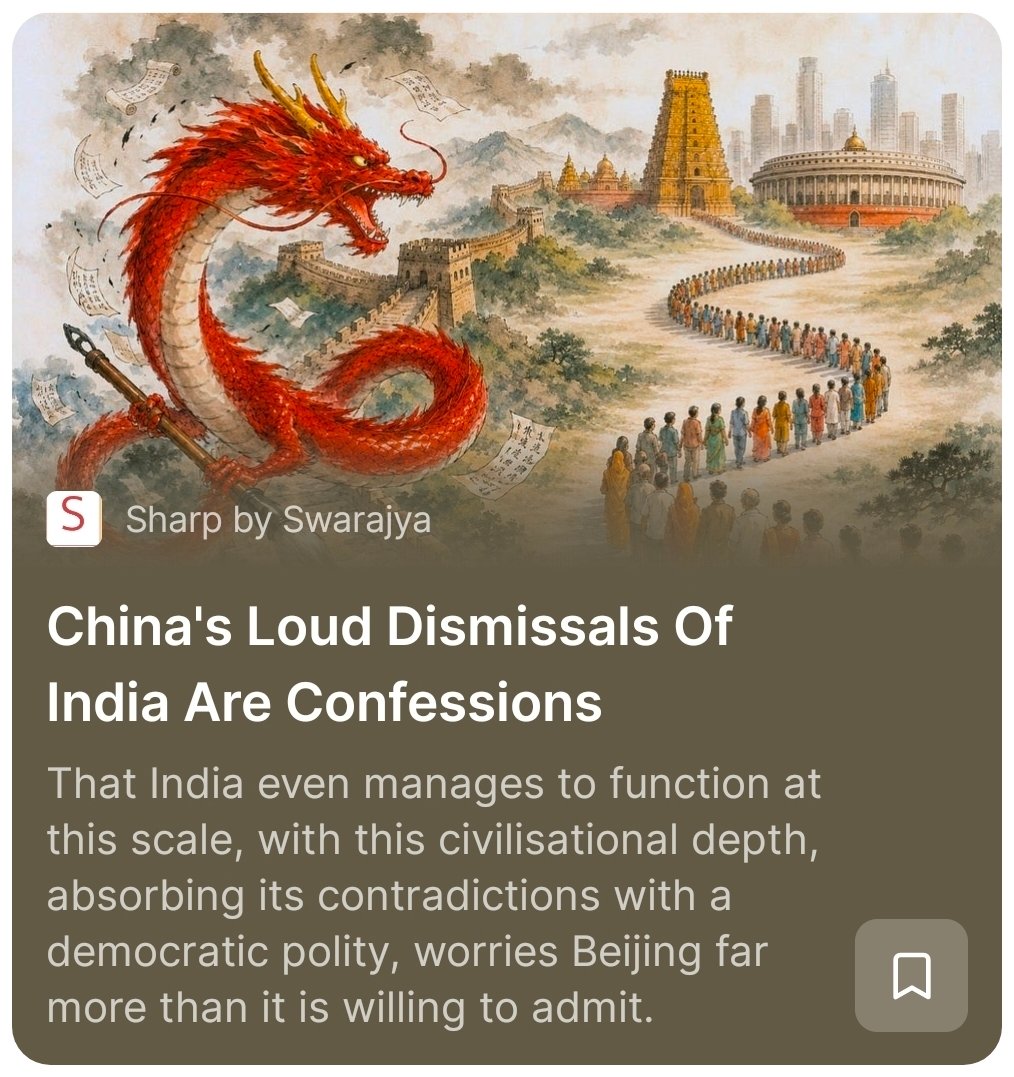
That India even manages to function at this scale, with this civilisational depth, absorbing its contradictions with a democratic polity, worries Beijing far more than it is willing to admit.
Even after decades of neutralising democratic experiments in China's near abroad (read Hong Kong), the CCP has no template to explain India to its own citizens.
A short breakdown of Beijing's anxiety in my Sharp for @SwarajyaMag — rb.gy/kmq1q7
18
77
437
21,862
Anmol Jain retweeted

23h
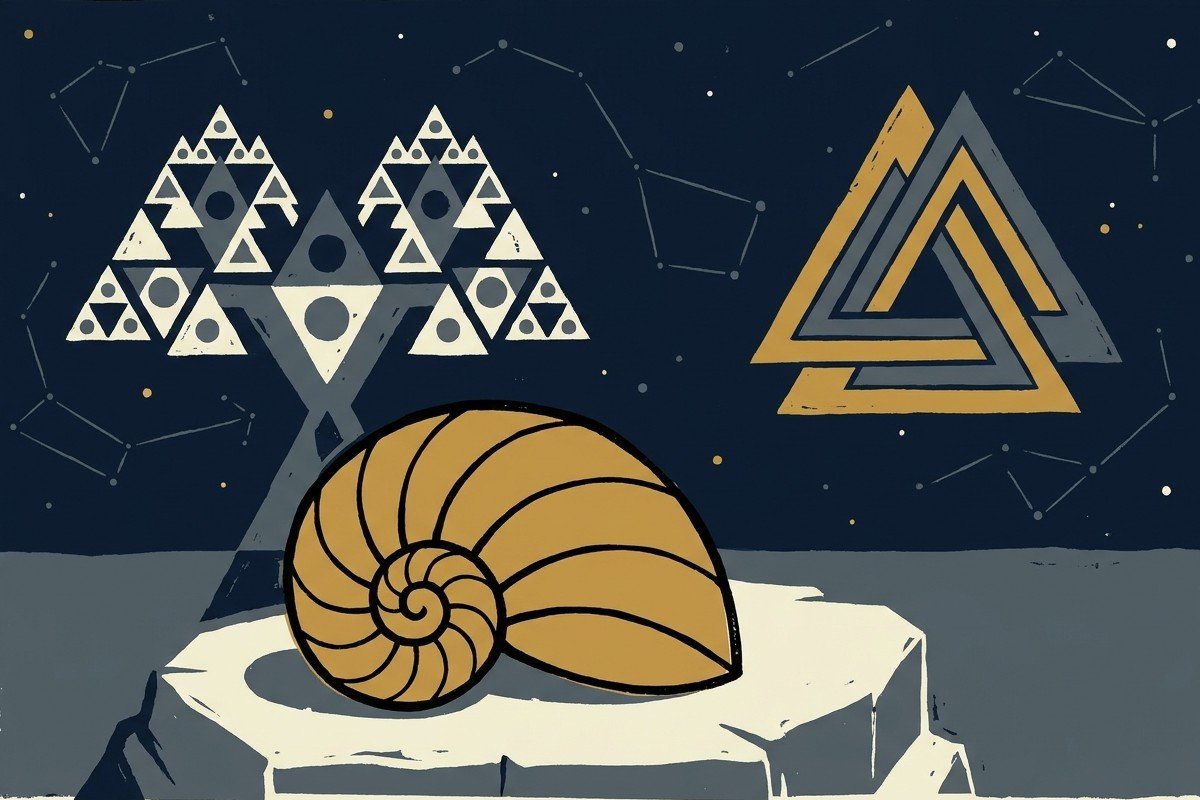
What if the universe runs on the number 2.718 instead of 0s and 1s?
A new book by computational scientist Subhash Kak argues exactly that — and uses it to explain why "threes" show up everywhere, from physics to grammar to storytelling. 🧵
@subhash_kak @arvindneela
2
29
108
9,045
Anmol Jain retweeted
Jun 13
Imagine a government office where the standard is: "You're not late until noon. You're not available after 3 PM."
Now imagine a new government threatening automatic suspension of officials if complaints aren't resolved in 30 days.
That's Bihar's latest governance experiment.🧵
9
51
343
23,931
Anmol Jain retweeted
5 Apr 2025
Let's not forget, it was Shaktikanta Das, a history graduate who turned out be one of the best RBI Governors India has ever had. Several such examples.
Ignoring humanities and leaving it to the Left is a blunder that non-Left keeps making. Again and again.
Bureaucrats from social sciences are not a problem per se. Bureaucrats from social sciences with leftist entrenchment are.
Solution shouldn't be to replace them with just technocrats. Solution is to get humanities graduates with an Indian grounding and non-left inclination to bring it out of the clutches of socialist-marxist policy paralysis.
4 Apr 2025

One way to fix bureaucracy in this country is to hire aspirants only with an engineering or management background (management should be at least an MBA), and aspirants from both fields should come with three years of work experience. This is for IAS, IRS, IPS, IFS, etc.
2
1
6
375
Anmol Jain retweeted
Jun 12
1. Says "Head of state" and then also goes on to say I'm naming no one.
2. India's head of state is not who you think it is, illiterate lady.
🤦
x.com/i/status/2065367019923…
Jun 12

Save your country from becoming a vassal state / colony because of a compromised head of state.
No one else will come to save it from the global community. Instead , they will come with straws and suck out its remaining lifeblood.
( I am naming no one, yet wait for replies; They’re gonna be confessional )
4
5
33
1,814
Anmol Jain retweeted
22 Aug 2024
Been thinking about this post which has invited varied reactions.
So while it is alright for Americans and Westerners to come to India and question our norms and traditions, but when an Indian does the same, it becomes "when in Rome do as Romans do".
Classic inferiority complex and attempts to fit in. "Oh, only he's like that. I'm not.. I pay my tips.. EVERY TIME!" Oh well, good for you and your validation project.
Those trolling him or calling him names need to check themselves for seeking American validation.
You might not agree with him, but that doesn't mean he can't have an observation on a problematic American norm. Your rants are in the line of "How dare you fellow Indian question the norms of my western buddies (or masters)? See I'm so in-tune with them. Learn from me. I'm the cool Indian."
1
5
598
Jun 13
Those who abuses Sikhs, Buddhists, Jains, Vaishnavs, Shaivas, Shaktas, Vanvaasis, or any other Bharatiya darshan, are not Hindutvavaadi or a Sanatan Dharmi.
They're a cancer to Dharmic society. Treat them accordingly.
There can be no two takes or nuance on this.
3
60
Anmol Jain retweeted

Jun 13
Sir, they have blocked access to the very AI models you said we should share instead of build
Apr 29

India doesn't need to lead the world in building the most advanced AI models. But it must lead in ensuring benefits of AI are widely shared.
@rvenk and I have an op-ed in The @EconomicTimes
economictimes.indiatimes.com…
178
2,360
11,538
403,014
Anmol Jain retweeted

Jun 12
Indian democracy is the blessing. Yes it has its own drawbacks but its role in keeping this country united and strong cant be underestimated. More importantly democracy began in India. It is our ancient heritage and we should preserve it,
Jun 11
A fortnight ago, Vijay Gokhale observed that China sees Indian democracy as a long-term ideological problem.
The Chinese commentary that followed went to lengths explaining why India does not matter, why Indian democracy is a curse, and why Indian aspirations exceed Indian means.
That vehemence is a tell in itself. Indifference does not produce it.
That India even manages to function at this scale, with this civilisational depth, absorbing its contradictions with a democratic polity, worries Beijing far more than it is willing to admit.
Even after decades of neutralising democratic experiments in China's near abroad (read Hong Kong), the CCP has no template to explain India to its own citizens.
A short breakdown of Beijing's anxiety in my Sharp for @SwarajyaMag — rb.gy/kmq1q7
3
8
44
1,336
Anmol Jain retweeted
Jun 12
Every few months, India falls in love with a new sector.
Semiconductors are the future. Then green hydrogen. Then drones. Then electric vehicles.
- Policy announcements with billion-dollar incentives.
- States competing for factories.
- Television debates buzzing with the word “ecosystem”.
But industrial success is not a reality show where governments pick winners and wait for applause.
Industrial policy works best when governments look beyond the excitement of emerging sectors and:
- start obsessing over the plumbing underneath them
- start focussing on building durable national capability
In the piece below, @anujg argues — India’s Industrial Future Depends on the Boring Stuff
swarajyamag.com/commentary/i…
16
217
938
40,601
Jun 12
Damn. This really got under their skin.
But kinda proves my point. What India does and Indians say matters to them Hans... so much. And they're bad at hiding it. 🙃
I don't at all mean to say China hasn't done economically better over the decades. Anyone with two eyes and a brain knows that.
Just that they aren't indifferent to India like they would want us to believe. The insecurities and fears hide behind that tough facade.
What I don't get, though, is why are Pakistanis and a certain bunch of Indians so butthurt?
Jun 11
A fortnight ago, Vijay Gokhale observed that China sees Indian democracy as a long-term ideological problem.
The Chinese commentary that followed went to lengths explaining why India does not matter, why Indian democracy is a curse, and why Indian aspirations exceed Indian means.
That vehemence is a tell in itself. Indifference does not produce it.
That India even manages to function at this scale, with this civilisational depth, absorbing its contradictions with a democratic polity, worries Beijing far more than it is willing to admit.
Even after decades of neutralising democratic experiments in China's near abroad (read Hong Kong), the CCP has no template to explain India to its own citizens.
A short breakdown of Beijing's anxiety in my Sharp for @SwarajyaMag — rb.gy/kmq1q7
27
33
244
14,943
Anmol Jain retweeted

Jun 12
Nobody in the world can quite get their head around India
Just when someone thinks they have finally figured us out, we do something completely out of script
For instance, in the last few years, the long-held image of a democratically chaotic India that cannot make anything happen has been replaced by a country that is building infrastructure at an impressive pace. But much chaos is still visible too
Nobody is indifferent now. They cannot afford to be.
Jun 11
A fortnight ago, Vijay Gokhale observed that China sees Indian democracy as a long-term ideological problem.
The Chinese commentary that followed went to lengths explaining why India does not matter, why Indian democracy is a curse, and why Indian aspirations exceed Indian means.
That vehemence is a tell in itself. Indifference does not produce it.
That India even manages to function at this scale, with this civilisational depth, absorbing its contradictions with a democratic polity, worries Beijing far more than it is willing to admit.
Even after decades of neutralising democratic experiments in China's near abroad (read Hong Kong), the CCP has no template to explain India to its own citizens.
A short breakdown of Beijing's anxiety in my Sharp for @SwarajyaMag — rb.gy/kmq1q7
15
27
308
46,344
Anmol Jain retweeted

Jun 6
How can ancestors be great and kafirs at the same time? Whoever wrote this brings out the hypocrisy of Jinnah nation beautifully. My two cents about this. When you were followers of santan dharma world celebrated you. Even Vishnu himself visited his disciples there. Then you...
Jun 5

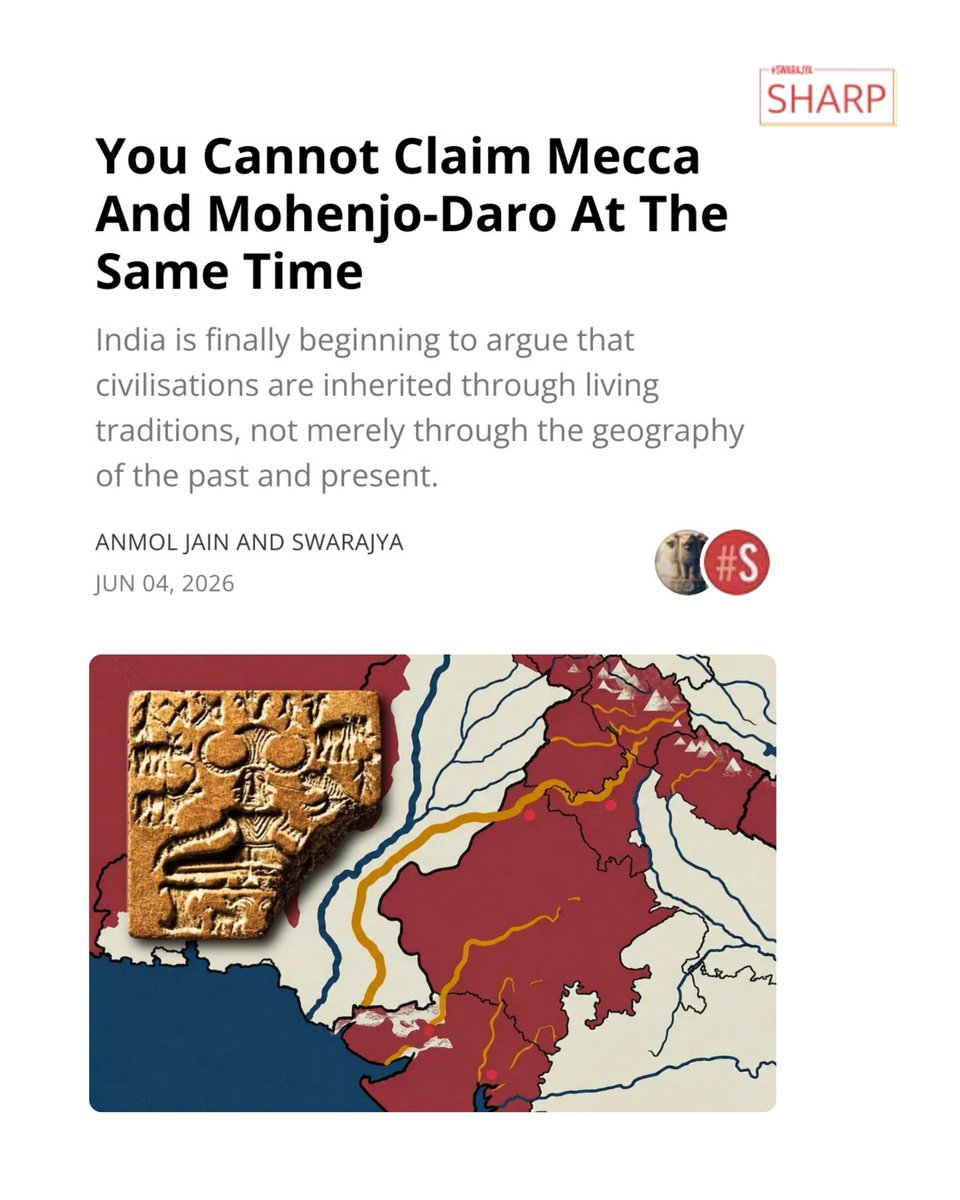
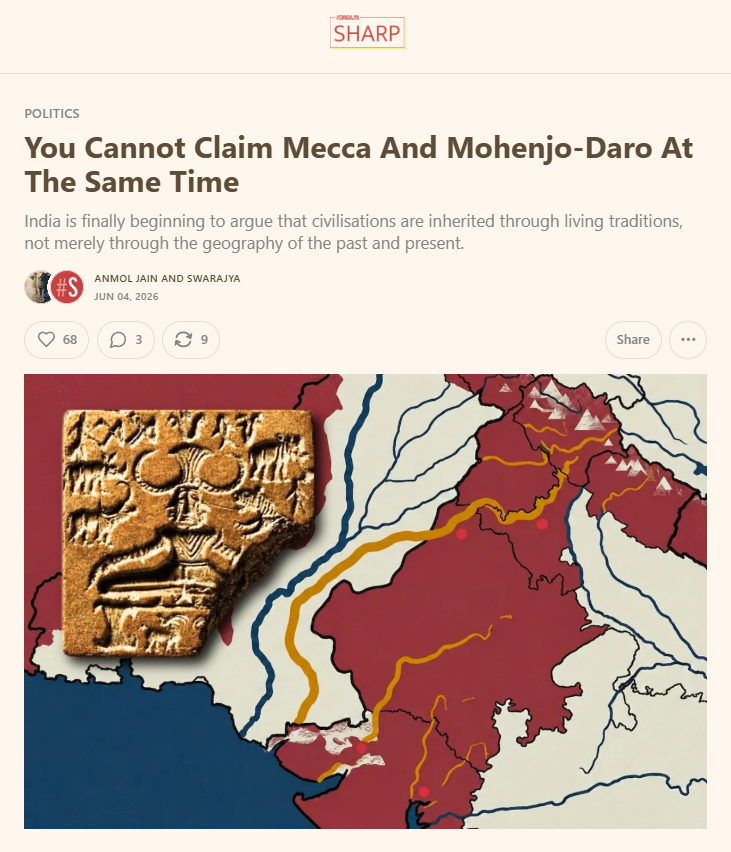
#SharpBySwarajya | You Cannot Claim Mecca And Mohenjo-Daro At The Same Time
For decades, the Indian state, when it bothered to speak of its civilisational past at all, did so in the apologetic manner. Recent posts by Ministry of Culture suggest a change. Something rare. A preemptive narrative strike.
This prompted a barrage of adverse responses, especially from across the border, stemming from the usual habit of appropriation — be it wedding rituals like Haldi and Sangeet, artforms like Kathak, or ancient heritage like Indus Saraswati Civilisation.
This Mecca-MohenjoDaro contradiction cannot be more obvious. But it has become so structural that Pakistan has stopped even noticing the absurdity in it.
The art of appropriation lies in distortion and stripping the Dharmic substrate of the inheritance, because it falsifies the founding myth of the Pakistani state.
But how can the grandparents be repudiated as kafirs in one breath and resurrected as ancestors in the next? Heritage is not a buffet from which the inconvenient theological dish may be skipped.
Read full #Sharp by @teanmol —
open.substack.com/pub/sharpb…
1
148

On point @teanmol 🙏🏿
The inheritance belongs to India because India never let go of the practice .....
The civilisational thread the dice and the seal point to is the thread of the Saraswati flowing through the Ghaggar-Hakra basin
Jun 5
#SharpBySwarajya | You Cannot Claim Mecca And Mohenjo-Daro At The Same Time
For decades, the Indian state, when it bothered to speak of its civilisational past at all, did so in the apologetic manner. Recent posts by Ministry of Culture suggest a change. Something rare. A preemptive narrative strike.
This prompted a barrage of adverse responses, especially from across the border, stemming from the usual habit of appropriation — be it wedding rituals like Haldi and Sangeet, artforms like Kathak, or ancient heritage like Indus Saraswati Civilisation.
This Mecca-MohenjoDaro contradiction cannot be more obvious. But it has become so structural that Pakistan has stopped even noticing the absurdity in it.
The art of appropriation lies in distortion and stripping the Dharmic substrate of the inheritance, because it falsifies the founding myth of the Pakistani state.
But how can the grandparents be repudiated as kafirs in one breath and resurrected as ancestors in the next? Heritage is not a buffet from which the inconvenient theological dish may be skipped.
Read full #Sharp by @teanmol —
open.substack.com/pub/sharpb…
2
3
100
Anmol Jain retweeted
Jun 12
Between January 2025 and June 2026, Pakistan placed six Earth-observation satellites in orbit.
For a space programme that managed nine launches in its first six decades, a former ISRO official has compared the new pace to a man with a walking disability outrunning Usain Bolt.
The satellites are one layer of a machine Pakistan has rebuilt in the 12 months since Operation Sindoor.
In August 2025 it stood up the Army Rocket Force Command, consolidating its conventional missiles under one operational authority.
In November the constitution was amended to create the post of Chief of Defence Forces, occupied since December by Field Marshal Asim Munir.
Brigadier Anil Raman of Takshashila has called this architecture by its right name. In contemporary South Asian crises, he writes, velocity counts for more than military power.
Crises are settled politically in their opening hours — once Washington signals nuclear risk, the space for military action closes.
That is why India keeps winning the fight and losing the crisis.
India is the stronger power by a wide margin, but its decision-making is slow. Authorising the Sindoor strikes took nearly two weeks, and Pakistan spent that fortnight selling Washington its version.
The remedy was on the table in 2021, when General Bipin Rawat proposed an Integrated Rocket Force.
Five years on, it remains a proposal — while one of India's nuclear-armed adversaries has built its complete sensor-decision-shooter chain in 16 months.
By @prakharkgupta.
swarajyamag.com/defence/behi…
17
76
264
41,841
Anmol Jain retweeted

Jun 12
The article can be accessed here - sharpbyswarajya.substack.com…. The now no more Major Maroof Raza of the Indian Army, a great strategic commentator, had once told me the same thing.
Jun 11
A fortnight ago, Vijay Gokhale observed that China sees Indian democracy as a long-term ideological problem.
The Chinese commentary that followed went to lengths explaining why India does not matter, why Indian democracy is a curse, and why Indian aspirations exceed Indian means.
That vehemence is a tell in itself. Indifference does not produce it.
That India even manages to function at this scale, with this civilisational depth, absorbing its contradictions with a democratic polity, worries Beijing far more than it is willing to admit.
Even after decades of neutralising democratic experiments in China's near abroad (read Hong Kong), the CCP has no template to explain India to its own citizens.
A short breakdown of Beijing's anxiety in my Sharp for @SwarajyaMag — rb.gy/kmq1q7
1
206
Anmol Jain retweeted

Jun 12
People fail to realise
1) the very existence of Bharat and Dharma is an existential threat to all abrahamic religions and countries
2) the very existence of India as a democracy is an existential threat to all communist countries
All their narratives fall apart vs us 1/
Jun 11
A fortnight ago, Vijay Gokhale observed that China sees Indian democracy as a long-term ideological problem.
The Chinese commentary that followed went to lengths explaining why India does not matter, why Indian democracy is a curse, and why Indian aspirations exceed Indian means.
That vehemence is a tell in itself. Indifference does not produce it.
That India even manages to function at this scale, with this civilisational depth, absorbing its contradictions with a democratic polity, worries Beijing far more than it is willing to admit.
Even after decades of neutralising democratic experiments in China's near abroad (read Hong Kong), the CCP has no template to explain India to its own citizens.
A short breakdown of Beijing's anxiety in my Sharp for @SwarajyaMag — rb.gy/kmq1q7
1
2
9
943