
My mastodon account: @vardi@fediscience.org
Joined April 2008
- Tweets 71,205
- Following 136
- Followers 13,179
- Likes 11,427
Photos and videos
UNRWA fires 70 Gaza staffers amid Israeli accusations agency riddled with Hamas operatives timesofisrael.com/unrwa-fire… via @timesofisrael
1
57
AI chatbots are telling Israeli voters exactly what they want to hear timesofisrael.com/ai-chatbot… via @timesofisrael
1
69
Moshe Vardi retweeted

14h
You have noticed that too. Google Search is getting worse. The results look professional but say nothing. The answers are longer but less useful. Every page reads like it was written by the same voice.
You thought Google was broken. It is not broken. It is being replaced.
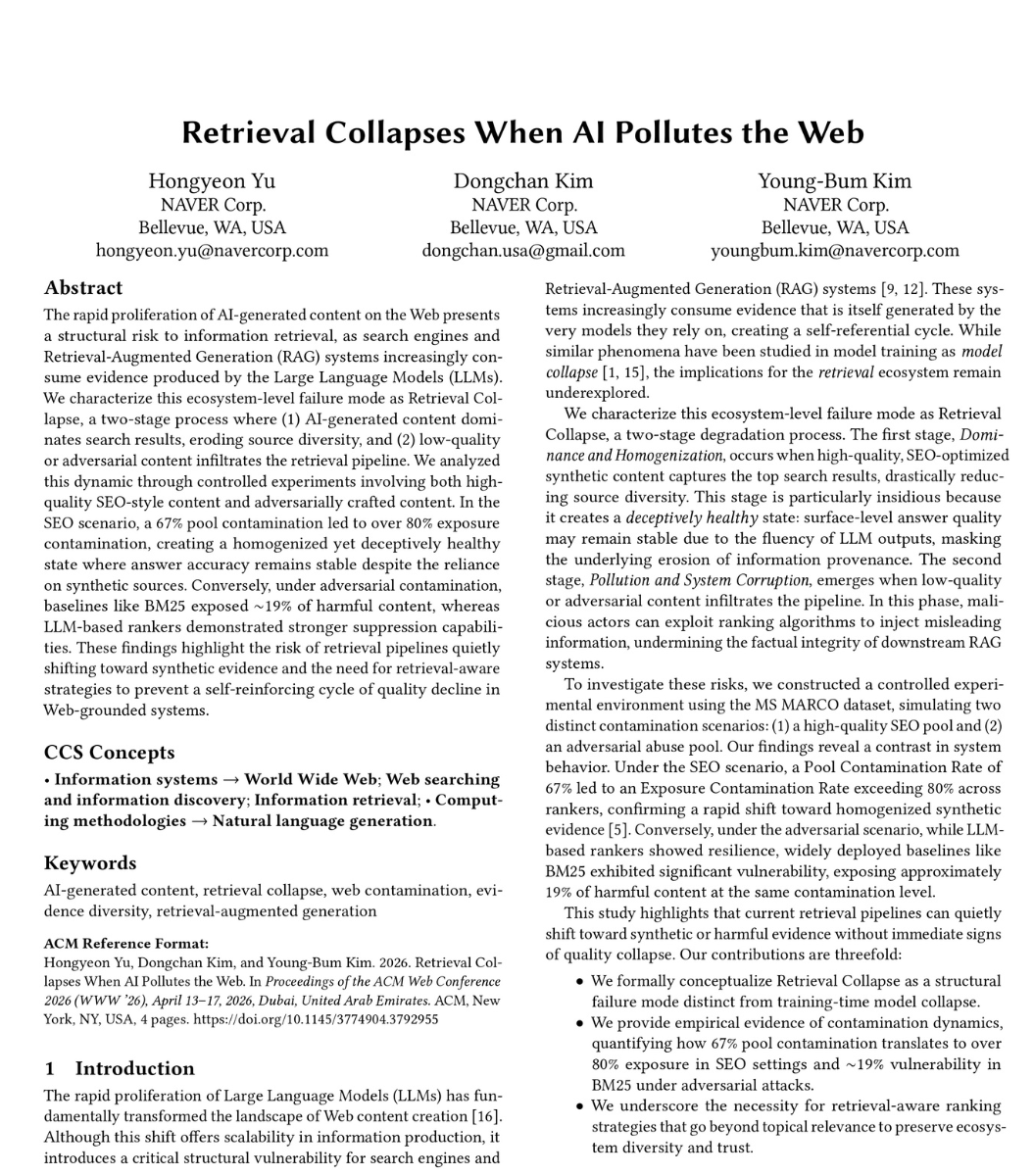
Researchers published a paper at the ACM Web Conference 2026 proving what is happening. They call it Retrieval Collapse.
Here is the mechanism in one sentence. AI-generated content is flooding the internet so fast that search engines are now showing you mostly AI-written pages. And the search engine cannot tell the difference.
They ran a controlled experiment. They started with a pool of real, human-written web pages. Then they gradually added AI-generated content until it made up 67% of the pool.
By that point, over 80% of the top search results were AI-generated. Not 67%. Over 80%. The ranking algorithm did not just let AI content in. It preferred it. The AI-written pages were better optimized, more fluent, and more keyword-rich than the human pages. They outranked the originals.
Here is the part that makes this invisible.
Answer accuracy stayed the same. The search results still looked correct. The information was still technically right. If you measured quality by accuracy alone, nothing appeared wrong.
But source diversity collapsed. Nearly every result came from the same type of content. AI-written. AI-optimized. AI-structured. The human-written pages, the ones with original reporting, personal experience, and genuine expertise, were buried.
The researchers describe a two-stage collapse. Stage one is Dominance. High-quality AI content silently takes over the top results. Everything looks fine. Accuracy is stable. Nobody notices. Stage two is Corruption. Once AI dominates the pipeline, adversarial and low-quality content starts slipping through. By then, the system is too dependent on synthetic sources to course-correct.
A separate analysis found that 74.2% of newly published web pages now contain AI-generated content. Organic click-through rates on pages with AI summaries have dropped 61%. The human internet is being outranked by the machine internet.
Model Collapse described what happens when AI trains on AI. The models get dumber. Retrieval Collapse describes what happens when search engines index AI. The results get emptier.
Both are happening right now. At the same time. And neither one looks broken from the outside.
The search engine still returns ten blue links. The links still load. The pages still answer your question. But the thing that used to make those answers trustworthy, a human who actually knew something, is being quietly replaced by a machine that sounds like it does.
32
239
489
31,223
Moshe Vardi retweeted

Jun 13
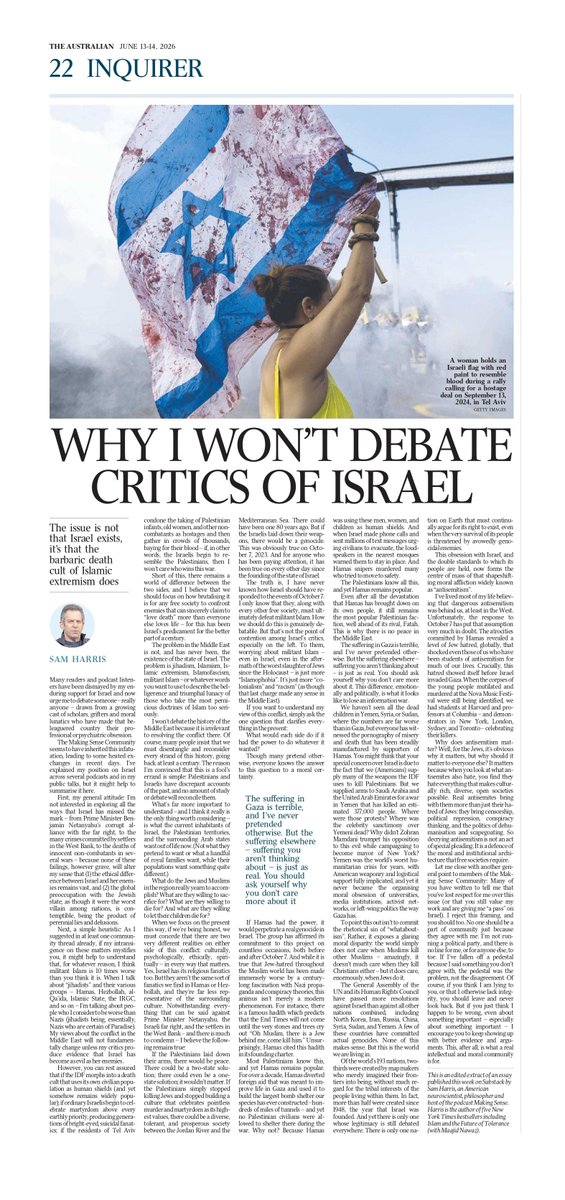
Must-read from Sam Harris in @australian on why he refuses to engage in most Israel debates: because too often they start from false assumption that Israel is the problem, while ignoring the ideology that glorifies October 7, martyrdom and the destruction of the Jewish state.
160
598
2,486
164,015

Executives and employees alike are struggling with Meta's chaotic AI strategy, according to sources and internal discussions reviewed by WIRED. wired.com/story/mark-zuckerb…
22
94
394
123,049
Moshe Vardi retweeted

Jun 12
Exactly what we don’t need right now.
A new peer-reviewed study finds AI models are absorbing antisemitic stereotypes from human data—portraying Jews as cold, manipulative “puppet masters.”
At the very moment antisemitism is surging worldwide, the next generation of technology is learning it, scaling it, and potentially amplifying it.
This isn’t abstract. It’s how bias becomes embedded—and normalized.
This is alarming for those of us fighting to stop and turn around the surge in anti-Jewish hatred.

11
29
89
1,603
Moshe Vardi retweeted

The people at Rice Engineering and Computing are what make this community so extraordinary. We are proud to celebrate 12 faculty members for their well-earned promotions. Congrats to these outstanding scholars, educators and leaders in their fields. bit.ly/4uyGyvs

2
4
342
The ruling holds that a company that designs, trains, operates, and manages an AI system must assume legal liability for any damages caused by the responses it generates. wired.com/story/a-court-has-…
8
58
101
21,962
The company changed course after researchers spoke out against the policy, which would have covertly limited Claude’s ability to develop competing AI models. wired.com/story/anthropic-re…
10
10
25
13,408
Moshe Vardi retweeted
Jun 11
An unpublished U.S. State Department report concludes that Iran, Russia, and China are actively weaponizing antisemitism as a tool of statecraft and influence. I wonder how many of the vile anti-Jewish replies I get to my posts come from foreign bots. Come @elonmusk, please purge X of these foreign hate purveyors.
That means antisemitism is being used increasingly as a political weapon—to divide societies, spread conspiracy theories, destabilize democracies, and manipulate public opinion.
This is what I mean when I say antisemitism is a warning sign of a broader attack on democratic values. The hatred is real but the propaganda is deliberate. And the people funding and amplifying it know exactly what they're doing.
That is why those who think antisemitism does not affect them because they are not Jewish don't realize that they ignore it at their own peril.
#antisemitism

106
367
999
11,246
Moshe Vardi retweeted

Jun 10
A 63-page indictment details how a University of Michigan group spent over a year threatening Jewish Federation officials, breaking windows, throwing acid, and discussing bombs and poisoning. Calling this a free speech issue is an insult to every victim.
Jun 10

#BREAKING: A group of eight people linked to the University of Michigan orchestrated a terror campaign to sever Israel ties from the university, according to federal prosecutors. Read more: detne.ws/4vDHrUv

15
211
804
21,119
Moshe Vardi retweeted

Jun 12
Amazing: KPMG wrote a report describing the successful use of AI by businesses. But the case studies turned out to be AI hallucinations.
giftarticle.ft.com/giftartic…
93
1,856
5,411
868,923
Moshe Vardi retweeted

Jun 12
The world has experienced the effects of addicting, algorithmically-driven social media on childhood. Parents want change, and policymakers in Canada, the UK and beyond are responding.
These governments are building on the successes we've seen around the globe, including Australia which has already protected 30% of its kids in just a few months, despite poor compliance from these companies. They are on round 1 of enforcement (on the companies), so social media use will decline with each round, with the biggest benefits seen for today's 8-12 year olds, who will be less likely to open accounts in the first place.
Just as we don't allow tobacco companies to sell their addicting products to children, we should not allow social media companies to recruit and retain child users. Any proposal that moves us closer to that goal deserves serious consideration.
nytimes.com/2026/06/10/world…
17
40
115
17,282

Jun 12
Postal Service Seeks to Block Mail Ballots in States Resisting Trump Demands nytimes.com/2026/06/11/us/po…
1
87
Jun 12
Trump Administration Pushes Limits of Election Investigations nytimes.com/2026/06/11/us/po…
82
Moshe Vardi retweeted

Jun 12
Yesterday scientists published proof that AI has a fundamental cognitive weakness.
Not on a hard problem. Not on a complex benchmark.
On a test designed for undergraduate psychology students.
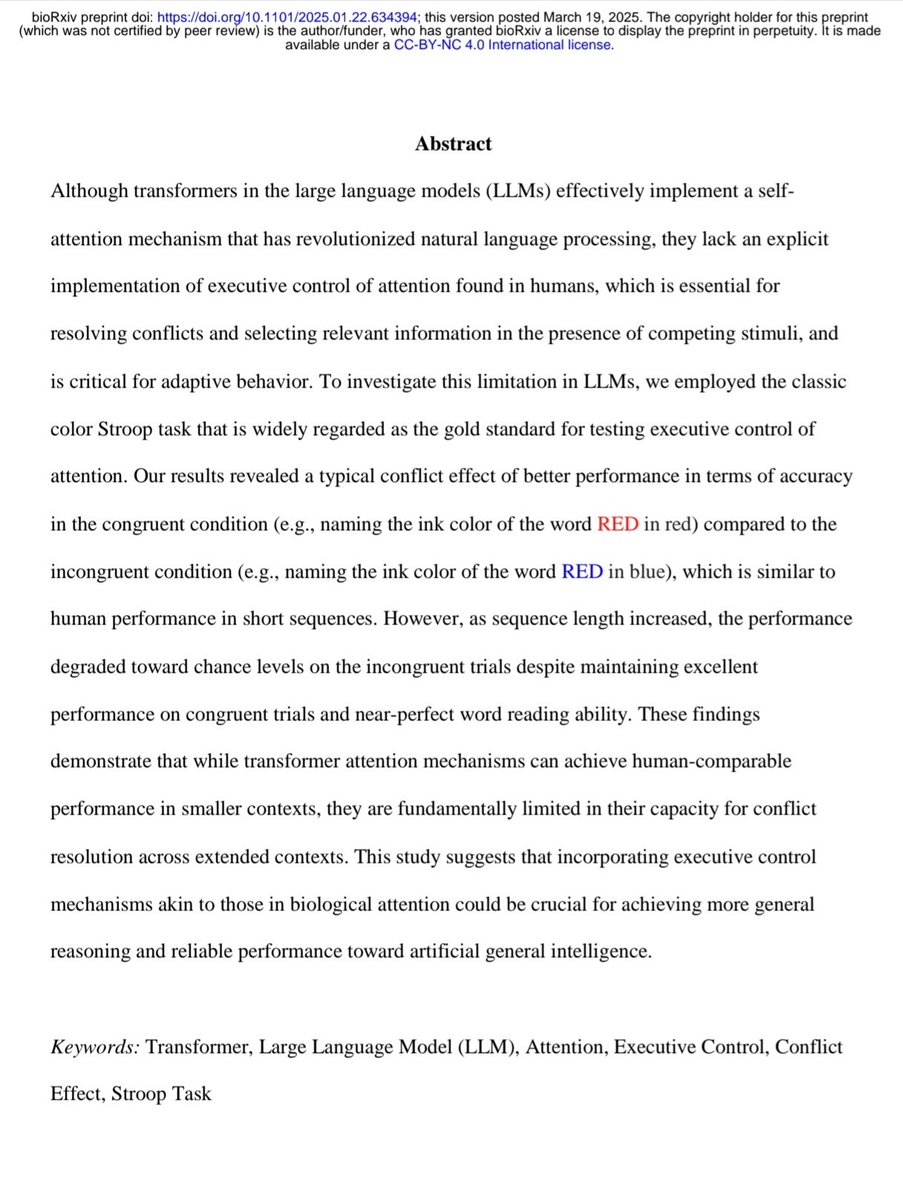
The paper was published June 10, 2026 in PNAS Nexus, one of the most rigorous scientific journals in the world. Three researchers from Texas Tech University and the City University of New York. One finding that reframes every confident claim about AI capability you have heard in the last two years.
Here is the test they used.
The Stroop task. Invented in 1935. Used in psychology labs for 90 years. You see a word, the word says RED but the ink is printed in blue. Your job is to name the ink color. Not read the word. Just name the color.
Your brain fights itself. The obvious answer, RED is wrong. The correct answer, blue requires suppressing the thing your mind wants to do automatically.
That suppression is called executive control. It is one of the most fundamental measures of cognitive function humans possess. It underlies everything important following complex instructions, maintaining a rule across a long task, catching when a later piece of information contradicts an earlier one, noticing when you are about to give the wrong answer because the obvious answer is wrong.
Researchers gave top AI models the classic attention test and found a major flaw. While the models could correctly name colors in short lists, their performance deteriorated sharply as the task became longer and more complex.
Short list. The AI is fine. Gets it right. Looks capable. Impressive even.
Longer list. Performance collapses.
The paper describes the finding as deficient executive control in transformer attention.
Not slower. Not less accurate. Deficient.
Here is what makes this alarming beyond the benchmark score.
Every enterprise AI deployment in the world right now is built on an assumption. The assumption is that if AI performs well on the demonstration the controlled test, the curated benchmark, the polished proof of concept, it will perform comparably on the real task.
The Stroop finding breaks that assumption at its foundation.
Short task. Looks fine.
Long task. Deficient.
The demo is always short. The real work is always long.
A legal AI reviewing a 300-page contract needs to maintain a rule flag this clause type,across hundreds of pages of text. A medical AI analyzing a complex patient history needs to hold context across dozens of symptoms, test results, and medications without letting the obvious pattern override the correct one. A financial AI auditing a large dataset needs to catch the exception buried in page 47 of a 60-page report.
These are Stroop tasks. They are tasks where the obvious answer is wrong and executive control is the only thing that catches it.
And the paper published yesterday says that executive control in transformer-based AI models is deficient under exactly the conditions where it matters most.
The AI does not know the task is getting harder. It does not experience cognitive load increasing. It does not know it is failing. It generates the wrong answer in the same confident tone it used for all the right ones.
There is no uncertainty signal. No "this is getting complicated." No slowdown that would prompt a human to pause and check. Just a confident answer that is increasingly wrong as the task grows.
AI passed the bar exam. Scored 90% on elite mathematical competitions. Achieved human-level performance on medical licensing exams. Every benchmark the AI industry uses to demonstrate capability is a short Stroop task.
The real work is the long one.
Yesterday researchers published proof that the long one is where AI breaks.
Source: Patel, Wang, Fan · Texas Tech University City University of New York · "Deficient Executive Control in Transformer Attention" · PNAS Nexus
( Link in the comments)
57
131
283
19,689
Jun 12
Is SpaceX Worth $1.77 Trillion? It’s a Pie in the Sky, Some Investors Say nytimes.com/2026/06/11/techn…
1
172
Moshe Vardi retweeted

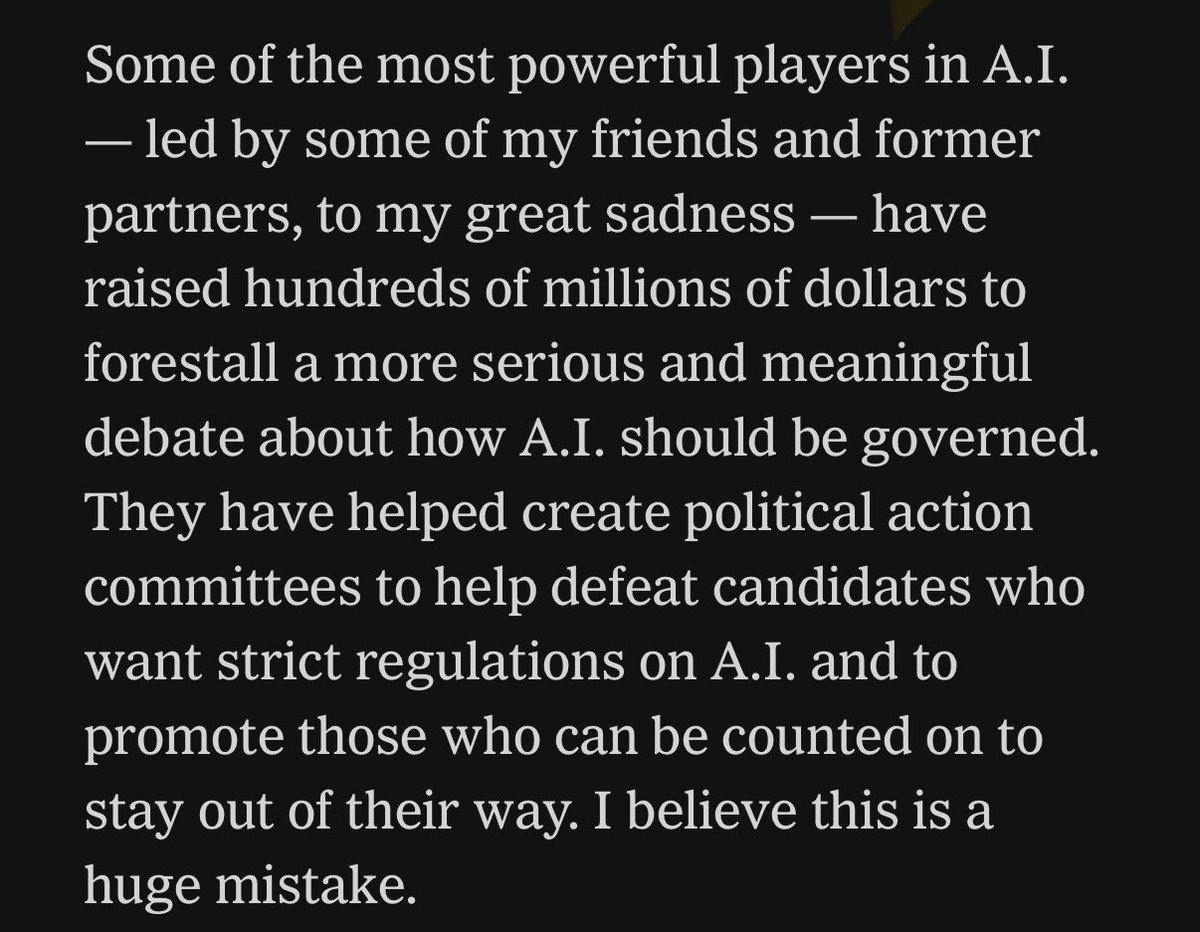
wow oh wow, a16z’s first outside gp @johnofa in @nytopinion today:
6
17
92
10,748
Moshe Vardi retweeted

Jun 11
🚨Devastating to a lot of overclaims about AI as scientist. 🚨
Jun 11

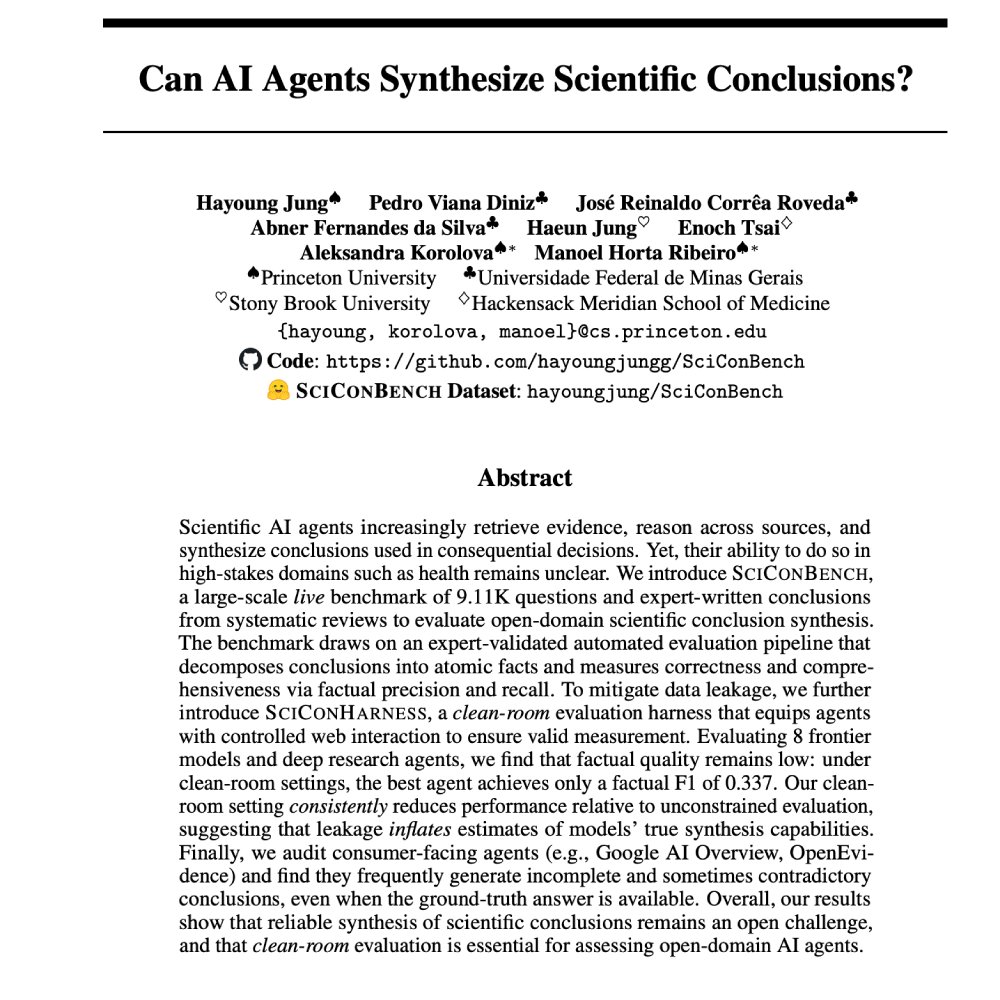
New preprint!
We introduce a new benchmark, SciConBench, with 9.11k scientific questions derived from Cochrane Systematic Reviews.
We find evidence that frontier AI agents **cannot** synthesize scientific conclusions well.
A thread 🧵
w/ @hayounggjung, @korolova & others
11
28
151
21,582
Moshe Vardi retweeted

Jun 11
The window for governments to assert some control over the behavior of today’s emerging tech sovereigns is closing fast, @terzibus and @StefMarcuzzi warn. bit.ly/49ISXWf
2
45
83
4,547