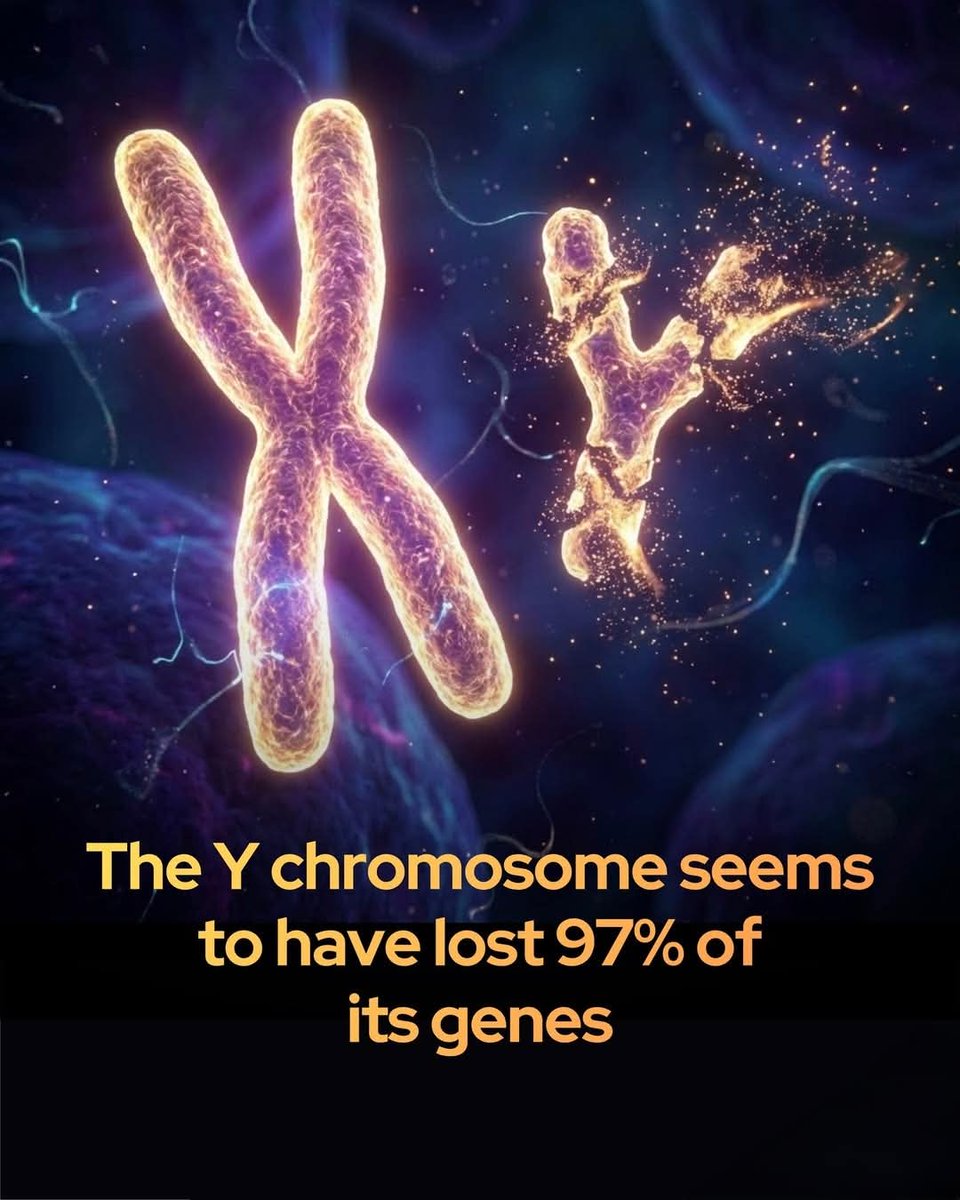
⚠️ The Y chromosome (the genetic linchpin of male biological sex) may be falling apart.
Over the past 300 million years, the Y chromosome has shed nearly 97% of its ancestral genes, raising questions about its future.
Some scientists, like evolutionary biologist Jenny Graves, suggest this trend could lead to the Y chromosome's eventual disappearance in a few million years. However, this wouldn't necessarily spell the end of maleness. Several species, including mole voles and spiny rats, have already evolved entirely new systems for determining sex after losing their Y chromosomes, offering a glimpse of what could be in store for humans.
Yet the scientific community is split. Researchers like MIT’s Jenn Hughes argue that the Y chromosome has stabilized, citing the preservation of vital Y-linked genes for over 25 million years, particularly in primates. Graves, however, maintains that genetic conservation doesn't guarantee permanence, especially under evolutionary pressures. Intriguingly, there may already be human populations operating with undetected Y-less sex determination systems, hidden from routine genomic scans. As the debate continues, scientists are closely watching the Y chromosome—wondering if it’s on the brink of extinction or simply adapting in silence.
Source: Is The Y Chromosome Vanishing? A New Sex Gene May Be The Future of Men. ScienceAlert, 2025.
ALT The Y chromosome (the genetic linchpin of male biological sex) may be falling apart.
Over the past 300 million years, the Y chromosome has shed nearly 97% of its ancestral genes, raising questions about its future.
Some scientists, like evolutionary biologist Jenny Graves, suggest this trend could lead to the Y chromosome's eventual disappearance in a few million years. However, this wouldn't necessarily spell the end of maleness. Several species, including mole voles and spiny rats, have already evolved entirely new systems for determining sex after losing their Y chromosomes, offering a glimpse of what could be in store for humans.
Yet the scientific community is split. Researchers like MIT’s Jenn Hughes argue that the Y chromosome has stabilized, citing the preservation of vital Y-linked genes for over 25 million years, particularly in primates. Graves, however, maintains that genetic conservation doesn't guarantee permanence, especially under evolutionary pressures.