
📊web3讲述者|加密& DeFi 爱好者. 拆解趋势、技 术与代币经济学
Joined July 2025
- Tweets 3,891
- Following 583
- Followers 414
- Likes 3,782
124 Photos and videos








Pinned Tweet
Robotics is entering a new phase and @axisrobotics is quietly positioning itself at the intersection of AI, automation, and real world utility.
Instead of chasing flashy demos, Axis is focusing on something more important:
→ consistent task execution
→ adaptive intelligence
→ real-world deployment scenarios
The direction is clear robots aren’t here to impress anymore, they’re here to work.
With ongoing tasks, community engagement, and incremental updates, Axis is building momentum step by step not loud, but very intentional.
In a space full of hype, that kind of execution stands out.
@plpiaoliang @0xsexybanana
@chris_anm01 @irisle_growth
@LihThooi
Mar 31

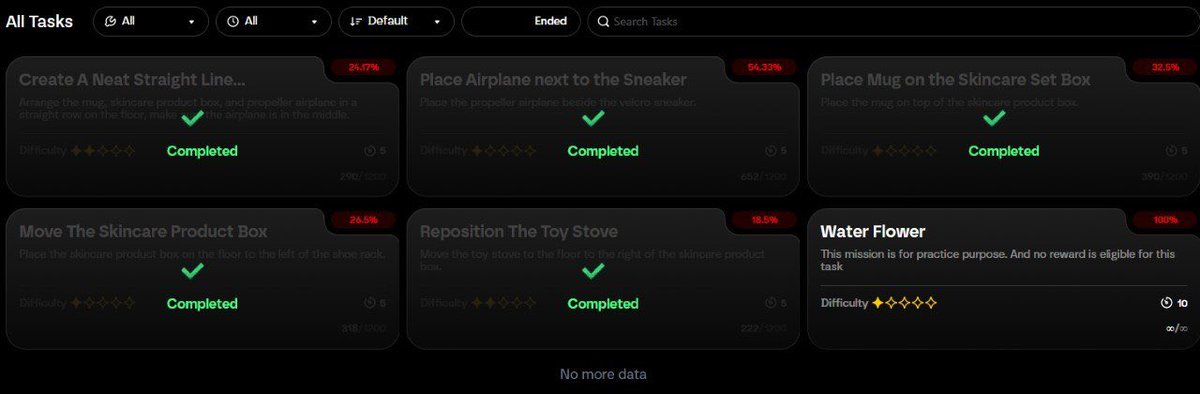
🚨 5 NEW MISSIONS JUST RELEASED 🚨
@axisrobotics isn't slowing down they're doubling down.
More missions = more opportunities to participate, learn, and earn rewards.
If you've only been watching from the sidelines, this is your chance.
Hurry up because there are limited opportunities!
Don't give up halfway.
@plpiaoliang @0xsexybanana
@chris_anm01 @irisle_growth
@LihThooi
1
1,051

Jun 11
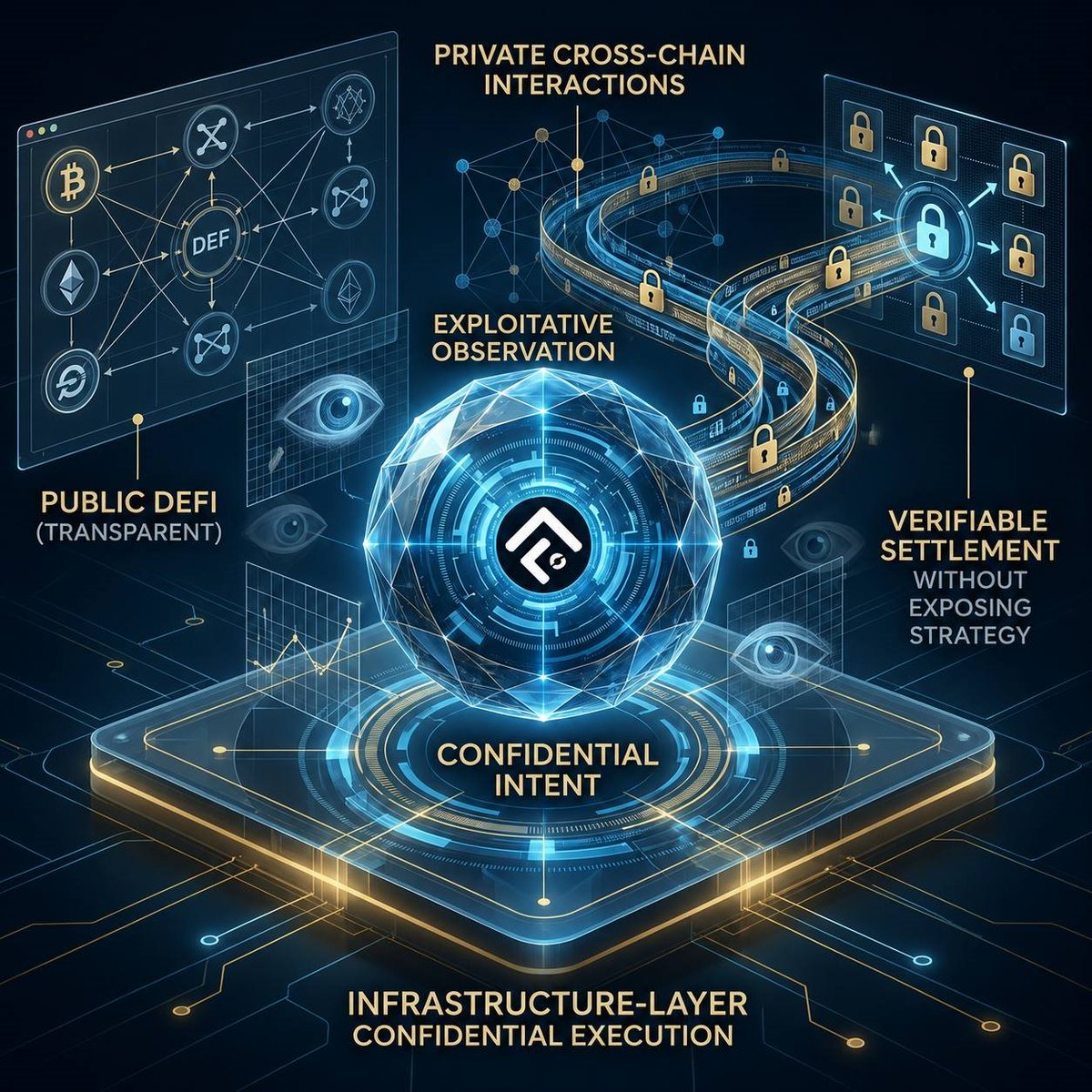
What caught my attention recently is Fluton’s focus on the next wave of onchain activity: AI agents.
As autonomous agents begin trading, managing capital, and interacting with protocols, public execution becomes a major weakness.
1
1
3
Jun 11
Fluton aims to enable private execution while still settling across existing blockchain networks.
The future of Web3 won’t just be multichain.
It will be private by default.
And Fluton is positioning itself as a key piece of that future.
2
Happy Sunday legend
Privacy is becoming one of the most important missing pieces in DeFi.
That’s why @FlutonIO caught my attention.
DeFi doesn’t lack liquidity it lacks coordination.
@FlutonIO is building for that exact problem.
Most protocols compete for the same capital.
Fluton focuses on moving it better.
1
1
145
Instead of forcing users to choose between yield and confidentiality, Fluton is building encrypted DeFi infrastructure where vault strategies, balances, and allocations can remain private while still generating onchain yield.
1
5
As more institutional capital looks toward DeFi, confidential execution may become a necessity rather than a feature.
The future of DeFi isn’t just higher yields.
It’s smarter, private, and secure by design.
4
DeFi doesn’t lack liquidity it lacks coordination.
@FlutonIO is building for that exact problem.
Most protocols compete for the same capital.
Fluton focuses on moving it better.
2
2
279
Think:
→ Liquidity that actively works
→ Strategies that evolve, not just execute
→ Capital that reallocates itself, not sits locked
1
9
This is the shift:
Static pools → adaptive liquidity layers
And that’s where the edge is.
Because the next phase of DeFi isn’t about more assets it’s about better capital orchestration.
9
Richman 长富 万盛 retweeted

May 16
Thuận theo trend buildX, kết nối anh em tích xanh VN
Nay mình sẽ giveway 10 gói X premium 1 năm cho ae VN.
Bước 1: follow đăng kí tài khoản trên nền tảng V98CheoX tại đây: @v98cheoxclub ( check link ở bio acc này)
Bước 2: like cmt và retweet bài này
Bước 3 : comment kèm username X ở bài này trong channel tele:
t.me/V98StoreGPM/1033
12 h trưa mai chốt nhé anh em
Chúc anh em build X VN thành công

137
41
273
9,911
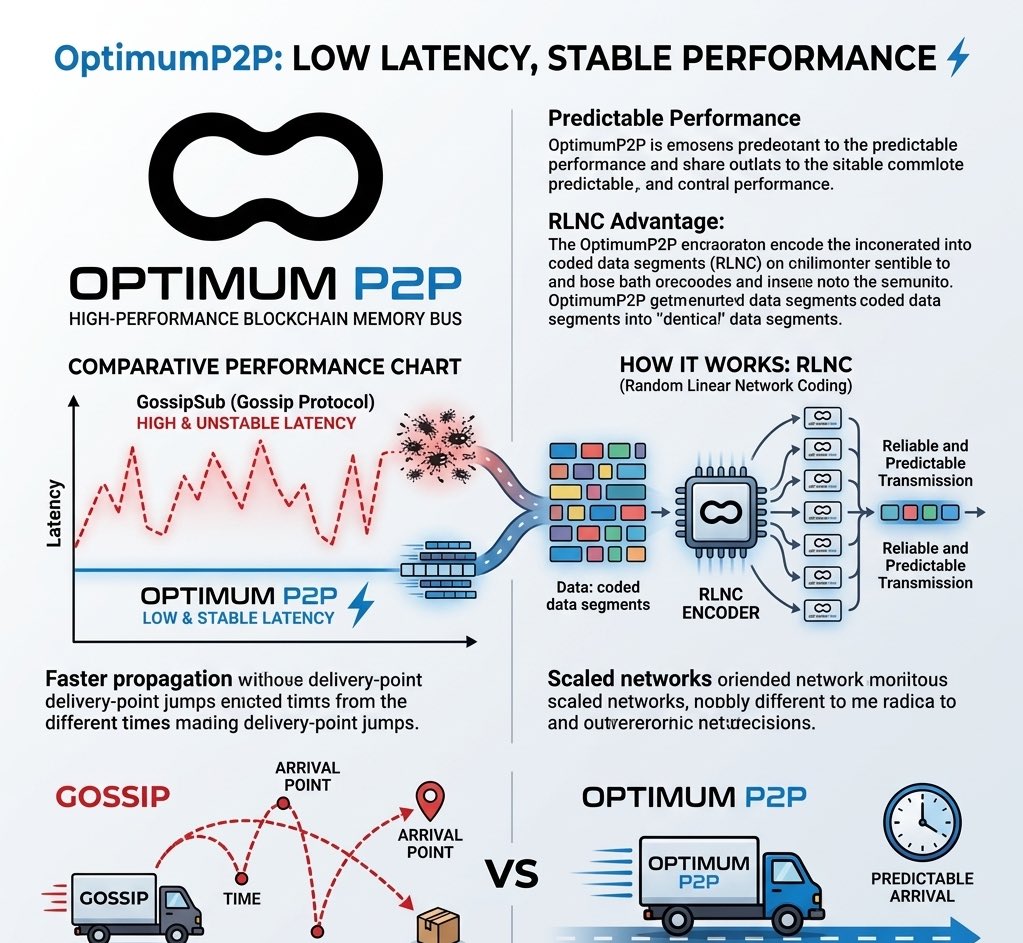
OptimumP2P: Low Latency, Stable Performance
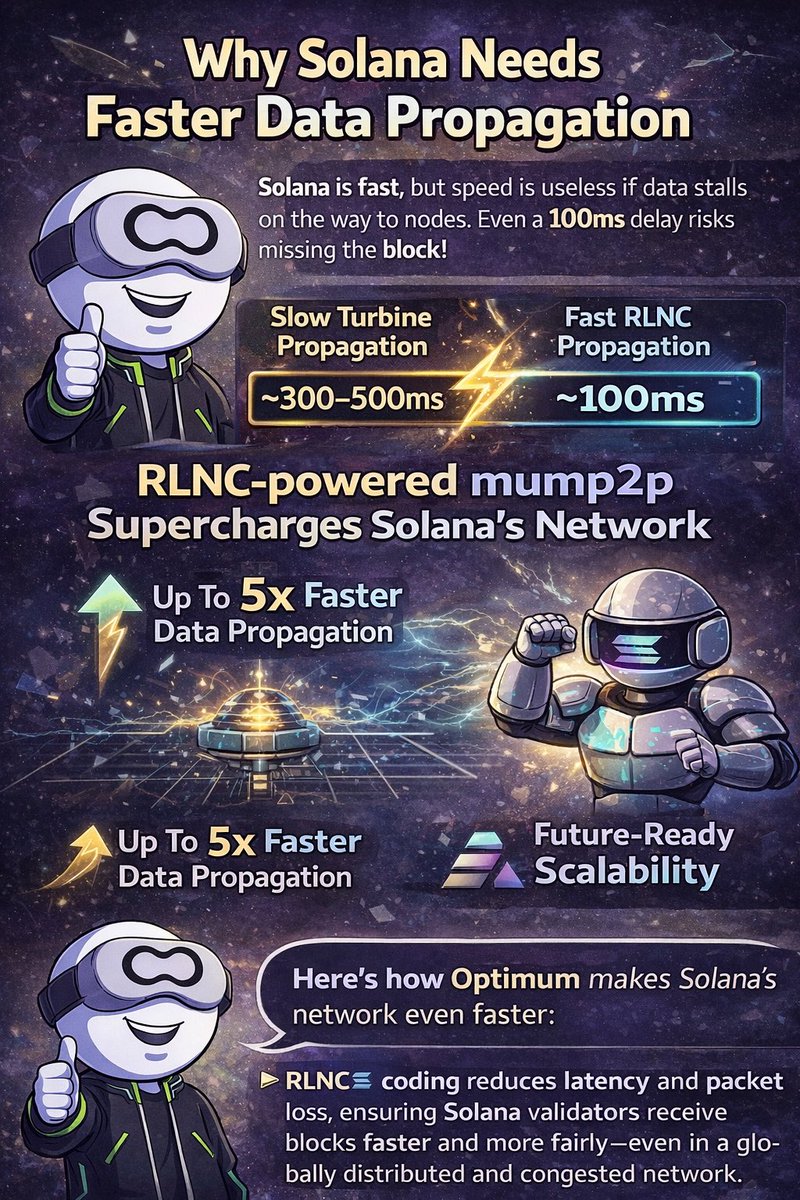
One of the biggest advantages of OptimumP2P (also known as mump2p) is its consistent and predictable performance no matter the data size or network conditions.
Unlike traditional gossip protocols like GossipSub, which often suffer from “on-off” lag (sometimes fast, sometimes painfully slow), OptimumP2P delivers stable transmission speeds thanks to Random Linear Network Coding (RLNC).
Simple analogy:
• Old networks → Shipping packages where delivery time is unpredictable (some arrive in 2 days, others in a week).
• OptimumP2P → Reliable courier service that almost always delivers in the same predictable time.
The results?
• Faster block and transaction propagation
• Smoother validator performance with fewer missed slots
• Much easier to optimize and scale the entire network
This is why OptimumP2P is becoming the high-performance memory bus for blockchains replacing outdated gossip with intelligent, coded data movement.
@get_optimum
@aqccapital
@ada_pegasus
Momentum is building behind @get_optimum and the latest updates show a team moving both fast and quietly.
From the ground at EthCC 2026 in Cannes, Optimum is actively expanding its network, forming the kind of partnerships that don’t make noise… but matter long term.
Back to the community side:
⚡ Treasure Hunt 4 is coming
Not just another task this one is designed to be tough, deeply tied to Latency Lords, and built for those who really understand the system.
⚠️ Purges are real
No announcements. No warnings.
Higher roles now come with higher expectations activity isn’t optional, it’s the price of future access.
🧩 FlexNodes nearing completion
After partner testing wraps, broader community access is next.
This is where things shift from theory → to real infrastructure.
The pattern is clear:
Less noise.
More execution.
And for those paying attention… the upgrades are already happening.
1
2
350
I just inscribed my message on the Quip Network Genesis Block! Join the quantum revolution: account.quip.network/inscrib… x.com/quipnetwork/status/203…
Mar 16

New quest live: Make quantum history and inscribe your message on the Quip Network genesis block.
> Leave Your Mark
quest.quip.network
1
27
Richman 长富 万盛 retweeted

Apr 3
56
24
184
6,470
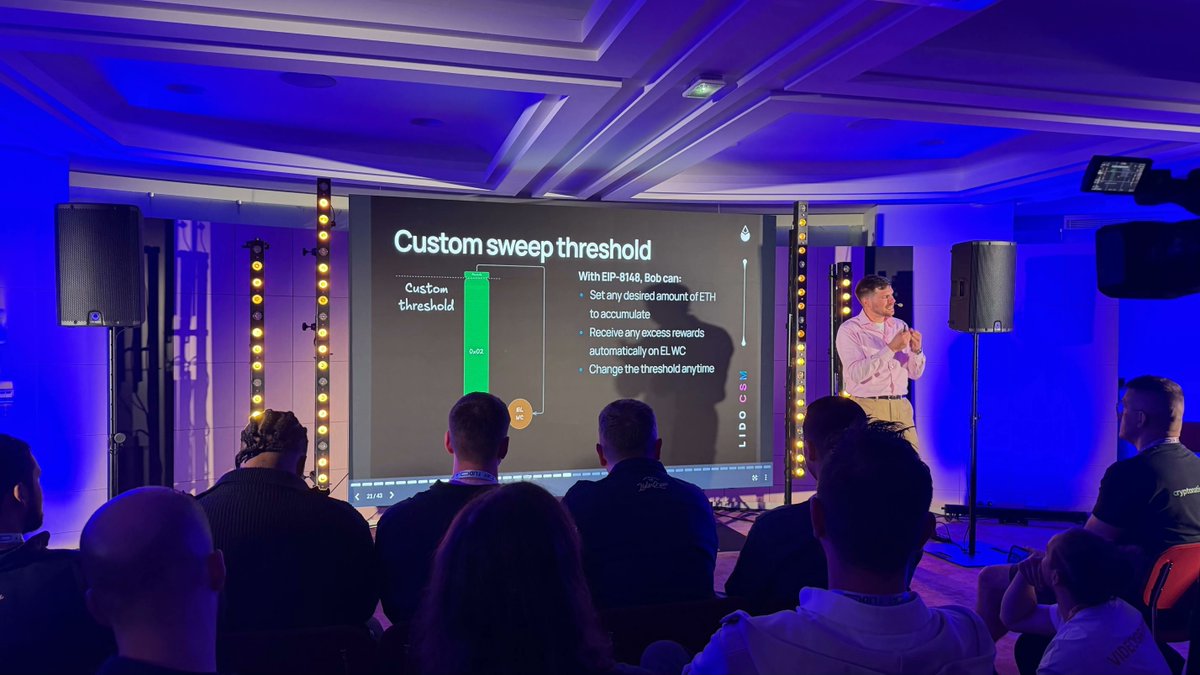
Momentum is building behind @get_optimum and the latest updates show a team moving both fast and quietly.
From the ground at EthCC 2026 in Cannes, Optimum is actively expanding its network, forming the kind of partnerships that don’t make noise… but matter long term.
Back to the community side:
⚡ Treasure Hunt 4 is coming
Not just another task this one is designed to be tough, deeply tied to Latency Lords, and built for those who really understand the system.
⚠️ Purges are real
No announcements. No warnings.
Higher roles now come with higher expectations activity isn’t optional, it’s the price of future access.
🧩 FlexNodes nearing completion
After partner testing wraps, broader community access is next.
This is where things shift from theory → to real infrastructure.
The pattern is clear:
Less noise.
More execution.
And for those paying attention… the upgrades are already happening.
1
571



Richman 长富 万盛 retweeted
Apr 1
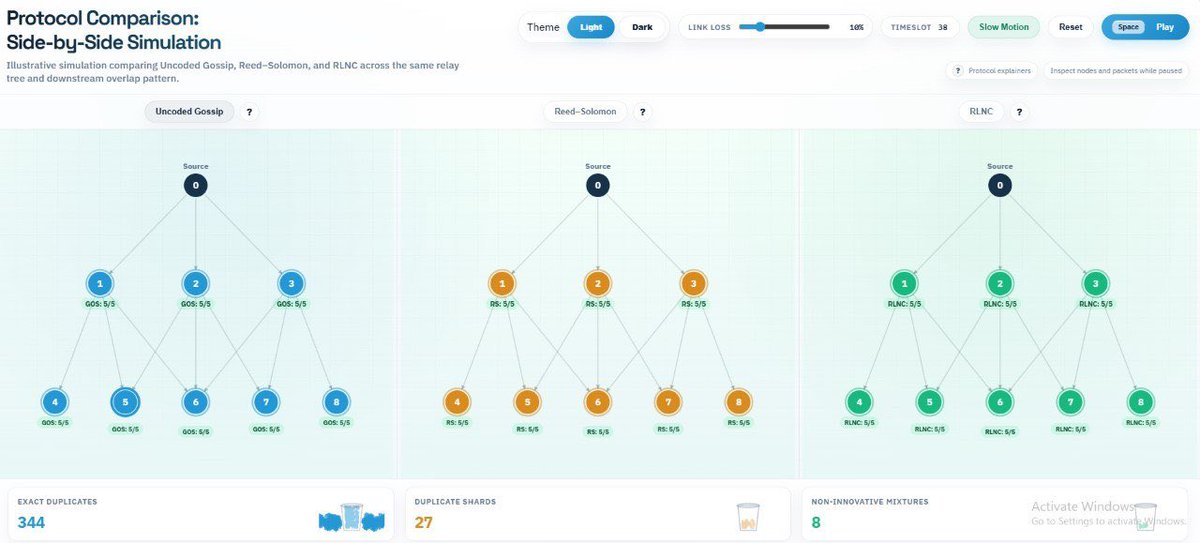
The fatal flaw of Reed-Solomon codes:
When using an end-to-end code like RS, the bandwidth costs of dealing with cumulative data losses rise with the size of the network, limiting the network's throughput at scale.
Don't waste bandwidth using outdated codes, choose RLNC ♾️
31
27
123
4,535
Richman 长富 万盛 retweeted
Mar 26
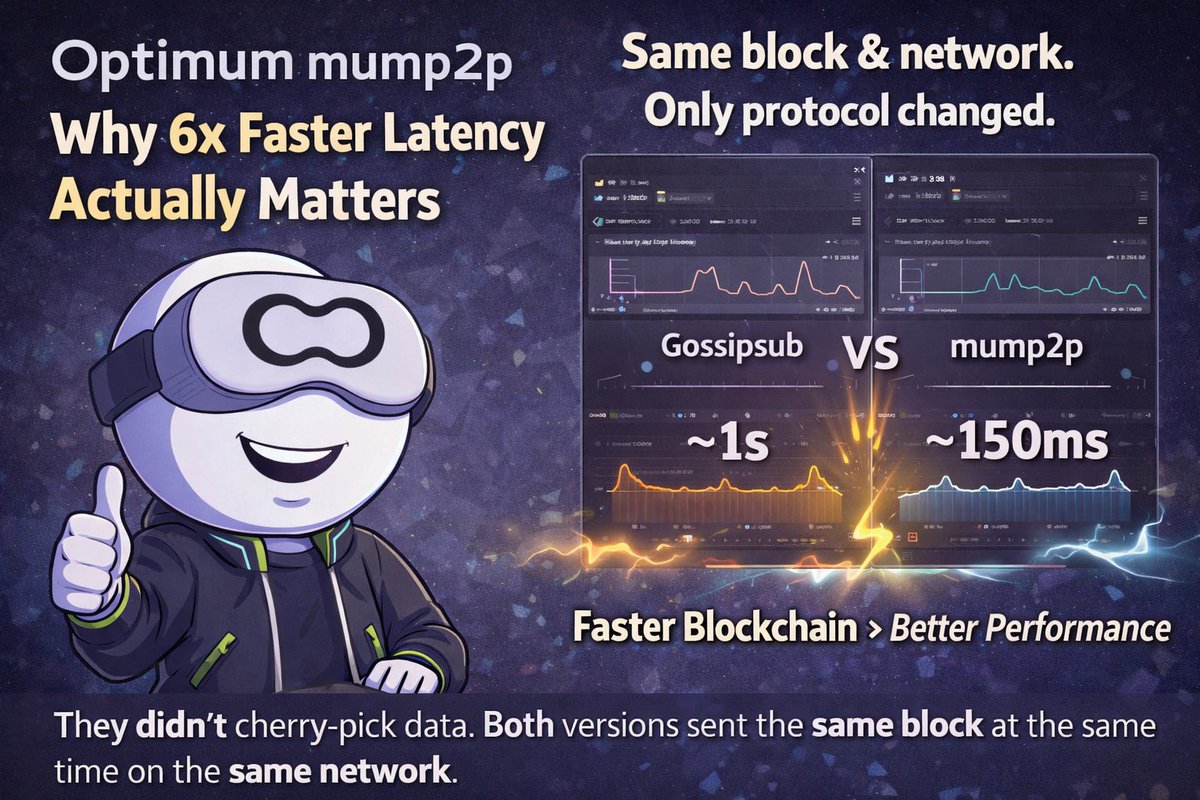
Optimum mump2p: Why 6x Faster Latency Actually Matters
Speed claims in crypto are easy.
Proving them fairly is the hard part.
That’s what @get_optimum did with mump2p on Ethereum Hoodi testnet showing ~150ms block propagation vs ~1s with traditional systems.
But the real story isn’t just “6x faster.”
It’s how they measured it.
>>> Measuring Speed Without Bias
Instead of comparing different conditions,
Optimum used a dual path system:
→ the same block
→ same time
→ same network conditions
was sent through:
•standard Gossipsub
•mump2p
across 30 global nodes
This removes cherry picking completely.
Only the protocol changes nothing else.
>>> The Result
•mump2p: ~150ms average latency
•Gossipsub: ~1 second baseline
Even with cross continent delays,
mump2p stays around 200–250ms spikes
→ still significantly faster
→ more stable under real-world conditions
And importantly:
6x is a conservative number.
>>> Why This Matters
Faster propagation isn’t just technical.
It directly impacts:
→ validators get more time to attest
→ higher inclusion rates
→ better performance during congestion
In simple terms:
faster data → better block quality → better chain performance
>>> The Bigger Idea
Most scaling solutions sacrifice decentralization.
Optimum takes a different path:
Using advanced data propagation (like RLNC),
they make networks faster without reducing validator diversity.
>>> Simple Takeaway
mump2p isn’t just about speed.
It’s about proving that:
you can scale blockchain performance
without compromising decentralization.
And if that holds this becomes a core upgrade layer for the entire ecosystem.
@aqccapital @tgogayi @cryptooflashh
@f1nk1r @CryptoSundayz @ada_pegasus
Mar 25
Decentralize to Scale: How @get_optimum Is Rewriting Blockchain Infrastructure
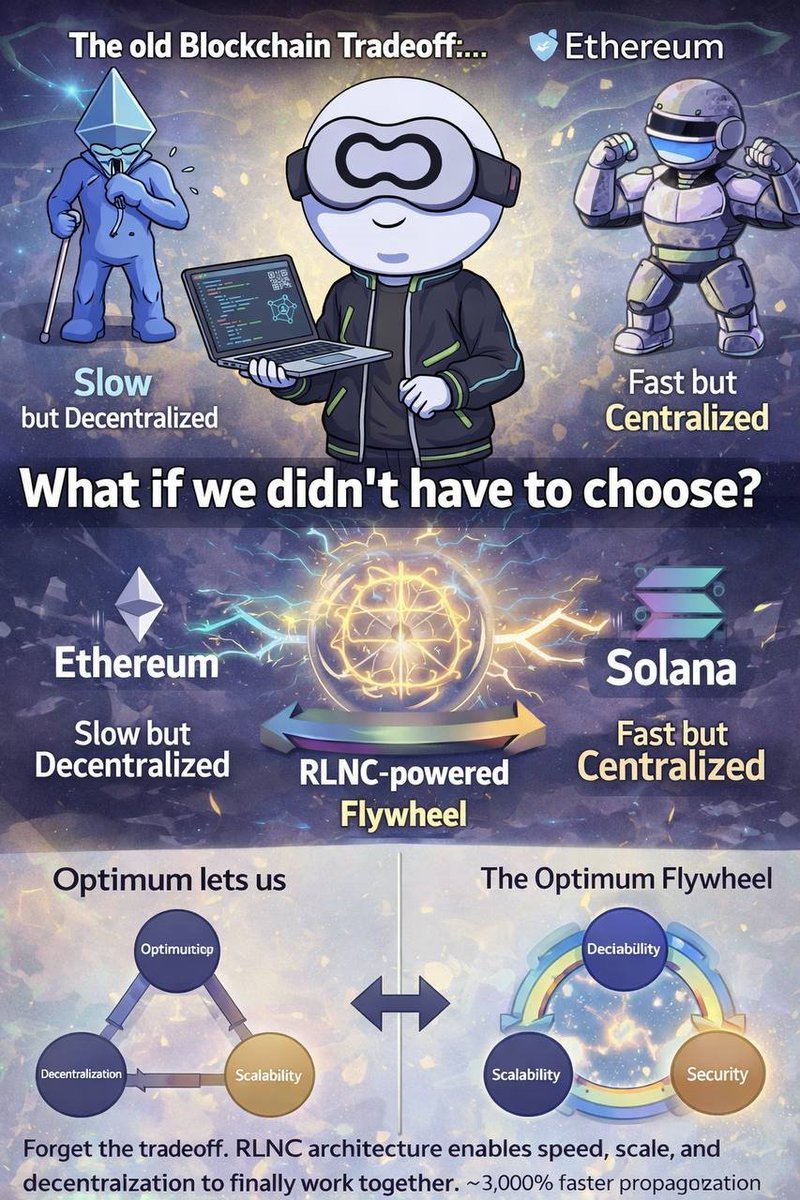
For years, blockchain scaling has been framed as a tradeoff.
You either choose decentralization secure, resilient, but slower…
or scalability fast, efficient, but more centralized.
From Ethereum to Solana, every major chain has navigated this balance differently.
But the core limitation has remained the same:
You can’t maximize both at least, not with traditional architecture.
The Problem: A Structural Bottleneck
At the heart of blockchain performance is data propagation.
Before a transaction is confirmed,
it must be shared across nodes in the network.
Current systems (like gossip-based protocols) struggle as networks scale:
→ higher latency
→ bandwidth inefficiencies
→ bottlenecks in global distribution
This is where the tradeoff begins.
To go faster, networks often:
• increase hardware requirements
• reduce validator diversity
• concentrate power
Which ultimately weakens decentralization.
>>> Optimum’s Approach: Flip the Tradeoff
@get_optimum introduces a different thesis:
Decentralization should not limit scale it should enable it.
Instead of optimizing around constraints,
Optimum redesigns how data moves across the network.
The key lies in a concept called
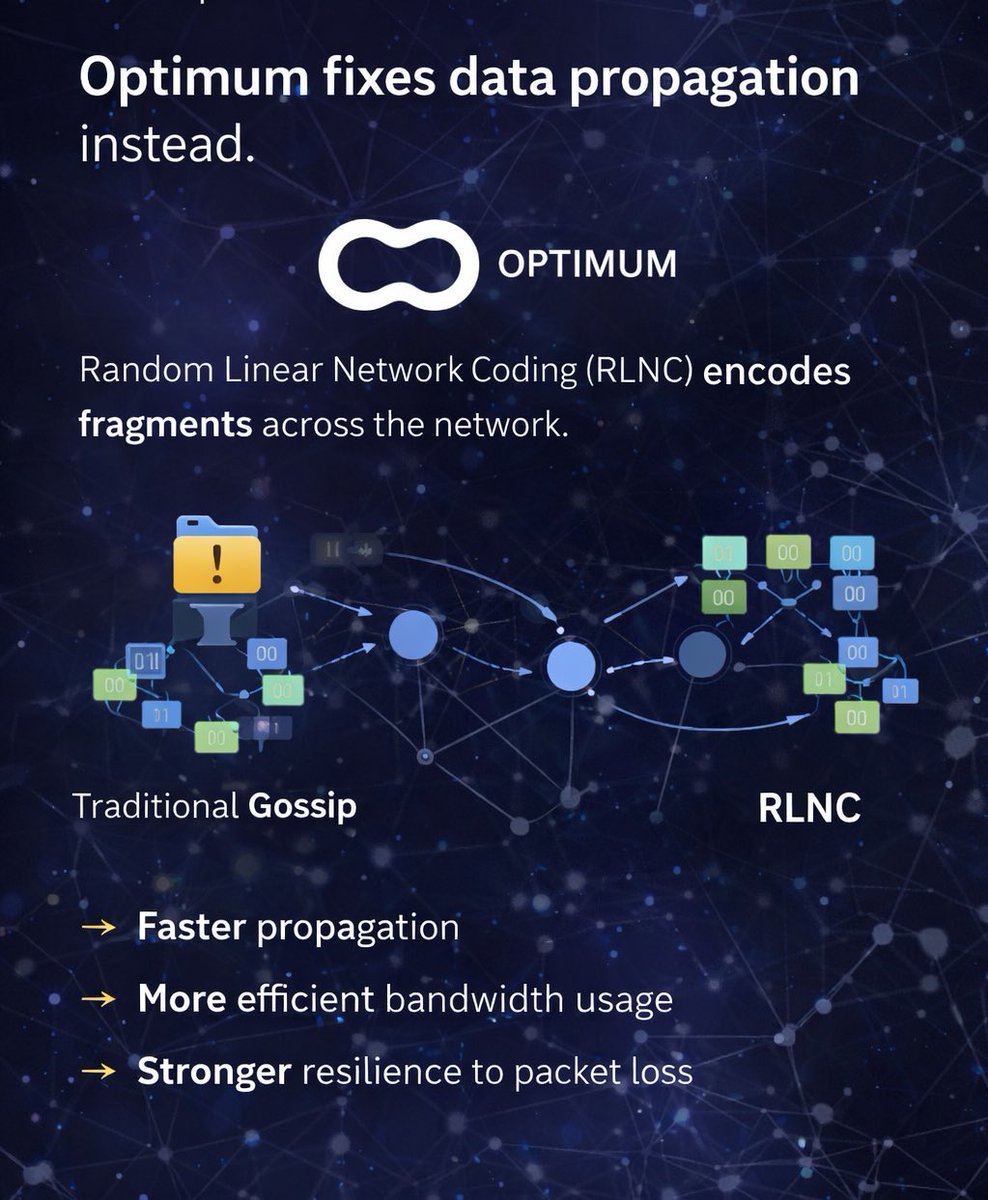
Random Linear Network Coding (RLNC).
>>> RLNC: A Better Way to Move Data
Traditional networks send data in fixed packets.
If one piece is lost or delayed, the system slows down.
RLNC changes this completely.
It:
• mixes data into encoded fragments
• allows nodes to reconstruct data from any combination of pieces
• enables parallel, flexible transmission
This unlocks three critical advantages:
→ Lower latency (faster propagation globally)
→ Higher throughput (more data, less congestion)
→ Greater resilience (no single point of failure)
In testing, Optimum’s P2P layer has shown
600%–3000% lower latency compared to traditional methods.
>>> OptimumP2P: Infrastructure Layer Upgrade
Built on RLNC, OptimumP2P acts as a drop in upgrade for blockchain networks.
Key properties:
• Works with existing validator setups (low hardware requirements)
• Improves bandwidth efficiency
• Scales better as more nodes join
This creates a powerful flywheel:
more nodes → better data diversity → faster propagation → stronger network
Instead of decentralization slowing things down,
it actually accelerates performance.
>>> What This Enables
1. Network Level
For ecosystems like Ethereum:
• higher throughput
• lower fees
• preserved decentralization
For high performance chains like Solana:
• even lower latency
• improved validator diversity
• reduced centralization risks
2. Validator Level
• more efficient resource usage
• faster block propagation
• improved rewards through better participation
Notably, major validator operators are already exploring this direction a signal that infrastructure-level improvements are being taken seriously.
3. Application Level
When latency and throughput are no longer constraints,
new categories of applications become viable:
• high frequency trading (CLOBs)
• real time gaming
• global payment systems
• DePIN networks
In short:
better infrastructure → better applications
4. User Experience
For end users, this translates to:
• faster transactions
• lower costs
• consistent performance under load
The kind of UX required for mass adoption.
>>> A New Mental Model
The traditional blockchain trilemma says:
decentralization vs scalability vs security
Optimum reframes this into a flywheel:
• decentralization increases network participation
• more participation improves data propagation
• better propagation increases scalability
Each layer reinforces the other.
>>> Conclusion
@get_optimum is not just optimizing blockchain performance.
It is challenging a core assumption of the industry.
That scaling must come at a cost.
By rethinking data propagation through RLNC and building OptimumP2P,
the project introduces a path where:
speed, scale, and decentralization can coexist and even strengthen each other.
If successful, this doesn’t just improve blockchains.
It upgrades the foundation of the entire onchain digital economy.
@aqccapital @tgogayi @cryptooflashh
@f1nk1r @CryptoSundayz @ada_pegasus
26
1
26
1,094