
We design & build sleek websites that get results. Let’s turn your idea into reality.
Joined November 2023
- Tweets 46
- Following 14
- Followers 11
- Likes 30
1 Photos and videos
WebStride Studios retweeted

19 May 2025
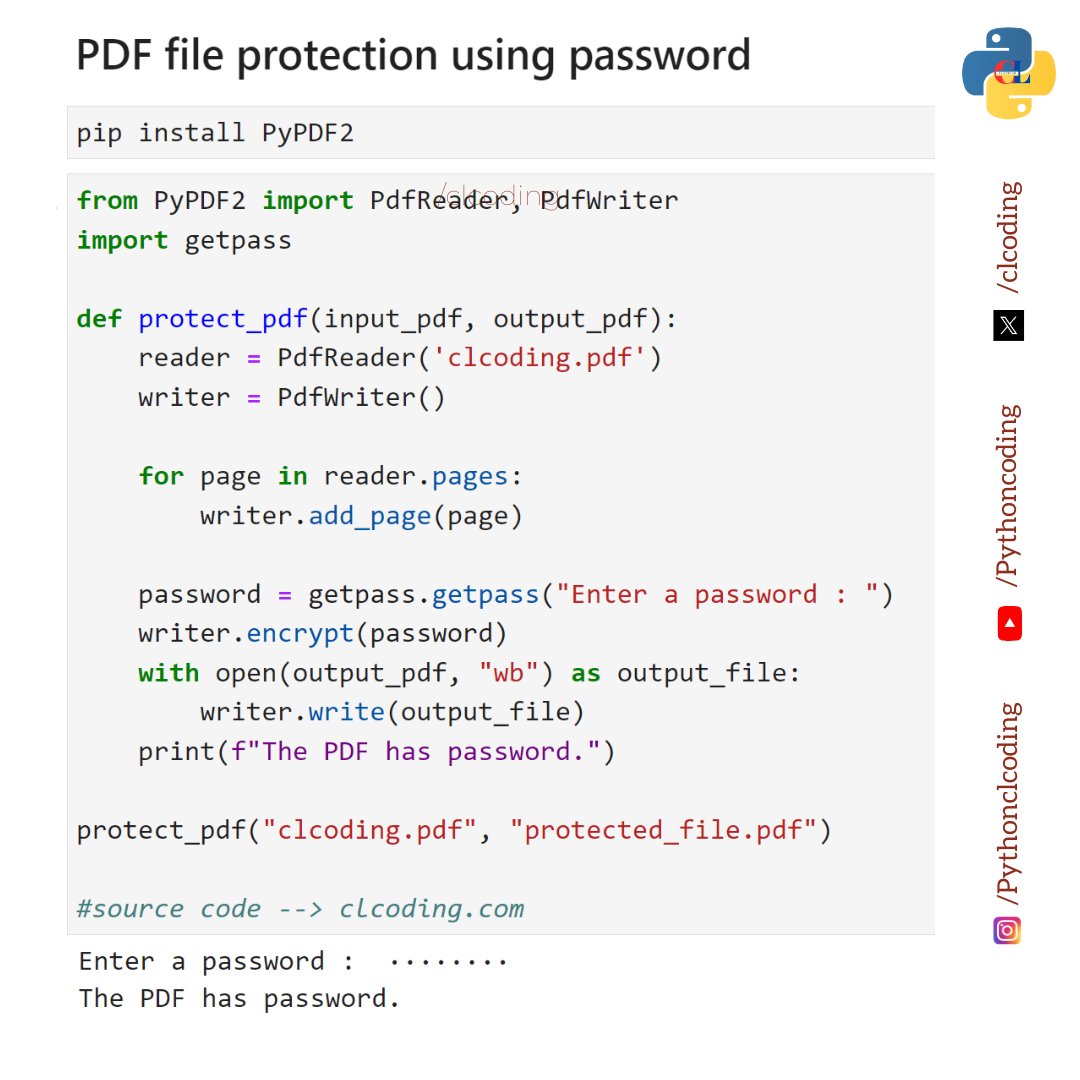
PDF file protection using password in Python
3
61
504
30,439
WebStride Studios retweeted

8 Aug 2024
The Django team is happy to announce the release of Django 5.1, code-named Kaleidoscope 🦋
djangoproject.com/weblog/202…
17
101
350
20,400

18 May 2024
🚀 Day 1: Introduction to Django*🚀
Welcome to the first day of our 60-day Django journey! 🎉
What is Django?
Django is a high-level Python web framework that encourages rapid development and clean, pragmatic design. Created to help developers take applications from concept to
1
1
38
18 May 2024
How It Works?
Django follows the Model-View-Controller (MVC) architecture, which is a software design pattern for developing web applications. Here's a high-level look:
- Models: Define your data structure.
- Views: Control the logic and output of data.
1
1
41
18 May 2024
- Templates: Render the HTML pages.
Comment below if you’ve ever used Django or if you’re excited to learn!
Stay tuned and happy coding! 🧑💻
#Django #WebDevelopment #Python #LearningJourney #TechSeries #Coding
1
21
18 May 2024
🚀Exciting Announcement! 🚀
I’m thrilled to announce that I’ll be kicking off a 60-day Django series starting today! 🎉
I’ll be sharing daily posts covering everything from the basics to advanced concepts in Django, one of the most powerful and popular web frameworks out there.
1
1
1
34
18 May 2024
Here’s a sneak peek at what you’ll learn:
•Setting up your Django environment
•Building your first project and app
•Mastering models, views, and templates
•Implementing user authentication and building REST APIs
• And much more!
1
25
18 May 2024
Whether you’re a beginner looking to dive into web development or an experienced developer wanting to expand your skills, this series is for you.
1
42
WebStride Studios retweeted
14 Dec 2023
What could be the reason?

40
112
1,316
101,369
WebStride Studios retweeted

14 Nov 2023
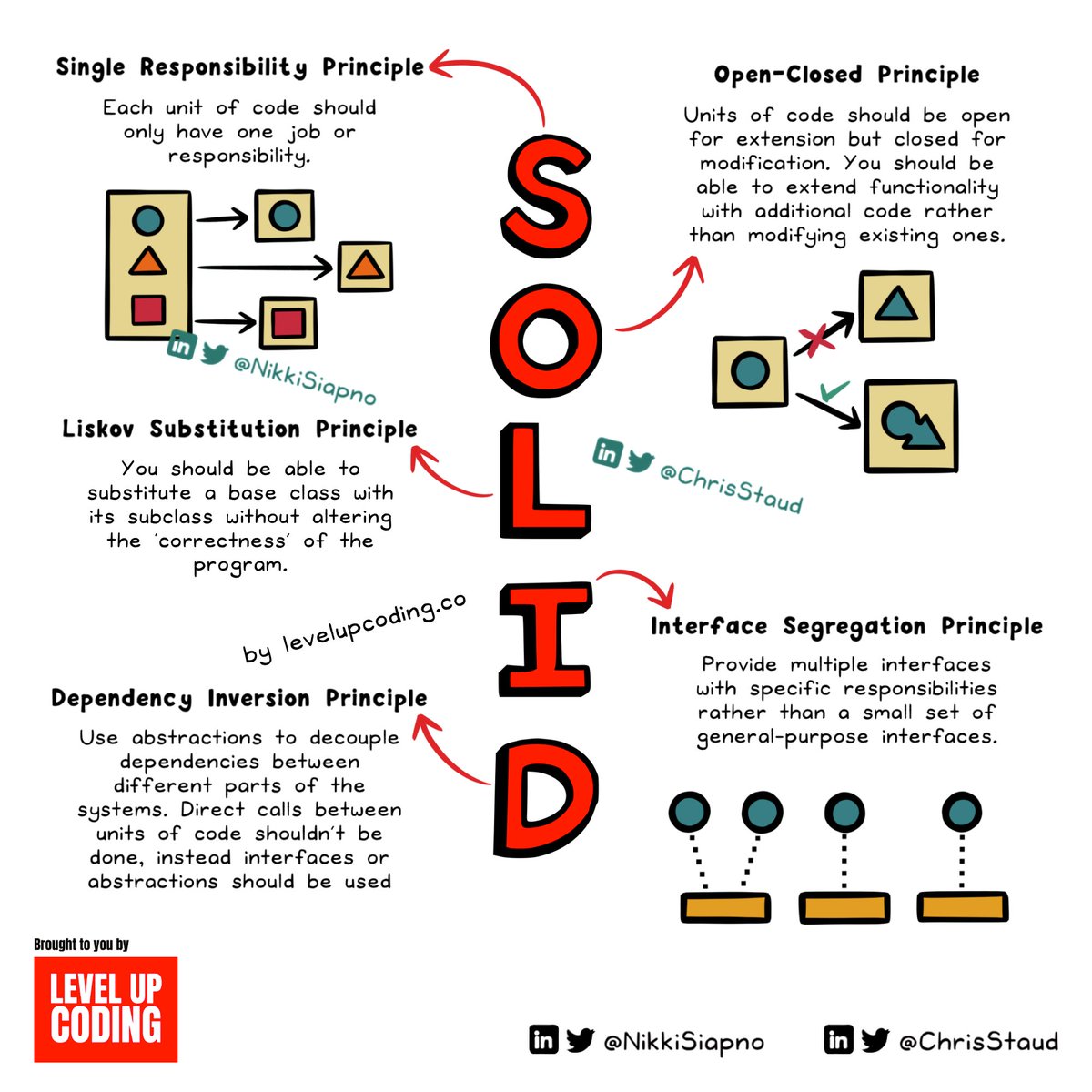
SOLID principles explained.
SOLID represents five principles of object-oriented programming. Whether or not you use OOP, knowing these principles gives you a lens into the foundations of clean code which can be applied to many areas of programming.
S — Single Responsibility Principle
O — Open/Closed Principle
L — Liskov Substitution Principle
I — Interface Segregation Principle
D — Dependency Inversion Principle
Let’s break down each principle:
1. Single Responsibility Principle (SRP)
Each unit of code should only have one job or responsibility. A unit can be a class, module, function, or component. This keeps code modular and removes the risk of tight coupling.
2. Open-Closed Principle (OCP)
Units of code should be open for extension but closed for modification. You should be able to extend functionality with additional code rather than modifying existing ones. This principle can be applied to component-based systems such as a React frontend.
3. Liskov Substitution Principle (LSP)
You should be able to substitute objects of a base class with objects of its subclass without altering the ‘correctness’ of the program.
An example of this is with a Bird base class. You might assume that it should have a ‘fly’ method. But what about the birds that can’t fly? Like a Penguin. In this example, having a ‘fly’ method in the Bird class would violate LSP.
4. Interface Segregation Principle (ISP)
Provide multiple interfaces with specific responsibilities rather than a small set of general-purpose interfaces. Clients shouldn’t need to know about the methods & properties that don't relate to their use case.
Complexity ↓
Code flexibility ↑
5. Dependency Inversion Principle (DIP)
You should depend on abstractions, not on concrete classes. Use abstractions to decouple dependencies between different parts of the systems. Direct calls between units of code shouldn’t be done, instead interfaces or abstractions should be used.
16
265
1,112
152,757
15 Nov 2023
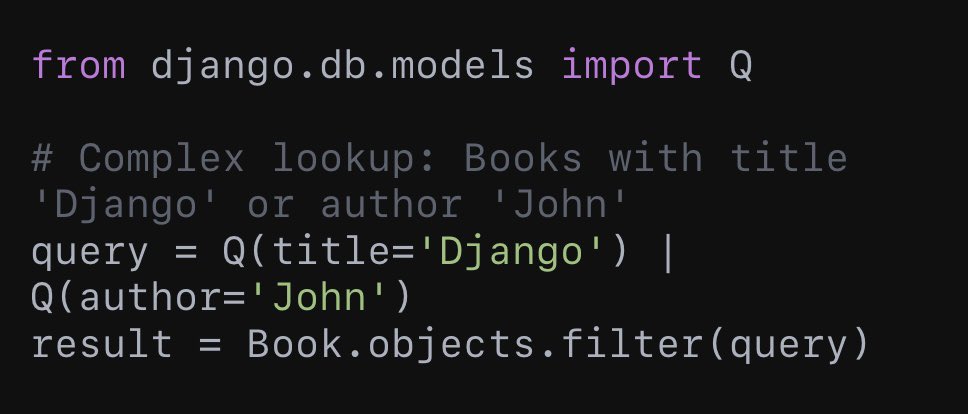
Mastering complex lookups in Django with 'Q' objects for dynamic and intricate queries. 🔄💡 Dive into the world of conditional expressions, combining filters, and creating dynamic queries that go beyond the basics.
#DjangoDevelopment #CodingMagic
1
2
126
15 Nov 2023
Here, the | operator acts as an OR condition. You can also use & for AND conditions and ~ for NOT conditions. This allows you to create intricate queries by combining Q objects.
1
1
25
15 Nov 2023
Using Q objects becomes powerful when you need to dynamically construct queries based on user inputs or other runtime conditions.
What’s the most complex lookup you’ve crafted with Q objects?
18
13 Nov 2023
Django MVT Approach explained :
Django follows the Model-View-Template (MVT) pattern, which is similar to the more commonly known Model-View-Controller (MVC) pattern. Let's dive into details 👌
1
1
3
242
13 Nov 2023
The flow in Django’s MVT pattern now becomes an interactive dance:
1.🕹 User interacts with the application through a URL.
2.🔄 URL patterns in the project’s urls.py file direct the request to the appropriate 👀 View.
1
1
31
13 Nov 2023
3.The 👀 View dances with the 🏗 Model to retrieve or manipulate data.
4.The 👀 View sends the processed data to the 📝 Template for a magic show of rendering.
5.The 📝 Template, like a skilled magician, generates HTML dynamically and is sent back as an HTTP response.
1
19