
Joined April 2020
- Tweets 2,387
- Following 73
- Followers 2,522
- Likes 156
14 Photos and videos


9 Jul 2025
The analogousness between artificial intelligence and cybernetics is both true and natural. In fact, it’s inherent.
However, it is erroneous to equate AI with human intelligence. These two are also analogous, but there exists a fundamental difference.
Part of the reason is that “brain” and “mind” are ontologically different.
Link to the full article:
zemgao.com/?p=16182
3
1
15
1,316
20 Jun 2025
Linked below is an article with in-depth discussions of the so-called quantum threat to Bitcoin.
Bitcoin blockchain is not based on encryption, but uses one-way hashes that reduce the size of the information space, making reverse computing mathematically infeasible.
Furthermore, all these potential threats, real or imagined, highlight the importance of single-use key practice, something advocated by Satoshi but misunderstood or ignored by BTC followers.
Implementation of real, effective single-use keys requires a blockchain that is scalable and efficient with negligible transaction costs.
Only Bitcoin Satoshi Vision (BSV) can meet these challenges.
It's a long article, but it's an important subject.
The Quantum Cryptopocalypse Myth zemgao.com/?p=16052
5
19
61
2,815
16 Jun 2025
Cybernetics view of systems that are bound to collapse zemgao.com/?p=16014
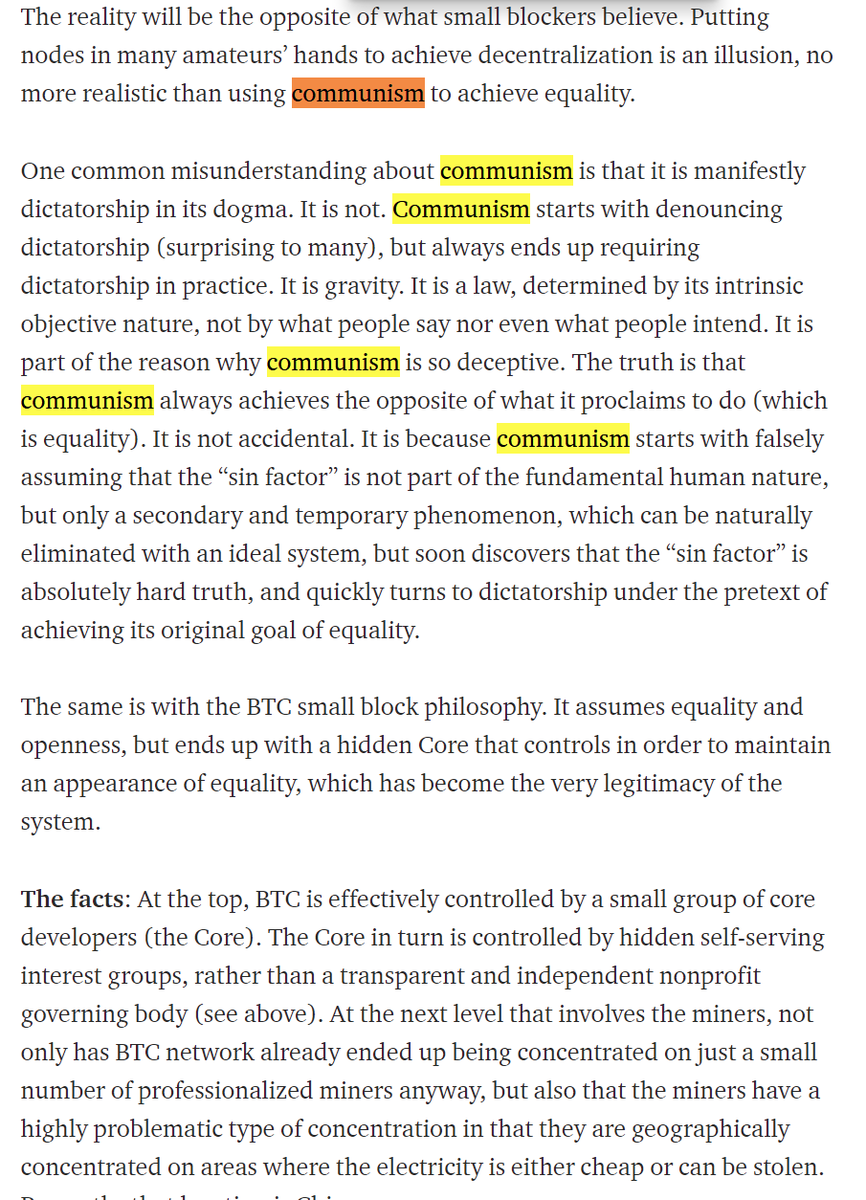
BTC is fundamentally an election system, but BTC as an election system is corrupt and self-contradictory, like communism.
1
6
21
1,284
10 Jun 2025
While the concepts (history, current political reality, budget bill and appropriations bill, discretionary spending, and mandatory spending, etc.) they are explaining are true, they miss the most basic reality:
With the current bill, which does not have the necessary drastic measures, the system will collapse.
The reliance on all these political procedures is just self-deceiving, escapist excuses of a drug addict.
But what's even more painful is the fact that one can't really blame Trump, Johnson, and the Congress, for they're doing their best facing the US political reality.
They cannot get out of this debt addiction when they are a central part of the symptom.
(The following is an excerpt of a longer article: The Looming Economic Crises in China and the United States: A Tale of Two Corrupt Systems. - zemgao.com/15920/ )
Few people truly understand how desperate the situation is. Many say that the US debt-GDP ratio is only about 130%, significantly lower than that of Japan and China. But there’s a misunderstanding about this matter.
The problem is not the debt numbers themselves, but the annual interest that a nation must pay for its debt, and how hard it is for the nation to restructure the debt to avoid a default. All this has to do with how the debt is sold and purchased, and who the creditors are.
To put it simply, in China and Japan, when a crisis arises to a point that the governments have to force the creditors to write down what they own or accept an artificially lower interest rate, they would be able to do it (to understand why, read the article, which is too long to be quoted here). They will also suffer, but they do not risk the collapse of their current system.
Not in the US. The US debt is of an entirely different nature. The whole thing is based on free market principles, meaning that the creditors buy the US national debt for their own financial gains. It is not an evil to start with, because it is exactly where the strength of the US economy lies: the free market.
But as always is the case in this world, the better a thing is, the worse the effect of abusing the thing will be.
The free market is the bedrock of the US economy and society, but when the nation abuses it by taking on an excessive amount of debt, it will find that it is left with no non-market administrative means to solve the problem.
Rather, the US will face the devastating cost of its own abuse of the free market: destruction of the free market.
With the current trend, the US cannot solve its debt problem without damaging or even destroying its economic foundation: the free market.
If there is still the slightest last chance to solve the problem politically, it is now. But now is already too hard.
That is the political reality the US faces. It is an addiction, affecting both the Republicans and Democrats. The difference is that the Republicans are kind of awake and making an effort, only with an illusion that measures like the big beautiful bill are going to solve the problem, or at least will maintain the status quo, while the Democrats are simply wasted.
Again, please read the full article: The Looming Economic Crises in China and the United States: A Tale of Two Corrupt Systems. - zemgao.com/15920/ )
9 Jun 2025

Speaker of the House @MikeJohnson defends the "One, Big, Beautiful Bill" against criticism from @elonmusk and others, arguing it delivers historic tax cuts, $1.6 trillion in savings, and crucial investments in border security and national defense.
Watch the full conversation with @SpeakerJohnson in the latest episode of @UncKnowledge: x.com/HooverInst/status/1931…
2
6
959
10 Jun 2025
Less than 1% of the earth people today are aware of this, but 99% are being affected, and many will end up bearing the mark of the beast on their forehead (the mind, the thinking) and the right hand (the strength, the doing).
It's a spiritual battle, so both the energy and the ultimate victory must come from the higher realm.
However, before the end when the Victor does arrive from above, the earth must, and will, devour the waters from the Dragon's mouth (Revelation 12:16).
It's not the salvation, but protection in time.
That's why I still work on the real Bitcoin blockchain, Bitcoin Satoshi Vision. It is the earth part, but it is a necessary part.

"It looks to me like we are now at the brink of a new era in which machine thinking will supplement or surpass human thinking in many ways, like how machine labor supplemented and surpassed human labor during the Industrial Revolutions"
Ray Dalio, Cyborg Theocrat
2
7
45
1,826
6 Jun 2025
Speaker Johnson and commentator @larry_kudlow are trying to explain that @elonmusk Musk's protest against The One Big Beautiful Bill arises from his misunderstanding of the government spending procedures, such as the budget bill and appropriations bill, discretionary spending, and mandatory spending, etc.
While the concepts they are explaining are true, they miss the fundamental truth, as also President Trump and the Congress:
With the current bill, which does not have the necessary drastic measures, the US economic and political systems will collapse.
The reliance on all these political procedures is just self-deceiving escapist excuses of a drug addict.
But what's even more painful is the fact that one really can't blame Trump, Johnson, and the Congress: they're doing their best facing the US political reality.
They cannot get out of this debt addiction when they are a central part of the symptom.
(The following is an excerpt of a longer article: The Looming Economic Crises in China and the United States: A Tale of Two Corrupt Systems. - zemgao.com/15920/ )
Few people truly understand how desperate the situation is. Many say that the US debt-GDP ratio is only about 150%, significantly lower than that of Japan and China. But there’s a fundamental misunderstanding about this matter.
The problem is not the debt numbers themselves, but the annual interest that a nation must pay for its debt, and how hard it is for the nation to restructure the debt to avoid a default. All this has to do with how the debt is sold and purchased, and who the creditors are.
To put it simply, in China and Japan, when a crisis arises to a point that the governments have to force the creditors to write down what they own or accept an artificially lower interest rate, they would be able to do it (to understand why, read the article, which is too long to be quoted here).
Not in the US. The US debt is of an entirely different nature. The whole thing is based on free market principles, meaning that the creditors buy the US national debt for their own financial gains. This is not an evil to start with, because this is exactly where the strength of the US economy lies:
The free market.
But as always is the case in this world, the better a thing is, the worse the effect of abusing the thing will be.
The free market is the bedrock of the US economy and society, but when the nation abuses it by taking on an excessive amount of debt, it will find that it is left with no non-market administrative means to solve the problem.
Rather, the US will face the devastating cost of its own abuse of the free market: destruction of the free market.
The bottom line is that the US cannot solve its debt problem without damaging or even destroying its economic foundation: the free market.
If there is still the slightest last chance to solve the problem politically, it is now. But now is too hard. I disagree with Musk on many things, but I feel him on this one.
6 Jun 2025
Peter Robinson (@P_M_Robinson) interviews Speaker of the House @MikeJohnson about the contentious passage of the "One, Big, Beautiful Bill," a sweeping budget reconciliation measure crafted to implement core elements of the Trump agenda. @SpeakerJohnson defends the bill against criticism from @ElonMusk and others, arguing it delivers historic tax cuts, $1.6 trillion in savings, and crucial investments in border security and national defense.
The conversation delves into the arcane rules of Congress, the realities of leading a narrow majority, and the significance of the DOGE (Department of Government Efficiency) effort—driven in part by Musk—to root out waste and fraud. Johnson positions the legislation not only as fiscally responsible but also as a turning point in restoring constitutional governance and federal oversight.
Watch the full episode of @UncKnowledge on X:
3
490
Zem Gao retweeted
16 May 2025
It depends on what one means by “invalid”.
First of all, “invalid transaction” and “invalid address” are not exactly the same.
Mining nodes are responsible for checking the validity of the transaction, including its scripts, but they do not check the validity of the human-readable output address string; that validation is primarily left to wallet software.
These two are different because, if a wallet somehow allowed a transaction to be created using a invalid address (bypassing a checksum failure, for example), the resulting transaction would be considered “valid” by the network if the ScriptPubKey created from that mistyped data is syntactically well-formed according to script rules, even if it locks funds to an unrecoverable or unintended condition. The transaction isn’t invalid by network rules, but it’s a problem for the user unless that is exactly what the user intends.
A purported burn address can be fake. There are addresses that might seem “invalid,” but are not. If the address passes the sender’s wallet, and the transaction associated with that address passes the validation of the mining nodes, you may not really be so sure the coins sent to the address are indeed unredeemable.
For example, an address that has a wrong checksum can pass the validation by mining nodes, who don’t validate the checksum in an address but leave that to user wallets. A transaction sent to such an address may be stopped by a standard wallet, but one just cannot be so sure that the senders are not using a nonstandard wallet (especially when senders are lured to participate in some kind of scheme, not knowing they’ve been tricked).
On the ohter hand, an address that is inherently unspendable-from, if it exists, is a genuine burn address.
But how does the public, particularly the senders, know for sure that an address is inherently unspendable-from, namely, unredeemable by its owner?
One sure case is a scenario where the owner of an address can provide mathematical proof that he does not have a valid private key for the address. But the question is, how does one provide such mathematical proof?
Well, that’s what CSW has done in his example.
In contrast to the potentially fake burn addresses, the address “1CounterpartyoThisIsAlsoAoBurnoAddr” given by CSW is a very strong valid burn address.
This is because for that address to be redeemable, its owner would have to compute almost every one of the 35 characters (because they are not random) in the address to find out a valid private key that corresponds to a public key, which, in turn, matches that particular address.
Note that the above example given by CSW is not a practical vanity address. To understand why, realize that computing a vanity address that has 35 targeted nonrandom characters is not three times harder than computing a vanity address that has 12 targeted characters. Using Base58, it is (58)^23 times harder, which is so close to infinite that it would be beyond practicality to compute.
In other words, with an address given by CSW, you are practically sure that its owner does not have a valid private key. You only need to trust the math. In contrast, in the purported burn address, you just don’t know. You have to trust the owner.
1
2
7
482
14 May 2025
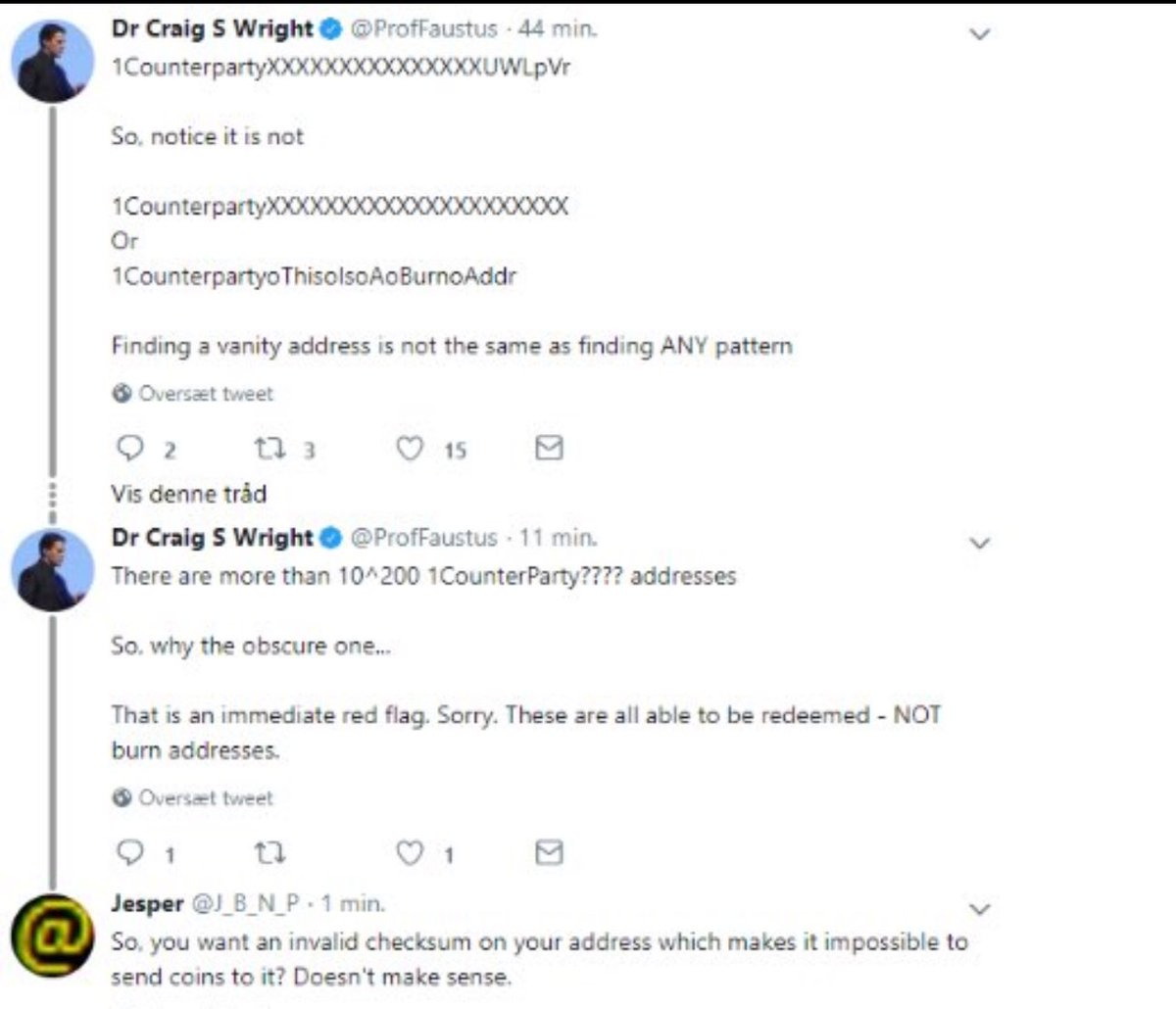
It was an old thread in 2018. Because the original posts have been deleted, the context is rather obscure.
But based on what I can see, this is what happened:
--Someone promoted an idea of "burn address" for bitcoin (the purported burn address ending with the string "UWLpVr").
--CSW argued that it must be a scam, because if they wanted a real burn address, they could create an address that is verifiably invalid (he gave two examples, one ending with XXXXXX, the other ending with BurnoAddr), so why a particular one that cannot be verified (and therefore others have to trust that the promoter is telling the truth)?
Therefore, CSW asserted that the purported burn address is not a real burn address but was fraudulently presented as a burn address. (A real burn address would be verifiably permanently unredeemable. An address purported as a burn address but can be redeemed by the people behind it is, by definition, a fraud.)
Whether CSW's accusation against the fraud was factually valid or not, his reasoning was impeccable.
If Roger Ver used that thread as "evidence" that CSW did not know that Bitcoin had a checksum, then I really agree with @EquityDiamonds conclusion that Roger is either a fraud or wasn't knowledgeable.
By the way, @J_B_N_P's reply to CSW's post was very strange. It was literally saying that because CSW had given an example of what a real burn address could be, he (CSW) did not make sense. But that was the raison d'être for the very conversation itself!
It only proves that CSW knew what he was talking about, and others didn't (or intentionally didn't want to)!
Anyway, there are too many ridiculous examples of such accusations against CSW. It takes more than a team of psychologists, along with the help of historians, real bitcoin experts (and honest ones) to explain why and how this has happened, and continues to happen.
Yes, I do mean "psychologists," not only because of the subconscious motivation behind the Cult of Satoshi, which has grown to such an idolatrous level that it preemptively and absolutely denies the real person behind Satoshi (or any real human being for being Satoshi for that matter), but also because the whole behavior pattern is deeply driven by greed, and masked by clever schemes.
12 May 2025

This ⬇️ is proof that @rogerkver is a massive moron
— either that or a dirty liar criminal trying to con gullible Libertarians into financing his #bch bags. (We know which one #MyLegacyKit is for sure)
The Xs in this lesson from CSW are variables (as per Renee Descartes)— not literals.
CSW’s ELI5’g a concept about true burn addresses vs fake ones (created by criminals) to teach people how to spot cryptoFrauds— but all the CoderBros (I won’t name names but know-it-all guys like F.R. )take it literally— and in typical reverse fashion the fraudsters deliberately misunderstand and tell everyone their narrative (“He’s a fraud so how do we backfit a fraud story to match it?) instead.
What’s great about people who use this conversation as proof that “Satoshi would understand checksums, so @CsTominaga must be a fraud”, is you can just throw them into the shithead pile with the rest of the flotsam: either they are indignant imbeciles or 100% criminals looking to sell you their $bch shitKKKoyne (and those Ks are not strikeouts)
Anyone who would include the checksum in this discussion would have to have zero teaching experience; as in, he never taught a single thing to another human being as long as he lived. OR. A criminal.
I report you judge.
10
12
63
3,951
30 Apr 2025
The whole system and the concept of money and finance need to be revolutionized to save the world and the US. Financialization started as a booster stimulus to the economy, but has infested the entire world so deeply and broadly that it has become a systemic and critical disease in itself.
We need to rethink money, the very concept of it. Please read:
Tokenized Credit-based Community Money zemgao.com/?p=13464
3
11
37
1,287
Zem Gao retweeted
25 Apr 2025
Tim, please think about this more deeply. Consider your own example: If every person on Earth bought a cup of coffee, it would take about 40 years for the BTC blockchain to process them all.
What you are really referring to, unbeknownst to you, is not BTC, but the real Bitcoin according to Satoshi Vision (#BSV ).
BSV can already process all those transactions in about two hours, and could do it in seconds in the future.
Gold may be "dead," but it is a reliable physical anchor that can be made alive using tokenization on a blockchain like BSV. (See "Gold is superior money, and tokenized gold is a superior currency" zemgao.com/9730/).
But BTC is both dead and empty, promoted by a fake narrative of "digital gold" that is based on circular logic and predicated on people's ignorance (see The Idea of “Digital Gold” — BTC’s Value Fundamentals, zemgao.com/649/)
No amount of propaganda and Layer-2 dressing can make something both dead and empty live and substantive.
BTC will always be a mere object of people's belief (false faith), and never anything that is useful to people.
If you brush away BSV by an overheard assertion that it is "centralized", please think beyond that. BSV is the only blockchain that achieves the true decentralization vision by Satoshi.
There can be no true decentralization without a locked core protocol.
There can be no true decentralization without unbounded scalability, because real P2P transactions can only be enabled by unbounded scalability (without such scalability, once P2P is a mere abstract notion, as unrealistic as your coffee example).
I don't make these statements lightly. I wrote a book on it (bitandcoin.net), not to promote the coin but to tell people the truth.
You have always had a great vision, so please don't be blinded by other people's narratives or be entrenched by your early investment.
13
45
173
4,720
24 Apr 2025
I had an exchange of messages with an analyst/trader “TZ” (pseudonym) at BlackRock today. TZ asked me about BTC, Elon Musk, and macroeconomics. I thought it may be useful to post part of my replies here.
Bitcoin blockchain: an introduction
I wrote extensively on this subject (Bitcoin & Blockchain – zemgao.com/category/bitcoin-…). I even wrote a book (Bitandcoin.net).
May I invite you to read the following sample articles? If you disagree with what I wrote, that’s fine; at least you will have a glimpse of what my view is.
- BTC is a combination of a cult and a scam
-The fraudulent fiat “money” and fake “digital gold”
- Bitcoin and electronic cash
- Stock Market Amplified Ponzi Schemes (SMAPs)
- Tokenized Credit-based Community Money.
(Note: links in the article)
I am a builder and thinker. I’ve been involved in a startup project that is closely related to the last article above.
If you are further interested, I would like to recommend that you get a copy of my book (not trying to sell you a book, because the price barely covers the cost, and the Kindle version is free):
BIT & COIN: Merging Digitality and Physicality
About BTC and BSV
Frankly, I’m surprised that you actually read the articles. You are a trader. I am a philosopher and a builder. I have never seen a trader who is genuinely interested in my views. And I don’t blame them, because we look at two entirely different worlds. Not just two different angles of the same world, but two entirely different worlds. And my views don’t help traders by a long shot. As a matter of fact, my views might even hurt the trading prospects, and that’s why I myself don’t trade.
For this reason, take what I say with a bunch of salt.
First, you mentioned “original BTC”. I don’t know what your definition of that is. BTC is BTC, a version of Bitcoin. It is not the real Bitcoin, but a corrupt version of the original Bitcoin of Satoshi. It is a fact, and I know it. But that fact doesn’t matter to traders, because the concept of “originality” has nothing to do with trading. It is deeply technological. For cryptocurrency trading, BTC is BTC. Whatever has been recognized in the market and traded is the whole reality. Who cares about what the original Bitcoin is? Only technologists like me do.
I care because I care about the actual utility of any technology to the world and humanity. That’s why I focus on Bitcoin Satoshi Vision (BSV). In the view field of a trader like you, BSV probably doesn’t even appear on the radar screen.
However, I’m not saying that the technological and economic reality of a blockchain is never relevant to trading. Ultimately, the substance will bear on the appearance. See, Price matters.
About Elon Musk
About Musk, my limited views about him can be found here: “zemgao.com/?s="Elon Musk%2…”.
Musk is mostly sincere, and extremely creative and charismatic. But he’s wrong about Bitcoin and blockchain. Like many others, Musk thinks he understands blockchain and Bitcoin, but he doesn’t.
There’s no denying that Musk is highly intelligent. But the appearance of his intelligence is multiplied by his influence (and vice versa). The trouble is that the magnification creates the illusion that he understands everything. He does not. When it comes to Bitcoin and blockchain, he is probably just slightly better than an average mainstream commentator, but still miles away from the truth.
About macroeconomics
You asked me to comment on the interest rate and macroeconomics. Although I do have my views, I don’t think you really need to hear them. I suspect that you have your own views and are unlikely to change them.
My first view is that the existing geopolitical, economic, and financial systems, including the fiat system, are collapsing. The only way for the US and much of the world to get out of the debt is by high inflation. There is no other way. The political system and the human nature of the masses simply are incapable of implementing and carrying out a principled and disciplined solution. Not going to happen. Under Republicans, the US has a better chance. But still, I’m pessimistic about it.
From a biblical point of view (I am Christian, and I don’t try to hide my identity), I believe the world as we know it is unlikely to exist 20 years (perhaps even five years) from now. (See "The Days and Hours of the End Times'" - link in the article).
The biblical view, however, is fundamentally optimistic, not pessimistic.
I am more concerned with the existence and overall viability of humanity, not the short-term or even long-term interest rates and economies. I ask myself this very simple question: what will survive (continue to exist and be needed) in the new world in which the existing systems have perished.
A conversation with a BlackRock trader zemgao.com/?p=15705
4
38
111
5,905
18 Apr 2025
Jesus has risen from the dead—this is the only reason humanity still has hope.
Yet at that time, the disciples did not believe.
“Jesus appeared to them and rebuked them for their unbelief…” — Mark 16:14
Our fleshly nature is not only unbelieving by default, but also tends to view “faith” as a duty, a burden, a task we must reluctantly carry out.
But let us not forget—this is the risen Lord! He is risen! How full of joy He must be. Could He simply stand by and watch His disciples remain in unbelief?
His heart is such that He shows mercy even to a donkey that falls into a pit on the Sabbath—how much more to these disciples, who are trapped in the pit of human weakness and spiritual blindness?
He wants them (and us) to believe. He wants them to understand what has happened. And He wants them to go and tell all the nations—all the people in the world (Mark 16:15).
The original text of Mark 16:15 says: “Proclaim the gospel to every creature,” meaning the entire universe, not only all people, but also angels and all created things.
“For we know that the whole creation has been groaning together in the pains of childbirth until now.” (Romans 8:22)
Today, we can declare to all creation: the Lord is risen! The sons of God will rise with Him, and when that day comes, all things will partake in the glorious freedom of the children of God.
Resurrection zemgao.com/?p=2496
3
18
921
9 Apr 2025
The Copyright Crisis in the Age of AI isn't merely about copyright, but will ultimately be an essential threat to digital humanity by hampering human creativity.
AI has already pillaged nearly all information created by humans throughout the entire history of humanity and will continue to do so freely unless a new distribution model is made available.
Without a proper solution, this would lead to an increasingly closed information system, dominated by AI-synthesized derivations of past work. The system would still generate seemingly new information, but the "newness" of the information is just a reflection of the vast information space that is already created by human creativity. New permutations will certainly appear new, and even functionally new, but not new from a fundamental information point of view, as everything comes from a closed system.
It will eventually reach an entropic equilibrium, a vast echo chamber endlessly reflecting diminishing returns on human creativity.
People make very strong arguments for AI-impunity based on pragmatism. But the arguments are fundamentally flawed, not because the practical points made are invalid, but because they are premised on the wrong assumption that no technological solution is available.
Effective technological solutions are available. The key is automated decentralized content management with automated verification and payment using the true Bitcoin blockchain (#BSV, not BTC) that has unbounded scalability, full smart contract capability, and near-zero fees.
Read the following linked article for a full discussion. It explains why the world has a serious problem with information source management today and why a decentralized data paradigm built upon the true Bitcoin blockchain (BSV, not BTC) is the only viable economic and tech solution to save digital humanity from corruption.
It is a chapter in Volume 2 of my book BIT & COIN: Merging Digitality and Physicality (bitandcoin.net).
For a limited time, the chapter is freely accessible to everyone.
The Copyright Crisis in the Age of AI: Pragmatism, Peril, and Solution zemgao.com/?p=15407
2
12
30
1,501
2 Apr 2025
I have been trying to show the world why a decentralized data paradigm built upon the true Bitcoin blockchain (#BSV, not BTC) designed and developed according to Satoshi’s vision is the needed economic and tech solution to save digital humanity from corruption.
The human information system is part of the cosmic information system. Whether you are aware of it or not, we are in it for an across-realm battle for Truth.
If I may sound like a preacher, I am unapologetic about it, as it is a genuine burden I am feeling.
If you are also concerned or at least curious, even if just slightly, read the full article linked below. It is a chapter in Volume 2 of my book BIT & COIN: Merging Digitality and Physicality. For a limited time, the chapter is freely accessible to everyone.
The Cosmic Information System: Across-Realm Battle for Truth zemgao.com/?p=15385
14
50
180
7,859
19 Mar 2025
Scaling witnessing (oracle) is a fundamental problem digital humanity faces. With the threat of AI, the option now is not whether to scale or not, but whether to scale falsefully or to scale truthfully.
Without a scalable blockchain, economically incentivized witnessing (oracle) such as UMA, at its best, is an enhancement tool for the financial elites rather than a broad solution to humanity.
If everything is automated, however, the same concept may also work for low-value data entries or attestations. In that case, the underlying blockchain needs to be highly scalable and efficient. Any blockchain that is neither scalable nor efficient is a wrong choice for broader applications.
The ideal choice for scaling witnessing for digital humanity is Bitcoin Satoshi Vision (BSV), which has unbounded scalability, extremely low transactional cost, and full smart contract capability (practically Turing complete).
Read the full article: Scaling witnessing zemgao.com/?p=13942
1
6
30
1,098
17 Mar 2025
Bitcoin Satoshi Vision (BSV), with the upcoming Teranode, is the only blockchain system that offers the kind of scalability and transactional efficiency required by any global adoption of blockchain technology.
One of the key benefits of such a system is not just the high-level verifiability itself but the automation of verification or, more broadly, automatically guaranteed integrity of data and processes.
I’d collectively call it “automated integrity”.
Read the full comment below: Automated integrity of enterprise systems zemgao.com/?p=13919
12
45
185
6,098
6 Mar 2025
It’s time for the public sector to adopt a scalable blockchain as its IT backbone. In traditional systems, compliance and automation are at odds—manual checks slow down efficiency, while automation risks bypassing oversight. A scalable blockchain resolves this tension, uniting the two seamlessly.
Imagine processes being automated with verifiable, tamper-proof data and transactions, all free from self-interested intermediaries yet transparent to authorized inspection and always ready for extremely efficient auditing, potentially hundreds of times cheaper than the traditional auditing method.
It will deliver unmatched cost savings and robust compliance. From welfare distribution to tax collection, this shift will redefine governance, offering transparency and trust at scale.
Adoption hurdles need to be overcome. But the pain alone has accumulated to such a high level that is sufficient to overcome them. It is time.
Full article:
The public sector and blockchain zemgao.com/?p=13883
4
28
85
2,845
6 Mar 2025
This is just an example of the reason why the world is getting more and more corrupt. People are being exploited for their weaknesses rather than being built up.
"Masterminds" like these lead the way, and more and more people devote their careers and lives to learn after them, to become more skillful in doing exploitations of others. It's not just in business. It is in politics. In education. In religion...
It is a big scam perpetrated upon humanity by its arch enemy, the Devil, who is preparing as many souls as he can to be his subjects of abuse in eternity.
In the end, the exploiters will be the true victims.
The Devil does his best to hide it and to deceive many. But the effect of such corruption cannot be hidden. It manifests itself with stronger and stronger symptoms and stench, as a warning. A great example can be found in the recent development of the crypto cancer (
bitandcoin.net/the-cancerous…).
But dismay not. Sons of light shall hear and obey the call from above and overcome. This world is not home nor the destination, but a temporary assignment. Walk the Way, pursue Truth, and receive Life.
6 Mar 2025

I used to think marketing was all logic,
until I discovered Rory Sutherland.
His ideas on consumer psychology changed everything.
He asks one question that exposes why most marketing fails.
Here’s what it is (and how to use it):

3
30
1,540