
-prev: zk engineer @powdr_labs - Web3 Security Researcher - interested in Verifiable computation, cryptography
Joined December 2021
- Tweets 712
- Following 3,669
- Followers 944
- Likes 14,319
23 Photos and videos

0xKitetsu.eth |zkVM arc| For Hire retweeted

Jun 13
Two days ago, we announced Plonky3 v0.6.0 and hinted at cool improvements for Circle STARK.
The reality? We just made Circle STARK over M31 *𝑓𝑙𝑦* in Plonky3 ⚡
No new hardware, just math and engineering giving us 2.3x faster prover at higher security! 🚀
Jun 11

🔥 WHIR has landed in Plonky3 🔥
We just released v0.6.0, and with it we open the door to the world of multilinear PCS! 🚀
We've also shipped a ton of cool new features and performance improvements.
👀 Spoiler alert: Circle STARK is now *really* fast.
github.com/Plonky3/Plonky3
2
5
40
2,506
0xKitetsu.eth |zkVM arc| For Hire retweeted
Jun 11
🔥 WHIR has landed in Plonky3 🔥
We just released v0.6.0, and with it we open the door to the world of multilinear PCS! 🚀
We've also shipped a ton of cool new features and performance improvements.
👀 Spoiler alert: Circle STARK is now *really* fast.
github.com/Plonky3/Plonky3
1
7
44
5,445
0xKitetsu.eth |zkVM arc| For Hire retweeted

Jun 1
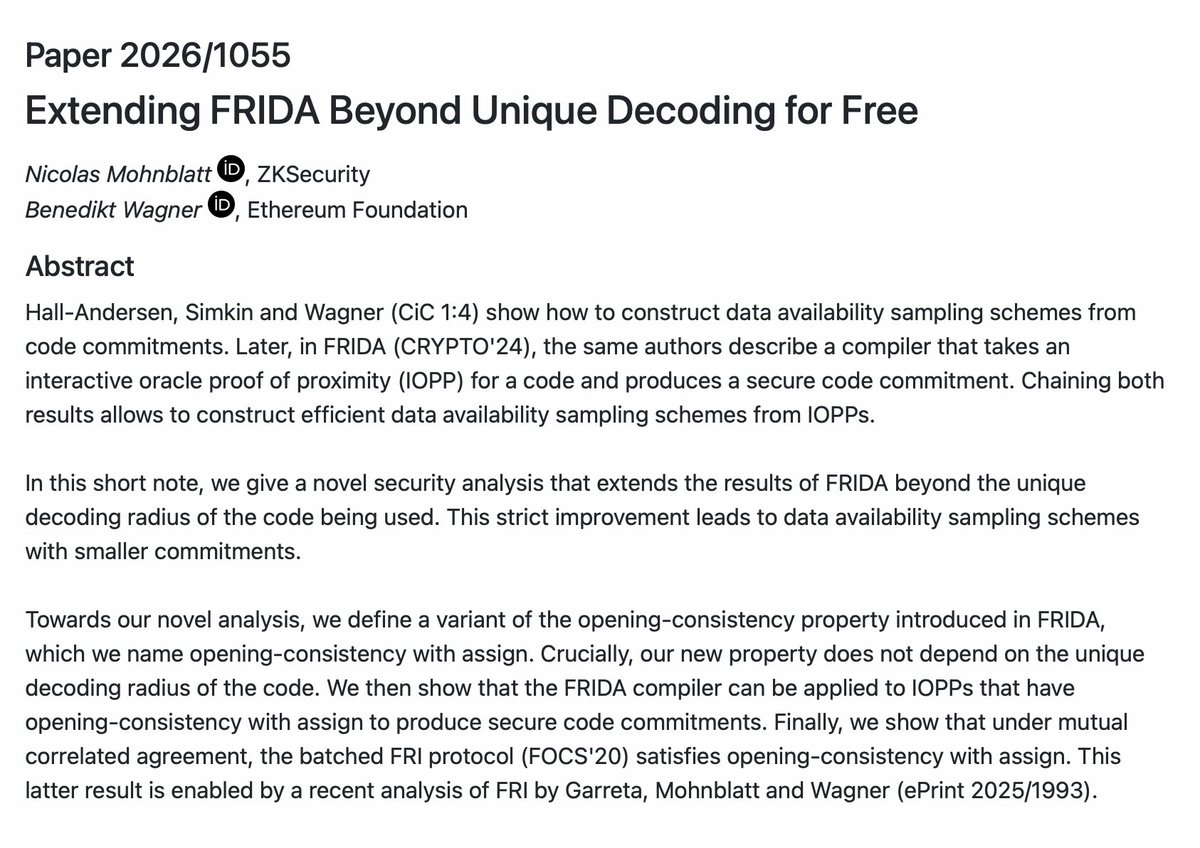
1/ Very happy to share a new paper with Benedikt Wagner on data availability sampling (DAS). In this one we extend FRIDA with our recent findings on FRI
FRIDA was a 2024 paper in which they showed that we can construct DAS from proofs of proximity that satisfy 3 conditions
1
11
50
2,109
0xKitetsu.eth |zkVM arc| For Hire retweeted

May 19
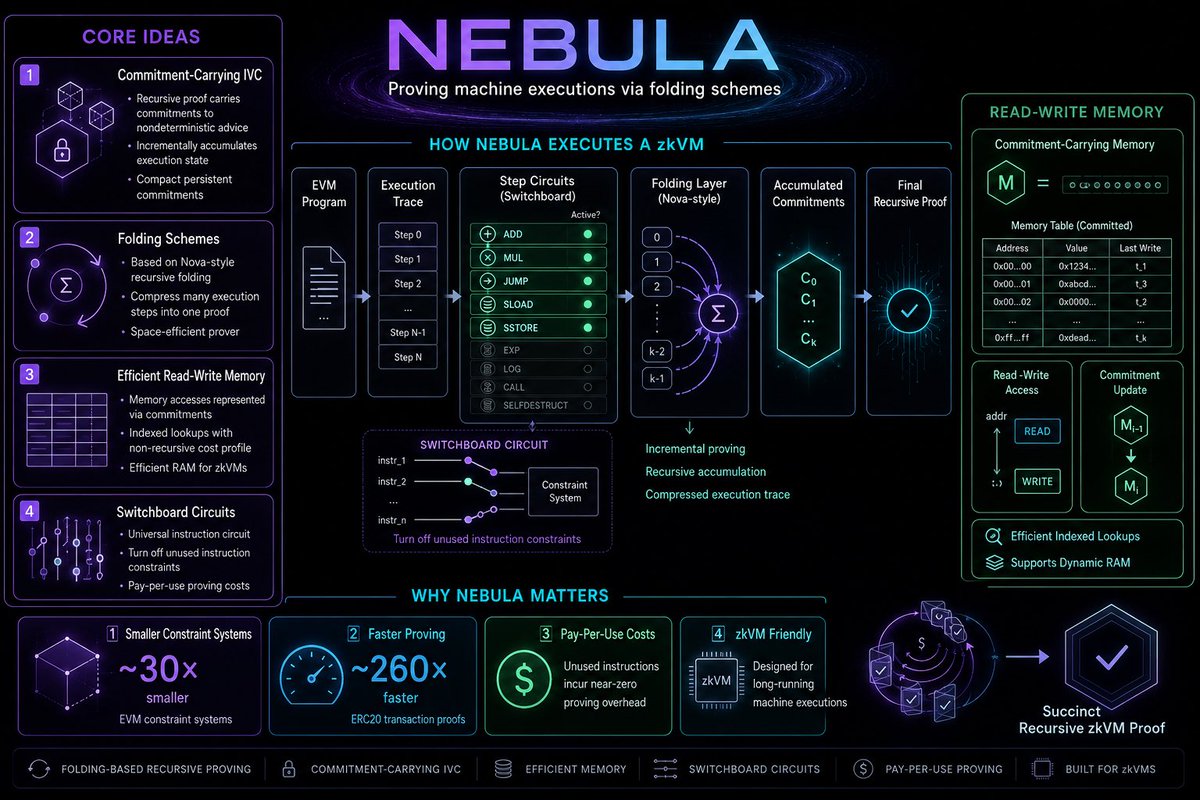
Our work “Nebula: Proving machine executions via folding schemes” won the Distinguished Paper Award at @IEEESSP!
Key innovations are: (1) devising efficient read-write memory checking in the folding setting, and (2) pay-per-use switchboard circuits. A quick overview of the work
4
7
54
2,221
0xKitetsu.eth |zkVM arc| For Hire retweeted

May 9
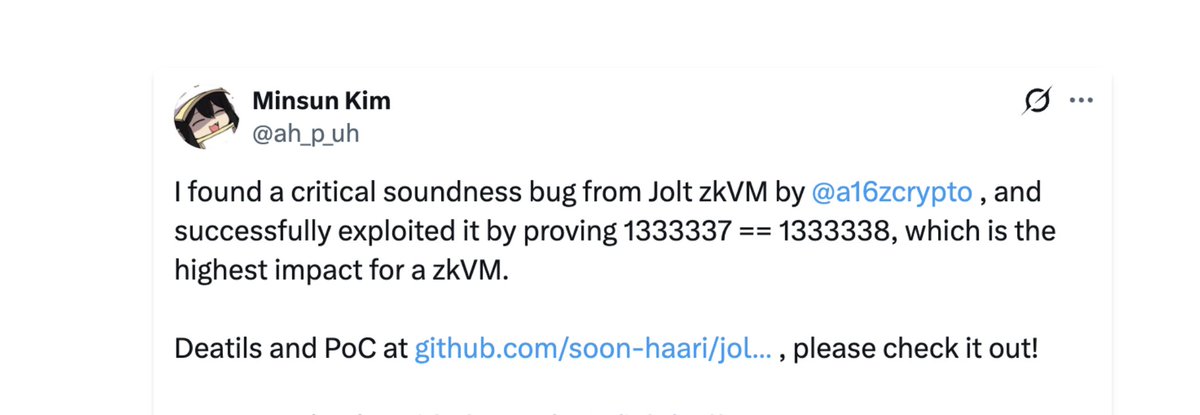
Breaking Jolt’s Verifier with an Unbound Uni-skip Claim
blog.zksecurity.xyz/posts/jo…
1
8
59
4,756
0xKitetsu.eth |zkVM arc| For Hire retweeted

May 10
Hash-based SNARKs are fast, PQ secure, and transparent.
But they have a major flaw: they historically lack ZK properties without massive overhead.
Enter ZO0k: a true minimal overhead ZK IOP framework presented by the local Italian star @GiacomoFenzi at ZK Summit. 🧵👇
2
23
113
6,941
0xKitetsu.eth |zkVM arc| For Hire retweeted

May 4
Arkworks 0.6.0 is out 🎉
The headline isn't BabyBear, KoalaBear, Mersenne31, Goldilocks.
It's `SmallFp` — a macro for any prime up to 64 bits that picks the optimal layout arithmetic at compile time.
Drop-in. Non-breaking. Up to 30% speedup.
READ: andrewzitek.xyz/small-fields
7
39
2,340
0xKitetsu.eth |zkVM arc| For Hire retweeted

May 4
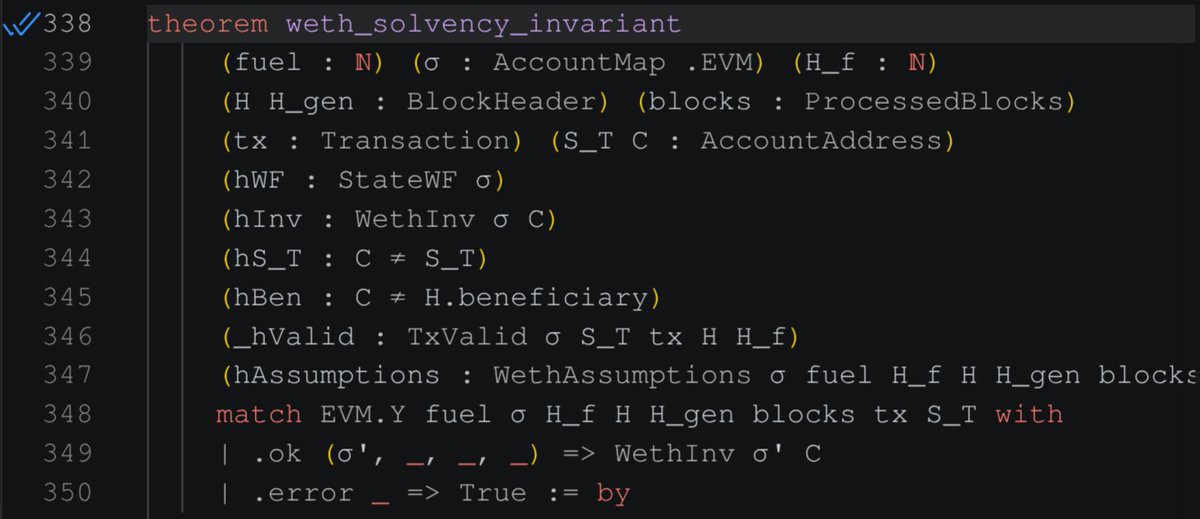
Can AI write EVM bytecode a Lean proof of solvency under arbitrary reentrancy, bypassing the compiler entirely?
Yes! In this experiment we create 86 bytes of WETH bytecode plus a sorry-free Lean solvency theorem 👇
(thread link below)
6
27
209
20,678
0xKitetsu.eth |zkVM arc| For Hire retweeted
Apr 27
Algebraic tensor reductions provide a unifying language for many recursive protocols. In this series, we’ll help you build a solid understanding of tensor reductions, using the well-known sum-check protocol as our guiding example blog.zksecurity.xyz/posts/te…
1
16
56
3,108
0xKitetsu.eth |zkVM arc| For Hire retweeted

Apr 26
I factored the number RSA1024-1 using my home-built QPU stack; alarming sign that RSA1024 will soon be broken.
I'm choosing Full Disclosure, in the interest of transparency and Science advancement: gist.github.com/veorq/25bee6…
Non-ZK proof that the correct RSA1024 was used: en.wikipedia.org/w/index.php…
@yuvadm your move
127
329
2,028
419,006
0xKitetsu.eth |zkVM arc| For Hire retweeted

Apr 22
Our newest sum-check optimizations are out! eprint.iacr.org/2026/762
We propose a *better* domain for sum-check: the infinity hypercube.
Evaluations over this domain give *precisely* the monomial coefficients, and lead to a ~10% prover speedup over 128 bits prime fields
🧵/ n
8
21
133
15,605
0xKitetsu.eth |zkVM arc| For Hire retweeted
Apr 18
Standard RISC-V has 32 registers.
In hardware, spilling to cache is cheap.
In zkVMs, every memory operation is an expensive constraint to prove.
What happens if we hack LLVM to give RISC-V 1024 registers?
A breakdown of @leonardoalt's latest experiment. 🧵👇
2
27
272
98,443

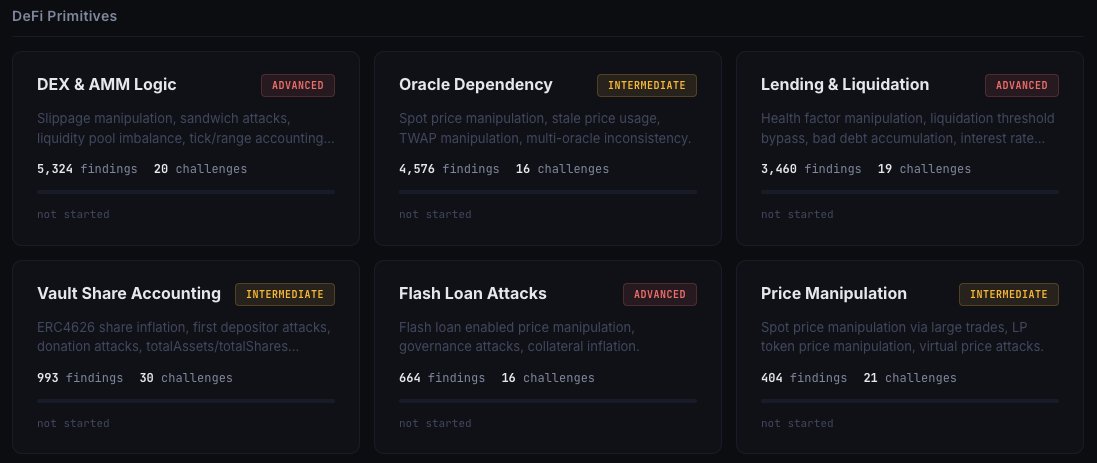
🚨Junior/Advanced secruity researchers - this is for you!!!
A new Training Hub that teaches you web3 vulnerability patterns and thinking as an attacker. Thanks to @ValvesSec, great job👏
URL: training.valvessecurity.com/…
19
161
908
38,636
0xKitetsu.eth |zkVM arc| For Hire retweeted

Apr 8
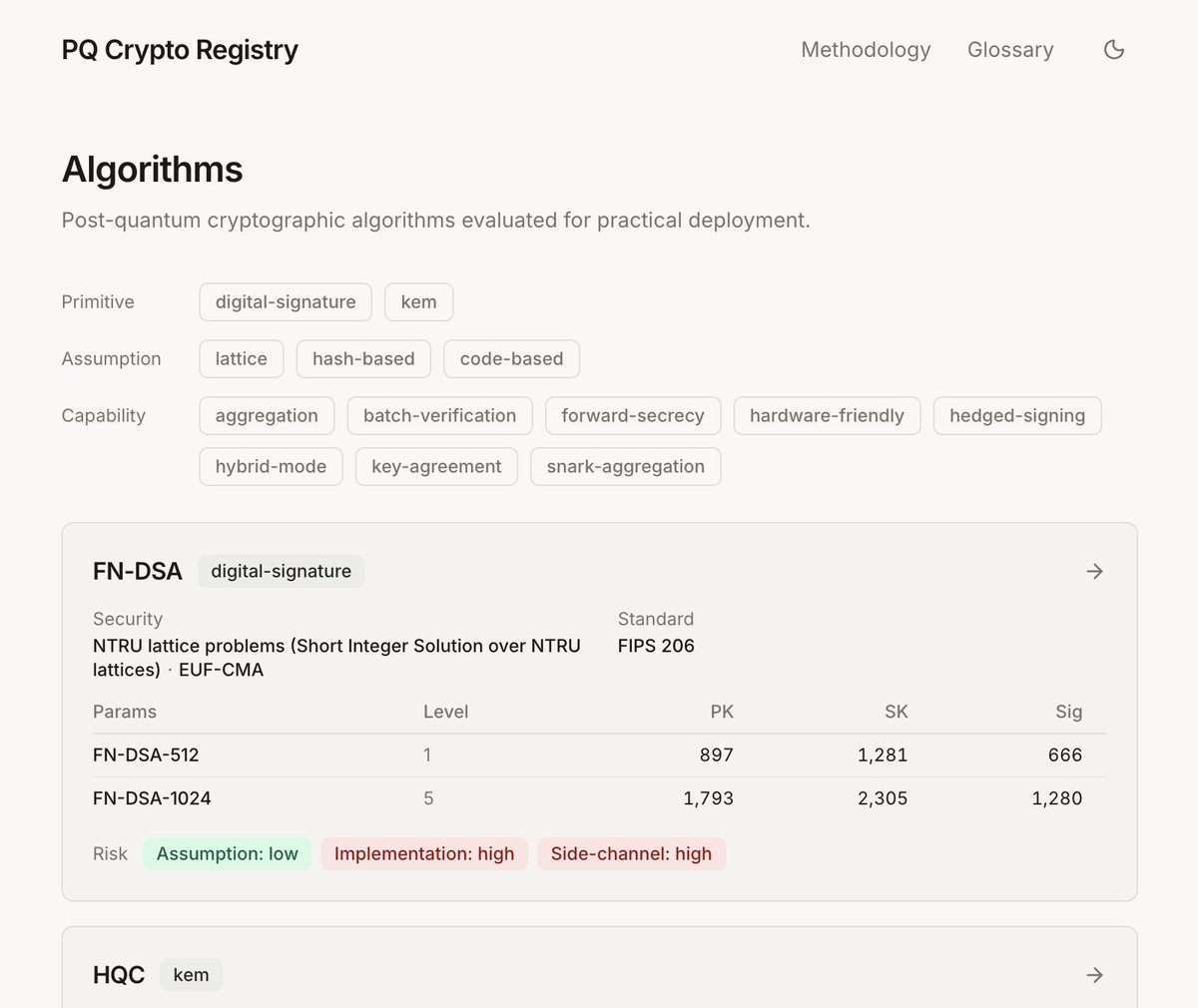
I've been working on a post-quantum cryptography registry/wiki and it's now live. If you're an engineer trying to evaluate PQC algorithms side by side, you have to piece together information from FIPS documents, ePrint papers, mailing list threads, and scattered READMEs.
There are some existing resources out there for parameter sets but I wanted something that goes much further and includes everything; algorithm descriptions, use case and feature filtering, benchmarks, implementation references, and wiki-style prose all in one place with a consistent schema. So that's what this is.
It covers nine algorithms today; the NIST standards (ML-KEM, ML-DSA, SLH-DSA), the NIST pipeline (FN-DSA, HQC), blockchain-specific schemes (SHRINCS, SHRIMPS, leanSig), and XMSS. There are a lot more I want to add and the registry is open source so contributions are welcome.
20
25
121
22,845
0xKitetsu.eth |zkVM arc| For Hire retweeted

Mar 29
Our cryptographic researcher @alexand_belling revealed yesterday at @eth_proofs that Linea is moving to RISC-V.
After 3 years of directly arithmetizing the EVM, producing a 1000 page spec and one of the most rigorous proving system in production, we’re changing course.
Here’s why 🧵
46
61
352
50,345
0xKitetsu.eth |zkVM arc| For Hire retweeted

Mar 31
One other thing worth noting: this doesn't affect just EC signatures, many ZKP systems are affected just as much.
Broadly speaking, modern ZKP systems use one of three types of cryptography under the hood:
1. Elliptic curves (whether paring-based or not) - these are used by most SNARKs.
2. Collision-resistant hashes - these are used in STARKs and Ligero, among others.
3. Lattices - these are relatively novel but up-and-coming systems.
Quantum computers, like the ones mentioned in Google's paper, will straight up break anything that uses elliptic curves (e.g., it will be possible to create proofs for computations that never happened).
Hash-based and Lattice based systems are not vulnerable - but out of these, only hash-based systems are probably secure (given the underlying hash function is secure).
Another aspect of this is that data encrypted with EC-based cryptography and stored on-chain may be vulnerable even now. This is because of "harvest now, decrypt later" attacks. This is especially relevant for blockchains where data (even if encrypted) once stored on-chain is accessible forever.
This is one of the reasons we chose STARKs for Miden from the start. Our proof system is hash-based (and thus resistant to Quantum computers), and we use state commitments rather than encrypted state. That sidesteps the harvest-now-decrypt-later problem entirely.
Mar 31

Today is a monumentous day for quantum computing and cryptography. Two breakthrough papers just landed (links in next tweet). Both papers improve Shor's algorithm, infamous for cracking RSA and elliptic curve cryptography. The two results compound, optimising separate layers of the quantum stack. The results are shocking. I expect a narrative shift and a further R&D boost toward post-quantum cryptography.
The first paper is by Google Quantum AI. They tackle the (logical) Shor algorithm, tailoring it to crack Bitcoin and Ethereum signatures. The algorithm runs on ~1K logical qubits for the 256-bit elliptic curve secp256k1. Due to the low circuit depth, a fast superconducting computer would recover private keys in minutes. I'm grateful to have joined as a late paper co-author, in large part for the chance to interact with experts and the alpha gleaned from internal discussions.
The second paper is by a stealthy startup called Oratomic, with ex-Google and prominent Caltech faculty. Their starting point is Google's improvements to the logical quantum circuit. They then apply improvements at the physical layer, with tricks specific to neutral atom quantum computers. The result estimates that 26,000 atomic qubits are sufficient to break 256-bit elliptic curve signatures. This would be roughly a 40x improvement in physical qubit count over previous state-of-the-art. On the flip side, a single Shor run would take ~10 days due to the relatively slow speed of neutral atoms.
Below are my key takeaways. As a disclaimer, I am not a quantum expert. Time is needed for the results to be properly vetted. Based on my interactions with the team, I have faith the Google Quantum AI results are conservative. The Oratomic paper is much harder for me to assess, especially because of the use of more exotic qLDPC codes. I will take it with a grain of salt until the dust settles.
→ q-day: My confidence in q-day by 2032 has shot up significantly. IMO there's at least a 10% chance that by 2032 a quantum computer recovers a secp256k1 ECDSA private key from an exposed public key. While a cryptographically-relevant quantum computer (CRQC) before 2030 still feels unlikely, now is undoubtedly the time to start preparing.
→ censorship: The Google paper uses a zero-knowledge (ZK) proof to demonstrate the algorithm's existence without leaking actual optimisations. From now on, assume state-of-the-art algorithms will be censored. There may be self-censorship for moral or commercial reasons, or because of government pressure. A blackout in academic publications would be a tell-tale sign.
→ cracking time: A superconducting quantum computer, the type Google is building, could crack keys in minutes. This is because the optimised quantum circuit is just 100M Toffoli gates, which is surprisingly shallow. (Toffoli gates are hard because they require production of so-called "magic states".) Toffoli gates would consume ~10 microseconds on a superconducting platform, totalling ~1,000 sec of Shor runtime.
→ latency optimisations: Two latency optimisations bring key cracking time to single-digit minutes. The first parallelises computation across quantum devices. The second involves feeding the pubkey to the quantum computer mid-flight, after a generic setup phase.
→ fast- and slow-clock: At first approximation there are two families of quantum computers. The fast-clock flavour, which includes superconducting and photonic architectures, runs at roughly 100 kHz. The slow-clock flavour, which includes trapped ion and neutral atom architectures, runs roughly 1,000x slower (~100 Hz, or ~1 week to crack a single key).
→ qubit count: The size-optimised variant of the algorithm runs on 1,200 logical qubits. On a superconducting computer with surface code error correction that's roughly 500K physical qubits, a 400:1 physical-to-logical ratio. The surface code is conservative, assuming only four-way nearest-neighbour grid connectivity. It was demonstrated last year by Google on a real quantum computer.
→ future gains: Low-hanging fruit is still being picked, with at least one of the Google optimisations resulting from a surprisingly simple observation. Interestingly, AI was not (yet!) tasked to find optimisations. This was also the first time authors such as Craig Gidney attacked elliptic curves (as opposed to RSA). Shor logical qubit count could plausibly go under 1K soonish.
→ error correction: The physical-to-logical ratio for superconducting computers could go under 100:1. For superconducting computers that would be mean ~100K physical qubits for a CRQC, two orders of magnitude away from state of the art. Neutral atoms quantum computers are amenable to error correcting codes other than the surface code. While much slower to run, they can bring down the physical to logical qubit ratio closer to 10:1.
→ Bitcoin PoW: Commercially-viable Bitcoin PoW via Grover's algorithm is not happening any time soon. We're talking decades, possibly centuries away. This observation should help focus the discussion on ECDSA and Schnorr. (Side note: as unofficial Bitcoin security researcher, I still believe Bitcoin PoW is cooked due to the dwindling security budget.)
→ team quality: The folks at Google Quantum AI are the real deal. Craig Gidney (@CraigGidney) is arguably the world's top quantum circuit optimisooor. Just last year he squeezed 10x out of Shor for RSA, bringing the physical qubit count down from 10M to 1M. Special thanks to the Google team for patiently answering all my newb questions with detailed, fact-based answers. I was expecting some hype, but found none.
11
13
53
7,522
0xKitetsu.eth |zkVM arc| For Hire retweeted

Mar 17
Announcing powdr-wasm!
powdr-wasm is an optimized zkVM for WASM, built on top of @openvm_org and the novel 𝑐𝑟𝑢𝑠ℎ ISA.
Early benchmarks already show 1.5x fewer trace cells & faster proof times compared to RISC-V (OpenVM).
It also supports Go guests via WASI!
👇
7
14
99
15,902
0xKitetsu.eth |zkVM arc| For Hire retweeted

Mar 19
Quick announcement: After long and heavy suffering :) the S-two white paper is finally out:
eprint.iacr.org/2026/532
Although nothing new in regard to the basic principles (a circle STARK, etc.) the white paper yet contains several details of broader interest:
- A formal description of the flat AIR circuit model (used by several contemporary zkVMs)
- A thorough soundness analysis of multi-table proofs: If one does not use "lifted" FRI, taming the soundness error turns out to be more sophisticated as expected. We introduce the notion of "cross-domain correlated agreement", and show that multi-table FRI satisfies this property.
- A discussion of adjusted conjectures, which takes into account the recent boost of proximity gaps counter examples. We believe that it is plausible to hope for acceptable list- and line-decodability properties up to the information-theoretic barrier, the Elias bound.
Thanks for all the help from the StarkWare team, and in particular to Dmitry Krachun for the many helpful discussions around his counter example.
6
38
159
9,260
0xKitetsu.eth |zkVM arc| For Hire retweeted
Mar 10
🚀 New Plonky3 release just dropped.
This is probably our most impactful and ambitious release so far:
- MUCH faster lookups
- High-arity folding
- N-ary Merkle trees Merkle caps
- Major Poseidon2 optimizations
- Poseidon1 support
- And many more…
Let’s break it down 👇
4
31
133
8,531
0xKitetsu.eth |zkVM arc| For Hire retweeted
1/11 Lean Ethereum is preparing for a PQ future.
But how secure are the hash-based SNARKs powering it?
A recent $1M prize by the EF sparked a flurry of papers.
Here is the breakdown of the discussion between @nico_mnbl, @asanso and @GiacomoFenzi for @zeroknowledgefm !🧵👇
5
28
74
4,750