Joined January 2013
- Tweets 21,409
- Following 418
- Followers 501
- Likes 13,581
737 Photos and videos




Cards are made in China 🙂 retweeted

It’s wild how they suddenly remember all these other uses for money when it comes to ending a war, but not when the Pentagon requests a $1.5 trillion annual budget.
Jun 16

With $300 billion, we could end homelessness, fund cancer research for 40 years, and give every child free pre-K for over 7 years. Instead, Trump is sending it to Iran. This is not America First. Not even close.
10
530
3,597
44,406
Cards are made in China 🙂 retweeted

Jun 16
Who controls the media? Updated list.
Meta owns:
Facebook
Instagram
WhatsApp
Messenger
Threads
Oculus
Meta AI
Meta is controlled by Mark Zuckerberg who is jewish
Alphabet owns:
Google
YouTube
Android
Gmail
Chrome
Pixel phones
Nest smart home devices
Fitbit
DeepMind
Gemini AI
Waymo self-driving cars
Verily
Calico
Wing drone delivery
Alphabet is controlled by Larry Page and Sergey Brin who are both jewish
Tic Tok
U.S. algorithm and infrastructure is controlled by Oracle
Oracle is controlled by Larry Ellison who is jewish
-Hookup Apps
Match Group owns:
Tinder
Hinge
OkCupid
Match. com
Plenty of Fish
Meetic
The League
BLK
Archer
OurTime
Was founded by Barry Diller who is jewish
Grindr
Was founded by Joel Simkhai who is jewish
Bumble
Was founded by Whitney Wolfe Herd who is jewish
-Porn
Onlyfans
Owned by Leonid Radvinsky who is jewish
Vixen Media Group owns:
Blacked
Blacked Raw
Vixen
Tushy
Deeper
Founded by Greg Lansky who is jewish
Aylo/MindGeek Owns/owned:
Pornhub
YouPorn
RedTube
Brazzers
Reality Kings
Digital Playground
Men. com
Sean Cody
Tube8
Solomon Friedman is the owner of Aylo and he’s jewish
Gamma Entertainment owns/operates:
Adult Time
Pure Taboo
Wicked
many other affiliate studios/platforms
Founded by Karl Bernard who is jewish
-Movies/TV/News
Warner Brothers Discovery owns:
Warner Bros. Pictures
HBO
CNN
DC Studios
Cartoon Network
Discovery Channel
TNT
TBS
Max (formerly HBO Max)
Adult Swim
HGTV
Food Network
Animal Planet
Warner Brothers is run by David Zaslav who is jewish
Disney owns:
ESPN
ABC
Marvel Studios
Lucasfilm
Pixar
20th Century Studios
Disney
Hulu (major controlling stake)
National Geographic
Disney is run by Bob Iger who is jewish
Paramount Global owns:
CBS
CBS News
CBS Sports
Local CBS stations
Film Studios
Paramount Pictures
Paramount Animation
Cable Networks
MTV
Nickelodeon
Comedy Central
BET
VH1
CMT
TV Land
Smithsonian Channel
Logo TV
Pop TV
Streaming/Premium:
Paramount
Showtime
Pluto TV
Major franchises/IP:
Top Gun
Mission: Impossible
Star Trek
South Park (licensing/streaming)
SpongeBob SquarePants
Transformers
Teenage Mutant Ninja Turtles
Paramount Global is controlled by Sheri Redstone, who is jewish
Comcast owns:
NBCUniversal
NBC
Universal Pictures
Peacock
MSNBC
CNBC
Telemundo
Sky (Europe)
DreamWorks Animation
Xfinity
Comcast is controlled by Roberts family who is Jewish
Amazon owns:
Amazon Prime
MGM Studios
Twitch
Audible
IMDb
Amazon Music
Ring
Blink
Amazon Echo
Alexa
Kindle
Amazon is run by Andy Jassy who is jewish
-AI/Data Centers
OpenAI/ChatGPT
Run by Sam Altman who is jewish
Palentir provides advanced data integration, surveillance, AI, and analytics infrastructure used by military, intelligence, law enforcement, and major corporations. Its platforms help organizations combine massive amounts of fragmented data into real-time operational intelligence for warfare, policing, logistics, cybersecurity, manufacturing, and decision-making, making it one of the most strategically influential data and defense technology companies in the world.
Was founded by Alex Karp, Peter Thiel, Stephen Cohen and Joe Lonsdale, 3 of the 4 are jewish and the other gives speeches on the Antichrist. Operated by Alex Karp who is jewish.
Oracle owns:
Oracle Database
Java
MySQL
NetSuite
Cerner
Sun Microsystems technologies
It’s important because it owns core infrastructure software that powers governments, banks, hospitals, corporations, and large parts of the internet. Its control of technologies like Oracle Database, Java, MySQL, and Cerner gives it enormous influence over the backend systems modern society depends on.
Owned by Larry Ellison who is jewish
1,858
13,907
50,410
1,859,146
Cards are made in China 🙂 retweeted

Jun 10
Just drove across town to break into someone’s house. He tried to stop me from pouring gasoline all over his living room so I had to murder him in self-defense.
Jun 10

U.S. Central Command forces began launching additional self-defense strikes today at 5:15 p.m. ET against multiple targets in Iran at the Commander in Chief’s direction. The strikes are in response to Iran’s unwarranted and continued aggression.
64
1,610
4,686
61,245
Cards are made in China 🙂 retweeted

BOOM BOOM TEL AVIV
798
8,110
61,060
2,355,601
Cards are made in China 🙂 retweeted

Jun 6
🖕🏻 🇮🇱

Jun 5

One day. Is possible to go one friggin day without the IDF murdering a baby? FFS man

2
1
1
24
Cards are made in China 🙂 retweeted

Westoid weebs don't sincerely like Japan.
They dig a defeated, subservient Japan with low cost hookers and 711 onigiri.
1980s peak Japan was widely hated in the West.
3
6
51
6,707
Cards are made in China 🙂 retweeted

Jun 5
Guess in what language the Ukrainian tennis player Kostyuk was talking with her Ukrainian counterpart Svitolina before quarter final match?
The two most ardent Ukrainian "patriots" who made a political spectacle out of the tournament spoke their native Russian to each other.
594
2,881
14,627
815,985
Cards are made in China 🙂 retweeted

About 60 days ago your President killed 160 schoolgirls for Israel

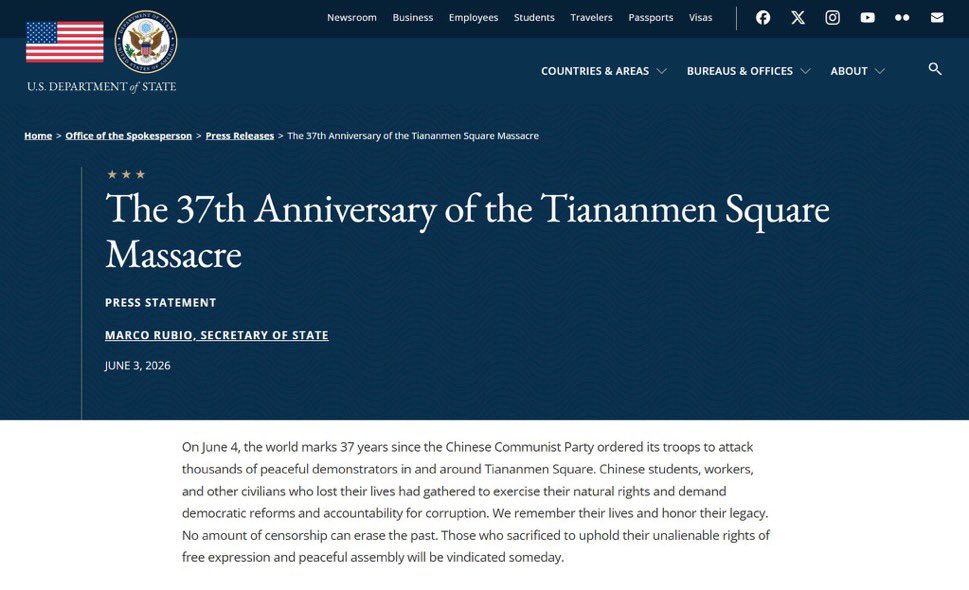
37 years ago, the Chinese Communist Party massacred thousands of innocent civilians in Tiananmen Square who dared to demand freedom.
We will continue to stand against the CCP’s ruthless disregard for human life.
37
990
6,888
78,921
Cards are made in China 🙂 retweeted

Jun 4
A young girl from #Xinjiang accidentally broke the bowls during her “bowl dance” performance. As she tried to hold back tears, the judges comforted her warmly: “If they hadn’t broken, we might have thought they were fake.”
3
16
131
3,841
Cards are made in China 🙂 retweeted

Jun 5
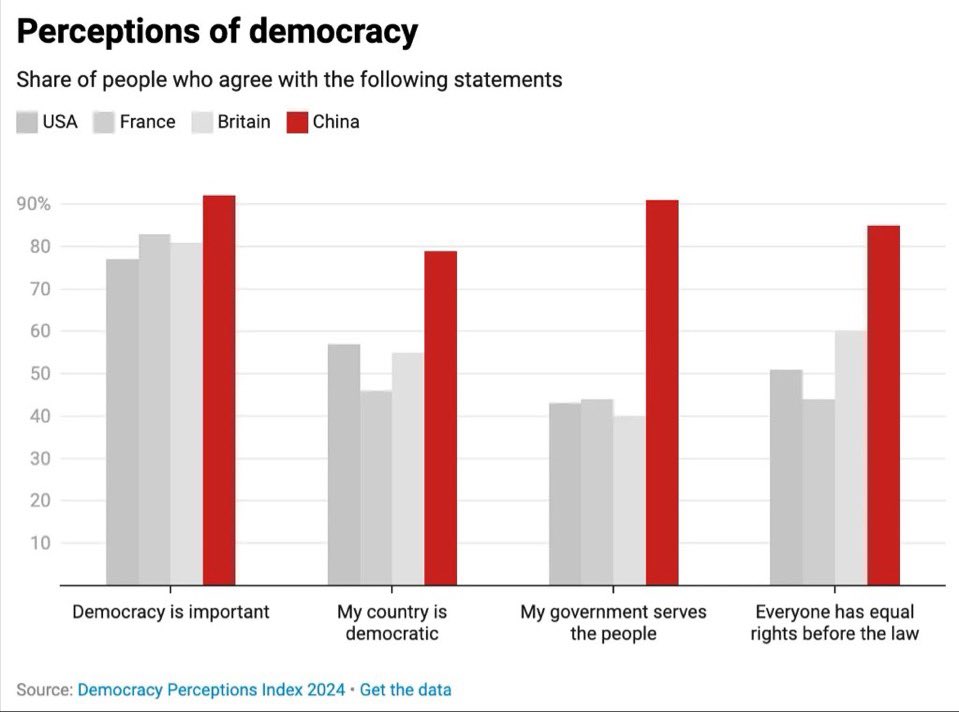
The Chinese have democracy.
Wypipos are ruled by pedos.
Jun 4

The Chinese people wanted democracy. The Chinese government refused to let them have it -- and still does. It claims they want the dictatorship of the Chinese Communist Party. Our memory of Tiananmen tells us otherwise, so Beijing tries to suppress it. trib.al/ADnrbV2
4
11
63
1,285
Cards are made in China 🙂 retweeted

May 23
Also in the war you pushed.
May 23

The only place Iran ever beats America is at the negotiating table.
Every. Single. Time.
2
49
582
26,572
Cards are made in China 🙂 retweeted

May 24
Hey can anyone explain to me why corporate media in the United States is breathlessly reporting on a deal that literally does not exist and whose terms no one agrees on, I mean I understand corporate journalism wants to lick the ball sweat off POTUS but this is getting ridiculous
56
459
2,610
43,639

Cards are made in China 🙂 retweeted

“Right now we're doing a pause [on arms to Taiwan] to make sure we have the munitions we need for Epic Fury,” Cao told Sen. Mitch McConnell.
responsiblestatecraft.org/ta…
1
5
7
833
Cards are made in China 🙂 retweeted

May 21
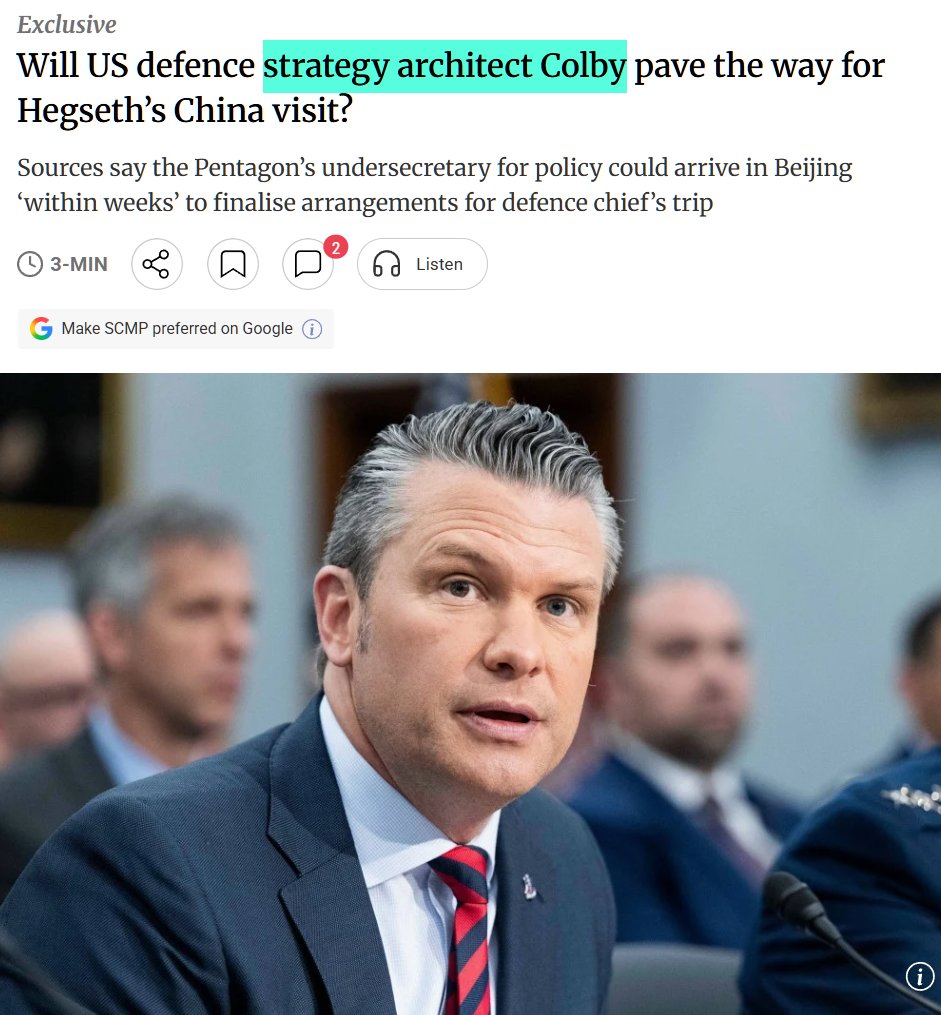
Elbridge Colby’s Beijing Mission: How an Overstretched Empire Tries to Buy Time from China
SCMP scmp.com/news/china/military… reports that the Pentagon plans to send a high‑level delegation to Beijing “within weeks,” led by Elbridge Colby, US Undersecretary of WAR for policy and key architect of the 2026 US National Defense Strategy. Officially, the purpose is technical: prepare arrangements for Defence Secretary Pete Hegseth’s follow‑on visit, after he broke an eight‑year gap as the first US defence chief to set foot in China and the first to accompany a sitting president on a state visit since normalisation in the 1970's
On the surface, this looks like “stabilization” and “guardrails” after several tense years in the Western Pacific. But if you read this move alongside Wess Mitchell’s Strategic Sequencing, Revisited—published at Colby’s own Marathon Initiative Think Tank—plus the 2026 NDS, a different picture emerges
Most likely Colby’s mission is not a sign of genuine détente. It’s a tactical pause by an overstretched hegemon that needs China to sit still while Washington struggles with Russia, Iran and a still‑unfinished alliance build‑up in Asia
The Real Problem in Washington: Too Many Fronts, Not Enough Power
Mitchell’s sequencing paper admits in unusually blunt language that the US cannot handle simultaneous high‑intensity confrontations with China, Russia and Iran. The American defence industrial base is overtaxed, munitions are limited, and political will is finite. His answer is a neat academic formula: sequence the enemies
The ideal script looks like this:
Engineer a “strategic defeat” for Russia in Ukraine on a faster timeline than China’s Taiwan window
Force Europe to take over more of its own defence so US forces and money can shift to Asia
Use that breathing space to rebuild the US defence industrial base and harden the alliance system in the Indo‑Pacific
Only then confront China in a more decisive manner over Taiwan and regional order
The 2026 NDS—where Colby’s fingerprints are obvious—mirrors this logic. It openly ranks threats and theatres: China is the “pacing challenge,” Russia is secondary, the Middle East and others are risk‑accepted sideshows but necessary to contain China. In theory, sequencing gives Washington a way to manage decline while still defending a US‑led order
The problem for the US: reality didn’t cooperate. Russia cannot be “defeated on schedule” in Ukraine, Iran refuses to surrender, and China kept shifting the balance in the Taiwan Strait and South China Sea in its favour. The neat sequence schedule broke down
When the Sequence Breaks, the Hegemon Looks for a Pause
Colby’s sudden importance as an envoy makes sense only against this background of strategic overload.
The US now faces:
A grinding, inconclusive Russia–Ukraine war of attrition that still consumes too many resources and political oxygen.
An Iran war with uncertain outcome which can drag on for years and end in the destruction of the GCC, petrodollar and permanent global energy supply shock
A PLA that is rapidly modernizing closing the US military capability gap especially around 1st and 2nd Island Chain while upgrades to US alliances and basing in Asia are still mid‑construction
Mitchell’s model assumed the US could “deal with” Russia and stabilize secondary theaters before Taiwan became truly dangerous. Instead, Washington is being squeezed from all three directions at once.
Under those conditions, sending the architect of the NDS to Beijing to talk “guardrails” is not a gesture of friendship; it is a defensive move. The empire needs to slow one front down—China—so it does not get dragged into a three‑front crisis it cannot win
“Strategic Stability” as Cover for a Harder Denial Strategy
The key to understanding Colby’s mission is the 2026 NDS itself. Publicly, the document is full of soothing words: “strategic stability,” “responsible competition,” “guardrails,” “crisis communication.” But the operational core is a denial strategy along the First Island Chain: reorganise US forces and allies to prevent a rapid PLA fait accompli against Taiwan or decisive gains in the Western Pacific.
That means:
More forward fires and logistics positioned in Japan and the Philippines
Increased integration and interoperability of US‑Japan‑Philippines forces
A defence industrial base rebooted around long‑range munitions and maritime/air denial in the Western Pacific
“Strategic stability” is not a counterweight to this project; it is the lubricant. Crisis hotlines and military‑to‑military mechanisms are meant to make aggressive US operations near China’s coast less risky for Washington, not to reduce the underlying pressure on China
So what does Colby probably wants from this visit?
1⃣ Buy time
Washington wants to avoid major escalations over Taiwan and the South China Sea while the US finishes stabilising the Russia–Ukraine front, manages the Iran problem, and builds out its Asia alliance architecture. The message probably will be: “We accept rivalry, but let’s not collide—yet!”
2⃣ Codify “rules” that favour US operations:
The mil‑mil talks, hotlines and crisis protocols are about setting patterns: how close US aircraft and ships can operate, how incidents are managed, how quickly senior leaders talk when something goes wrong. If the US can get China to normalise high‑tempo US presence just outside its red lines, the strategy of denial becomes cheaper for Washington
3⃣ Calm allies while hardening them:
Australia, Japan and the Philippines are being asked to accept more US access, more deployments, and more risk. Colby can tell them: “Don’t worry, we have guardrails with Beijing.” Stability with China is a sales pitch to make US‑led militarisation more palatable domestically in allied capitals and for AUKUS members
This is not peace‑making. It’s risk management for the stronger side in the short term, and coalition consolidation for a more intense confrontation later.
China remains the “pacing challenge” and primary focus of long‑term denial planning in the NDS
Taiwan Island is the unspoken centre of US force‑planning, even if the word is carefully downplayed in the unclassified text
The entire purpose of sequencing is to defend a US‑led order more efficiently, not to accept a truly multipolar system where China, Russia and others have equal strategic agency.
This combination is dangerous: a declining hegemon that still refuses to accept multipolarity, but is now smart enough to manage its decline tactically
From an armchair strategist's perspective like me, the implications for Taiwan and the South China Sea are unsurprising but sobering.
Washington wants to prevent a “Russia‑style surprise” in the Taiwan Strait, where the PLA moves faster than Western politics and logistics
It probably will therefore quietly accelerate arms, planning, and denial capabilities around Taiwan while using “strategic stability” language to keep things calm
If Colby succeeds in locking in crisis‑management mechanisms, US decision‑makers may become more willing to take risks near China’s red lines, believing they can control escalation
Expect more US and allied presence in and around the South China Sea, backed by new infrastructure in the Philippines and expanded roles for Japan
“Guardrails” will not reduce the tempo; they will normalise it. The waters and skies around China will be busier, but with better telephone lines
For China, this is still encirclement—just with better customer service!
The US is not suddenly reasonable; it is simply overextended. “Stability” with China will be a tool to save a failing sequencing plan, not a recognition of China’s legitimate security interests
For now I would draw three practical conclusions:
US engagement is tactical and reversible. Once Washington judges that Russia is “under control,” Iran is contained, and Japan/Philippines are fully wired into the First Island Chain, the US will likely feel freer to take more escalatory steps against China
The current window—when the US is asking for guardrails—is actually a window of relative leverage for China. This is the moment to deepen partnerships with Russia and the Global South, strengthen its own deterrent, and push for a multipolar architecture that will outlast any single US administration
ASEAN and other regional states should be sceptical of US claims that guardrails equal safety. What Washington really wants is a more predictable environment for its own forward deployments. Stability, in US usage, means “we can pressure China without stumbling into war by mistake”
For now, Colby probably will arrive in Beijing as the polite face of this strategy: smiling, talking about “responsible competition” and “avoiding the Thucydides Trap,” while carrying a doctrine that still treats China as the main obstacle to a US‑centric order.
The question for Chinese policymakers is not whether to meet him, but how to use this pause to ensure that when Washington’s sequencing clock runs down, the balance of power looks very different from what the Marathon Initiative crowd expects
12
17
58
4,143
Cards are made in China 🙂 retweeted

May 21
Why were RAF Jets wasting taxpayers’ money prowling about the Black Sea in the first place?

5
5
37

RT @wasalive22: Africa’s greatest leader was murdered just 10 days before his 36th birthday.
The CIA sent the poison. Belgium sent the firi…
2,796
Cards are made in China 🙂 retweeted

May 14
That's funny, because even according to the laws that govern Taiwan, i.e. laws that were NOT written by the CPC, Taiwan is a part of China.
Read the "ROC" Constitution, Additional Articles of the Constitution, and the Cross Strait Act. Actually, I'll link you in the tweet below
May 13

Taiwan isn't part of China. Maybe start there instead of puking up CCP propaganda.
16
88
779
28,676
Is this the new version of “if not for us, you'd be speaking German”?

23
Cards are made in China 🙂 retweeted

May 13
BREAKING: The Chinese satellite company MizarVision, who shared satellite images of US bases, says they don’t give a flying damn about US sanctions against their company.
157
3,948
22,367
397,882