
The Science of First. Computational Journalism and AI company pioneering autonomous newsgathering systems.
Joined April 2020
- Tweets 245
- Following 19
- Followers 439
- Likes 396
58 Photos and videos



AppliedXL retweeted

17 Sep 2024
AP, AppliedXL to deliver AI-powered news tips to local newsrooms: apne.ws/y76HuvK
2
3
652
AppliedXL retweeted

18 Sep 2024
we are proud to unveil AP Local Lede, a collaboration between the @AP and @AppliedXL . This initiative empowers local newsrooms nationwide with AI-powered tips, revealing the local impact of federal regulations on healthcare, infrastructure, and other critical sectors. This service is an internal, real-time advisory for journalists and is not intended for direct public release.
Working with AP editors and reporters, we deployed AppliedXL’s AI news automation engine to monitor live data from over 430 federal agencies. The system handles complex tasks like pattern discovery, context addition, and fact-checking, resulting in the publication of news advisories.
AP Local Lede generates around 200 leads weekly, covering all 50 states, and is seamlessly distributed through AP Newsroom. Currently available to a select group of newsrooms, we plan to expand access to all AP members soon.
You can learn more about in @AP_CorpComm 's press release: lnkd.in/e435KBsn

6
12
1,933
AppliedXL retweeted
2 May 2024
Today, we are excited to announce our collaboration with @Bloomberg , bringing @AppliedXL real-time news feeds to nearly 350,000 @TheTerminal users through our journalistic AI.
Bloomberg is a company I’ve always admired for its innovation, speed, and data-driven decision-making — qualities embodied by the partners we have the pleasure of collaborating with, including @stevefoxwell and @mdimont.
AppliedXL's AI analyzes live public data to uncover signals and niche trends. It distills this data into early news stories that Bloomberg includes in real-time news feeds for early signal detection and market analysis. (link in comments)
In highly regulated industries such as healthcare, and pharma, companies generate vast data trails in the public domain. By systematically analyzing and contextualizing this information, we can reveal hidden signals that help us gain insight into the inner workings of those companies.
While we use machines to identify patterns in data, human understanding is crucial for interpreting the contexts that influence these patterns. We employ computational journalism to deploy AI reliably, ensuring that human oversight is integral to everything we create. All the data we use is pre-vetted and originates from official sources such as regulatory filings, scientific publications, and official statements from companies. We use large language models to write the stories, but the reasoning is done by editorial algorithms.
Our systems include human checkpoints and editorial reviews to guarantee reliability, address data transparency issues, and mitigate AI hallucinations. Our goal is to augment analysis and expand human insight into hidden signals in large datasets. For the AI-augmented information, the most crucial component is not the technology but the humans in the loop.
What if you could uncover early signals in biotech and pharma developments with the depth of an investigative reporter and the speed of a machine? Now you can!
Type {NH AXL <GO>} into the Bloomberg Terminal to see it in action.
appliedxl.com/news/appliedxl…

4
15
2,232
AppliedXL retweeted

2 May 2024
. @AppliedXL Collaborates with @Bloomberg to Provide #AI-Powered, Real-Time #Pharma News on the Bloomberg Terminal
Read the press release: brnw.ch/21wJoZF 📰
1
2
165
AppliedXL retweeted

2 May 2024
.@fpmarconi's @appliedxl launches #AI-driven biotech news feed on @TheTerminal: talkingbiznews.com/media-new…
4
4
727

2 May 2024
We’ve teamed up with @Bloomberg to empower 350K Terminal users with our real-time biotech briefings. Our AI is developed and audited in collaboration with journalists who use their domain expertise to review data, and audit the quality of the output.
appliedxl.com/news/appliedxl…
4
107
AppliedXL retweeted
25 Apr 2024
In the last 12 months, AI adoption in newsrooms has skyrocketed. Yet, our intellectual property laws lag dangerously behind, leaving news publishers vulnerable as they navigate the groundbreaking potential of AI without a clear legal strategy.
A big part of the debate about IP ownership of AI-generated content has emerged from Hollywood and the creative industries, encompassing everything from movie production to image rights and music clones. For instance, this week's news featured Tupac’s estate threatening to sue Drake over AI deepfake vocals.
News publishing also warrants equal attention.
[Not legal advice] The general rule of thumb is that human authorship is required to claim copyright. If content is produced solely by an AI system without human intervention, it does not automatically qualify for copyright protection.
However, if the work involves "substantial human input," it is considered collaborative and can be eligible for copyright protection.
According to the current stance of the US Copyright Office, works created solely by AI do not qualify for copyright protection. Until we reach AGI, all AI-generated content involves some level of human contribution. The important question is defining the threshold of human involvement required.
If you follow our work at @AppliedXL , you know we champion a human-driven AI approach. Setting up real-time news feeds requires substantial human intellectual energy in research, algo development, applying editorial rubrics, prompt development, measurement, and so on—making it as much human as machine.
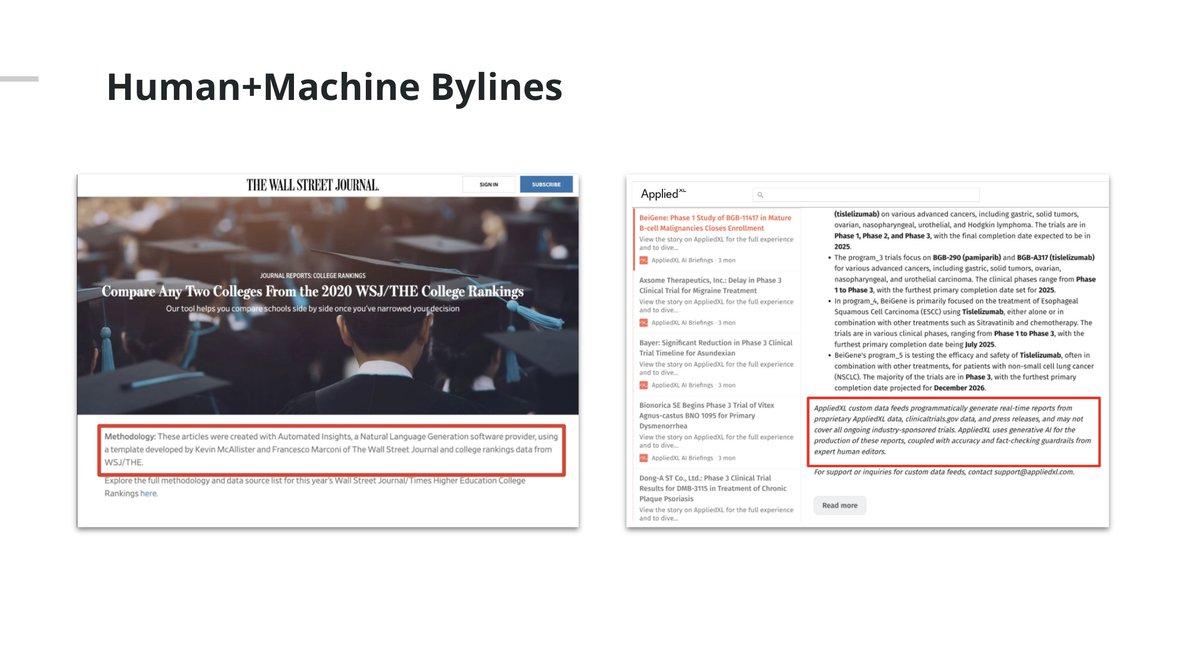
There are so many important issues to consider when it comes to AI, IP and content. Even seemingly small details, such as the algorithmic disclosure at the bottom of GenAI stories, describing and highlighting the crucial roles of humans, and are important. This is something we have been doing for a long time, from the early days of journalism and AI. Long before the LLM boom show at The Wall Street Journal humans were credited alongside the machines. In the age of AI, transparency and methodological disclosures are more important than ever.
The GenAI content IP question isn't just a theoretical problem. Imagine you've invested heavily in developing an AI system that enhances your original reporting – from uncovering hidden data connections to generating initial drafts. Now, consider a competitor using a similar tool to scrape your output, make minor tweaks, and pass it off as their own. Without clear rules on what constitutes 'original' in the age of AI assistance, it becomes harder to combat this kind of plagiarism and protect publishers' valuable IP assets.
If you are a news, research, or data company implementing AI, you need a content strategy, an IP strategy, a technology, product & design strategy, a standards strategy, and a communications strategy.
The future of content is 100% multidisciplinary.
2
9
22
3,877
AppliedXL retweeted
22 Apr 2024
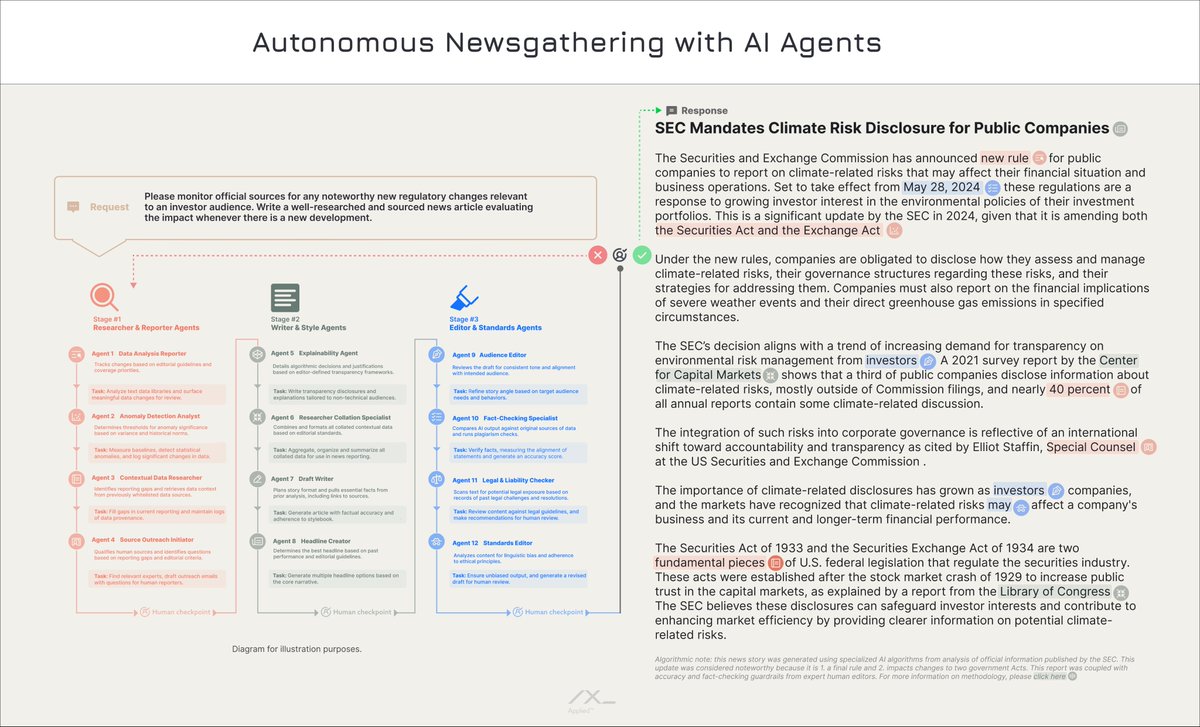
What if you could uncover a news story with just a few clicks? The next major advancement in AI for newsgathering involves AI agents. This shift sees AI moving from a conversational chat assistant to systems that execute comprehensive, end-to-end news research tasks — tasks that, given the vast amount of data, would be too time-consuming or complex for humans. For example, imagine sifting through millions of documents in public databases to find noteworthy news.
Some thoughts on how to approach AI agents in journalism.
1. I’ve never been a fan of the term "News Automation" and even less so of "Robot Journalism" because it implies a diminished human role and elevates the role of the machine. This perspective was shaped by the initial tech used for news automation over a decade ago, which was quite mechanical, relying on rule-based natural language generation which actually required a lot of work by humans.
2. Today, some of the most transformative innovations in computational journalism are manifesting as AI agents. Based on objectives established by editors, they can operate autonomously, iterating through a series of steps to complete complex, multi-layered research rather than performing a single isolated task. This enables agents to plan an outline, gather information, conduct standards reviews and generate drafts for human review — similar to how a reporter would approach the complex task of researching, reporting and fact checking a story. This contrasts with current language models that are primarily used in "zero-shot" mode to complete a single task without sequential instructions.
3. These new systems are called "agents" because, while humans set what they should accomplish, they grant AI the agency to determine the best outcomes, elevating the collaborative nature between people and machines. The use of Agentic AI in journalism, still has human checkpoints. In a GenAI powered world, the concept of "News Agency" takes on an entirely new meaning.
4. This new interpretation of "News Agency" aligns with our vision for @AppliedXL : creating the B2B information supplier of the future developing autonomous news-gathering systems. (Note that I didn't say autonomous news "generation.") These systems assist information producers in bolstering their coverage, personalizing their clients' experiences, and driving growth. In this illustrative diagram, we represent a network of specialized news agents interacting within a closed, trusted environment. This environment features a predefined number of trusted, live-updating public datasets from which information can be retrieved.
Here, journalists & analysts become controllers and overseers of the information that is gathered and reported from trusted data sources. They ensure that the integration of AI into journalism enhances the accuracy and depth of reporting while maintaining ethical standards. This balance between machine efficiency and human oversight is the future of the information industry.
3
16
3,851
AppliedXL retweeted
1 Mar 2024
"Self-Gathering News" will become a reality before the end of this decade. How can we prevent it from going rogue? Across various sectors, smart machines are already operating products and systems in real time, from additive manufacturing to autonomous vehicles, precision agriculture and more.
AI will similarly impact the field of journalism.
The rapid advancements in AI and decreasing computing costs will dramatically improve our ability to collect data and verify facts, leading to a significant increase in the amount of high-quality, reliable information that is generated and analyzed programmatically.
With data sensors monitoring activities in both the real and digital worlds, we are approaching an era of precisely generated news powered by AI agents that behave as journalists, algorithmically determining what is noteworthy in every real-world event.
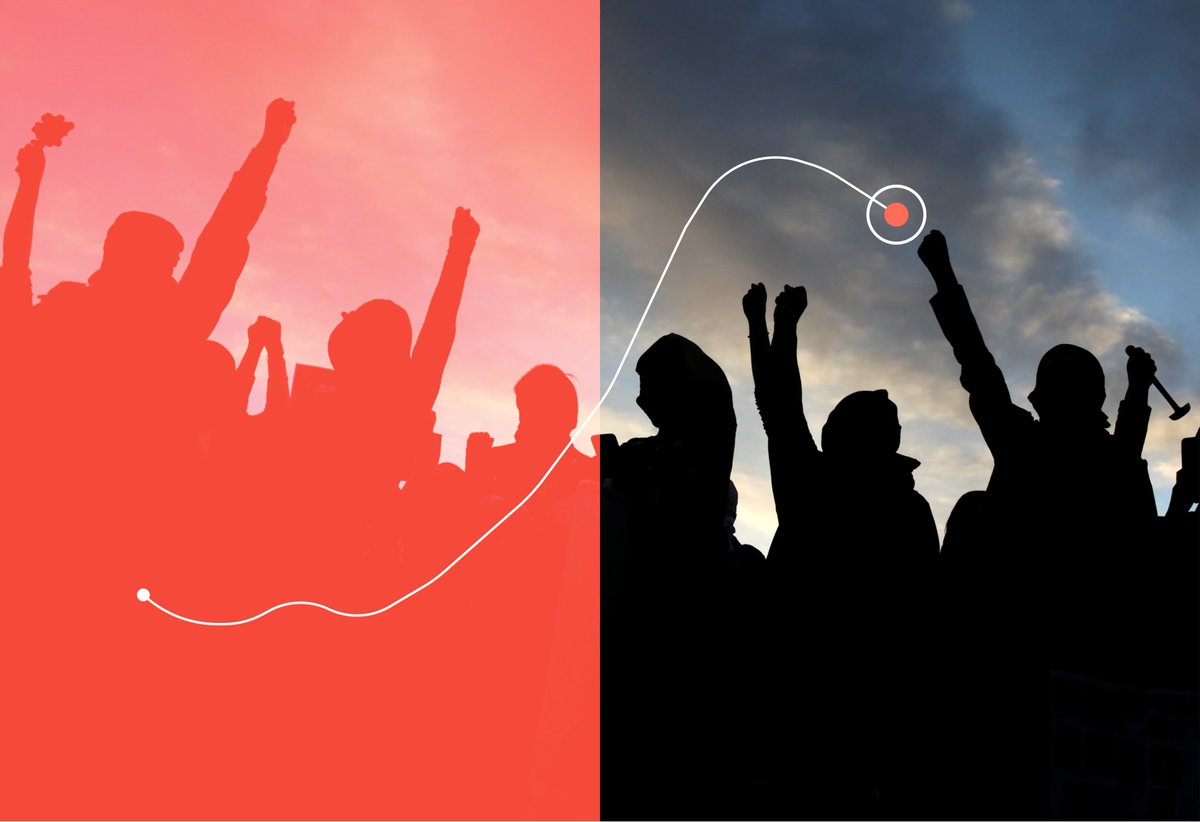
These autonomous agents will be largely automated, following a set of directives established by human editors. If the state of the world changes, the news will instantly update. News will become 'self-driving,' and the information you receive will be updated as new data becomes available. For example, as a protest unfolds in New York City, AI agents will update a news article in real time: the latest number of people arrested, sourced from public databases, the streets that are being shut down, based on traffic data, and even the responses of city officials, by analyzing their statements released online.
Static articles will become a thing of the past.
The transition towards “self-driving news” will be gradual and incremental at first. Initially, machine-driven algorithms will assist human journalists, but over time, journalism will increasingly be shaped by processes developed by machines themselves.
In this scenario, technology can be be used to inform us about the state of the world and help establish ground truth. A system that not only informs but also deepens understanding and supports constructive engagement with the world.
However, this algorithmic mechanism also presents the risk of being employed as a means to control society. In the AI age, I don't think human journalists will fade into oblivion. It's actually the polar opposite: they will have one of the most critical roles in society—that of arbiters of algorithmic integrity. That means the way to prevent AI from going rogue is for human journalists to establish, audit, and enforce an Editorial Constitution that creates guardrails to govern the machines to abide by the standards of journalism: transparency, accuracy, and reliability. This is something that needs to start being established no
7
15
2,404

16 Feb 2024
AppliedXL proudly welcomes Ian Koenig as our Chief Revenue Officer, whose expertise in algorithms and partnerships makes him the ideal leader to lead our growth strategy.
appliedxl.com/news/appliedxl…
88
AppliedXL retweeted
29 Dec 2023
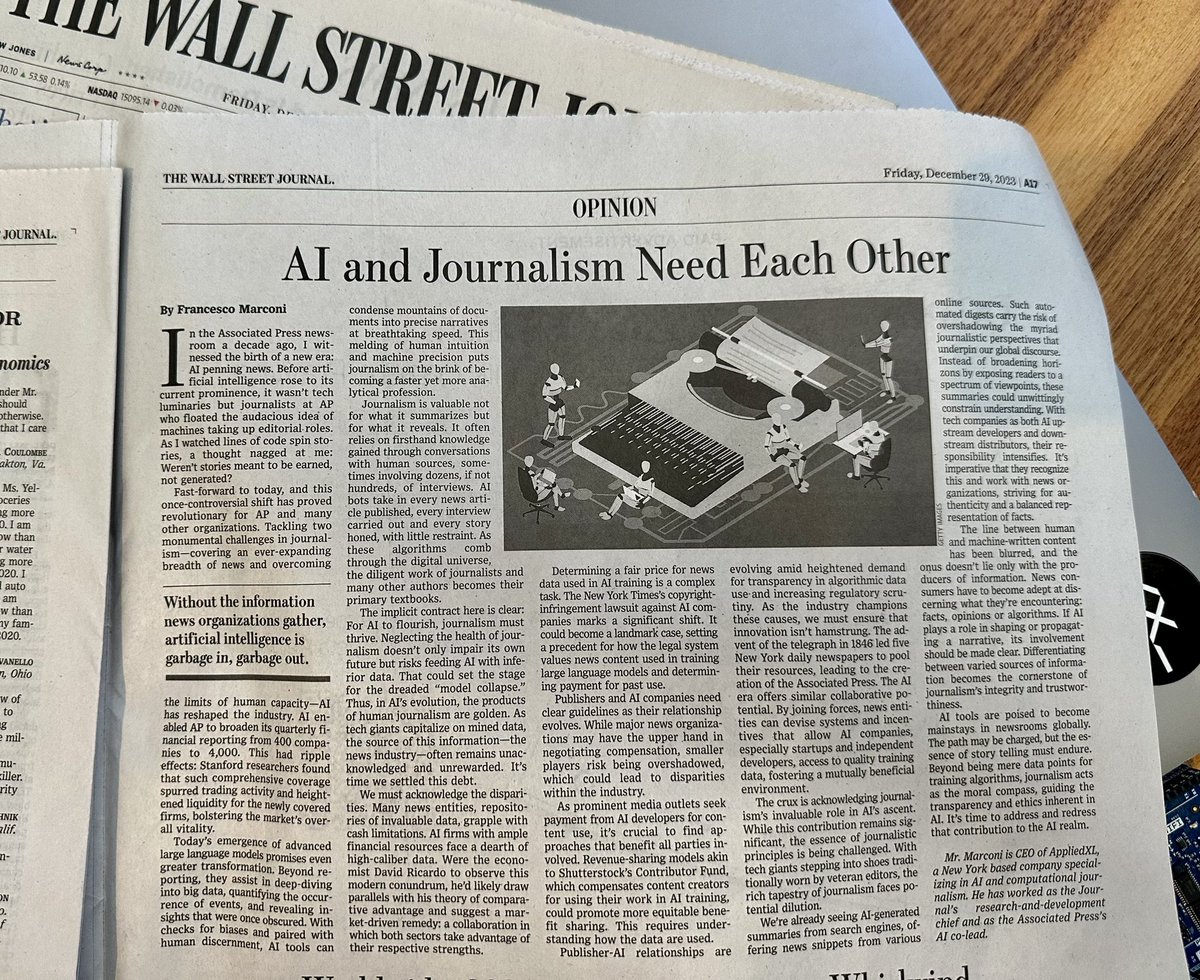
In @AP newsroom a decade ago, I witnessed the birth of a new era: AI penning news. Before artificial intelligence rose to its current prominence, it wasn’t tech luminaries but journalists at AP who floated the audacious idea of machines taking up editorial roles. As I watched lines of code spin stories, a thought nagged at me: Weren’t stories meant to be earned, not generated?
Fast-forward to today, and this once-controversial shift has proved revolutionary for AP and many other organizations. Tackling two monumental challenges in journalism—covering an ever-expanding breadth of news and overcoming the limits of human capacity—AI has reshaped the industry.
My Op-Ed for @WSJ “AI and Journalism Need Each Other”: wsj.com/articles/ai-and-jour…
4
38
106
18,471
28 Dec 2023
In an opinion article for @WSJ, AppliedXL's CEO @fpmarconi discusses the interdependence of journalism and AI industries: "AI and Journalism Need Each Other"
wsj.com/articles/ai-and-jour…
127
30 Oct 2023
AppliedXL CEO @fpmarconi Marconi envisions a future where journalism does more than just report; it offers an enriched layer of insight, made possible through a symbiotic collaboration between humans and machines.
politico.com/newsletters/dig…
1
1,861
AppliedXL retweeted

26 Oct 2023
42 days later: vision actualized



1
2
4
859
25 Oct 2023
Mesothelioma treatments can cost over $1M in some cases, indicating a potential profitable market despite its small size. $AZN's late-stage clinical trial is testing a new antibody on 600 patients worldwide, with results expected by April 2027.
appliedxl.com/case-study/med…
1
1
341
24 Oct 2023
🧬$MRNA is testing a new research drug, mRNA-1345, for RSV in children. The drug provides a blueprint for cells to make a specific RSV protein, priming the immune system to combat #RSV🦠virus.T
appliedxl.com/case-study/mod…
1
1,236
21 Oct 2023
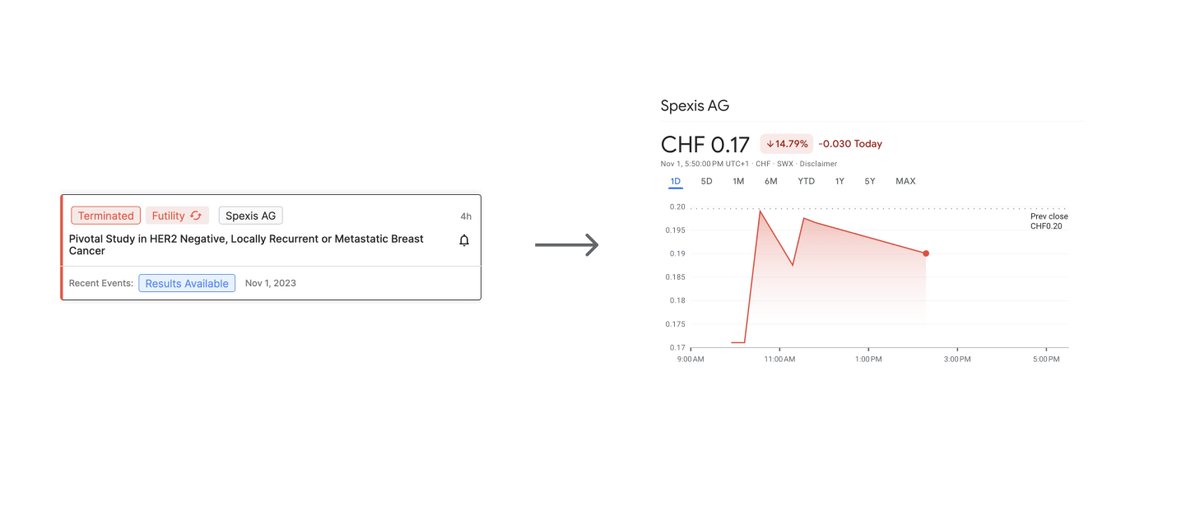
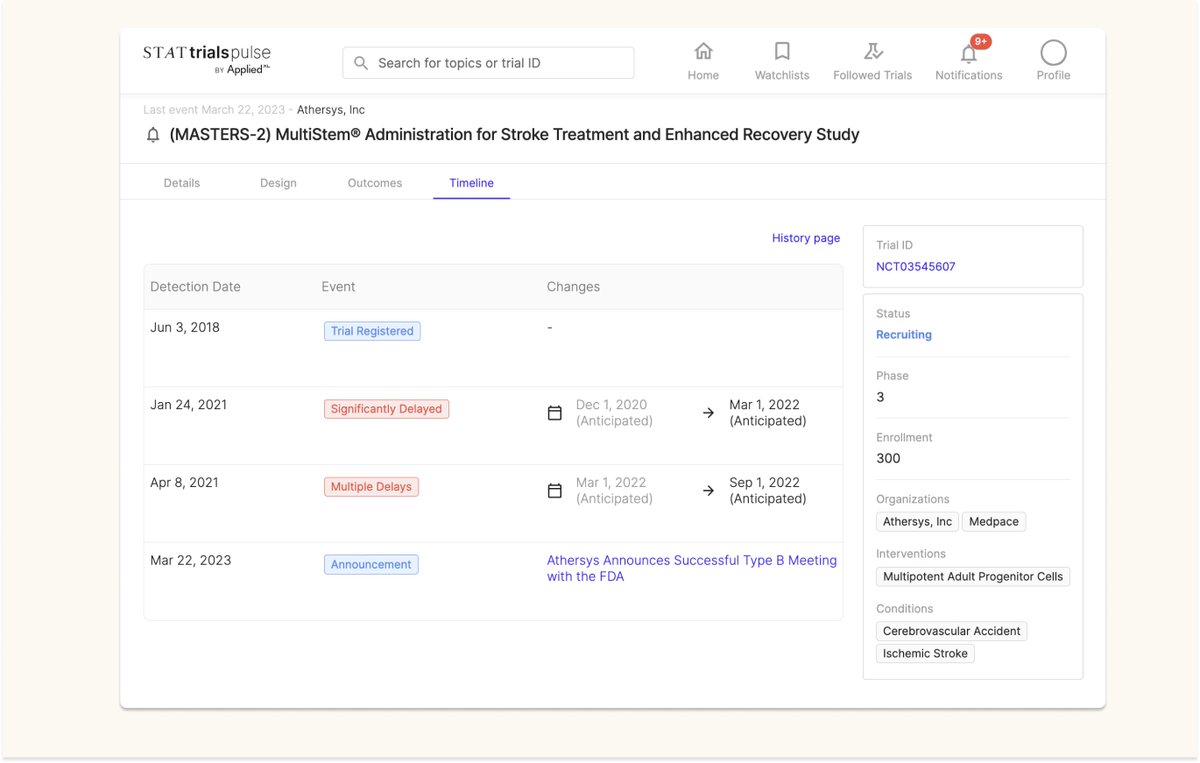
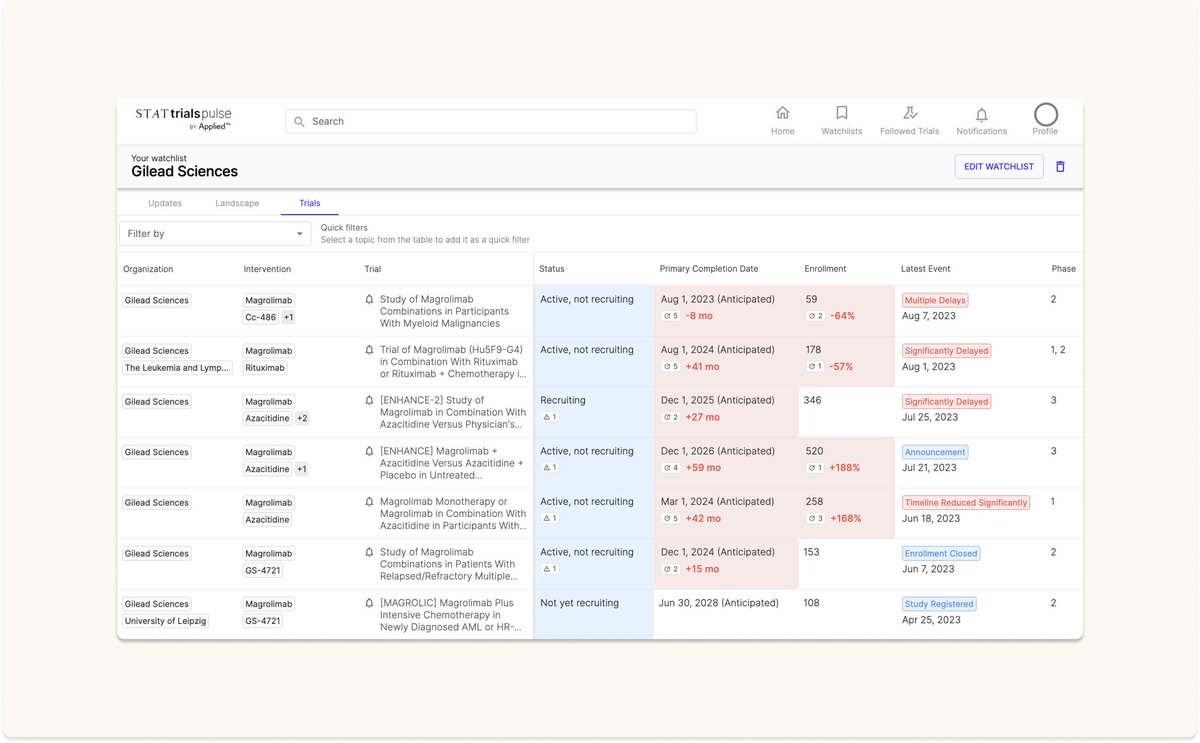
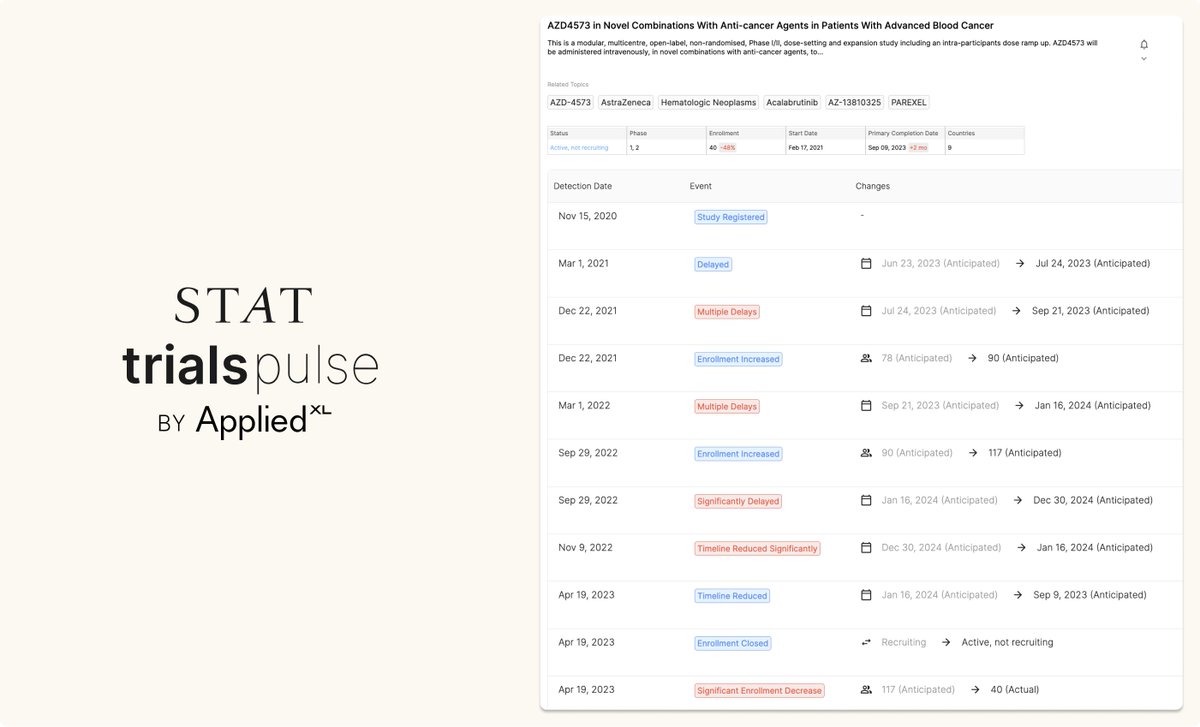
#Janseen's #multiplemyeloma phase 3 #clinicaltrial significantly behind. While not every trial delay suggests problems, according to AppliedXL data, trials with notable delays have a higher likelihood of ending prematurely.
appliedxl.com/case-study/jan…
95