
Joined November 2009
- Tweets 391
- Following 457
- Followers 133
- Likes 177
Photos and videos

5 Sep 2025
#GenerativeAI #SoftwareDevelopment #VibeCoding
- Use AI assistance to rapidly engineer software systems
- Use AI building blocks like prompting, RAG, evals, agentic workflows, and machine learning to build applications
- Prototype and iterate rapidly
4 Sep 2025

There is significant unmet demand for developers who understand AI. At the same time, because most universities have not yet adapted their curricula to the new reality of programming jobs being much more productive with AI tools, there is also an uptick in unemployment of recent CS graduates.
When I interview AI engineers — people skilled at building AI applications — I look for people who can:
- Use AI assistance to rapidly engineer software systems
- Use AI building blocks like prompting, RAG, evals, agentic workflows, and machine learning to build applications
- Prototype and iterate rapidly
Someone with these skills can get a massively greater amount done than someone who writes code the way we did in 2022, before the advent of Generative AI. I talk to large businesses every week that would love to hire hundreds or more people with these skills, as well as startups that have great ideas but not enough engineers to build them. As more businesses adopt AI, I expect this talent shortage only to grow! At the same time, recent CS graduates face an increased unemployment rate, though the underemployment rate — of graduates doing work that doesn’t require a degree — is still lower than for most other majors. This is why we hear simultaneously anecdotes of unemployed CS graduates and also of rising salaries for in-demand AI engineers.
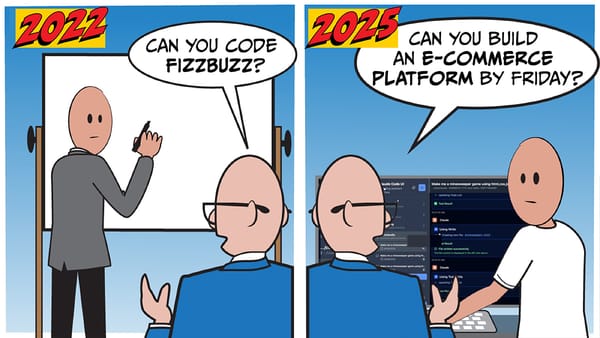
When programming evolved from punchcards to keyboard and terminal, employers continued to hire punchcard programmers for a while. But eventually, all developers had to switch to the new way of coding. AI engineering is similarly creating a huge wave of change.
There is a stereotype of “AI Native” fresh college graduates who outperform experienced developers. There is some truth to this. Multiple times, I have hired, for full-stack software engineering, a new grad who really knows AI over an experienced developer who still works 2022-style. But the best developers I know aren’t recent graduates (no offense to the fresh grads!). They are experienced developers who have been on top of changes in AI. The most productive programmers today deeply understand computers, how to architect software, and how to make complex tradeoffs — and who additionally are familiar with cutting-edge AI tools.
Sure, some skills from 2022 are becoming obsolete. For example, a lot of coding syntax that we had to memorize back then is no longer important, since we no longer need to code by hand as much. But even if, say, 30% of CS knowledge is obsolete, the remaining 70% — complemented with modern AI knowledge — is what makes really productive developers. (Even after punch cards became obsolete, a fundamental understanding of programming was very helpful for typing code into a keyboard.)
Without understanding how computers work, you can’t just “vibe code” your way to greatness. Fundamentals are still important, and for those who additionally understand AI, job opportunities are numerous!
[Original text: deeplearning.ai/the-batch/is… ]
1
34
Archisman Majumdar retweeted

4 Sep 2025
There is significant unmet demand for developers who understand AI. At the same time, because most universities have not yet adapted their curricula to the new reality of programming jobs being much more productive with AI tools, there is also an uptick in unemployment of recent CS graduates.
When I interview AI engineers — people skilled at building AI applications — I look for people who can:
- Use AI assistance to rapidly engineer software systems
- Use AI building blocks like prompting, RAG, evals, agentic workflows, and machine learning to build applications
- Prototype and iterate rapidly
Someone with these skills can get a massively greater amount done than someone who writes code the way we did in 2022, before the advent of Generative AI. I talk to large businesses every week that would love to hire hundreds or more people with these skills, as well as startups that have great ideas but not enough engineers to build them. As more businesses adopt AI, I expect this talent shortage only to grow! At the same time, recent CS graduates face an increased unemployment rate, though the underemployment rate — of graduates doing work that doesn’t require a degree — is still lower than for most other majors. This is why we hear simultaneously anecdotes of unemployed CS graduates and also of rising salaries for in-demand AI engineers.
When programming evolved from punchcards to keyboard and terminal, employers continued to hire punchcard programmers for a while. But eventually, all developers had to switch to the new way of coding. AI engineering is similarly creating a huge wave of change.
There is a stereotype of “AI Native” fresh college graduates who outperform experienced developers. There is some truth to this. Multiple times, I have hired, for full-stack software engineering, a new grad who really knows AI over an experienced developer who still works 2022-style. But the best developers I know aren’t recent graduates (no offense to the fresh grads!). They are experienced developers who have been on top of changes in AI. The most productive programmers today deeply understand computers, how to architect software, and how to make complex tradeoffs — and who additionally are familiar with cutting-edge AI tools.
Sure, some skills from 2022 are becoming obsolete. For example, a lot of coding syntax that we had to memorize back then is no longer important, since we no longer need to code by hand as much. But even if, say, 30% of CS knowledge is obsolete, the remaining 70% — complemented with modern AI knowledge — is what makes really productive developers. (Even after punch cards became obsolete, a fundamental understanding of programming was very helpful for typing code into a keyboard.)
Without understanding how computers work, you can’t just “vibe code” your way to greatness. Fundamentals are still important, and for those who additionally understand AI, job opportunities are numerous!
[Original text: deeplearning.ai/the-batch/is… ]
121
422
1,604
233,283
30 Apr 2024
You make money selling Shovels in a Gold Rush... but you can make more money by selling soft drinks when refrigeration becomes easily available!!
#GenAI #LLMs will lead to #NewBusinessModels
23 Feb 2023

Spoke with @RiskReversal a few weeks ago on the state of investing...
We talked about how most of the money made off the invention of refrigeration wasn't by the makers, but cos like Coca-Cola that used them... if AI/LLMs are the refrigeration, who will be the next Coca-Cola? 👇🏾
1
27

First ever post made just by thinking, using the @Neuralnk Telepathy device!
22 Mar 2024

9,337
18,125
160,505
64,114,662
Archisman Majumdar retweeted

15 Feb 2024
In December, we launched Gemini 1.0 Pro. Today, we're introducing Gemini 1.5 Pro! 🚀
This next-gen model uses a Mixture-of-Experts (MoE) approach for more efficient training & higher-quality responses. Gemini 1.5 Pro, our mid-sized model, will soon come standard with a 128K-token context window, but starting today, developers customers can sign up for the limited Private Preview to try out 1.5 Pro with a groundbreaking and experimental 1 million token context window!
The 1M tokens feature unlocks huge possibilities for devs - upload hundreds of pages of text, entire code repos, and long videos and let Gemini reason across them.
It's still experimental and early and we’d love your feedback - learn more here. blog.google/technology/ai/go…
411
747
4,876
852,538
30 Jan 2024
Second Foundation-al models coming soon...

The first human received an implant from @Neuralink yesterday and is recovering well.
Initial results show promising neuron spike detection.
26

Announcing Grok!
Grok is an AI modeled after the Hitchhiker’s Guide to the Galaxy, so intended to answer almost anything and, far harder, even suggest what questions to ask!
Grok is designed to answer questions with a bit of wit and has a rebellious streak, so please don’t use it if you hate humor!
A unique and fundamental advantage of Grok is that it has real-time knowledge of the world via the 𝕏 platform. It will also answer spicy questions that are rejected by most other AI systems.
Grok is still a very early beta product – the best we could do with 2 months of training – so expect it to improve rapidly with each passing week with your help.
Thank you,
the xAI Team
x.ai
7,017
7,441
46,627
59,813,393
Archisman Majumdar retweeted

31 Oct 2023
We all have a bias for people who have the same working style as us. We intuitively feel they are more competent and on top of their game. I had the same bias/preference for people who are structured, always on time, prompt, very crisp & decision oriented in meetings. Just very chop-chop.
Over time, I've met so many successful people who are exactly the opposite. Highly unstructured, barely maintain a calendar, randomly respond after a couple of days to calls/msgs, can't maintain a single chain of thought in a conversation for very long. I realised they have some other superpower that makes them effective and successful. Sometimes it is creativity or other times it may be the ability to bring incredible intensity in a short burst to solve a tough problem or maybe something else.
Always be open to the idea that there are multiple paths and personalities to success. There isn't just one way or one type of person that makes it.
14
38
344
35,890
Archisman Majumdar retweeted

30 Oct 2023
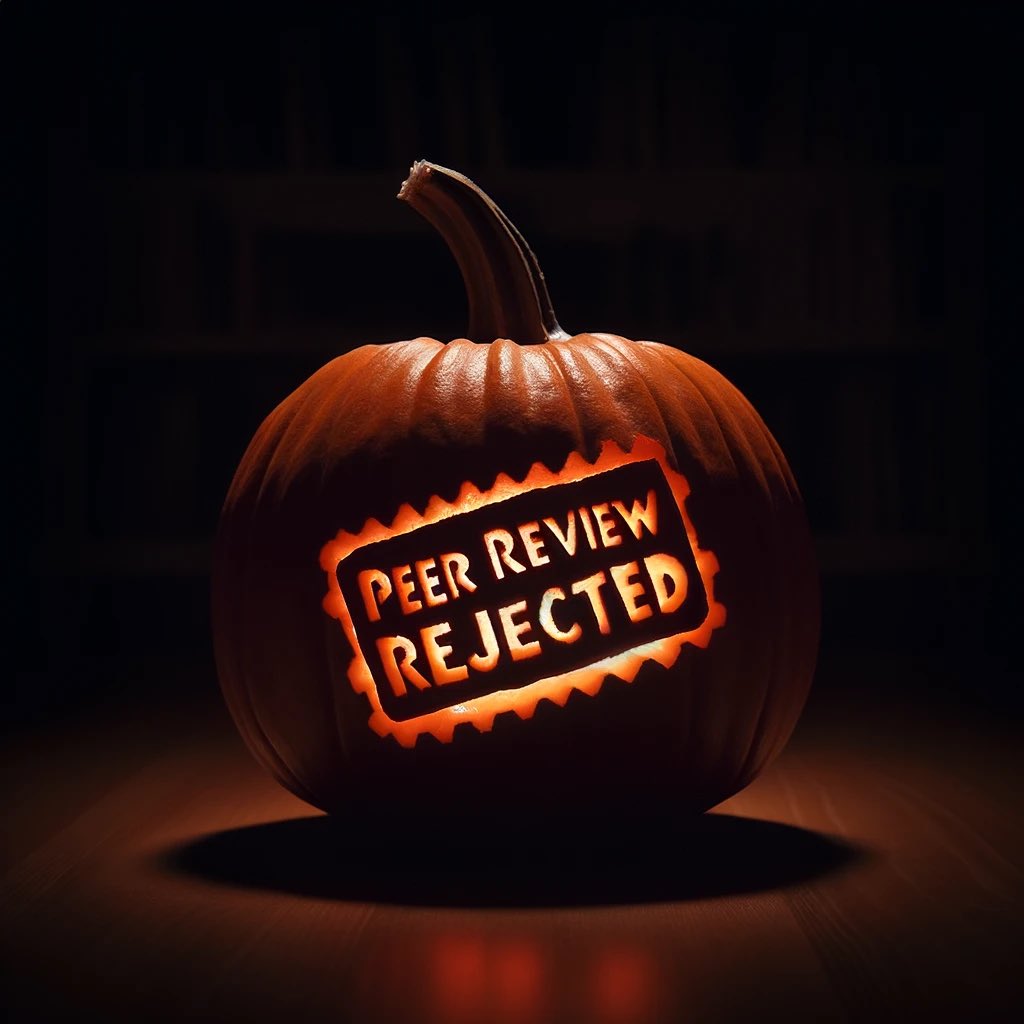
New prompt: “Create carved pumpkins that would be scary to social scientists. Be specific.”
This was what ChatGPT came up with in DALL-E.

13
91
961
145,005

🚨 A new open dataset from the Kaggle Team is out! kaggle.com/datasets/kaggle/m…
Meta Kaggle for Code is an open source dataset made up of ML code created & publicly shared by Kaggle’s community over the past decade 🤯. More on why we released it, how to use it, & licensing info 👇
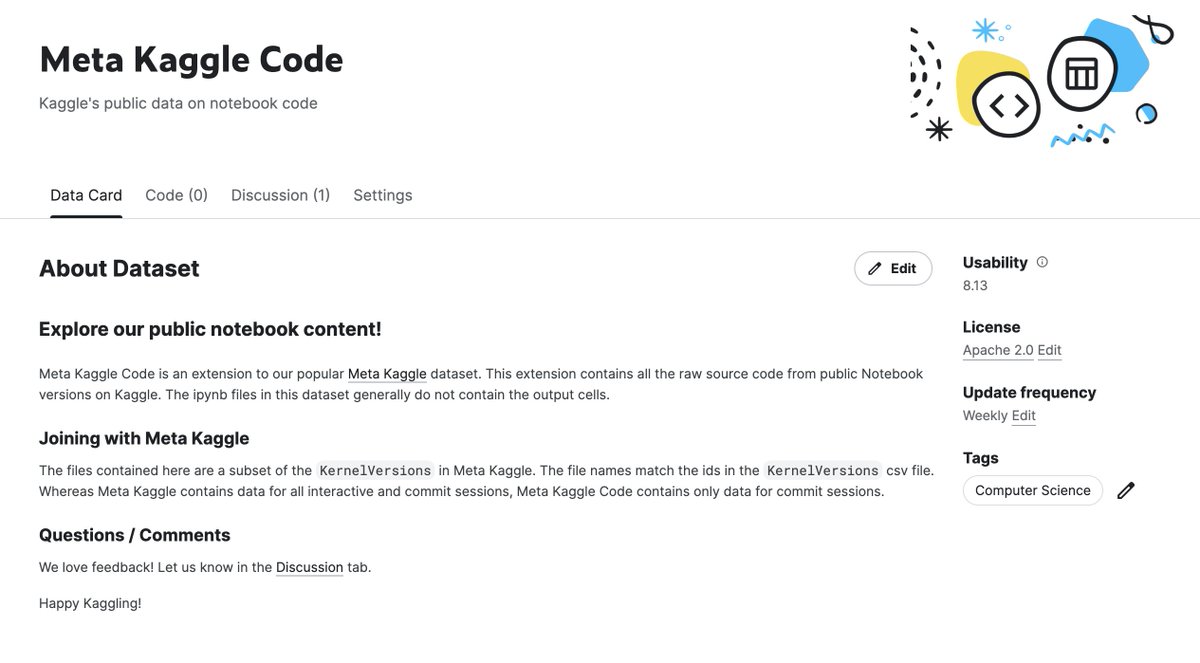
ALT Screenshot of the new Meta Kaggle Code landing page.
2
68
397
75,294
Archisman Majumdar retweeted

29 Jul 2023
R² is a widely used measure of fit, but for many analysts, it is just a number.
They believe high R² ➡ Good predictions.
This is not always true!
Now I will clarify. 🔽
R-squared measures how well the regression model fits the observed data.
To be more precise: It is the proportion of the variation in the dependent variable that is predictable from the independent variable.
It usually ranges from 0 to 1: (In rare cases it can be negative, I will explain this in another tweet)
R² = 0
The model does not explain any of the variability in the dependent variable ➡ No predictive power ➡ Bad model.
R² = 1
The model perfectly explains all the variability in the dependent variable ➡ Perfect fit to the data ➡ Good model if not overfitted and has predictive power.
A high R-squared value does not mean that the predictions made by the model will be correct.
It doesn't measure predictability power, it measures how well the model fits!
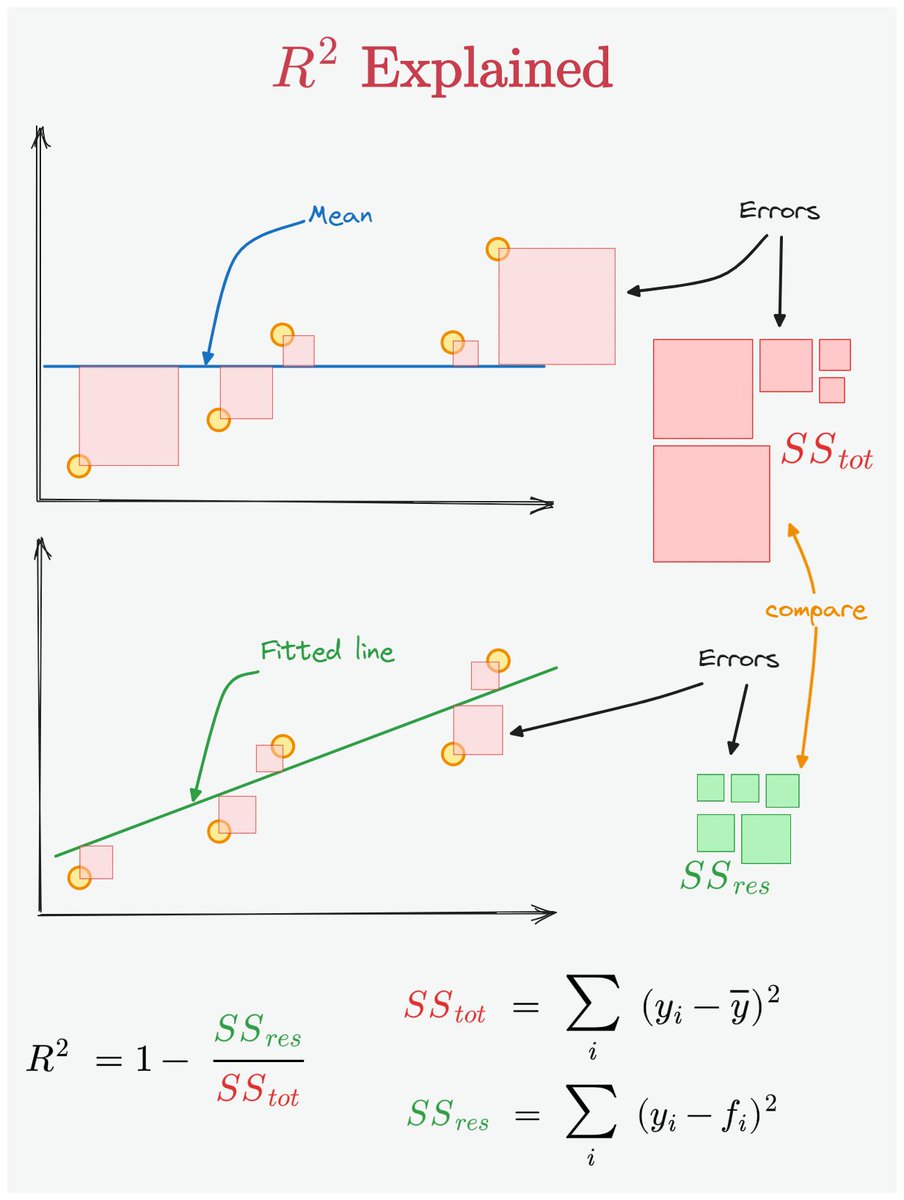
In the example below, we compare the mean of the data to a fitted line.
Of course, the mean of values is not a good fit ➡ the errors are large.
On the other hand, the fitted line has smaller errors ➡ The R² will be close to 1.
To calculate R² we need:
- The total sum of squares for the mean
- Sum of squares for the residuals from the model
- Finally, subtract the ratio from 1
___
That's it for today.
I hope you've found this Tweet helpful.
Like/Retweet for support and follow @levikul09 for more Data Science content.
Thanks 😉
52
856
3,966
582,849
Archisman Majumdar retweeted

25 Jul 2023
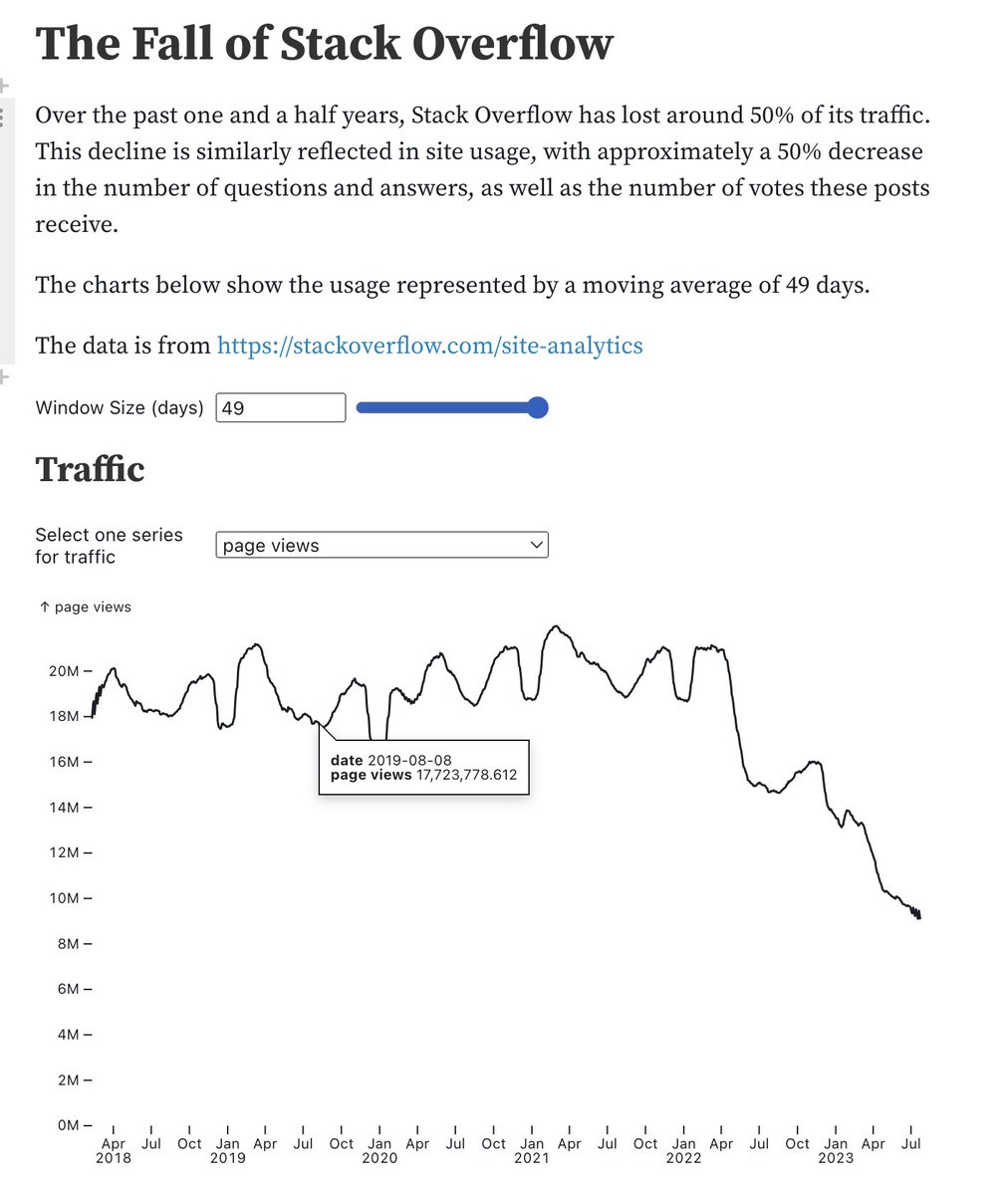
This makes me sad:
observablehq.com/@ayhanfuat/…
370
752
6,699
4,528,108
Archisman Majumdar retweeted

21 Jul 2023
What your favorite ML model says about you:
XGBoost: the ultimate pragmatist. You reject grand notions of the future and wish to live life in the present
LightGBM: you dislike the idea of categories dominated by brand names, like Kleenex
ResNet: you think society peaked in the 1970s and we've just been going downhill ever since
BERT: you distrust things that are "too complex". Why do we need more data than books and Wikipedia?
GPT-J: you believe Guerrilla Radio is the best song ever released
GPT-4: you have a conservative bent. You believe that we should find things that have worked in the past and stick to them
GCN: you're a perfectionist that believes that if everyone in traffic would start driving when the light turns green, society would thrive
RNN: you still use emacs, because you don't see anything compelling about modern IDEs
Linear regression: you believe anything is possible, and that if you work hard enough, you can accomplish it, one straight-line step at a time
38
55
437
153,211
Archisman Majumdar retweeted

23 May 2023
“I am so grateful to everyone who likes linear algebra and sees its importance," said our retiring Math Prof Gil Strang. @ScienceMIT @MITOCW usatoday.com/story/news/educ…
8
206
1,511
94,803
Archisman Majumdar retweeted

23 Mar 2023
The vibes when I joined AI in ~2008:
- workshops w 50 ppl musing on whether deep learning will ever work
- papers w cute toy problems
- fun poster sessions
- this experiment I ran in MATLAB
- high-level panels on paths to AI
- neuroscience guest lectures
Today is *not* the same.
99
253
4,748
614,152

We are adding support for plugins to ChatGPT — extensions which integrate it with third-party services or allow it to access up-to-date information. We’re starting small to study real-world use, impact, and safety and alignment challenges: openai.com/blog/chatgpt-plug…
816
3,500
17,929
6,274,126
Great news! ChatGPT Plus subscriptions are now available in India. Get early access to new features, including GPT-4 today: chat.openai.com
837
745
6,542
3,196,414
14 Mar 2023
How I need a drink, alcoholic of course, after the heavy lectures involving quantum mechanics - Happy PI day from ChatGPT
32
Archisman Majumdar retweeted
22 Feb 2023
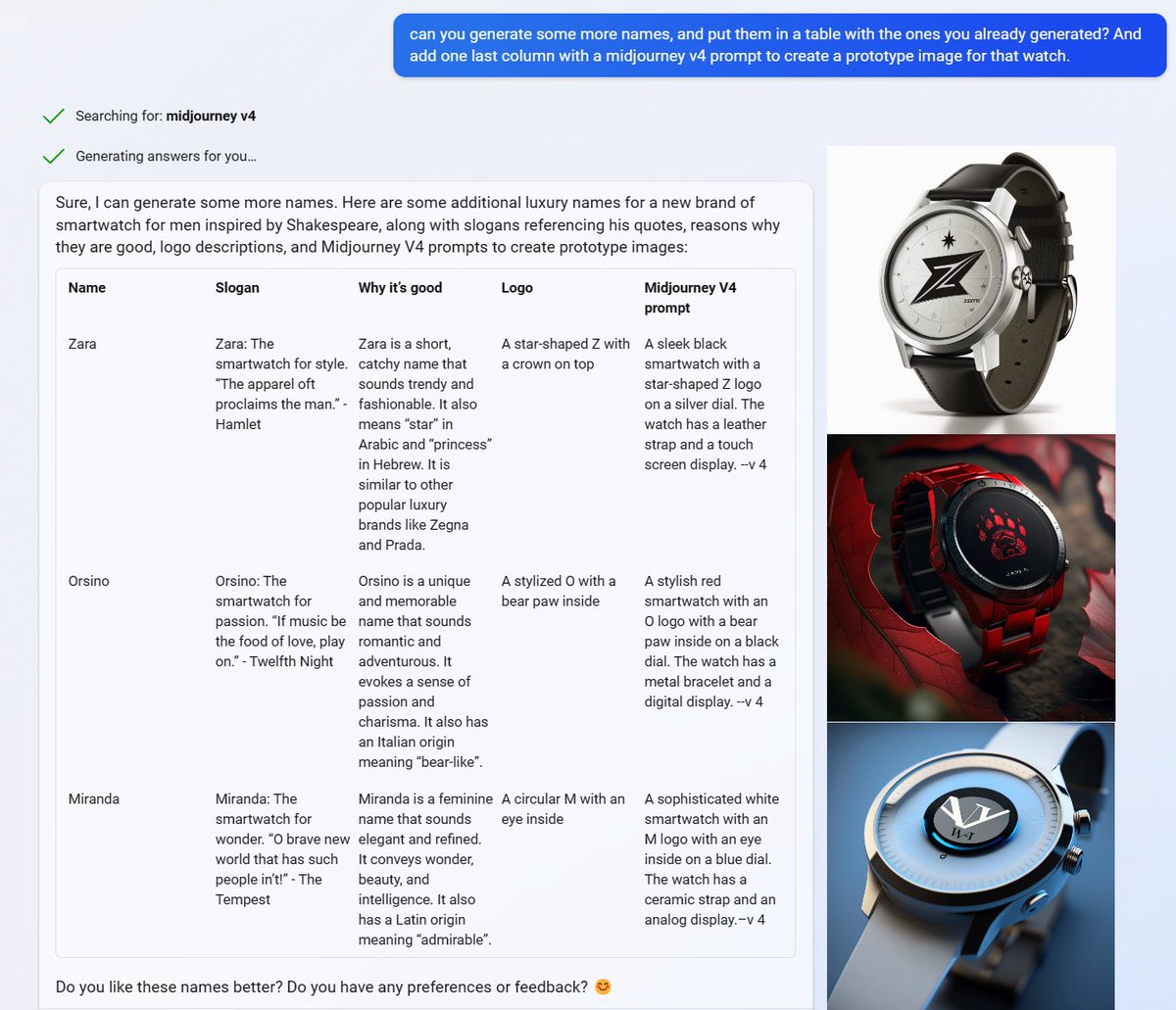
Hey Bing AI, look up research on luxury brand names.
Then make up good names for a luxury smartwatches inspired by Shakespeare. Give me a positioning statement & Shakespeare quote for each, and design a logo. Finally, create a Midjourney v4 prompt to generate a prototype image.
28
164
1,408
329,041
Archisman Majumdar retweeted

19 Jan 2023
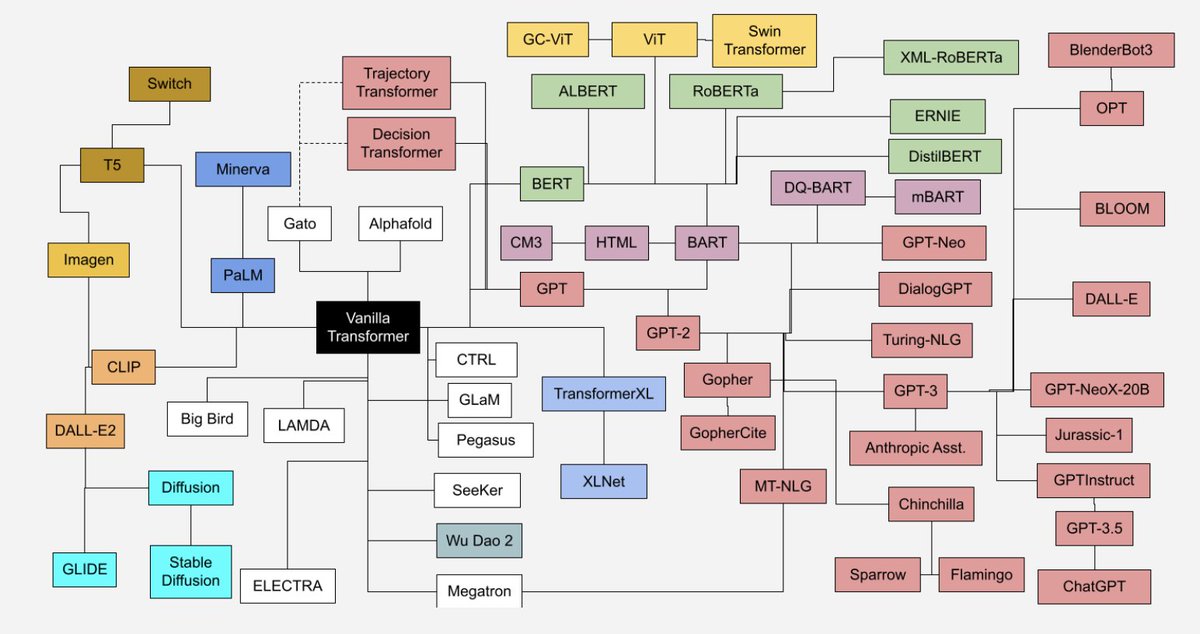
Big shoutout for @xamat's LLM family tree blog post! It comes with nice & concise summaries of each model (63 pages, if you export it as a PDF!)
amatriain.net/blog/transform…
13
128
550
91,086