
Joined August 2025
- Tweets 221
- Following 66
- Followers 357
- Likes 983
9 Photos and videos






Pinned Tweet

7
13
63
28,171
Also should be noted that $UTHR renewed their licesing agreement with $MNKD in March. $5M upfront, up to $35M in development milestones, and 10% royalties on net sales of any resulting product.
LOL.

Kinda strange getting away from a licensed asset is a drawback he mentioned. I thought better margins were a good thing.
1
8
1,384
Sure, owned > licensed on sales, all else equal. A low double-digit royalty to Pharmosa on a product that opens incremental TAM in IPF, PPF, PH-COPD and Raynaud's, markets at $4-5B on top of the $7-8B PAH/PH-ILD base - would be a step forward no?
This model is a step back from what exactly? They get to enter newer markets and multiply their TAM. $UTHR, which was a monopoly up until yesteryear is still paying $MNKD royalties on DPI, their crown jewel, no?
So UTHR paying royalties warrants the stock trading like an incumbent, but $LQDA paying those same royalties somehow makes it an inferior biz?
Kinda strange getting away from a licensed asset is a drawback he mentioned. I thought better margins were a good thing.
10
1,288
The irony of calling $LQDA investors myopic while posting the rest of this tweet is not lost.
Why would L606 use PRINT technology when they're not even dealing with a dry powder there? You can't make a liposomal nebulizer formulation with PRINT, it's for dry powder.
Calling L606 backward because it's 2x daily? Really? L606's whole pitch is that its 7x-lower Cmax decouples dose from systemic adverse events, so patients titrate higher with ease.
Which is why you see median at ~19 breath equiv. but patients pushed to 378 mcg / >25 breath equiv., with only ~14% drug related cough and zero cough dropouts at 48 weeks.
All this while holding benefit across the full 24-hour interval. Seems to me that you don't quite understand the treatment landscape here.
Jun 11

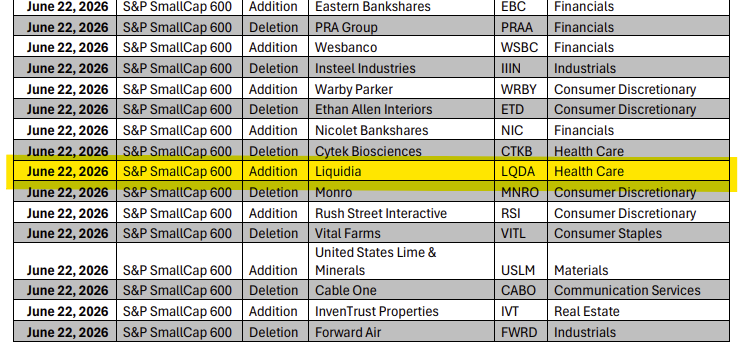
$LQDA investors are incredibly myopic.
Yutrepia likely has just a few years before becoming obsolete. Liquidia's backup, which doesn't even utilize its proprietary PRINT manufacturing technology (it's a licensed asset), L606, is a twice daily nebulizer that represents a step backwards for both business economics and patient convenience.
I look stupid right now (I've rated LQDA a Sell amid the stock rally), but when the dust settles in a few years from now, we'll look back at this and have a chuckle.
7
1
55
5,019
Blue Duck Cap - Analyst retweeted

Jun 9
Do a mass primer on 800V for the masses and then say checks likely pushed it back a year 2 weeks later to institutional clients..
8
13
243
59,854
Blue Duck Cap - Analyst retweeted

Jun 5
The sell side analysis of the implications of the Hikma ruling for $LQDA misses the mark.
Sell side is calling it bullish but calling it bullish for the wrong reasons - e.g. that it takes away the possibility of a drug removal. While that may be true, that is not the important read through.
Hikma is bullish because it has a direct bearing on the dependent claims analysis. Everyone has been focused on Claims 1 and 14, and ignored the dependent claims.
The dependent claims are murky and Andrews was always troubled by them. He could use Bayer to say that they don't have patentable weight, and are therefore not valid but the cleaner arrow was always going to be Hikma - which if it got over turned would allow him to say that there is no induced infringement either.
This Hikma ruling in effect says that if it is not on the label, then it is not the company's problem. The capabilities outlined in the dependent claims are not in $LQDA's label ergo it is impossible per Hikma for $LQDA to infringe those claims.
That new precedent knocks out every dependent claim very cleanly now.
The timeline of this case as much as it vexed folks makes more sense now.
Andrews hears the case in June and recognizes both that a launch is underway and he might have to rule against the party launching - which is why he asks for expedited briefing and speaks to the mess it would be if he finds against $LQDA.
After the initial briefing, he sees that he has a route to find for $LQDA on Claim 14 and Claim 1, which is the case, but he still has these outstanding dependent claims.
That fall, the solicitor general asks that the SC take up Hikma (this being Andrew's prior case and one that $UTHR cited in their brief is likely one he is following). He knows that if the SC takes it up and reverses the Federal Circuit court, he has a clean shot on the murkier dependent claims and a much more thorough opinion. He also knows that his ruling at this point is not going to affect the commercial realities and equities and so he is not rushed. Might as well wait for this ruling to come out. So he takes his time and now we finally have this ruling and so he has all the pieces he needs.
5
5
78
5,958
Blue Duck Cap - Analyst retweeted
You should. I think, if you see this in the context of Bayer. Would make sense that he would wait for Hikma.
Fed. Cir's language on Bayer was very vague and if that got overturned by SCOTUS ruling *for* Amarin, then that would've been a different mess.
On the other hand if SCOTUS elaborated and provided a backstop upholding Fed. Cir in Bayer, that would lead to a different outcome & this is what happened today.
1
6
421
Overheard someone saying Hikma is good but $LQDA still needs to prove obviousness.
DTX3 - On UTHR's May 2018 earnings call, Martine said, in response to a question about using Tyvaso for PH-ILD, that she was aware Dr. Waxman and other doctors used Tyvaso off-label to treat PH-ILD patients, and they told $UTHR that "this drug works" — even better in Group 3 PH (PH-ILD) than in PAH, specifically in improving exercise capacity.
This compounds actually. UTHR's own NEJM paper (the INCREASE publication) identifies Faria-Urbina and Agarwal as "pilot studies" that provided a reasonable expectation of success to run INCREASE.
UTHR's start witness also testified no company runs a Phase 3 trial like INCREASE without proof-of-concept pilot studies. So UTHR's own witness and own documents establish that the prior art gave both motivation and a reasonable expectation. Liquidia's opening brief opens with exactly this btw: "This drug works." — UTHR's CEO, 2018.
Thank you Dr. Rothblatt & Dr. Nathan for your service.
2
5
42
3,897
Blue Duck Cap - Analyst retweeted

Jun 4
$LQDA Hikma wins SCOTUS trial. Andrews now has what he needs to end this long and painful 327 cloud over our heads.
I expect Andrews to move fast just like when PTAB killed 793.
9
20
152
69,067
$LQDA - The court holds that Amarin, a drug maker, has failed to state a claim for active infringement of its patent.
🫳🎤
3
2
49
4,325
Blue Duck Cap - Analyst retweeted
Jun 3
After listening to $LQDA Jefferies conference today, I'm not selling a single share under $100. Will wait for Q2 to confirm script growth rate.
'327 doesn't concern me. Andrews is waiting on Hikma which will be decided by June 30th. Expecting Andrews opinion in July. Q2 in August and new trial details in Q3.
RJ hinted at partnership interests. Too much upside. His bar is probably $15B for someone like Merck.
$5 in EPS on $1B in sales.
3
16
110
14,458
Blue Duck Cap - Analyst retweeted

Jun 3
Exciting turnaround underway at $AIRS. Think this new management team has really got things cooking.
We are long the stock but may sell at any time. We may not share future positioning. This is not advice, we could be wrong, and please do your own research to arrive at your own conclusions.
Jun 3

Best $AIRS mgmt has ever sounded in public webcast just now: “Investment community is just starting to see the progress we are making, and we are in the early innings.”
Expressed high confidence in their guide, which includes no GLP-1 linked volume despite already being 10-15% of total.
Noted path to doubling margins and resuming highly profitable new store growth into “huge population we can’t serve”
Signed off by noting the aesthetics industry “is just getting started”
1
6
1,685
Blue Duck Cap - Analyst retweeted
Yes, thanks for engaging. The statistical claim that KEYNOTE-942 cannot reliably estimate efficacy in ctDNA patients is established.
My forecast is informed by the math (working backwards from overall HR 0.51 and published ctDNA-negative HR 0.21 suggests ctDNA HR likely 1.0-1.3), the biology (ctDNA patients have higher tumor burden and more immunosuppressive features that should limit vaccine response), and the precedent of cancer vaccines underperforming in MRD-positive populations.
Either way, the Ph3 readout is the falsification point. They seem to have a lot going against them in Ph3 which once again, makes sense in light of mgmt comments at Barclays wrt 0.80 HR.
1
1
386
Blue Duck Cap - Analyst retweeted
That's a narrower claim than the paper's own discussion makes ("benefit across all subgroups including ctDNA status") no?
ctDNA analysis isn't optional here. This is a question of commercial success. If a drug shows overall benefit driven mostly by ctDNA-negative patients (where untreated 5-yr RFS is already 75-80%), insurers will require ctDNA status for coverage. That restricts coverage to the subgroup where the drug has no demonstrated effect.
This is the failure pattern oncology has seen repeatedly with biomarker-restricted approvals, from Tecentriq in TNBC to Blenrep in myeloma.
NCCN Cat 1 designation typically requires high-level evidence with consistent benefit signals across the trial population, including key subgroups. Without ctDNA evidence, their claims don't hold up. INT is heading to Cat 2A at best.
INTerpath-001 has n=1089, so the ctDNA subgroup will be analyzable. If it shows what the math implies given the published subgroup HRs (HR likely ~1.0-1.3), the primary endpoint win becomes commercially stranded.
1
2
4
1,354
Blue Duck Cap - Analyst retweeted
The ctDNA imbalance alone disadvantages combo. But PD-L1 ( 9.4pp) and TMB ( 13.8pp) imbalances favor combo. Net, bias-adjusted HR ~0.55-0.60 vs reported 0.51.
The ctDNA point isn't about bias but rather the analyzability. With n=2 in pembro, the highest-risk subgroup HR is not estimable. After 5 years, we still can't answer the most clinically important question: does INT work in the patients who actually need it?
The question then becomes, did pembro arm really have lower ctDNA patients?
Combo arm: 13 positive (12.1%), 76 negative (71.0%), 18 NE (16.8%)
Pembro arm: 2 positive (4.0%), 33 negative (66.0%), 15 NE (30.0%)
The control arm has both lower measured ctDNA and substantially higher "not evaluable" rate. Even if INT truly works in ctDNA patients (true HR 0.7), at n=2 in pembro the chance of showing statistically significant benefit is 1.4%. At n=6, still only 6.3%. The trial is so underpowered for this subgroup that even a real effect wouldn't show as statistically significant.
Again, this reveals the trial design structurally flawed. The trial wasn't designed to answer the question it's now being marketed on.
A trial that wasn't designed to characterize ctDNA patients in a balanced way cannot retroactively be used to claim "benefit across all subgroups including ctDNA status", like they do in the ASCO publication.
1
2
3
1,178
$MRNA shareholders really need to be asking questions here. From yesterday's ASCO paper.
"Treatment-related adverse events occurred in 104/104 patients (100%) in the intismeran plus pembrolizumab arm and 42/50 (84%) in the pembrolizumab arm"
Every single patient on combo had a treatment-related AE.
"Direct functional linkage between post-treatment T-cell clonotypes and specific intismeran-encoded neoantigens remains to be established."
5-yr OS: HR 0.471, CI 0.165-1.345. So INT reducing death risk by 84% is as equally true as INT increasing death risk by 34%.
Among the myriad of imbalances in the trial, the ctDNA imbalance is particularly telling.
Combo: 13 ctDNA (12.1%). Pembro: 2 ctDNA (4.0%).
With only TWO ctDNA-positive patients in the entire control arm, the ctDNA-positive subgroup HR is mathematically "not estimable."
So the highest risk subgroup, the patients who biologically need adjuvant therapy most, cannot be analyzed against a control. After 5 years and three publications, we still don't know if INT works in patients with detectable residual disease.
The pembro arm has 30% "not evaluable" ctDNA vs 16.8% in combo. 13 percentage points of unknown ctDNA status in the control arm.
In an expensive Phase 2 trial run by two of the largest pharma companies in the world, you would expect cleaner biomarker characterization.
Is this simply a coincidence? You be the judge of that.
3
1
5
3,957
The data published by $MRNA at ASCO makes complete sense. See mgmt's statements from Barclays in March:
"Even seeing a 0.8 hazard ratio, I think, would be a clinically meaningful result."
Translation: management is already conditioning the market for a Phase 3 HR of 0.75-0.80.
Need I even explain what a 0.8 HR in MELANOMA — the friendliest tumor for immunotherapy — implies for NSCLC, RCC, and bladder?
cc: @BlueDuckCap
1
1
7
2,905
👀
May 28

NEW: The court has indicated that it may release opinions next Thursday, June 4, at 10:00 a.m. EDT. We will be live blogging that morning beginning at 9:30.
1
13
2,447