
Joined May 2022
- Tweets 8,594
- Following 1,432
- Followers 1,433
- Likes 244,066
400 Photos and videos










Pinned Tweet

4 Sep 2025
A propos de rien du tout:
npub196l32566mfd74jaj3r4gjjs7h9s0pvn8hxw209ecqxdld0xewpeq82kwvg
4
945
BadBoatingClub retweeted

Nostr resists relay-level censorship — but not a digital-ID gateway, which moves the chokepoint below the protocol, to the connection itself.
You can’t sign your way past a network you’re not allowed to reach.
Unfortunately, they can.
Which is exactly why the privacy safeguards we advocate to be included in laws matter more than ever.
1
3
11
259
First: that through cowardice formerly respected institutions claimed to believe that humans can change sex; secondly: this.
Jun 13

The way people lost the plot during COVID and became proudly authoritarian.
1
47
BadBoatingClub retweeted

Jun 13
Their countries need them.
It is disgraceful taking poor countries medical staff.
Modern day mercenaries. Just for money whilst people die in their home countries.
@patcullen9 If you think this is good, you are deluded - taking poor countries staff and money.
I know what happens in Nepal - 29 medical institutes in Kathmandu and hardly any doctors outside the Kathmandu valley because they are all in the UK.
Meanwhile our nurses and doctors cannot find training places. Disgraceful woke nonsense.
Jun 12

As Gen Sec and CEO of the Royal College of Nursing, I spent many days in the company of our brilliant internationally educated nurses. Their commitment, dedication and personal sacrifice for our NHS is unquantifiable. Many of these nurses told me about leaving young families, elderly parents and even spouses behind in their parent country in order to look after our patients. Now they are being intimidated, burnt out of their homes and asked for professional ID at blockades when on their way to work. There are no words to describe how I feel about this as a registered nurse. #despicable #sickening #deplorable

15
159
470
3,864
BadBoatingClub retweeted

Jun 12
Another good article by Renaud related to spam and BIP-110.
Some commentary on the spam subject since he raised the topic. As I see it, it is certainly a fact that, to date, spam has essentially always gotten through. Very little has been stopped it or slowed it, and, for the most part, the premium paid for the spam has been quite low (if any). These facts have driven many, maybe even most, to conclude that the fight against spam is futile. There are some bad actors that want spam, but those are fringe folks (although loud), I believe most people, especially those that are more technical, hate it, but they are tired of the topic and feel it has taken too much energy already, so they want to focus on other things. I get that. Their hope is that eventually it will diminish because monetary transactions will be at a premium and this will eventually squish it. They might be right.
However, as I see it, the historical case of spam not being slowed does little to prove that it cannot be done. Why? The reason is that block template creation has been highly centralized during the past decade. When 70% - 90% of all blocks are produced by just a handful of entities, their actions or policies dictate the result. If they all allow spam, it will get through without friction. If a material chunk of them don't allow it, then it will face friction, and if the spam has a time critical component, it will face considerable friction and get very expensive.
As we sit here today, all the big template creators do largely let spam through. The obvious retort to this is "But Bob, the pools are going to create the blocks with the highest block reward whether they have spam or not. This makes the pool the most money and makes the participants the most money." My response is, not necessarily. A pool maximizes revenue primarily by maximizing its number of participants/hash rate and winning more blocks, variance in the block reward makes little difference to the pool. In other words, if Pool A has 10% of global hash rate and produces an average block reward of X, and Pool B has 20% of global hash rate and produces an average block reward of 0.99X, Pool B makes considerably more revenue and profit than Pool A. Pool B has little incremental overhead compared to Pool A. This means Pool B could pay its participants at an equal or greater rate (likely in the form of lower fees) even though its blocks have slightly lower revenue. In other words, there is a reasonable path where Pool B and its participants do better producing blocks with lower block rewards.
As we have seen at Ocean, there is significant and growing demand from people and entities who wish to create their own templates. Almost all Ocean blocks are created by its participants (via DATUM) not by Ocean. These blocks typically have much lower spam content than the average network block and indicate that there is at least a portion of network participants that value low-spam blocks. While Ocean represents 2-3% of all blocks, it is still not large enough to present material friction to spam transactions. That said, Ocean is growing rapidly and this could change in the relative near term. Additionally, there are still efforts to bring Stratum V2 (SV2) to a wider audience and maybe more pools and solo miners using DATUM.
It is my belief that over the next few years, all large pools will offer their participants an option to use either DATUM or SV2 to create their own templates, and I believe the uptake from participants will be high. Ocean already has about 2000 independent template creators, and by the end of the decade the whole network will add an order of magnitude more. It is my belief that it is only when we reach this point that the first valid data set around spam will be available. How many miners want to create blocks with it? How many want to create blocks limiting it? Are there enough blocks with limits to create material friction? Does this friction lift overall fees? We will find out then. Until we have answers to these questions with broader template creation across the ecosystem, the jury is still out on all spam related topics.
The key before then is to make sure we keep (and expand) the tools in place to allow template creators the ability to make their desired blocks. My advice, and my request, to Bitcoin Core, Knots, @ProductionReady
and anyone else working on a Bitcoin client is to make sure that template creation has the greatest flexibility possible as it relates to transaction selection. This gives us the best chance to limit spam, and at a minimum, we ultimately will get a valid data set upon which to base our decisions.
Note: I purposely have avoided talking about BIP-110, V30, etc. here. Those topics have too much emotion around them and neither are relevant to the long term issue anyway.
Jun 12

"BIP-110 catches almost no spam."
That's become the main argument against it.
By raw transaction count, it's not entirely wrong. But count is the wrong metric.
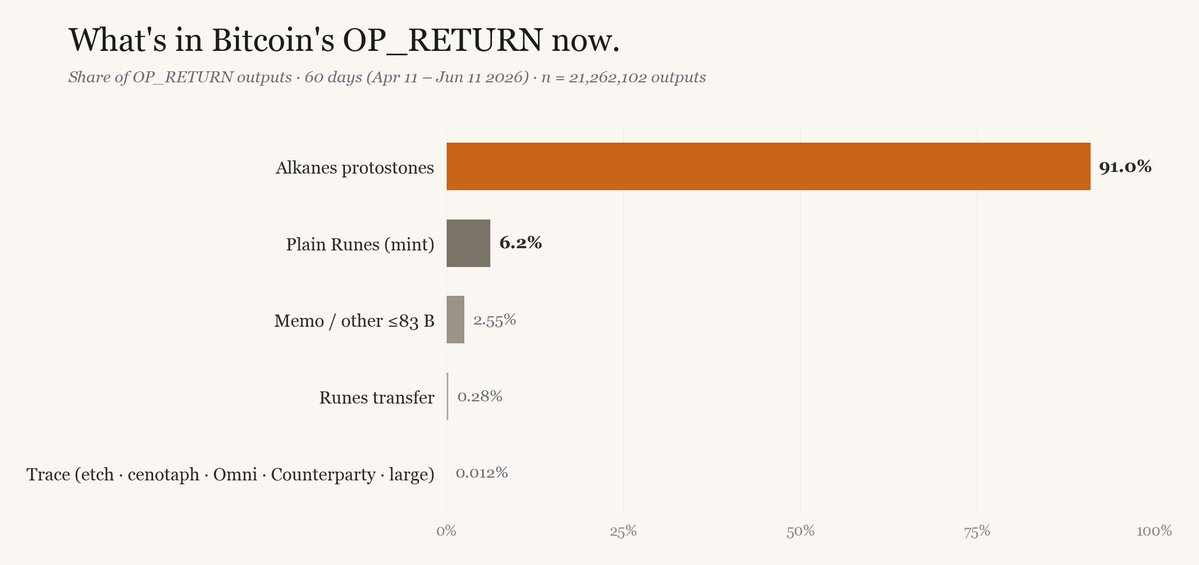
After decoding every OP_RETURN on Bitcoin for the last 60 days:
91% is now one funded protocol: Alkanes -> Millions of tiny mints BIP-110 won't touch (and shouldn't, that's relay policy's job).
But those mints exist because contracts were deployed for them.
- Deployment = a WASM binary in a Taproot reveal. 627 of them in 60 days.
- Every single one rejected by BIP-110.
You don’t stop a metaprotocol by filtering its mints.
You stop it at deployment.
👇
blockspaceweekly.substack.co…
7
19
107
4,687

BadBoatingClub retweeted

That mirrored gazing ball in your garden might have a bird wearing itself ragged against an enemy that doesn't exist.
Male cardinals, robins, mockingbirds, and towhees defend their territory hard, wired to drive off any rival male they see. A reflective ornament hands them one that never backs down.
The bird sees itself in the curved glass, reads it as an intruder sitting in the middle of its nesting territory, and attacks. It can go for hours a day, for weeks, right when it should be feeding a mate and raising chicks. All of it burns energy the family needs, against a rival that never leaves.
Smaller birds can also collide with the sky reflected on a large mirrored surface, the same way they hit windows.
You don't have to toss it. Move it where birds don't patrol, tuck it low in dense foliage so it doesn't read as open sky, or bring it in through the spring breeding season and set it back out after.
The bird thinks it's protecting its family. It's exhausting itself against a threat that's only ever its own reflection.


10
126
498
9,545
Jun 11
🎯🎯🎯
Jun 11

Unpopular opinion:
Core isn't enabling "data use case" to support miners.
Core is enabling "data use case" to weaken the monetary use case.
The only use case that the banking cartel has an issue with.
1
11
BadBoatingClub retweeted

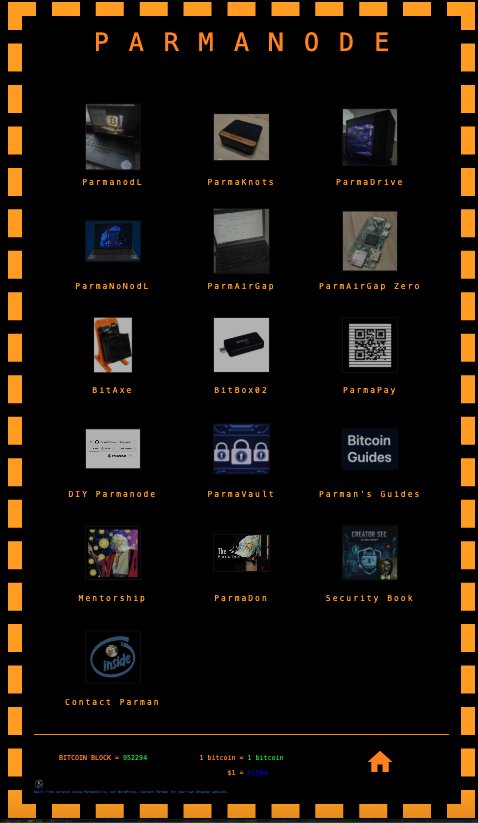
You can order a ready-made, fully Bitcoin-synced Laptop node (ParmanodL) which has the Parmanode software installed, configured, and tested, delivered to anywhere in the world (except Eptstein's Island, sorry Andy) parman.org
1
25
453

BadBoatingClub retweeted

Jun 11
Imagine opening a restaurant and employing people in the kitchen who have never cooked. Pretty bad idea.
Similarly bringing @UKLabour into power when their entire cabinet have zero business or financial pedigree is a pretty sure fire way to bankrupt the country.
3
3
27
781
BadBoatingClub retweeted

Jun 9
Time to educate the Lucerne University people who wrote this article in Lugano @giacomozucco @bitcoin_usi This is truly embarrassing for Switzerland. Given that the article was written on behalf of the German Federal Environment Agency, it raises even more concerns and should be seen as a significant red flag.
2
13
735
BadBoatingClub retweeted

Jun 10
I don't condone any of what I've seen in Belfast. I mean, I'd go to prison if I did, but all the same, it's not my preferred way of doing things. But then my preferred way of doing things (voting and public debate) hasn't made the slightest impact on the decision-making of the state. As such, there was a certain inevitability about this.
Moreover, it's not really my place to judge. I am an extremely fortunate individual who happens to live in a 99% white area, miles from any "diversity" and thanks to my self-employed status, I don't have to self-censor or live a double life at work. I don't have to bottle up my opinions. I actually make a modest income by expressing them.
Most low income working class people, meanwhile, have to live in close proximity to diversity and the squalor that goes with it. Their votes are even more worthless as mine, and they can't speak their minds freely because there'll be some HR ghoul in the mix who will fire them. Ordinary people bear the burden of potentially losing everything for having the wrong opinions.
Meanwhile, they can work hard to carve out a little corner of peace for themselves, just for the local authority to turn next door into a migrant HMO with illegal Deliveroo drivers coming and going at all hours. It's their communities being turned into alien, hostile and violent slums. To then say there is no justification for riots is to tell them they simply have to suck it up - even when they run the risk of an African savage beheading them. What are they supposed to do? Write to their MP? Everyone has a breaking point.
While politicians call for calm, they can only expect to be heeded if they actually do something, but remaining calm when the politicians continue to sit on their hands as people are butchered in the street is absolutely bovine. Ultimately these riots are a consequence of the wilful deafness of politicians, and the blame for what we've seen tonight lies squarely in their shop.
121
891
4,659
101,862
Before I make any purchases, a question please @start9labs and @FOUNDATIONdvcs - is it possible to connect Envoy to a Start9 node?
3
3
1,099
BadBoatingClub retweeted

Jun 8
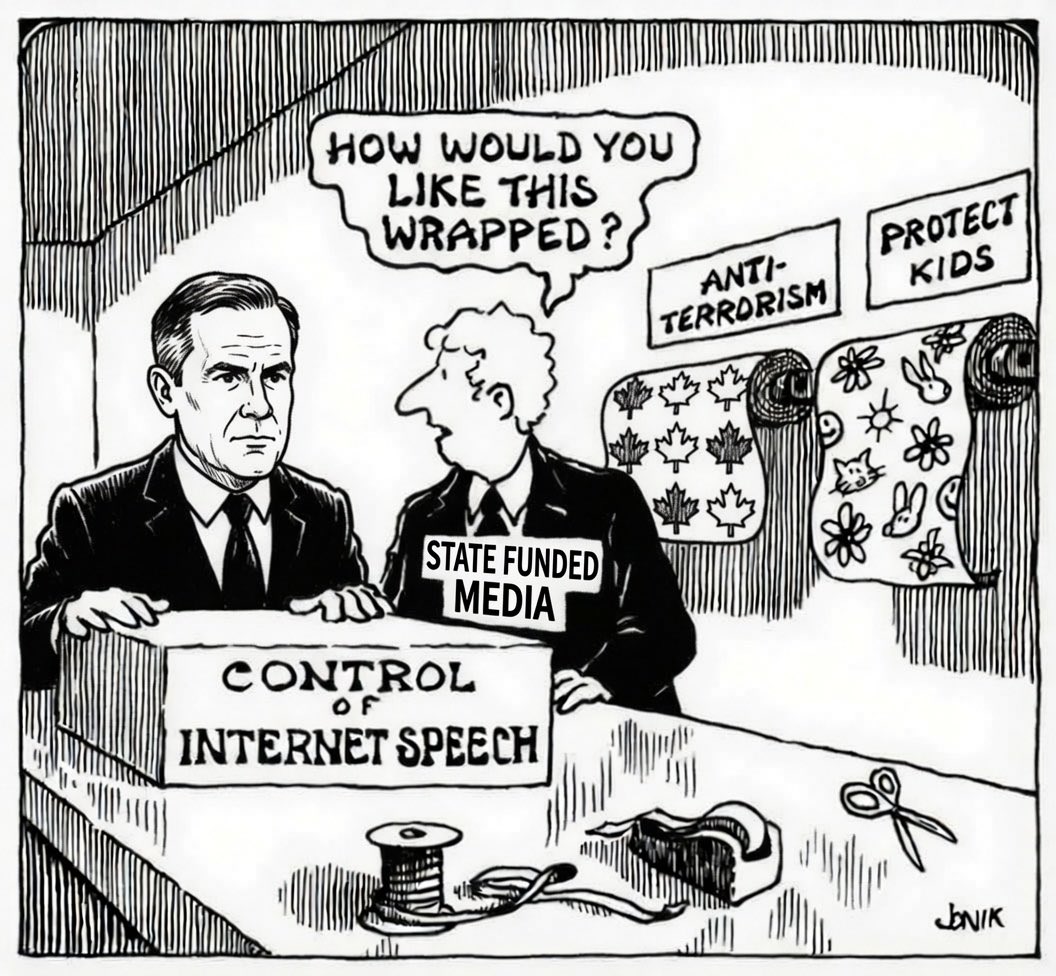
You are not serious, if you were serious of protecting children from paedos you might speed up the nation Inquiry into Grooming gangs rather than spying on my Dms.

I make no apologies for doing the right thing to protect children from paedophiles. This is about stopping the coercion and sextortion of children, not surveilling or policing people’s phones.
This technology is already on devices. The tech firms just need to switch it on to block children from seeing nude imagery.
There is no reporting, no data collection, no monitoring, and no images leaving the device. All adults will be able to switch off the protections if they are over 18.
This is targeted, proportionate and - most importantly - it protects children from vile abusers.
Community note
This is a misrepresentation of people's concerns around how adults must prove their age under this new rule.
~3 million people signed a petition calling for this to stop because they are concerned about privacy by being forced to digitally prove that they are over 18.
petition.parliament.uk/petitions/7301…
gov.uk/government/col…
privacyinternational.org/explainer/2672…
computerweekly.com/opinion/Whats-…
32
506
3,223
53,336
BadBoatingClub retweeted

Jun 7
It's just verification for under 16s...
It's just having to have ID for social media...
It's just losing anonymity online...
It's just giving your details so that every post or comment criticising the government can be traced back to you and punishment can be enforced...
42
781
3,181
27,978
BadBoatingClub retweeted

What Japan needs is more Japanese people.
Not more people in Japan.
There is a difference.
397
1,686
34,458
292,264
BadBoatingClub retweeted

Jun 7
Protests in Southampton tonight. Do NOT give the state ANY excuse to throw you in prison. Because they will use anything.
I know people are angry. I am angry. But do not throw your life away doing something you will later regret.
The police need to treat protestors fairly, and any unacceptable behaviour by any officers must be recorded and called out.
But I will say this again.
Do not get violent.
That is not how we win.
We win at the ballot box, peacefully and democratically.
We win by electing Restore Britain across our country.
It's the only way.
1,465
8,250
58,385
970,954
BadBoatingClub retweeted

Jun 6
It is so wild that the Yookay government is simultaneously trying to lower the voting age to 16, and ban the Internet until age 16.

The Times's weekend read:
* The Labour leadership contest has already begun. In No 10 Starmer is fighting for his political life, putting huge pressure on teh system to bolster his Premiership in face of existential threat posed by Andy Burnham
* Expect a frenzy of activity in coming weeks - the defence investment plan, social media restrictions for under 16s, the Brexit reset. Announcements bogged down in months of bitter internal rows will finally come into public view
* All the announcements are coming before or shortly after June 18th, the date of the Makerfield by-election. Starmer is trying to send a message to Labour MPs that he can deliver
* He isn't the only one. Burnham has began issuing his own national leadership pledges - starting with a £300million cut in business rates for pubs and small businesses
* His press release directly attacked Starmer and Reeves, accusing the government of 'undervaluing' their importance to local communities. This is a *Labour* candidate directly criticising a *Labour* government
* The lines between the Labour Party and Burnham's campaign are increasingly blurred. Team Burnham now has a lot of the party machinery on his side - press officers, officials etc - and also has most of the cabinet out knocking doors in Makerfield. Power is already moving
* Starmer thinks he can fight Burnham, but his allies are unconvinced. One said that he thinks Burnham has behaved 'appallingly'. 'His view is why should he make it easy for him?'
* But there is an acknowledgement that Starmer is on borrowed time. That it is a case of when, not if he goes
* There are divides in Team Burnham over when he should amke a move if he wins Makerfield. The 'go-now' camp say he must seize the opportunity or it could slip through his hands, using the momentum of the by-election to act decisively
* But others think this could be disastrous - that he needs time to build up a proper plan for government and No 10. That if he doesn't he risks repeating Starmer's mistakes all over again
* Then there's what's being billed as the 'battle for the soul of Burnham'. There are those on the left - Louise Haigh, Miatta Fahbulleh and others - who favour a radical break from Starmer. Then there are the centrists - Josh Simons, Jim O'Neill - are are said to be emphasising the importance of fiscal credibility. It is potentially a v unwieldy coalition
thetimes.com/uk/politics/art…
427
1,421
6,428
1,398,818
I could not agree more strongly - wake up, bitcoiners. There are times for fence-sitting, for waiting to see. This is not one of them.
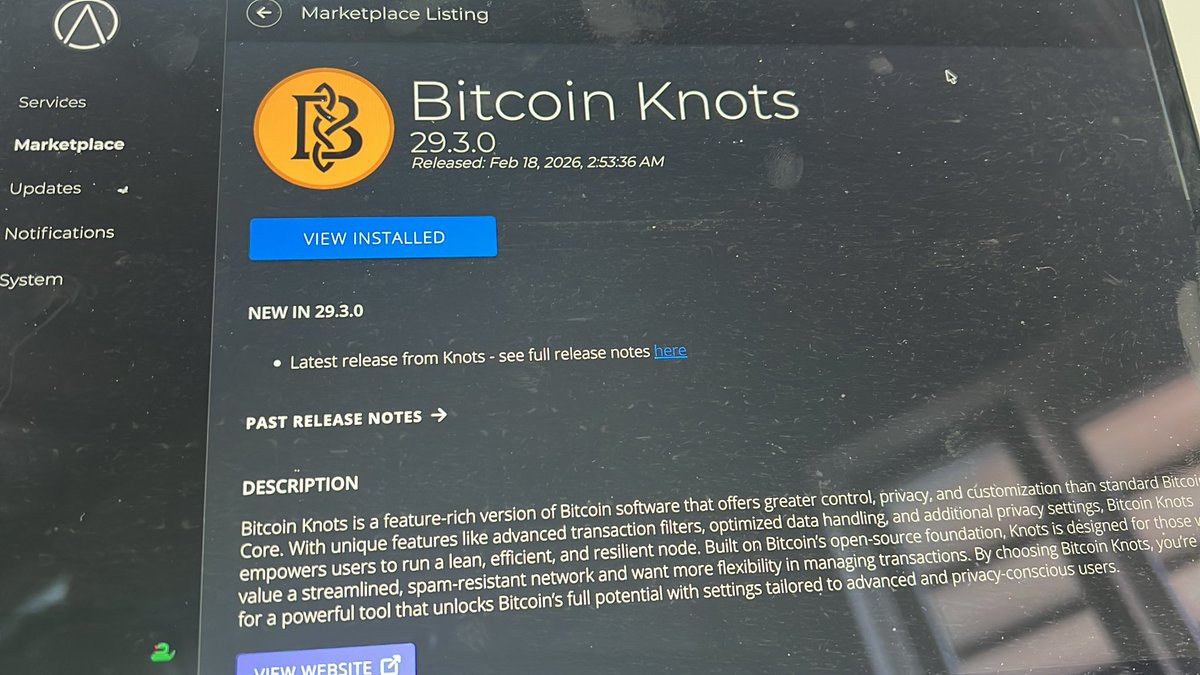
Run Knots, support BIP110

My opening statement from this debate:
---------------------
BIP110 is a simple statement: "we reject Core 30’s proposed addition of data storage to bitcoin."
Bitcoin is money. That is the starting point. If we lose sight of that, we lose the plot.
The block size war was one of the defining moments in bitcoin history because it forced bitcoiners to answer a basic question: who is bitcoin for? Is it for large companies, exchanges, miners, and professional infrastructure providers? Or is it for ordinary people: pleb merchants, individual savers, and node runners, who need to verify the system for themselves?
In 2017, bitcoiners answered correctly. We rejected the bigblock roadmap because it put bitcoin on a slippery slope: whenever blocks fill up, make them bigger; when they fill up again, make them bigger again. That path leads directly to centralization. It prices out ordinary node runners, turns validation into a professional activity, and recreates the trusted intermediaries bitcoin was designed to eliminate.
But the bigblockers got one thing right: bitcoin must work as a payment system. Their mistake was thinking bigger blocks were the way to get there. The real path is conservative base-layer validation, combined with trustless off-chain protocols like lightning. That is how bitcoin can scale commerce while preserving decentralization.
The current conflict over data spam is part two of the block size war. Once again, the question is whether we prioritize node runners and people using bitcoin as money, or whether we allow other interests to consume scarce block space and raise the technical, economic, legal, and moral cost of running bitcoin.
The worst centralization pressure here is not merely that spam makes nodes more expensive (which it does). It is that arbitrary data storage creates the possibility of deeply harmful illegal material, including CSAM, being embedded in the chain. If that happens, fully validating archival node operators could be placed in the position of storing and distributing material they find morally abhorrent. Even if the legal analysis varies by jurisdiction, the social consequence is obvious: most decent people will not voluntarily run infrastructure that forces them into that position. Node running would become limited to large institutions with legal departments, specialized infrastructure, or people with no moral objection to hosting such material. That is an extreme centralization pressure, and it attacks bitcoin’s security model directly.
So the answer should be the same as it was in 2017: the protocol must protect node runners first. Pleb merchants, especially in poorer parts of the world, must be able to run nodes and conduct business without trusted intermediaries. If they cannot, bitcoin will become dominated by large corporations, custodians, and professional infrastructure providers.
That is why protocol changes should be rare and careful (unlike the removal of the opreturn filter). Unless a change is necessary to make bitcoin more useful as money, or to defend bitcoin against a serious threat, the default should be caution.
But caution is not ossification.
Bitcoin is not a museum piece. It is a living system in a hostile environment. If we pretend the current ruleset is perfect forever, bitcoin loses the ability to adapt to new attacks, incentives, and failure modes. Ossification only makes sense if the protocol is already perfect. It is not.
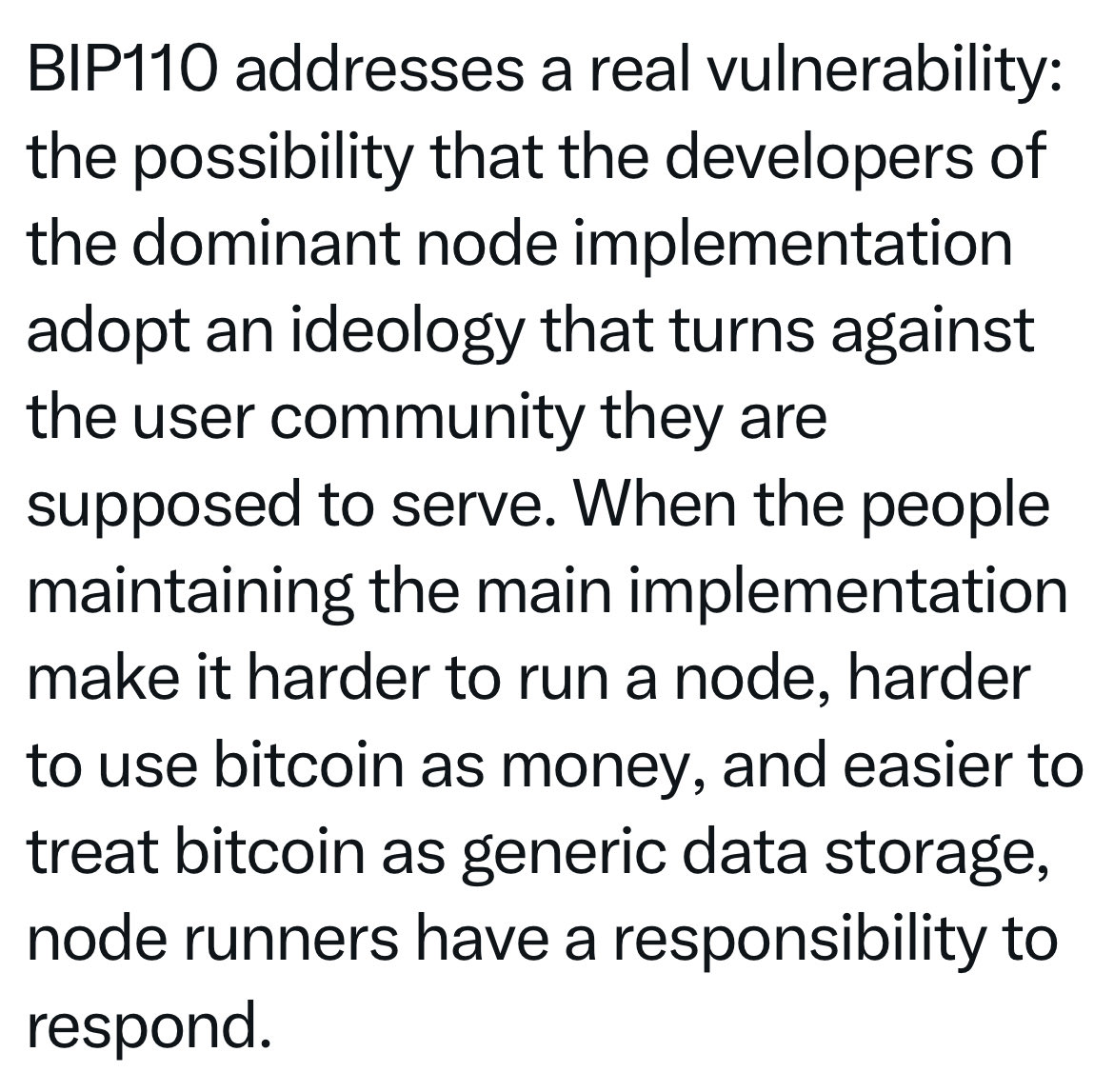
BIP110 addresses a real vulnerability: the possibility that the developers of the dominant node implementation adopt an ideology that turns against the user community they are supposed to serve. When the people maintaining the main implementation make it harder to run a node, harder to use bitcoin as money, and easier to treat bitcoin as generic data storage, node runners have a responsibility to respond.
This problem is made worse by a small number of influential developers who appear to have an effective pocket veto over consensus changes. They can support changes that create harmful unintended consequences, and then block or stall the fixes. That is an unhealthy level of centralization in the development process.
Core v30 was a breaking point. Before it, there was a delicate balance between consensus and policy: consensus was permissive enough to allow future upgrades, while policy was restrictive enough to discourage abuse. Now we are told that policy does not matter, that spam transactions should be treated like real payments, and that node runners should simply accept the consequences.
That argument is not serious. Core still maintains many policy limits. Nobody actually believes every possible transaction must be relayed and mined on equal terms. The question is not whether policy matters. The question is whose interests policy serves.
BIP110 is therefore a vote of no confidence in the current leadership of Bitcoin Core. Mistakes happen. But refusing to admit a mistake, refusing to fix the damage, and blocking others from fixing it is far more dangerous than the original mistake itself.
One side effect of that pocket veto is the bikeshedding treadmill. Leadership quietly opposes a fix, but instead of saying what would actually earn support, the discussion becomes endless nitpicking: this opcode, that activation path, this implementation detail. At some point, “review” stops being review and becomes a strategy for delay.
Ultimately, the node network does not need permission from Core leadership to defend bitcoin. Especially not when Core itself introduced or normalized the harmful behavior in question. BIP110 is on track to activate with or without their blessing.
And BIP110 is not merely defensive. I am very bullish on its activation because it breaks the consensus logjam, among other things.
Bitcoin needs other improvements if it is going to destroy the fiat standard. We need better payment systems. We need better custody tools. We need mechanisms like covenants, vaults, and more powerful trust-minimized point-of-sale systems. But the current process makes every consensus change feel impossible, because if any mistake is made, we are told we must live with it forever.
That is not conservatism. That is paralysis.
BIP110 shows that bitcoin can fix mistakes. It shows that unintended consequences from prior upgrades do not have to become permanent vulnerabilities. It shows that node runners can still act when the dominant implementation fails them.
So yes, I strongly support BIP110.
It reestablishes payments as the primary use case of the bitcoin blockchain.
It reasserts that bitcoin is money, not arbitrary data storage.
It protects node runners from being pressured into storing or distributing morally abhorrent material.
It reminds everyone that node runners - not developers, not corporations, and not miners - are ultimately in control of bitcoin.
And it proves that bitcoin can adapt. Not recklessly, not casually, but when necessary: to defend its decentralization, its usefulness, and its purpose.
Bitcoin survives because node runners enforce the rules. BIP110 is node runners enforcing the rules.
Thank you.
1
6
390
BadBoatingClub retweeted

17 Sep 2025
Current state of Bitcoin Core
27
99
538
23,461