
Adonai. Self-First. Crypto & NFT trader|holder. Studying Human Nature & Elon Musk. Dreams do come true 🫵🏾📚🪬 LTC LINK KEKIUS DOGE
Joined October 2020
- Tweets 17,301
- Following 499
- Followers 984
- Likes 29,476
1,699 Photos and videos



Pinned Tweet

Jun 12
Episode 10 with Eugene Stone was fire and filled with real stories.
Is your drive coming from growth or fear of falling behind? 🥊
Pro boxer Eugene Stone opens up on the psychology of discipline, ambition, and high performance.
Raw conversation that hits for anyone building with purpose.
youtu.be/AaYEyrsXERA?si=pZpl…
1
84
Humanoids and Longevity stuff

10


AI will achieve Stockfish-level coding and generalized computer use

SpaceX has exercised the option to acquire @cursor_ai in an all-stock transaction with the goal of building the world’s most useful AI models.
For the past few months, SpaceXAI has been jointly training a model with Cursor, which will be released in Cursor and Grok Build soon.
We look forward to working closely with the Cursor team to advance our frontier AI capabilities
2,833
4,849
48,525
13,151,681
Jun 16
Best thing I’ve done for my brain and time so far is watching videos on 1.7x speed.
1
14
IAMTHEONE👽🦕🦬 retweeted

Jun 16
SpaceX is constructing a $250 million GigaBay at Starbase to accelerate Starship production
The 700,000-square-foot facility is designed to build up to 1,000 rockets per year
54
168
1,139
30,459

Elon Musk explains his 5-step algorithm for solving any problem:
"The most common mistake of smart engineers is to optimize a thing that should not exist."
"I have this very basic first principles algorithm that I run as a mantra."
Elon breaks it down:
Step 1: Question the requirements.
"Make the requirements less dumb. The requirements are always dumb to some degree, no matter how smart the person who gave you those requirements. You have to start there, because otherwise you could get the perfect answer to the wrong question."
Step 2: Try to delete it.
"Try to delete the part or the process step entirely. If you're not forced to put back at least 10% of what you delete, you're not deleting enough. Most people feel like they've succeeded if they haven't been forced to put things back in. But actually they haven't, they've been overly conservative and left things in that shouldn't be there."
Step 3: Optimize or simplify.
"The most common mistake of smart engineers is to optimize a thing that should not exist. So you don't optimize until after you've tried to delete."
Step 4: Speed it up.
"Any given thing can be done faster than you think. But you shouldn't speed things up until you've tried to delete it and optimize it otherwise, you're speeding up something that shouldn't exist."
Step 5: Automate.
"And then the fifth thing is to automate it."
Elon explains why the order matters:
"I've gone backwards so many times where I've automated something, sped it up, simplified it, and then deleted it. I got tired of doing that. So that's why I have this mantra."

98
1,255
6,030
1,016,279
IAMTHEONE👽🦕🦬 retweeted

Jun 16
People calling SpaceX overvalued are looking in the rearview mirror. The market DOES NOT value great companies based on what they earned in the past… it values them based on what they can earn tomorrow in the future.
The real question is what this company’s future cash flow could look like if it executes on its plans. Between Starlink, launch services, government contracts, direct-to-cell connectivity, AI infrastructure, and eventually a fully operational Starship network, SpaceX is building multiple massive revenue streams all at the same time.
If Elon is anywhere close to his projection of roughly $1 trillion in annual revenue by 2030, today’s valuation will look extremely small in hindsight.
This is why some people see an expensive company, while others see one of the largest growth opportunities of our generation. The difference comes down to whether you’re valuing the past or valuing the future.
But any smart investor knows the right way to value a company is based on the future.
Jun 16

SpaceX's market cap crossed above $3 trillion today in after hours trading.
That's higher than the market cap of Amazon ($2.65 trillion) & Microsoft ($2.97 trillion).
Microsoft Sales: $318 billion
Microsoft Net Income: $125 billion
Amazon Sales: $743 billion
Amazon Net Income: $91 billion
SpaceX Sales: $19 billion
SpaceX Net Income: -$9 billion
23
20
138
13,563
Jun 16
I lived in the time of Elon Musk
Jun 16

SpaceX hit $3 trillion market cap today.
This means Elon Musk made more money in the last 24 hours than Warren Buffett made in his entire lifetime.
Insane.
1
55
IAMTHEONE👽🦕🦬 retweeted

Jun 15
Understand. Don't memorize.
Learn principles, not formulas.
151
2,450
14,669
318,744
IAMTHEONE👽🦕🦬 retweeted

Jun 15
The single biggest threat to Nvidia, Amazon and Azure right now is a rocket company: SPACEX
SpaceX generated $18.67 billion in revenue in 2025. At $184 per share today, it is valued at $2.41 Trillion, 129 times trailing revenue.
Nvidia trades at 22 times.
Amazon at 4 times. The valuation only makes sense when you understand what SpaceX is actually building.
SpaceX declared a total addressable market of $28.5 trillion in its IPO filing, equal to the entire annual GDP of the United States.
$26.5 trillion of that is AI alone. At just 1% capture of its own stated market, SpaceX generates $285 billion in annual revenue.
Starlink is the proven starting point.
The constellation has crossed 10,000 satellites, holds 60% of the LEO broadband market, and has 10 million monthly active users on Direct-to-Cell. Goldman Sachs projects Starlink reaches $144 billion in revenue by 2030.
At a standard 10x revenue multiple for subscription infrastructure, Starlink as a standalone business is worth $1.4 trillion, more than SpaceX's entire market cap today, before counting anything else.
The bigger bet is orbital AI infrastructure and this is where SpaceX directly threatens Nvidia, AWS, and Azure simultaneously.
AI data centers have a problem that is getting worse. A 1-gigawatt facility now draws more electricity than some mid sized nations. Local governments are rejecting new projects because of grid strain and water use.
AWS and Azure pay $0.05 or more per kilowatt-hour for electricity. That cost is rising as AI demand grows. SpaceX's answer is to move the compute off the grid entirely.
In orbit, solar panels generate more than 5 times the energy of an identical array on Earth because there is no atmosphere blocking sunlight. Capacity factor exceeds 95% versus 24% for terrestrial solar.
No cooling is required, the vacuum of space handles it passively. No land, No grid, No permits, No energy shortages.
An independently verified 10-year cost model for a 40-megawatt cluster: $8.2 million in orbit versus $167 million on the ground.
Effective energy cost in orbit: $0.001 to $0.005 per kilowatt hour, 10 to 50 times cheaper than what AWS and Azure pay today.
SpaceX unveiled the AI1 satellite a few days ago, its first orbital data center prototype with 150-kilowatt peak compute, a 70-meter wingspan, and Nvidia GPUs confirmed by the CFO.
The company has filed with the FCC to deploy up to 1 million AI satellites. Goldman Sachs projects this division alone generates $322 billion in revenue by 2030, a 100-fold increase from $3.2 billion today.
Nvidia generated $115 billion in data center revenue last year at 50 to 80% gross margins. AWS and Azure each generate approximately $120 billion in annualized cloud revenue.
All three are energy buyers locked into grid infrastructure. SpaceX's orbital compute becomes an energy generator with near-zero marginal operating cost. That is not a competitive advantage, it is a different physics regime.
SpaceX is also moving to eliminate Nvidia's chip pricing entirely.
Terafab is a joint semiconductor fabrication venture between SpaceX, Tesla, xAI, and Intel near Austin, Texas.
Total investment: $119 billion.
Target output: 1 terawatt per year of AI compute capacity.
Intel brings its 14A process node, one of only three sub-5nm processes in commercial production globally. The facility will produce D3 chips, radiation hardened and optimized for orbital data centers, alongside AI chips for terrestrial use.
Every dollar Terafab saves on chip costs is a dollar Nvidia loses.
The xAI merger on February 2, 2026 completed the vertical integration. At a combined valuation of $1.25 trillion, SpaceX now owns the AI models (Grok), the training infrastructure (Colossus 1 in Memphis), the orbital deployment system (Starship), the connectivity layer (Starlink), and the chip manufacturing (Terafab).
Anthropic is already paying SpaceX to rent unused Colossus 1 compute, a competitor writing checks to SpaceX for access to its own infrastructure. This is the exact model Amazon used when it built AWS from its own retail logistics and then sold access to the world.
The entire orbital data center thesis depends on Starship. At current launch prices of $900 per kilogram, a 1-gigawatt orbital data center costs $42 billion, three times the ground-based equivalent. At $200 per kilogram, the math inverts completely.
SpaceX has completed two consecutive Super Heavy booster catches. Full ship-side reusability has not yet been demonstrated. Goldman's $474 billion 2030 revenue projection requires growing from $18.7 billion at a rate faster than any company at this scale has ever managed.
SpaceX itself acknowledged in its IPO filing that orbital AI infrastructure "relies on unproven technologies and may not become commercially viable."
But if even half of this works, $2.35 trillion looks cheap before 2030.
72
178
1,058
73,839
IAMTHEONE👽🦕🦬 retweeted

Jun 15
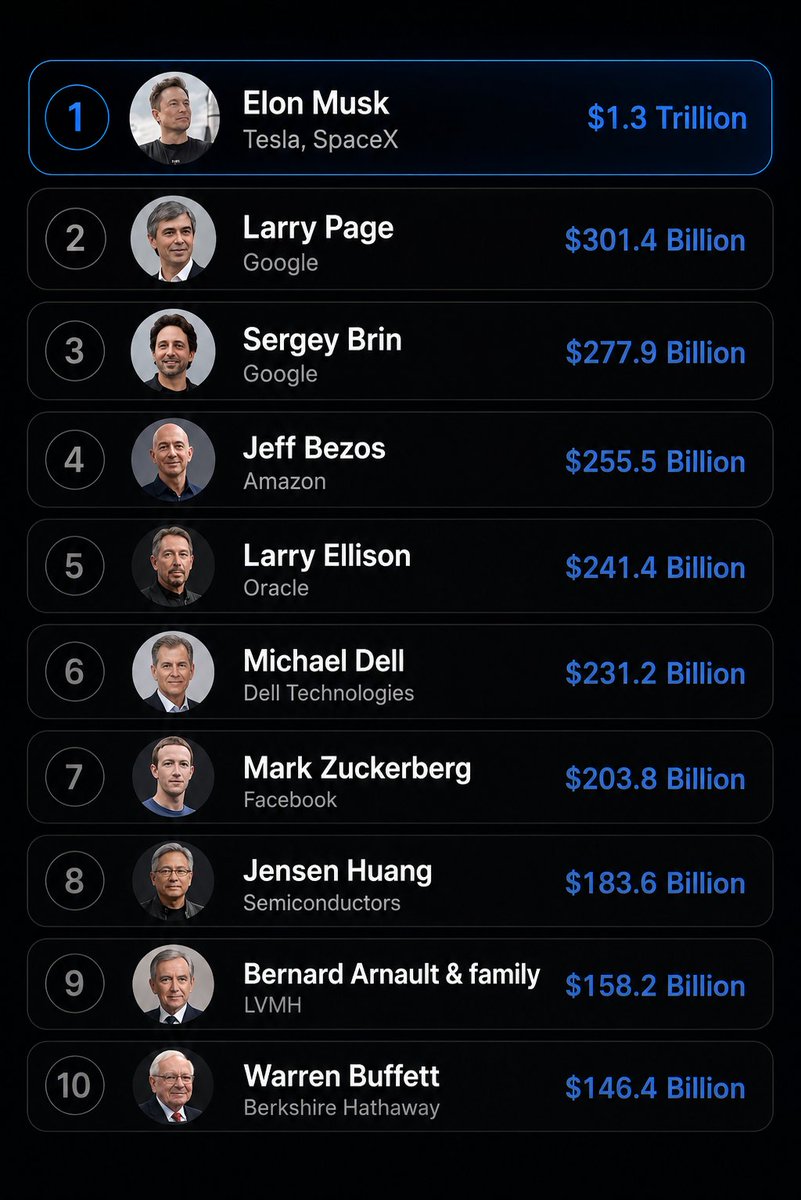
Elon Musk is now nearly $1 trillion ahead of the second-richest person in the world.
808
1,441
13,036
2,121,484
IAMTHEONE👽🦕🦬 retweeted

Jun 15
If Digital ID is so safe and secure, why would MPs and members of the Royal Family need exemptions?
204
4,983
42,556
765,119

UK is a police state
Jun 15

JUST IN: UK Government clarifies adults will still be able to use social media by verifying their identities with digital IDs, facial recognition, passports and credit cards.
13,802
43,694
290,088
40,257,944
IAMTHEONE👽🦕🦬 retweeted

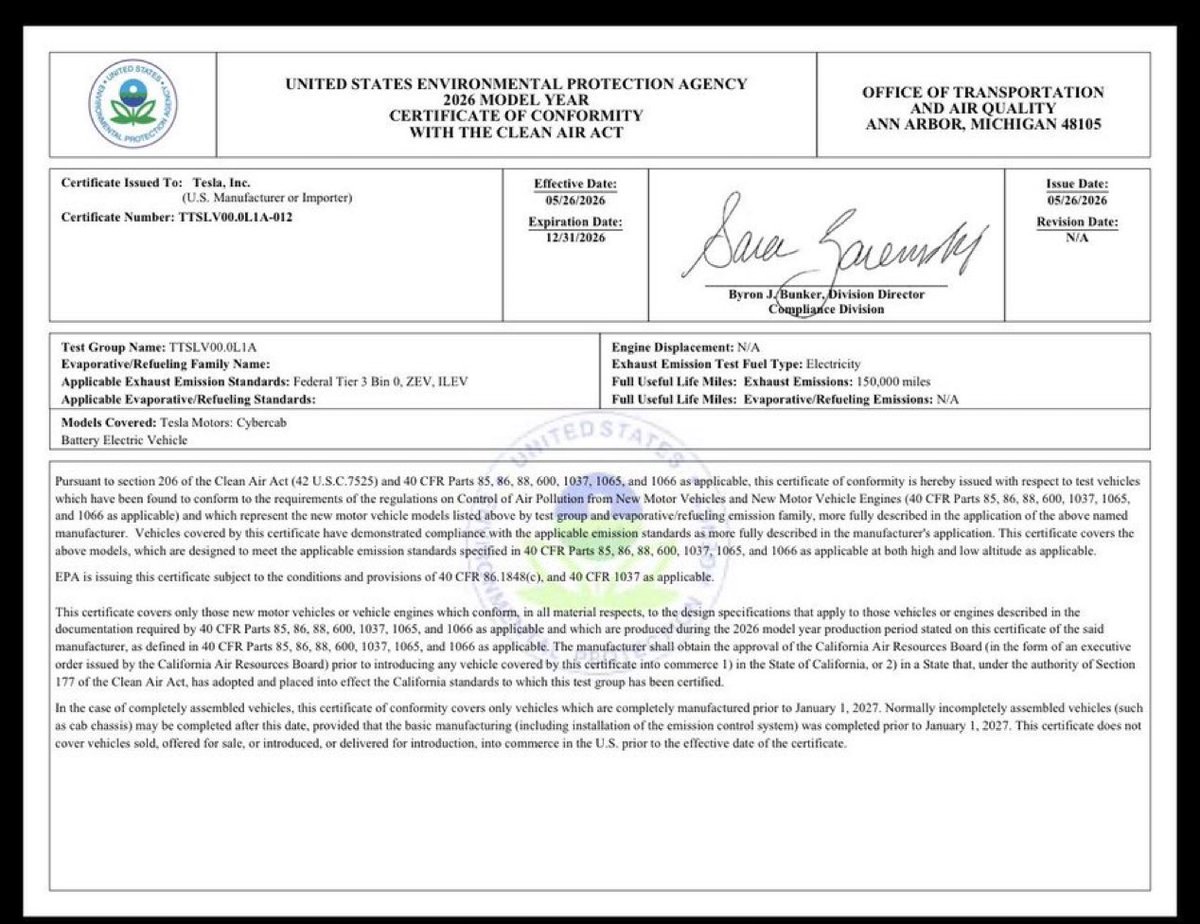
🚨 BREAKING: Tesla Cybercab Secures Key EPA Approval for 2026 Deployment
Tesla has officially received an EPA Certificate of Conformity for its Cybercab robotaxi, marking a major regulatory milestone.
The certificate confirms the vehicle meets all federal emissions standards under the Clean Air Act as a zero-emission electric vehicle. Issued to Tesla Inc. with an effective date of May 26, 2026, it legally clears the Cybercab for introduction into U.S. commerce.
This paves the way for broader deployment of Tesla’s autonomous robotaxi fleet.
24
116
501
20,175
Jun 15
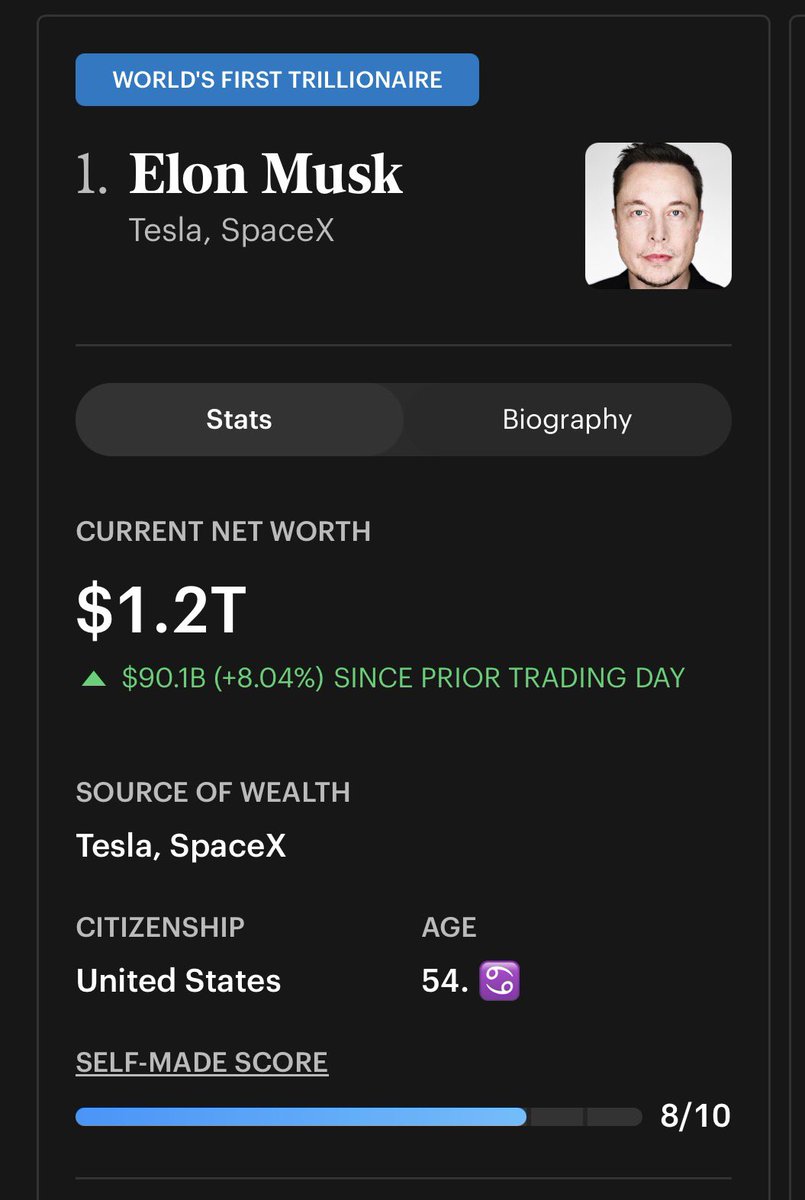
RT @SJosephBurns: Elon is now worth $1.2 trillion. His net worth rose $100 billion in one day.
17
The scale of what is to come has no precedent
Jun 15

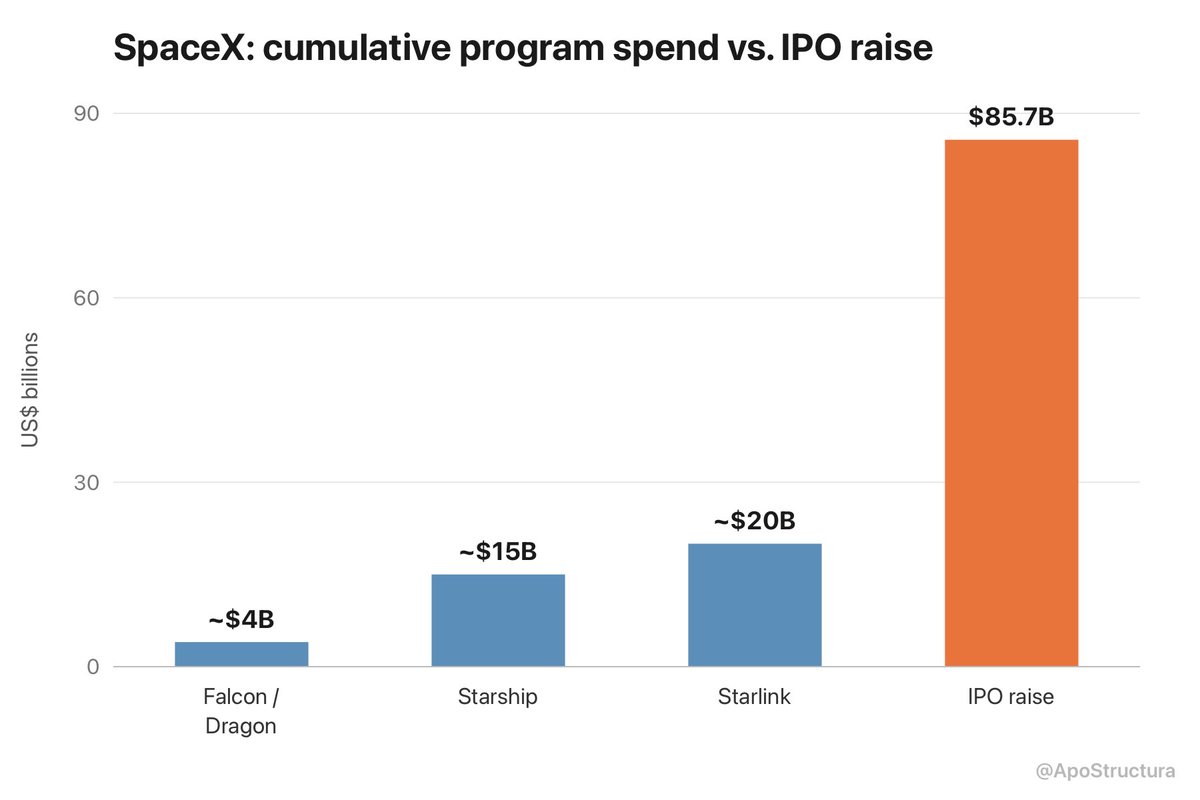
To get a sense of scale, here’s how the $85.7b SpaceX just raised compares to what they’ve historically spent on different programs.
People aren’t ready for the magnitude of things to come
3,312
9,751
80,118
10,341,813
Starship is about to completely transform Starlink
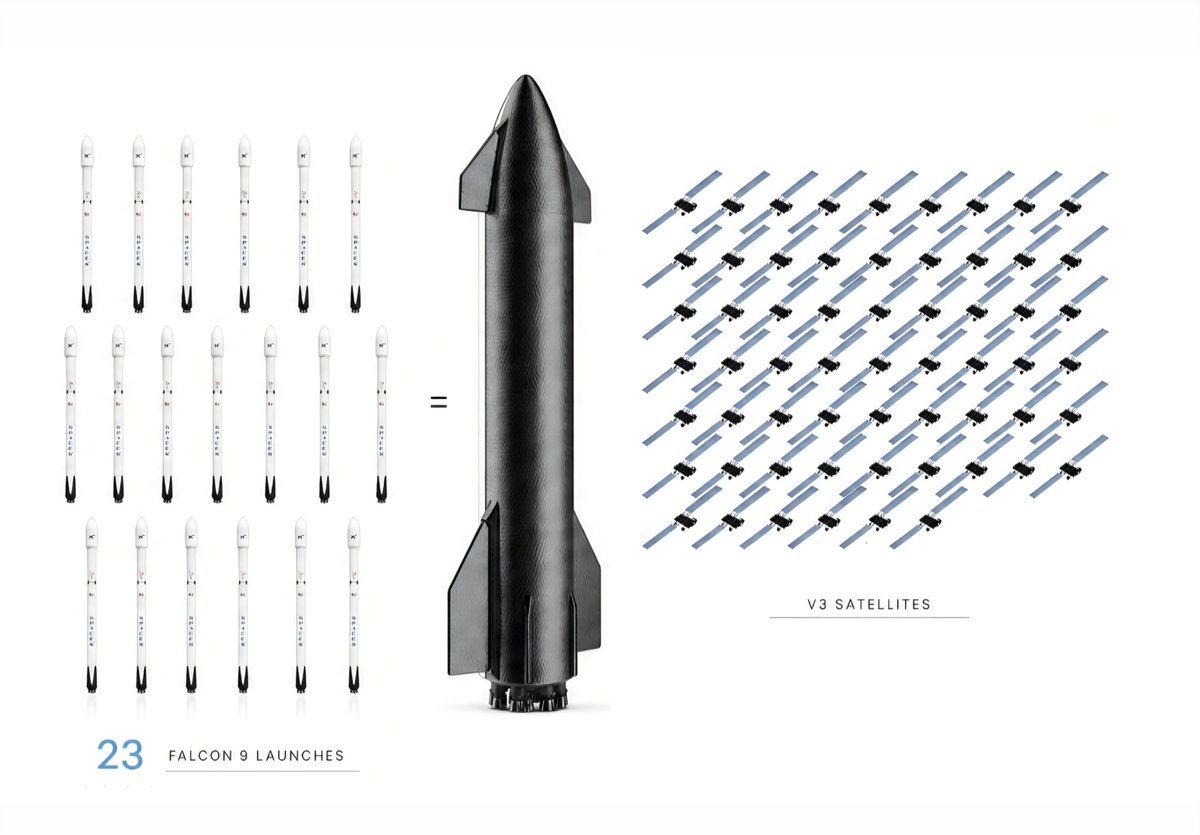
A single Starship launch could deploy up to 60 next-generation V3 Starlink satellites at once.....adding around 60 Tbps of downlink capacity to the network
That is roughly the same capacity as 23 Falcon 9 launches carrying V2 Mini satellites
Each V3 satellite is designed for 1,024 Gbps of downlink capacity more than 10x a V2 Mini
Falcon 9 built Starlink into the largest satellite internet network on Earth
Starship turns it into something completely different
- More capacity
- Lower cost per bit
- Faster deployment
- Gigabit-class internet from orbit
This is not just “more satellites”
This is the industrialization of global internet infrastructure in space
Starship Starlink might be one of the most powerful technology combinations ever built
43
153
759
13,080