Too many kids, not enough bitcoin. Ph.D.
Joined November 2013
- Tweets 22,446
- Following 4,045
- Followers 31,592
- Likes 84,064
1,907 Photos and videos











Pinned Tweet

14 Feb 2014
@aantonop The arc of history is long, but it bends toward decentralization.
100
143
779
Brooke⚡️ retweeted

May 27
We’re surprised @in3rsha couldn’t think of educators and advocates who have publicly praised his work, but maybe that’s exactly the problem: many of us took it for granted.
We’ve run multiple educational programs, host 900 bitcoin tech learners in our Discord, and Learn Me A Bitcoin has always been an obvious go-to resource.
And we’re not alone. We’ve collaborated with, or had visibility into, programs and communities run by @ChaincodeLabs, @btrust_builders, @libdesatoshi, @bitshala_org, @Bitcoin_Devs, and @summerofbitcoin, and Learn Me A Bitcoin is so complete, unique, and thoughtful that people naturally find it, share it, and bring it into their own study paths, often before we even need to recommend it ourselves.
So here’s the urge: if Greg’s awesome explainers and diagrams helped you or your community, say it publicly. Work like this deserves more appreciation.

learnmeabitcoin .com is goated amongst educational bitcoin resources
it's got the best explainers and it's packed with utilities
was a pleasure chatting with @in3rsha diving into everything: from the genesis story to how Tachyons is his preferred CSS framework, and much more
4
15
51
6,395

Fwiw, bear markets always involve people saying things like:
"Bitcoin is actually dead this time"
"It isn't what it used to be"
"There's no more narrative or investment case"
Heard variations of all of that in late 2011, 2014/15, 2018, 2022. Usually get some rage-quits too.
19
13
225
14,461

a news desk that monitors the situation for you
no ads, no paywalls, no clickbait, pure signal
citadelwire.com
5
23
148
9,481
Brooke⚡️ retweeted

May 22
The UX shift is real: you no longer need to be a Lightning expert to start building on Lightning.
May 22

I made a Claude skill for setting up Lightning nodes!
The skill, run-litd, can set up a wide variety of nodes, full node, pruned node, neutrino back-end, build a remote signer, connect to a remote signer, etc. and run on mainnet or signet!
You are guided through choosing the type of node that you need and then the skills builds a properly configured node, that means a config file, a systemd service, etc.
You can find it in this collection of Lightning skills…
github.com/Liongrass/lightni…
Give it a try and maybe tell your Lightning newb vibe coding friends!
4
16
1,925
Brooke⚡️ retweeted

"It's insane to say that Bitcoin will not solve the quantum problem... of course Bitcoin will survive it and of course Bitcoin will solve it," says Stanford cryptographer @danboneh
33
86
531
63,444
Brooke⚡️ retweeted

May 13
Not a new podcast... a comeback, actually.
I started this in 2016. 10 years, 3 businesses, 2 kids, and 1 new country later, I promised myself I’d bring it back.
10-minute episodes, on average. Just like a Bitcoin block.
Raw interviews. Personal stories. Randomness. Italian accent included.
Here's the first block with @jackmallers
youtu.be/mhWP362ikL4?si=CJGh…
17
19
122
21,851
Brooke⚡️ retweeted

Apr 29
The Bitcoin Company.
Nakamoto Stage, 6:50pm ET, @TheBitcoinConf

83
40
763
58,493
Brooke⚡️ retweeted

In Chicago this Thursday and want to hangout at the collective?
Good thing we're hosting the Bitcoin Open Blockchain meetup!
RSVP and join us!
Checkout this Meetup with Bitcoin & Open Blockchain Community - Chicago: meetu.ps/e/PY51C/zvhMN/i
7
17
2,060
Brooke⚡️ retweeted
Bitdevs this week, then B.O.B. meetup next week and then another Bitdevs at the collective the week after.
Summer/Spring time Chi never looked so good 🌞
Apr 8

Join us tomorrow at 6 pm for Bitdevs there are tons of things to talk about this month!!!
chibitdevs.org/2026-04-09-so…
3
13
838
Brooke⚡️ retweeted
Thank you for your blessing we're hoping to do it justice 🙏
A Bitcoin renaissance is among us in Chicago.
Apr 10
Look! Look! There is a BOB meetup happening in Chicago next week!
I don't think I can justify getting on an airplane for just this😩Have fun without me y'all 🫶
meetup.com/bitcoin-open-bloc…
4
20
2,212


Brooke⚡️ retweeted

Mar 15
These pioneers often operated at the absolute edge of mental and physical endurance. Antonopoulos’s early obsession, which cost him sleep, meals, and weight, foreshadowed the longer-term price. While we celebrate the near-immortality of the code—immutable and replicated across thousands of nodes—we rarely acknowledge the fragility of the people who advocated for it. His situation serves as a stark reminder: technological progress is measured not only in hash power, but also in the neurological well-being of its most dedicated minds.
Toward a Reset: Breaking the Cycle of Sensitization
For those facing chronic migraines, a meaningful “reset” means interrupting the cycle of central sensitization through sustained changes. While professional medical guidance is essential, common evidence-based strategies include:
Lifestyle Foundations: Re-establishing circadian stability with consistent sleep schedules (7–9 hours), minimizing evening blue-light exposure, and reducing overall screen time.
Trigger Elimination: Systematic tracking of dietary and environmental provocateurs—processed foods, artificial additives, excessive caffeine, or dehydration—often via detailed symptom journals.
Medical and Neuromodulatory Approaches: Preventive medications (such as CGRP inhibitors), supportive supplements (e.g., magnesium, riboflavin), or non-pharmacological therapies like biofeedback and acupuncture.
Broader Life Adjustment: Redefining identity when high-intensity work is no longer sustainable. This involves delegating tasks and building community support.
The Legacy Beyond the Ledger
Every technological revolution leaves artifacts—protocols, code repositories, and transformed institutions. But beneath the digital ledger lies the physical and human history of those who carried the ideas. Andreas Antonopoulos’s contributions remain foundational. His journey underscores a deeper truth: decentralized systems still depend on dedicated humans in their infancy.
Celebrating the resilience of the code should not come at the expense of compassion for the people who built understanding around it. Progress, after all, is not only about building unbreakable systems. It is also about ensuring the builders and teachers remain whole enough to enjoy the world they helped create.
2
6
587
Brooke⚡️ retweeted
Mar 15
The Cognitive Cost of Bitcoin: Andreas Antonopoulos and the Hidden Toll of Early Crypto Evangelism
In the nascent years of Bitcoin, few figures were more instrumental in bridging the gap between esoteric code and public understanding than Andreas M. Antonopoulos. Through his seminal book Mastering Bitcoin, hundreds of global lectures, and tireless explanations of cryptography, distributed systems, and revolutionary monetary theory, he became the ecosystem’s most trusted “interpreter.” He translated dense technical concepts into accessible education for millions, helping transform Bitcoin from a niche cryptographic curiosity into a global movement.
Yet behind this intellectual legacy lies a profoundly human story of obsession, endurance, and neurological cost. Antonopoulos has described his first deep encounter with Bitcoin in vivid terms: stumbling upon it initially in mid-2011 with a dismissive “Pfft! Nerd money!” reaction, he ignored it for six months. The second time, via a mailing list discussion, he read Satoshi Nakamoto’s white paper and experienced an immediate epiphany—“this isn’t money, it’s a decentralized trust network.”
What followed was a four-month fugue state of total immersion. He read, wrote, and coded for 12 or more hours a day, forgetting to eat or sleep. He lost 26 pounds in the process, later jokingly calling it “the Bitcoin diet” while cautioning others not to follow his example. This all-consuming obsession marked the beginning of his role as educator and advocate—and planted the seeds for the cognitive and physical toll that would later manifest.
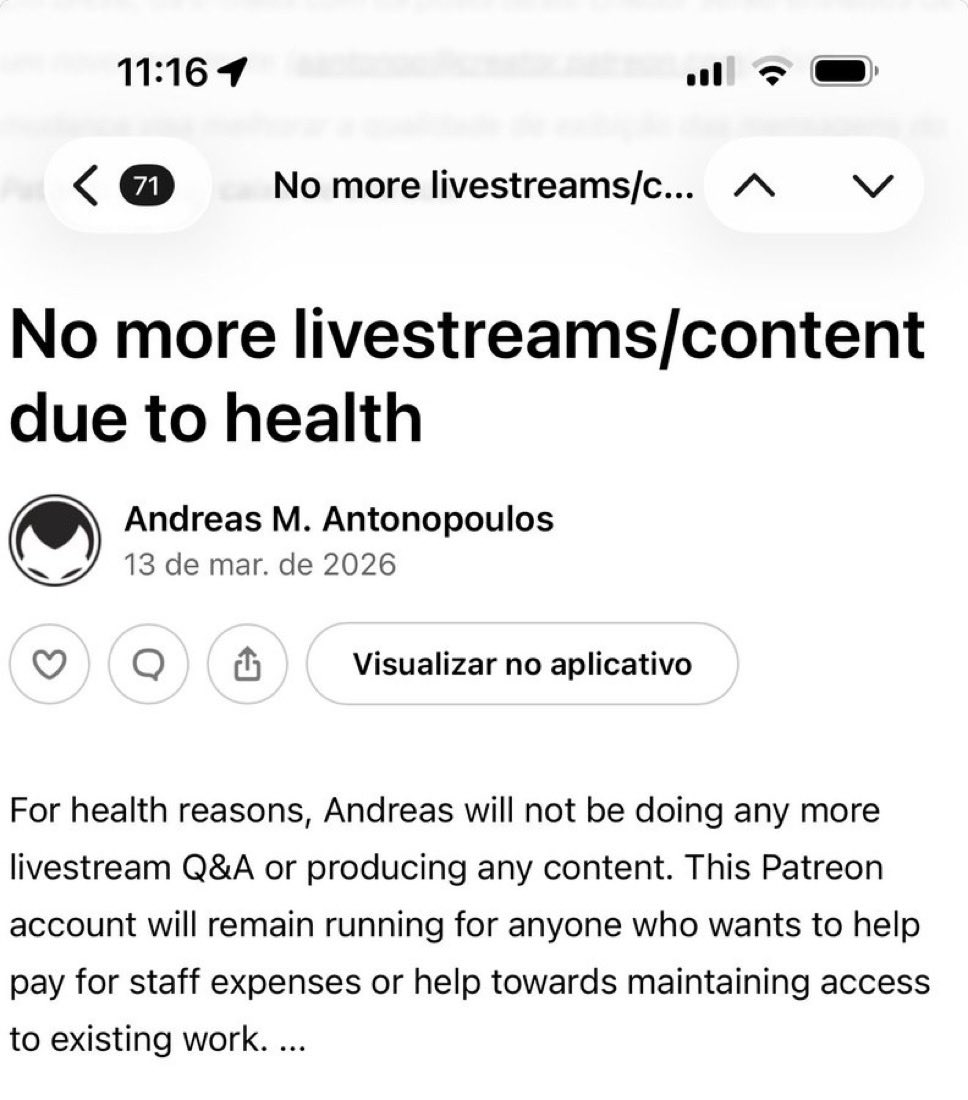
In recent years, Antonopoulos has spoken candidly about suffering from debilitating migraines that have severely curtailed his ability to produce new content, update his books, or continue livestreams. He recently announced he would stop producing new material to focus on his health, having tried nearly every available treatment without full resolution. His experience illuminates a rarely discussed reality of technological revolutions: the extreme neurological pressures placed upon the pioneers who carry the vision forward.
A Perfect Storm: From Obsession to Central Sensitization
The early Bitcoin environment was an unusually potent incubator for migraine triggers. For a polymath like Antonopoulos, the risks were multiplicative. Deep mastery demanded simultaneous engagement with cryptography, economics, security, and game theory—an intensity of cognitive load that can overstimulate the trigeminal nerve system, a key pathway in migraine pathogenesis.
This mental marathon was compounded by relentless physical triggers. Early advocates lived in digital “garrisons,” auditing code and engaging in 24/7 global forums. Blue light disrupted circadian rhythms; computer vision syndrome bred neck tension; LED flicker sensitivity acted like a strobe on a vulnerable brain. Bitcoin never sleeps, and in those formative years, neither could many of its human interpreters. The result was chronic circadian destabilization—perpetual jet lag without travel—which destabilizes the hypothalamus, the brain’s command center for both sleep-wake cycles and migraine initiation.
Antonopoulos’s initial four-month obsession exemplified this pattern: total immersion at the expense of basic self-care. Over years of sustained high-stress “arousal” states, the brain can undergo central sensitization. Episodic migraines evolve into a chronic condition where the nervous system becomes hyper-reactive. Pain signals become a learned default response, such that even minor stimuli provoke debilitating attacks.
The Irony of the Human Layer
There is a poignant irony at the heart of the story. Bitcoin was designed as a decentralized system promising individual sovereignty and freedom from centralized points of failure. Yet birthing and explaining this vision relied heavily on a small number of centralized human figures who served as the vital “human layer.”
5
9
20
1,430


Brooke⚡️ retweeted
Mar 3
Announcing the @Strike Bitcoin Line of Credit.
What's the best way to live on bitcoin? What if you never had to sell?
Save in bitcoin. Spend in fiat. Avoid selling. Save better money. Stack more sats. Gresham's Law. Speculative attack.
The Bitcoiner's Life Hack.
210
310
2,554
394,467
Brooke⚡️ retweeted

Feb 26
I never knew @andreneves was so key to early LN innovation.
I love these kinds of stories in Bitcoin.

2
6
30
6,763
Brooke⚡️ retweeted

Feb 20
126
555
2,057
870,403