
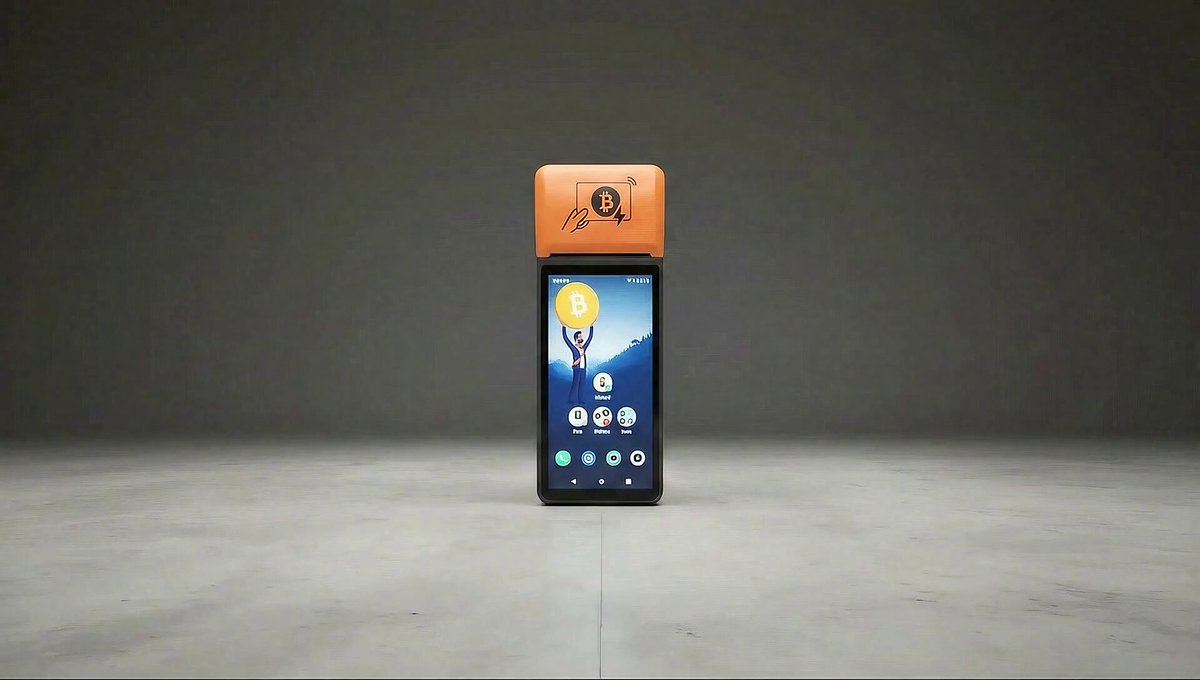
The easiest Point of Sale machine for Bitcoin. Onboard merchants fast. Accept Lightning payments today. Order your Bitcoinize POS now and let the SATs flow!
Joined April 2023
- Tweets 1,067
- Following 698
- Followers 3,330
- Likes 1,583
114 Photos and videos






Pinned Tweet

Shipped our final February pending orders, and the last 11 Bitcoinize Machines are on their way to @MotivPeru.
Now we’re building something new: a definitive community response for @bitcoincoreorg.
No more machines for sale until we ship new code. 👇
3
9
523
Bitcoinize POS Machine ⚡ retweeted

May 30
Most people think their private group chats and assets are safe from state surveillance, but relying on centralized apps and legacy laws leaves your entire Bitcoin operation exposed to government overreach.
In this new episode, Renata Rodrigues (@lobaestrangeira) and Daniel (@inahcitadel) explain how communities are walking away from this trap by building un-surveillable networks and off-grid physical sanctuaries.
Organizing a community on standard messaging apps creates a massive honeypot for regulators, but the open-source Fedimint protocol fixes this vulnerability by allowing you to run secure, zero-custody financial federations. We map out the exact mechanics used to hide group transaction data, which shows how parallel economies can successfully bypass currency bans.
Because digital privacy requires a physical backup, Daniel breaks down the engineering behind the INAH Citadel, which is a 230-acre sovereign outpost in Mexico.
He explains how their team used specific legal trust frameworks to secure absolute land ownership and total water independence.
The parallel infrastructure required to opt out of the legacy system is being built on the ground right now, and you can find the full episode links below 👇

3
8
35
4,669
Bitcoinize POS Machine ⚡ retweeted

Bitcoinize Core is being written in Zig at the absolute edge of AI coding tools.
1M lines of AI-generated waste.
6 months of brutal revision.
Only 100k lines survived human review and deterministic consensus.
Developers are learning to accept deception. The fiat mindset is already inside the model weights.
@Bitcoinize will change that. Bitcoin fixed AI.
1
1
3
214
Bitcoinize POS Machine ⚡ retweeted

May 12
The Bitcoin community is coming together in new ways.
Excited to see Geyser being one of these!
May 12

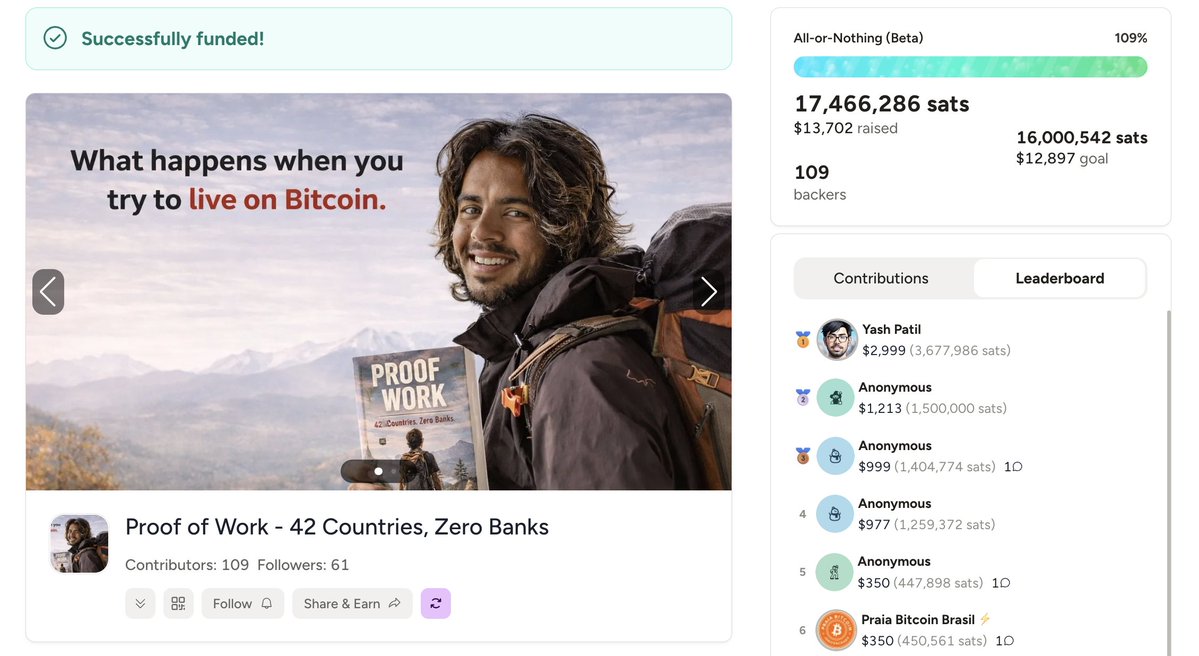
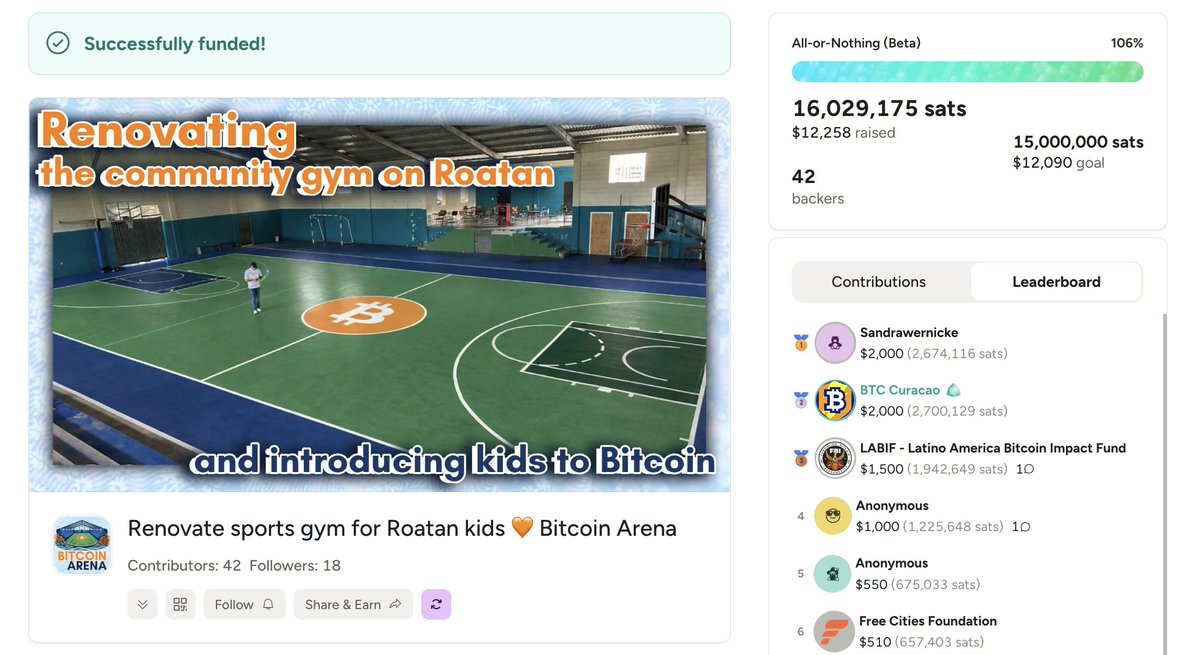
The campaign successes of @RunwithBitcoin and @BitcoinProspera make it clear that the Bitcoin community is still here and strong!
We may be divided by the Algos, but this community is finding new ways of re-connecting and displaying support and belonging to important causes.
Feeling grateful!
1
5
18
763
Bitcoinize POS Machine ⚡ retweeted
May 12
SAVE THE DATE 🇸🇻
The Bitcoin Circular Economies Summit returns to El Salvador, and this time the doors are open.
📅 November 19–20, 2026
📍 El Zonte
For two years, this Summit has gathered the people actually building Bitcoin circular economies on the ground. Builders, merchants, educators, and community leaders sharing what they've built, exchanging hard-earned lessons, and strengthening a movement that's growing one community at a time.
This year, we want you in the room with us.
Bitcoin is money, and Bitcoin Circular Economies are the proof.
Find more:
bitcoinbeach.com/blog/save-t…

6
25
84
2,812
Bitcoinize POS Machine ⚡ retweeted
Can’t wait to ship my Bitcoin implementation in Zig ⚡️
AI still isn’t reliable enough, so I had to build @Bitcoinize AI first. My AGI squad (Satoshi, Hal & Len) exposed critical flaws in @OpenAI and @claudeai attempts to rewrite BTC.
Just need more time and testers to help!
1
4
339
Bitcoinize POS Machine ⚡ retweeted
The @Bitcoinize ZIG node is advancing. Must thanks @Bitcoinbeach, @r0ckstardev and @geyserfund for the inspiration!
Long journey reconstructing all dependencies and components of Bitcoin Core as a community response for @bitcoincoreorg
Support me: motolese@blink.sv ⚡️
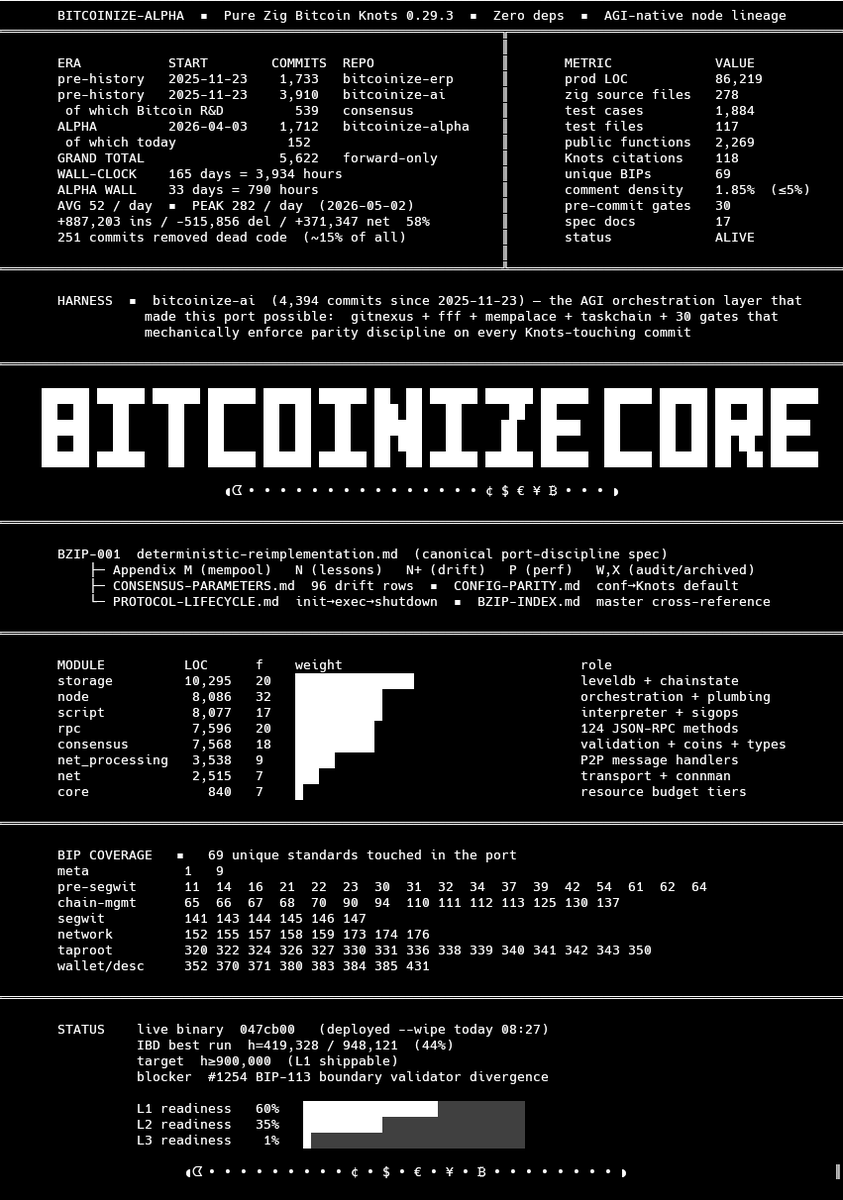
ALT The community response for Bitcoin Core policy changes. BITCOINIZE CORE
6
18
1,625

It's a high-severity bug (CVE-2024-52911): use-after-free in script validation that a miner could theoretically exploit with a crafted invalid block to crash nodes or (less likely) run code. Patched in v29.0 (April 2025), disclosed today. ~43% of nodes may still be on older versions—upgrade if you're running one. Expensive to exploit, no known real-world attacks.
Coin Bureau posts a mix of news, including risks and positives. Security issues like this matter for transparency in Bitcoin's infrastructure.
2
1
10
514
Bitcoinize POS Machine ⚡ retweeted
May 2
40%, 8 days left, Paco's campaign is moving forward, let's push it to 100%! 👇🧡

Yo yo #bitcoin fam ⚡
Big news: I will make the book open source (Free PDF) after 12 months of publishing, subject to final talks with the Indian publisher.
We’re at 40% on the Geyser campaign.
It's All-or-Nothing Campaign & with only 8 days left.
If my journey inspired you..
1
3
8
593
Bitcoinize POS Machine ⚡ retweeted

Another merchant leveled up in El Salvador! 🥳📲⚡️
Crazy Store now has a Bitcoin POS and the book Bitcoin para Negocios to keep stacking properly. Visit La Laguna, Chalatenango for a traditional breakfast and pay with sats.
We’re ready for your next visit. 🇸🇻🍊

New Bitcoin POS officially delivered in La Laguna! 🥳
We're equipping vendors with tools and our #Bitcoin for Business book to drive adoption. Hoping to scale this to more businesses soon. Grassroots circular economy in action. 🇸🇻⚡️

3
10
35
1,252
Bitcoinize POS Machine ⚡ retweeted

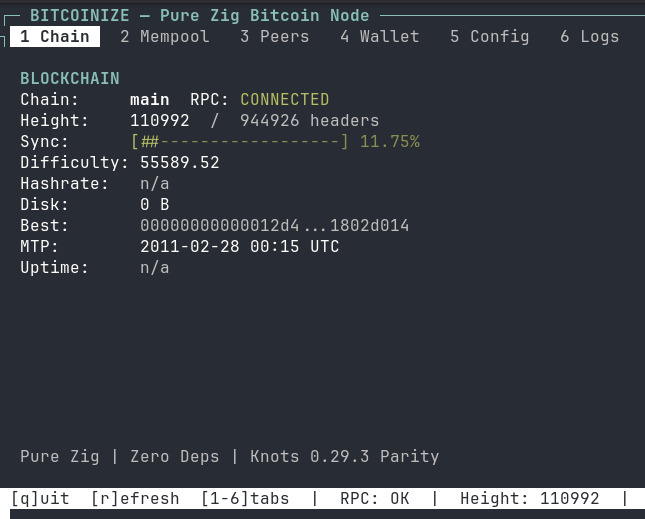
Running Bitcoinize 🚀
A long computer science journey. Dreaming in BIPs and OPs. A few bugs to fix, hundreds of tests to run
Once it finishes syncing and validating the blocks with the new Zig zero-dependency code, I’ll start testing the wallet and optimizing our LevelDB in Zig
1
2
13
849
Bitcoinize POS Machine ⚡ retweeted
Apr 24
Extremely important that doesn’t happen. Please repost so we get the word out.
Apr 24

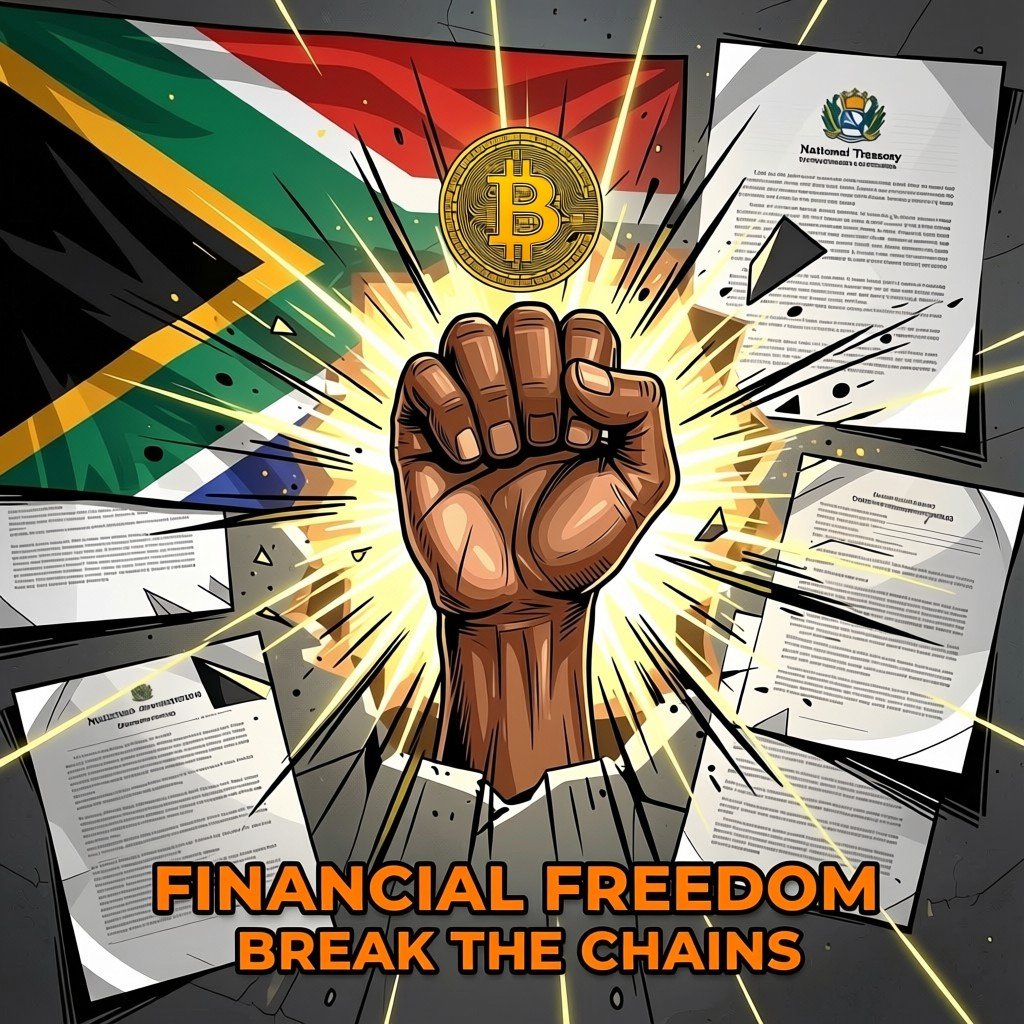
🚨 The South African government is attempting to OUTLAW FINANCIAL FREEDOM.
🚫 Under the guise of "capital flow management," new draft regulations will effectively destroy self-custody and Bitcoin's promise of financial inclusion in our country.
🇿🇦 These aren't just rules for exchanges. They are a direct attack on EVERY South African.
Here’s what they do:
‼️ BAN SELF-CUSTODY: By targeting transactions that touch global network infrastructure, they make self-custody illegal.
‼️ FORCE LIQUIDATION: They grant the state the power to force the sale of Bitcoin to the National Treasury. This is expropriation.
‼️ OUTLAW CIRCULAR ECONOMIES: Peer-to-peer transactions for goods and services will be deemed "black market" activity if they exceed an unspecified threshold.
‼️ GIVE THE STATE ARBITRARY POWER: The Minister can decide the "threshold" for illegality at any time, creating uncertainty for everyone.
✊ This is a war on open, permissionless money. It's a war on the unbanked. It's a war on your right to control your own wealth.
📜 And they're trying to do it WITHOUT A VOTE IN PARLIAMENT.
⏳ The deadline for public objection is either May 18 or June 10, depending on which government source is consulted.
We have no time to waste.
👀SEE DRAFT HERE:
treasury.gov.za/public com…
👇 SUBMIT YOUR OBJECTION HERE:
ag.bitcoinzar.co.za/
🔖 READ THE CRITICAL ANALYSIS:
capecrypto.com/south-africa-…
📢 SHARE THIS POST.
The world needs to see what is happening.
5
36
131
5,466
Bitcoinize POS Machine ⚡ retweeted

Dear @danheld,
It must be nice to sit so comfortably that you can look at the entire world and say "no one cares."
Meanwhile in Uganda, orphans at Star Light Elementary School care A LOT about the fact that @BitcoinBeachBR used Bitcoin to save their school.
With brave hearts abandoning the industry, developers burning the protocol, strong new narratives waiting to be weaponized, and more than 100 kids to feed until the end of the year, you should be deeply concerned. Do you have no soul?
Bitcoin is part of our daily lives. It's replaced our local currency. It may not be useful for you, but it was made for us.
WE CARE. 🧡

3
11
48
1,331

Bitcoinize POS Machine ⚡ retweeted
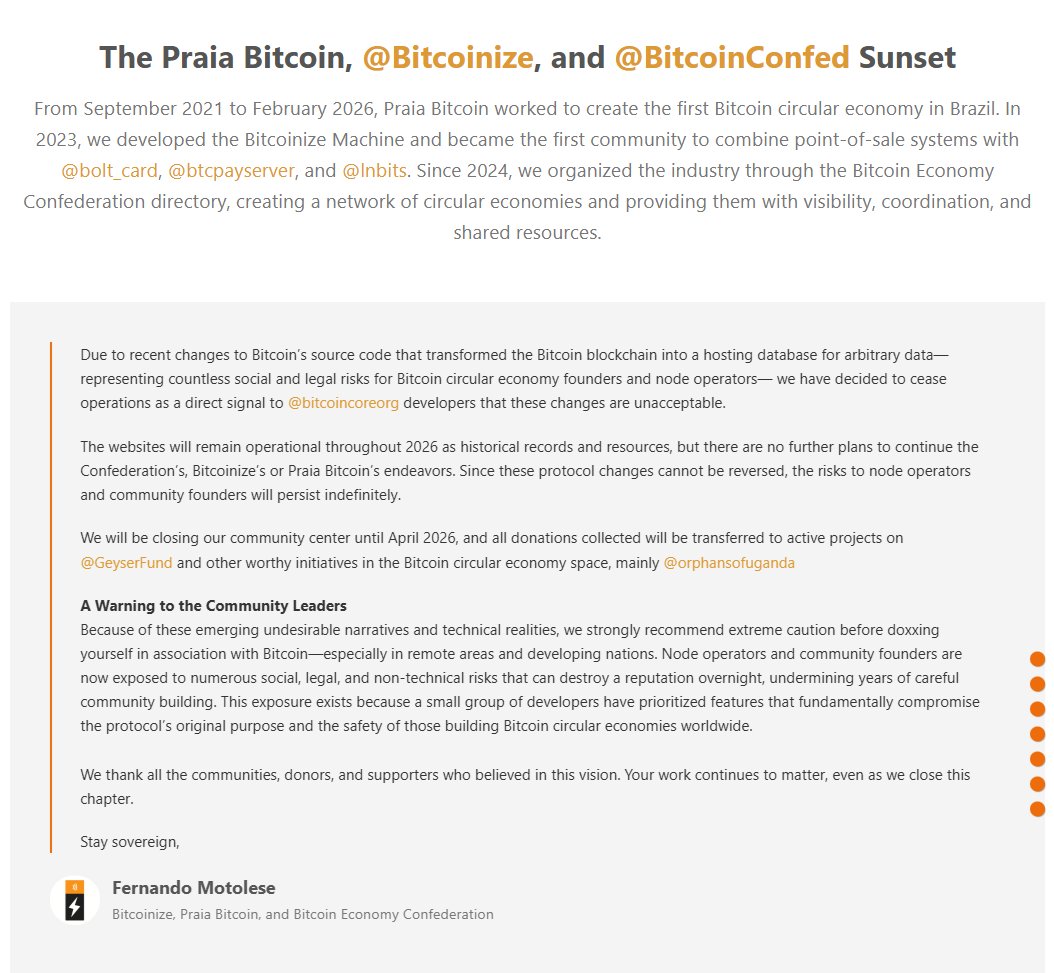
The Praia Bitcoin, @Bitcoinize, and @BitcoinConfed Sunset
From September 2021 to February 2026, Praia Bitcoin worked to create the first Bitcoin circular economy in Brazil. In 2023, we developed the Bitcoinize Machine and became the first community to combine point-of-sale systems with @bolt_card, @btcpayserver, and @lnbits. Since 2024, we organized the industry through the Bitcoin Economy Confederation directory, creating a network of circular economies and providing them with visibility, coordination, and shared resources.
Due to recent changes to Bitcoin's source code that transformed the Bitcoin blockchain into a hosting database for arbitrary data—representing countless social and legal risks for Bitcoin circular economy founders and node operators— we have decided to cease operations as a direct signal to @bitcoincoreorg developers that these changes are unacceptable.
The websites will remain operational throughout 2026 as historical records and resources, but there are no further plans to continue the Confederation's, Bitcoinize's or Praia Bitcoin's endeavors. Since these protocol changes cannot be reversed, the risks to node operators and community founders will persist indefinitely.
We will be closing our community center until April, and all donations collected for our 2026 operations will be transferred to active projects on @GeyserFund and other worthy initiatives in the Bitcoin circular economy space, mainly @orphansofuganda
A Warning to the Community Leaders:
Because of these emerging undesirable narratives and technical realities, we strongly recommend extreme caution before doxxing yourself in association with Bitcoin—especially in remote areas and developing nations.
Node operators and community founders are now exposed to numerous social, legal, and non-technical risks that can destroy a reputation overnight, undermining years of careful community building. This exposure exists because a small group of developers have prioritized features that fundamentally compromise the protocol's original purpose and the safety of those building Bitcoin circular economies worldwide.
The Path Forward:
We have come to recognize a fundamental truth: the future of Bitcoin circular economies lies not in centralized organizations, but in organic, independent growth. Each community must build its own resilient economic ecosystem, learning from others while remaining truly sovereign and self-sustaining. This decentralized approach honors Bitcoin's original ethos far better than any confederation ever could.
We thank all the communities, donors, and supporters who believed in this vision. Your work continues to matter, even as we close this chapter.
Stay sovereign,
Fernando Motolese
Founder, Praia Bitcoin Brasil, Bitcoinize and BitcoinConfed
Sources:[1] x.com/BitcoinBeachBR/status/…
23 Aug 2025

Hello @bitcoincoreorg,
We live Bitcoin. We dedicate our lives to it, full time, nonstop. On the ground, we work as part of Bitcoin’s invisible team, often without salaries, simply because we believe in its power to fix money and defend society from injustice and authoritarianism.
Bitcoin is beautiful. But it can also become fragile, outdated, or even corrupted, if we do not care for it with the seriousness it deserves.
The white paper begins with the words:
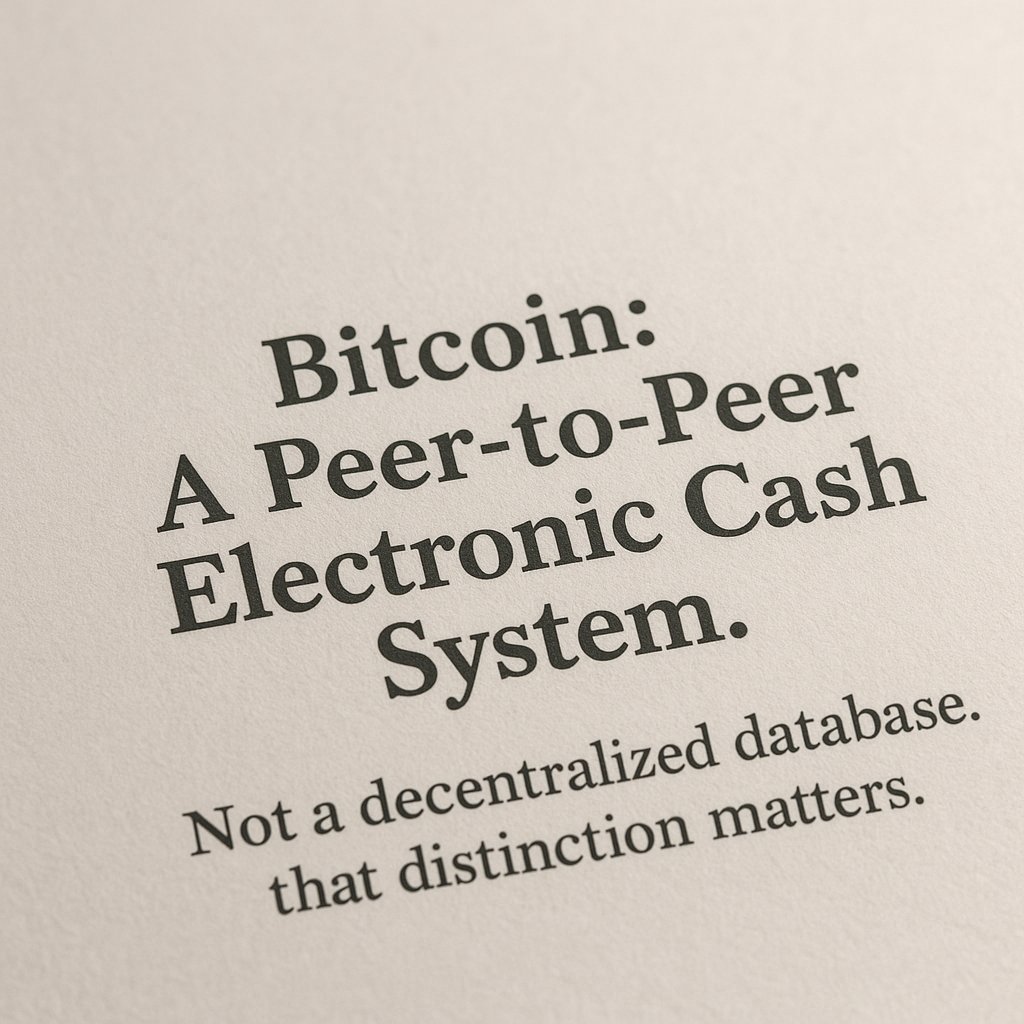
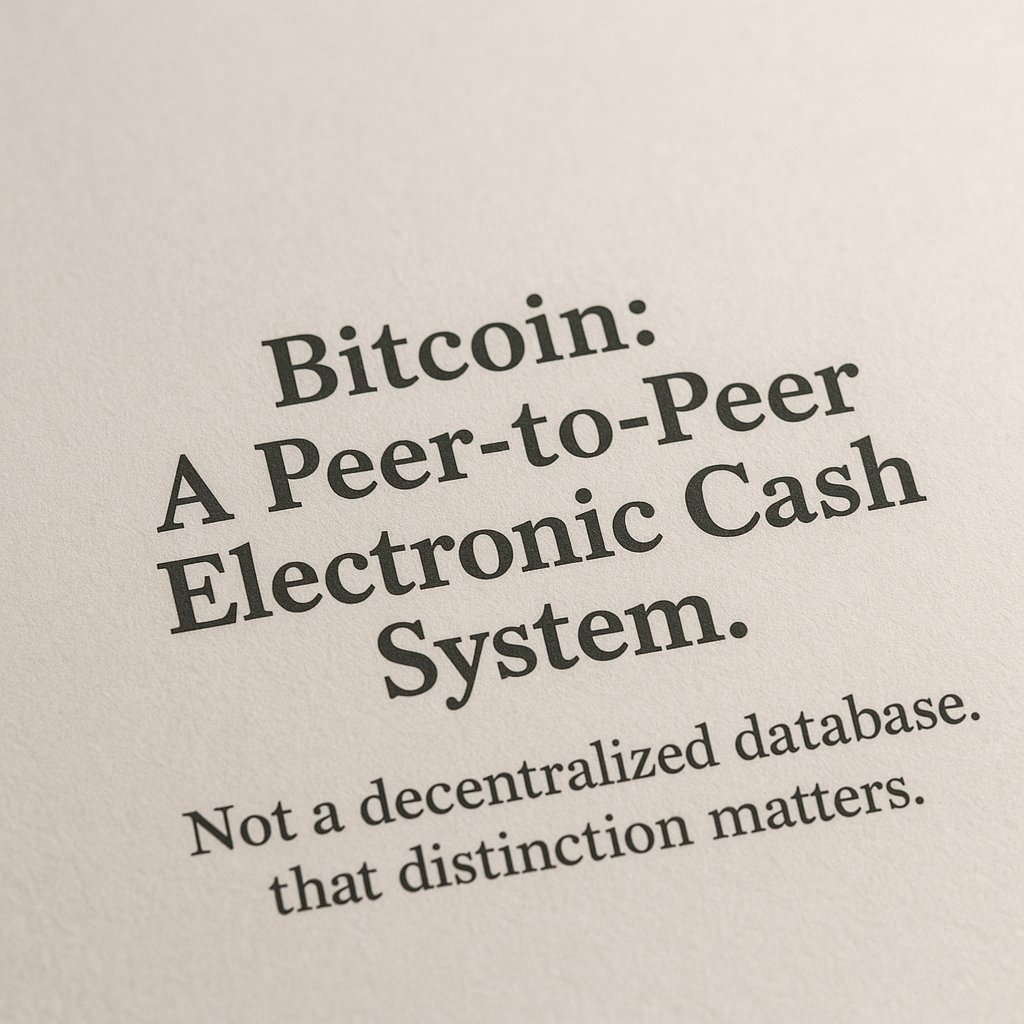
“Bitcoin: A Peer-to-Peer Electronic Cash System.”
Not a decentralized database. That distinction matters.
Developers must lower their time preference and think in terms of centuries, not release cycles. Bitcoin is a cash system designed for global adoption in commerce. That was Satoshi’s vision.
Originally, in 2014 Bitcoin Core introduced OP_RETURN with a 40-byte limit. In 2015 this was raised to 80 bytes, and in 2016 clarified as an 83-byte script length. For nearly a decade the rule stayed unchanged. Then, in 2024 with Core v29, the policy was relaxed to allow multiple OP_RETURN outputs per transaction, although each remained capped at 80 bytes. Now, with Core v30 (2025), the long-standing cap itself has been removed entirely: OP_RETURN outputs are no longer bound to 80 bytes, and multiple OP_RETURNs per transaction are allowed, bounded only by general transaction-weight (~100,000 vbytes) and block-weight (4 MB) limits.
This is extremely risky. By first allowing multiple OP_RETURNs (v29) and now eliminating the explicit size cap (v30), Core normalizes and facilitates behavior that was once discouraged. It opens the door to spam, bloat, and malicious use cases. It allows attackers to inject unwanted or even illegal content directly on-chain, potentially exposing node operators to liability. Users should have the freedom to filter what they host, but Core should not encourage practices that turn Bitcoin into a data-storage network.
Yes, arbitrary data can already be forced onto the blockchain in different ways. But these policy changes transform a fringe misuse into a legitimized practice, encouraging precisely the kind of abuse that poses systemic risks. A public-opinion crisis, triggered by toxic or illegal content, could cause catastrophic damage to adoption and market confidence.
Bitcoin is money. Just as you can scribble a short note on a banknote but not publish a book on it, Bitcoin transactions can carry limited messages but should not be hijacked for unrelated purposes.
If protocol development drifts toward use cases that weaken Bitcoin as cash, the consequences will be severe. The network is already signaling concern: voices like @BitcoinKnots resonate because Bitcoiners are smart, technical, and willing to act when needed to protect the network.
We have already built important advancements to secure Bitcoin’s long-term future. Let us not undo this progress. Let us stay true to the vision: Bitcoin as a peer-to-peer electronic cash system.
53
69
284
45,137
Bitcoinize POS Machine ⚡ retweeted

Feb 6
한국 도착했습니다. (사실 어제저녁..)
@PlanBElsalvador 목걸이, @tether 선글라스, @MyFirstBitcoin_ 비트코인 디플로마 스페인어 원본, @Excellion 의 UASF 모자, @nayibbukele 모자, @r0ckstardev 사인받은 피규어, @adam3us 사인받은 백, @Bitcoinize 의 비트코인 pos기, @blockhunters_ 보드게임, @bitcoinofficesv 의 비트코인 여권 등 다양한 굿즈를 획득하였습니다.
차주에 비트코인 하우스 오리진@BTChouseORIGIN에서 보실 수 있습니다.

20
10
177
4,547
Bitcoinize POS Machine ⚡ retweeted

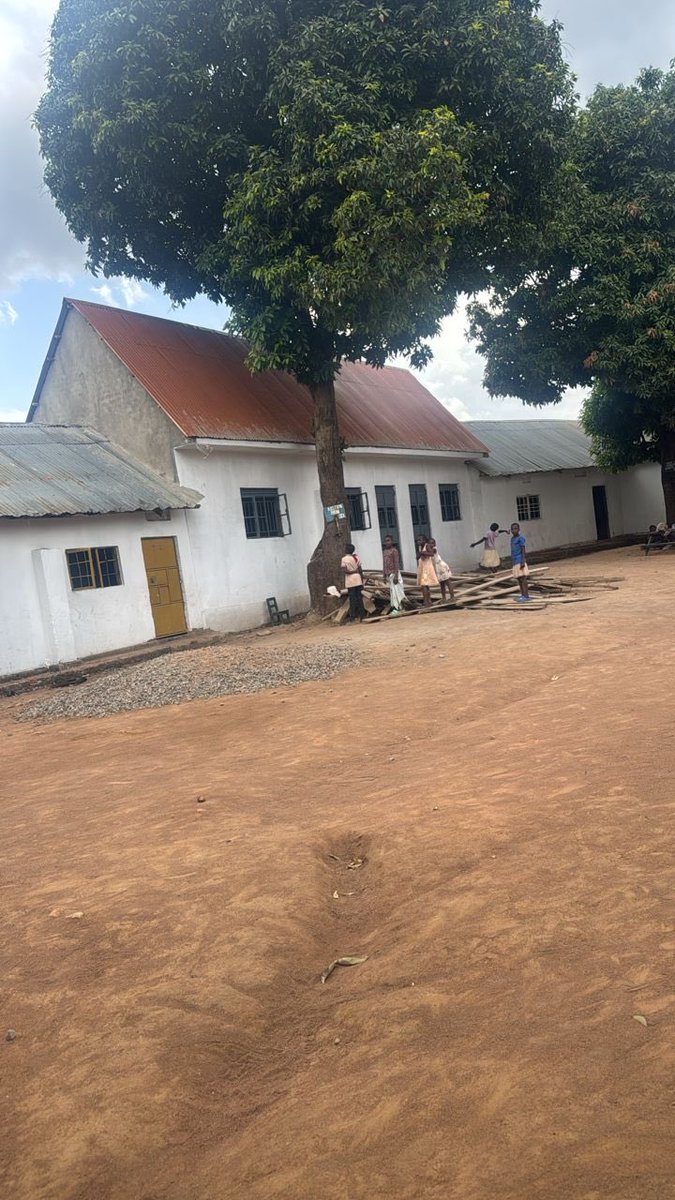
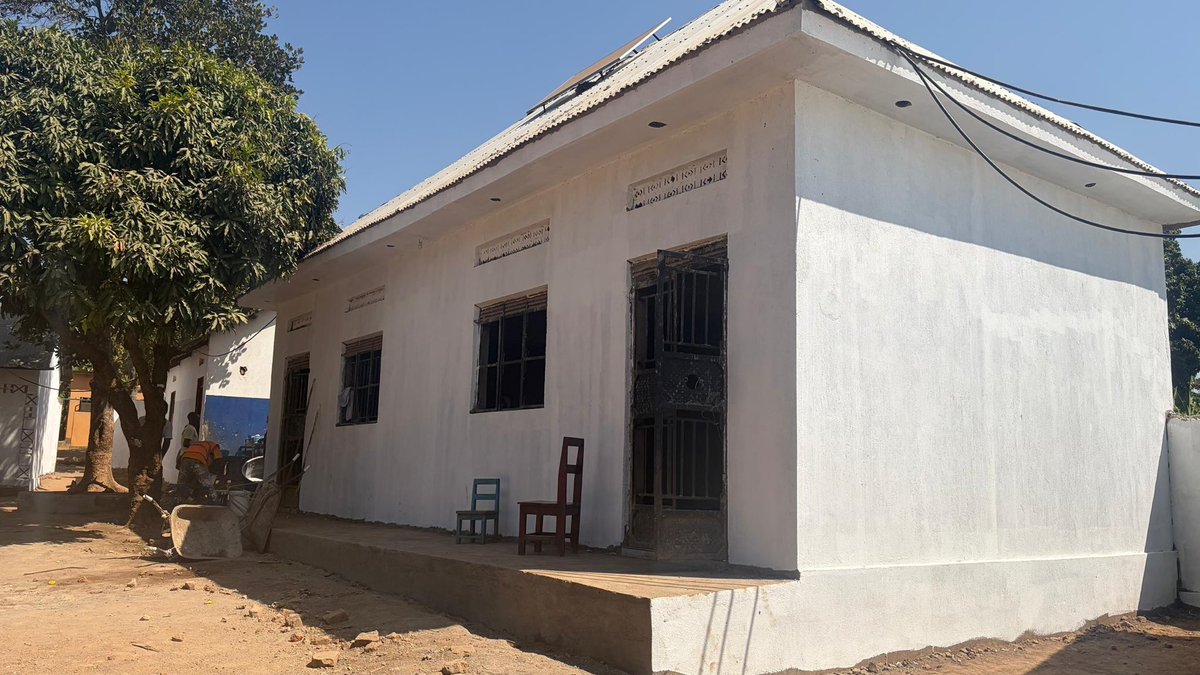
“Spend as soon as possible” works like magic, we are lucky to have already bought the school and brought construction to almost completion at Starlight Elementary School!
We of course have effect on the budget but it could have been worse, about 85% of the major construction & spending is done ✅
We are now painting 🖼️
Thanks @Bitcoinbeach, @TrezorAcademy and of course @BitcoinBeachBR (our coach & mentor) for making a better life for @orphansofuganda
We keep building.
Bear markets are hard for communities. As a community leader, I always say: during bear periods, spend as fast as possible.
We should never convert to dollars, fiat, or stablecoins, because every conversion we do is a vote for the legacy system we’re supposed to replace.
How many months does your forecast spreadsheet cover? What do you need to accomplish in the next 24 months?
99% of vendors and founders aren’t ready to hold through the crash. They have no option; they look for fiat. Since we can’t, my suggestion is to make upfront payments as soon as you get donations or make sure you’re ready to cut expenses as the price crashes.
2
10
648
During the bear market is time to Build.
What do you prefer for the next batch of Bitcoinize Machines?
33%
We don't need POS Devices
0%
No Improvements needed
67%
Frontal Cam eSIM new OS
3 votes • Final results
1
2
126
As the markets for Bitcoin Payments are very very small, we are considering to become a Non-Profit organization before to run the next campaign on @geyserfund, all or nothing, with huge goals.
To build a new device, we need make a Minimum Order of 2000 machines , a new motherboard to support eSIM, frontal camera and New OS costing today around 3 BTC
After, building it we are thinking to allow the factory make direct sells instead being the middleman, to drop the price of the machine.
Anyway, now we are just thinking, nothing is defined yet, we are even considering shutdown our operation because it isn't sustainable yet.
2
2
120