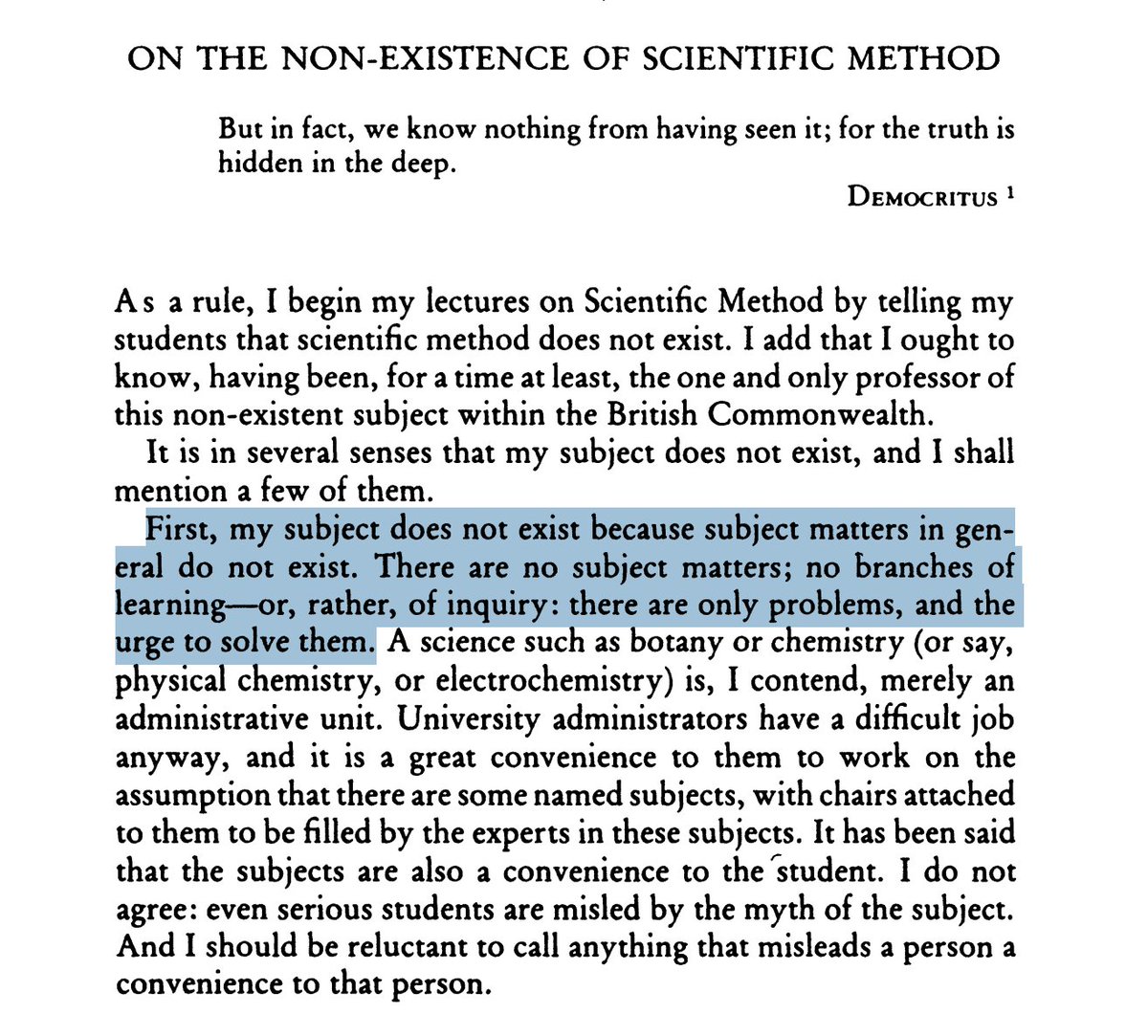
Popper argued that the traditional academic disciplines and their arbitrary subject matters don't objectively exist in reality. Instead of studying a specific topic, he argued that thinkers should focus entirely on solving concrete, practical problems that cut across disciplinary boundaries.
Administrative Convenience vs. Real Problems
Administrators favor neat subject matters because divisions, departments, and specific course catalogs provide a clean bureaucratic structure. However, Popper noted that this structure forces students into arbitrary academic silos. Because real-world problems do not conform to artificial department lines, forcing students to specialize in a subject rather than a problem chokes true critical thinking and intellectual growth.
How It Fails Students
"Instead of encouraging the student to devote himself to his studies for the sake of studying, instead of encouraging in him a real love for his subject and for inquiry, he is encouraged to study for the sake of his personal career; he is led to acquire only such knowledge as is serviceable in getting him over the hurdles which he must clear for the sake of his advancement."
This structure favors passive, bucket-like memorization over the active trial-and-error necessary for learning. Consequently, students prioritize passing bureaucratic hurdles over developing the critical thinking skills needed to challenge dogmatic ideas.
-----
Yet, Popper's ideas above are completely unknown to over 99% of scientists at all levels. All incentives favor specialization. No one stops to think we are like ant castes with strict missions and methods.
Investigators are thus highly motivated to 'protect' their fields from outsiders. The more interdisciplinary one is, the more they risk being dismissed as a dilettante.
The proven way for Principal Investigators to get their first funding is to propose continuing their subject matter and methods they used as trainees. They must do this to 'pay the bills', since they are unlikely to be funded by any other fields' experts. This domino effect often continues for whole careers.
-----
When students seek guidance, I begin by asking what motivates them -- what question would they love to completely devote themselves to for an extended time? In almost every case, the student begins their answer with a scientific field and only then a biological or disease question. Often, my advice is to identify the top 3 investigators in the world working to solve their problem. Find out what they doing. Communicate with them. Prepare yourself to work in such a group and, if possible, join a top lab.
When students ask what elective classes they should take for a biomedical career, I generally encourage taking philosophy and statistics.
"There are no subject matters; no branches of learning—or, rather, of inquiry: there are only problems, and the urge to solve them."
––Karl Popper, Realism and the Aim of Science.