
Joined December 2021
- Tweets 3,336
- Following 3,148
- Followers 1,842
- Likes 14,086
352 Photos and videos
















Pinned Tweet

Feb 11
Feels good to be back on the #1 ecosystem in the space
Hyve <> Arbitrum, put simply:
-> High-performance applications no longer need to deploy on high-TPS chains. With this architecture, Arbitrum becomes the first chain to natively support cloud-grade, real-time storage whose state is cryptographically verified and anchored onchain
-> $ARB holders can passively recapture data fees that would otherwise flow to centralized providers like AWS
-> Acting as a trustless verification layer, the Arbitrum-Cluster enables TradFi institutions to abstract away blockchain complexity while cryptographically proving the state of their offchain data
-> Arbitrum builders now have a fully aligned way to make their off-chain stored data verifiable and composable onchain at a fraction of the cost
-> By making data fully composable, builders can earn data royalties when their data is egressed by external parties
-> Builders can also earn performance-based rewards through the upcoming Pilot program

Thrilled to welcome @HyveXYZ to Arbitrum
They’re turning real-time data into a shared, verifiable primitive - giving apps faster performance, lower infra overhead and more
Excited to see Hyve tap Arbitrum’s speed, reliability and deep liquidity to help build the data economy
2
15
1,257

Chris ≡ Damen retweeted

Apr 1
Words: 500
Objective evidence: 0
Let's dissect some of the claims made in this post about @aave v4.
1. “Only $4M deposits in the first 24 hours"
Framing bias low-quality metric.
New deployments always start slow, it's even the responsible (and in this case intentional) approach. Liquidity is already productive incentivized in V3, and risk frameworks are still being explored.
V3 has years of Lindy, integrations, and trust. Comparing day 1 of V4 vs multi-year system is simply a lazy analysis.
2. “No demand for V4 / Pro”
False. The vote was very tight before Labs exercised its right to vote, and institutions are actively demanding the key characteristics brought in by V4:
> better capital efficiency
> unified liquidity via Hub
> isolated risk via Spokes
> higher flexibility (look at Morpho)
> institutional / RWA-compatible design
V3 is absolutely phenomenal. Unmatched, even. But it doesn't focus on institutional needs or what the market is currently hungry for. Morpho did have many of these characteristics, and it led to its recent growth.
Adapt or die.
3. "Unsuspecting users believe everything Aave Labs is building is in the benefit of the DAO and the AAVE token, when in fact that's a smokescreen to syphon money quietly."
False again. Most definitely not "in fact". Using "in fact" as a smokescreen to voice out your own opinions is quite unethical. Regarding the actual (lack of) substance:
Siphon money where? Into V4? That's literally the point. Eating the institutional pie. Revenue from Aave App, Aave Pro, V3, V4, Horizon, and everything Aave will flow to the DAO.
> Does Labs have a lot of influence in the DAO? Yes.
> Does Labs Stani hold >50% of the AAVE supply? No.
> Can Aave Labs unilaterally control the DAO? No.
4. "Aave Labs changed the Aave website, which they control, to benefit themselves, created the conflict (perhaps on purpose) so they can take over the DAO and do as they please."
False super weak argument.
It's called product launch. When organizations launch a new product, it tends to be promoted, especially when said product has the potential to grow into the flagship product.
Why does it have the potential to become the flagship product?
Because it's directly aligned with current institutional needs and wants. Again: adapt or die. Aave chose the former.
5. "If you scroll the Aave website you'll notice v3 gets no attention, besides some links. Moreso, they present v4 as the "pro" version. That's totally misleading."
What even is the argument here? V3 has never been presented by anyone as "Pro version". So, what's misleading?
It's called Pro because it focuses on allowing organizations and institutions to create Spokes (markets) without fragmenting liquidity. These are... pro... prof... professional entities instead of retail users. This wasn't the case in V3 (i.e. EtherFi market liquidity and Mainnet market liquidity being fragmented).
V3 is live, dominant in TVL, widely used, and heavily incentivized, but we choose to complain about the marketing team doing its job.
6. $50M swap loss equating to "gross negligence”
False again. Negligence is failure to take proper care in doing something. Aave built a permissionless protocol that allows users to make their own choices.
The core protocol worked exactly as designed.
If they would've never shown users a warning sign before fat fingering $50M into a single swap, that would be negligence. But hey, if my grandma had wheels she would be a bicycle.
This was a problem related to user execution, not "gross negligence".
Important distinction.
7. “Founder bought a $30M mansion”
Irrelevant ad hominem pure emotional bait
Founder can buy whatever he wants with the money he has rightfully earned. There is no single proof of misconduct.
And, at the end of a post full of unproven claims, misinterpretations, and framing bias, the author has the audacity to ask for "Like, share and follow".
Astonishing.
Mar 31

The launch of Aave v4 is not what it seems.
It's the direct result of breaking down everything that was good about Aave.
Let me expose why this is the case.
24h since AAVE v4 launched generated only 4M in deposits.
This is a protocol with over 30 bil in TVL on Ethereum alone. That sits on v3, the one people actually trust and was built by the DAO.
If you visit the main page of AAVE today, you'll be presented with:
Aave App - an Aave Labs product
Aave v4 - an Aave Labs product
There was no actual demand for these products, except that they were created to generate income for Aave Labs.
Since that went against the DAO interests, the founder and owner of Aave Labs did a hostile takeover by outvoting the other DAO members that protested against these initiatives.
He then proceeded to pay himself via a rigged vote 50M in DAO funds to develop a roadmap including the above products.
Initially, they wanted to play the DAO game, but since they couldn't get their way, they went ahead and broke the DAO.
Now, Aave Labs tells users that every product they are building and 100% of its associated revenue will go to the DAO treasury.
That's great, until you realize they control the DAO and can always vote to pay themselves whatever amounts they want.
So instead of their products paying Aave Labs directly like they wanted initially, they now use a broken DAO as a cover to pay themselves whenever they want.
Unsuspecting users believe everything Aave Labs is building is in the benefit of the DAO and the AAVE token, when in fact that's a smokescreen to syphon money quietly.
This conflict of interest caused the recent Aave drama that saw key DAO service providers quit and leave. The ones that actually built and maintained v3 at over 30 bil in TVL.
Aave Labs changed the Aave website, which they control, to benefit themselves, created the conflict (perhaps on purpose) so they can take over the DAO and do as they please.
They succeeded.
This is why we have v4 today. The ones against it were pushed out.
If you scroll the Aave website you'll notice v3 gets no attention, besides some links. Moreso, they present v4 as the "pro" version. That's totally misleading.
v3 is the actual product that was tested and held strong during times of stress, not v4 which is an untested product from a team that showed gross negligence in the past.
For example, a user recently lost 50M using the Aave Labs swap function on their website. Imagine trying to buy a lot of AAVE on their own site and losing all your money.
That's who is behind v4.
The founder also bought a 30M mansion in one of the fanciest neighborhoods in London most recently.
Aave Labs was thirsty for money and this was their solution. It worked.
However, people will vote with their money.
Time will tell how v4 will do, but I would never touch any product developed by Aave Labs, unless you want to risk your money.
Like, share, and follow @duonine
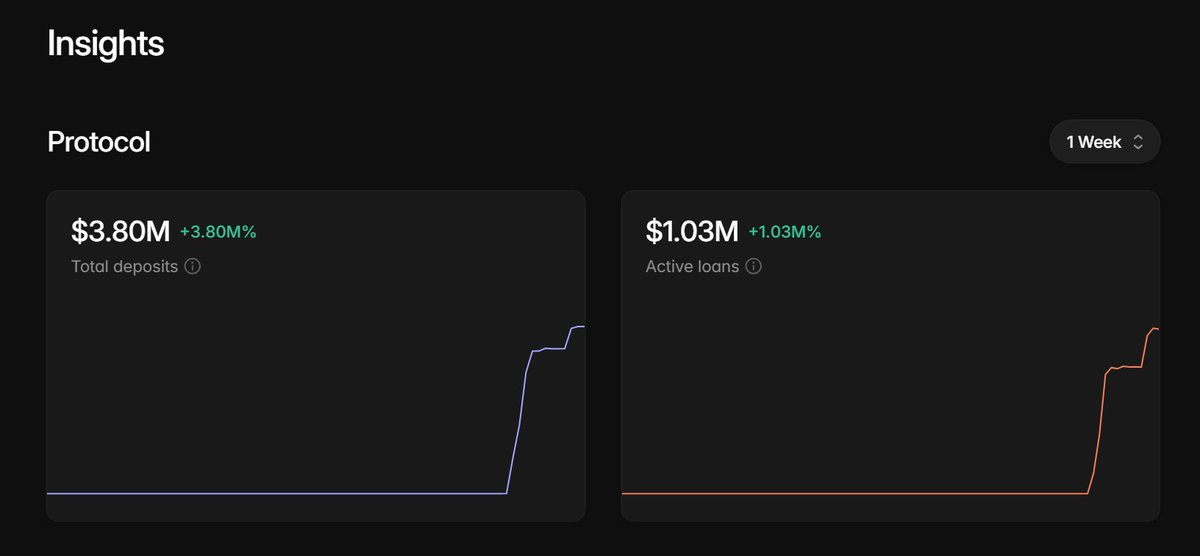
4
3
26
3,045
Chris ≡ Damen retweeted

Mar 23
Welcome to the new Castle Labs!
104
52
348
36,660
Mar 23
Universal Staking by @symbioticfi is another critical, yet underappreciated, piece in the RWA puzzle
Their modular stack enables novel architecture designs ranging from:
- @capapp enabling trustless guarantees for private loan
- @HyveXYZ enabling off/onchain atomic data synchronization via CloudGrade object storage
- @NexusMutual onchain reinsurance and programmable risk coverage
- (@...) RWA programmable redemption liquidity via slash-enforced MMs NAV bids
- more incoming
Neo Finance was yesterday
The future is now
Don't blink
Mar 20

Redemption liquidity is one of the major holdups of RWA adoption as identified by this great report. Some quick comments on the 3rd party solutions discussed:
Pre-fund a stablecoin pool that buys tokens at NAV
- using USDC directly means you'd be foregoing base yield, which isn't capital efficient
- (manual) management implies operational overhead
- limited by RWA issuer treasury
Use market makers to buy tokens at NAV
- market makers don't want to have exposure to long duration RWAs (or it'd be costly as they would need to hedge)
Borrow against RWA tokens on DeFi lending markets
- borrowable supply is impacted by lack of redemption liquidity itself
- additionally, looping/leverage dry out the supply (e.g. @3FLabs looking to solve this)
We've got something cooking here at @symbioticfi that seeks to address the shortcomings of approach 1 and 2 🧑🍳
Keep an eye out and find @0xhenrique_d at @blockworksDAS next week to discuss!
1
11
375
Mar 23
Exotic RWAs are the king of yield, but fail on state
Without programmatic transparency, these doesn't belong onchain
Atomic off/onchain state sync (@HyveXYZ) solves that
Aave Horizon v4 solves risk isolation
Soon, @aave will evolve from liquidity hub → balance sheet infra
Feb 24

As the largest RWA market on Ethereum, Horizon offers a unique opportunity for integrators to enable stablecoin lending against traditional assets directly onchain, while providing instant liquidity for borrowers. No waiting. No barriers. Just liquidity.
7
199
Mar 20
It's becoming clearer that @arbitrum is the most underappreciated piece in the RWA puzzle.
If RWAs need:
-deep onchain liquidity
-scalability (ArbOS 51)
-flexible execution environment
-off/onchain state bridging with atomic guarantees (@HyveXYZ)
Arbitrum checks all 4.
Mar 19

Largely agree. We’ve been building at the convergence of DeFi and tradfi for more than five years and it’s clear that the pace and innovation in the vertical is accelerating
1
1
24
1,360

Mar 9
Point well made. We can all appreciate RWAs to some extent, but the current landscape remains largely gatekept to publicly traded instruments, and for good reason.
The architecture is still fragile, composability is subjective, and the issuer trust bond remains quite high. But overall it works, largely because tokenized financial instruments can be verified through trusted infrastructure like BloomTerminal or Refinitiv.
The real challenge and opportunity for RWAs lies imo beyond markets that already have perfect price discovery. It lies with real-world infrastructure: energy systems, industrial capacity, logistics networks, assets that cannot simply be queried on a terminal but can meaningfully benefit from crypto-native capital (and vice-versa).
Since d1, Hyve has been building for exactly this gap, starting at the data layer. Our infrastructure enables real-time, offchain data to be atomically reflected onchain with verifiable proofs, while keeping sensitive operational data private. This isn't just a technical detail: it's the missing link between illiquid, complex real-world assets and the composable, trustless capital rails that crypto enables.
Paired with ecosystems like @arbitrum & protocols like @Aave Horizon, which are laying the foundational plumbing, the conditions for non-traditional RWAs to thrive onchain are, for the first time, genuinely credible.
Mar 9

Most RWAs are just the same asset on new rails. Tokenized treasuries, tokenized stocks. They work, but they're not new.
The RWAs I'm paying the most attention to are crypto native. Tokenization that actually enables new types of financing like GPU infrastructure, electricity markets, or wireless broadband.
Not digital twins. New products that only exist because of tokenization, composable in DeFi from day one.
2
6
319
Feb 3
"Reset to Factory Settings"
Feb 3

There have recently been some discussions on the ongoing role of L2s in the Ethereum ecosystem, especially in the face of two facts:
* L2s' progress to stage 2 (and, secondarily, on interop) has been far slower and more difficult than originally expected
* L1 itself is scaling, fees are very low, and gaslimits are projected to increase greatly in 2026
Both of these facts, for their own separate reasons, mean that the original vision of L2s and their role in Ethereum no longer makes sense, and we need a new path.
First, let us recap the original vision. Ethereum needs to scale. The definition of "Ethereum scaling" is the existence of large quantities of block space that is backed by the full faith and credit of Ethereum - that is, block space where, if you do things (including with ETH) inside that block space, your activities are guaranteed to be valid, uncensored, unreverted, untouched, as long as Ethereum itself functions. If you create a 10000 TPS EVM where its connection to L1 is mediated by a multisig bridge, then you are not scaling Ethereum.
This vision no longer makes sense. L1 does not need L2s to be "branded shards", because L1 is itself scaling. And L2s are not able or willing to satisfy the properties that a true "branded shard" would require. I've even seen at least one explicitly saying that they may never want to go beyond stage 1, not just for technical reasons around ZK-EVM safety, but also because their customers' regulatory needs require them to have ultimate control. This may be doing the right thing for your customers. But it should be obvious that if you are doing this, then you are not "scaling Ethereum" in the sense meant by the rollup-centric roadmap. But that's fine! it's fine because Ethereum itself is now scaling directly on L1, with large planned increases to its gas limit this year and the years ahead.
We should stop thinking about L2s as literally being "branded shards" of Ethereum, with the social status and responsibilities that this entails. Instead, we can think of L2s as being a full spectrum, which includes both chains backed by the full faith and credit of Ethereum with various unique properties (eg. not just EVM), as well as a whole array of options at different levels of connection to Ethereum, that each person (or bot) is free to care about or not care about depending on their needs.
What would I do today if I were an L2?
* Identify a value add other than "scaling". Examples: (i) non-EVM specialized features/VMs around privacy, (ii) efficiency specialized around a particular application, (iii) truly extreme levels of scaling that even a greatly expanded L1 will not do, (iv) a totally different design for non-financial applications, eg. social, identity, AI, (v) ultra-low-latency and other sequencing properties, (vi) maybe built-in oracles or decentralized dispute resolution or other "non-computationally-verifiable" features
* Be stage 1 at the minimum (otherwise you really are just a separate L1 with a bridge, and you should just call yourself that) if you're doing things with ETH or other ethereum-issued assets
* Support maximum interoperability with Ethereum, though this will differ for each one (eg. what if you're not EVM, or even not financial?)
From Ethereum's side, over the past few months I've become more convinced of the value of the native rollup precompile, particuarly once we have enshrined ZK-EVM proofs that we need anyway to scale L1. This is a precompile that verifies a ZK-EVM proof, and it's "part of Ethereum", so (i) it auto-upgrades along with Ethereum, and (ii) if the precompile has a bug, Ethereum will hard-fork to fix the bug.
The native rollup precompile would make full, security-council-free, EVM verification accessible. We should spend much more time working out how to design it in such a way that if your L2 is "EVM plus other stuff", then the native rollup precompile would verify the EVM, and you only have to bring your own prover for the "other stuff" (eg. Stylus). This might involve a canonical way of exposing a lookup table between contract call inputs and outputs, and letting you provide your own values to the lookup table (that you would prove separately).
This would make it easy to have safe, strong, trustless interoperability with Ethereum. It also enables synchronous composability (see: ethresear.ch/t/combining-pre… and ethresear.ch/t/synchronous-c… ). And from there, it's each L2's choice exactly what they want to build. Don't just "extend L1", figure out something new to add.
This of course means that some will add things that are trust-dependent, or backdoored, or otherwise insecure; this is unavoidable in a permissionless ecosystem where developers have freedom. Our job should make to make it clear to users what guarantees they have, and to build up the strongest Ethereum that we can.
6
223
It's 2026 and data is still not treated as an economic primitive, leading to:
📉 Data siloes that inhibit innovation
📉 Economic leakage that strips operational funds away from protocols
The underutilization of cryptoeconomic data is hindering Web3's potential.

8
2
18
662
10 Dec 2025
Goals for 2026
☐ Transcend DATA from being a liability to becoming a full-blown economy
☐ Make RWAs self-verifiable and composable without the wrapper nonsense
☐ Own 1% of @aave's circulating supply (just because)
☐ Hold my breath for 3 minutes straight without fainting
3
13
276
5 Dec 2025
Cloudflare is down again. These occurrences seem to be getting more common as time goes by. Yet again, this is not the only big concern.
The rhetorical question is, why are we still, as an industry that claims to be the core alternative to centralized tech, so profoundly concerned when Cloudflare, AWS, or Azure go offline? Shouldn't we be more bullish on crypto when this happens?
The answer is simple: although blockchain technology introduced brilliant methodologies to reduce unique points of failure, its dependency on centralized cloud remains very real. The fee extraction alongside the unethical crossover rapidly became quietly accepted a side effect of our rapid expansion.
From blockchain node infrastructure, to dAPPs’ critical data storage, passing by web hosting and indexer computing, clouds found their way into almost every piece of our stack.
Who is to blame? No one, really.
Why is that? Because the blockchain was never meant to take over Big Tech companies.
It does not matter how many TPS your chain can handle. Blockchains cannot sustainably store and serve petabytes of data per month at a global scale with sub-second latency.
As the years go by, we start seeing some decentralized solutions rise up, each with their specific specializations.
Time is the remedy, but the clock is ticking fast.
One of the only categories that remains unsolved is real-time data storage/egress, one of the most critical needs for high-performance dAPPs such as DePIN, AI, RWA, Central Limit Order Books, and SocialFi.
Specifically, how to serve high-frequency storage with the same cost and efficiency ratio as centralized incumbents while ensuring that the data remains openly verifiable and modular. Moreover, without the typical value extraction, and tokenomic & settlement layer misalignment?
A lot of crucial questions that can all be answered by Hyve.
But this is only one battle. There will be no "one protocol" doing it all. This is a battle that can only be won by uniting and slowly changing the social consensus.
Providing superior decentralized alternatives.
Introducing higher standard.
Step by step;
Block by block.
9
492
Chris ≡ Damen retweeted

27 Nov 2025
They’ll definitely try - and they’ll push Ethereum forward.
26 Nov 2025

tempo might actually kill ethereum
once it has more stablecoin liquidity than eth it’s literally over
8
3
81
12,137

The “Decentralized” Web Runs On Centralized Infrastructure
→ 60% of Ethereum nodes run on centralized cloud
→ AWS alone hosts ~30% of the network
→ Google Cloud & Hetzner control the remaining
→ 80% of validators sit in corporate data centers
We can't build decentralized finance on centralized hardware
@HyveXYZ fixes this
3
2
13
772
13 Nov 2025
There is no better time to head to the nearest airport. Direction Buenos Aires.

1
11
218
11 Nov 2025
Introducing the Hot Data Manifesto
Put simply, Hyve is taking a decisive shot at uprooting AWS S3 and other centralized alternatives from crypto for good
Bringing real-time data and related financial value back to where it rightfully belongs
A must-read!
The web built markets.
Web3 built economies.
But data, the substrate of all value, remains captive.
Today marks a new phase for Hyve, starting with the release of our new website, documentation, and The Hot Data Manifesto:
Hyve’s formal position paper, outlining why decentralized economies can’t exist without sovereign, real-time data primitives, and how Hyve is designed to make data composable.
When data cannot be verified, aligned, or reused across protocols, it cannot form economies. It stays static, trapped in markets.
Hyve changes this by introducing a sovereign, high-throughput data fabric enabling ecosystems to turn data into an economic primitive rather than a cost center.
Finance became composable through smart contracts. Logic became composable through blockchains.
Now, data becomes composable through Hyve.
3
14
622

After a little over a year of heads down building, I’m excited to be sharing our vision for data in web3 through our Hot Data Manifesto.
Our foundation lies in building a data availability product, which has its origins in rollups, but the tech was never meant just for rollups. From day one, we were building a high-throughput, real-time data product for all of Web3. The “DA” label tied the story to rollups and blurred the bigger goal. Today, this changes.
Our vision is that real-time applications and protocol need more than just availability or storage to turn into an economy. Data has to be verifiable, aligned with its origin, sovereign, and reusable across protocols. When it isn’t, it becomes just a cost item. When it is, data becomes an economic primitive that enables composability and ecosystem growth, all in real-time.
We’ve already seen the pattern:
- Smart contracts made finance composable.
- Blockchains made logic composable.
- Now data becomes composable.
What we’ve built with Hyve is a data layer that is parallelized, verifiable, and high-performance from the edge to the network. We’ve worked on optimizing the erasure coding, the storage, and the retrieval.
Our thesis is simple:
- When data can be verified, it can be trusted without a middleman.
- When data can be aligned, the people who create it can share in the value it generates.
- When data can be reused, networks compound rather than fragment.
If you’re building order books, agents, DePIN networks, or anything data-heavy, you already know the current tradeoff: on-chain economics with an off-chain product behind a centralized API. That contradiction taxes your users and your upside.
Today we’re releasing three things:
- a site that reflects what we actually built,
- Updated documentation
- The Hot Data Manifesto
Web3 freed money and compute. It’s time to bring data into this equation.
Read the manifesto: hyve.xyz/blog/the-hot-data-m…
The web built markets.
Web3 built economies.
But data, the substrate of all value, remains captive.
Today marks a new phase for Hyve, starting with the release of our new website, documentation, and The Hot Data Manifesto:
Hyve’s formal position paper, outlining why decentralized economies can’t exist without sovereign, real-time data primitives, and how Hyve is designed to make data composable.
When data cannot be verified, aligned, or reused across protocols, it cannot form economies. It stays static, trapped in markets.
Hyve changes this by introducing a sovereign, high-throughput data fabric enabling ecosystems to turn data into an economic primitive rather than a cost center.
Finance became composable through smart contracts. Logic became composable through blockchains.
Now, data becomes composable through Hyve.
3
4
26
2,260
Chris ≡ Damen retweeted

7 Nov 2025
May the disruption begin!
4
5
15
1,794