
Serving yield @SoleraLabs 👨🏼🍳 | prev Founder in Crypto, SaaS, Brick and mortar
Joined October 2024
- Tweets 327
- Following 35
- Followers 524
- Likes 1,734
32 Photos and videos









24 Jul 2025
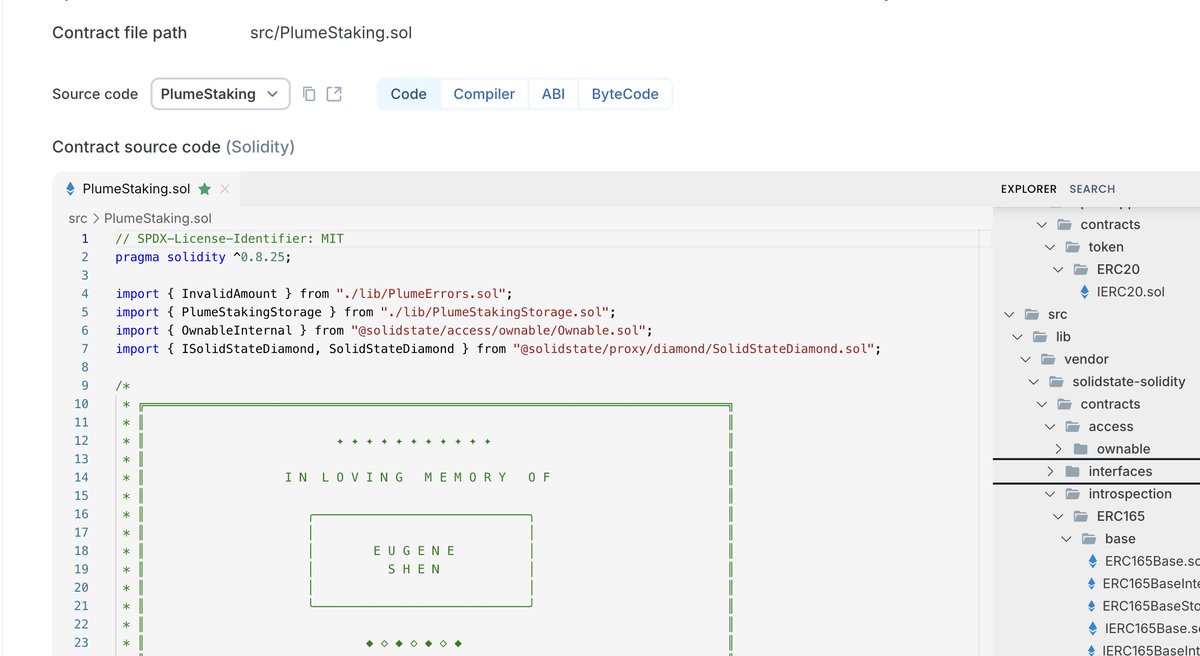
Chain wide AML, KYC, and asset backed vaults is such a major unlock, most haven't realized yet just how major
24 Jul 2025

Plume is the only public blockchain that has implemented advanced compliance into its deepest technology layer.
RWA Protocols building on it get that out of the box, and we’re doing more to make it easier for them to create standardised rules at their own protocol layer.
This ultimately benefits end users and issuers that are entering the space with their asset and capital.
Adoption will happen gradually, then suddenly
2
1
18
949
16 Jul 2025
It’s Modular™️
15 Jul 2025

Morpho recently announced V2 with a suite of novel lending primitives
From intent-based markets, fixed rates, and cross-chain borrow settlement
Here’s how Solera integrates @morpholabs V2 to curate institutional lending markets 👇
1
2
20
968
Chef Goon 🪶 retweeted

2 Jul 2025
Pic related:
x.com/plumenetwork/status/19…
1 Jul 2025

Off the heels of our meetings with Treasury and SEC's Crypto Task Force last month, we are grateful that we got the privilege to spend time with Donald J. Trump, the president of the United States to discuss crypto policy, tokenization, and the future of RWAs in America.
The passing of the GENIUS Act sets the stage for the future of crypto in America. Our meeting with the SEC Crypto Task Force and the announcement from Paul Atkins referencing the innovation exemption that we introduced for onchain products like Nest underscore how serious this is.
We are excited to continue working with the President of the United States, Donald J. Trump, and the rest of the cabinet — including Scott Bessent, Vice President J.D. Vance, the SEC Crypto Task Force, and the Treasury to define and advance crypto policy in America, enabling a free, open, and permissionless world for everyone.
This is the start of much more, where permissionless innovation and regulatory clarity go hand-in-hand. Trillions of dollars of liquidity inbound.
Plumerica 🇺🇸

1
7
983
26 Jun 2025
Yes.
25 Jun 2025

🪶🪶🪶 RWA Liquidity Is Coming. But It Won’t Look Like You Expect.
Everyone’s busy tokenizing assets:
→ U.S. Treasuries
→ Real estate
→ Invoices and credit
That’s the supply side of RWAs.
It’s necessary. But it’s not enough.
Because tokenizing something doesn’t automatically make it useful.
And it definitely doesn’t make it liquid.
Most projects stop there.
@plumenetwork doesn’t.
Instead of asking what to tokenize, @plumenetwork asks:
What can people actually do with tokenized assets?
That’s where the real unlock is—
Not in representation.
In utility.
This is the demand side of RWAs.
→ Can you stake it?
→ Can you mint stablecoins from it?
→ Can you LP it into a yield strategy?
→ Can it be looped through multiple DeFi apps?
→ Can it become programmable collateral?
That’s where liquidity comes from.
Not from wrapping old-world assets…
But from composing new onchain behaviors.
@plumenetwork is the first chain built around this thesis:
Demand-side composability > Supply-side tokenization.
RWAs aren’t the product.
They’re the input.
The product is what users can do with them.
That’s why on Plume:
→ T-Bill-backed assets like nTBILL can be minted and looped
→ Assets staked on @NestCredit can earn real yield
→ LPs on @roosterprotocol use real-world collateral to power DeFi use cases
→ Yield is composable, capital is programmable
It’s not just tokenization.
It’s RWAfi.
RWAs × DeFi × Utility at scale.
The next wave of RWA adoption won’t look like TradFi 2.0.
It’ll look like this:
→ Composability → Utility → Liquidity → Adoption
Plume isn’t just bringing the real world onchain.
It’s turning it into something new.
🪶 Explore what’s possible portal.plume.org
1
11
509
25 Jun 2025
Everything on chain all at once
25 Jun 2025

Stork now supports real-time FX data feeds.
Launching with support for AUDUSD, EURUSD, GBPUSD, NZDUSD, USDCAD, USDCHF, and USDJPY.
FX feeds are now available to builders across 70 blockchains.
15
508

16 Jun 2025
RWAfi season is here 🔥
16 Jun 2025

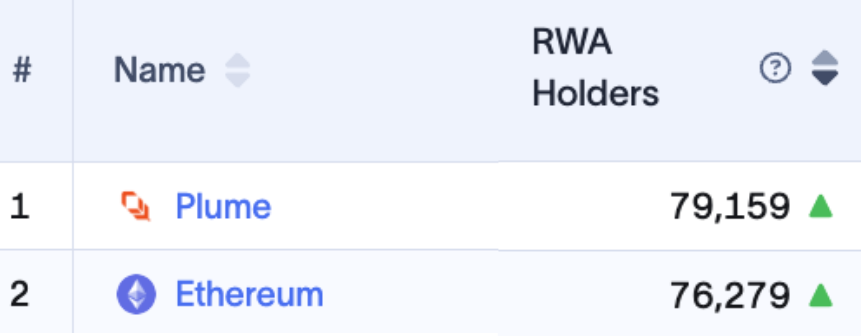
the day has come -- @plumenetwork has topped Ethereum in RWA holders in less than 2 weeks
RWAfi season is here.
2
1
22
678
8 Jun 2025
Very excited to ship Solera V1 this week
Working on borrower onboarding and minor UI improvements this weekend
With over 5m of borrow liquidity and morpho deposits scaling up there are a few early opportunities
Feel free too reach out if you're interested in exploring
5 Jun 2025
Solera is now live on Plume
A permissionless lending layer for tokenized yields
Lend, borrow, and loop structured RWA products fully on-chain
From credit to composability, here's what’s live on Solera 🧵

9
8
101
5,842
7 Jun 2025
Impressive? Yes
Just getting started? Yes
Goons in absolute and utter control
7 Jun 2025

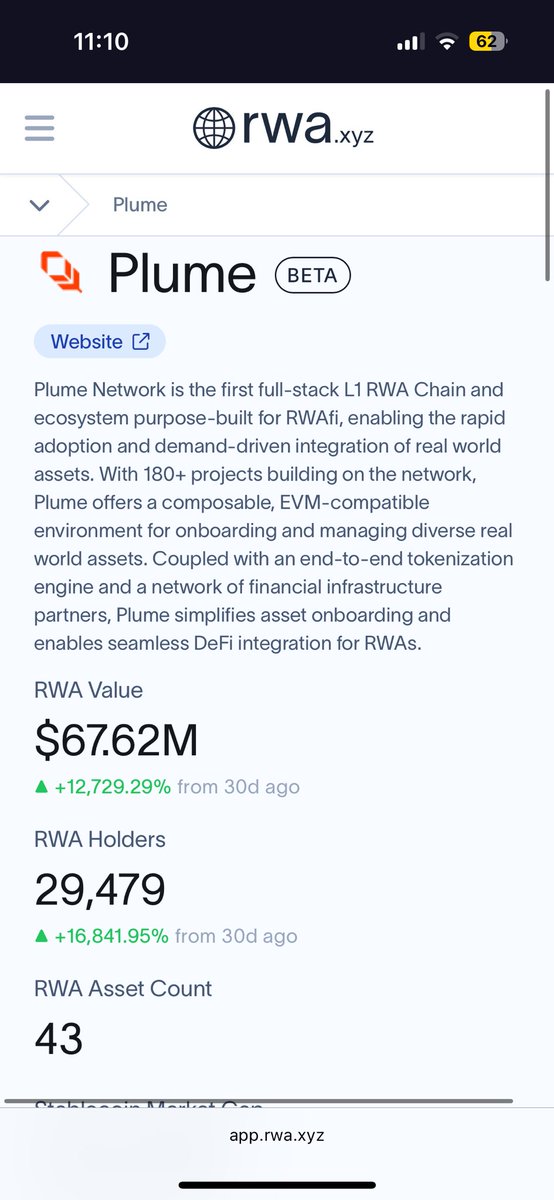
Doubled the number of RWA holders again in less than 24 hours
Goons are in control
9
5
93
3,518
5 Jun 2025
Less than a day until mainnet. Less than one week since the tragic news of Eugene's passing
Up late working on the finishing touches feeling honoured to be able to carry on his legacy tomorrow and in the years to come
This one's for him, may he Rest in Peace🕊️
67
17
259
10,044
3 Jun 2025
Yeah, I'm finna loop
3 Jun 2025
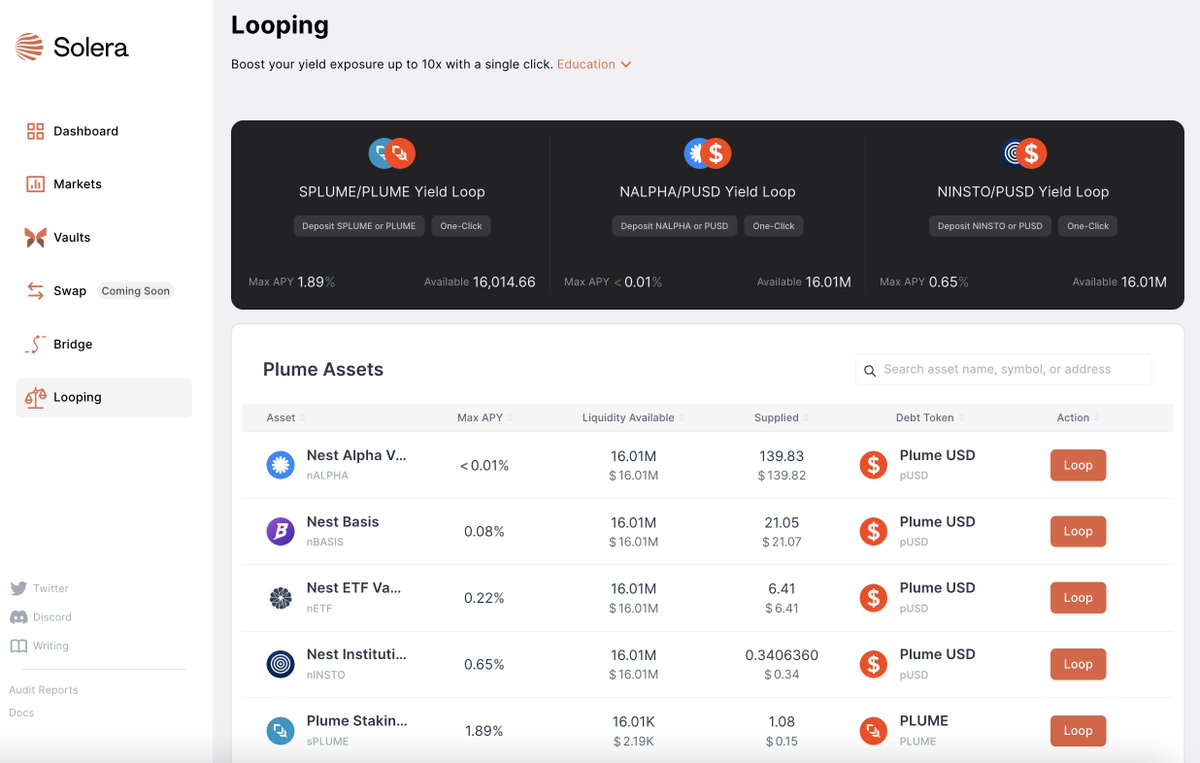
Solera’s Looping automates recursive lending for yield-maximizing strategies
Supply yield bearing collateral → borrow against it → repeat to target leverage ratio
✅ One click
✅ Infinite opportunities
DeFi-native leverage on Credit, Basis, and Crypto native assets
4
4
84
4,509
3 Jun 2025
>End to end compliance stack
>Tokenized asset standard
>On chain structured product vaults
>Native lending and exchange primitives
>Liquidation auction for on chain RWAs
Native application and tooling stack connecting Asia <> NYC <> London <> Dubai on chain
This week.
3 Jun 2025

This was a big part of the early success of BNB Chain. The Binance team just built a bunch of apps and made sure they were good. Same with Tron.
In Asia, nobody believes "if you build it they will come." You have to muscle it. It's only western founders who need to be dispelled of this fantasy.
That doesn't mean you literally need to build the apps yourself. But you better roll up your sleeves and do everything you humanly can to make your first cohort successful. Think Solana Serum—even if they're external, you pick the best team(s) and work like hell to make them win.
Being a platform not a strategy, it's a privilege. You earn it through success.
23
18
180
33,070
3 Jun 2025
Plume Genesis this week. Time to lock in.
3 Jun 2025
Thank you to everyone who has shown support for Eugene and our team. The outpouring from this community has meant everything to us during this difficult time.
As previously mentioned, while we had targeted last week to ship Plume Genesis, we put that on pause to mourn and cherish our friend. But we must move forward. It's what Eugene would've wanted, and this is how we honor him.
We've worked closely with our team, investors, and advisors to ensure that our roadmap continues full steam ahead. To that end, we're ecstatic to have @danlevine step up as our new Head of Engineering, to lead all of our engineering team and staff.
Dan joined Plume last year as one of our lead engineers and has been nothing short of exceptional. He brings with him a tremendous background spanning both Web2 and Web3, as a founder, operator, and executive.
Previously Dan founded StyleSeat, a leading ecommerce platform, and raised over $50M while scaling it to over $2B in bookings / year. He then dove headfirst into crypto as a derivatives trader, and then founded Swan to build Bitcoin-based financial services.
Dan's expertise in both founding and scaling world-class Web2 products while deeply understanding crypto is incredibly unique and a perfect fit for what we're doing at Plume -- bringing web2 and web3 together. We couldn't be more excited to have Dan take us to the next level.
Plume Genesis this week. Time to lock in.
19
19
263
8,307
3 Jun 2025
dapplications
2 Jun 2025

i dont understand why anyone in the year of our lord 2025 would still focus on building handwave-y bullshit infrastructure when it's clear that apps accrue the lions share of revenue and app tokens are starting to perform better than infrastructure tokens
applications
14
725
2 Jun 2025
Holy crap!
That’s @NestCredit & @SoleraMarkets
2 Jun 2025

Steve Ballmer quote from Acquired:
“Platforms need apps. You want to own the top first party app that runs on your platform, otherwise your platform can’t get good.
Office was the best first party app on Windows. Outlook was the best first party app on Exchange.
You want to make sure you own the first party app in addition to just your platform.
You will get stuck in the mud if you’re just a platform.”
Applied to crypto, L1s should not only build the chain.
They should build a few amazing apps as well.
Very different strategy than most take today (outsourcing 100% of app building).
4
3
41
2,196
29 May 2025
#5 is by far the largest, and by far the least explored
28 May 2025

There are 5 major sources of yield in defi:
1. Leverage (lending APYs, funding rates)
2. Staking (network rewards)
3. Swap fees (LPs)
4. Token incentives
5. RWAs (treasuries, credit, etc)
#5 is by far the largest, and by far the least explored
1
1
22
895
Chef Goon 🪶 retweeted

28 May 2025
3/
Premier lending markets on Plume are also powered by Morpho.
→ @SoleraLabs is building structured products and yield strategies for crypto with a liquidation framework for RWA collateral
→ @mystic_finance is creating curated structured vaults for isolated risk exposure and RWAfi lending
1
3
40
3,547
27 May 2025
Soon
27 May 2025
The Royco Era Begins🪶
Users will soon be able to deposit into Solera Markets via Royco for yield and additional incentives
Deposit into the optimizer or looping vaults to gain additional exposure to RWAfi yields on @plumenetwork
1
1
24
689