
Joined August 2023
- Tweets 37,648
- Following 3,913
- Followers 4,298
- Likes 203,680
2,236 Photos and videos


Pinned Tweet

OF GOLDERS GREEN AND STOLEN GRAIN
(Originally posted April 29, 2026)
Two stories have energized debate in the Jewish world this week, stories which have helped expose the very different conditions that diasporic and Israeli Jewry live, both physically and epistemically.
The first we could call the "Stolen Grain Fiasco:" for the second time in less than a month, a Russian ship filled with stolen Ukrainian grain is attempting to disembark its cargo at the Port of Haifa.
This has caused a diplomatic crisis between Ukraine and Israel, one in which Ukraine has accused Israel of ignoring its overtures while trading in its stolen property with its enemy, and in which Israel has, in turn, has accused Ukraine of going through impromper channels and engaging in "Twitter diplomacy."
Beyond what my personal position is on the matter, which is nuanced but decidedly falls on the Ukrainian side, what has fascinated me most has been the divergence of reaction between diasporic and Israeli Jewry.
While the Israeli government has maintained its stubborn truculance, its population's reaction has been one ranging from puzzlement to outright disgust with respect to the state's behavior. I have witnessed figures spanning from the left to the far right criticize the choice of the government to alienate Ukraine and the world on the issue.
To give a noteworthy example, Tsvi Sukkot - a radical settler activist who sits inside the governing coalition for the Religious Zionist party - has said:
"The wheat incident with Ukraine is a moral disgrace... [Israelis have] for years demanded that the entire world act with justice even against other interests, we simply cannot choose the side of the bad guys."
To be sure, staunch Bibists and general hyperdefensive-types in Israel have pushed the government's line, but members of the governing coalition calling the issue a "moral disgrace" is demonstrative of the widespread internal dissent against the official Israeli position.
On the other hand, much - but not all, or even a majority - of diaspora Jewry has responded to the crisis with contempt for the Ukrainian position.
I have seen liberal erstwhile-supporters of Ukraine accuse Zelensky of "backstabbing" Israel (to the accusers' credit, Ukraine has softly-handled far greater offenders on the issue of surreptitious dealings with Russia, such as Turkey or the Arab states).
These "backstab" stories have often been accompanied by more extreme claims, such as absurd denials of Zelensky's Jewish parentage, theories about malign Ukrainian-Turkish-Qatari subterfuge, and relitigation of Jews' (admittedly abysmal) experiences in Ukraine - as though the ghosts of Khmelnytsky or Bandera figure into this conversation in some way.
While cooler heads largely prevail within the diaspora, and many Israelis have responded with vitriol and disdain, the difference in reaction between the anglophonic and Hebraic discursive spaces has been apparent to me, and noted by many others. The question of why is one I will answer through what occured in London yesterday.
During midday on April 29, in the predominatly Jewish area of Golders Green, London, a 45-year-old man identified as Essa Suleiman engaged in a targeted stabbing attack against two identifiably Jewish men.
Reactions were as to be expected: politicians quickly denounced the attacks in typical, hollow fashion - "this has no place here," and the like; antizionists have responded with trademark cynical soft-justifications of Israel as the "ultimate cause of antisemitic violence," with added criticisms of the police use-of-force in apprehending the subject (apparently, kicking someone who is holding onto a knife while wrestling with police is inhumane); and Jews across the diaspora responding with a mix of despondence at the continued onslaught and dismissive disdain at Western states' willingness to address the issue.
(Continued in comments)
Apr 30

🚨 BREAKING:
Israeli importer drops shipment of allegedly stolen Ukrainian grain, says PANORMITIS ship will have to find another destination to unload
@DanielSchmil
themarker.com/news/macroecon…
3
9
29
7,309
Western Hegemony Enjoyer retweeted

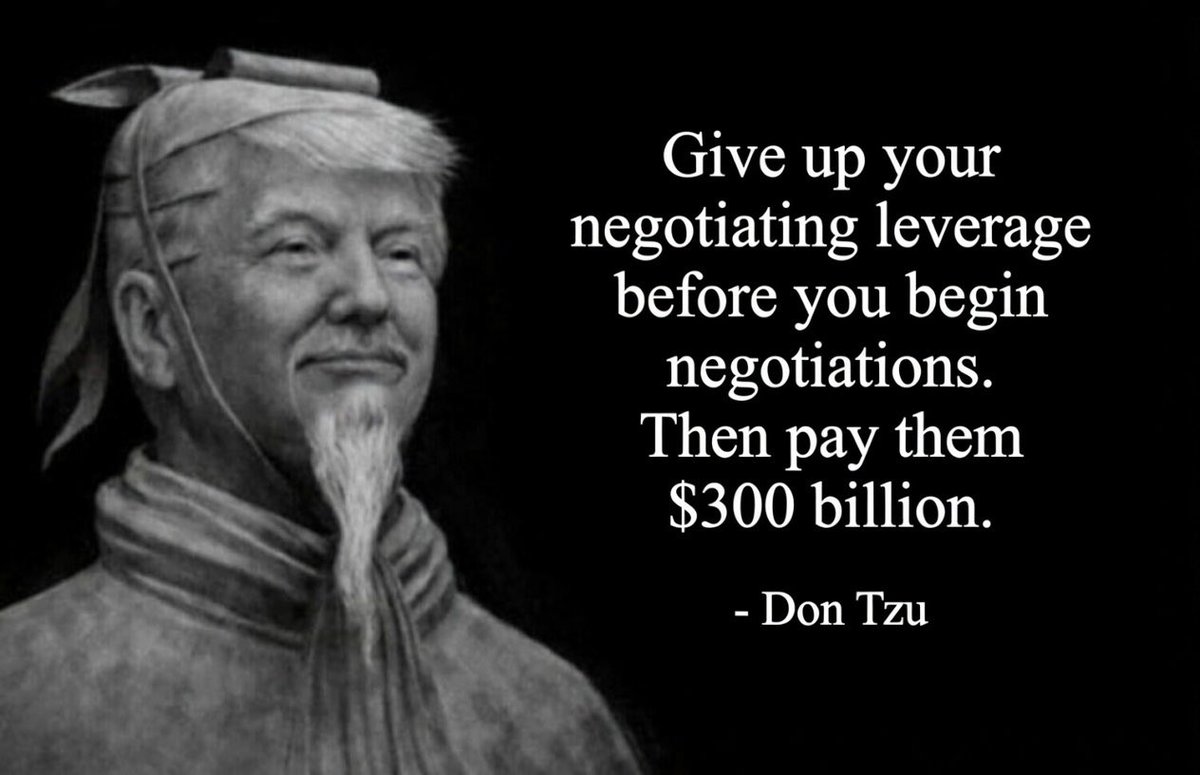

BREAKING: US officials have now confirmed in a briefing that Iran will get full access to a total of $100 billion in frozen funds and the $300 billion reconstruction fund, both included in the deal with implementation now underway, per WSJ.
More than $150 billion of the fund has already been committed, directly contradicting Trump's claims that the US would not contribute to the $300 billion fund, per Reuters.
14
542
5,321
137,178
Western Hegemony Enjoyer retweeted

It’s not just that the U.S. is retreating from the Middle East just as the IRGC is entrenching itself; it’s that Trump is *facilitating* the IRGC’s entrenchment, this wretched MOU is an instrument of that entrenchment, while he turns tail and flees.
2
6
17
586
Decapitation strikes sans strategy have little impact; had Trump allowed Israel to continue to attrite regime instruments of control and empower actors on the ground, rather than kiboshing such efforts early in the campaign as he did, such strikes would be a key part of putting the regime at risk of internal collapse.
If Trump had actually wanted such an outcome, however, he wouldn't have nixed those efforts in the first place, hence why the idea he is teeing up the IAF to kill Mojtaba or Vahidi is idiotic in the extreme.
Trump never cared about regime change: he always wanted a fresh set of players holding the same levers of power in place with whom he could play ball, like in Venezuela. This was always about his (delusional) art of the deal.
Now the only thing being played is Trump, and we're all worse off for it.

Why are they so convinced that decapacitation strikes actually do anything?
George W. Bush had *so* much better of an understanding of foreign policy than modern Republican hawks, honestly. Regime change generally needs some sort of ground force!
15
Western Hegemony Enjoyer retweeted

Everything we've seen since last week in a nutshell.

Legitimately insane cope.
No, Trump isn't thinking about the speed of wars of Israel's past (which also happens to be your personal bugbear, coincidentally enough), nor is he motivated by his support for Israel. He is an amoral transactionalist who thinks only in terms of his political fortunes and family's enrichment, as he has since before he descended the golden escalator. None of this is new.
Witkoff, Kushner & Barrack get their bread buttered in Doha and Ankara, Vance is a multipolarist pseudo-groyper who believes selling Israel down the river is his ticket to the big prize, and Rubio has been sidelined because he can only communicate in the language of national interest and traditional alliances. It's really that simple.
1
2
90
Western Hegemony Enjoyer retweeted

Spot on. ⬇️
Legitimately insane cope.
No, Trump isn't thinking about the speed of wars of Israel's past (which also happens to be your personal bugbear, coincidentally enough), nor is he motivated by his support for Israel. He is an amoral transactionalist who thinks only in terms of his political fortunes and family's enrichment, as he has since before he descended the golden escalator. None of this is new.
Witkoff, Kushner & Barrack get their bread buttered in Doha and Ankara, Vance is a multipolarist pseudo-groyper who believes selling Israel down the river is his ticket to the big prize, and Rubio has been sidelined because he can only communicate in the language of national interest and traditional alliances. It's really that simple.
1
1
37
Western Hegemony Enjoyer retweeted

Looks right. I might urge that President Trump has a pro-America philosophy to a degree also, though, although it could be stronger.
Legitimately insane cope.
No, Trump isn't thinking about the speed of wars of Israel's past (which also happens to be your personal bugbear, coincidentally enough), nor is he motivated by his support for Israel. He is an amoral transactionalist who thinks only in terms of his political fortunes and family's enrichment, as he has since before he descended the golden escalator. None of this is new.
Witkoff, Kushner & Barrack get their bread buttered in Doha and Ankara, Vance is a multipolarist pseudo-groyper who believes selling Israel down the river is his ticket to the big prize, and Rubio has been sidelined because he can only communicate in the language of national interest and traditional alliances. It's really that simple.
12
7
76
8,169
Western Hegemony Enjoyer retweeted

Amoral transactionalist is gold.
I would add that an additional motivation for Trump here is crazed narcissism. But your post I think shows the difference between smart people and people like Seth who have a very childish concept of our world and the lunatics who inhabit it.
3
2
12
508
Western Hegemony Enjoyer retweeted

So it turns out real estate is not the best base for effective foreign policymaking.
13
30
259
3,814
Western Hegemony Enjoyer retweeted

A lot of people told me early on that I was too partial to the Israeli viewpoint and didn’t understand the Palestinian viewpoint very well.
3
1
42
4,704
Western Hegemony Enjoyer retweeted

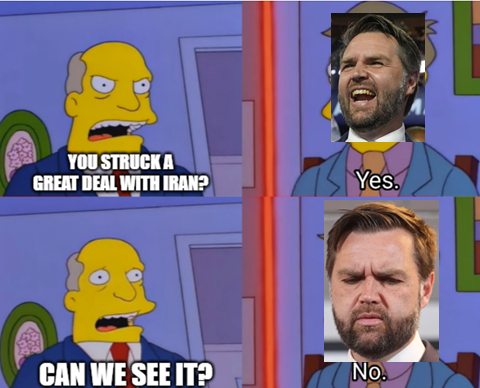

🔴 Israel formally requested access to the US-Iran MoU and was denied, i24NEWS has learned
1
7
65
1,240
Western Hegemony Enjoyer retweeted

Israel's brief detention of Sumud flotilla influencers led to international headlines and state condemnations.
3 weeks ago, ten members of the Sumud Land Convoy were captured & imprisoned in Libya while on their way to Gaza. They're still there.
No headlines. Little outrage.
50
458
2,003
25,872
Western Hegemony Enjoyer retweeted

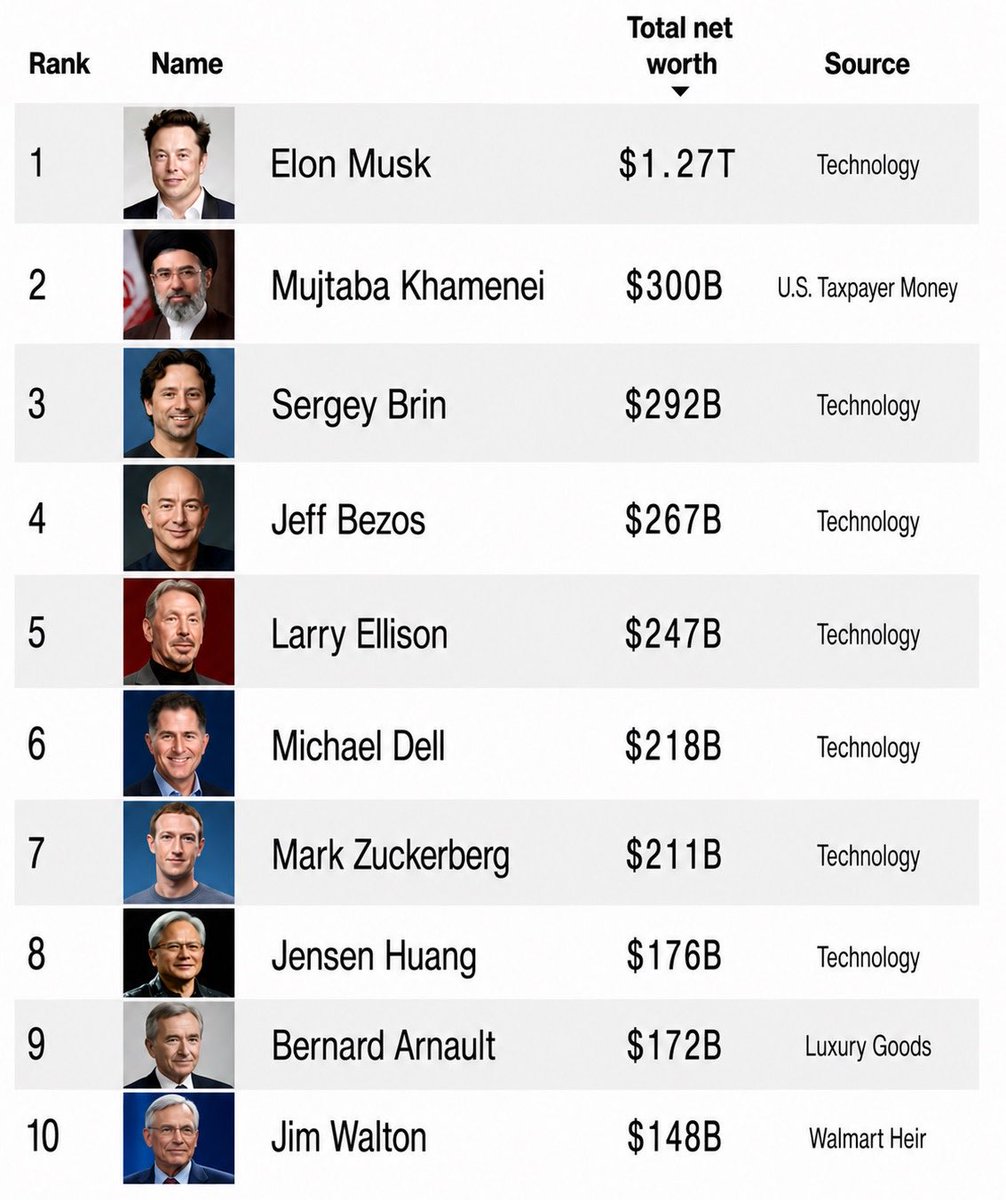
The wealthiest people in the world (updated)
888
3,647
36,716
2,298,864
Western Hegemony Enjoyer retweeted
I think it is very weird that liberals think we can't just take the Palestinians at their word that they believe they're actually going to win.
Do you think German Jews talked about conquering Germany? Do Chinese Uyghurs talk about a jihad making Beijing and Shanghai Uyghur?
18
15
250
10,611
Western Hegemony Enjoyer retweeted
And this is not just a peripheral aim on the edge of what they might one day hope to accomplish. It's the central impetus for their cause and the basis for their resistance to compromises.
The slogan is literally From the River to the Sea.
4
3
51
1,223
"Together with [our] allies in the current war" - he means Qatar, Turkey & Syria; Israel's position in the Pax Americana org chart is now somewhere between Taiwan and Ukraine.
Jun 16

Copy of the document to be signed by the United States and Iran
1. The Islamic Republic of Iran and the United States, together with their allies in the current war, declare upon the signing of this Memorandum of Understanding an immediate and permanent end to the war on all fronts, including Lebanon, and undertake that from now on they will not launch any hostile action against each other, and will refrain from the threat or use of force against each other. The final agreement will confirm the provisions of this Article and the remaining Articles.
2. The Islamic Republic of Iran and the United States undertake to respect each other's sovereignty and territorial integrity, and to refrain from interfering in each other's internal affairs.
3. The Islamic Republic of Iran and the United States undertake to negotiate and reach a final agreement within a maximum period of 60 days, extendable by mutual consent.
4. Immediately upon the signing of this Memorandum of Understanding, the United States Lift the naval blockade and prevent any interference or obstruction against the Islamic Republic of Iran, and restore traffic within a maximum of 30 days to its full capacity; the traffic of ships shall be proportional to the pre-war volume of traffic on the part of the Islamic Republic of Iran. The United States also undertakes to withdraw its forces from the surrounding areas within 30 days after the final agreement.
5. Upon signing this Memorandum of Understanding, the Islamic Republic of Iran will immediately take steps to ensure that the movement of merchant ships from the Persian Gulf to the Sea of Oman and vice versa is resumed within 30 days to the pre-war volume, taking into account the need for the removal of technical obstacles and the neutralization of mines by Iran.
6. The United States undertakes, together with its regional partners, to create a comprehensive plan agreed upon by both parties for the rehabilitation and economic development of the Islamic Republic of Iran, While ensuring financing of at least $300 billion. The implementation mechanism of this plan, as part of the final agreement, will be formulated within 60 days.
7. The United States commits to ending, on a schedule to be agreed upon as part of the final agreement, all types of sanctions currently facing the Islamic Republic of Iran, including resolutions of the United Nations Security Council and the Board of Governors of the International Atomic Energy Agency (IAEA), and all unilateral U.S. sanctions, both primary and secondary.
8. The Islamic Republic of Iran reiterates that it will never produce nuclear weapons. The Islamic Republic of Iran and the United States have agreed that the fate of enriched material and the fate of all other mutually agreed nuclear-related issues, including Iran’s nuclear needs, will be adequately addressed in a final agreement; the final agreement will confirm the provisions of this Article.
9. The Islamic Republic of Iran and the United States agree that, pending a final agreement, they will maintain the status quo: Iran will maintain the status quo on its nuclear program, and the United States will not impose new sanctions on Iran or strengthen its forces in the region.
10. The United States undertakes that immediately after the signing of this Memorandum of Understanding, and until the date of the lifting of sanctions, the United States Treasury Department will issue waivers for exports of Iranian crude oil, petrochemical products and their derivatives, and all related services, including banking, insurance, transportation, and the like.
11. The United States undertakes that, in light of the progress of negotiations towards a final agreement, frozen or restricted funds and assets of the Islamic Republic of Iran will be released and made fully available. These funds, whether held in the master account or transferred, will be used for any final beneficiary payment determined by the Central Bank of the Islamic Republic of Iran
1
1
8
305
Western Hegemony Enjoyer retweeted

16h
In retrospect, probably suboptimal that Trump administration's chief negotiators were in the pay of foreign governments
57
644
3,263
88,815
Western Hegemony Enjoyer retweeted

Worth monitoring.

President Trump says Sen. Lindsey Graham (R-SC) will be "in big trouble" if he is skeptical of his deal with Iran.
15
20
232
6,238
Western Hegemony Enjoyer retweeted

🔴 Israel formally requested access to the US-Iran MoU and was denied, i24NEWS has learned
🔴Israel requested to see the US-Iran MoU document and was rejected - report
12
39
123
11,981
Western Hegemony Enjoyer retweeted

Jun 16
Vance doing boosterism for the "deal" that Hezbollah is celebrating, while also hanging out with Grandma Groyper on her podcast, is a little on the nose about the game being played here.
8
76
433
11,321
Legitimately insane cope.
No, Trump isn't thinking about the speed of wars of Israel's past (which also happens to be your personal bugbear, coincidentally enough), nor is he motivated by his support for Israel. He is an amoral transactionalist who thinks only in terms of his political fortunes and family's enrichment, as he has since before he descended the golden escalator. None of this is new.
Witkoff, Kushner & Barrack get their bread buttered in Doha and Ankara, Vance is a multipolarist pseudo-groyper who believes selling Israel down the river is his ticket to the big prize, and Rubio has been sidelined because he can only communicate in the language of national interest and traditional alliances. It's really that simple.

A major issue for President Trump has always been to ask why these wars take so long. He likely recalls the 1967 war, which occurred when he was 21 and may be a formative memory; and asks this question because he wonders why these wars today seem to drag on without a clear strategy. He also has an interest in asking tough questions about damage to civilian infrastructure. And if he doesn’t get answers he will keep asking questions or pressure for the conflicts to end. It’s the same cycle he had with tiring of the Gaza war and getting a deal.
He also doesn’t believe these long wars are in Israel’s interest, he supports Israel but knows that true support also means asking tough questions and pulling back from conflict, unquestioning support for any friend or ally isn’t really support. A good friend or partner makes sure to ask the tough questions when necessary and intervene when necessary to achieve good outcomes
The question of why the wars on all fronts drags on and enemies remain, is being asked also in Israel in the lead-up to elections. Claims, just weeks ago, that Hezbollah will be “crushed” increasingly appear to ring hollow
7
22
165
23,160