
Software development YouTube channel specializing in Rust and LLMs.
Joined October 2022
- Tweets 639
- Following 213
- Followers 1,064
- Likes 933
50 Photos and videos












May 29
If you’re a developer worried about AI, you’re going to love this post. Great perspective from a legendary developer
May 28

I've got an agent in a loop optimizing a renderer with the goal to minimize frame times (and tests to measure). It got times down from 88ms to 2ms and allocations down from ~150K to 500. Sounds good, right? Wrong. This is exactly why agent psychosis is a big fucking problem.
As an experiment, I rewrote the Ghostty core render state in Go, with access to identically laid out data structures as Ghostty and the exact same validation tests. I made a purposely naive renderer (simple, correct, but slow). 88ms per frame with 150,000 allocations (horrendous, lol)!
I then kickstarted a Ralph loop to bring the frame times down. I told it it can't modify input data structures or the public API or tests (they're correct), but it can do anything else it wants. It got to work.
It has worked for about 4 hours. I've spent around $350 on this experiment so far. The results?
88ms => 1.5ms
150K allocs => ~500 allocs
Incredible right? Nope.
My hand-written renderer I ported has frame times (same benchmark) of ~20us (0.020ms) and 0 allocations in the update path.
This is the problem with psychosis and lacking systems understanding. If you don't understand the system, you're going to accept that this is an incredible result. If you understand the system, you'll see better solutions immediately and can do roughly 75x better on throughput.
The people who blindly trust agent output are in the former camp. They're sheeple, overdrinking from a fountain of mediocrity.
Standard disclaimer: I use AI all the time. I like AI. The point I'm making is to not blindly accept results. Think. Analyze. Learn.
1
3
181
May 22
It's official. Rewrite your project in Rust, lose 5lbs. Presumably due to lower cortisol levels.
May 21

Mar 6: 167 lbs ( -12% )
Apr 14: 156 lbs ( -18% )
May 21: 151 lbs ( -21% )
v close to goal weight
11
316
Code To The Moon retweeted

Mar 10
Insightful video here by Code to the Moon. 🦀
Check it out! 👌youtube.com/watch?v=9L9oOmqD…
#RustLang #RustRig #RustCrate
1
2
8
642
Code To The Moon retweeted

Mar 8
rig is... rust crate of the year???
watch @CodeToTheMoons talk about the number 1 AI framework in rust: youtube.com/watch?v=9L9oOmqD…
8
4
32
2,028
Jan 28
Fantastic depiction of the current state of LLM assisted coding
Jan 26

A few random notes from claude coding quite a bit last few weeks.
Coding workflow. Given the latest lift in LLM coding capability, like many others I rapidly went from about 80% manual autocomplete coding and 20% agents in November to 80% agent coding and 20% edits touchups in December. i.e. I really am mostly programming in English now, a bit sheepishly telling the LLM what code to write... in words. It hurts the ego a bit but the power to operate over software in large "code actions" is just too net useful, especially once you adapt to it, configure it, learn to use it, and wrap your head around what it can and cannot do. This is easily the biggest change to my basic coding workflow in ~2 decades of programming and it happened over the course of a few weeks. I'd expect something similar to be happening to well into double digit percent of engineers out there, while the awareness of it in the general population feels well into low single digit percent.
IDEs/agent swarms/fallability. Both the "no need for IDE anymore" hype and the "agent swarm" hype is imo too much for right now. The models definitely still make mistakes and if you have any code you actually care about I would watch them like a hawk, in a nice large IDE on the side. The mistakes have changed a lot - they are not simple syntax errors anymore, they are subtle conceptual errors that a slightly sloppy, hasty junior dev might do. The most common category is that the models make wrong assumptions on your behalf and just run along with them without checking. They also don't manage their confusion, they don't seek clarifications, they don't surface inconsistencies, they don't present tradeoffs, they don't push back when they should, and they are still a little too sycophantic. Things get better in plan mode, but there is some need for a lightweight inline plan mode. They also really like to overcomplicate code and APIs, they bloat abstractions, they don't clean up dead code after themselves, etc. They will implement an inefficient, bloated, brittle construction over 1000 lines of code and it's up to you to be like "umm couldn't you just do this instead?" and they will be like "of course!" and immediately cut it down to 100 lines. They still sometimes change/remove comments and code they don't like or don't sufficiently understand as side effects, even if it is orthogonal to the task at hand. All of this happens despite a few simple attempts to fix it via instructions in CLAUDE . md. Despite all these issues, it is still a net huge improvement and it's very difficult to imagine going back to manual coding. TLDR everyone has their developing flow, my current is a small few CC sessions on the left in ghostty windows/tabs and an IDE on the right for viewing the code manual edits.
Tenacity. It's so interesting to watch an agent relentlessly work at something. They never get tired, they never get demoralized, they just keep going and trying things where a person would have given up long ago to fight another day. It's a "feel the AGI" moment to watch it struggle with something for a long time just to come out victorious 30 minutes later. You realize that stamina is a core bottleneck to work and that with LLMs in hand it has been dramatically increased.
Speedups. It's not clear how to measure the "speedup" of LLM assistance. Certainly I feel net way faster at what I was going to do, but the main effect is that I do a lot more than I was going to do because 1) I can code up all kinds of things that just wouldn't have been worth coding before and 2) I can approach code that I couldn't work on before because of knowledge/skill issue. So certainly it's speedup, but it's possibly a lot more an expansion.
Leverage. LLMs are exceptionally good at looping until they meet specific goals and this is where most of the "feel the AGI" magic is to be found. Don't tell it what to do, give it success criteria and watch it go. Get it to write tests first and then pass them. Put it in the loop with a browser MCP. Write the naive algorithm that is very likely correct first, then ask it to optimize it while preserving correctness. Change your approach from imperative to declarative to get the agents looping longer and gain leverage.
Fun. I didn't anticipate that with agents programming feels *more* fun because a lot of the fill in the blanks drudgery is removed and what remains is the creative part. I also feel less blocked/stuck (which is not fun) and I experience a lot more courage because there's almost always a way to work hand in hand with it to make some positive progress. I have seen the opposite sentiment from other people too; LLM coding will split up engineers based on those who primarily liked coding and those who primarily liked building.
Atrophy. I've already noticed that I am slowly starting to atrophy my ability to write code manually. Generation (writing code) and discrimination (reading code) are different capabilities in the brain. Largely due to all the little mostly syntactic details involved in programming, you can review code just fine even if you struggle to write it.
Slopacolypse. I am bracing for 2026 as the year of the slopacolypse across all of github, substack, arxiv, X/instagram, and generally all digital media. We're also going to see a lot more AI hype productivity theater (is that even possible?), on the side of actual, real improvements.
Questions. A few of the questions on my mind:
- What happens to the "10X engineer" - the ratio of productivity between the mean and the max engineer? It's quite possible that this grows *a lot*.
- Armed with LLMs, do generalists increasingly outperform specialists? LLMs are a lot better at fill in the blanks (the micro) than grand strategy (the macro).
- What does LLM coding feel like in the future? Is it like playing StarCraft? Playing Factorio? Playing music?
- How much of society is bottlenecked by digital knowledge work?
TLDR Where does this leave us? LLM agent capabilities (Claude & Codex especially) have crossed some kind of threshold of coherence around December 2025 and caused a phase shift in software engineering and closely related. The intelligence part suddenly feels quite a bit ahead of all the rest of it - integrations (tools, knowledge), the necessity for new organizational workflows, processes, diffusion more generally. 2026 is going to be a high energy year as the industry metabolizes the new capability.
1
210
Jan 21
Great line to have in the back pocket for your next interview

2
442
Code To The Moon retweeted

Jan 21
New podcast dropped! 📢🎉🐁
With @CodeToTheMoons we talked about Ratatui, Rust, terminal code editors, AI-assisted coding & sustainable open source 🦀
▶️ Check it out here: youtube.com/watch?v=LGrx9ueO…
#rustlang #ratatui #tui #terminal #podcast #devtools
3
20
2,078
19 Nov 2025
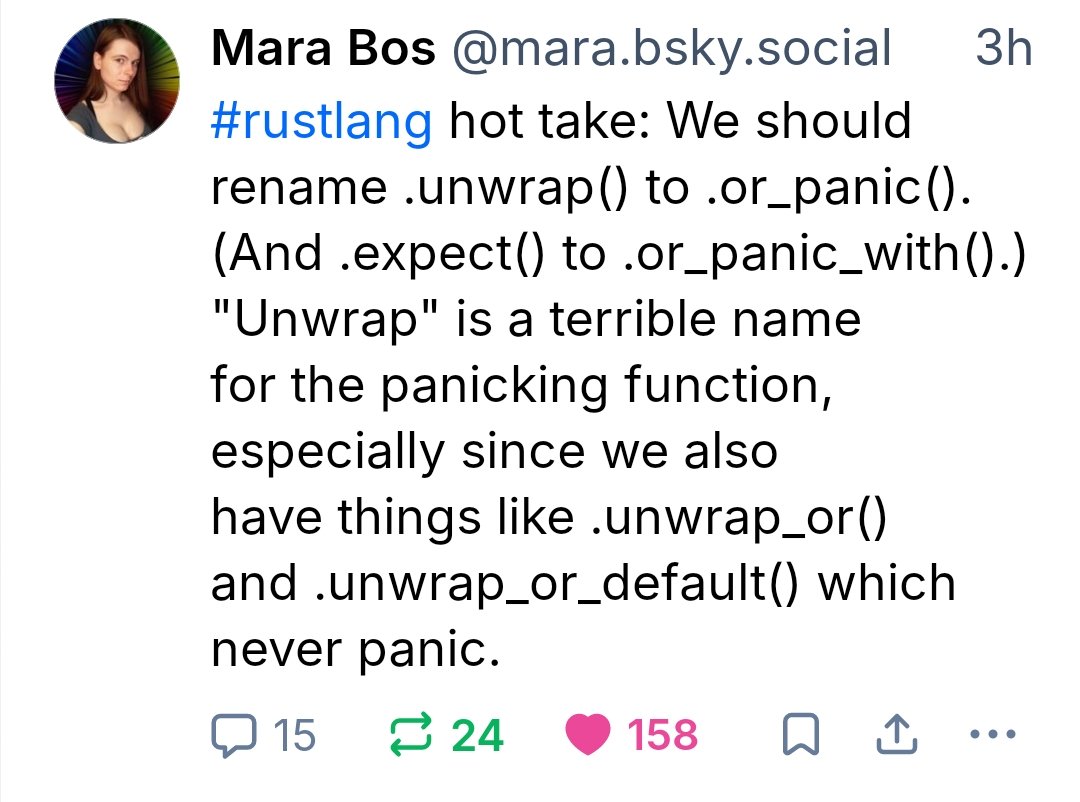
I think this idea makes a lot of sense, even if it is not necessarily feasible at this point. I've also always thought that unwrap/expect should be a compile time error by default, at least in release builds.
19 Nov 2025

It would have been better if named .or_panic()
People will think twice before using it
1
8
933
Code To The Moon retweeted
11 Nov 2025
Great video here by Code to the Moon. Check it out! youtu.be/UAK6dQbnknE?si=gcgt…
#RustLang #DevCommunity #RustProgramming
3
30
2,330
12 Nov 2025
When the feature isn't quite finished but you try to squeeze it into the sprint demo anyway
11 Nov 2025

Russia presented its human-like AI robot. It fell down as it walked onto the stage.
1
232
21 Oct 2025
When us-east-1 goes down but your app uses us-west-2
7
408
20 Oct 2025
Odds AWS outage can be traced back to unreviewed AI generated code? Sad part is even if this is the case, it probably won’t be framed this way
1
9
575
17 Sep 2025
Written 100% in Rust 🦀

Kelai completely reimagines knowledge management. Keep your notes organized without ever having to manage folders or tags. kelai.io
7
408
11 Aug 2025
At some point, a religious group will form based on the premise of divine revelation from a specific large language model.
Calling it now.
3
312
11 Apr 2025
My take on the current language model API market after a few days of research, and what I ultimately chose for my application. Did I miss anything notable? All of these have OpenAI compatible APIs, though don't necessarily support all of the same features 👇
@cerebras - makes custom chips that appear to outperform all others by a large margin. Faster than all other options by at least 1-2 orders of magnitude. Generally double or triple the cost of other providers, but if you need the speed it's probably a great value. Full support for enforcing strict JSON schema on output. Currently has a wait list for direct access but you can work around this by using it through HF Inference providers (see below)
@GroqInc - also makes custom chips for inference, extremely fast. An order of magnitude faster than pretty much everyone except Cerebras. Really great price for Llama 4 Scout, other prices are average. Currently no "true" support for enforcing strict JSON schema on output currently. Default rate limits might be too low for some use cases, you can request higher ones but I have yet to have my request fulfilled.
@awscloud Bedrock - proprietary API format (Converse, InvokeModel) but offers an OpenAI-compatible shim called bedrock-access-gateway. Awful prices for everything except Amazon Nova models. Strict output schema only via "tool use", which works but feels hacky. In my experience the API is flaky, sporadically returning errors. Amazon Nova Micro is particularly inexpensive and surprisingly good for some tasks.
@huggingface Inference Providers - new "inference marketplace" that is a superset of the previous "HuggingFace Inference API" product. Gives you the ability to source inference from any of the supported providers. Inference sourced from a provider costs the same $ as the provider would charge you directly. Right now there are 10 providers supported, including Cerebras. Requires you to have a $9/month pro membership to go beyond the modest "free" tier limits (in addition to paying the per token cost). Currently doesn't appear to be able to tell you the cost of each provider/model in advance, I've been using OpenRouter to determine pricing.
@AnthropicAI - great models, but seems horrendously overpriced. Sonnet 3.7 is literally 107x the cost of Amazon Nova Micro per output token
@novita_labs - great prices, no "true" output schema support right now. Offers a more "precise" Llama 3.3 than most other providers (bf16) at a price that is among the most inexpensive for Llama 3.3
@FireworksAI_HQ - average prices, full support for output schema enforcement
@togethercompute (TogetherAI) - average prices, full support for output schema enforcement
@openrouter - also an "inference marketplace" - one API for many providers. Far more providers supported than HuggingFace Inference Providers. Has Groq but does not appear to have Cerebras
@OpenAI - the OG. IMO the only reasonably priced model is GPT-4o-mini, the rest are severely overpriced
NLP Cloud - a bit of a deviant in that they offer a flat monthly rate for a fixed number of requests per minute. Might be a good fit for high token count use cases that have a predictable request volume. Limited model options, but they have some SOTA models.
Self hosting on AWS Spot instances - this is always going to be the most cost effective option assuming you can completely saturate the compute power 24/7. It can be challenging to find the right instance type for a specific model. Smaller models are easy to accommodate via GPUs with modest amounts of VRAM. But 70B models are challenging because to get the necessary A100, H100 or H200 GPUs you have to provision an instance that *has 8 of them*, which is very expensive. Inferentia is a bit of an oddball - you have to go through a proprietary model transformation process to use it.
For the time being, I decided on @huggingface Inference Providers for my application. I have it route through Fireworks for cases where I need output to conform to a strict JSON schema, and Novita for cases where I do not. I am using Llama 3.3 70B, Llama 4 Scout and LLama 4 Maverick. I might use Groq directly for some scenarios if it supported strict schemas and accepted my rate limit increase request.
1
354
11 Apr 2025
Definitely agree with the general sentiment here 😎
But is drawing on prompt history the best way to understand a user?
10 Apr 2025

we have greatly improved memory in chatgpt--it can now reference all your past conversations!
this is a surprisingly great feature imo, and it points at something we are excited about: ai systems that get to know you over your life, and become extremely useful and personalized.
1
327