The law has changed. The culture hasn’t. Exposing threats to academic freedom in UK universities — and pushing institutions to meet their free-speech duties.
Joined October 2023
- Tweets 1,787
- Following 613
- Followers 3,693
- Likes 887
303 Photos and videos
Pinned Tweet

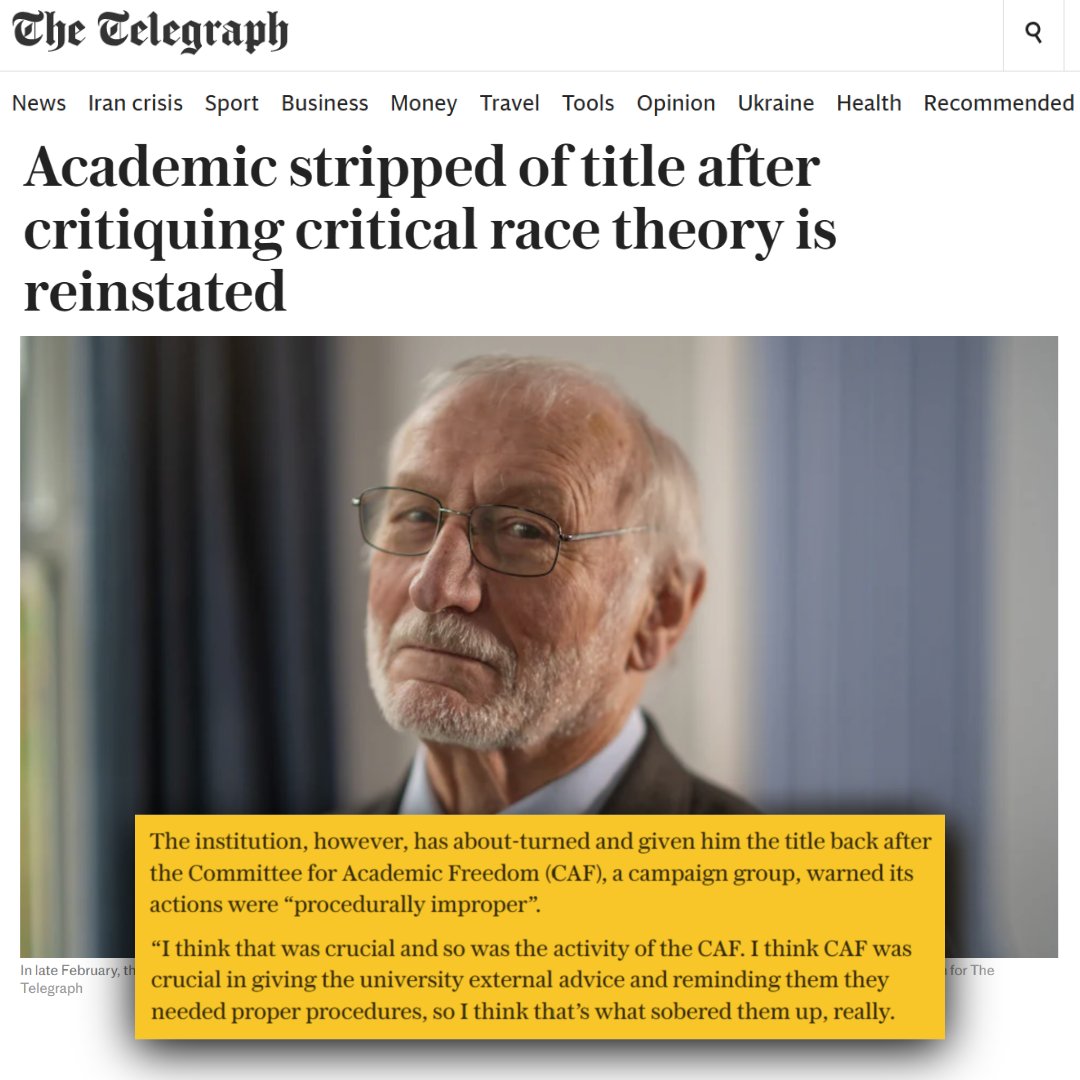
🚨 BREAKING: Another win for #academicfreedom!
After intervention from the Committee for Academic Freedom (CAF), Plymouth Marjon University has restored the emeritus title of Dr David Harris, which was withdrawn last year after he published a critique of critical race theory.
Internal emails secured via a Subject Access Request (SAR) show senior administrators describing Professor Harris’s research as “controversial” and suggesting the university should “sever ties”.
CAF challenged the decision as procedurally improper and inconsistent with the terms under which his emeritus title had originally been awarded. The university has now reversed course and reinstated the title.
As our Research Manager Freddie Attenborough told The Telegraph:
“The episode raises serious questions about how easily lawful academic research can end up being labelled ‘controversial’ inside university administration, with damaging consequences for the individuals involved.”
Professor Harris isn’t the first emeritus scholar we’ve had to defend — and we doubt he’ll be the last.
🙏 Much of CAF’s work, from supporting members in difficult cases to holding universities to account for breaches of #freespeech law, is only possible because of donations from supporters. If you’d like to help us continue and expand this work in defence of academic freedom, you can donate here:
donorbox.org/support-the-com…
📩 Subscribe to our newsletter to see how CAF is pushing back against free speech breaches across UK universities:
afcomm.org.uk/updates-from-t…
📰 Read the full story in The Telegraph here:
telegraph.co.uk/news/2026/03…
20
353
1,592
37,428
Great to see CAF research published in the Telegraph today:
'Research last year by the Committee for Academic Freedom found that at least 20 universities across the country now understand the “E” in the acronym DEI (Diversity, Equality, Inclusion) to refer not to “equality” but “equity”.'
The difference is not just semantic. "Equity" in DEI-speak refers to equality of outcome, not equality of opportunity. An unjust and divisive agenda is being smuggled in by the back door.
telegraph.co.uk/news/2026/06…
2
129
Committee for Academic Freedom retweeted
The full letter in support of Dr Michael Foran can be read below. Academics and students who wish to add their names to the growing list of signatories are invited to do so via the online form, which requires an ORCID identifier for verification purposes.
johnarmstrongmaths.com/openl…

More than 100 academics, including CAF Director Dr Edward Skidelsky, Prof Richard Dawkins and Sir Bernard Silverman, have signed a letter urging the University of Oxford to reinstate Dr Michael Foran’s lecture series after it was cancelled following repeated disruption by trans activists.
thetimes.com/uk/education/ar…
10
34
829
Committee for Academic Freedom retweeted

Jun 11
Here is the letter in support of @michaelpforan, as it appears in today's Print edition of the Times. We believe that the Proctors got this one wrong, and we urge Oxford to make sure they get it right.
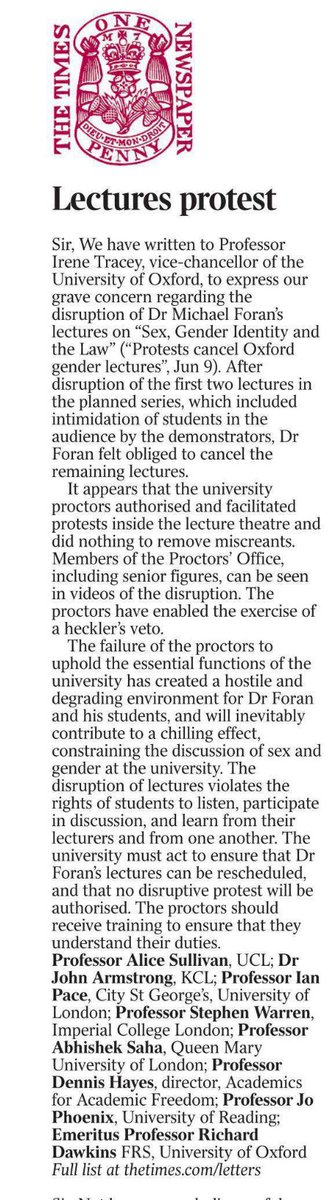

More than 100 academics have urged the University of Oxford to reinstate a lecture series that was cancelled after protests from trans activists.
In the letter, published in The Times on Thursday, they wrote: “It appears that the university proctors authorised and facilitated protests inside the lecture theatre and did nothing to remove miscreants."
thetimes.com/uk/education/ar…
60
258
6,701
Committee for Academic Freedom retweeted
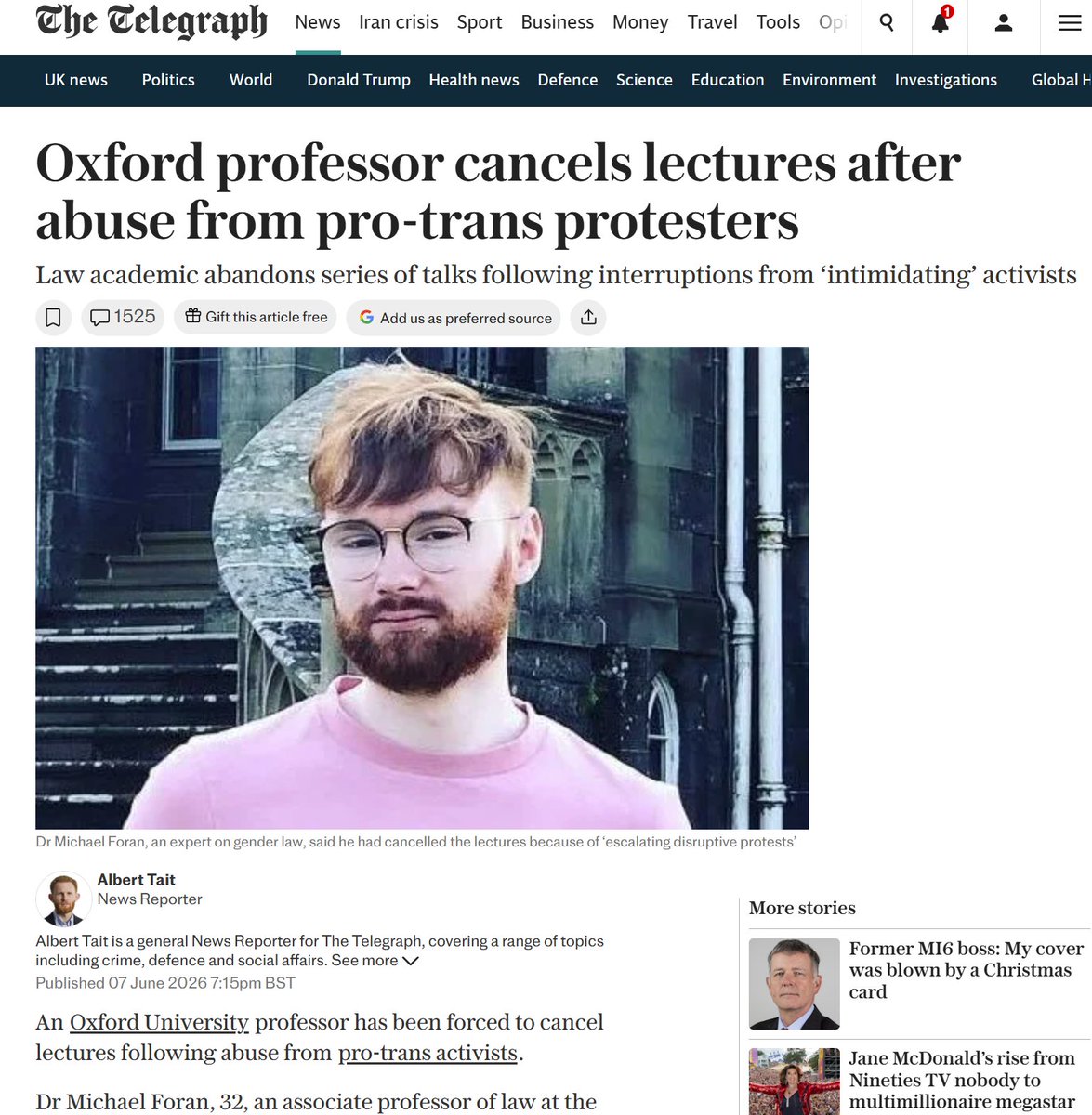
Oxford University is facing serious questions over its handling of repeated disruption of public talks by Dr Michael Foran, an associate professor of law and tutorial fellow at Keble College, after trans activists interrupted two events linked to his recent work on sex, gender identity and the legal tensions that have emerged between them.
thecritic.co.uk/the-screamin…
2
15
85
1,882
Committee for Academic Freedom retweeted
More than 100 academics, including CAF Director Dr Edward Skidelsky, Prof Richard Dawkins and Sir Bernard Silverman, have signed a letter urging the University of Oxford to reinstate Dr Michael Foran’s lecture series after it was cancelled following repeated disruption by trans activists.
thetimes.com/uk/education/ar…
3
19
67
1,979
Committee for Academic Freedom retweeted

The screaming spires | Freddie Attenborough | The Critic Magazine thecritic.co.uk/the-screamin…
1
1
213
Committee for Academic Freedom retweeted

Jun 9
In the aftermath of disruptive protests against lectures, writes Freddie Attenborough on Artillery Row, Oxford University must clarify where it stands on academic freedom
thecritic.co.uk/the-screamin…
13
25
1,987
Committee for Academic Freedom retweeted

Jun 9
The rest of @michaelpforan's talks should go ahead.
Freedom of speech is a fundamental academic freedom and it must be upheld. Equally, legitimate and lawful protest has an important place in university life. The task is to maintain both.
Especially at events open to the public like this, it is an important Oxford tradition that any disagreement is expressed in a civil and respectful way.
192
365
1,915
115,765
Committee for Academic Freedom retweeted

Jun 9
Vital: Freddie Attenborough interprets events at Oxford through the OfS Regulatory Advice 24 (on HEFSA).
Jun 9

In the aftermath of disruptive protests against lectures, writes Freddie Attenborough on Artillery Row, Oxford University must clarify where it stands on academic freedom
thecritic.co.uk/the-screamin…
1
11
825
Committee for Academic Freedom retweeted

No, he is a very reputable and talented UK legal academic who has taken the time and effort to consider law, like the Equality Act and other statutes it interacts with; and explains it in writing and lectures *as it is*, not how activists want it to be.

Calling Michael Foran a “distinguished legal academic” is very generous. He is a Gen Z culture-war lawyer who found a career lane in turning transphobia into respectable-sounding legal argument.
People object because they can see the grift, not because they fear “debate.”
Community note
Michael Foran’s work (specifically academic writing on equality law and related topics) was cited in the UK Supreme Court’s judgment on For Women Scotland Ltd v The Scottish Ministers. supremecourt.uk/cases/uksc-202…
32
163
1,268
24,961
Committee for Academic Freedom retweeted

This unqualified bore says his secondhand opinions are “not up for debate.” Yes they are. At a university all opinions are up for debate. If you cannot defend your opinions rationally, either they are indefensible or you are too stupid to defend them. In either case you have no right to force them on students who have expressed their wish to attend a lecture by doing so.
thetimes.com/uk/education/ar…
235
2,585
12,891
277,447
Committee for Academic Freedom retweeted
Jun 8
‘A university source who was present at the lectures, but has asked to remain anonymous, has revealed that the university proctors’ office gave permission for the protests to go ahead.’

Oxford ‘allowed’ trans protest that cancelled lecture series thetimes.com/uk/education/ar…
14
86
388
24,049
Committee for Academic Freedom retweeted
Jun 8
‘Student attendees also confirmed that despite making complaints to the proctors about the disruptive and intimidating nature of the demonstration at Foran’s first talk, the officials still allowed the activists to protest at a second lecture.’
Oxford ‘allowed’ trans protest that cancelled lecture series thetimes.com/uk/education/ar…
10
36
991
Committee for Academic Freedom retweeted
Jun 6
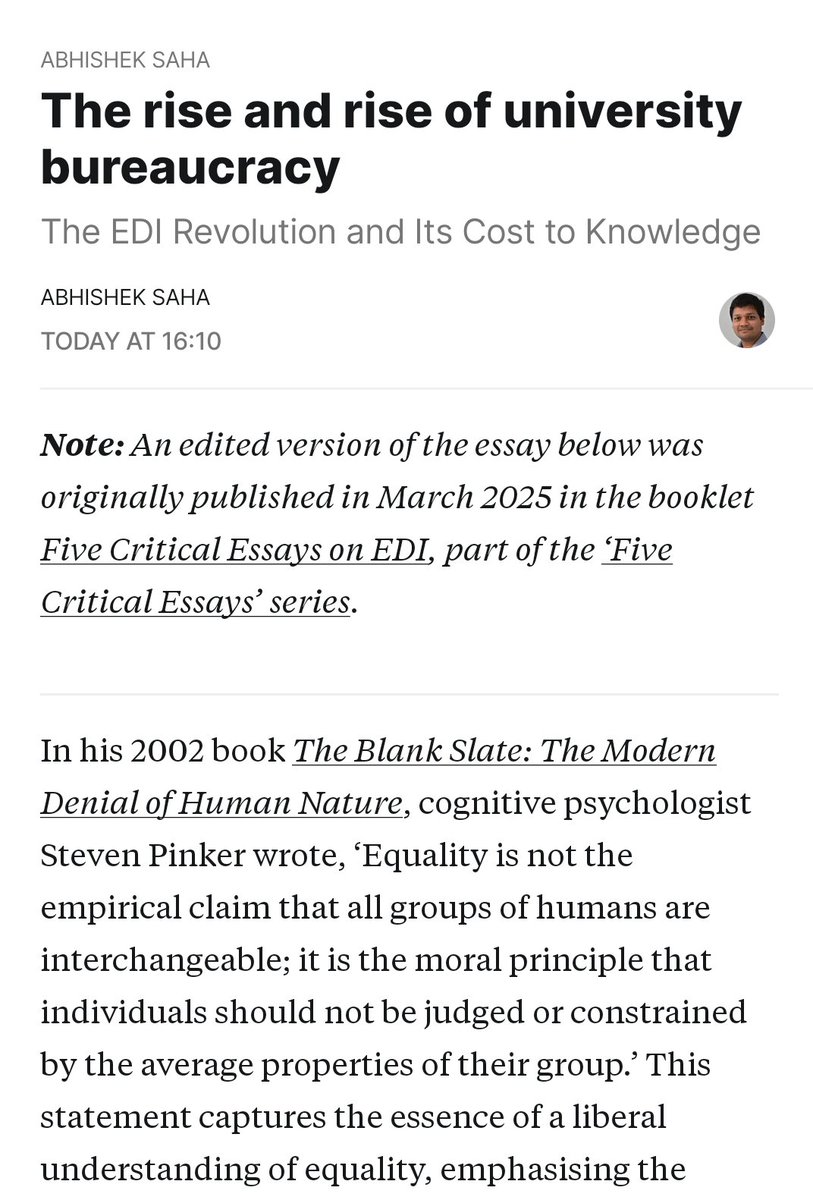
To restore academic freedom, merit, and intellectual diversity, EDI must return to its liberal roots.
Equality law should be reformed to raise the threshold for indirect discrimination and eliminate the public sector equality duty.
1
7
10
1,135
Committee for Academic Freedom retweeted

Apologies for using Oxford-ese without explanation.
The proctors are not the security guards. proctors.ox.ac.uk/
My understanding is that the proctors took the decision to allow protests inside the lecture theatre. If that is correct, it is extraordinary.
The protesters are not helped to understand that their behaviour is wrong when they are given permission by people in authority. And security guards are unlikely to be able to intervene if the proctors have given permission.
Questions must be asked of the Oxford University Proctors.
Why did they allow protests inside a lecture theatre?
Why do they think it is acceptable to create a hostile and degrading environment for Michael Foran and his students?
What do they think education is for?
34
220
907
38,353

Lord @WilliamJHague…was elected Chancellor of Oxford …on a platform that included a commitment to #freespeech and #academicfreedom.
STATEMENT: Oxford University is facing serious questions over its handling of repeated disruption of public lectures by Dr @michaelpforan, an associate professor of law and tutorial fellow at Keble College, after trans activists interrupted two events linked to his recent work on sex, gender identity and the legal tensions that have emerged between them.
Foran, an expert in equality law whose scholarship was cited in the Supreme Court’s landmark judgment in For Women Scotland v The Scottish Ministers, had been due to deliver four lectures on themes from his recently published book, Sex, Gender Identity and the Law.
Footage circulating online shows Foran being interrupted at two separate events. At the first, activists stood in front of his lectern and told the audience he was a “bigot” who “masks his transphobia behind a thin veneer of academia”.
One protester then declared: “If you are here in a critical capacity to challenge his ideas... that is not the same as refusing to platform him. He will not be convinced by your arguments. Please join me in walking out and refusing to platform this bigot.”
Not unreasonably, Foran cancelled the remaining talks, saying the “escalating disruptive protests” had “undermined the academic nature of this series”. He later added: “In attempting to shame students into de-platforming these lecturers, they manifest the antithesis of what a university stands for.”
CAF has questions about what role the University’s Proctors — Oxford officials responsible for overseeing events and enforcing the University’s rules on freedom of speech and protest — played here, and whether they took adequate steps to distinguish between protected protest, which may require facilitation, and conduct foreseeably likely to interfere with the talks themselves, which plainly does not.
Although the Proctors exercise their own independent responsibilities under Oxford’s rules, what happened here ought also to concern the institution’s senior leadership. Lord @WilliamJHague, in particular, was elected Chancellor of Oxford in November 2024 on a platform that included a commitment to #freespeech and #academicfreedom. Last year, he warned prospective students that “they will hear things that will upset them, that will offend them”, declaring that there would be “no safe spaces” during his tenure.
At CAF, we hope he will use his influence to bring clarity to what occurred in this case and to ensure that those responsible for implementing Oxford’s freedom of speech duties understand both what the Higher Education (Freedom of Speech) Act 2023 requires and what it does not.
Protecting lawful protest is indeed part of what it means to sustain a culture of free inquiry — but so too is ensuring that protest does not become a soft mechanism for preventing academic events from taking place.
3
15
59
2,601
Committee for Academic Freedom retweeted
STATEMENT: Oxford University is facing serious questions over its handling of repeated disruption of public lectures by Dr @michaelpforan, an associate professor of law and tutorial fellow at Keble College, after trans activists interrupted two events linked to his recent work on sex, gender identity and the legal tensions that have emerged between them.
Foran, an expert in equality law whose scholarship was cited in the Supreme Court’s landmark judgment in For Women Scotland v The Scottish Ministers, had been due to deliver four lectures on themes from his recently published book, Sex, Gender Identity and the Law.
Footage circulating online shows Foran being interrupted at two separate events. At the first, activists stood in front of his lectern and told the audience he was a “bigot” who “masks his transphobia behind a thin veneer of academia”.
One protester then declared: “If you are here in a critical capacity to challenge his ideas... that is not the same as refusing to platform him. He will not be convinced by your arguments. Please join me in walking out and refusing to platform this bigot.”
Not unreasonably, Foran cancelled the remaining talks, saying the “escalating disruptive protests” had “undermined the academic nature of this series”. He later added: “In attempting to shame students into de-platforming these lecturers, they manifest the antithesis of what a university stands for.”
CAF has questions about what role the University’s Proctors — Oxford officials responsible for overseeing events and enforcing the University’s rules on freedom of speech and protest — played here, and whether they took adequate steps to distinguish between protected protest, which may require facilitation, and conduct foreseeably likely to interfere with the talks themselves, which plainly does not.
Although the Proctors exercise their own independent responsibilities under Oxford’s rules, what happened here ought also to concern the institution’s senior leadership. Lord @WilliamJHague, in particular, was elected Chancellor of Oxford in November 2024 on a platform that included a commitment to #freespeech and #academicfreedom. Last year, he warned prospective students that “they will hear things that will upset them, that will offend them”, declaring that there would be “no safe spaces” during his tenure.
At CAF, we hope he will use his influence to bring clarity to what occurred in this case and to ensure that those responsible for implementing Oxford’s freedom of speech duties understand both what the Higher Education (Freedom of Speech) Act 2023 requires and what it does not.
Protecting lawful protest is indeed part of what it means to sustain a culture of free inquiry — but so too is ensuring that protest does not become a soft mechanism for preventing academic events from taking place.
12
53
194
11,219