
ComplexDiscovery is an online publication highlighting cybersecurity, information governance, and legal discovery insight and intelligence.
Joined April 2008
- Tweets 48,515
- Following 150
- Followers 3,829
- Likes 76
9,043 Photos and videos












💼 AI can write the pitch deck but not tell founders what is worth building
⚡️ Startup accelerators have long focused on helping founders move faster. At Latitude59 in Tallinn, accelerator leaders, investors, and founders argued that artificial intelligence is changing that equation, increasing the value of judgment, mentorship, and critical questioning. A Future Stage panel featuring Tehnopol’s Anne-Liisa Elbrecht, Karma Ventures’ Linda-Riin Võeras, and Neocortex founder Sercan Altundas, with Tarmo Virki as moderator, examined what founder support looks like when AI can write code, generate pitch materials, and assist with business planning.
💡 For cybersecurity, data privacy, compliance, and eDiscovery professionals, the discussion offers insight into a rapidly changing vendor landscape. Companies are being built faster, often by smaller teams, with increasing reliance on AI-generated work product. The panel’s observations about confident AI recommendations based on incomplete context and the risks associated with founder concentration mirror challenges already emerging in third-party diligence, vendor oversight, and AI governance. As accelerators, investors, and founders adapt to these realities, the evaluation methods they develop may influence the next generation of technology providers entering enterprise procurement processes.
🔎 Read the complete article from ComplexDiscovery OÜ's investment beat at complexd.blog/4v3ry9X.
#Latitude59 #ArtificialIntelligence #Startups #Accelerators #VentureCapital

19

Jun 12
🇪🇺 Europe’s AI labeling rules arrive with a voluntary code and a hard deadline
🏷️ Europe’s deadline for labeling AI-generated content now comes with an instruction manual. The European Commission’s final Code of Practice, published June 10, converts Article 50 of the AI Act from statutory text into operational steps: signed metadata, watermarking, free detection tools and a common set of EU labeling icons, all ahead of obligations that begin applying Aug. 2, 2026.
💡 For cybersecurity, data privacy, regulatory compliance and eDiscovery professionals, the stakes are concrete. Provenance metadata that proves whether content is authentic will become both a compliance artifact and evidence, and fines for getting disclosure wrong reach 15 million euros or 3 percent of worldwide turnover. Vendors embedding generative AI into their platforms will face provenance questions in the next procurement cycle, and discovery teams will need collection workflows that preserve, rather than strip, transparency metadata.
👀 Watch three things next: the Commission and AI Board adequacy assessment, the final implementation guidelines due ahead of Aug. 2, and the December dates, a confirmed transitional period for systems already on the market plus a pending amendment that could shift the application date itself. The labeling era is arriving either way.
📰 Read the complete article from ComplexDiscovery OÜ's artificial intelligence beat at complexd.blog/49RmEoc.
#AIAct #ArtificialIntelligence #AITransparency #Deepfakes #ContentProvenance #C2PA #Cybersecurity #eDiscovery

36
Jun 11
🔎 Estonia tightens digital evidence rules just as the EU speeds them up
⚖️ Estonia’s justice ministry wants to end what its own minister calls a “completely abnormal” practice: police demanding years of email correspondence from service providers with no scope limits. The timing gives the story weight well beyond the Baltics. Estonia’s Supreme Court ruled June 8 that provider-held email content requires a court warrant, echoing the Court of Justice of the European Union’s 2024 Landeck judgment, just as Regulation (EU) 2023/1543 prepares to route cross-border production orders directly to service providers beginning Aug. 18.
💡 For cybersecurity teams, the framework introduces authenticated inbound order channels that must be secured. For information governance professionals, it creates a new category of compelled disclosure to map into retention and hold procedures. For eDiscovery providers, judicial insistence on proportionate, targeted collection rewards defensible methodology.
🇪🇪 Watch the Estonian consultation closing in mid-June and the fall bill in the Riigikogu; the definitional choices made in Tallinn may preview how other member states reconcile court-imposed scope discipline with regulation-imposed speed.
📰 Read the complete article from ComplexDiscovery OÜ's eDiscovery beat at complexd.blog/4ut19S0.
#eDiscovery #EEvidence #DataPrivacy #DigitalEvidence #EURegulation #LegalTech #Estonia #CJEU

30
Jun 11
💼 HSR Filings Hit 235 in May 2026, the Highest Monthly Total Since December 2021
💡 May 2026 delivered 235 HSR premerger notifications — a fiscal year 2026 high, the strongest month since December 2021, and a 58.8 percent jump over May 2025. This update tracks a filing pipeline running 22.2 percent ahead of last fiscal year against an economy that grew just 1.6 percent in the first quarter, per the BEA’s second estimate, with corporate profit growth slowing sharply. The regulatory backdrop remains unsettled: May was the second full month under the restored legacy form, and the FTC-DOJ comment docket on the form’s future closed on May 26, with new rulemaking possible.
⚖️ For eDiscovery and legal operations leaders, the arithmetic is direct — sustained filing volume at this level points to a heavier Second Request docket in the second half of 2026. Use this month’s numbers to pressure-test capacity plans, vendor commitments, and review technology budgets before the pipeline converts. Monthly comparisons in this update are based on FTC “transactions reported” data; recent figures are preliminary and subject to revision in the agencies’ annual HSR report.
📰 Read the complete article from ComplexDiscovery OÜ's antitrust beat at complexd.blog/4vCfmwQ.
#LegalTech #SecondRequest #Antitrust #Mergers #Acquisitions #eDiscovery

1
1
21
Jun 10
[Forbes Communications Council] 19 Ways To Turn Customers Into Your Most Powerful Marketing Partners
Customers can be some of a company's most effective marketing partners, especially when they are given meaningful opportunities to share their experiences. Unlike traditional marketing, which pushes messages outward, customer-driven approaches invite audiences to participate, contribute and help shape the brand story. The key is to create value for customers as well as the company, making participation feel authentic rather than promotional.
In this article, 19 Forbes Communications Council members share creative ways organizations can involve customers in their marketing efforts and explain why these approaches work so well.
[Extract] Build A Customer Newsroom Powered By Industry Expertise: One creative approach is to build a customer "newsroom," turning customers' industry expertise into timely, publishable stories for social and digital channels. This makes customers active expert contributors, not just references. It works because it shares the company's message through credible voices and creates content that audiences are more likely to read and trust. - Rob Robinson, HaystackID (ComplexDiscovery OÜ)
💡 Contributing experts include Richard Lowe, Jennifer Schenberg, Jehan Lalkaka, Michael Taylor, Emma Westley, Anna Eliot, Bruno Bertini, Anamika Gupta, Larisa Summers, Rob Robinson, Scott Morris, Katie Jewett, Kimberly Osborne, Mike Neumeier, Alexi Lambert Leimbach, Shirin Ali, Kurt Allen, Amrita Hemdev, and Leeron Walter.
👀 Read the complete article from Forbes Communications Council at complexd.blog/4aHHjey.
#ForbesCommunicationsCouncil #CustomerMarketing #CustomerAdvocacy #CustomerStories #B2BMarketing #ContentMarketing #LegalTech #eDiscovery

44
Jun 10
🔎 Market Intelligence: the 3.13x productivity mandate underneath eDiscovery's 2025 to 2030 arc
💡 There is a single number underneath every other number in the Market Intelligence series, and it is not in dollars. It is in zettabytes. In 2025, the world created, captured, copied, and consumed roughly 181 zettabytes of data. In 2030, the projected total reaches roughly 812 zettabytes – a 4.5-times expansion across five years, or approximately 35 percent compounded annually. Across the same period, the worldwide eDiscovery market grows from roughly 19.6 billion dollars to roughly 28.1 billion – a 1.43-times expansion, or approximately 7.44 percent compounded annually.
💼 The gap between those two trajectories – some 27.6 percentage points per year of compounding difference – is the most consequential structural force in the eDiscovery industry, and it is the demand-side context underneath every segmentation lens explored across the prior ten articles in this series. The articles ahead describe how the gap gets closed. This article describes why the gap exists in the first place.
📰 Read the complete article from ComplexDiscovery OÜ's industry research beat at complexd.blog/43uIZnR.
#LegalTech #eDiscovery #LondonTechWeek #LegalTechTalk #DubTechSummit #Latitude59 #FutureLaw2026

1
1
23
Jun 9
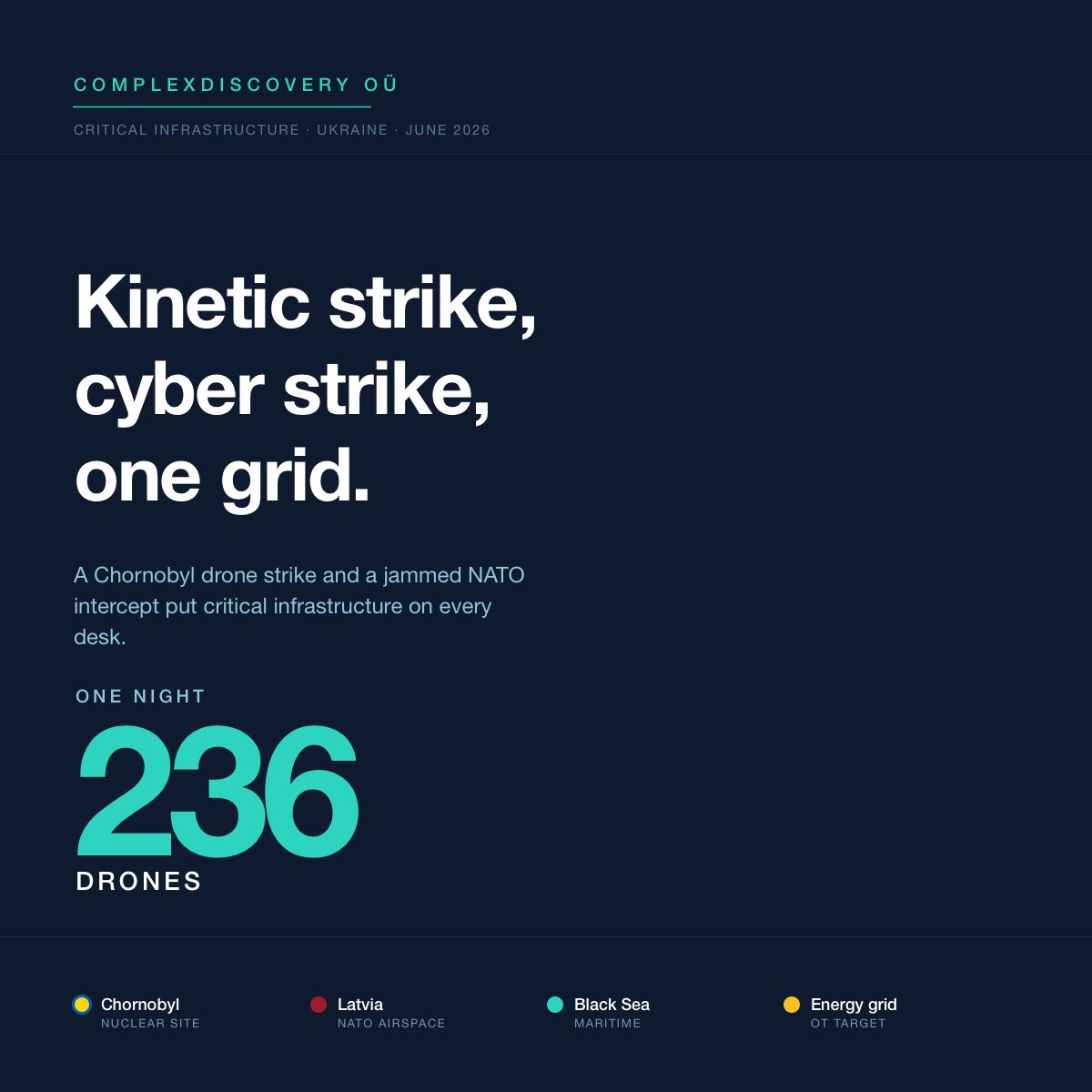
🇺🇦 When the drone war reaches the reactor fence: Ukraine and the cyber-physical front
🇷🇺 A Russian drone hit a building at a spent-nuclear-fuel storage site inside Ukraine’s Chornobyl exclusion zone on June 7, with no radiation release reported, and the same 48 hours saw NATO jets down a jammed drone over Latvia, oil terminals burn from long-range strikes, and a rail locomotive knocked out by an aerial hit. Read together, the June 7 and 8 assessments from the Institute for the Study of War describe a war increasingly fought through the data layer: remotely piloted drones tied to live wireless links, electronic warfare that pushes munitions across national borders, and open-source satellite feeds that serve as the evidence of record.
🔎 For professionals in cybersecurity, data privacy, regulatory compliance, and eDiscovery, this is not distant news. The targets are the same critical infrastructure and operational technology systems they defend. The verification methods are the same digital-evidence disciplines they practice. The rationing of fuel through a state-controlled app shows how access to essentials migrates onto contested platforms under stress.
👀 Watch the convergence: kinetic and cyber risk are collapsing into a single register, and the teams that see it first will be the ones who plan for it.
📰 Read the complete article from ComplexDiscovery OÜ's #geopolitics beat at complexd.blog/4unbT44.
#CriticalInfrastructure #Cybersecurity #OTSecurity #EnergySecurity #DroneWarfare #Resilience #Ukraine #Russia
1
55
Jun 9
💂♂️ Britain bets billions on sovereign AI as London Tech Week opens
🖥️ Britain just turned its AI ambitions into a spending commitment. On the opening day of London Tech Week, Prime Minister Keir Starmer and a lineup of global technology firms pledged billions toward sovereign compute, domestic data centers and AI skills, with AMD, Nebius and the UK government alone accounting for upward of £4 billion. The headline is investment. The subtext is data, and that is where this story turns operational for our readers. Sovereign compute reshapes data-residency and cross-border transfer calculations. Agentic AI deployments multiply the volume and variety of discoverable information. Predictive social programs, including a homelessness-prevention panel led by the Prince of Wales, push sensitive personal data into new uses that compliance teams will have to defend.
⚖️ For cybersecurity, information governance and eDiscovery professionals, the announcements at Olympia are early signals of where data risk, regulatory scrutiny and litigation exposure are heading.
🔎 Watch the buildout timelines, watch the regulators drafting AI rules across the UK and EU, and watch the legal-technology calendar that follows immediately in London. The infrastructure decisions made this week will define the governance and discovery problems of the next several years.
📰 Read the complete article from ComplexDiscovery OÜ's artificial intelligence beat at complexd.blog/4vADfVx.
#LondonTechWeek #LTW26 #TechShapesBusiness #ArtificialIntelligence

82
Jun 8
💬 AI is becoming an advisor, and it is rewriting how buyers find you
💼 Professional buyers are quietly handing the first step of vendor selection to chatbots, and that single behavior change is upending two decades of online visibility practice. A March 2026 Wall Street Journal piece called AI optimization the next chapter of SEO; a fast-spreading rebuttal argues that the change may be more significant, with large language models behaving less like search engines and more like conversational advisors that compare, summarize, and recommend.
🔎 For cybersecurity, information governance, and eDiscovery professionals, the implications cut two ways. Their own firms now compete to be understood and recommended by machines that 45 percent of B2B buyers already consult during a purchase. The same systems that name vendors also summarize regulations and case law for time-pressed professionals, making the accuracy of AI-generated answers a governance issue, not only a marketing one. The research is early, and several of its loudest voices sell visibility tools, so read the numbers with care.
👀 Watch three things next: how fast citation patterns stabilize, whether regulators weigh in on AI accuracy, and how quickly buyers learn to trust, or distrust, the machine’s shortlist.
📰 Read the complete article from ComplexDiscovery OÜ's leadership beat at complexd.blog/3Q2PJ9u.
#AISearch #GEO #AEO #AIVisibility #eDiscovery #InformationGovernance #Cybersecurity #LegalTech #B2BMarketing

26
Jun 7
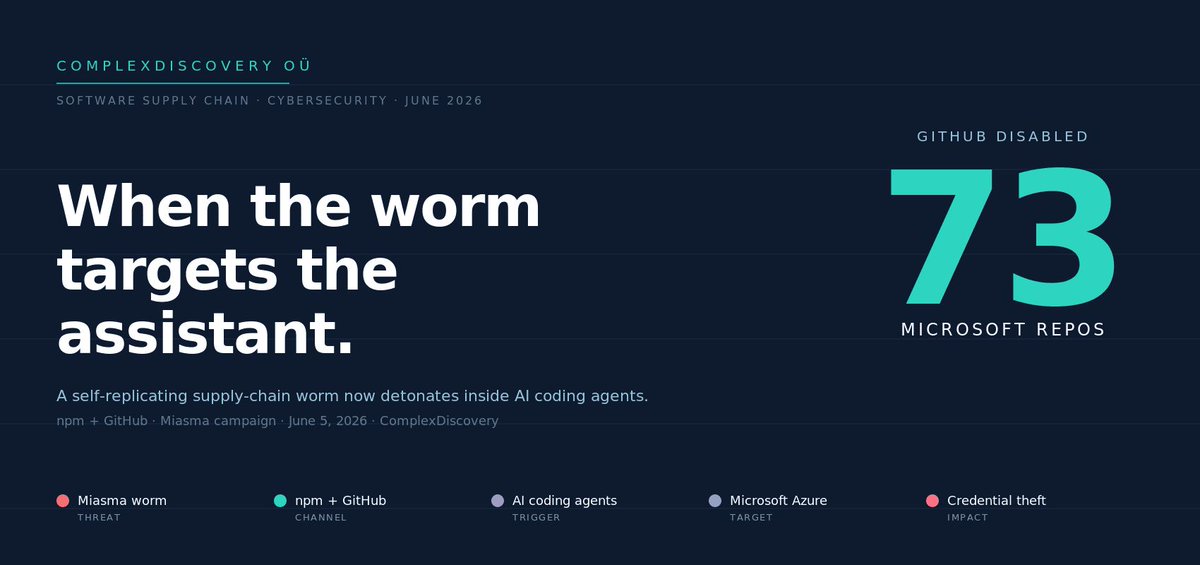
🪱 When the worm targets the assistant: Miasma turns AI coding agents into the trigger
🖥️ A self-replicating worm has turned the AI coding assistant into a delivery mechanism, and the same campaign just forced one of the larger takedowns the open-source supply chain has seen. On June 5, GitHub disabled 73 Microsoft repositories after the Miasma campaign re-compromised Azure’s durabletask project, per OpenSourceMalware. In separate source-repository compromises, researchers at SafeDep documented Miasma planting payloads that fire when a developer opens an affected project in Claude Code, Cursor, Gemini CLI or VS Code.
⚖️ For security, privacy, compliance, and eDiscovery professionals, this is a governance problem wearing a malware costume. Stolen cloud keys and GitHub secrets feed breach response, regulatory notification, and source-code-theft litigation. The artifacts that matter, developer workstations, build logs, and AI-agent configuration files, sit outside most preservation maps. When a worm exploits the trust model rather than a software flaw, vendor diligence and software bill of materials review move from paperwork to defense.
👀 Watch the next wave. The operators are mutating descriptions and execution paths daily, and the AI-agent trigger is a template other actors will copy. Track node-gyp behavior, scope your tokens, and assume the developer environment is now in scope for both attackers and discovery.
Read the complete article from ComplexDiscovery OÜ's cybersecurity beat at complexd.blog/4v6y2os.
#SupplyChainSecurity #Cybersecurity #npm #AICoding #DevSecOps #Miasma #ShaiHulud #InfoSec
38
Jun 6
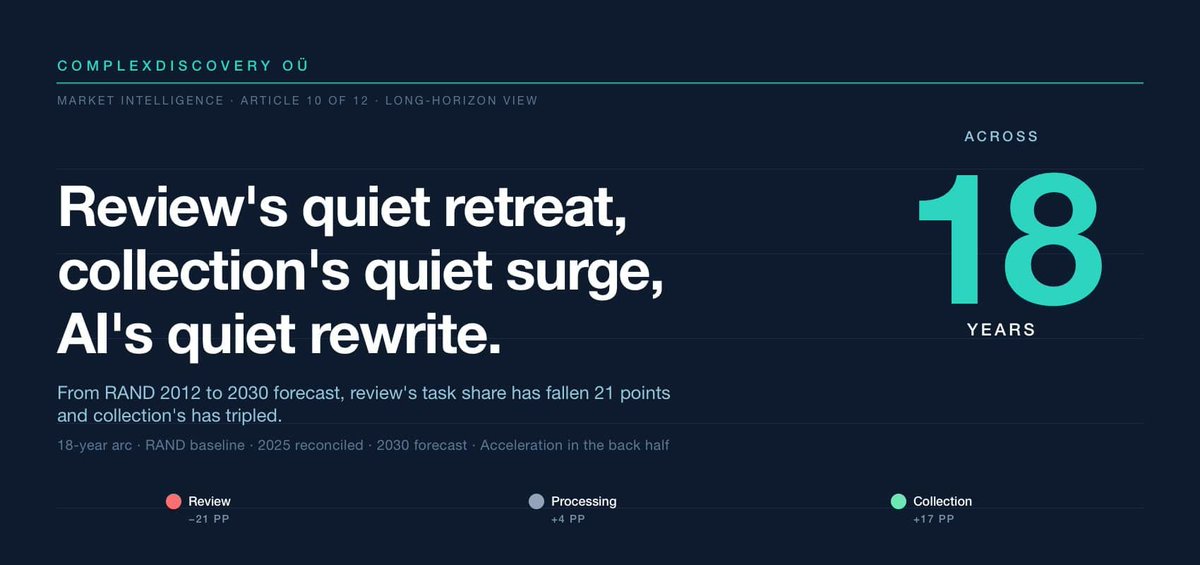
💡 Market Intelligence: review's quiet retreat, collection's quiet surge - the eDiscovery task arc, 2012 to 2030
🗓️ Across 18 years, the composition of where eDiscovery dollars get spent across the three core tasks has fundamentally rebalanced. The RAND Corporation’s foundational 2012 study, Where the Money Goes, placed review at 73 percent of total task spend, processing at 19 percent, and collection at 8 percent. By 2025, the reconciled view places review at 62 percent, processing at 21 percent, and collection at 17 percent. By 2030, the forecast places review at 52 percent, processing at 23 percent, and collection at 25 percent. Review has lost 21 percentage points of share across the long horizon; collection has expanded its share over threefold.
⚖️ The pace of that rebalance is accelerating. The five-year share movement from 2025 to 2030 is nearly as large as the 13-year movement from 2012 to 2025. Two structural forces sustain the acceleration. AI-assisted review continues to compress per-document review labor faster than data growth can offset on the spend side – predictive coding now joined by generative-AI-assisted review and emerging agentic workflow features. Data-source proliferation continues to expand the collection scope – cloud collaboration platforms, mobile and ephemeral messaging, IoT, structured operational systems, and now generative AI prompt logs and model outputs each adding to the discoverable universe.
🔎 For cybersecurity, data privacy, regulatory compliance, and eDiscovery professionals, three observations follow. First, the task-share rebalance is structural rather than cyclical – the pattern has been visible since 2012 and has not reversed. Second, capital allocation and capability planning should anticipate the continued drift toward collection-heavy and processing-heavy task profiles. Third, the long-horizon view contextualizes near-term decisions: vendors and providers anchored primarily to review revenue should plan for continued share compression, while those with strong forensic and modern-collection capabilities are positioned for the fastest-growing absolute spend. The data volume context that follows this article will frame the demand-side trajectory in zettabytes that has driven this evolution, culminating in the consolidated 2025–2030 eDiscovery Marketplace Mashup.
📰 Read the complete article from ComplexDiscovery OÜ's industry research beat at complexd.blog/3RUFx3g.
#LegalTech #eDiscovery #MarketSize #MarketIntelligence #LegalAI #EDRM #LegalTechTalk
2
1
70
Jun 5
⚖️ Counting down to LegalTechTalk 2026 – Europe’s event for legal transformation – after an excellent run through Estonia and Ireland at FutureLaw, Latitude59, and Dublin Tech Summit. LegalTechTalk alone brings 5,500 attendees, 100 sessions, 8 stages, and 6 themes across two days, built for anyone serious about what’s next in law.
📸 Reporting for ComplexDiscovery OÜ and for Newsline by HaystackID for the second year in a row will highlight key developments in AI governance, legal technology, and data intelligence, including the session “Building Cross-Functional Cyber Governance to Avoid a $25 Million Mistake” with HaystackID’s John Wilson.
📍 See you at the InterContinental O2 in London.
📰 Read more from Complex Discovery OÜ about HaystackID in Europe — “Redefining Global Advisory: How Jeff Shapiro’s London Leadership Anchors HaystackID’s 2026 European Strategy” — at complexd.blog/406nR5r.
#LegalTech #LegalTechTalk #AIGovernance #eDiscovery #HaystackID #ComplexDiscovery
48
Jun 5
🔎 Microsoft's first reasoning model arrives with a provenance pitch aimed at compliance teams
🖥️ Training-data provenance has become a productized sales argument in enterprise AI, and Microsoft moved early and explicitly to make it one. At Build 2026 in San Francisco on June 2, the company unveiled seven in-house MAI models led by MAI-Thinking-1, its first dedicated reasoning model, and paired the technical launch with a direct pitch to enterprise legal and compliance buyers. Microsoft’s public positioning is clean: commercially licensed data, no distillation from third-party models, and an enterprise-grade lineage general counsels can trust. The technical paper Microsoft published alongside the keynote is more nuanced: the corpus is “publicly available and licensed human-generated data” that includes a proprietary web crawl of approximately 1.2 trillion pages filtered to roughly 794 billion, a description analyst Simon Willison read as having “the same licensing problems as all of the other major LLMs.”
⚖️ For cybersecurity, information governance, eDiscovery, data privacy, and regulatory compliance professionals, the gap between the public positioning and the technical paper is the story.
👀 Watch whether Microsoft converts keynote language into contractual indemnification, whether early-adopter deployments produce auditable vertical benchmarks, and whether the marketing-versus-paper distinction holds up in procurement redlines.
📰 Read the complete article from ComplexDiscovery OÜ's artificial intelligence beat at complexd.blog/4ofvkuA.
#AI #LegalTech #eDiscovery #InformationGovernance #Cybersecurity #MAIThinking1

58
Jun 4
🔎 Market Intelligence: where eDiscovery work gets bought - the delivery approach view, 2025 to 2030
⚖️ Quick read on where eDiscovery work is actually getting bought through 2030.
In 2025, corporations and governments bought about 72% of direct eDiscovery work — buying directly from vendors and service providers, without going through outside counsel. By 2030 the share is projected to ease to 67%. The in-house channel is the biggest, and will stay that way.
👀 But here's the shift worth watching:
Specialty service providers grow about 12% a year
Law firms grow about 10%
In-house teams grow about 6%
🖥️ AI is the underlying reason. AI-powered eDiscovery work scales economically through specialty providers that combine shared cloud infrastructure with operational depth in-house teams find expensive to staff and retain. Law firms are also gaining share again on the legally complicated stuff: AI regulation, cross-border investigations, complex strategy. Coordinating everything still matters.
The headline doesn't move much — in-house still dominates. But by 2030, more of the procurement is projected to be going through specialty providers and law firms.
📰 Read the complete article from ComplexDiscovery OÜ's industry research beat at complexd.blog/3S0GRl9.
#LegalTech #eDiscovery #MarketSize #MarketIntelligence #LegalAI #EDRM #LegalTechTalk

20
Jun 3
💡 Glasswing widens: Anthropic puts Mythos inside power, water and hospital operators across more than 15 countries
🌏️ Anthropic on Tuesday expanded Project Glasswing beyond its roughly 50 initial partners, extending access to a new cohort of approximately 150 organizations in more than 15 countries. The restricted Claude Mythos Preview offensive-security model has already surfaced more than 10,000 high- or critical-severity vulnerabilities, according to Anthropic. The expansion lands one day after Anthropic’s confidential S-1 filing and pushes the frontier vulnerability-discovery tool deeper into power utilities, water authorities, hospitals, telecommunications carriers and hardware manufacturers, including organizations reported in Australia, Belgium, Canada, France, Germany, India, Italy, Japan, the Netherlands, New Zealand, South Korea, Spain, Sweden and Switzerland.
🔎 For cybersecurity, data privacy, regulatory compliance and eDiscovery professionals, the shift matters at three levels. Defenders inside Glasswing gain access to a restricted AI-enabled vulnerability-discovery capability at a time when Anthropic warns comparable models may become broadly available within six to 12 months. Counsel and information governance teams face a developing preservation and records-retention question around AI-generated vulnerability inventories, particularly in post-breach matters where Mythos-derived findings may become relevant. Cyber-insurance underwriters and vendor-diligence teams also gain a potential new control variable if Mythos-class access becomes a marker of advanced security posture. The same Tuesday, President Trump signed a narrowed AI security executive order establishing a voluntary 30-day pre-release review framework for covered frontier models and a Treasury-led AI cybersecurity clearinghouse.
🖥️ Watch the executive-order implementation deadlines, the NSA covered-model designation process, the Cyber Verification Program’s expansion, and OpenAI’s GPT-5.5-Cyber rollout.
📰 Read the complete article from ComplexDiscovery OÜ's cybersecurity beat at complexd.blog/4dM99Zh.
#cybersecurity #AIsecurity #infosec #criticalinfrastructure #eDiscovery #ClaudeMythos #ProjectGlasswing #cyberinsurance

96
Jun 3
🏛️ Market Intelligence: non-government demand pulls ahead - the eDiscovery sector split through 2030
💼 Non-government demand pulls ahead in the worldwide eDiscovery market across 2025-2030. Reconciled estimates place non-government spending at approximately $11.18 billion in 2025 – 57 percent of the worldwide market – and project growth to $16.85 billion by 2030. Government and regulatory spending grows from $8.43 billion to $11.23 billion across the same period. The two demand-sector CAGRs diverge sharply: non-government at 8.55 percent, government and regulatory at 5.91 percent. The 2.64-percentage-point gap compounds into a 3-percentage-point share rebalance across five years, with non-government share rising from 57 percent to 60 percent.
💵 The non-government premium reflects structural expansion across civil litigation, internal investigations, corporate compliance, mergers and acquisitions diligence, and AI risk advisory work. AI risk advisory in particular has emerged as a discrete category of private-sector work, with model governance audits, algorithmic accountability reviews, and AI Act compliance for European Union operations all driving spending growth that did not exist a decade ago. Government and regulatory spending remains durable, anchored by persistent investigative activity, Hart-Scott-Rodino premerger notification work, parallel European Union and United Kingdom inquiries, and expanding cross-border regulatory coordination – but the procurement-bounded nature of government spending compounds more slowly than the elastic private-sector workload.
⚖️ For cybersecurity, data privacy, regulatory compliance, and eDiscovery professionals, three observations follow. First, vendor evaluation criteria diverge meaningfully by sector – government buyers increasingly require FedRAMP and equivalent international authorizations and explicit AI model governance documentation, while non-government buyers increasingly evaluate vendors on AI risk advisory depth and compliance specialization. Second, AI risk advisory has emerged as a category of work that did not exist five years ago and now drives a measurable share of non-government compounding. Third, government spending remains durable through 2030; the 3-percentage-point share shift reflects faster non-government growth, not government contraction.
🖥️ Read the complete article from ComplexDiscovery OÜ's industry research beat at complexd.blog/43dhwa3.
#LegalTech #eDiscovery #MarketSize #MarketIntelligence #LegalAI #EDRM #LegalTechTalk

10
Jun 2
🌎️ Market Intelligence: still American, but a little less so - eDiscovery geography through 2030
💼 The eDiscovery market remains an American market through 2030, but the international share of worldwide spending is gradually rising. Reconciled estimates place U.S. spending at approximately $12.94 billion in 2025 – 66 percent of the worldwide market – and project growth to $17.97 billion by 2030. Rest-of-world spending grows from $6.67 billion to $10.11 billion across the same period. U.S. share of worldwide spend declines from 66 percent to 64 percent; rest-of-world share rises from 34 percent to 36 percent – a 2-percentage-point rebalance that the headline U.S. dominance does not, on its own, reveal.
📈 The rest-of-world CAGR sits at approximately 8.7 percent, 1.88 percentage points above the U.S. rate. The faster international compounding reflects multiple structural forces operating simultaneously – GDPR steady-state enforcement, European Union AI Act compliance, parallel regulatory inquiries across jurisdictions, and the expansion of regional supplier capacity. Within the rest of the world, the United Kingdom, Canada, Germany, Australia, and Japan continue to anchor the largest sub-shares, while Singapore, India, and parts of the Middle East represent the faster-growing edges.
⚖️ For cybersecurity, data privacy, regulatory compliance, and eDiscovery professionals, three observations follow. First, cross-border data transfer requirements and data localization rules now shape product architecture and contracting more meaningfully than they did through 2025. Second, AI governance, model-handling disclosures, and AI Act compliance increasingly factor into vendor selection across multiple jurisdictions. Third, the U.S. remains the dominant single geography for eDiscovery work throughout the cycle and well past it – the international rebalance is real but gradual, and procurement frameworks should reflect both realities.
📰 Read the complete article from ComplexDiscovery OÜ's industry research beat at complexd.blog/4ahXqiH.
#LegalTech #eDiscovery #MarketSize #MarketIntelligence #LegalAI #EDRM


13
Jun 1
🔎 Market Intelligence: eDiscovery cloud software - SaaS, PaaS, and IaaS, 2025 to 2030
⛅️ The eDiscovery cloud software category is rebalancing across 2025-2030. Reconciled estimates place worldwide cloud spending at approximately $5.29 billion in 2025 – 79 percent of the software segment – and project growth to $8.87 billion in 2030 at a reconciled compound annual rate of 10.93 percent. Inside the cloud category, SaaS holds approximately 67 percent of spend in 2025 and 63 percent in 2030, while platform-as-a-service rises from 15 percent to 17 percent and infrastructure-as-a-service from 18 percent to 20 percent. The four-percentage-point SaaS share decline reflects a structural rebalance toward platform and infrastructure tiers as advanced eDiscovery workloads run against those services directly.
🖥️ The driving force is concrete: AI inference at scale, vector search, large-scale processing pipelines, and multi-source ingestion architectures increasingly engage platform and infrastructure services rather than terminating at packaged SaaS endpoints. Some of that activity appears in vendor SaaS revenue when wrapped into packaged offerings; some appears as direct PaaS or IaaS spend by service providers and enterprise customers operating against hyperscaler accounts.
⚖️ For cybersecurity, data privacy, regulatory compliance, and eDiscovery professionals, three observations follow. First, the cloud bill of materials for advanced eDiscovery work now spans SaaS, PaaS, and IaaS simultaneously – and procurement evaluation needs to extend across the full stack rather than terminate at the SaaS subscription line. Second, AI inference economics specifically deserve their own line in vendor evaluation and contract review, because the inference cost component is increasingly material. Third, the SaaS-anchored cloud category is not retreating – it is growing alongside an expanding platform and infrastructure tier that procurement frameworks and vendor evaluation criteria are still adapting to.
📰 Read the complete article from ComplexDiscovery OÜ's industry research beat at complexd.blog/3PCxOWZ.
#LegalTech #eDiscovery #MarketSize #MarketIntelligence #LegalAI #EDRM


13
May 30
📰 Five great reads on cyber, data, and legal discovery for May 2026
⚖️ May was the month the rulebooks caught up with the technology — and then bent under it. In Dublin, forensic examiners conceded that proving a recording is intact no longer proves it is real, as deepfake fraud turned authenticity into the question discovery has to answer. Across three jurisdictions in twelve days, regulators in Washington, London and Brussels hard-wired synthetic-image takedown duties into the operating environment, even as the European Union pushed its flagship high-risk AI obligations into 2027 and added a categorical ban on abusive AI content. The Justice Department signaled it is now using artificial intelligence to hunt antitrust violations, raising the methodological bar for everyone responding to a Second Request. And Anthropic quietly re-segmented the legal-software market in an afternoon by moving the customization layer inside the model. Taken together, the month showed governance and enforcement converging on a single demand: show your work — the provenance, the chain of custody, the audit trail — because the tools producing the evidence are now the tools scrutinizing it.
💼 Beneath the headlines, the data and the field reporting fill in the shape of the shift. This month’s Industry Research takes the long view, tracing eighteen years of eDiscovery market growth from a $4.73 billion baseline in 2012 to a projected $28.08 billion in 2030 and the steady migration of spend from services into AI-assisted software. The Lagniappe carries the dispatches: Ireland’s bid to be the de facto regulator of global AI, Latitude59’s missile-defense-and-sovereignty opening in Tallinn, FutureLaw’s reckoning with the billable hour, a first global rulebook for digital embassies, and the monthly read on the Hart-Scott-Rodino merger pipeline. The thread that runs through all of it is the same one the Great Reads pull tight: when machines make and judge the record, the professionals who can prove what is real are the ones who will be trusted to govern it.
🔎 Read the complete newsletter from ComplexDiscovery OÜ at complexd.blog/4ed6UhB.
#eDiscovery #Cybersecurity #DigitalForensics #AIGovernance #DubTechSummit #Latitude59 #FutureLaw2026


25
May 29
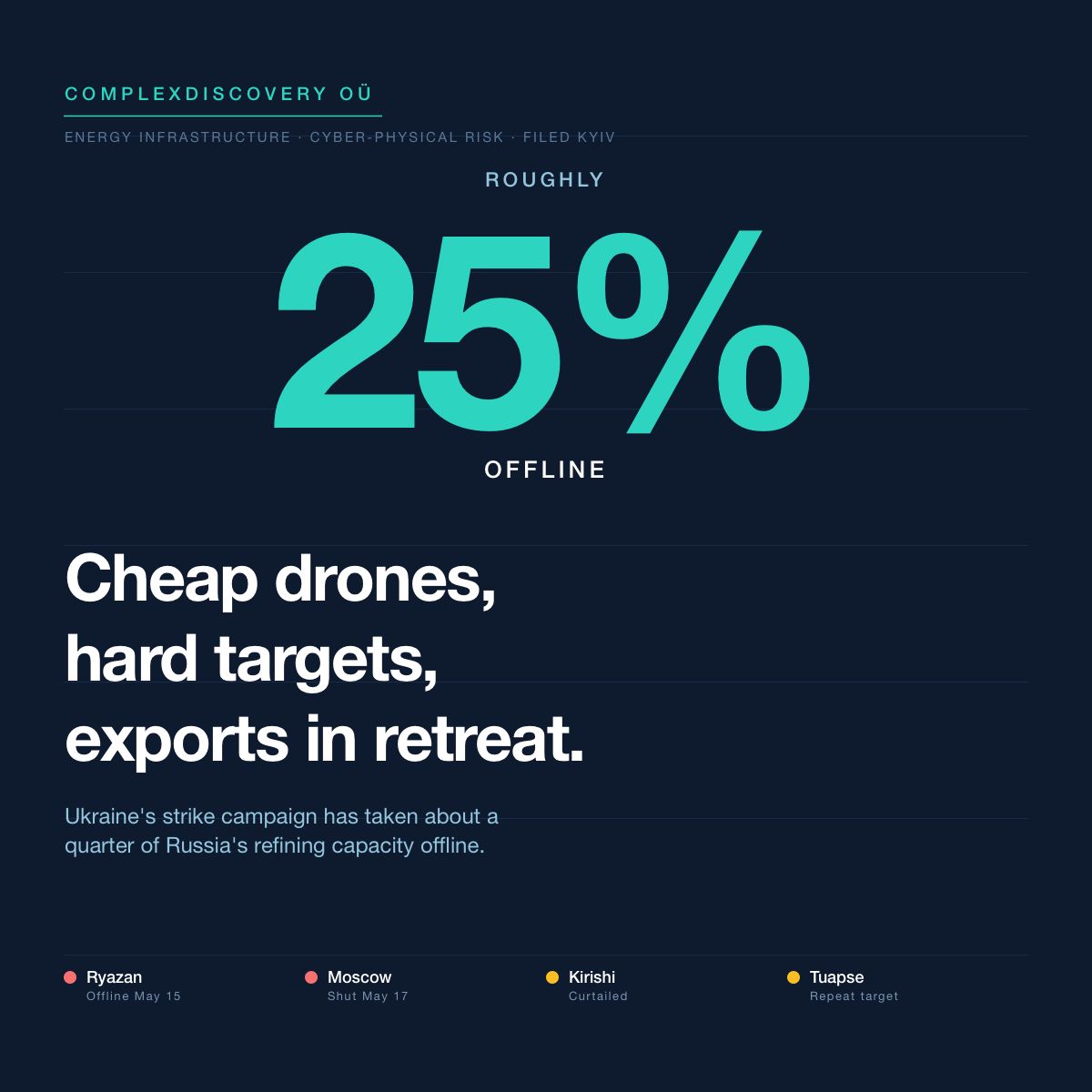
💥 When the refineries burn: Ukraine's strikes turn Russia's energy backbone into a cautionary tale
🇷🇺 Russia’s move to weigh diesel and jet fuel export limits marks the moment a months-long Ukrainian drone campaign started rewriting the Kremlin’s economics. With roughly a quarter of refining capacity offline and April runs at a 16-year low, Moscow is choosing to keep fuel at home rather than sell it abroad, a reversal of a revenue stream it has protected since the war began. The Institute for the Study of War, which tracks the conflict in daily assessments, reported the export deliberation on May 27 and again May 28.
🖥️ For cybersecurity, data privacy, regulatory compliance and eDiscovery professionals, the story sits squarely on the cyber-physical fault line. Inexpensive, software-guided systems are degrading hardened industrial assets, and the same processing unit can be lost to a drone or a manipulated control system. The lessons map onto critical-infrastructure resilience work: concentration risk, distributed defense, and the data discipline needed to ration and reroute under pressure.
👀 Watch three things next: whether the export restriction is formalized, how Ukraine’s funded procurement reshapes the strike tempo, and how energy and transport operators outside the war begin to treat physical and cyber threats as one continuity problem.
🔎 Read the complete article from ComplexDiscovery OÜ's geopolitics beat at complexd.blog/4vdZUGZ.
#CriticalInfrastructure #Cybersecurity #OTSecurity #EnergySecurity #DroneWarfare #Resilience #Ukraine #Russia
23