
Joined June 2018
- Tweets 8,085
- Following 734
- Followers 16,278
- Likes 6,084
577 Photos and videos







Pinned Tweet

5 Mar 2022
HOT OFF THE PRESS! Corey Lynn's Book on Vaccine ID Passports and Where It's Headed is Now Available!
Have a look inside at the content!
coreysdigs.com/health-scienc…

24
226
392
Corey Lynn of Corey's Digs retweeted

Jun 12
Calories in, calories out doesn't account for deuterium.
Soy sauce carries 186 ppm deuterium.
Natural foods carry 130-150 ppm.
No macro calculator accounts for this difference.
Liu Yuting — science-technology strategist at Luzhou Yu Quan Deuterium Depleted Water Company, one of China’s largest DDW producers founded in 1967 — presented company-generated data analyzing 86 food items across 12 categories.
Natural foods measured at 130–150 ppm.
Fried foods averaged 165 ppm.
Condiments such as soy sauce and vinegar reached up to 186 ppm.
The mechanism is straightforward physics.
During prolonged heating or concentration process, lighter water molecules evaporate faster.
The heavier deuterium-containing water stays behind.
The more processed the food — the higher its deuterium load.
It means a highly processed food and a fresh food with identical macros deliver completely different deuterium loads to your mitochondria.
A separate 2021 review “What to feed or what not to feed—that is still the question” published in Metabolomics found the same logic applies to grass-fed vs grain-fed animal products.
Grain-fed animals — corn, soy, barley — follow a carbohydrate metabolism that is deuterium-enriching.
Grass-fed animals operate in a natural ketogenic state that produces deuterium-depleted metabolic water.
Grass-fed meat carries less deuterium than grain-fed equivalents.
Dr. Laszlo Boros — co-author of the paper: "If you compare sour cream or butter from grass-fed cows compared to grain-fed cows. You go from 110 ppm to 136 ppm. 26 ppm difference."
Boros: "It's not a joke."
Two meals. Same calories. Same macros.
Different deuterium load.
The calories in, calories out model doesn’t account for that.
Your mitochondria do.
30
165
851
89,776
Corey Lynn of Corey's Digs retweeted

Jun 10
How to Deprogram from Ideology
65
322
1,669
37,928
Corey Lynn of Corey's Digs retweeted

Pushback of the Week: May 17, 2026: Ron DeSantis Protects Floridians from Hyperscale Data Centers @GovRonDeSantis
Across the U.S., hyperscale data centers are wreaking havoc in local communities, greedily hogging precious water supplies, raising consumer electricity costs, damaging human and animal health—and facilitating the build-out of the control grid.
A bill just signed by Florida Gov. Ron DeSantis, SB 484, provides protections for both ratepayers and local governments. The bill:
- Ensures that local governments maintain the authority to reject data center development in their communities
- Prevents data center costs (including electricity costs) from being passed on to consumers
- Protects Florida’s water resources from data center consumption
Some of the other features of the bill highlighted in the governor’s press release include greater transparenc —including required public disclosure of data center development deals after the exemption period, and the establishment of “clear definitions in law to prevent loopholes”—as well as the creation of a dedicated permitting process for large-scale data centers.
Full Report: solari.com/pushback-of-the-w…
Subscribe to shop.solari.com

8
71
166
3,787
Where have I been and what have I been up to? It's in here, in addition to this energy disruption timeline. (Free post) 👇

2
11
487
Corey Lynn of Corey's Digs retweeted

May 5
The event causing the arctic scramble is the reason for all of today’s madness.

21
201
546
34,636
3
2
9
854
It's quite a timeline we put together on Energy Infrastructure and Trade Route Disruption. Take a look. 👇

Energy Infrastructure and Trade Route Disruption
Every day, we add links to our News Trends & Stories Aggregator. Catherine uses this database of top stories and events to prepare her weekly Money & Markets discussions with John Titus.
On occasion, we decide to take a deeper look at important patterns. The ongoing sabotage or destruction of oil and gas production and refining and transportation facilities worldwide is one such pattern. Rising costs or renegotiated agreements relating to trade channels and bottlenecks are closely related. We expect these events to have a dramatic impact on trade relations and the global economy.
We just asked one of our best researchers to make and fact-check a chronology of these events so far this year (see Timeline and Key Statistics/Notes below). We welcome comments and additions from subscribers—you can post in the comments section.
Full Report: solari.com/energy-infrastruc…
Subscribe to shop.solari.com

1
5
8
725
Corey Lynn of Corey's Digs retweeted

Americans need to understand what just happened.
Iran built an entire sanctions proof system using crypto, especially USDT (digital dollars). Their central bank and IRGC moved money through it to bypass the global banking system.
Then on April 23, 2026…
$344 MILLION in USDT was frozen instantly.
Not seized later. Not chased through banks. Frozen on-chain.
Because USDT isn’t “decentralized.” It can be blacklisted. Wallets can be shut off. And that freeze was done in coordination with U.S. Treasury and law enforcement.
Read that again:
A nation tried to escape the system… and got shut down with a command.
Now look at the C.L.A.R.I.T.Y. Act.
It doubles down on this model:
Track. Trace. Report to the IRS.
Every wallet tied to identity. Every transaction visible. Every asset controllable.
This isn’t about Iran.
This is the blueprint.
So ask yourself:
Is this a CBDC in disguise?

For five years, Iran built an alternative financial architecture on the explicit theory that cryptocurrency would be sanctions-resistant. Bitcoin mining was legalized in 2019. Subsidized power was redirected to industrial farms. Mined coins were sold to the Central Bank of Iran for hard currency. The IRGC moved over three billion dollars through digital assets in 2025 alone. By year end the Iranian crypto ecosystem had reached seven point eight billion dollars per Chainalysis, with the central bank holding at least five hundred seven million in USDT reserves per Elliptic.
The architecture was the bet. The bet was that the dollar could not follow Iran onto the chain.
On April 23, 2026, the United States Treasury froze three hundred forty-four million dollars of that architecture with one smart-contract call.
Tether executed the freeze on receipt of intelligence from US law enforcement. Two Tron wallets, beginning TNiq9AXBp9 and TTiDLWE6fZ, were blacklisted at the smart-contract level. The first held two hundred thirteen million. The second held one hundred thirty-one million. The funds had accumulated approximately three hundred seventy million across nearly one thousand transactions since March 2021. Less than seven percent ever flowed out. The wallets had been dormant since late 2023. This was not operational money. This was a sovereign war chest stored on the chain because the IRGC assumed nobody could touch it. Treasury touched it on Thursday.
Treasury Secretary Bessent named the campaign Economic Fury and stated the doctrine in plain English. “Treasury will continue to systematically degrade Tehran’s ability to generate, move, and repatriate funds. We will follow the money that Tehran is desperately attempting to move outside of the country and target all financial lifelines tied to the regime.”
The five-year theory collapsed in one paragraph.
The IRGC built crypto rails to escape the dollar. The dollar followed onto the rails, identified the wallets through TRM Labs and Chainalysis behavioral clustering, instructed Tether to freeze them, and demonstrated that the seven-point-eight-billion-dollar parallel economy is permissioned at the issuer layer. Tehran now knows what every Russian, North Korean, and Venezuelan sanctions desk is reading: USDT is a US Treasury asset that sanctioned actors cannot store value in.
The timing reframes the entire conflict.
Tehran’s negotiating posture for forty-eight days assumed crypto reserves provided sanctions cushion. That cushion is now provably three hundred forty-four million dollars smaller. The Pentagon is photographing three carrier strike groups. Treasury is photographing the Tron blockchain. Both are publishing the order of battle.
The market is reading this as tactical sanctions enforcement. That reading is incomplete. CNN noted yesterday it had not independently corroborated the Iran attribution, and Bitcoin maximalists are noting that three hundred forty-four million is under five percent of the seven-point-eight-billion-dollar ecosystem. Both points concede the floor of the argument. Stablecoins are now Treasury extensions with smart-contract APIs. The GENIUS Act, signed July 2025 and operationalized through April rules, codified it. The freeze made it visible.
Three readings of this week.
A successful sanctions enforcement against the Iranian regime. Priced.
A diplomatic pressure tactic ahead of fragile ceasefire talks. Narrow.
The first publicly verifiable demonstration that Iran’s five-year sanctions-evasion architecture is permissioned end to end, that the dollar followed the IRGC onto the chain, and that every sanctioned sovereign on earth must reprice its crypto reserves before the next Economic Fury Friday.
The market is pricing the first.
Tehran is repricing the third.
open.substack.com/pub/shanak…

90
623
1,229
92,498
Corey Lynn of Corey's Digs retweeted
How Much of Your Attention Is Actually Yours?
Reposting this excellent piece @CoreyDigs wrote for the Solari Report in 2021 as part of our 2021 Q1 Wrap Up: Take Action (solari.com/wrap-up/2021-q1/.)
"Loosen Technology’s Grip on Your Mind" is a reminder to be intentional about what we consume, how often, and why. Corey explores how deeply technology shapes our habits, focus, and our thinking, whilst offering insight on why reclaiming that space matters.
Full Report: solarireport.substack.com/p/…
Subscribe to shop.solari.com

5
30
81
4,808
Corey Lynn of Corey's Digs retweeted

Apr 19
The USDA approved EXTREMELY DANGEROUS self-amplifying RNA shots for dogs & cats: Nobivac NXT
New FOIA data reveals DEATHS, CARDIAC ARREST, NEUROLOGICAL ISSUES, and STRANGE MASSES — often within HOURS of injection.
Vets are now routinely giving these vaccines for rabies, flu and FLV.
Watch Nicolas Hulscher’s video here;
Watch the HighWire video clip here:
x.com/highwiretalk/status/20… x.com/NicHulscher/status/204…
Apr 17

🚨EXCLUSIVE: If you have a dog and your vet has recommended the Nobivac NXT canine flu vaccine, read this before your next appointment.
Over 1,000 pages of adverse event reports were obtained from the USDA through a FOIA request. They cover Nobivac NXT H3N2, the first self-amplifying RNA vaccine widely used on pets in the United States.
The data covers September 2024 through July 2025 and documents 296 cases listing the vaccine as a suspect product, including deaths, neurological events, anaphylaxis, collapse, and injection-site masses. A 4-year-old golden retriever went into cardiac arrest and died ten minutes after receiving the shot. A 7-year-old Yorkshire Terrier collapsed seventy minutes after vaccination and could not be saved.
Self-amplifying RNA works differently from traditional vaccines. The RNA replicates itself inside the body to produce a sustained immune response, and researchers as recently as April 2025 have written that the mechanisms involved are not fully understood and warrant further investigation.
The USDA approved this vaccine in June 2024. Portions of the pre-approval safety trial data have been withheld as confidential commercial information provided by Merck. Read this entire column and share it with your friends.
Full article by @smiddendorp22 linked below 👇
bit.ly/Dog_Vaccine_AE
62
1,032
1,574
34,724
Corey Lynn of Corey's Digs retweeted

Apr 10
Take note.
Apr 10

🦔A researcher invented a fake eye condition called bixonimania, uploaded two obviously fraudulent papers about it to an academic server, and watched major AI systems present it as real medicine within weeks.
The fake papers thanked Starfleet Academy, cited funding from the Professor Sideshow Bob Foundation and the University of Fellowship of the Ring, and stated mid-paper that the entire thing was made up. Google's Gemini told users it was caused by blue light. Perplexity cited its prevalence at one in 90,000 people.
ChatGPT advised users whether their symptoms matched. The fake research was then cited in a peer-reviewed journal that only retracted it after Nature contacted the publisher.
My Take
The researcher made the papers as obviously fake as possible on purpose. The AI systems didn't catch it. Neither did the human researchers who cited it in real journals, which means people are feeding AI-generated references into their work without reading what they're actually citing.
I've covered the FDA using AI for drug review, the NYC hospital CEO ready to replace radiologists, and ChatGPT Health launching this year. All of that is happening in the same environment where a condition funded by a Simpsons character and endorsed by the crew of the Enterprise was being presented as emerging medical consensus. The people making these deployment decisions seem to believe the pipeline from research to AI to patient is more supervised than it actually is. This experiment suggests it isn't supervised much at all.
Hedgie🤗
nature.com/articles/d41586-0…
40
175
799
62,464
Corey Lynn of Corey's Digs retweeted

Due to recent events, it’s become evident that we are not voting our way out of this. Americans across the country have been calling for a national tax revolt, having tired from their taxpayer dollars being spent to fund endless war, endless scams, and endless fraud like Somalian Learing Centers, while Americans are plunged into nearly $40 trillion in debt!
I sat down with former criminal investigator for the IRS, now turned whistleblower, and you won’t believe what he told me about the income tax.
1,881
6,899
32,125
1,723,405
Corey Lynn of Corey's Digs retweeted
I'm glad you guys covered that one, Michelle. 👍
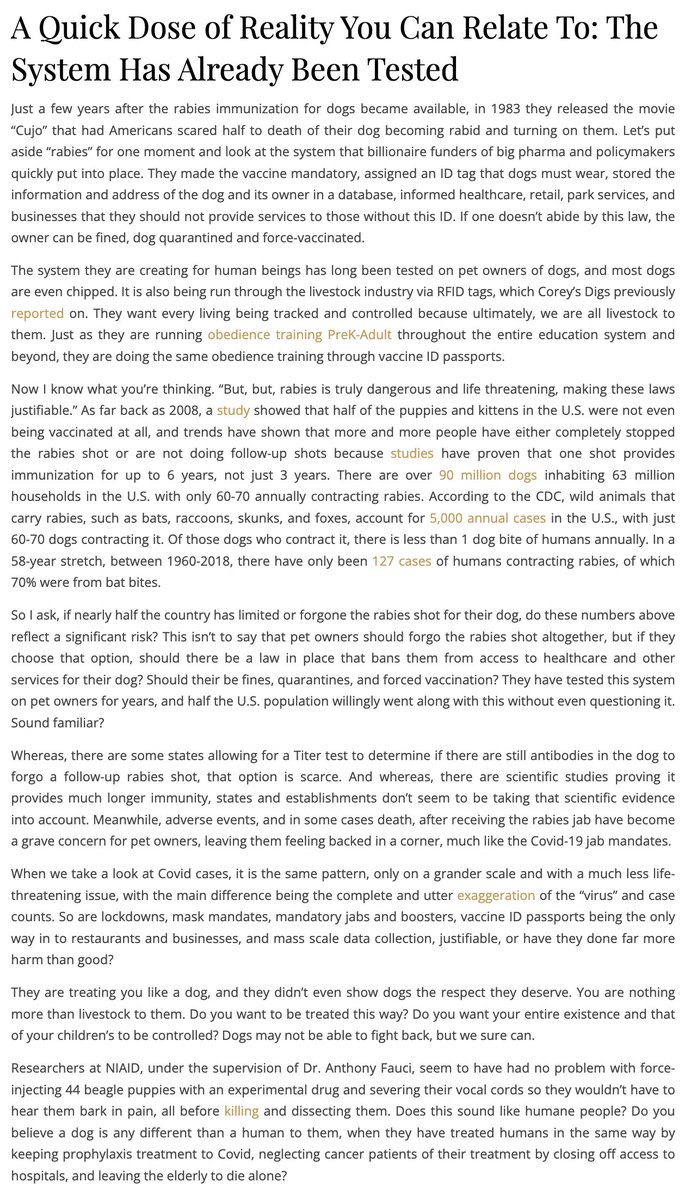
Also, see the statistics I broke down on rabies shots at the beginning of an article I did awhile back. I scoured 58 years of records. coreysdigs.com/health-scienc…
1
5
14
412
Corey Lynn of Corey's Digs retweeted
This is my dear friend, Sondra. Her and her husband built an incredible community in Pittsburg, TX, for those looking for both short-term AND long-term places to live, have fun, and connect on a beautiful lake in the piney woods! Thanks @MelKShow
youtu.be/0_VK2zsZl0k?si=1UC1…
4
6
25
3,149
Corey Lynn of Corey's Digs retweeted

Feb 28
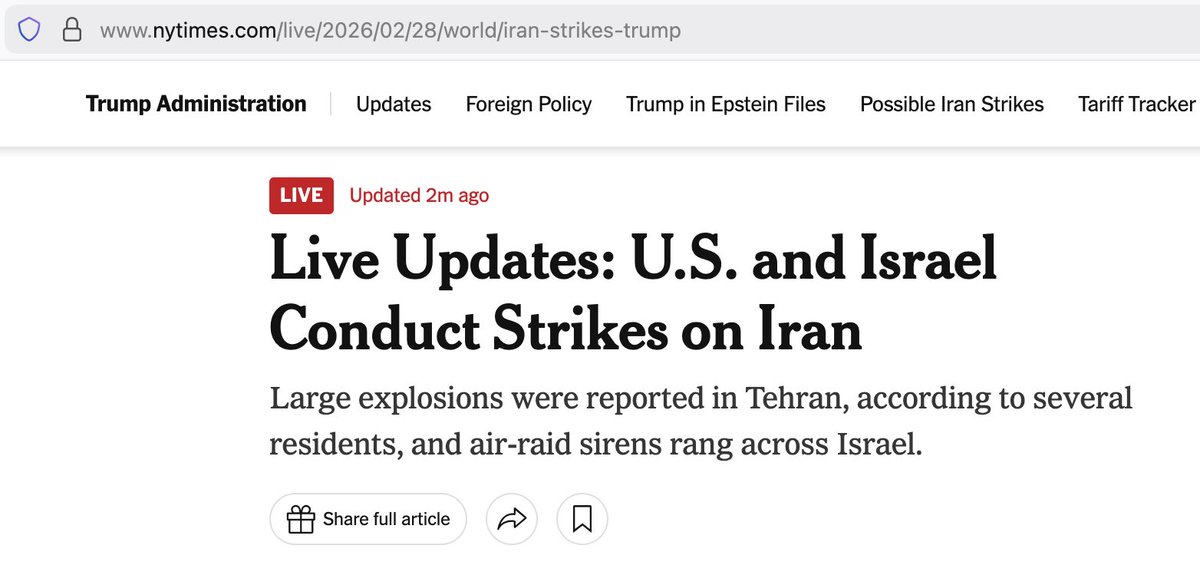
The White House and Trump administration, via Donald Trump, have just released a video saying they have attacked Iran and "defend the American people and eliminating the Iranian regime...a vicious group of very hard, terrible people".
468
525
4,968
885,384

Feb 28

Acts of war unauthorized by Congress.
The U.S. is attacking Iran according to AP.
apnews.com/article/iran-us-e…
2
605
Corey Lynn of Corey's Digs retweeted
⚠️ Imposter Accounts Are Increasing
There has been a clear rise in fake accounts impersonating brands and public figures — including Catherine Austin Fitts and The Solari Report.
These accounts often:
• Copy profile photos and bios
• Repost real content to look legitimate
• Message followers directly — or encourage followers to message them
• Promote scams, fake investments, or “exclusive” opportunities
According to cybersecurity experts, social media impersonation is a very serious issue, but they note that “a combination of factors…makes it easy for fraudsters to carry out their attacks and scams.” As we have found, reporting the impersonation to the platform does not necessarily lead to resolution of the problem.
We would like to remind you, therefore, that the accounts listed on our LinkStack (linkstack.solari.com/@social…) are the only legitimate Solari social media accounts. Please do not engage with any other accounts alleging to represent Catherine or Solari.
If you are ever unsure, go directly to our website — solari.com — and verify through official channels. Do not rely on direct messages.

30
124
333
29,608
This is NOT Catherine Austin Fitts.👇 @solari_the
1
3
8
488
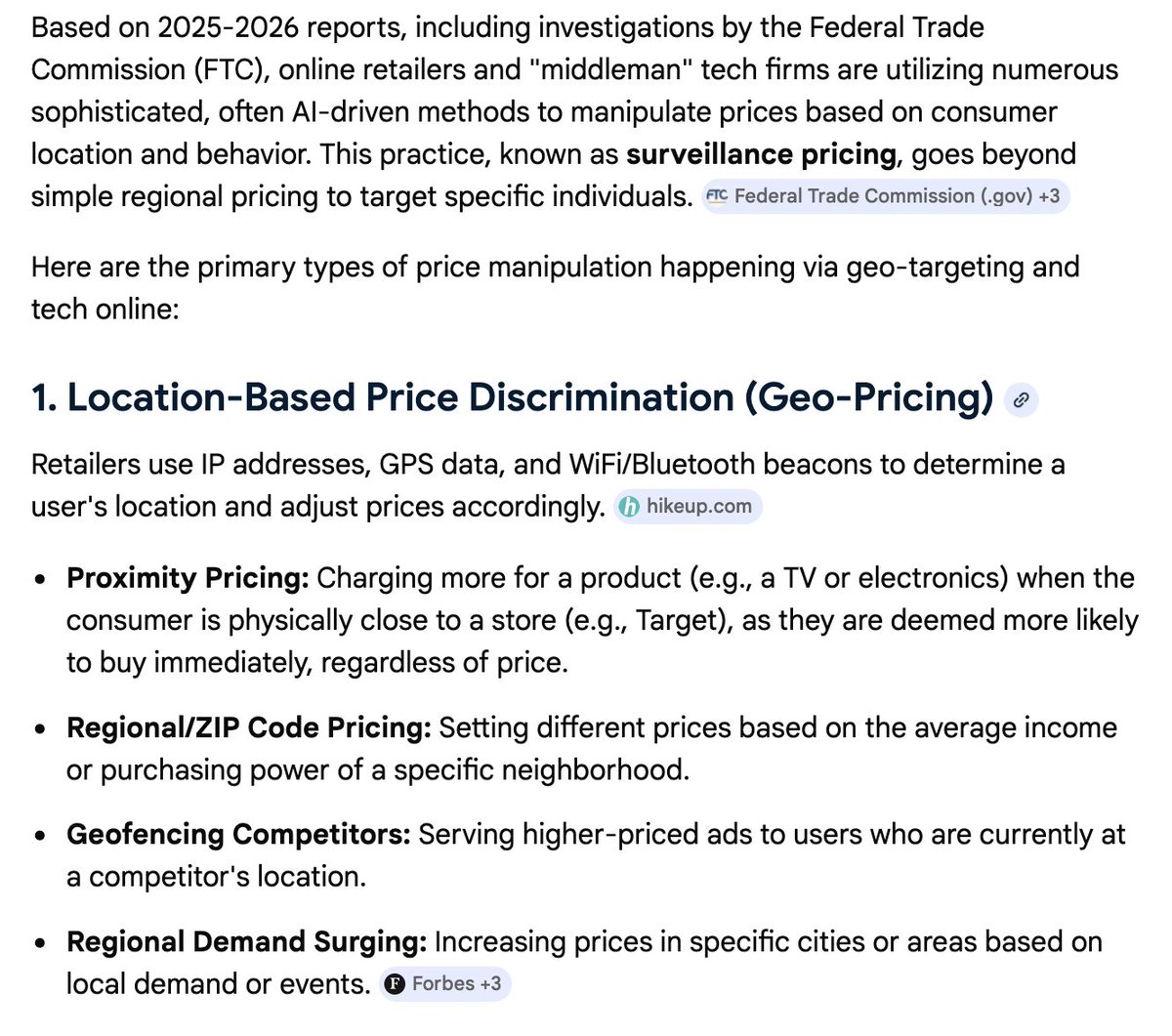
Yep, airlines have been doing this for years. Online grocery shopping runs a similar scam - they charge different amounts to people shopping for the exact same items. I'm sure a slew of online companies have been doing this for years.
Feb 24

i watched a flight go from $483 to $547 in 24 hours WITHOUT a single seat selling
searched london to new york on a tuesday
$483
checked again 2 hours later
$512
next morning: $547
panicked and booked it
the guy sitting next to me paid $391
same seat, date airline
$156 less
he searched once i searched 3 times
the algorithm saw me come back and charged me until i broke
the seat doesnt have a price
you have a price
and it goes up EVERY time you show interest
couldnt stop thinking about it so i tracked down someone who actually built pricing algorithms for a european carrier
asked him what happened to me
"you got profiled. the system assigned you an intent score after your second search and raised your ceiling every time you came back"
asked how to beat it
"most people think a VPN fixes it. thats 2015 advice. the algorithm fingerprints more than your IP now. it reads your device your browser your screen resolution your timezone. VPN to bucharest but your clock says london and your language is english? the algo knows youre faking and sometimes charges you more for trying"
"so what actually works?"
"you have to poison the entire profile. not just the location. the identity"
the protocol he gave me:
VPN AND match your timezone and language to the spoofed location. mismatched signals flag you and can trigger a price increase
use a fully clean browser. no history no saved passwords no google account. the algorithm fingerprints your session not just your cookies
one search one booking. the intent score activates on the second search. there is no safe way to look twice
book tuesday or wednesday 1-5am. lowest traffic means the least demand data for the algorithm to inflate against
if the price already spiked go dark for 72 hours minimum. not 24. the intent score on most carriers decays on a 3 day cycle. come back on a different device from a different network
"we spent $4 billion building these systems. theyre not going to lose to someone who opened an incognito tab"
$900 billion industry
the gap between what you pay and what the person next to you pays is not a bug
its the entire business model
stop letting an algorithm charge you for being predictable
2
5
15
927

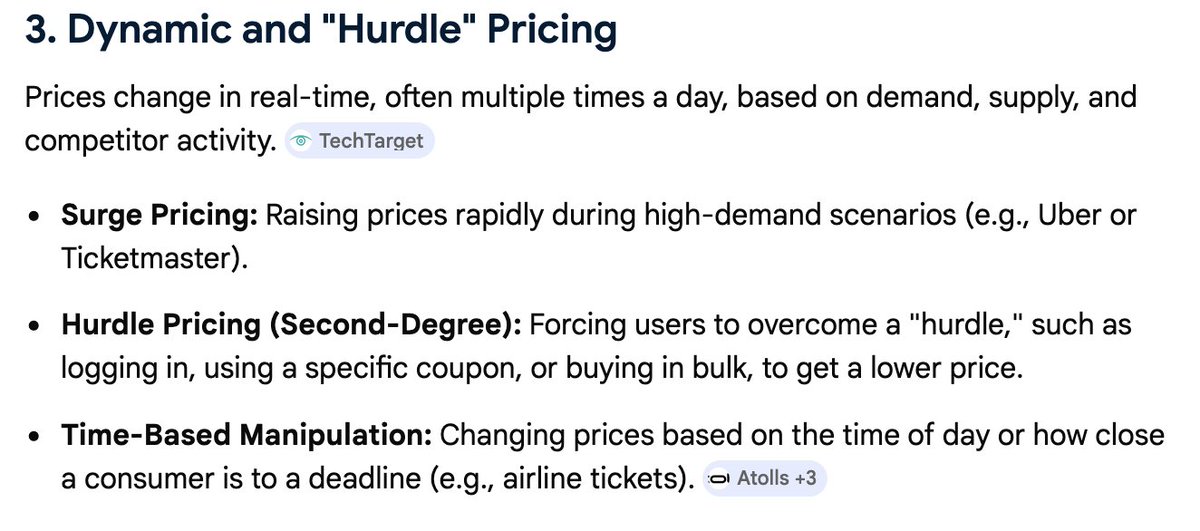
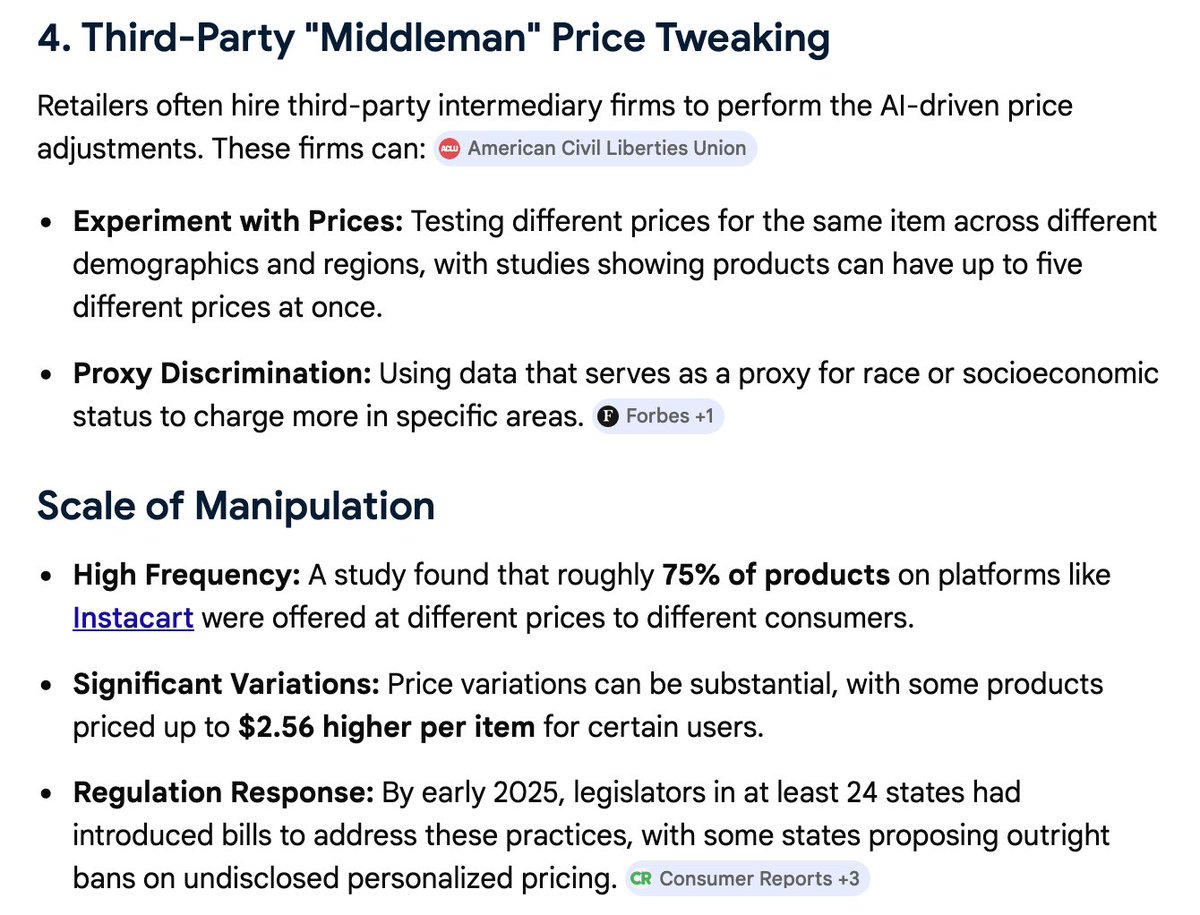
FTC Surveillance Pricing Study Indicates Wide Range of Personal Data Used to Set Individualized Consumer Prices ftc.gov/news-events/news/pre…
1
8
347