
A global leader offering 24/7 access to deep crypto liquidity. Not investment advice. Disclosures: cumberland.io/compliance/dis…
Joined September 2017
- Tweets 763
- Following 92
- Followers 33,303
- Likes 116
187 Photos and videos



Cumberland retweeted

May 27
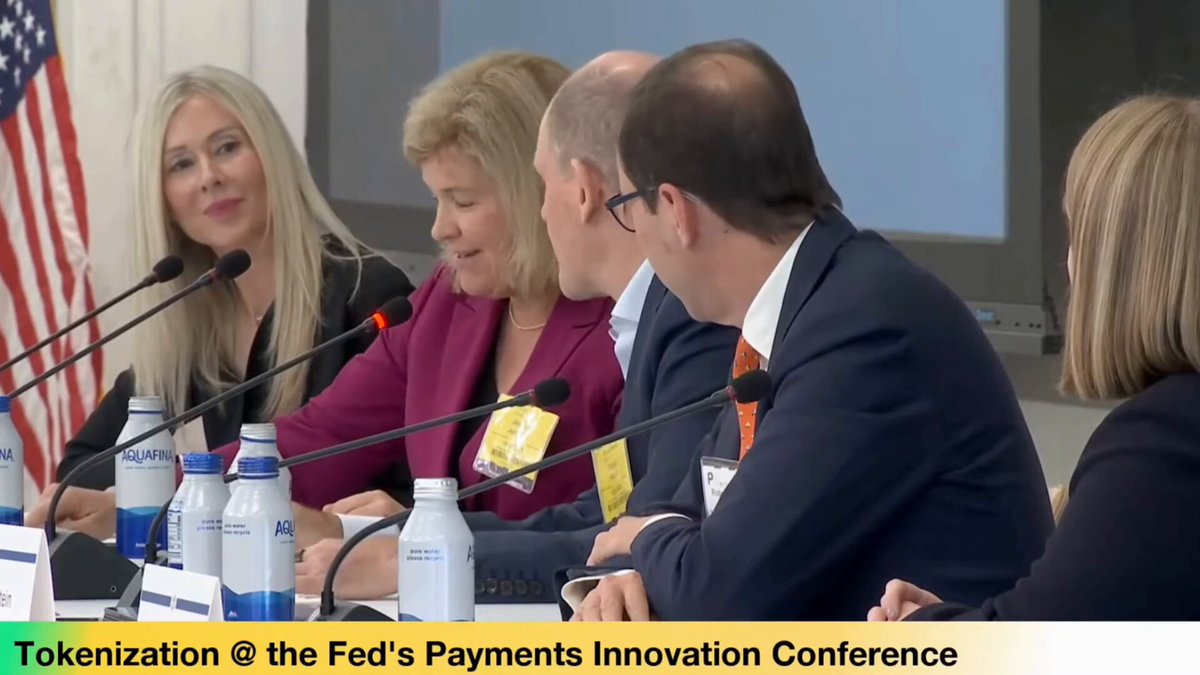
As global regulators including the @SECGov, @CFTC and @bankofengland explore how best to enable markets to benefit from the efficiencies moving on-chain, blockchain selection is an underrated but critical choice. Some designs embed front-running and information leakage directly into execution. Others are designed to prevent it. My latest in the @FT on why these choices matter for investors and capital markets: ft.com/content/2fdbb11e-8c8d…
6
12
73
10,278
Cumberland retweeted

May 20
Most blockchains were never designed for regulated financial markets.
@CantonNetwork is attempting to build shared financial infrastructure with synchronized settlement, atomic interoperability, and institutional-grade privacy, without relying on a globally replicated public state.
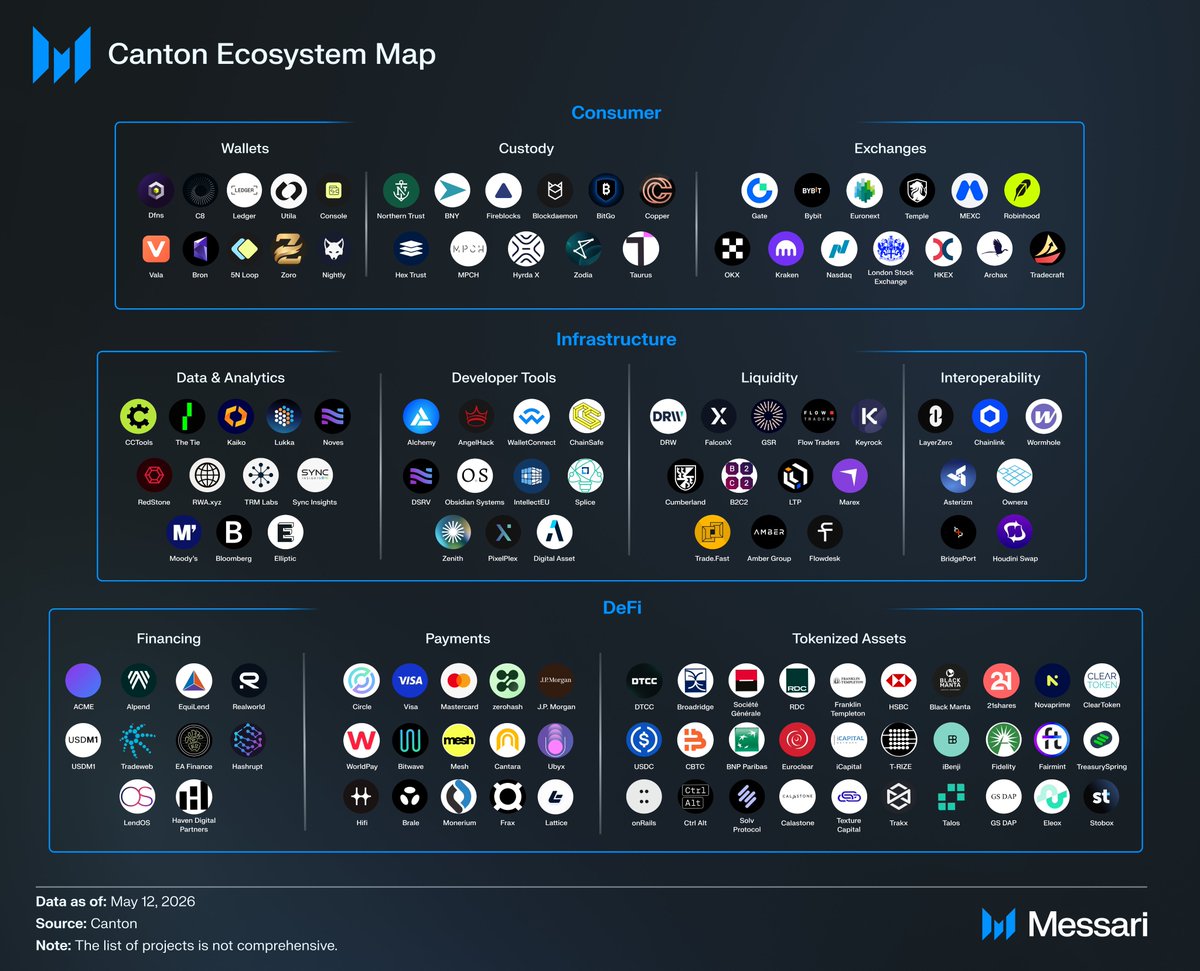
That design is already attracting participants like DTCC, J.P. Morgan, Broadridge, HSBC, Visa, and Franklin Templeton.
@immutablejacob breaks down Canton’s architecture, sub-transaction privacy model, institutional adoption, CC tokenomics, and the role of the Global Synchronizer in this new report 👇
May 20

the most in-depth and up-to-date @CantonNetwork report is live.
22 pages covering:
> technical architecture
> privacy model
> tokenomics
> governance
> institutional adoption
> the role of $CC
👉 messari.io/report/understand…
let’s break down the key points:
1/ what is Canton Network?
Canton is a public network for interoperable, privacy-preserving financial applications.
unlike most blockchains, Canton does not rely on a single globally replicated state where every validator sees every transaction.
instead, each participant only sees the part of a transaction it is entitled to access.
Canton’s core differentiator -> configurable sub-transaction privacy with composability.
independent financial applications can interoperate atomically across shared infrastructure without exposing all transaction data to the entire network.
2/ what problem is Canton solving?
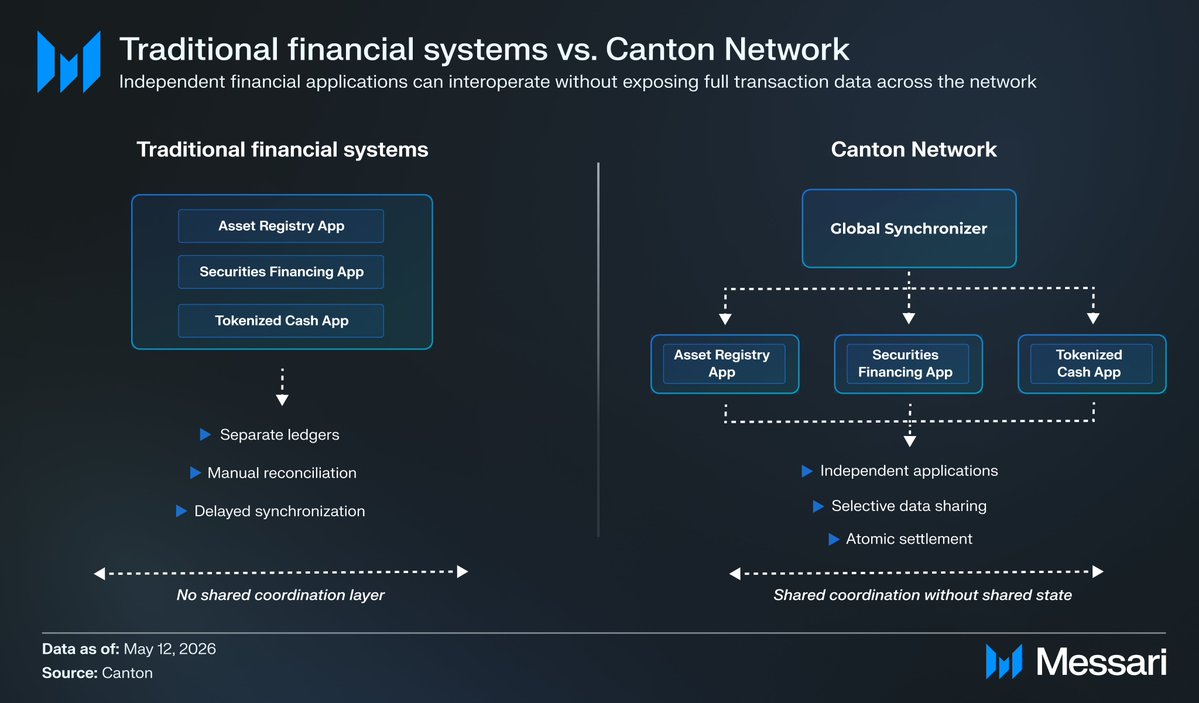
traditional financial infrastructure is fragmented.
collateral, cash, securities, repo, and settlement workflows often sit across separate ledgers, intermediaries, and operational systems.
that creates:
> reconciliation overhead
> delayed settlement
> operational risk
> trapped collateral
> inefficient capital movement
most blockchains solve interoperability by making everything globally visible.
most private systems preserve confidentiality but recreate isolated silos.
Canton is designed to solve both problems at once:
> synchronized shared infrastructure
> without full public transparency
3/ how does Canton actually work?
Canton separates transaction coordination
from transaction visibility.
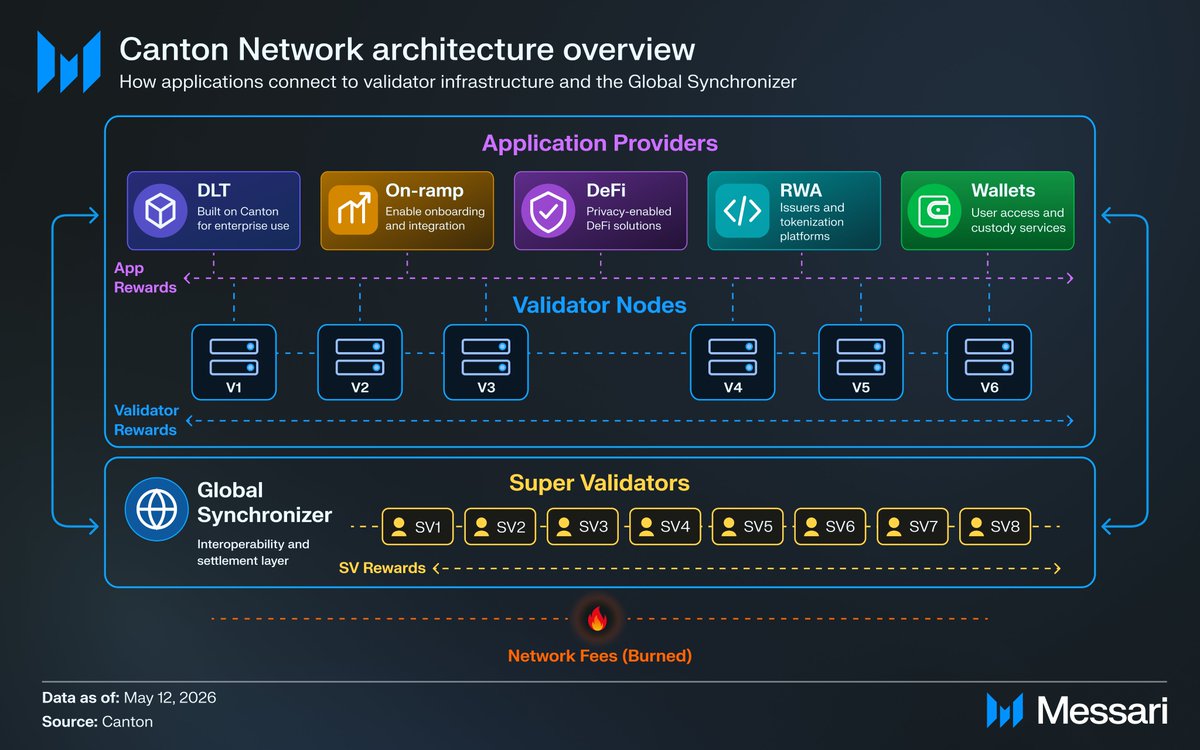
validator nodes only store and validate the subset of state relevant to the parties they host.
the Global Synchronizer orders transactions and prevents conflicts, but transaction contents remain encrypted and selectively disclosed.
applications can interoperate atomically across the network while preserving confidentiality.
this is very different from monolithic blockchain architecture.
4/ why does sub-transaction privacy matter?
financial workflows often involve multiple parties that need to settle together, but should not see the same information.
in Canton, a transaction can settle atomically while each participant only sees the portion relevant to them.
issuers, counterparties, validators, and applications can coordinate without every party observing the full transaction graph.
this is the privacy/composability tradeoff Canton is trying to solve.
5/ who is building on Canton?
Canton already has a meaningful institutional and crypto-native footprint. examples include:
@Broadridge, @The_DTCC, @jpmorgan, @HSBC, @FTI_US, @Tradeweb, @Visa, @EuroclearGroup, @SocieteGenerale, @chainlink, @LayerZero_Core, @circle, @FireblocksHQ, @BitGo, @zerohashx, @tradecraftfi, & @temple_ny
key developments include:
> tokenized deposit pilots
> collateral mobility workflows
> synchronized repo settlement
> stablecoin and custody infrastructure
Broadridge DLR processes more than $8T in monthly repo volume on Canton infrastructure.
important note: much of Canton’s highest-value activity has historically occurred through private deployments or private synchronizers using the same underlying technology.
the next phase is the migration of these workflows toward shared public infrastructure coordinated through the Global Synchronizer.
6/ where does $CC fit in?
$CC is used for:
> transaction fees
> infrastructure incentives
> application rewards
> operation of the Global Synchronizer
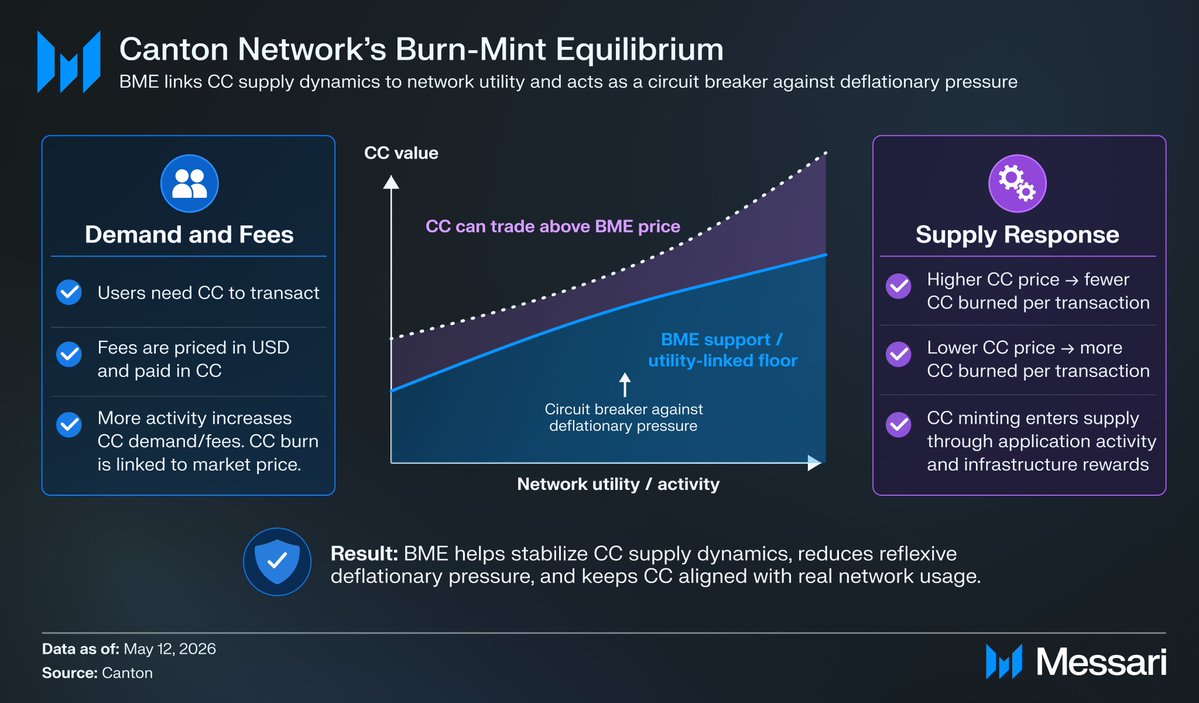
fees are denominated in USD terms and settled in $CC.
Canton’s token model uses a burn-mint equilibrium tied to network usage.
higher activity increases $CC demand/fees, and $CC burn is linked to market price.
higher $CC price -> fewer $CC burned per tx
lower $CC price -> more $CC burned per tx
issuance is distributed across:
> Super Validators
> validators
> application providers
> users
over time, the reward model increasingly shifts toward applications generating real network activity.
7/ what is next on Canton’s roadmap?
Canton’s 2026 priorities are focused on institutional asset adoption, performance, usability, standards, and ecosystem participation.
key roadmap items include:
> DTCC’s tokenized U.S. Treasury MVP, targeted for H2 2026
> initial phases of JPM Coin integration
> continued expansion of collateral mobility and synchronized settlement workflows
> scaling improvements targeting thousands of TPS on the Global Synchronizer
> higher throughput across application-specific subnets
> migration toward Canton-native BFT consensus
> broader adoption of wallet interoperability standard CIP-0103
> continued development of token standard CIP-0112
> further simplification of validator onboarding
longer term, Canton is focused on:
> regulated digital cash
> tokenized collateral
> privacy-preserving DeFi
> public-party functionality
> public verifiability for private transactions
> expanded smart contract language support beyond Daml
the roadmap reinforces Canton’s broader strategic focus of building shared infrastructure for privacy-preserving institutional settlement and regulated asset movement.
8/ disclaimer
this report was commissioned by Canton Network. all content was produced independently.
this post is informational only and not investment advice.
8
10
51
32,382
Cumberland retweeted

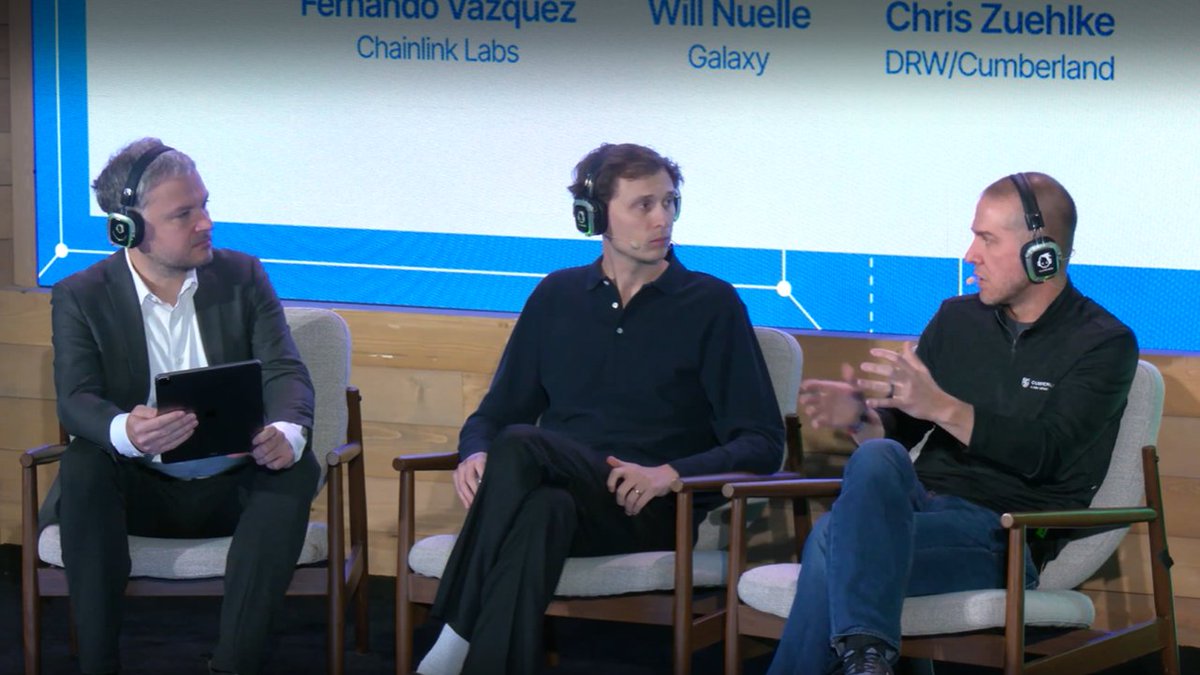
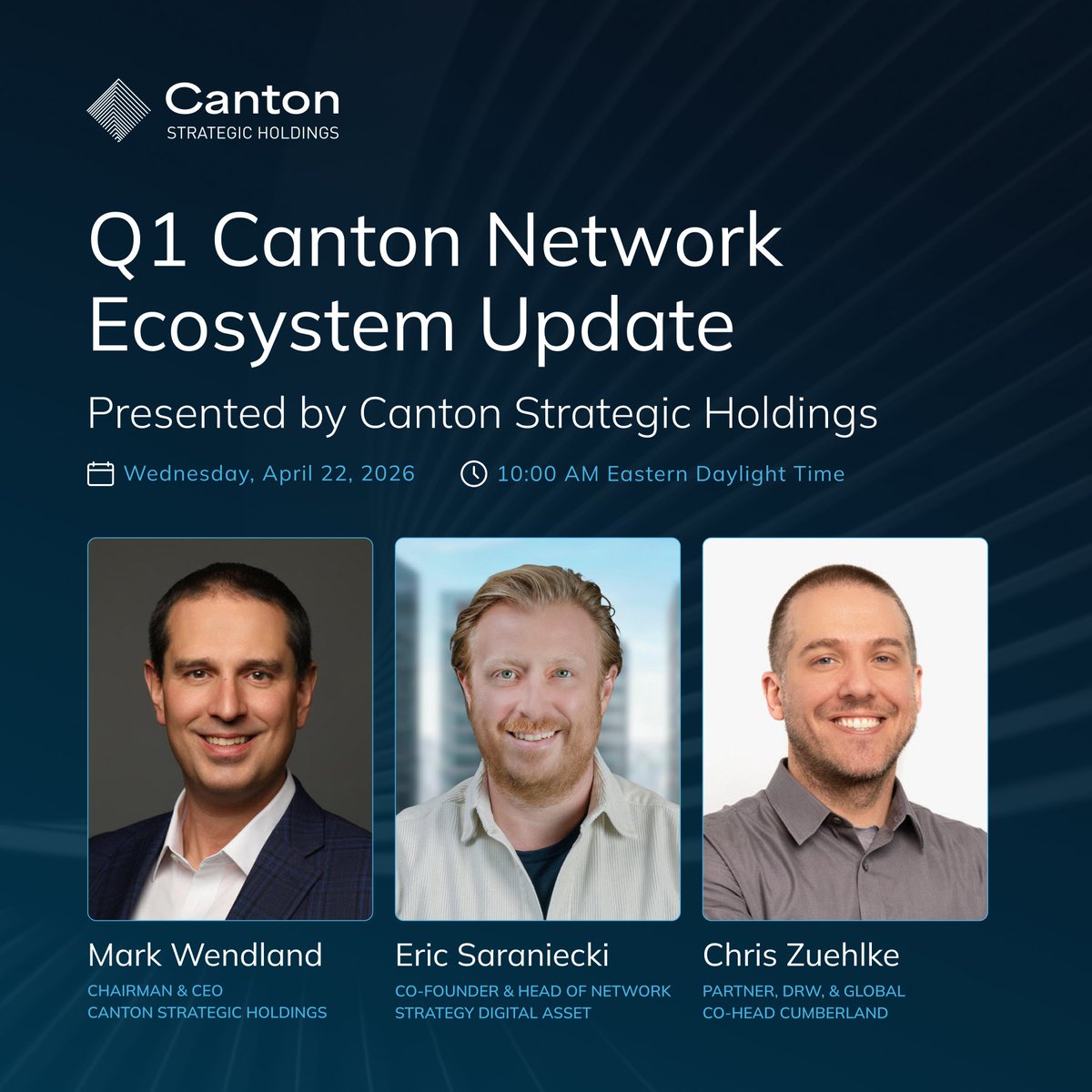
Join us Wednesday at 10:00am ET for a live webinar on our Q1 2026 @CantonNetwork Ecosystem Update. Together with @wesarn_real of @digitalasset and @Chris_Zuehlke of @CumberlandSays, @MarkWendlandCSH will to discuss ecosystem development and deep dive into $CC #tokenomics. Register here: app.webinar.net/Q45aZYxw9Pd
5
6
49
5,674

Apr 15
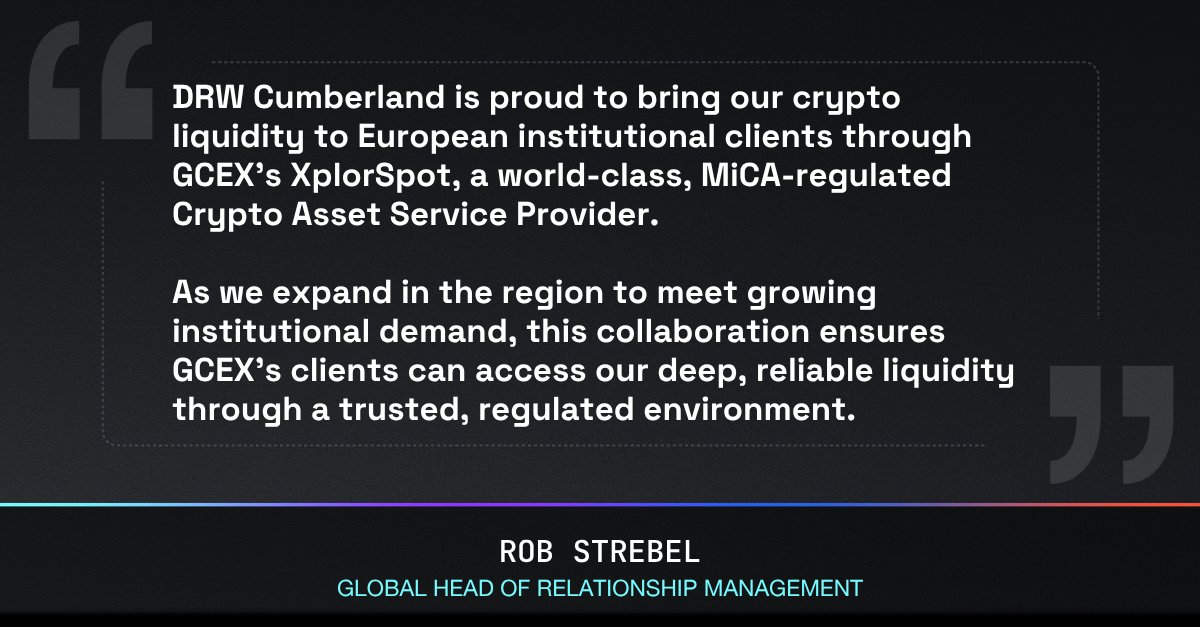
Cumberland is partnering with @GCEX_Official to expand access to institutional-grade crypto liquidity for GXEC’s professional and institutional clients across Europe.
Through this collaboration, GCEX clients can tap into Cumberland’s deep, reliable spot liquidity, enhancing execution quality and broadening access within a regulated framework.
Read the full press release: gc.exchange/media-room-press…
4
1,614

Today, we announced the launch of SoFi Big Business Banking—regulated infrastructure that gives enterprises the power to hold deposits, move money across fiat and digital assets, and settle transactions 24/7 instantly.
“To be competitive businesses today must operate in a global, always-on environment 24 hours a day, 7 days a week, while legacy banks typically still operate 9 to 5, Monday to Friday. - @anthonynoto
The future of enterprise finance starts here. Learn more: investors.sofi.com/news/news…
50
156
1,120
271,872
Mar 26
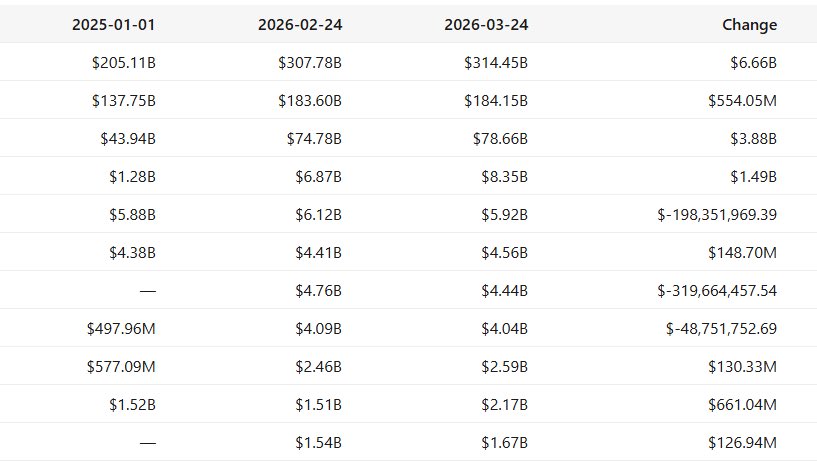
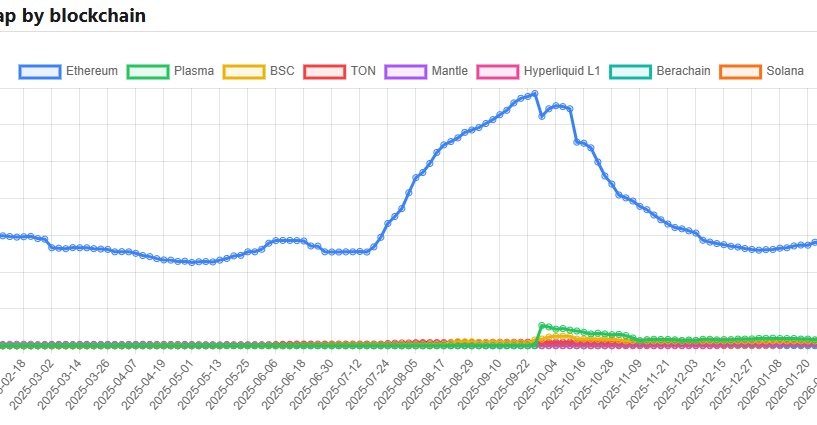
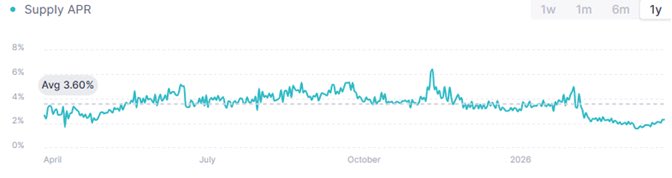
1/ During the height of every bull run, yields elevate across every corner of the crypto market. One primary driver is the desire for leveraged longs — most evident in the perpetual basis. Last cycle, a group of products led by Ethena emerged to systematically take advantage of these elevated yields.
7
3
28
7,541
Mar 26
12/ The positive take: low yields signal that long‑side leverage within crypto is depleted. Just as high yields signal an over‑leveraged long market (often preceding brutal sell‑offs), low yields imply fewer long positions to be forced liquidated.
2
2
9
1,993
Mar 26
13/ Bottom line — Yield compression is reallocating capital away from crypto risk products toward TMFs or cash. That reduces leverage‑driven downside risk, but also signals muted appetite for a bullish run until onchain returns re‑open.
3
9
1,530
Cumberland retweeted

Mar 16
Earlier this month the Fed, FDIC, and OCC issued major new guidance: they view bank capital requirements as “technology-neutral.” This is a massive opportunity for increased adoption of blockchain technology.
With the regulatory framework becoming increasingly clear, institutions are racing to adopt blockchain — but many are building walled gardens that could kill the very innovation they're chasing.
Three risks no one is talking about:
❗️Fragmented ecosystems — private chains that can't talk to each other
❗️ Bifurcated liquidity — same asset, different settlement, siloed markets
❗️Stranded value — atomic settlement's upside locked behind proprietary walls
2
3
21
3,313
Mar 6
We’re aware of fake accounts impersonating CumberlandSays. Our team will only communicate through this verified account and official Cumberland channels. Any other outreach claiming to be us is fraudulent. Please do not engage and report those accounts to the platform immediately.
3
1,848