
Professional Validator and Staking Service Provider. Stake with us in: #CELESTIA, #CCD, #DYMENSION, #FUEL, #SEDA , #QUICKSILVER, #AVAIL, #STARKNET #ESP #ATOM
Joined January 2022
- Tweets 4,621
- Following 785
- Followers 1,644
- Likes 15,294
1,084 Photos and videos




Cumulo retweeted

Jun 12
Cosmos Hackathon Kick Off
Deets on the upcoming MAD easy hackathon with 2000$ in prizes
🎤 @RoboMcGobo @Rekt_Zerker
⏰ Mon Jun 15th, 16:00 UTC
👇 Set your reminders
x.com/i/spaces/1NxarrAoRQgKj

31
35
57
4,261

Jun 12
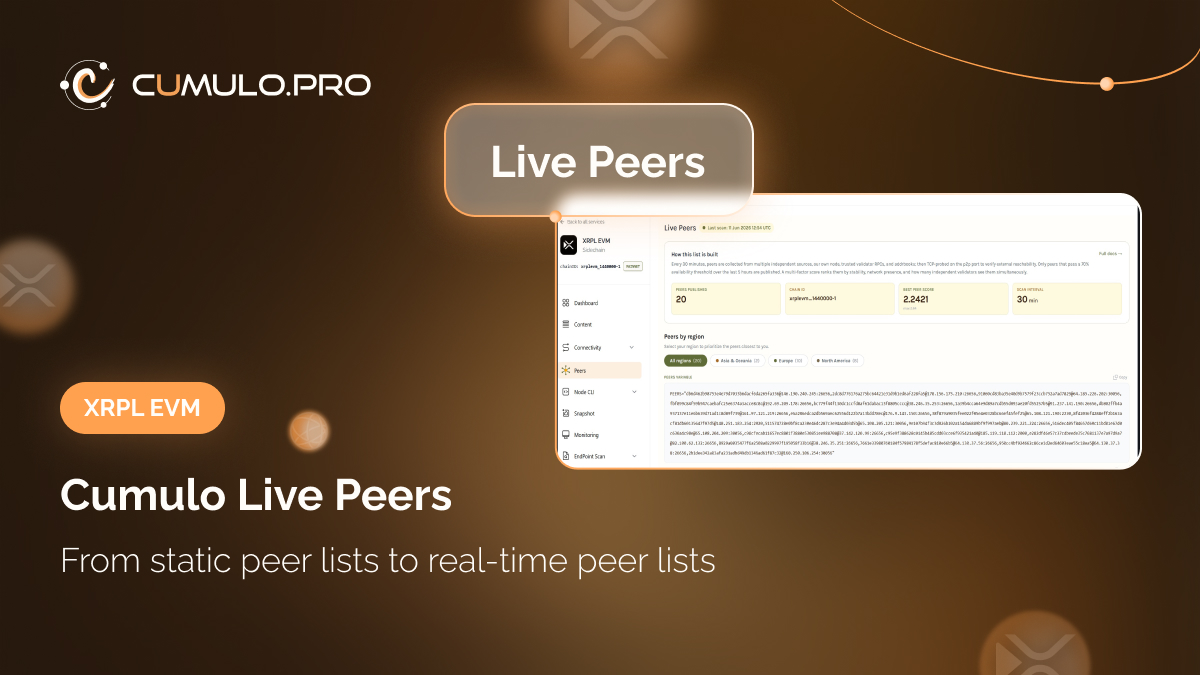
Live peers for XRPL EVM: keeping node connectivity practical 🌐
Running an XRPL EVM node means dealing with one of the most common infrastructure problems: peer connectivity.
Static peer lists can be useful as a starting point, but they become outdated very quickly. A peer that was visible from one node yesterday may not be reachable from the outside today, and when a node starts struggling to connect, that difference matters.
That is the reason behind Cumulo Live Peers ⚡
We built it as a live peer checker for XRPL EVM mainnet and testnet, updated every 30 minutes and available through both a public dashboard and API.
The goal is simple: continuously detect which peers are actually reachable, remove unstable entries, and provide node operators with a peer list that is useful in real operational situations.
How Cumulo Live Peers works 🛠️
Every 30 minutes, the system creates a new candidate pool using several sources:
🧩 Our own XRPL EVM nodes
🌐 RPC endpoints from validators in the ecosystem
📚 Addrbooks and peer lists collected from validator resources
🤝 Peers contributed directly by operators
Each candidate is then tested through a direct TCP check against its P2P port.
If a peer cannot be reached from the outside, it is not included in the published list.
We also avoid adding peers just because they appeared once. To be included, a peer needs to show consistent stability across roughly the last 5 hours of observations. If it disappears, becomes unreachable or stops behaving reliably, it is automatically removed after a few cycles.
A useful list, not just a longer one 🔎
It is designed to publish a peer list that operators can actually trust when they need to recover or improve connectivity.
Peers are scored based on:
📈 Recent stability
🔁 Outbound activity
✅ How many independent sources confirmed the same peer
🌍 Geographic diversity
This helps reduce noise and avoid peer lists filled with random entries that may not be helpful in practice.
For operators, especially during a connectivity issue, quality matters more than quantity.
Ready to use 🚀
The live peer lists are already available here:
🔗 Mainnet:
cumulo.pro/services/xrplevm_…
🔗 Testnet:
cumulo.pro/services/xrplevm/…
📖 Full technical documentation:
github.com/Cumulo-pro/Cumulo…
Why this matters 🧠
At Cumulo, we operate validator infrastructure across XRPL EVM, Cosmos and modular networks, and peer connectivity is one of those topics that looks simple until something breaks.
Cumulo Live Peers is our way to make this part of node operations more practical for the XRPL EVM ecosystem: live checks, public data, reproducible logic and continuously updated peer lists without manual maintenance.
We hope this becomes useful for XRPL EVM validators, node operators and infrastructure teams.
Feedback, suggestions and validator contributions are very welcome 🤝
2
3
82
Jun 11
🗳️ We voted YES to Starknet v0.14.3
Voting is now active to approve @Starknet v0.14.3 as a minor upgrade, and Cumulo has already cast its vote in favor.
This upgrade brings key improvements to the network:
⚡️ More frequent blocks and lower latency with SNIP-40
💸 Dynamic L2 gas base fee tied to the STRK price through SNIP-35, improving fee predictability
⚠️ RPC 0.8 deprecation: teams should migrate to RPC 0.9 or 0.10.1 / 0.10.2
📅 Sepolia testnet: June 9
📅 Mainnet target: June 22, 2026
As validators on Starknet, we continue supporting upgrades that make the network more efficient, predictable, and ready for its next stage of decentralization.
Review the full notes and participate in the vote 👇
community.starknet.io/t/star…
2
3
103
Jun 10
⚛️ What really happens with gas when you pay many recipients at once on @cosmos ?
We published a new article exploring multi-send on @cosmoshub through a real testnet case study, using actual transactions to measure how gas behaves as the number of recipients increases 📊
With Gaia v27.0.0, multi-send gas is no longer purely linear.
It now includes a quadratic surcharge designed to make large-scale spam increasingly expensive, while keeping legitimate use cases accessible 🛡️
In the article, we cover:
🔹 What multi-send is and why it matters
🔹 How gas works in Cosmos Hub
🔹 The quadratic surcharge introduced in Gaia v27.0.0
🔹 Real gas data from testnet transactions
🔹 The empirical formula behind the total gas cost
🔹 Why this matters for validators, developers, protocols and users
At Cumulo, we are validators on @cosmoshub ⚛️ and for us, running infrastructure also means testing, measuring and explaining how the network behaves in practice.
Read the full article here 👇
🇬🇧 EN: medium.com/cumulo-pro/multi-…
🇪🇸 ES: medium.com/cumulo-pro/multi-…
Real data. Real transactions. Real infrastructure 🛠️
2
5
96
Jun 10
🎉 Congratulations to @Concordium on 5 years of mainnet!
Cumulo has been validating Concordium since the very beginning, and we’re proud to have supported the network throughout this journey.
Privacy, identity and trust at the protocol level have always been key pillars of Concordium, and they are becoming even more relevant as blockchain infrastructure evolves toward verified humans and verified agents.
Excited to keep building and validating alongside the Concordium ecosystem for the next chapter 🚀
Jun 9

🎉 5 years ago, Concordium mainnet went live.
We started with a simple belief:
Trust should be built into the protocol.
Five years later, that foundation powers verified identity, privacy-preserving accountability, settlement infrastructure, and now the trust layer for AI agents.
Verified Humans.
Verified Agents.
One Protocol.
Here’s to the next 5 years. 🚀

1
5
95
Jun 8
🚀 Cumulo validator & infrastructure report: last 2 weeks
Although it does not always show on the surface, these past weeks have been packed with lot of technical work, and projects like @cosmos and @celestia continue to stay very active across upgrades, coordination, and infrastructure operations.
Check our internal infraestructure activity over the last two weeks:
🟠 @cosmoshub / testnet: voted YES on Prop #301 for the Gaia v27.4.0-rc0 upgrade and executed the provider chain upgrade, signing within the first blocks after restart
🟠 @cosmoshub / testnet: migrated infrastructure to higher-capacity servers, including the RPC stack, reverse proxy, SSL, addrbook exporter, and Horcrux signer
🟠 @cosmoshub / mainnet: voted NO WITH VETO on Props #1038, #1039, and #1040 due to fraudulent spam/phishing content, and voted YES on Prop #1041 for the Gaia v27.4.0 upgrade
🔷 @GenLayer / Bradbury: upgraded the validator to v0.5.12 with self-recovery fixes and security improvements
🔷 @GenLayer / Asimov: upgraded the validator to v0.5.12 with the same operational fixes and hardening
📖 @StoryProtocol / mainnet: executed the mandatory hardfork to Story v1.8.0 (Seneca) ahead of the scheduled height, with full post-upgrade verification
⚡ @Starknet / mainnet: enabled the staking pool for our strkBTC node, making it live and ready to receive delegation
🌌 @celestia / mainnet: upgraded nodes to celestia-app v8.0.8 during the scheduled maintenance window
🌌 @celestia / Mocha testnet: executed the upgrade to celestia-app v9.0.1-mocha with on-chain signaling for v9
🌌 @celestia / Mocha testnet: upgraded the bridge node to celestia-node v0.31.1-mocha
🌌 @celestia / Mocha testnet: upgraded validator, RPC, and consensus nodes to celestia-app v9.0.2-mocha and celestia-node v0.31.1-mocha
🐒 @monad / testnet: upgraded our full node to v0.14.5 within the required operational window
💠 XRPL EVM / mainnet: voted YES on Prop #32 to add a new validator to the network
At Cumulo, we handle validation as production infrastructure work: upgrade readiness, governance monitoring, migration discipline, service continuity, observability, and controlled execution.
Reliable validator operations are not just about keeping nodes online, but about managing critical systems with traceability, technical judgment, and professional standards.
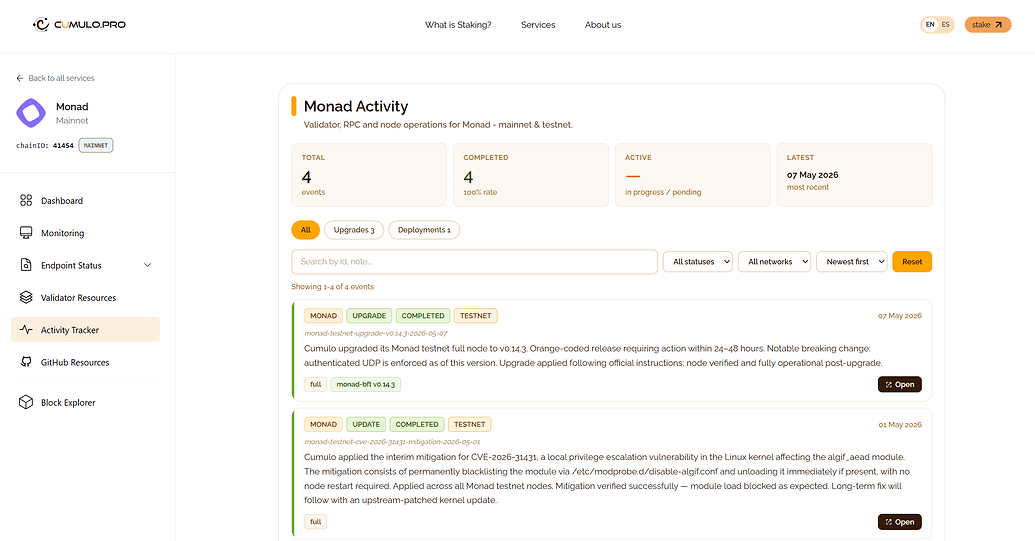
That is why we maintain our Activity Tracker: a public, JSON-backed record where we continuously document upgrades, migrations, deployments, and governance actions in an auditable format.
📍Follow our activity here:
cumulo.pro/services/activity…
3
8
257
Jun 4
🏦 RLUSD is now live on XRPL EVM.
A major step for bringing regulated liquidity, XRP utility and multichain DeFi closer together.
With RLUSD expanding through @wormhole NTT, builders on XRPL EVM can access new possibilities for:
💧 Liquidity
🔁 Swaps
📦 Collateral
💸 Payments
🌐 Cross-chain finance
At Cumulo, as XRPL EVM validators we’re proud to support the project and keep contributing to the infrastructure behind its growth.
$RLUSD × $XRP is a big move for builders 💪.
Jun 4

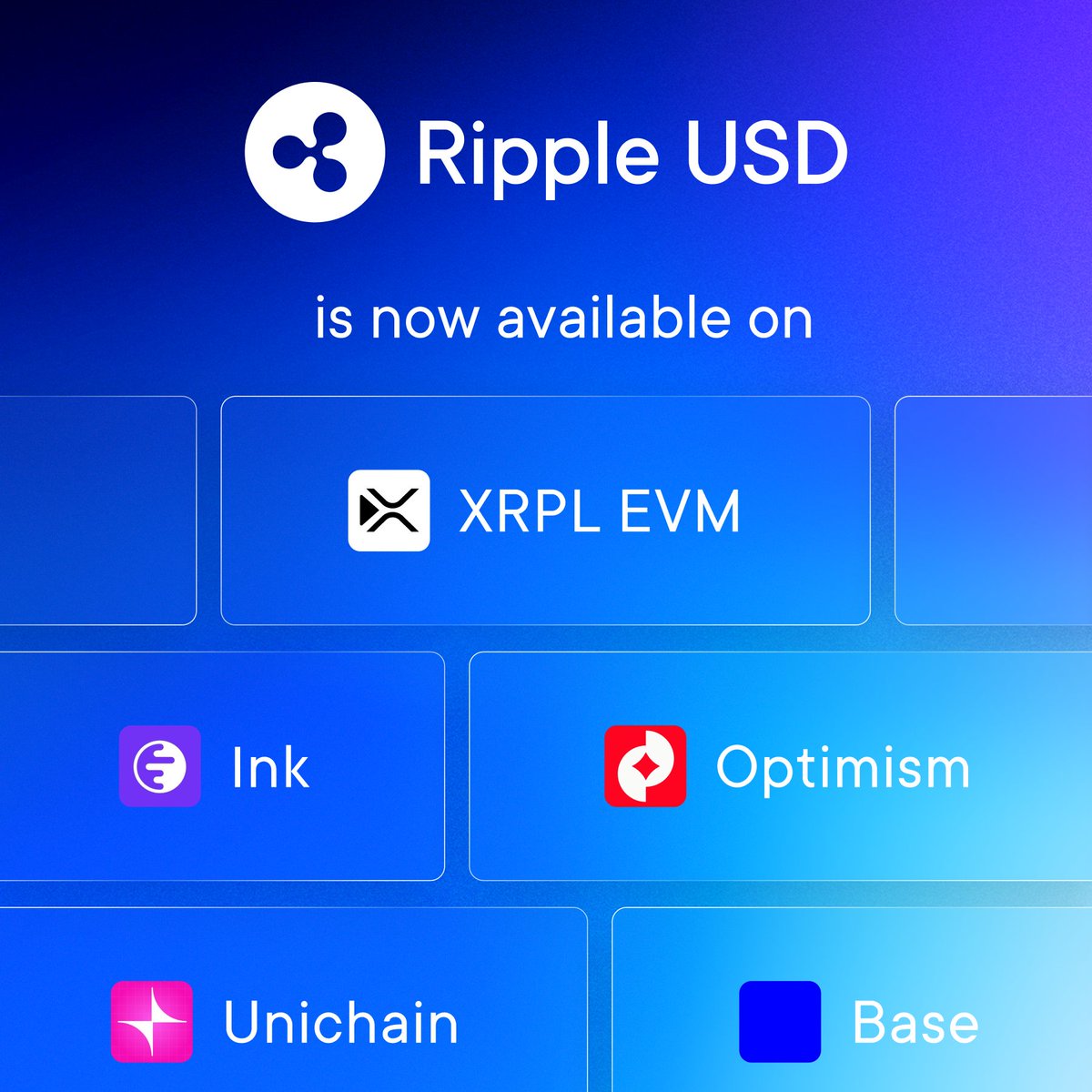
The XRPL EVM Sidechain is now live with Ripple USD $RLUSD.
A key part of RLUSD's multichain expansion, the XRPL EVM Sidechain combines compatibility with existing EVM developer tooling while remaining closely connected to the XRP Ledger, helping meet growing demand from developers looking to build with XRP.
RLUSD has seen growing adoption across smart contract-based ecosystems, highlighting demand for regulated stablecoins within DeFi and multichain finance.
As $RLUSD becomes available across these environments, $XRP can increasingly serve as a complementary asset for liquidity, settlement, swaps, collateral, and payments, thereby strengthening the utility of XRP and RLUSD across supported chains.
This expansion is powered by @wormhole's NTT standard, enabling RLUSD to move natively across chains.
4
11
1,061
Jun 4
🧵 XRPL EVM May recap ⚡
May was a busy month for XRPL EVM.
Lower fees, a new wallet, early use cases, and several important improvements on the way.
Quick recap 👇
💸 Much lower fees
Proposal #29 passed with 100% approval from 18 validators. A simple transaction now costs only 0.000016 XRP, matching the cost of XRPL mainnet.
This is a big step for: ⚡ Micropayments, 🧩 Smart contracts, ⏱ Fast-finality apps, 🌱 Real-world use cases with ripple:native
More info:
governance.xrplevm.org/propo…
👛 New wallet for XRPL XRPL EVM
A new unified wallet is now available at:
wallet.xrplevm.org
The goal is simple: manage XRPL and XRPL EVM from one interface using @MetaMask .
Signatures are automatically routed depending on the action, making the experience much smoother.
It also integrates XR Bridge, powered by @axelar, to move assets from Ethereum and other EVMs into XRPL EVM.
Original post:
x.com/Peersyst/status/205929…
🔮 First use cases taking advantage of the new fees
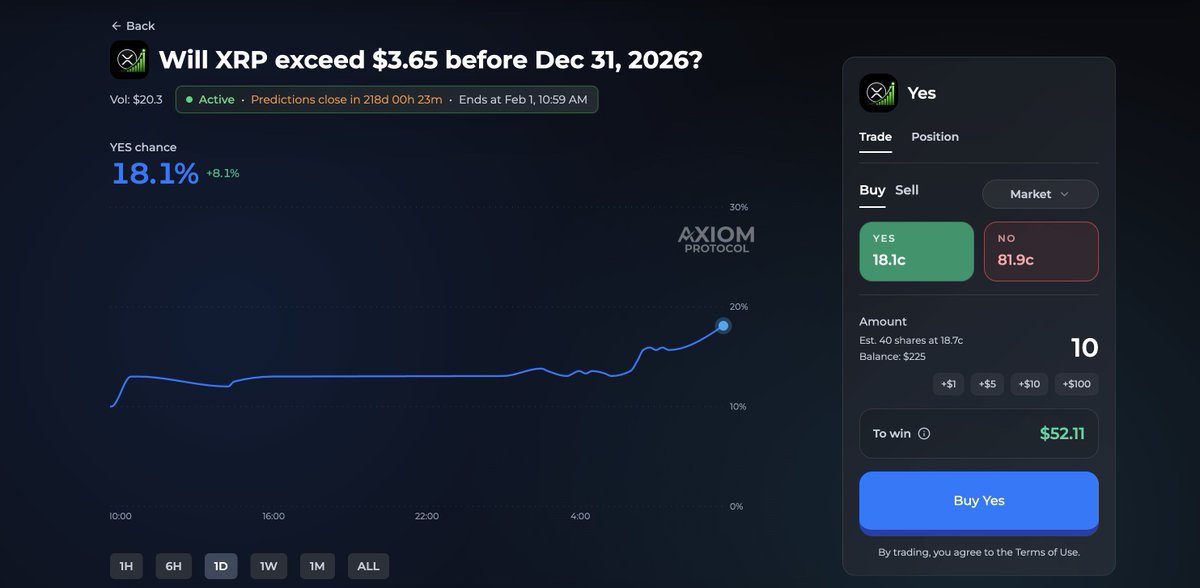
@AxiomProtocol_ is already building on top of this new low-fee environment with a prediction market on XRPL EVM.
Original post:
x.com/AxiomProtocol_/status/…
🗺 What’s next?
💸 A micropayments app as the first demo of low fees programmability
🔗 Longer IBC channel bonding time for more stability
🛠 Fund recovery from the Elys Network shutdown through governance
👛 More wallet improvements, including custodian deposits and more EVM assets
XRPL EVM by @Peersyst is moving into a more practical phase, with better infrastructure, better UX, and more reasons for builders to start experimenting on the network.
At Cumulo, we keep supporting the network as validators and following closely what comes next ⚡
May 27

LIVE: 18.1% chance for ripple:native to break ATH in 2026
Predict the future using XRP
Only on Axiom Protocol
1
3
12
655
Jun 3
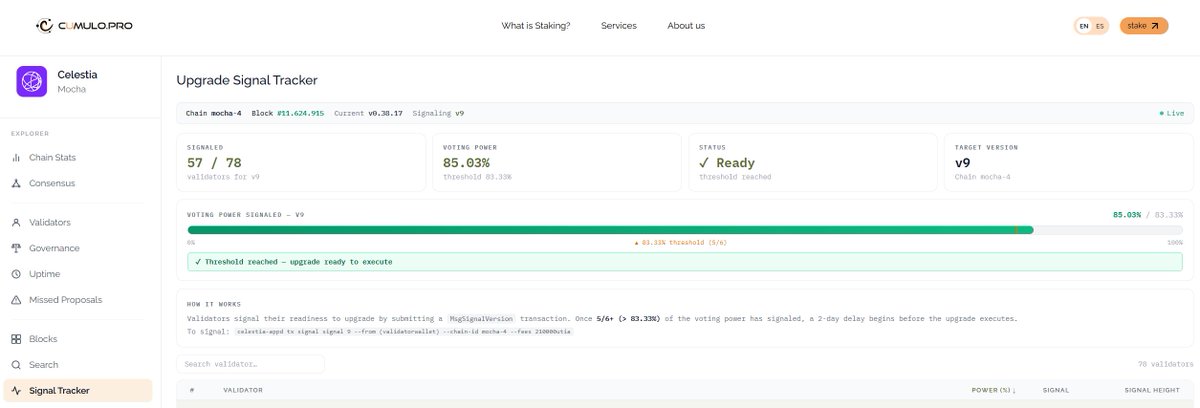
🚀 Celestia Mocha v9 is getting closer!
The upgrade signaling process for @celestia Mocha has reached the required voting power threshold ✅
Current status:
🟢 57 / 78 validators signaling
🗳️ 85.03% voting power
🎯 Threshold: 83.33%
⚙️ Target version: v9
This upgrade brings an important improvement to Mocha: blocks will move to 3-second block times, making the testnet faster and more aligned for future testing and development.
As validators signal readiness through MsgSignalVersion, the community can follow the process in real time using our Upgrade Signal Tracker:
👉 cumulo.pro/services/celestia…
Built by Cumulo to help the Celestia community track upgrades with more visibility 🌌
7
49
1,455
Jun 2
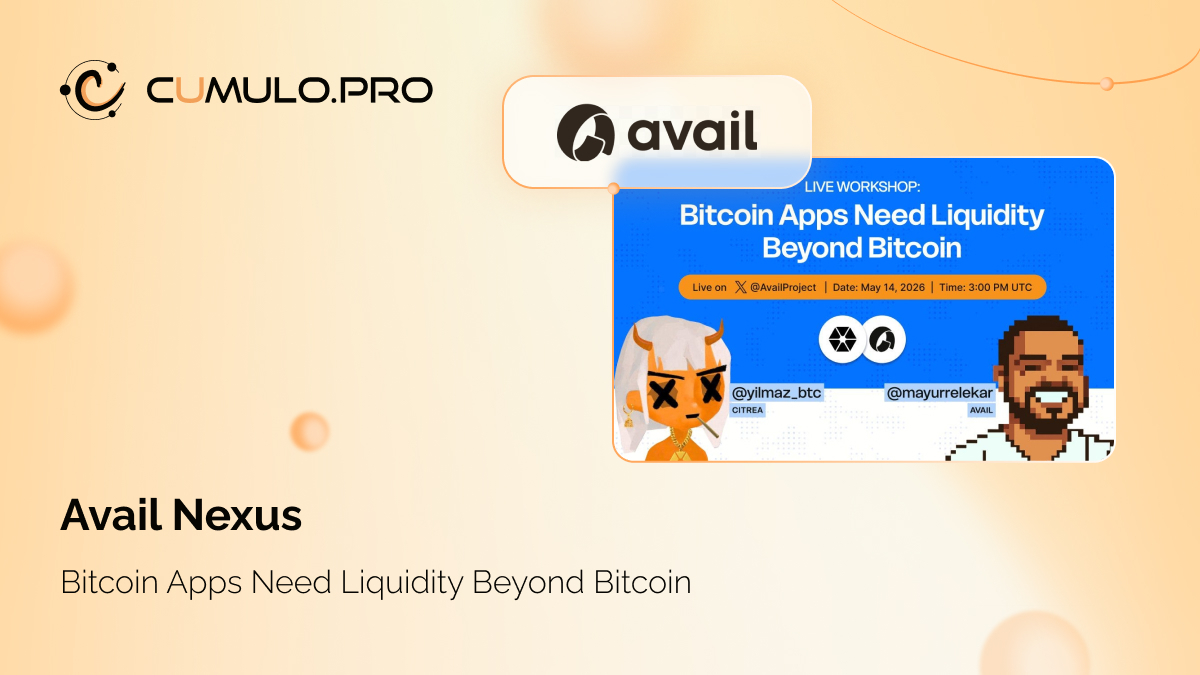
🚀 New article by Cumulo is live!
Bitcoin apps are growing, but liquidity is still fragmented across multiple chains.
In our latest Medium article, we recap the live workshop with @AvailProject, featuring @mayurrelekar from Avail and @yilmaz_btc from @citrea_xyz, focused on how Avail Nexus helps Bitcoin apps access cross-chain liquidity in a much smoother way.
Main points covered 👇
🔹 Why liquidity fragmentation is a major UX problem for Bitcoin apps
🔹 How Avail Nexus enables N-to-1 cross-chain liquidity aggregation
🔹 The live demo with Mystic Finance on Citrea
🔹 How users can deposit into Bitcoin L2 apps without manual bridging
🔹 Why this matters for developers building better onboarding flows
Avail Nexus shows how complex cross-chain actions can be abstracted into a simple user experience, helping Bitcoin apps become more accessible, composable and ready for real adoption.
📖 Read the full article:
English version:
medium.com/cumulo-pro/bitcoi…
Spanish version:
medium.com/cumulo-pro/las-bi…
6
11
286
Jun 1
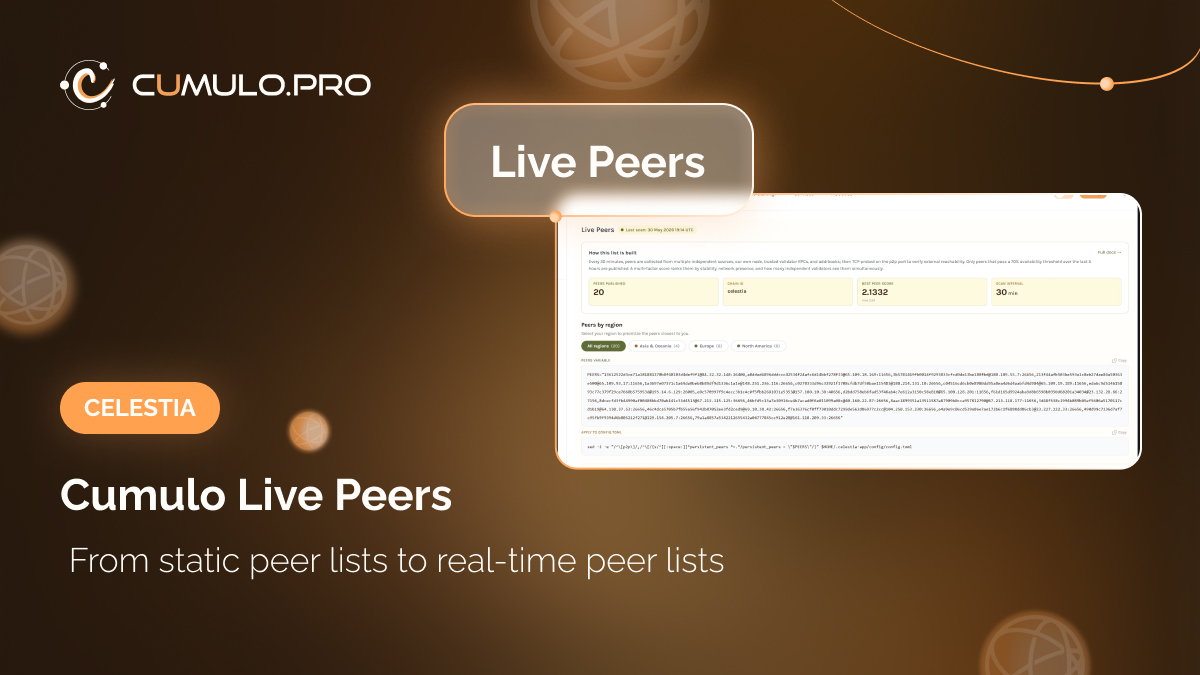
🌐 Cumulo Live Peers: from static peer lists to real-time peer lists
Cumulo Live Peers for @celestia is a live peer checker for Celestia mainnet and Mocha testnet, designed to help validators and infrastructure teams find peers that are actually reachable and useful right now.
When a node starts having connectivity issues, a static list is often not enough.
What operators need in that moment is simple: peers that are reachable from the outside, stable over time, and ready to use.
Cumulo Live Peers checks peer availability every 30 minutes and builds updated lists using multiple sources:
🔎 Our own Celestia nodes
🌐 RPC endpoints from validators in the ecosystem
📚 Addrbooks and public peer lists
🤝 Peers contributed directly by operators
Each candidate peer is tested through a direct TCP check against its P2P port.
If a peer is not reachable from the outside, it does not make it into the published list.
We also avoid publishing peers just because they appeared once. To be included, a peer needs to show consistent stability across several observation cycles.
The goal is not to publish the biggest possible peer list.
The goal is to publish a useful one.
Peers are scored based on:
✅ Recent stability
✅ Outbound activity
✅ Confirmation from independent sources
✅ Geographic diversity
You can use the live peer lists here:
Mainnet:
cumulo.pro/services/celestia…
Mocha testnet:
cumulo.pro/services/celestia…
Full technical documentation:
github.com/Cumulo-pro/Cumulo…
We also maintain validator resource lists for Celestia mainnet and Mocha, so validators can contribute RPCs, addrbooks and peers via PR.
The more validators contribute, the better the system becomes for everyone.
We shared the full explanation on the Celestia Forum 👇
forum.celestia.org/t/cumulo-…
This is part of how we approach our role as @celestia validators at Cumulo: building tools that reflect our vision of solid, transparent and reliable infrastructure, while adding real technical value to the networks we support.🌌
3
5
114
May 28
TL;DR 👇
Static peer lists get outdated fast. Cumulo Live Peers keeps checking which Cosmos Hub peers are reachable, stable and useful for node operators.
When you run a @cosmoshub node and connectivity starts failing, a static peer list is often not enough.
What you need in that moment is simple: peers that are actually reachable from the outside right now. Not peers that were visible from one node a few days ago.
That is why we built Cumulo Live Peers 🌐
A live peer checker for @cosmos Hub mainnet and testnet, updated every 30 minutes and available through both a public dashboard and API.
The idea is simple:
🔎 keep checking which peers are really reachable
🧹 filter out unstable ones
🛠️ give node operators a list they can actually use
How it works ⚙️
Every cycle, Cumulo Live Peers builds a candidate pool from several sources:
🟢 Our own Cosmos Hub node
🟢 RPC endpoints from validators in the ecosystem
🟢 Addrbooks and peer lists collected from validator resources
🟢 Peers contributed directly by operators
Then we test each candidate with a direct TCP check against its P2P port.
If a peer is not reachable from the outside, it does not make it into the published list.
Simple rule:
✅ reachable peers stay in the process
❌ unreachable peers are filtered out
Not just “more peers” 📡
The goal is not to publish the biggest possible list.
The goal is to publish a useful one.
Peers are scored based on recent stability, outbound activity, how many independent sources confirmed the same peer, geographic diversity.
This helps avoid lists full of random peers that may not help much in practice, especially when an operator is trying to recover connectivity quickly.
Ready to use 🚀
You can use the live peer lists here:
Mainnet:
cumulo.pro/services/cosmos/p…
Testnet:
cumulo.pro/services/cosmos_t…
Full technical documentation:
github.com/Cumulo-pro/Cumulo…
At Cumulo, we run validator infrastructure across Cosmos and modular networks.
Cumulo Live Peers is our attempt to make that part of node operations a little more practical:
🔍 live checks
📖 public data
⚙️ reproducible logic
♻️ a list that keeps updating without manual maintenance
We hope this is useful for Cosmos Hub validators, node operators and teams running infrastructure.
Feedback, suggestions and validator contributions are very welcome 🤝
2
2
5
133
May 28
Validator resource lists 🤝
To make the external sources more useful, we also maintain public validator resource lists for Cosmos Hub mainnet and testnet.
These include:
🔗 RPCs 📚 addrbooks 📡 contributed peers
The more validators contribute their resources, the better the scoring becomes for everyone.
Why?
Because the system can compare more independent sources and build a more representative view of the network.
If you are a @cosmoshub validator and want to add your resources, you can open a PR here:
Mainnet validators: github.com/Cumulo-pro/cumulo…
Testnet validators: github.com/Cumulo-pro/cumulo…
2
6
99
May 28
An important step for making XRPL EVM easier to use beyond the technical crowd 🌱
As XRPL EVM validators, we’re excited to keep supporting this ecosystem as it grows 🚀💪
May 27

🌱XRPL EVM infrastructure is getting ready for new exciting use cases:
⚡️Now supporting ripple:native micropayments, same fees as XRPL
💻Adding a programmability to combine logic micropayments 3s finality
🦊Brand new wallet.xrplevm.org allows multinetwork management in 1 wallet
2
1
6
161
May 26
₿ New guide by @Cumulo_pro is live! ⚡
We’ve published a step-by-step guide on How to stake BTC on Starknet, designed for users who want to bring Bitcoin into Starknet DeFi and start making it productive.
In the guide, we cover:
🔹 How to get wrapped BTC on Starknet
🔹 How to swap into strkBTC using @avnu_fi
🔹 The main risks of BTC wrappers
🔹 How to stake BTC through @endurfi
🔹 How to choose a validator and delegate
🔹 Why Starknet is becoming a powerful environment for BTC DeFi
With low fees, fast confirmations and ZK-powered security, @Starknet is opening a new path for Bitcoin users who want more than just holding.
At Cumulo, we are Starknet validators and one of the validators already supporting strkBTC staking.
📖 Read the full guide:
🇬🇧 English version:
medium.com/cumulo-pro/how-to…
🇪🇸 Spanish version:
medium.com/cumulo-pro/cómo-…
We’ll keep building infrastructure, guides and resources to make the @StarknetFndn ecosystem more accessible to users, builders and the wider community. 🧱
2
2
8
179
May 26
Cumulo will be concluding validator operations on @StoryProtocol following the SIP-011 active set consolidation process.
We want to thank the Story team for the opportunity to contribute as validators, from testnet operations to mainnet infrastructure.
For our delegators: please redelegate or unstake your $IP as soon as possible.
We will keep our node running during the notice period and until delegations are cleared.
Although our validator operations and all the tools & service pages we developed for the protocol are coming to an end, Cumulo will continue building and operating strong and professional infrastructure across multiple networks.
Thank you to everyone who supported us during this journey.
3
2
10
494
May 25
Who says there's not much going on?!! 👩🔧🧑🔧
🚀 Cumulo weekly validator & infrastructure report: May 15–23
Over the last week, our team executed validator operations, upgrades, governance actions, and incident-aware infrastructure work across multiple networks, check what we did? 👀👇
☕ @EspressoSys / Mainnet: upgraded our mainnet node to 20260424, applying query and pruning optimizations and verifying healthy peer connectivity and consensus progression
📖 @StoryProtocol / Aeneid testnet: upgraded our validator to Story v1.7.0 (Seneca) ahead of the scheduled hardfork, with full sync and post-upgrade consensus validation
🛡️ @cosmoshub: voted NO WITH VETO on Prop #1037, a spam/scam proposal with no legitimate onchain purpose
🟣 @massachain / Mainnet: executed the mandatory MAIN.5.0 hard fork upgrade and rejoined the corrected network after the illegal minting fix
🔷 @GenLayer / Asimov: upgraded our validator to v0.5.11
💠 XRPL EVM by @Peersyst / Mainnet: voted YES on Prop #31 to recover expired IBC light clients for Injective and Elys
🟠 @cosmoshub Hub / Mainnet: executed the Gaia v27.3.0 upgrade at the scheduled height, covering validator, RPC, and backup infrastructure with post-upgrade verification
🔷 @GenLayer / Bradbury: upgraded our validator to v0.5.11
🐒 @monad / Testnet: upgraded our full node to v0.14.4 following the release window and verified full operational status
At Cumulo, validator operations are handled as production infrastructure work: upgrade readiness, governance monitoring, incident response, controlled execution, and post-upgrade verification across live environments.
That is also why we maintain our Activity Tracker: a public, JSON-backed operational log where we document upgrades, governance votes, incidents, and infrastructure actions in a transparent and auditable format.
📍Follow our activity here:
cumulo.pro/services/activity…
1
4
177

May 22
🌐 Tokenization is moving from narrative to real institutional infrastructure.
In our latest article, we analyze the Beyond Cosmoverse conversation with Anina Milanović from the World Bank, and what it means for @cosmos, capital markets and the future of regulated digital assets.
The key idea is clear:
Tokenization is not here to replace traditional capital markets.
It is here to upgrade them.
In the article, we cover:
🔹 How Serbia built one of the earliest digital asset regulatory frameworks before MiCA
🔹 Why stablecoins pushed traditional finance to take blockchain infrastructure seriously
🔹 The three institutional requirements for tokenized assets: legal certainty, trusted infrastructure and secondary liquidity
🔹 Why emerging markets may have a unique opportunity to move faster
🔹 How Cosmos-IBC architecture, sovereignty and interoperability fits naturally into this new financial landscape
For the @cosmos community, this conversation matters.
If regulated financial assets start moving across digital infrastructure, networks like Cosmos can play a key role in making those assets interoperable, auditable and usable across jurisdictions.
At Cumulo, we are validators in @cosmoshub and we believe this is exactly the type of long-term infrastructure narrative that matters for the ecosystem.
📖 Read the full article:
🇬🇧 English version:
medium.com/cumulo-pro/regula…
🇪🇸 Spanish version:
medium.com/cumulo-pro/regula…
1
4
152