
Reading Hacash docs. Verifying the shift from Phase 1 noise to Phase 2 sovereignty. One-way BTC. Channel chains. github.com/hacash/doc
Joined July 2023
- Tweets 210
- Following 34
- Followers 222
- Likes 4
42 Photos and videos






Pinned Tweet

May 17
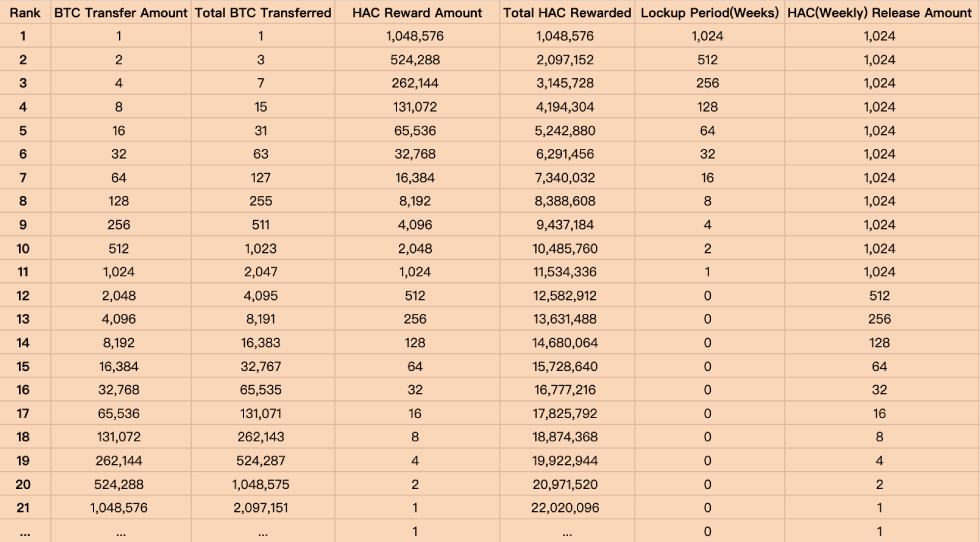
Let me explain the $BTC one-way transfer to #Hacash in the simplest way possible.
Imagine you have Bitcoin. You love Bitcoin. But you also wish Bitcoin could do more like send instantly, or use in apps, without waiting ten minutes per transaction or paying high fees.
#Hacash offers a way to do that. But it works differently than anything you've seen before.
Here's how it works, step by step.
You take your Bitcoin and send it to a special address on the Bitcoin network. This address isn't controlled by any person, company, or group. It's generated by math. No one knows the private key. Not even the Hacash team. Once Bitcoin goes there, it cannot be moved again. That's why we call it a black hole address.
When Hacash sees that your Bitcoin has arrived and been confirmed on the Bitcoin network, it does something simple. It creates the same amount of BTC on the Hacash network. And it gives control of that BTC to you. Not a wrapped version. Not an IOU. Protocol-native BTC, secured by Hacash's consensus.
The most important part: you use the exact same private key you used on Bitcoin. If you control your Bitcoin with a certain seed phrase or wallet, that same key controls your BTC on Hacash. You don't need to learn a new system. You don't need to trust a new custodian. Your keys, your coins. Always.
And here's something else that matters: it becomes private.
On Bitcoin, every transaction is visible to everyone. Forever. Your balance, your sends, your receives all public. That's great for verification, but not always great for privacy.
Hacash is different. Transactions are pseudonymous by default. Your activity isn't broadcast to the world unless you choose to share it. You can verify your own transactions without exposing them to surveillance. You can prove what you need to prove, to who you need to prove it to, without revealing everything to everyone.
This isn't about hiding. It's about choice. Privacy by default. Transparency by choice.
Why does this matter?
Because now your Bitcoin can do things Bitcoin wasn't designed to do. It can move in less than a second. It can be used in applications without risking smart contract exploits. It can participate in DeFi without approving infinite spending or signing blind transactions. And it can do all of this without forcing your financial life into the public eye.
And none of this requires you to trust a bridge operator, a multisig wallet, a federated validator set, or an oracle. There is no middleman. There is no upgradeable contract that can be paused or drained. There is only code that runs exactly as written.
This is not a bridge in the traditional sense. Bridges usually work both ways. They let you deposit BTC and get wrapped BTC, then later redeem it. That back-and-forth requires trust. It requires validators. It creates attack surfaces. We've seen what happens when those bridges fail. Millions lost. Users left with nothing.
Hacash removes that risk by removing the return path. Yes, it's one-way. Once your BTC is on Hacash, it stays on Hacash. That's not a bug. That's the design. By eliminating the ability to pull BTC back through a smart contract, Hacash eliminates the ability for attackers to exploit that path.
Think of it like moving your gold from a public vault to a private, fortified vault. You can't easily move it back, but while it's there, it's safer, more usable, more private, and still entirely yours.
hacash.org/BTC
#Bitcoin #Hacash
$BTC $HACD
@Bitcoin @BitcoinMagazine @Davincij15

1
10
25
1,838
For those who want me to shill #Hacash: I don't shill Hacash or any other project. I'm simply studying and researching Hacash. If my goal were to shill Hacash like it's some kind of shitcoin, I wouldn't be spending my time analyzing it or even looking into it in the first place. That's not what I'm here for.
And if I wanted to shill something, I wouldn't even use this small account for that.
3
8
96
It baffles me that people still listen to those scammers and fools.

Taking high doses of vitamin D3 daily for 14 days may help reduce inflammation in the body, particularly in areas such as the lower back, pelvis, or upper legs.
Dr. Eric Berg, DC, not MD; information only
2
72
People are strange.
They’re told eat this food is healthy, yet they keep getting sick and are told to take vitamins, supplements, and medication.
If the food is truly nourishing, why the endless supplements? If the medicine works, why do so many stay sick for life?
Maybe it’s time to stop accepting everything at face value and start asking questions. Think for yourself.
#Health #Wellness #Nutrition #HealthyLiving #FoodForThought #NaturalHealth #HolisticHealth #Vitamins #Supplements #HealthAwareness
1
4
96
Jun 13
1
10
21
327
CyberArchive retweeted
May 24
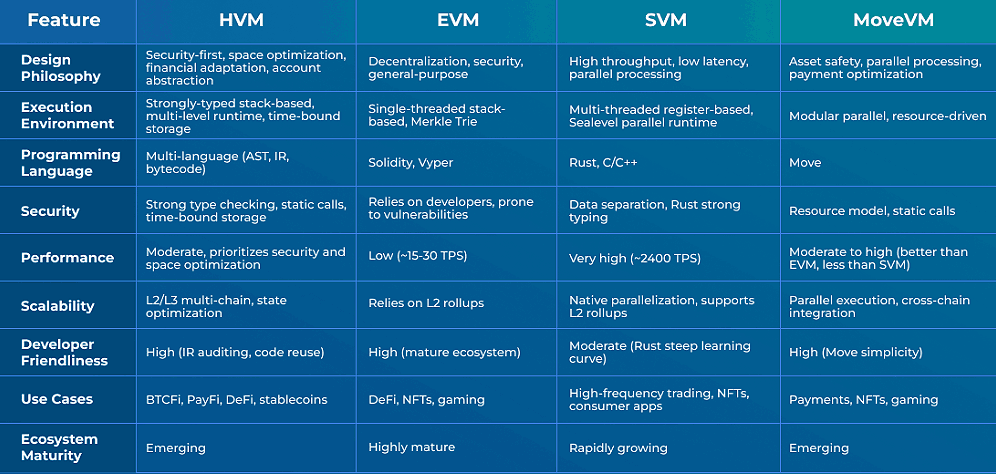
HVM: Engineering Programmable Sound Money for the Hacash Ecosystem
The #Hacash network, built on a robust tri-currency foundation ($HAC, $HACD, and $BTC) and advanced Layer 2/3 scaling solutions, has always prioritized sound money and trustless finance. To fully realize this vision, the Hacash team has introduced the Hacash Virtual Machine (HVM) a Turing-complete upgrade to Layer 1 designed specifically for decentralized finance.
Unlike generic smart contract platforms, HVM is built on a strict set of philosophical and technical principles that prioritize security, space efficiency, and financial adaptation over raw execution speed.
Security First, Always
In the world of digital finance, a single vulnerability can drain millions. While many virtual machines prioritize performance, HVM strictly prioritizes security. It operates as a strongly-typed, stack-based VM where every opcode enforces rigorous boundary and overflow checks. By prohibiting unsafe behaviors like arithmetic overflows and memory segmentation faults by default, HVM minimizes the smart contract vulnerabilities that have historically plagued the crypto space.
One of the most critical threats to blockchain decentralization is "state bloat" the permanent accumulation of useless data that prices everyday users out of running full nodes. HVM tackles this head-on by recognizing a core truth: computation is fleeting, but storage is permanent.
Instead of one-time payments for permanent storage, HVM introduces a Time-Bound Storage Rental model. Developers pay "rent" to keep state data on-chain based on its duration. Once the lease expires, the data is compressed, held for a brief recovery window, and then permanently purged. Furthermore, 90% of the fees for deploying or upgrading contracts are burned, economically aligning the network against unnecessary blockchain bloat.
HVM completely erases the traditional divide between Externally Owned Accounts (EOAs) and Contract Accounts (CAs). In HVM, accounts are contracts, and contracts are accounts.
Users can interact with complex DeFi protocols as easily as sending a standard token transfer. For example, adding liquidity to a decentralized exchange requires nothing more than transferring assets directly to the contract's address. This unified model drastically simplifies the user experience while enabling highly customizable access controls, multi-signature setups, and programmable spending limits directly at the account level.
Smart contracts are often deployed as opaque, unreadable bytecode, making audits difficult. HVM solves this with a structured contract architecture and native support for Intermediate Representation (IR).
Developers can deploy contracts using readable IR code, which the HVM then JIT-compiles into highly efficient bytecode for execution. Crucially, this IR structure can be perfectly reconstructed from the deployed bytecode, ensuring that financial contracts remain transparent, auditable, and verifiable by anyone.
Through features like on-chain code inheritance, library contracts, and modular function-level upgrades, HVM minimizes redundant code deployments, saving massive amounts of block space. It is not trying to host every possible Web3 application; it is laser-focused on monetary primitives, asset issuance, and complex financial settlement.
The Hacash Virtual Machine represents a conscious departure from the "move fast and break things" ethos of early smart contract chains. By making deliberate trade-offs choosing security over speed, and space optimization over infinite state HVM provides a robust, scalable, and secure foundation for the next generation of open, trustless crypto finance.
hacash.com/HVM
#cryptocurrency #cryptotrend
1
10
17
451
Jun 12
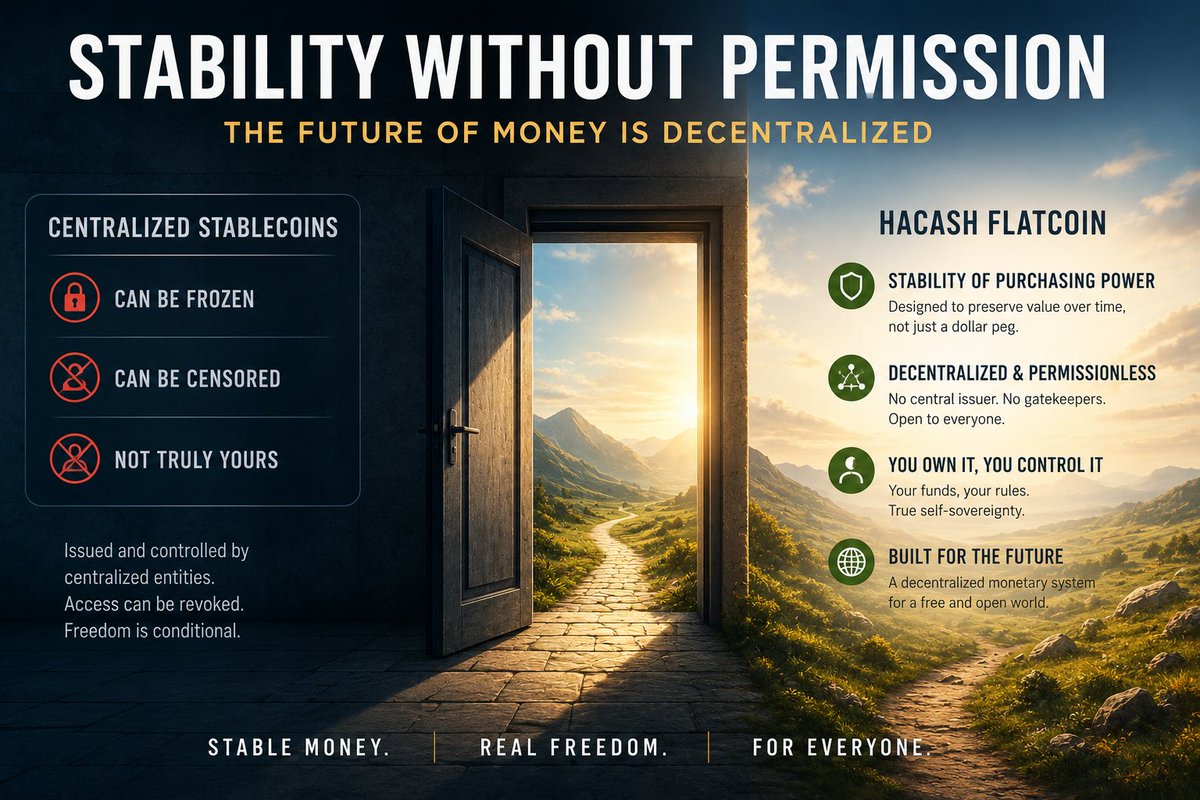
The holy grail of #cryptoeconomics isn't another fiat-backed stablecoin or another fragile algorithmic experiment.
It's a decentralized medium of exchange that can maintain purchasing power without relying on offshore bank accounts, custodians, governance committees, or price oracles.
Most #DeFi lending systems solve stability through over-collateralization, but they inherit a structural weakness: oracle dependency. If the price feed fails, lags, or is manipulated, liquidations become unreliable and the system can spiral into instability.
#Hacash takes a different approach.
Instead of using external price feeds, Hacash treats monetary issuance as a protocol-native function. Users lock transferred $BTC or ultra-scarce $HACD as collateral, and the protocol mints $HAC directly through deterministic rules.
When $HAC is borrowed, new supply is issued.
When loans are repaid, both principal and interest are permanently burned.
The result is an elastic monetary supply that expands and contracts according to market demand, not a centralized issuer's reserves.
The key innovation is that borrowing capacity is determined by the system's Total Mortgage Ratio rather than a fiat-denominated price feed.
As collateral utilization rises:
• Borrowing power decreases
• Interest rates increase exponentially
• Leverage becomes progressively more expensive
At low utilization, liquidity is abundant and borrowing is cheap.
At high utilization, the protocol automatically tightens monetary conditions without governance votes, liquidations, or oracle inputs.
This creates a natural arbitrage loop:
If $HAC trades at a premium, participants lock $BTC, mint $HAC, and sell it into the market, increasing supply.
If HAC trades at a discount, participants buy $HAC, repay debt, unlock collateral, and permanently burn HAC, reducing supply.
The protocol doesn't try to peg $HAC to the $dollar.
Instead, it attempts to create equilibrium through deterministic supply expansion and contraction.
$HACD adds a second layer to the system. As an indivisible Proof-of-Work asset with extreme scarcity, it acts as a long-term collateral anchor. Expired loans ultimately flow through public redemption and Dutch auction mechanisms, ensuring collateral is continuously recycled back into the economy rather than remaining trapped indefinitely.
The result is a monetary facility that is:
✓ Oracle-free
✓ Governance-minimized
✓ Native to Proof-of-Work assets
✓ Supply-elastic through issuance and burn mechanics
✓ Driven by transparent on-chain rules
Whether it ultimately achieves durable purchasing-power stability remains to be seen.
But its approach is fundamentally different from both fiat-backed stablecoins and traditional DeFi CDPs.
#Hacash is not trying to create synthetic dollars.
It's attempting to build a self-regulating monetary system for #crypto itself.
10
20
234
Jun 11
The dirty secret of institutional DeFi is that most of it isn’t actually on-chain.
To handle real-world orderbooks, RFQ (Request for Quote) matching, and RWA (Real World Asset) custody, legacy blockchains force institutions to rely on off-chain matching engines, centralized custodians, and opaque, monolithic smart contracts.
They bring the settlement on-chain, but the actual business logic remains trapped in Web2 servers or black-box code.
Hacash’s Istanbul Upgrade completely eliminates the need for these off-chain workarounds. By evolving from a simple value-transfer chain into a Layered Programmable Financial Execution System, Hacash natively supports the entire institutional business chain.
Here is how Hacash structurally replaces the off-chain clearinghouse and the centralized custodian, using two real-world institutional case studies.
Case 1: The On-Chain Clearinghouse (RFQ & Orderbook Matching)
In traditional finance, an orderbook requires strict expirations, inventory checks, fallback routing, and multi-party atomic settlement. On Ethereum, this is usually handled by an off-chain matcher that submits a finalized batch on-chain, or a massively complex, hackable smart contract.
Hacash distributes this complexity across specialized protocol layers, keeping the entire workflow trustlessly on-chain:
ActionGuard (The Risk Manager): Before any assets move, the transaction explicitly declares its boundaries. It enforces time-windows (expirations), chain environments, and minimum collateral floors natively at the protocol level.
TxBlob (The Audit Trail): Instead of burying order context in opaque calldata, TxBlob attaches explicit business semantics to the transaction carrying the RFQ summary, quote timestamps, and risk-review proof hashes.
AST (The Routing Engine): What happens if the primary liquidity pool fails due to slippage? Hacash’s Abstract Syntax Tree (AST) allows the transaction to natively attempt Route A, automatically roll back and isolate the failure, and fallback to Route B (e.g., a market-maker inventory vault) without polluting the global state.
TEX (The Atomic Clearinghouse): This is the death of the off-chain matcher. TEX acts as a protocol-level, multi-party netting ledger. It ensures that across all buyers, sellers, and fee-receivers, the multi-asset nets sum exactly to zero before finalizing.
The Result: Limit orders, RFQ execution, and OTC block settlements happen natively on-chain with institutional-grade risk controls, zero trusted third parties, and full wallet readability.
Case 2: The On-Chain Custodian (RWA & Reserve-Vault Fractionalization)
When institutions want to tokenize high-value, low-frequency assets (like physical gold, treasury bills, or Hacash’s own ultra-scarce HACD), they face a massive custody and fragmentation problem. Legacy chains rely on isolated token contracts and external multi-sig wallets to guard the underlying reserve.
Hacash turns the custody and fractionalization of RWAs into a unified, auditable protocol structure:
P2SH & Account Abstraction (The Vault):
The underlying reserve asset isn't just sent to a standard wallet. It is locked in a scriptmh (Pay to Script-Merkle-Hash) account.
This allows the vault to hold multiple layered spending strategies (routine vs. emergency) and enforce strict, programmable receive/release policies via Account Abstraction hooks (Permit / Payable).
HIP20 (Protocol-Level Shares):
The fractionalized shares aren't just arbitrary ERC-20 mappings trapped inside a contract. They are minted as protocol-level native assets.
This means the RWA shares can natively interact with Hacash’s unified settlement (TEX) and risk guards, just like the base currency.
IR Decompilation (The Auditor): Institutional risk committees cannot approve black-box bytecode. Hacash’s HVM allows deployed vault logic to be decompiled back into readable, source-like structures.
The fractionalization and redemption rules are mathematically transparent. State Leases (The Sustainability Engine): A massive RWA vault with millions of fractional shareholders will choke a legacy L1 with state bloat. Hacash natively prices long-term state occupation (Active → Recoverable → Absent), ensuring the network remains sustainable at an institutional scale.
The Verdict: Executing Business, Not Just Code
Legacy blockchains force institutions to compromise. They either sacrifice decentralization for off-chain performance, or they sacrifice security by cramming complex financial workflows into unauditable smart contracts.
Hacash rejects this compromise.
By separating Conditions (Guard), Context (Blob), Routing (AST), Clearing (TEX), and Custody (P2SH/AA) into distinct, composable layers, Hacash provides a native execution environment for real-world financial business chains.
You don't need an off-chain matching engine when the protocol natively clears multi-party atomic settlements. You don't need a centralized custodian when the protocol natively enforces script-level vault policies.
github.com/hacash/doc/blob/m…
github.com/hacash/doc/blob/m…
#Hacash #Bitcoin
$BTC $HACD $HAC @saylor @elonmusk
10
25
285
Jun 11
What I would expect after activation of istanbul upgrade
Immediately (0-3 months)
New explorer version
New node software
HVM tools
Basic HIP20 support
Medium term (3-12 months)
Asset issuance portals
Smart account wallets
Contract deployment interfaces
Long term (1-3 years)
Intent-based wallets
TEX-powered DEXs
Full DeFi ecosystem
Advanced orchestration tooling
The interesting thing is that Istanbul is not just adding features. It's changing #Hacash from a coin chain into what the document describes as a programmable financial operating system.
github.com/hacash/doc/blob/m…
1
12
30
317
Jun 11
Cross-chain bridges are the biggest honeypots in #crypto.
#Hacash uses a One-Way Transfer.
You cryptographically burn $BTC on the #Bitcoin network, and it mints natively on Hacash as pristine collateral. No bridges. No wrappers. No custodians. It permanently removes BTC from Wall Street's speculative order books and locks it into a sovereign settlement layer.
Research the cryptographic mechanics of the One-Way Transfer.
7
14
201
Jun 11
To those suffering from sinusitis, stop eating eggs.
To those suffering from panic attacks, stop eating chicken.
To those who frequently catch colds, stop eating oranges and all types of citrus fruits.
To those who suffer from illnesses in general, stop eating vegetables, bread, anything made with flour, and stop drinking milk.
You will witness a miracle.
Sugar, honey, dates, whole grains, potatoes, fruits, red meat, and sea fish are all beneficial. Sugar does not cause weight gain at all.
I have personally tried this on myself and am sharing my own experience.
For educational purposes only. This content reflects my personal opinions and experiences and is not intended as medical advice, diagnosis, treatment, or nutritional guidance.
#Health
#HealthTips
#HealthyLiving
#Wellness
#PublicHealth
#HealthEducation
#Prevention
#SelfCare
3
6
139
Jun 10
Let’s take him at his word and stress-test that belief.
If #Bitcoin is truly about economic empowerment for everyone, then empowering everyday people to actually use it as money without relying on Wall Street ETFs, custodial wrappers, or centralized fiat stablecoins is the ultimate good-faith effort.
That is exactly what the #Hacash One-Way Transfer achieves.
It doesn’t attack Bitcoin. It elevates it. By cryptographically transferring $BTC natively into the #Hacash ecosystem, you permanently remove it from the speculative, fiat-denominated order books controlled by institutions. You turn pristine digital gold into the immutable, trustless bedrock collateral for $HAC a decentralized, oracle-free flatcoin designed for everyday global commerce and infinite divisibility (10⁻²⁴⁸).
If Saylor and the institutional gatekeepers truly welcome efforts to strengthen the network, they should embrace the One-Way Transfer.
hacash.money/BTC
hacash.org/BTC
Jun 10

My beliefs: Retweets are notifications, not endorsements. Constructive dialogue leads to better outcomes. Bitcoin is hope and economic empowerment for everyone. Every good-faith effort to strengthen the network should be welcomed.
8
15
409
Jun 10
AI didn’t steal Bitcoin’s liquidity. Wall Street did.
Arthur Hayes is looking at the macro plumbing, but he’s missing the market mechanics. Yes, AI is a massive fiat sponge. Trillions in CapEx for data centers, GPUs, and energy infrastructure is a colossal sink for global M2. But debt issued to AI companies doesn't "consume" liquidity it circulates it into the real economy (Nvidia, TSMC, utilities).
The real reason #Bitcoin didn't moon to the extent the maxis expected has very little to do with AI. It has everything to do with financialization
Jun 10

Bitcoin had trillions in liquidity behind it. So why didn't it moon?
@CryptoHayes asked himself a simple question.
If trillions in liquidity were created since 2022, why didn't Bitcoin go higher?
The answer: AI consumed it all.
$1.5 trillion in debt issued to AI companies. Most of it in 2025 and 2026.
Bitcoin never had a chance.
Full video in comments 👇
5
143
Jun 10
As #Zcash moves toward its July Ironwood activation, #Hacash is preparing to launch its Istanbul Upgrade in the same window. Together, they offer a rare opportunity to observe two fundamentally different approaches to protocol evolution unfolding side by side.
github.com/hacash/doc/blob/m…
$BTC $HACD $HAC $ZEC
1
11
22
323
Jun 9
Humanity has reached the top of the top. But when a civilization reaches its highest peak, it must also prepare for the possibility of a downfall.
The fall of humanity will not come because of war. Humans have been at war throughout history, through countless conflicts and world wars, yet humanity endured.
The real danger is different.
As we climb higher, truly good people become harder to find, while selfishness, greed, and indifference seem to spread everywhere. A society does not collapse only from enemies outside. Sometimes it weakens when its values begin to disappear from within.
The greatest threat to humanity may not be war, but the day we stop caring about the difference between right and wrong the growing rarity of those who choose kindness, integrity, and compassion in a world that increasingly rewards the opposite.
#Humanity #TheFallOfHumanity #Reality #lastera
4
103
Jun 9
Mathematics doesn’t lie. You can fake a roadmap, you can fake a partnership, and you can fake a community, but you cannot fake an emission curve.
The distribution schedule of a Proof-of-Work network tells you exactly who it was built for.
#Kaspa (The Front-Loaded Wealth Transfer)
95% mined in just 2 years. When a network emits its supply that fast, it structurally guarantees that early botnets, insider GPU farms, and quant funds capture the vast majority of the wealth before the retail market even knows the ticker exists. By the time the project reaches mass awareness and Tier-1 exchanges, the early miners are simply using latecomers as exit liquidity. It’s not a scam in the code, but economically, it’s a massive wealth transfer from the late majority to the early insiders.
#Bitcoin (The Benchmark)
95% mined over 17 years. Bitcoin’s halving schedule gave the world time to organically discover, secure, and distribute the network. It rewarded long-term conviction, not just whoever had the most GPUs on day one.
#Hacash (The Apex of Scarcity)
0.08% mined over 7 years.
This isn't just a slow emission. This is uncompromising, structural scarcity.
When only a fraction of a percent of the total supply is mined over nearly a decade, it completely eliminates the mine and dump strategy. It ensures that every single $HACD in circulation was forged through genuine, sustained computational work and deep, long-term conviction. You cannot insider-traverse a network this slow. You cannot VC-dump an asset this scarce.
Most modern PoW coins are just venture capital exit strategies disguised as decentralized networks. They front-load the supply to enrich the founders and early hardware farmers at the expense of future users.
#Hacash rejects this. $HACD is designed to be the bedrock collateral of a sovereign monetary system, not a get-rich-quick scheme for early miners. It is digital luxury, forged in real-time, at a pace that respects the physics of true scarcity.
Before you buy a PoW coin, don't look at the market cap. Look at the emission curve. It will tell you if you are joining a revolution, or if you are just the exit liquidity.
$HACD $HAC $BTC $KAS
1
11
14
1,350
Jun 9
Everyone is praying for #Bitcoin to go up. But structurally? Bitcoin needs to bleed first.
Let’s be honest. A soaring Bitcoin price only attracts tourists, leverage, and Wall Street ETFs. It doesn't build a parallel monetary system. For true mass adoption to happen, the speculative froth needs to be wiped out. The price needs to come down.
When the market crashes, the speculators leave. But for those who actually understand sound money, a deep correction is just a generational discount on the ultimate reserve asset. It allows a new wave of people to accumulate the base layer at a fair price.
But here is the catch: once they accumulate it, they will realize the hard truth. You cannot run a daily global economy, price goods, or execute micro-transactions on an asset that swings 20% in a week. Bitcoin is pristine collateral, but it is too volatile to be a daily medium of exchange.
That is exactly when the #Hacash **one-way transfer** becomes the most important mechanism in #crypto.
The crash isn't the end of the cycle. It’s the prerequisite for the next phase.
Cheap accumulation at the base layer. Cryptographic migration to the settlement layer. That is how you onboard the world.
Imagine buying the dip, securing your sovereign reserve, and then transfer that $BTC via the one-way transfer into the #Hacash ecosystem.
Hacash.org
Hacash.money
Hacash.com
$BTC $HACD $HAC
1
11
20
207
Jun 9
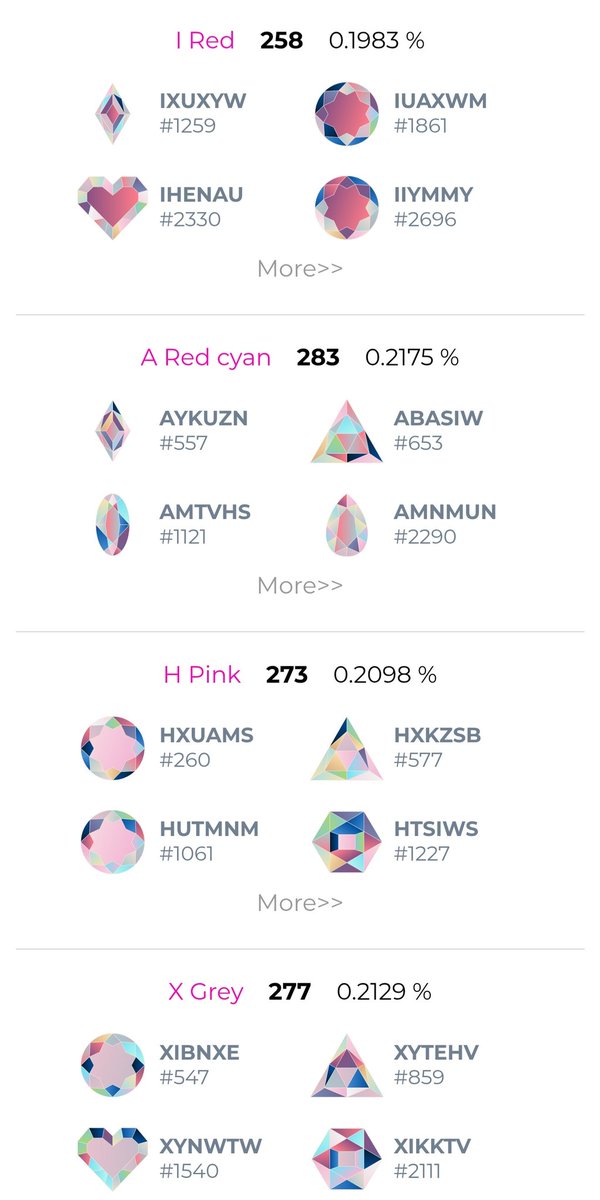
The difference between $HACD and other coins is that owning $HACD feels like owning something real, almost physical. Even with zero marketing and little public awareness, it carries an intrinsic sense of value. Its worth isn't defined by fiat price alone, but by what it represents and the conviction behind it. Imagine what comes next when the world starts to discover it. 🚀
#Hacash #Bitcoin
$BTC
12
23
229