
Anonymous economist. Tidyverse and ggplots...all day, every day.
Joined July 2023
- Tweets 976
- Following 407
- Followers 89
- Likes 797
3 Photos and videos


Derek retweeted

Jun 17
Flock helped solve over 1 million crimes last year. There were 7 reported cases of misuse by cops last year, where Flock’s audit logs were used as evidence against them.
That's 1 reported misuse case, caught by guardrails, for every 140,000 crime victims that got justice.
Jun 16

Any cop who uses Flock illegally should be prosecuted.
That's why we built our auditing tools. Illegal use is identified, and then used as evidence against them.
We have more tools to catch this behavior than almost any other technology used by the police.
6
5
80
5,577
Derek retweeted

Jun 17
Reuters is proud, bragging even, that their gently massaged interpretation of Tesla's FSD safety data is being cited as grounds to launch a senate investigation.
Shameful.

18
7
115
5,080
Derek retweeted

It's true but he's dead and Maduro is in jail ❤️
Jun 13

You’re a bitch ass vende patria 😹 Hugo chaves should’ve sent your whole family to the gulags
17
226
4,225
121,764
Derek retweeted

Jun 13
Idc about all morons saying that society shouldn’t have trillionaires. I was born in USSR and grew up in Russia in the 90s. For me it’s a true marvel that:
- an engineer can get rich by being a good engineer
- an entrepreneur can get rich by building something people want and not grifting on the government or natural resources
- an entrepreneur engineer can become a trillionaire and not be in prison
31
137
1,252
34,353
Derek retweeted

Jun 13
Or you could have invested social security in the S&P 500 instead of treasuries, and the problem would be solved.
Jun 12

Today, Elon Musk, a trillionaire, pays the same amount into Social Security as someone making $184,500.
If we end that absurdity and lift the cap on taxable income, we can make Social Security solvent for 75 years and expand benefits by $2,400. My Social Security bill does that.
2
2
19
1,054
Derek retweeted

Jun 12
We need so many more trillionaires.
116
184
3,465
89,130
Derek retweeted

Jun 12
Congrats to @elonmusk our first trillionaire, a noble accomplishment
12
27
428
16,817


“but 80% of workloads will be running on 99% cheaper models within 12-18 months”
Yup need for token usage growing exponentially does not mean willingness to shoulder costs go up exponentially

Good take
My guess is
- demand for intelligence is near infinite
- but 80% of workloads will be running on 99% cheaper models within 12-18 months
- 20% of workloads will still run on latest gen models where IQ maxing is important (scientific breakthroughs, higher level ochestrator agents?)
- rough analogy might be what % of macbooks or gaming PCs sold have the maxed out specs for CPU/GPU, prices are falling much faster than Moore's law here though
- this leads me to think the limiting factor will be energy and compute, not better models
At Coinbase we're working hard on routing prompts to cheaper models where appropriate, and in some cases have been able to keep costs roughly flat, while token usage continues to grow exponentially.
4
5
42
9,886
Derek retweeted

Jun 2
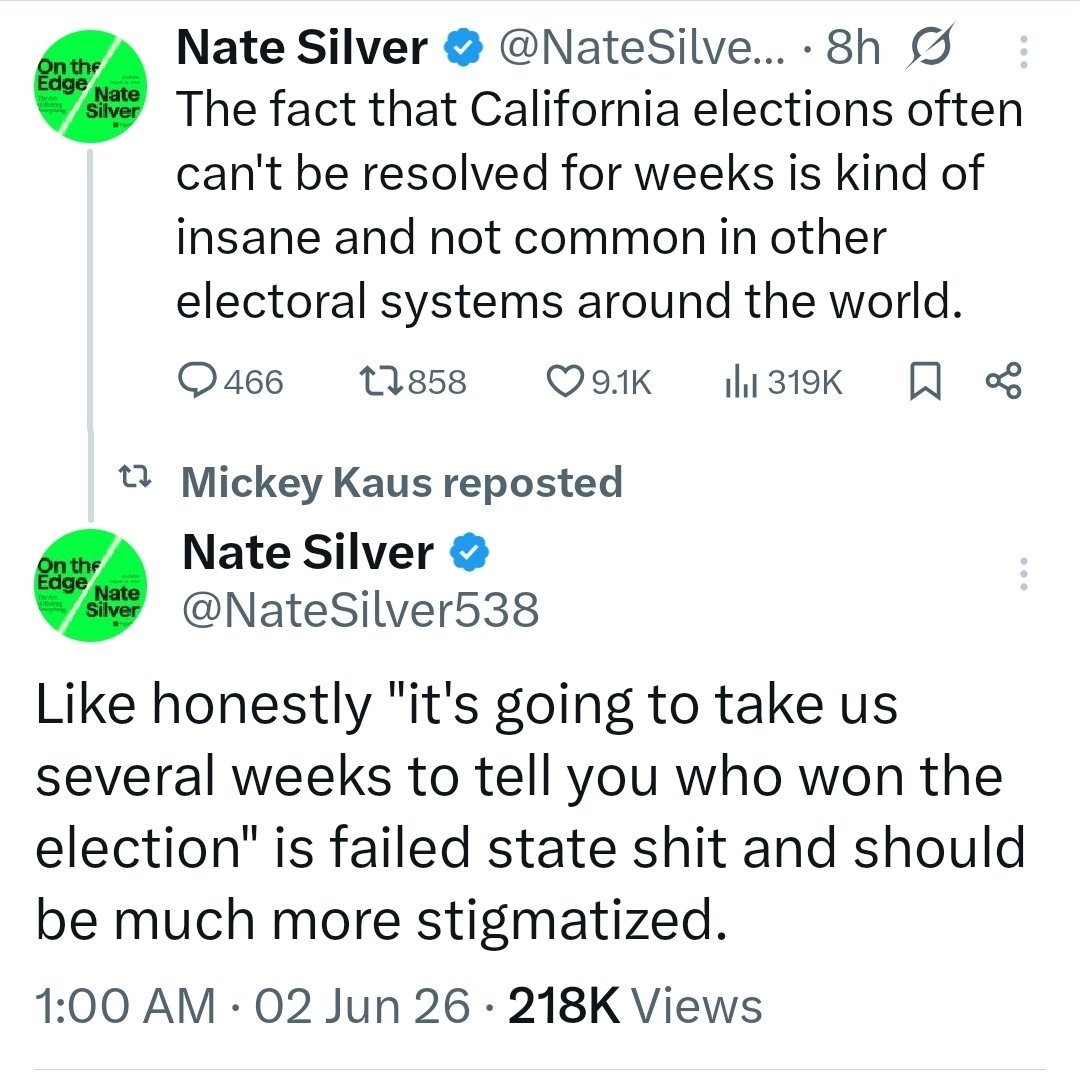
A government that can't count votes in a timely manner shouldn't be allowed to run so many aspects of our lives.
127
665
4,946
126,636
Derek retweeted

Jun 3
China is making a big push for outbound investment.
China is also building tools to hit back at other countries if they “take discriminatory measures against Chinese foreign investment” in Beijing’s view:
“First, in response to investment barriers related to trade or other obstacles to investment and business operations imposed by foreign countries or regions, the State Council’s commerce department may conduct investigations on its own or jointly with other relevant departments. Based on the investigation results, relevant State Council departments may take measures such as adjusting country-specific investment policies and prohibiting or restricting the import and export of relevant goods and technologies.
Second, in response to discriminatory prohibitions, restrictions, or other similar measures adopted by foreign countries or regions, or international organizations, in areas such as investment and business operations, the Chinese government has the right to take corresponding measures based on actual circumstances. It may also, in accordance with the Anti-Foreign Sanctions Law of the People’s Republic of China and its supporting regulations, impose countermeasures on organizations and individuals that directly or indirectly participate in formulating, deciding, or implementing such measures.
Third, in response to foreign organizations or individuals that harm China’s national sovereignty, security, or development interests; interrupt transactions in violation of normal market transaction principles; or adopt discriminatory measures that unreasonably deprive or restrict investors and their legitimate rights and interests in outbound investment, relevant State Council departments may take measures against them, including prohibiting or restricting their investment in China, entry into China, and relevant transactions or cooperation.”

3
19
74
6,127
Derek retweeted
May 31
Huawei is in the news again, so it’s a good time to re-up my High Capacity post fitting Huawei into China’s broader tech-industrial policy story: highcapacity.org/p/huawei-th…
3
21
70
4,897
Derek retweeted

May 31
America's postal system is a sort of negative lootbox where 99.9% of items are trash but the other 0.1% are special quest items that if not promptly handled result in crippling debts or your arrest.
32
441
9,043
206,166
Derek retweeted

May 29
The Shanghai Billionaire Behind America's Anti-Data Center Movement
bit.ly/43AYqe3
94
413
1,806
333,922
Derek retweeted
May 29
Have you actually read Mamdani's housing policy document? It is openly disdainful of market rate housing as anything other than a thing to be extorted for taxes, and focuses entirely on expanding subsidies.
x.com/AnechoicMedia_/status/…
May 29

At the nudging of a follower, I reviewed Mamdani's new Housing Plan. It confirms my belief that nothing is changing, this is not a YIMBY administration, and they are not serious about treating housing as a crisis that would require sacrificing any leftist or anti-market ideals.
4
3
47
4,352
Derek retweeted
May 29
I skimmed the report; It's about what I expected.
Section 1: Taking more from landlords; organizing the rabble
- "affordable housing" is defined explicitly as regulated housing, rather than "making housing more affordable" in the market
- push for stricter enforcement action against landlords to meet standards, without any corresponding relief on price controls to meet those obligations.
- "aggressive" use of the 7A program, a forced conservatorship where outside management is appointed to assume control of a building and use rents for repairs.
The program typically has a couple hundred buildings at a time, which are turned around within a few months; Activists envision thousands of buildings can be taken over this way and for a longer period of time. There's also been talk of putting tenants' groups in charge rather than professional managers.
Prosecuting negligent landlords is necessary, but you can't sue your way to greater housing supply. It's a way to effect greater state control over housing rather than incentivizing more of it to be created.
- pressure lenders to foreclose on problem landlords, then arrange for the properties to be bought up by administration-supported buyers. They mention a target list of housing portfolios. It sounds like the plan is to effect a taking by getting owners/lenders to take a hit on the buildings, then buy them up for the cheap.
- more funding to hire lawyers to represent tenants in eviction proceedings. This is the government spending money to make housing more expensive.
These are all proposals you make when you view the supply of market housing as a fixed thing to be taken over by your constituents, not a dynamic system that needs to remain functional and capable of expanding itself.
Section 2: I have to subsidize demand
The report acknowledges the fundamental problem that for regulated affordable housing, operating costs exceed rents. The solution to this is a basket of problems to push the costs of favored groups onto other people:
- drives to enroll more residents in a program that provides subsidized electricity and gas
- expand program that provides residents with subsidized water and sewer service
- new city-backed insurance program to sell subsidized coverage to regulated units
- expand program that subsidizes various capital improvements related to energy efficiency or "decarbonization" to meet new emissions compliance standards
- keep trying to get landlords to participate in a program that offers $50k per unit to renovate vacant units that are below standards and can't be economically rented at the regulated rent. Basically nobody has applied for this program because the requirements to get the money are onerous and still don't make it profitable to get a unit back on the market under the price controls.
- nudge the Department of Finance to lower valuations of rent-stabilized buildings to reduce their property taxes. The argument being made is that, since the legislature passed some laws that make it harder for landlords to turn over rent-stabilized tenants, purchases of rent-stabilized buildings have decreased, thereby depressing value.
It seems to go unnoticed this argument is demonstrating exactly how the kinds of policies they advocate have the effect of preventing the market from wanting to invest in affordable housing!
I don't think anybody ever incentivized a housing boom by crashing property values with regulations and price controls. Perhaps that's the point.
- tax breaks and subsidizes for converting unregulated buildings to public ownership or regulation
- a bunch of money to subsidize capital improvements in city-regulated subsidized private housing which is facing steep costs of meeting the new emissions reduction mandates.
There's only so many different ways you can restate "we're going to spend more money subsidizing regulated housing, while also lowering taxes on that housing, the gap to be made up by further raising taxes on the remaining unregulated housing stock".
- "ownership transfers" of currently unprofitable property where operating costs exceed regulated rent, to be bought out by tax subsidized landlords or tenant/community trusts.
- another version of the same program but this one targets buildings with back taxes and water bills for transfer to new owners
Again we have the overt theme of "the government is going to regulate private property into a financial crisis, then the solution to that crisis is the state redistributes your property to a new entity which receives subsidizes or other exemptions from the fiscal burden".
Section 3: Expanding public housing
There's a big push to fix up leaking pipes, mold, broken elevators, heat, remove lead, etc.
These are some of the same issues as above but without the annoyance of private landlords. But even with state ownership there's a giant backlog of work to be done, and the vacant unit problem that remediating units to the standard required to re-rent them is really expensive.
Notably, the report estimates that the cost to turn around vacant units in NYCHA is $59k - more than the money being offered to private landlords to remediate their rent-regulated vacant units, which still don't have positive operating cash flow. A depiction of the impossible task given to private owners in this system.
Section 4: Everything bagel leftism
- we have a housing crisis. To meet that crisis we're going to build a record amount of subsidized, regulated housing.
- Also at the same time we're going to subject public building to a "construction justice" mandate that nobody who works on those projects is paid less than $40/hr; a wage that would disqualify those workers for the affordable housing in question.
- housing and support services for homeless people in the same buildings as affordable housing units
- subsidized housing sites for criminals leaving prison
- preferences and subsidies for developers by sex, religion, and race
- preferences and aid for smaller developers who have difficulty bidding in public projects
- inclusionary zoning, where all increases in permitted capacity come with the requirement of building subsidized housing
- preferentially giving bid opportunities on city-owned properties to non-profit, minority, or women-owned developers
- require new private development on city-controlled land to cross-subsidize regulated affordable units (to an extent greater than is possible with usual inclusionary zoning mandates)
------
anyway you get the idea, I'm not a fan
4
5
46
32,975
Derek retweeted

May 28
Actually they’ve got 700 vehicles. 42 is the number that don’t have a safety monitor on board.
One year after Waymo One launched, Waymo had ~300 vehicles in Phoenix. And only a few dozen were fully driverless.
Nobody has ever deployed driverless Robotaxis faster than Tesla.

Tesla has just 42 vehicles operating as robotaxis in Texas almost a year after Elon Musk launched the service, a small fraction of the fleet commanded by rival Waymo bloomberg.com/news/articles/…
80
157
2,192
93,946
Derek retweeted

May 22
My block went from most car break ins in the country to very safe / no car break ins at all because a Flock camera was installed.
8
8
47
13,452
Derek retweeted

May 22
Every time I see these stats I am just as astonished at the first time I read any version of them.
“There are about 450,000 socially rented homes in inner London. This is about one in three homes. About half of the 450,000 are occupied by lead tenants who are not working, either because they are retired (18%), disabled (13%), caring for someone else (7%), studying (2%), or unemployed/otherwise inactive (11%).”
May 22

My thoughts on social housing and building in inner London:
- Almost everyone who lives in social housing is a decent human being who is trying their best in often difficult circumstances. Among them are many retirees, kids, and people with disabilities. This must be the starting point for any serious thinking about housing in London.
- London's job market is much stronger than that of the rest of the country. The median London wage is 25% more than the median English wage. The easier we make it for Britons to move to London, the richer they and the country will become.
- Housing in inner London is extremely scarce and building rates are very low. In 2024–25, only 4,170 homes were started in London. London's housing target is 20x that and I think it's possible that we could build 100–150x that with the right reforms.
- For now, we are in a roughly zero-sum game (which is one reason tensions are so high). We need to make this positive-sum by building more and by allowing voluntary exchanges of the existing housing stock.
- There are about 450,000 socially rented homes in inner London. This is about one in three homes. About half of the 450,000 are occupied by lead tenants who are not working, either because they are retired (18%), disabled (13%), caring for someone else (7%), studying (2%), or unemployed/otherwise inactive (11%).
- Social housing tenancies are basically tenancies-for-life, and can often pass down from parents to their children. They are close in practice to ownership, except that they cannot be sold. Ex-council flats in inner London are often worth £500,000 or more; there are many in extremely central parts of the city like Shoreditch, Soho and Farringdon that are worth even more than that.
- Kicking people out of these homes against their will is, in general, morally bad and politically impossible. The public does not resent these people and would, rightly, find it appalling to turf them out of their homes against their will.
- 'Gentrification' is a problem when it drives people out against their will by raising rents or other costs. It is primarily a problem caused by housing shortages. When housing supply can respond to new demand in an area, there is much less displacement of the people who live there.
- Poor people do not like dirt, graffiti, crime, or derelict buildings, and many of their supposed champions have a patronising and somewhat dehumanising idea of what is in their interests. They do not want to live in unsafe, unpleasant areas any more than anyone else does. Change that makes places safer, cleaner and prettier without displacing existing residents is a good thing for everyone.
- Large supermarkets are the cheapest places to buy food in London and allowing them to be built is the best way to protect people's access to affordable retail.
- There are options that are good for tenants and good for people who wish to live in these central areas that do not push people out against their will. These are options that put tenants in control and give them a large share of the value created. At best, they reduce scarcity overall.
- One is to make the social housing stock much more liquid by allowing social housing tenants to sell their tenancies into private ownership, keeping the returns to spend on a new property that is more suitable for their needs and the rest as savings.
- Arguments against this that focus on the fact that many of the out-of-work people are blameless completely miss the point. For retirees, parents, and some people with disabilities, a home in a London suburb or a town other than London may be preferable to an apartment in inner London – more spacious, easier to access (eg, not up flights of stairs), and in a quieter neighbourhood. Existing schemes to allow people to trade their social home for a home by the seaside or in the country are hugely oversubscribed; this would unlock the entire private market to them.
- Private owners already have the freedom to sell their home to who they want. That is one of the core benefits of private ownership. This extends that right to social tenants.
- Another option is 'estate regeneration', where entire housing estates are rebuilt and existing tenants are given larger, newer homes built to modern standards and thousands of private units also added. Where tenants are given a vote on this, they consistently vote in favour (29/30 ballots have passed, often with enormous majorities and turnouts.) Hundreds of thousands of homes could be added in this way.
- A vast amount of regulation also needs to be reversed – the Building Safety Regulator, second staircase rules, dual aspect rules, and others – in order to make building cheaper. Otherwise, we will find ourselves in a position where even if you get permission to build a home it is prohibitively expensive to do so.
- Affordable housing requirements are a tax on new housing and almost certainly reduce the overall amount of homes that get built. Manchester has built thousands of new homes without them. Richard Leese, the Labour leader of the City Council, said "If we’d tried to impose 20% affordability on it, it wouldn’t have happened. We wouldn’t have got 20% affordable housing, we would have got nothing."
- Many of the most vocal foes of new building in inner London are ideological opponents of private construction and cannot be reasoned or bargained with. Defeating them will involve a combination of targeted upzoning imposed by central government and the creation of hyperlocal mechanisms that allow the people who are most directly affected by new development to decide on it (eg, estate regeneration). The anti-building ideologues only win because normal people sympathise with them.
- If we do not do not work to make the existing housing stock more easily transacted and building much easier, London will become hollowed out. Existing market-rate housing will be bid up by wealthy people who can afford it, and anyone on a middle income – let alone a low income who does not have a social home – will find it very difficult to live here, except in cramped houseshares when they are young. London should not be a city for only the very poor and very rich.
21
63
625
120,372
Derek retweeted

May 20
it’s in gemini, just create it in ai studio. oh, that’s for your personal google one account. for workspace you need gemini business. no, not gemini advanced, that’s ai pro now. unless you need ai ultra. oh agents? you do that in spark actually. no, not gemini api managed agents, that’s different. for coding use jules. unless you mean the agentic ide, that’s antigravity. no, that’s the old antigravity, download the new one. actually gemini cli is being deprecated, use antigravity cli. no the flash model is smarter than the pro model. unless you need pro. if it’s video, use flow. no, flow uses veo. no, nano banana is images. actually that’s in gemini now. unless you’re in search, then it’s ai mode. no, research is notebooklm. anyway it’s all very simple.
512
2,065
19,062
1,648,582