
459 Photos and videos
Enigma retweeted

May 21
The modern economy:
a world where anything of value has a market, and where value moves instantly, globally, and freely.
Sei is infrastructure for the modern economy.
76
94
517
70,343

May 5
Enigma is at #Consensus2026 → Miami
You're building a chain, need validators, or looking for staking opportunities?
Join us at Consensus Miami, our DMs are open, let's talk. 🤝
250
May 2
Enigma is now a validator on @CantonNetwork
Canton is building the future of private, institutional-grade finance enabling secure, compliant transactions at scale. We are proud to support its builders and contribute to this mission.
Talk to us for infrastructure support
4
194
Enigma retweeted

May 2
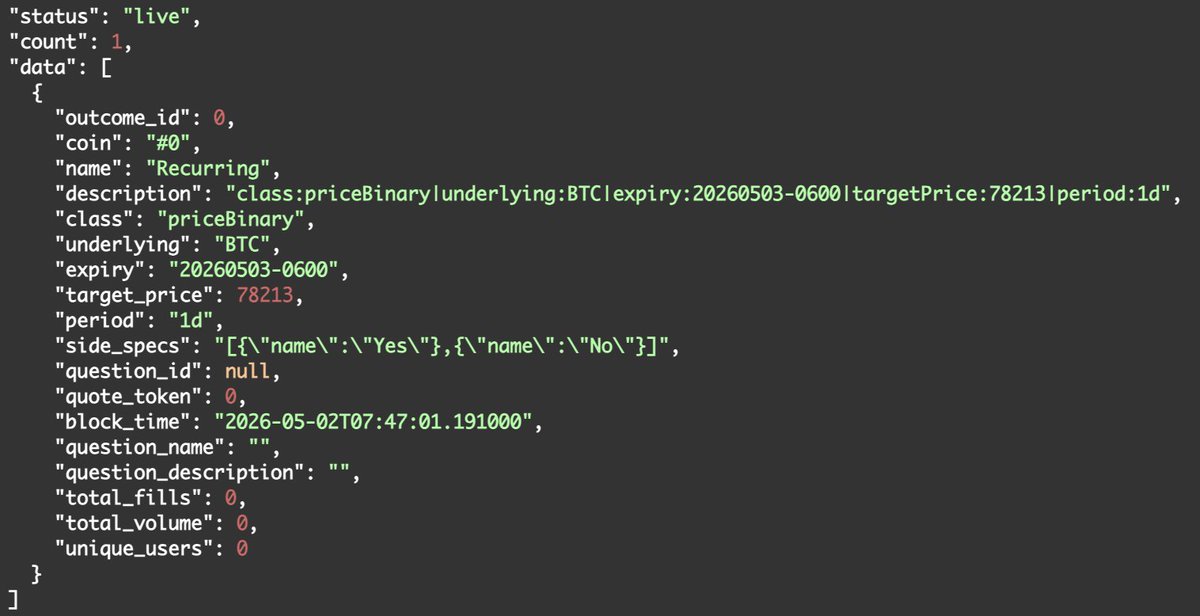
We just detected the first HIP-4 transaction on Hyperliquid mainnet at 07:46 UTC.
It begins.
15
13
105
45,902
Enigma retweeted
Apr 14
Hypedexer: house of all hyperliquid data 🫡
Apr 14

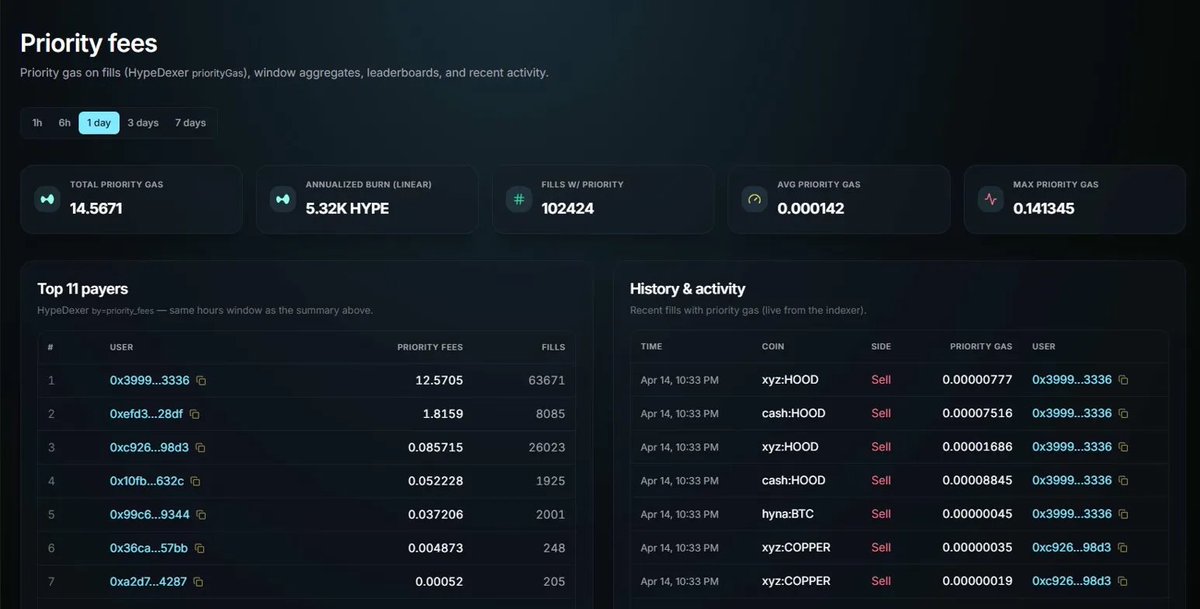
Priority fees explorer is now live on @liquidterminal.
Powered by @hypedexer. Part of our V2 release, deeper data, better insights, full picture of what's happening on Hyperliquid.
Last 24h on priority gas:
→ 14.56 HYPE in total priority gas
→ 102,424 fills with priority
→ 5.32K HYPE annualized burn (linear)
→ Avg priority gas: 0.000142
→ Max priority gas: 0.141345
The interesting part is who's actually paying.
One wallet (0x3999...3336) is responsible for ~86% of all priority gas burned in the last 24h. 12.57 HYPE across 63,671 fills. Mostly active on xyz:HOOD and cash:HOOD pairs.
Second is 0xefd3...28df with 1.81 HYPE across 8,085 fills. Third is 0xc926...98d3 with 0.085 HYPE across 26,023 fills.
What this tells us:
Priority fees have been live for 2 days. Some users are already testing them heavily. Activity is spread across pairs, not concentrated on any single market. Still very early, we're watching how usage evolves.
Still early. The feature just went live. As more MMs compete for execution, expect the numbers to grow and the concentration to spread.
Track it live: liquidterminal.xyz/explorer/…
Just build on Hyperliquid.
2
5
903
Enigma retweeted
Apr 13
Hyperliquid just rolled out Priority Fees
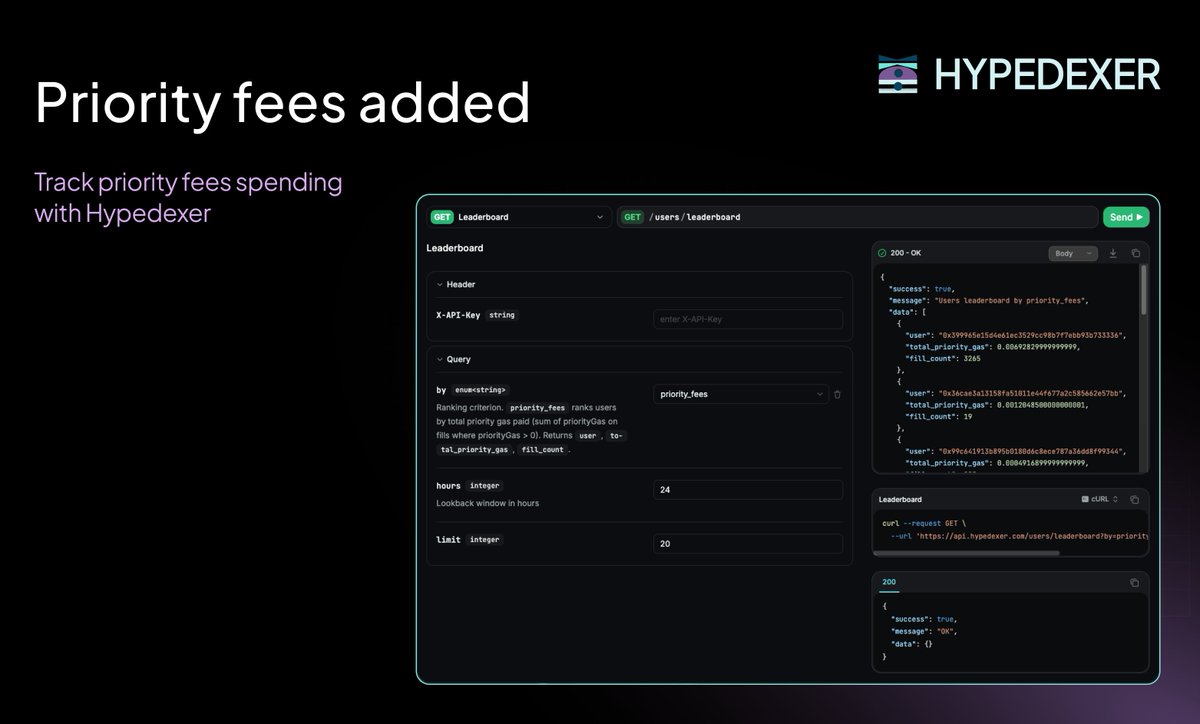
@hypedexer already supports it on the indexing side:
• priorityGas field on all fills endpoints
• Dutch auction slots tracked live (HIP-3)
• Analytics: total gas paid, unique users, avg/min/max
• Leaderboard ranked by priority fees paid
This address has already paid priority fees 3,000 times:
hypurrscan.io/address/0x3999…
Apr 13
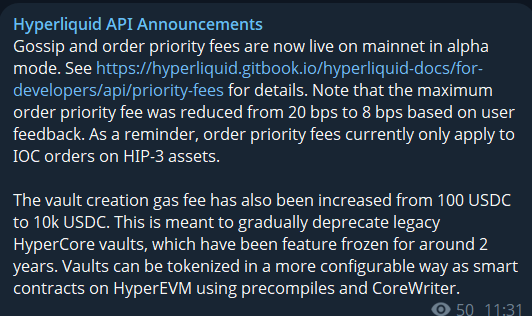
BREAKING: Priority fees are LIVE on Hyperliquid mainnet (alpha mode).
Both gossip priority and order priority just went live. Not testnet. Mainnet.
Key update from testnet: order priority max rate was reduced from 20 bps to 8 bps based on user feedback. More trader-friendly than expected.
Order priority still limited to IOC orders on HIP-3 assets for now.
Also announced: vault creation gas fee increased from 100 USDC to 10K USDC. Legacy HyperCore vaults are being gradually deprecated (feature frozen for 2 years). The future is tokenized vaults as smart contracts on HyperEVM via precompiles and CoreWriter.
Just use Hyperliquid.
hyperliquid.gitbook.io/hyper…
1
3
9
892
Enigma retweeted

Apr 9
Last call to join the Mezo Hackathon, applications close April 12th!
Build Bitcoin’s future with @MezoNetwork, @SupernormalFDN as well as our partners @goldskyio, @ValidationCloud, @SpectrumNodes, @TenderlyApp, @sats_ventures, @BoarNetwork and @EnigmaValidator!
Apply below ↓

3
5
30
4,668
Enigma retweeted
Apr 4
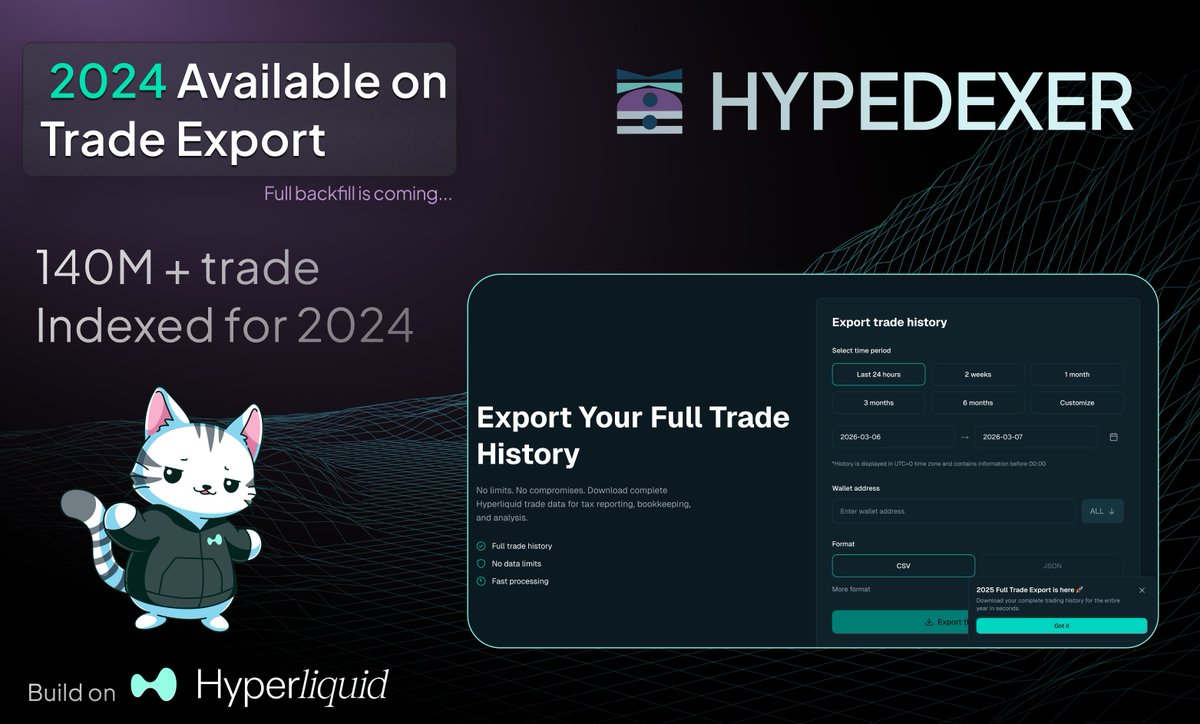
140M trades from 2024 are now indexed and available for free in Trade Export.
A portion of trades remain missing due to incomplete fields. We are actively working to recover them.
We are also actively contributing to HIP-4 research. Building on HIP-4? Reach out to Hypedexer for data access.
2
5
24
1,918
Enigma retweeted

Mar 27
Today, we're delighted to announce our strategic partnership with @OverlayProtocol!
Overlay is the Exotic Perps DEX that lets you trade the untradable, pushing the boundaries of what’s possible in DeFi.
Excited to deepen our collaboration as a data layer on Overlay. 🧵
7
10
41
2,713
Mar 26
Great research work !
We’re working with @hypedexer to ensure that HIP-4 data is available from day one of its mainnet launch.
Hyperliquid !
Mar 26
HIP-4 research update.
Correcting an assumption on the EVM contracts, new findings on multi-outcome mechanics, and next steps.
We got something wrong.
In our earlier analysis, we assumed the parimutuel contracts on HyperEVM (V1: 0x4fd7...44bd, V2: 0x6d86...cf07) were deployed by the Hyperliquid team. We had reasons to believe this:
The deployer wallet (0xe21c...d135) is over 2 years old with 19K transactions. The contracts were flagged as genesis deployments, but we've since learned that any contract on HyperEVM gets flagged this way. The timing correlated perfectly with the HIP-4 testnet launch, and the contracts are still actively used today with continuous contest creation, deposits, settlements, and fee withdrawals.
But after tracing the funding chain, the wallet that funded the deployer appears to be Block Theory Cap, an early HL user/fund, not the Hyperliquid team. No team members received genesis distributions. This is still a theory, not confirmed, but it changes the picture significantly.
If true, it means:
The official HIP-4 system is 100% HyperCore L1. Creation via registerTokensAndStandaloneOutcome, native pair minting (YES NO = 1.00), settlement via VoteGlobalAction. No EVM involved at any step.
The EVM parimutuel contracts are an independent project piggybacking on the same market data. Someone saw HIP-4 launch and immediately deployed their own parimutuel system on HyperEVM. Which is honestly impressive either way.
It's a total mystery right now. The timing, the activity level, the sophistication of the contracts (V2 has full OpenZeppelin security stack). Whether it's the team testing under a separate identity, a fund building on top of HIP-4, or something else entirely, we don't know yet.
Other findings from today:
Multi-outcome markets (food market with Akami, Canned Tuna, Otoro) work as independent YES/NO pairs on the CLOB. Posting an order on Akami doesn't affect Canned Tuna or Otoro at all. Each outcome is its own isolated orderbook with native pair minting. How the losing sides' collateral gets redistributed across multiple outcomes at settlement is still an open question we're investigating.
For off-chain data (who won the race, what did Hypurr eat), @androolloyd pointed out that HIP-3's data feed model could serve as a base for pushing custom resolution data to HyperCore. The infrastructure exists. For subjective events it's obviously more complex than price feeds, but the mechanism is there.
What's next:
We keep digging. @EnigmaValidator is joining the investigation and will help trace prediction market deployments on HyperCore, specifically multi-outcome creation transactions and the upcoming HIP-4 endpoints.
The game is far from over. We've been at this for 3 days straight and every layer we peel back reveals another question.
Stay tuned.
@androolloyd @0xExoMonk @EnigmaValidator
2
6
727
Mar 17
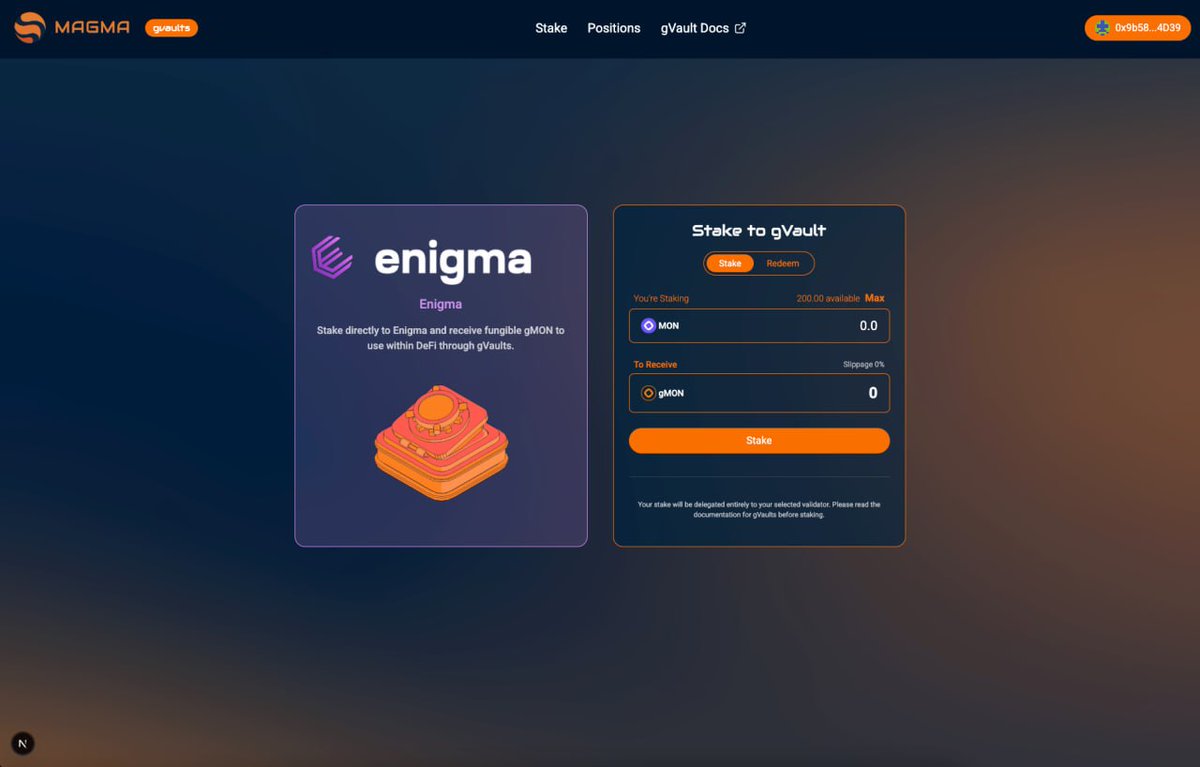
Stake $MON with Enigma as your validator, receive $gMON, and keep full access to Monad DeFi.
all while supporting us directly
@MagmaStaking's gVaults are the first staking vaults on Monad , stake with your preferred validator while keeping full liquidity.

Introducing gVaults: Staking vaults built for @Monad.
For the first time ever, liquid staking users on Monad can have their own validator.
gVaults offer an institutional on ramp to the liquid staking ecosystem.
Here’s how it works.
2
1
341
Enigma retweeted
Mar 7
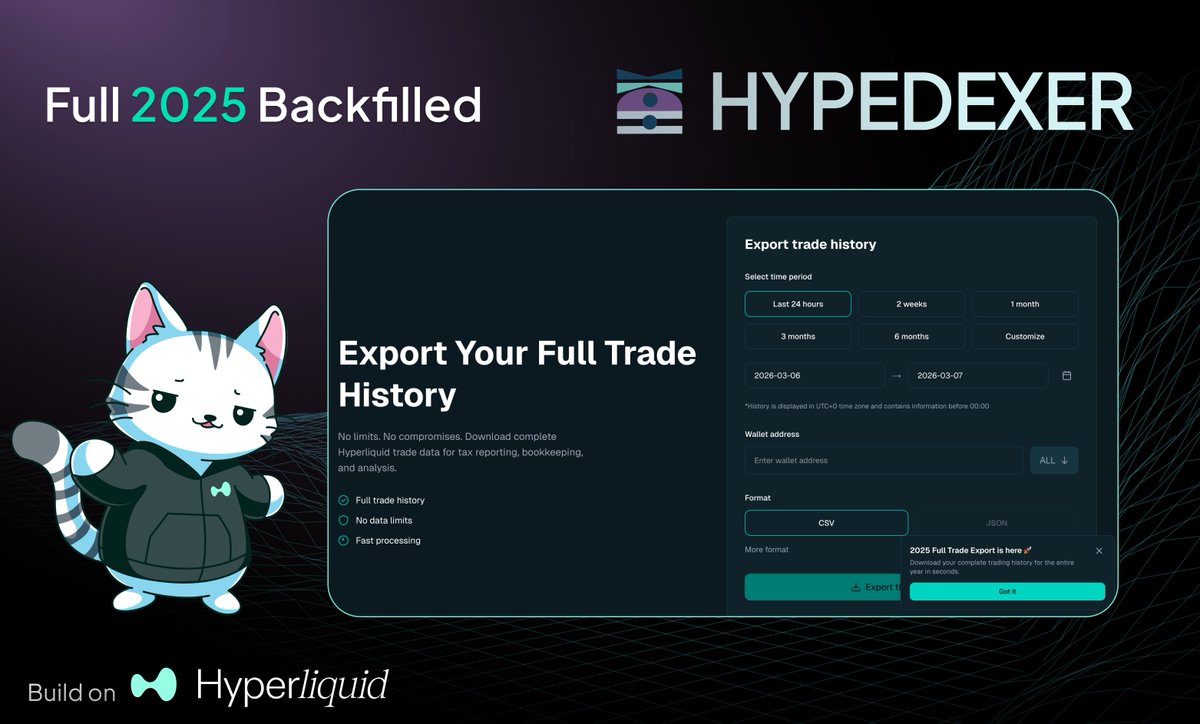
Trade export just got an upgrade.
You can now export your full 2025 trade history in one go — free for everyone, no restrictions.
Timely for tax season. For more advanced use cases, Hypedexer is here
5
6
37
12,598
Enigma retweeted
Mar 6
Full 2025 Hyperliquid trade history.
2024 coming soon.
Every address, fully backfilled.
The most complete dataset, available right now for scales users on Hypedexer :
unlimited access, customisable exports, no rate limits.
Trade export rolling out to everyone soon.
1
5
15
1,039
Enigma retweeted
Feb 21
If you're running volume on Hyperliquid, you've likely hit the 10k trade export limit.
As of today, we are making a full trade export available.
Pull your full 2025 trade history as a CSV file
Free. No sign-up.
(delegate to @EnigmaValidator for support)
Hyperliquid.
1
4
19
7,549

Enigma retweeted
Jan 23
We've just wrapped up our 2025 validator program evaluation.
Meet the 2026 legends gathering data from trusted sources and maintaining our decentralization.
The unsung heroes behind every data feed from Band Oracle.
🫡 Drop a "gBand" to show them some love to:
@Cosmos_Spaces @Bro_n_Bro @wanchain_org @HTX_Global @stakewolle @EnigmaValidator @AtlasStaking @polka_chu @AutoStake_ @ccclaimens @AValidators @CrowdControlNet @binance @ChorusOne @node_101 @IBSvalidator @westaking_io @StakeLab @stake_shark @InfStones @imperator_co @stakecito @Meria_Finance @stakingcabin @contributedao @TTT_Capital @NodesGuru @stakecraft @HighStakes_CH @w3coins_io @BitNordic @0baseVC @stakeflow @sf_validator @activenodes_io @B__Harvest @nansen_ai @CosmostationVD @ubikcapital @CitadelOne_ @HashKeyCloud @forbole

96
32
139
8,257
Enigma retweeted
Jan 20
IMPORTANT
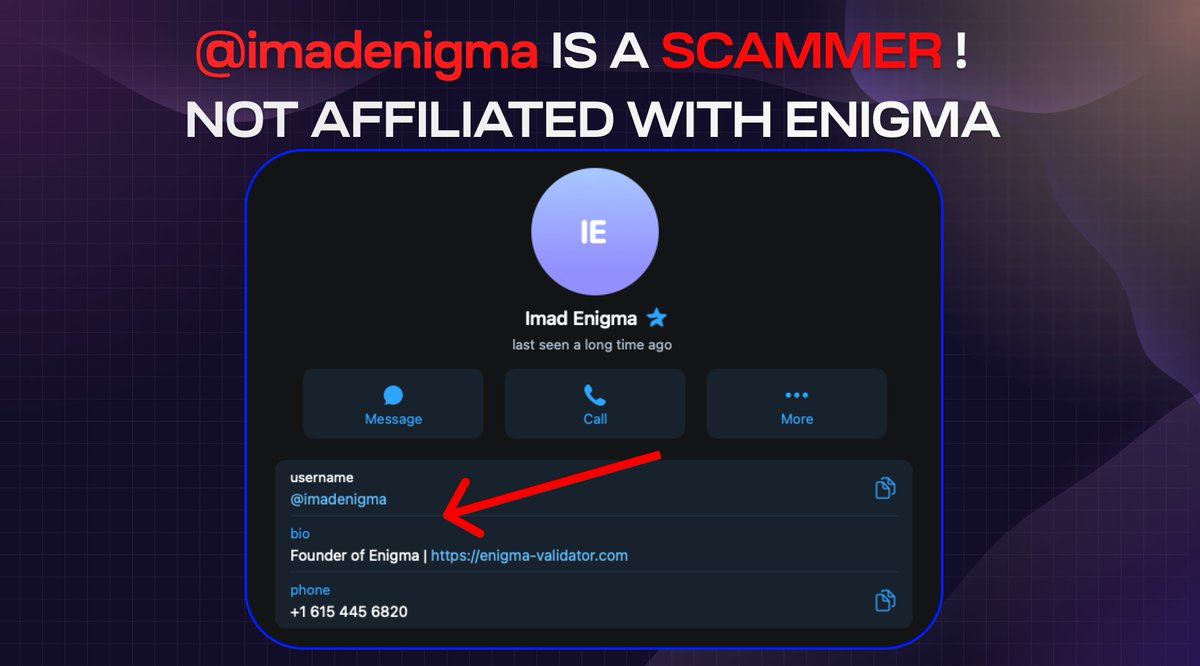
Our CEO's Telegram account (@imadenigma) has been compromised through a SIM swap attack. The unauthorized party is using the account to schedule fraudulent calls via Calendly and fake Zoom links.
Do NOT:
- Interact with @imadenigma on Telegram
- Click any links from this account
- Engage with previous Enigma owned Telegram groups
Please report @imadenigma to shut down his account.
ONLY relevant telegram account :
@enigma_validator , @wsm_enigma , @huzmond
Our official community chat link is provided in the tweet below.
Our core operations and systems remain unaffected.
Thank you for your attention to this matter.
13
4
21
3,883
Enigma retweeted

Jan 21
SagaEVM has been paused at block height 6593800 in response to a confirmed exploit on the SagaEVM chainlet.
Mitigation is underway, and the team is fully focused on a solution.
Further updates will follow once details are confirmed.
15
39
91
18,536
Jan 20
IMPORTANT
Our CEO's Telegram account (@imadenigma) has been compromised through a SIM swap attack. The unauthorized party is using the account to schedule fraudulent calls via Calendly and fake Zoom links.
Do NOT:
- Interact with @imadenigma on Telegram
- Click any links from this account
- Engage with previous Enigma owned Telegram groups
Please report @imadenigma to shut down his account.
ONLY relevant telegram account :
@enigma_validator , @wsm_enigma , @huzmond
Our official community chat link is provided in the tweet below.
Our core operations and systems remain unaffected.
Thank you for your attention to this matter.
13
4
21
3,883