Leading voice on Asia, experienced across government, think tanks and markets. Advisor to two Secretaries of State, a former Treasury Secretary and global CEOs.
Joined May 2014
- Tweets 69,940
- Following 8,193
- Followers 54,004
- Likes 28,311
2,644 Photos and videos








Pinned Tweet

In Asia, the United States is long on attitude, short on strategy. Re-upping this podcast deep dive I did last year into America's gathering policy failures in Asia. I pull the thread on several themes:
1. America's oversecuritization of its approach to Asia - to borrow the same metaphor, Washington is long on security and short on just about everything else. As I sometimes tartly put it, the United States is in serious danger of becoming "the Hessians of Asia."
2. Washington's strategic narcissism in filtering its entire Asia strategy through the prism of American competition with China. In other words, rather than trying to "get China right by getting Asia right," we are instead making every policy, initiative, and relationship derivative of America's own focus on Beijing.
3. Our collective national failure to adapt to an integrating Asia - one that is more "Asian" and less "Pacific" and more closely resembles its historical norm rather than the Cold War anomaly.
4. Our persistent inability to understand that Asian countries have domestic politics too - and how that, in turn, sometimes leads American policymakers both to misread Asian countries' interests and overestimate American leverage.
5. Why the United States isn't getting enough strategic traction EVEN in the Asian countries that are most ambivalent about the rise of Chinese power. When the mathematical operations that matter in Asia (and elsewhere) are addition and multiplication, it is strategically nonsensical to go long on subtraction and division.
6. What the Trump team gets right - for instance, about why Asian governments aren't attracted to a highly ideological American approach to their region - but then gets wrong in the execution and thus risks losing the strategic plot.
7. Why Washington won't be able to successfully ring-fence security cooperation by invoking shared fears of China while simultaneously coercing its allies and partners in the economic and technology domains.
8. Why China is more resilient than the United States thinks - but why Beijing, for all its strategic, political, ideological, and systematic differences from Washington, often shares American strategic narcissism.
9. How Beijing went from loathing sanctions to using them, copycatting the American architecture and, as I bluntly put it here, "learning from the best" - namely, Americans.
Give the podcast a listen. The United States needs to approach Asia as it is, not the region of its wishes, dreams, and fantasies.
pacificpolarity.substack.com…
5
30
108
49,829
Evan A. Feigenbaum retweeted

EVERYONE IN NYC IS SINGING EMPIRE STATE OF MIND
445
11,124
101,974
1,988,881
Evan A. Feigenbaum retweeted

Jun 13
#Thread
#ExportControl just changed shape. Not chips or tech, not code. It’s People. Foreign nationals, including a US lab’s own employees, locked out of frontier models overnight, wherever they sit.
Hmm… If talent itself is the leak, ring fencing tech gets a lot harder.
1/n
Jun 13

The US government, citing national security authorities, has issued an export control directive to suspend all access to Fable 5 and Mythos 5 by any foreign national, whether inside or outside the United States, including foreign national Anthropic employees.
The net effect of this order is that we must abruptly disable Fable 5 and Mythos 5 for all our customers to ensure compliance.
Access to all other Claude models is not affected.
We apologize for this disruption to our customers. We believe this is a misunderstanding and are working to restore access as soon as possible.
Read our full statement: anthropic.com/news/fable-myt…
49
291
1,033
175,039
Evan A. Feigenbaum retweeted

Jun 13
The US government, citing national security authorities, has issued an export control directive to suspend all access to Fable 5 and Mythos 5 by any foreign national, whether inside or outside the United States, including foreign national Anthropic employees.
The net effect of this order is that we must abruptly disable Fable 5 and Mythos 5 for all our customers to ensure compliance.
Access to all other Claude models is not affected.
We apologize for this disruption to our customers. We believe this is a misunderstanding and are working to restore access as soon as possible.
Read our full statement: anthropic.com/news/fable-myt…
12,092
25,260
85,505
83,466,210
Evan A. Feigenbaum retweeted

Jun 12
Spoke to US Secretary of State Marco Rubio this evening. I reiterated India’s strong protest at the attacks by the US Navy in the Gulf that killed three Indian mariners. Such lethal actions against commercial shipping are not justified.
4,555
8,897
44,958
2,725,837
Evan A. Feigenbaum retweeted

Jun 12
South Korea set to apply for CPTPP membership later this month with Japanese support - Japanese media
4
6
34
2,992

Chemo can't tell a cancer cell from a healthy one. That's the entire side-effect problem.
Nobel Prize winner Dr. Jennifer Doudna's lab just built something that can. It reads the cell's RNA, and if it finds the message for mutant p53, the single most common typo in cancer, it triggers a CRISPR enzyme to shred that cell's DNA.
One wrong letter is the trigger. Healthy cells, spared.
The killing works. In mice, a single dose roughly halved the tumors.
The unsolved half is getting it into every tumor cell in a living body. That's where every CRISPR cancer idea has stalled. Real advance, real wall.
Jun 10

A new CRISPR-based approach can selectively destroy cancer cells, according to a recent UC Berkeley-coauthored study. The technique opens a new frontier for treating the mutations found in nearly half of all cancers—including some of the most difficult types.
bit.ly/4e2x5aQ

28
374
2,029
328,525
Evan A. Feigenbaum retweeted

Jun 11
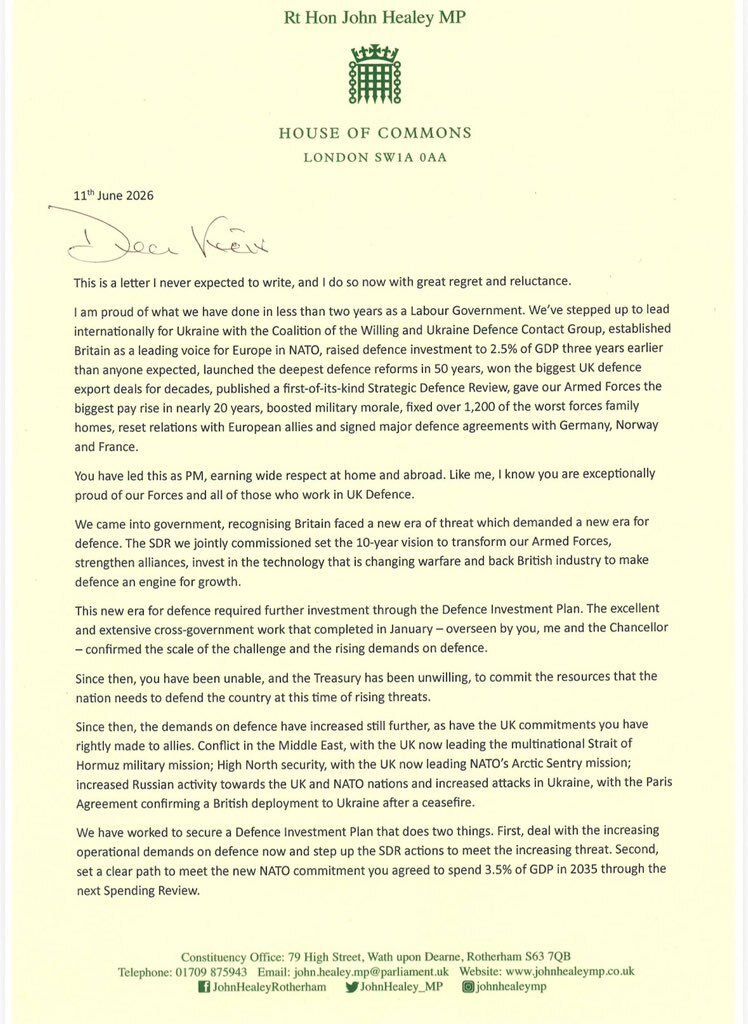
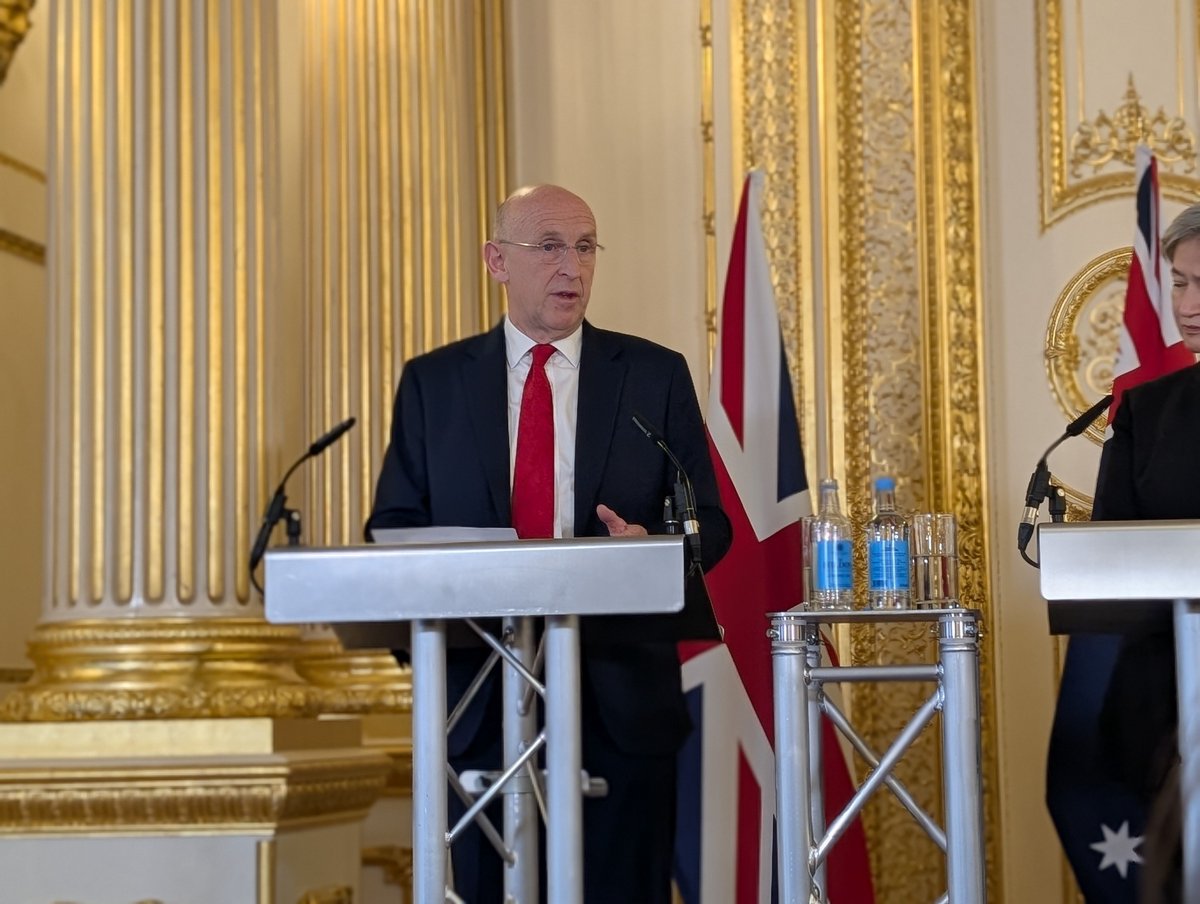
Wow. Hours before he was due to host Australia's Deputy Prime Minister Richard Marles at HMNB John Healey has QUIT over Starmer's lack of defence spending.
Healey's last outing was AUKMIN yesterday at Lancaster house.
3
19
57
16,387
Evan A. Feigenbaum retweeted

Jun 8
央视6分钟完整版:习近平访朝鲜,金正恩倾全国之力打造的欢迎仪式,估计是当今世界独一份。中朝两国领导人的巨幅画像高挂广场正中,上千名群众同时参与欢迎活动,动作整齐如同机械运转。三军仪仗队检阅等都是基本操作,广场上还有白马骑兵仪仗队。最后更放飞了印有中朝双语欢迎标语的气球,场面相当豪华用心!

173
85
1,106
915,757
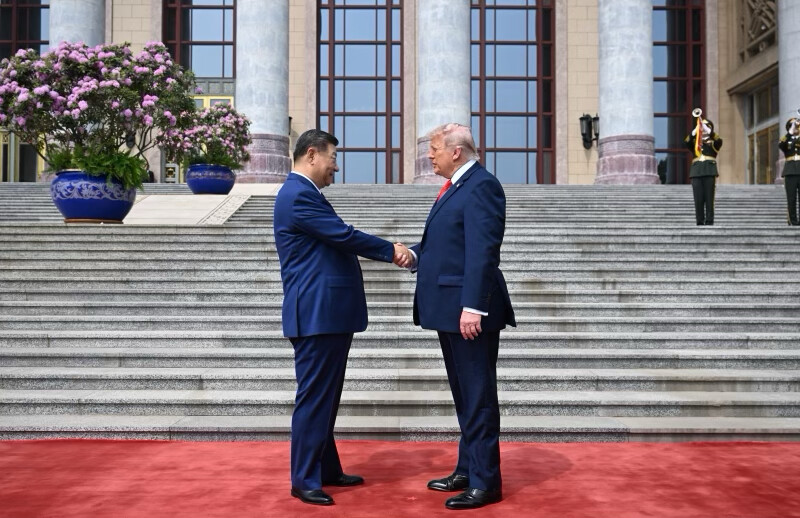
Sorry, but this is just bonkers.

See, they have a Ballroom — It's called The Great Hall of China! It's very large and beautiful. Why do people fight me for having something even better? The Dumocrats are CRAZY! President DONALD J. TRUMP
4
12
5,560
Evan A. Feigenbaum retweeted
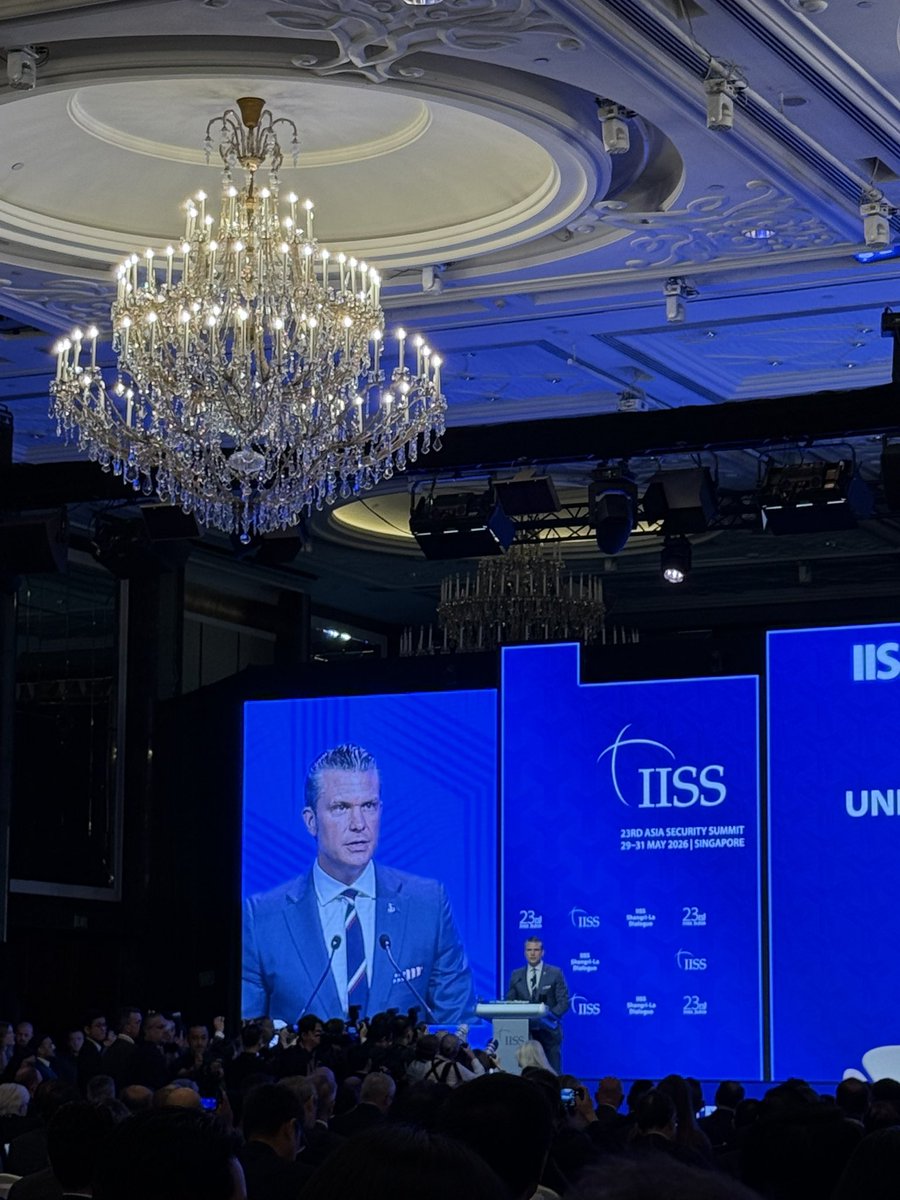
This is a silly binary. The point in Asia is not some academic, ivory tower version of Western liberal thought but that if you’re going to prattle about wanting a region that is “free and open”—even without ritualistic incantations of some formal catechism like, “free and open Indo-Pacific”—then it helps if you actually promote freedom and openness. Trashing values as a basis for policy alignment hardly suggests the United States cares about freedom, especially when such values include free passage, free navigation, free markets, not “just” domestic political systems. And imposing tariffs on literally everyone while leveraging coercive tools of economic statecraft against literally everyone doesn’t exactly sound like the U.S. is much interested in openness either. It would be better to anchor American policy in shared interests while also recognizing that relationships based solely on interests are more brittle than when interests and values are both engaged.
May 30

Hegseth loses no opportunity to take a jab at “moralizing” Europe in his Singapore speech praising the “pragmatic” Asian partners and allies. Shared interests, not shared ideals. #iiss_sld26
3
18
57
12,514
Evan A. Feigenbaum retweeted

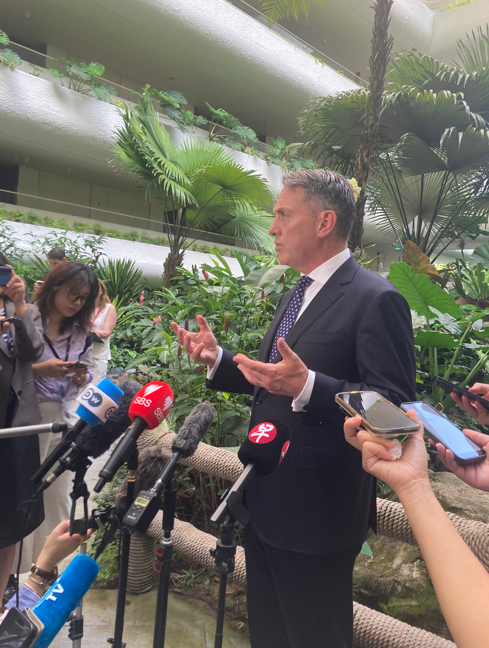
Defence Minister Richard Marles says shifting to buy three secondhand Virginia-class submarines (instead of a mix of old and new) from the US makes sense: "we need to place a premium on simplicity." He also says it will deliver "useful" savings to the program
24
31
66
16,432
Evan A. Feigenbaum retweeted

May 30
AUKUS represents the biggest leap in Australia's military capability in more than a century and we are delivering it alongside our close partners — the United States and the United Kingdom.
Great to meet with Secretary Hegseth and Secretary Healey in Singapore for our AUKUS Defence Ministers’ Meeting.
Today, we welcomed a significant milestone under AUKUS Pillar Two, which is focused on advanced capabilities, with the first “Signature Project” under our partnership — working together to develop interoperable and shared systems for Uncrewed Undersea Vehicles, like Australia’s sovereign Ghost Shark.
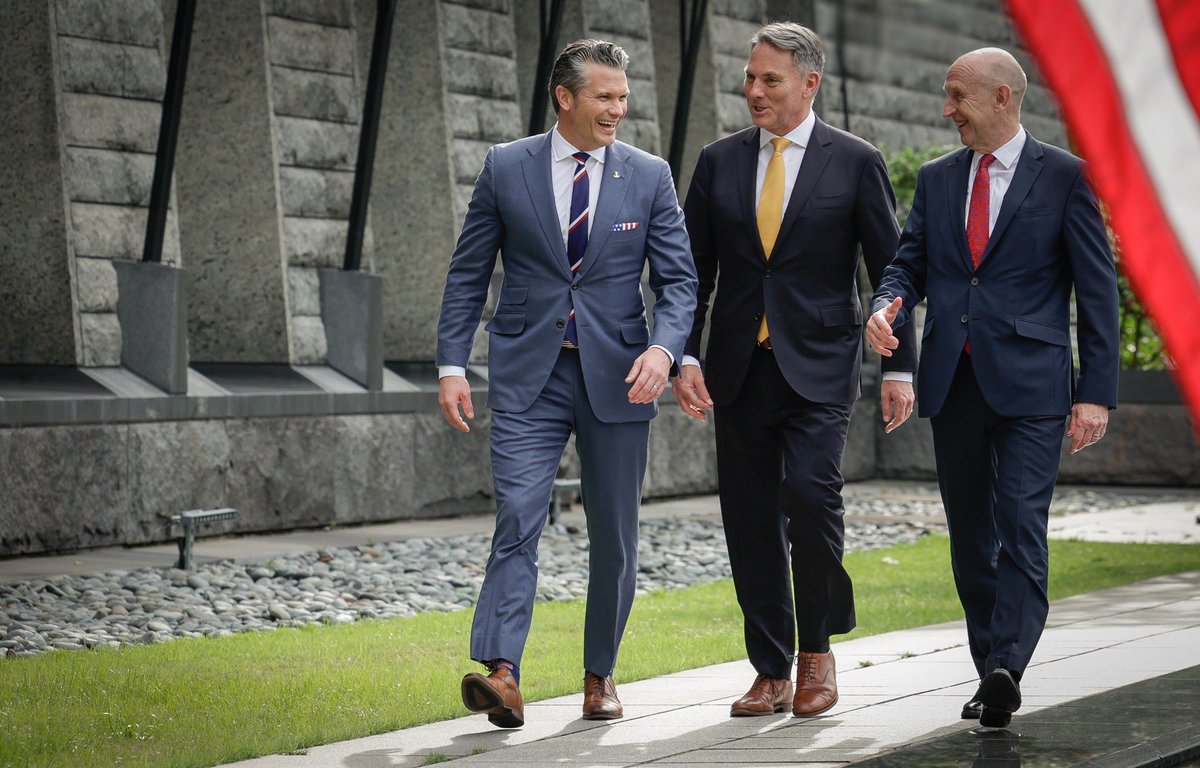
224
69
268
81,103
Evan A. Feigenbaum retweeted

May 30
AUKUS full steam ahead 🇦🇺🇬🇧🇺🇸
Today in Singapore, @RichardMarlesMP, @JohnHealey_MP and @PeteHegseth have announced the first AUKUS Pillar II Signature Project.
The project will develop systems for Uncrewed Undersea Vehicles – protecting vital national seabed infrastructure.
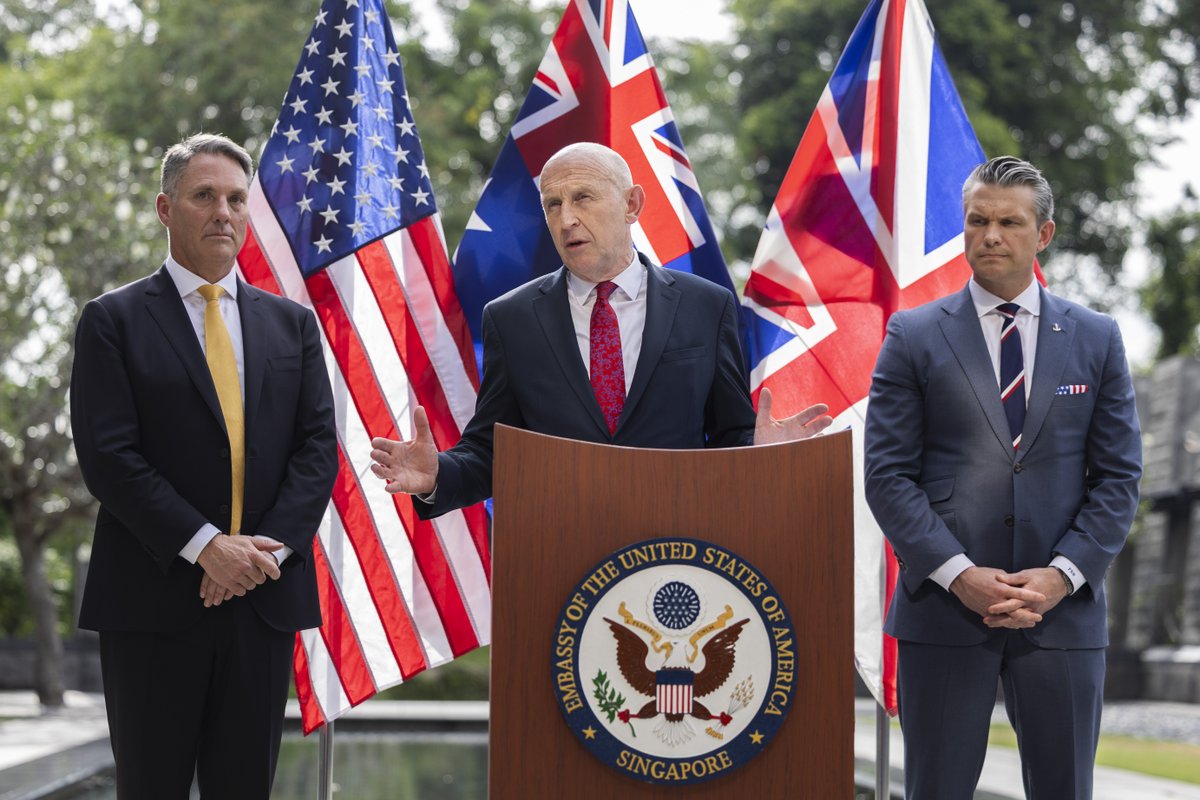
52
179
750
54,986
Spoiler alert: We are not, in fact, in “as strong of a position as we’ve ever been in the Pacific.”

.@SecWar just told @DailySignal the Trump admin’s policy on Taiwan hasn’t changed.
“Our stance on Taiwan remains unchanged, just as the President said when we came out of those historic meetings with China, and I think we're as strong of a position as we've ever been in the Pacific, and around the world.”
“The policy we have on Taiwan is the same as it was at the beginning of this administration. The only change you might see is how we talk about the entirety of it. What I talked about today was strong, quiet, but clear, ensuring our allies know precisely where we stand, whether it's open in public or behind closed doors, and that's why these meetings have been so important.”
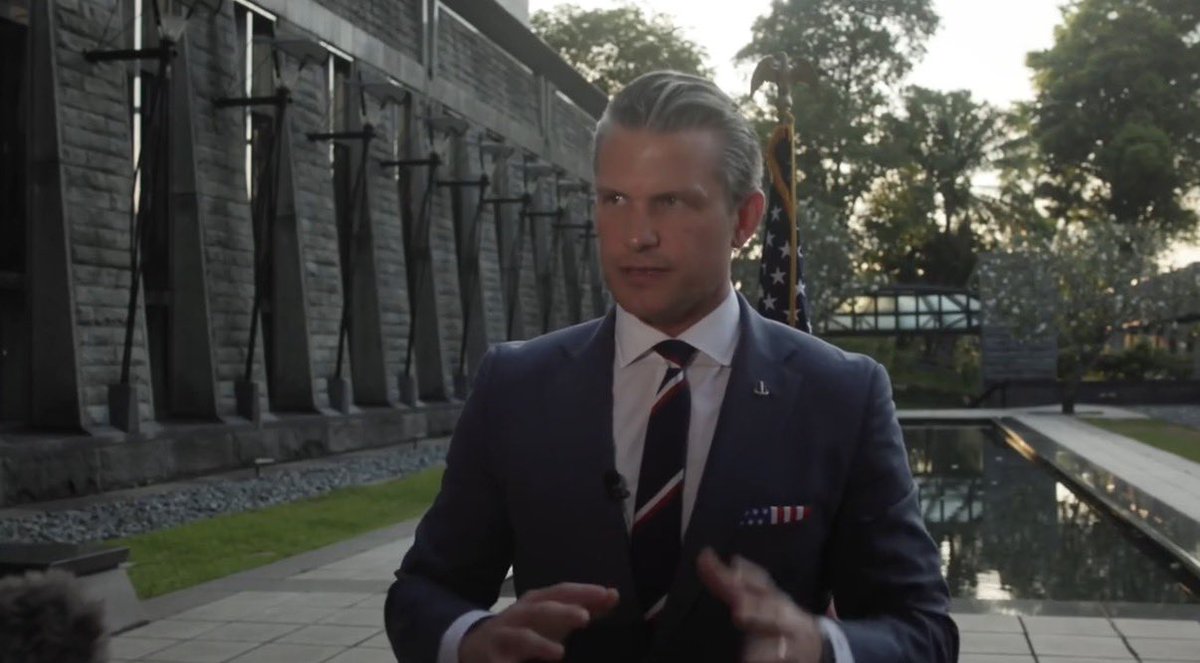
5
25
5,467
Evan A. Feigenbaum retweeted
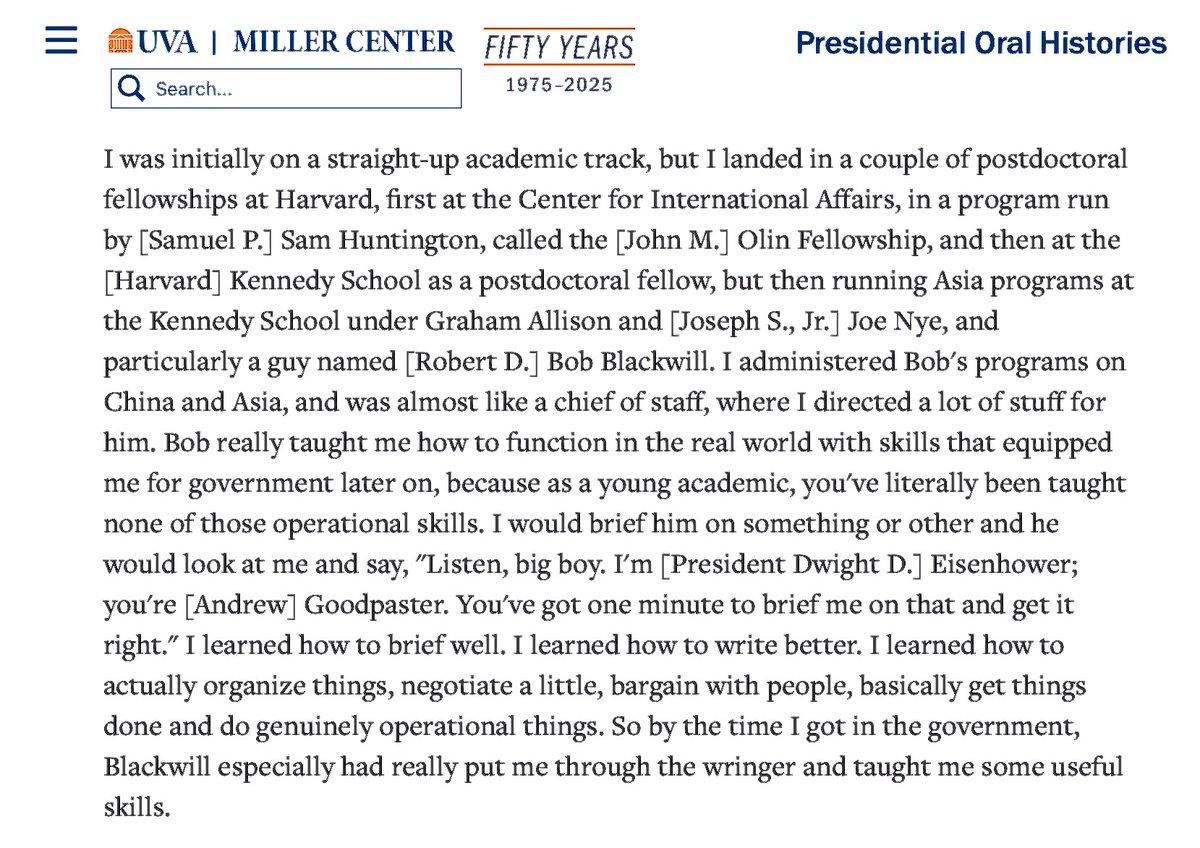
For whatever it's worth, all of this was tried in the Bush Administration, which is why the "South and Central Asian Affairs" bureau at the State Department was created in the first place. It was central to U.S. strategy in the 2000s, was smacked around by Russia, China, and several regional leaders themselves, and the most important cautionary examples come from the region's own experience. I did a long oral history on some of this for the @Miller_Center's George W. Bush project and there are lots of old speeches and policy documents going back to the 1990s and Strobe Talbott's "Flashman" speech that touch elements of this. What has changed is, most notably, Uzbekistan's foreign policy - because Islam Karimov was quite the case, to put it charitably. But there is a lot of history to this not-so-new initiative.
2
14
4,161
Evan A. Feigenbaum retweeted
In other words, U.S. alliance policy in Asia and the Pacific for two generations. Sorry, but what’s so radically new here?

“The National Defense Strategy makes clear that the old course of foreign policy was headed for disaster. That is all changing now. Our approach is one of flexible, practical realism that looks at the world with a clear-eyed perspective essential for serving our vital interests. And nowhere is this clarity more important than in the Pacific.” 10/
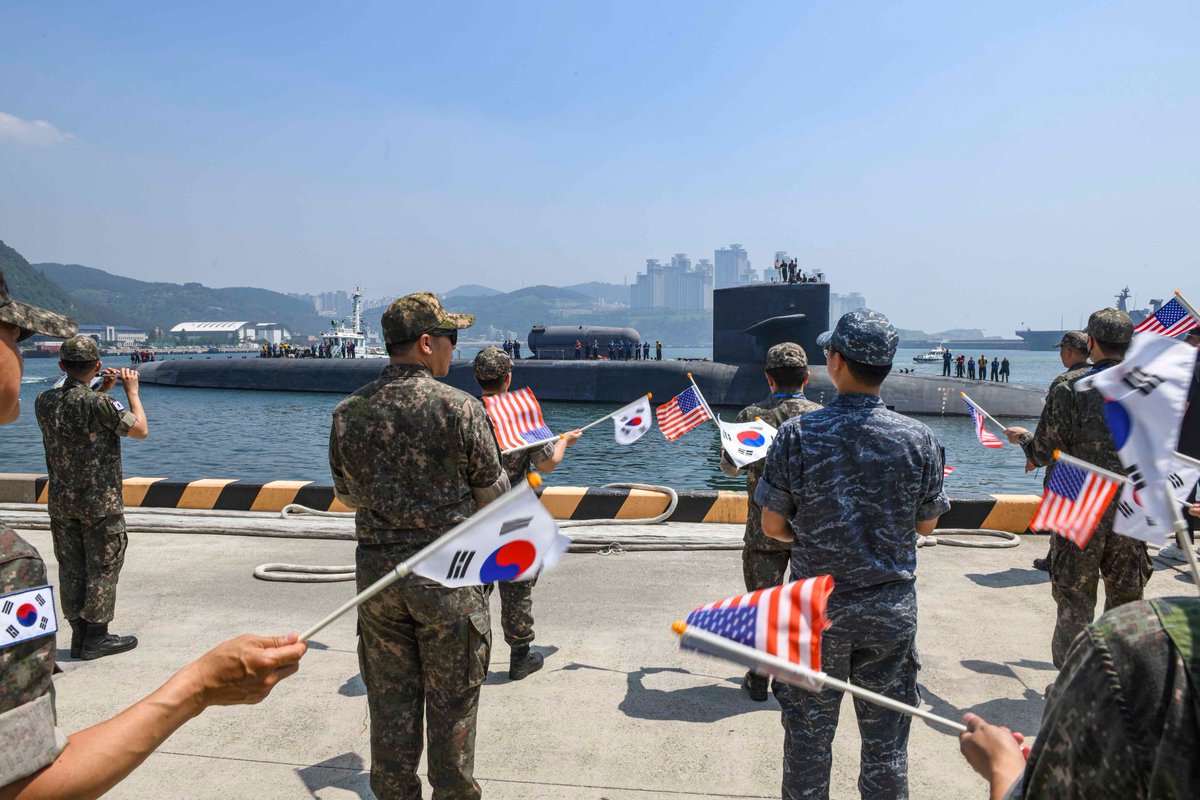
6
2
26
6,821
Evan A. Feigenbaum retweeted
Important new piece of research on China's overseas police and security cooperation agreements from my #CarnegieAsia teammate @SheenaGreitens and her collaborators, our former and current junior fellows @CameronWaltz_ and Sophie Zhuang. China’s Ministry of Public Security is often portrayed as a domestic law enforcement agency, but it is also a global security actor. This @CarnegieEndow paper explores how MPS has used international law enforcement and security cooperation agreements—over 200 of them since 2006—to advance China’s vision of security in a changing global environment. carnegieendowment.org/resear…
2
14
34
4,915