
Joined June 2026
- Tweets 80
- Following 27
- Followers 9
- Likes 67
72 Photos and videos


Pinned Tweet

Jun 2
🚨 Welcome to Exam Radar AI
An AI-powered current affairs intelligence platform for:
• UPSC
• RAS
• Competitive Exams
We transform breaking news into:
✔ Prelims-focused insights
✔ Mains frameworks
✔ Exam-oriented analysis
✔ Fast, structured intelligence
Built for serious aspirants who want to study smarter. ⚡
🔗 examradarai.in
4
51
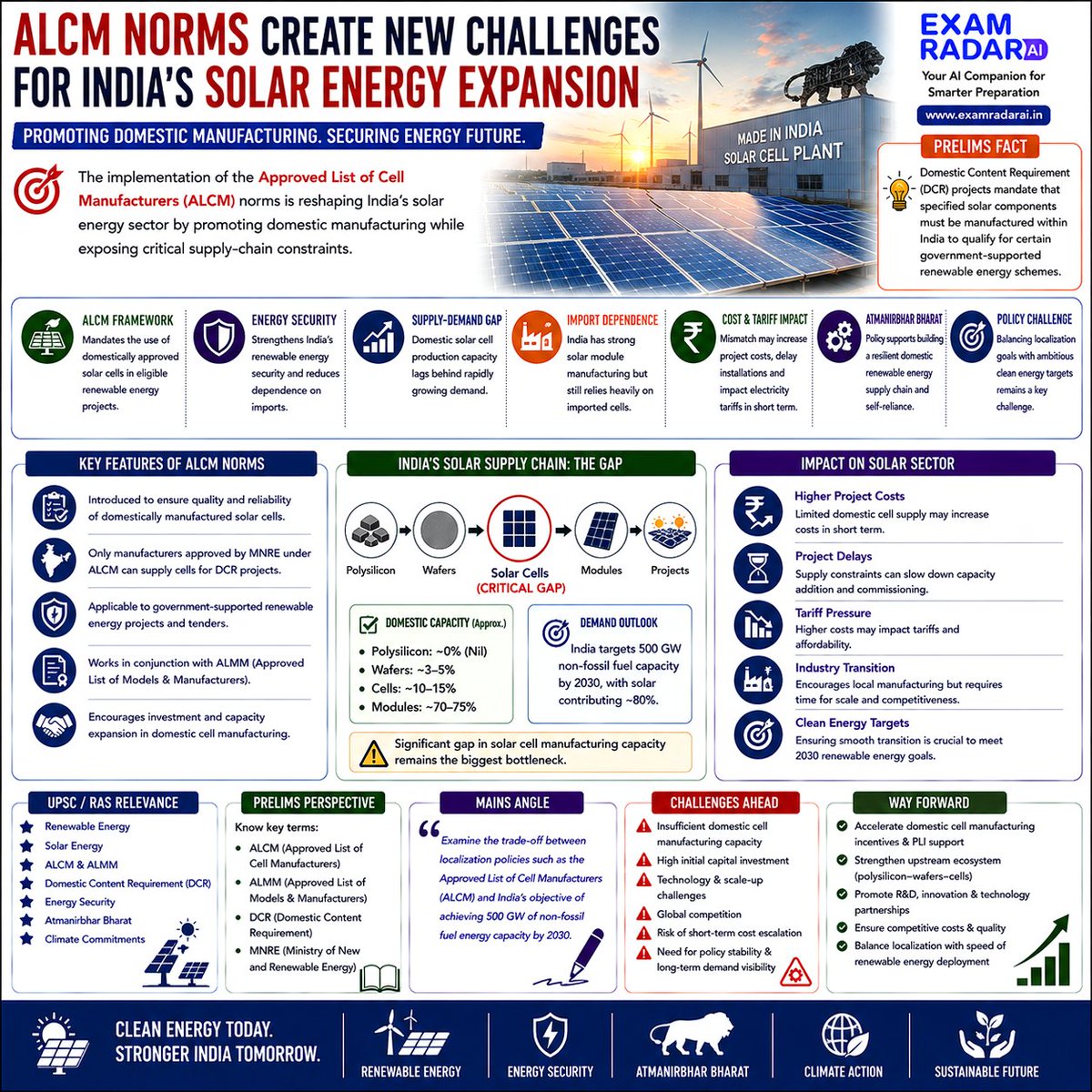
☀️ ALCM NORMS CREATE NEW CHALLENGES FOR INDIA'S SOLAR ENERGY EXPANSION
The implementation of the Approved List of Cell Manufacturers (ALCM) norms is reshaping India's solar energy sector by promoting domestic manufacturing while exposing critical supply-chain constraints.
📌 The ALCM framework mandates the use of domestically approved solar cells in eligible renewable energy projects.
📌 The policy is aimed at strengthening India's renewable energy security and reducing dependence on imported solar components.
📌 However, the industry currently faces a significant gap between domestic solar cell production capacity and rapidly growing demand.
📌 While India has developed substantial solar module manufacturing capacity, it still relies heavily on imported solar cells.
📌 The supply-demand mismatch could increase project costs, delay installations, and impact electricity tariffs in the short term.
📌 The policy aligns with broader efforts to build a resilient domestic renewable energy supply chain under the Atmanirbhar Bharat initiative.
📌 Balancing localization goals with ambitious clean energy targets remains a key challenge for policymakers.
🎯 UPSC/RAS Relevance:
• Renewable Energy
• Solar Energy
• ALCM & ALMM
• Domestic Content Requirement (DCR)
• Energy Security
• Atmanirbhar Bharat
• Climate Commitments
💡 Prelims Fact:
Domestic Content Requirement (DCR) projects mandate that specified solar components must be manufactured within India to qualify for certain government-supported renewable energy schemes.
📝 Mains Angle:
"Examine the trade-off between localization policies such as the Approved List of Cell Manufacturers (ALCM) and India's objective of achieving 500 GW of non-fossil fuel energy capacity by 2030."
#UPSC #RAS #CurrentAffairs #SolarEnergy #RenewableEnergy #ALCM #ALMM #EnergySecurity #AtmanirbharBharat #ClimateChange #Infrastructure #GS3 #ExamRadarAI
1
40
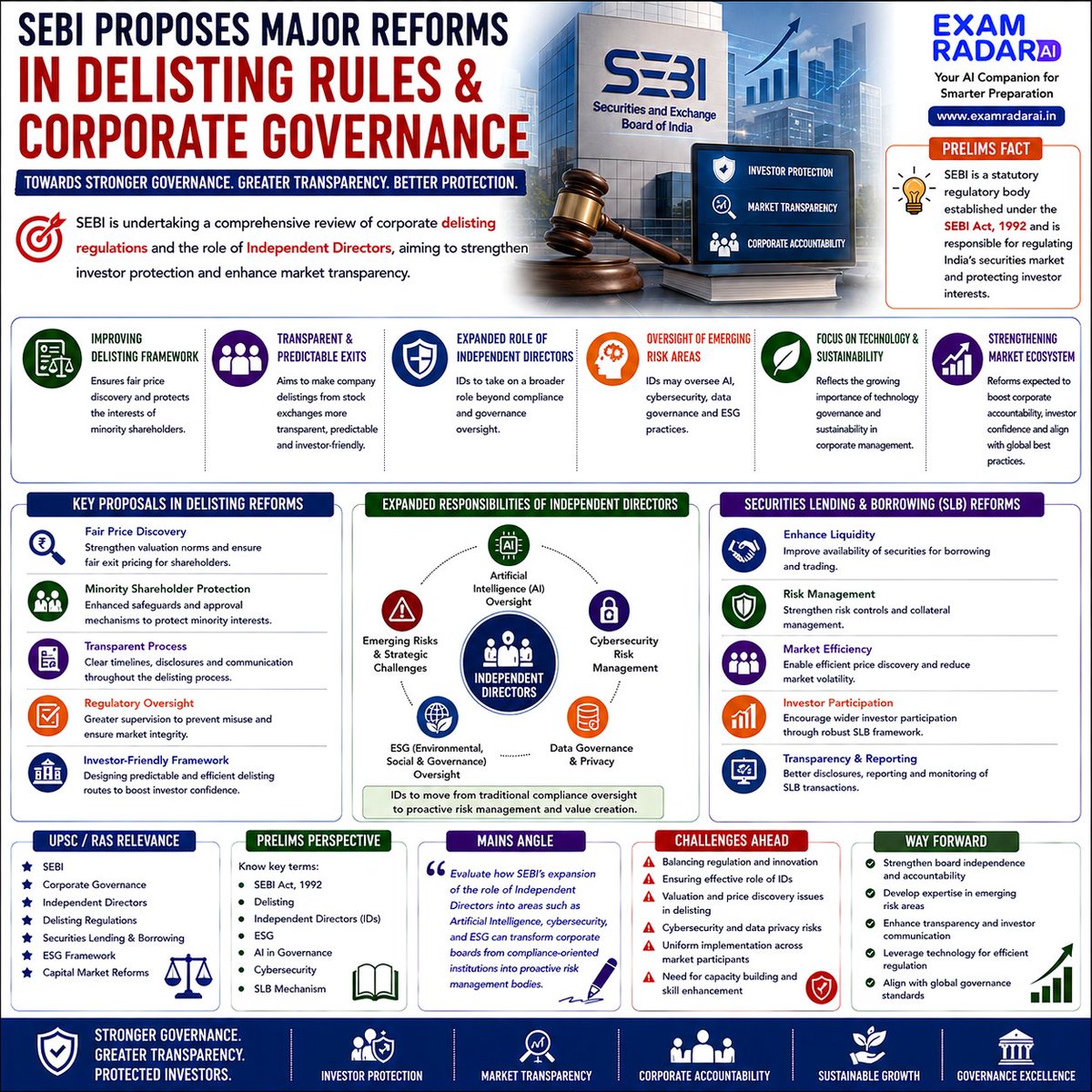
📈 SEBI PROPOSES MAJOR REFORMS IN DELISTING RULES & CORPORATE GOVERNANCE
The Securities and Exchange Board of India (SEBI) is undertaking a comprehensive review of corporate delisting regulations and the role of Independent Directors, aiming to strengthen investor protection and enhance market transparency.
📌 The reforms seek to improve the delisting framework by ensuring fair price discovery and safeguarding the interests of minority shareholders.
📌 SEBI aims to make company exits from stock exchanges more transparent, predictable, and investor-friendly.
📌 A key proposal involves expanding the responsibilities of Independent Directors (IDs) beyond traditional compliance functions.
📌 Independent Directors may be required to oversee emerging risk areas such as Artificial Intelligence (AI), cybersecurity, data governance, and ESG (Environmental, Social and Governance) practices.
📌 The move reflects the growing importance of technology governance and sustainability in modern corporate management.
📌 SEBI is also examining reforms related to the Securities Lending and Borrowing (SLB) mechanism to improve market liquidity and efficiency.
📌 The proposed changes are expected to strengthen corporate accountability, improve investor confidence, and align Indian governance standards with global best practices.
🎯 UPSC/RAS Relevance:
• SEBI
• Corporate Governance
• Independent Directors
• ESG Framework
• Securities Lending and Borrowing (SLB)
• Capital Market Reforms
💡 Prelims Fact:
SEBI is a statutory regulatory body established under the SEBI Act, 1992 and is responsible for regulating India's securities market and protecting investor interests.
📝 Mains Angle:
"Evaluate how SEBI's expansion of the role of Independent Directors into areas such as Artificial Intelligence, cybersecurity, and ESG can transform corporate boards from compliance-oriented institutions into proactive risk management bodies."
#UPSC #RAS #CurrentAffairs #SEBI #CorporateGovernance #IndependentDirectors #ESG #CapitalMarkets #IndianEconomy #CyberSecurity #ArtificialIntelligence #GS3 #ExamRadarAI
1
12
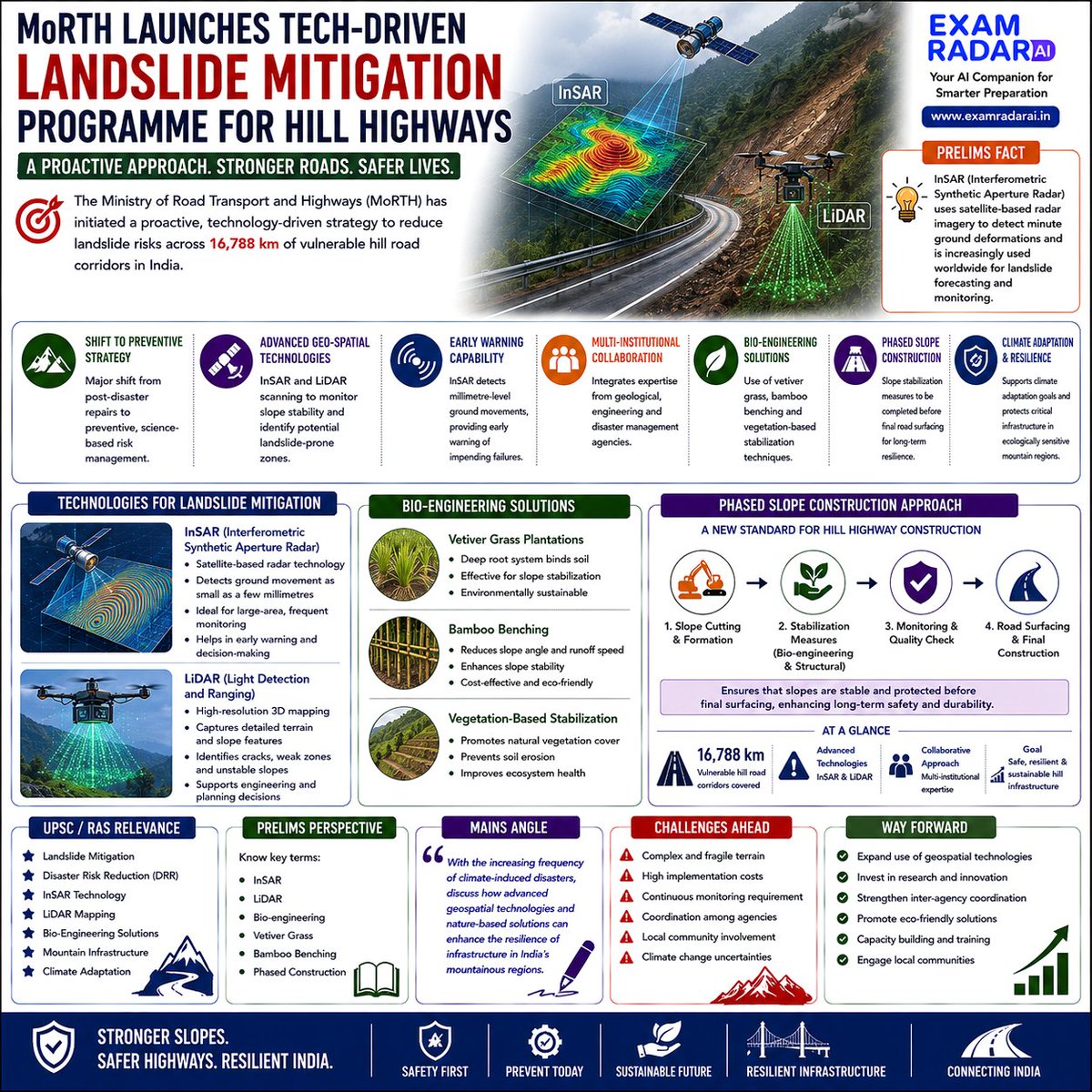
⛰️ MoRTH LAUNCHES TECH-DRIVEN LANDSLIDE MITIGATION PROGRAMME FOR HILL HIGHWAYS
The Ministry of Road Transport and Highways (MoRTH) has initiated a proactive, technology-driven strategy to reduce landslide risks across 16,788 km of vulnerable hill road corridors in India.
📌 The initiative marks a major shift from post-disaster repairs to preventive, science-based disaster risk management.
📌 Advanced geospatial technologies such as InSAR (Interferometric Synthetic Aperture Radar) and LiDAR scanning will be deployed to monitor slope stability and identify potential landslide-prone zones.
📌 InSAR technology can detect millimetre-level ground movements, providing early warning signals of impending slope failures.
📌 The programme integrates expertise from multiple institutions, including geological, engineering, and disaster management agencies.
📌 MoRTH is also promoting bio-engineering solutions, including vetiver grass plantations, bamboo benching, and vegetation-based slope stabilization techniques.
📌 A new phased slope construction approach will ensure that slope stabilization measures are completed before final road surfacing, enhancing long-term infrastructure resilience.
📌 The initiative supports climate adaptation goals and aims to protect critical transportation infrastructure in ecologically sensitive mountain regions.
🎯 UPSC/RAS Relevance:
• Landslide Mitigation
• Disaster Risk Reduction (DRR)
• InSAR Technology
• LiDAR Mapping
• Bio-Engineering Solutions
• Mountain Infrastructure
• Climate Adaptation
💡 Prelims Fact:
InSAR (Interferometric Synthetic Aperture Radar) uses satellite-based radar imagery to detect minute ground deformations and is increasingly used worldwide for landslide forecasting and monitoring.
📝 Mains Angle:
"With the increasing frequency of climate-induced disasters, discuss how advanced geospatial technologies and nature-based solutions can enhance the resilience of infrastructure in India's mountainous regions."
#UPSC #RAS #CurrentAffairs #MoRTH #Landslides #DisasterManagement #InSAR #LiDAR #ClimateAdaptation #Infrastructure #GS1 #GS3 #ExamRadarAI
1
21
📡 CENTRE RELEASES DRAFT UNIFIED BROADCASTING RULES, 2026
The Ministry of Information and Broadcasting has issued the Draft Unified Broadcasting Rules, 2026, proposing a single regulatory framework for television, radio, DTH, IPTV, and other broadcasting platforms.
📌 The rules aim to replace multiple fragmented regulations with a modern and unified broadcasting governance architecture.
📌 The framework has been formulated under the broader provisions of the Telecommunications Act, promoting regulatory simplification and ease of doing business.
📌 It introduces a fully digital authorization system, eliminating traditional paper-based approval mechanisms such as the Grant of Permission Agreement (GOPA).
📌 The draft mandates Public Service Obligations (PSO) requiring television channels to broadcast at least 30 minutes per day and radio stations 1 hour per day of content related to national and social importance.
📌 The reforms seek to improve transparency, reduce compliance burdens, and streamline interactions between broadcasters and the government.
📌 The framework is expected to strengthen media governance while ensuring wider dissemination of public welfare information.
🎯 UPSC/RAS Relevance:
• Telecommunications Act
• Media Governance
• Broadcasting Regulation
• Public Service Obligations (PSO)
• Digital Governance
• Ease of Doing Business
💡 Prelims Fact:
Under the Draft Unified Broadcasting Rules, 2026, television broadcasters may be required to allocate 30 minutes daily, while radio broadcasters may allocate 1 hour daily, for Public Service Obligation content.
📝 Mains Angle:
"Examine how the Draft Unified Broadcasting Rules, 2026 seek to balance ease of doing business, digital governance, and the state's objective of promoting public service broadcasting."
#UPSC #RAS #CurrentAffairs #BroadcastingRules2026 #MediaGovernance #TelecommunicationsAct #DigitalGovernance #PublicPolicy #Governance #GS2 #ExamRadarAI
1
49
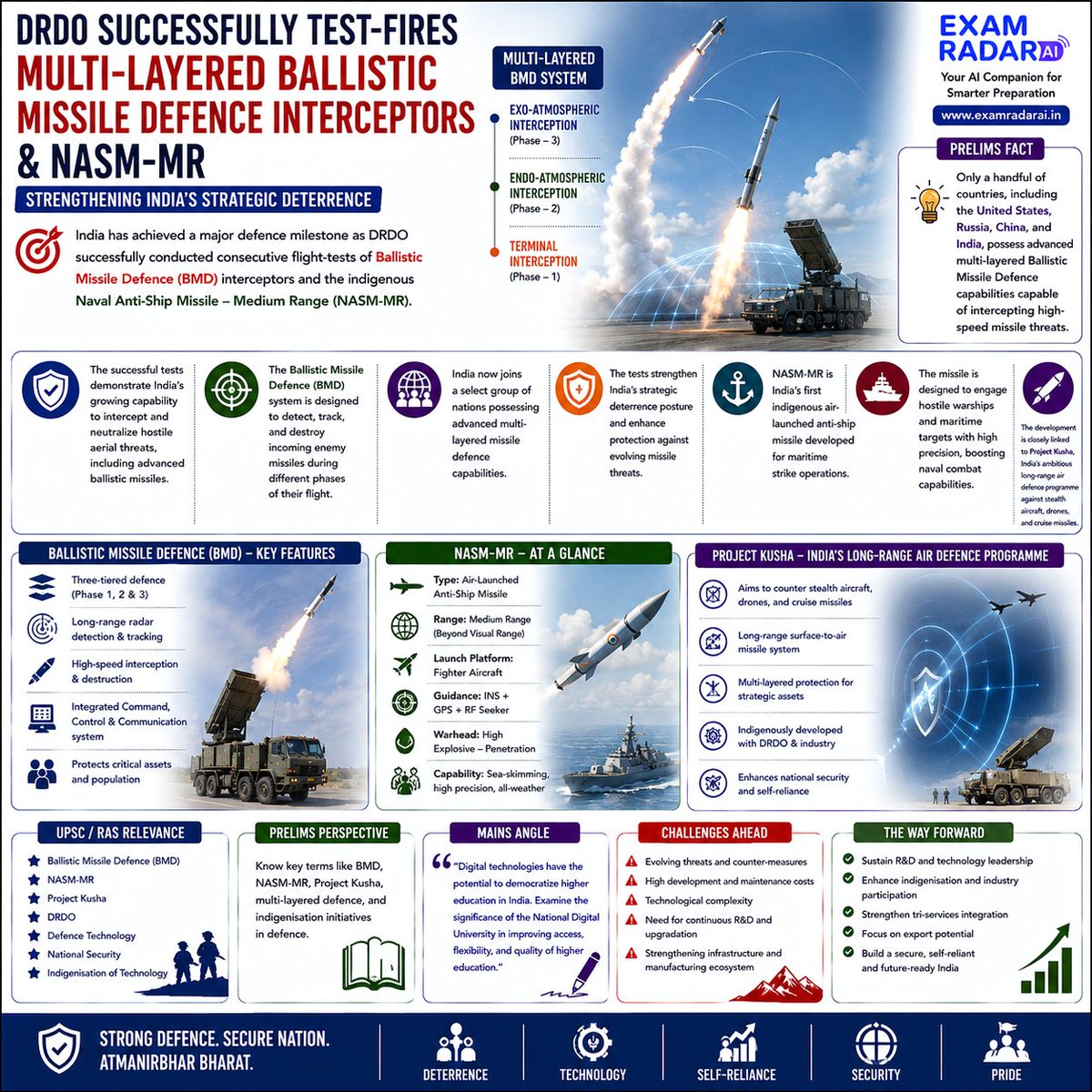
🚀 DRDO SUCCESSFULLY TEST-FIRES MULTI-LAYERED BALLISTIC MISSILE DEFENCE INTERCEPTORS & NASM-MR
India has achieved a major defence milestone as DRDO successfully conducted consecutive flight-tests of Ballistic Missile Defence (BMD) interceptors and the indigenous Naval Anti-Ship Missile–Medium Range (NASM-MR).
📌 The successful tests demonstrate India's growing capability to intercept and neutralize hostile aerial threats, including advanced ballistic missiles.
📌 The Ballistic Missile Defence (BMD) system is designed to detect, track, and destroy incoming enemy missiles during different phases of their flight.
📌 India now joins a select group of nations possessing advanced multi-layered missile defence capabilities.
📌 The tests strengthen India's strategic deterrence posture and enhance protection against evolving missile threats.
📌 NASM-MR is India's first indigenous air-launched anti-ship missile developed for maritime strike operations.
📌 The missile is designed to engage hostile warships and maritime targets with high precision, boosting naval combat capabilities.
📌 The development is closely linked to Project Kusha, India's ambitious long-range air defence programme aimed at countering stealth aircraft, drones, and cruise missiles.
🎯 UPSC/RAS Relevance:
• Ballistic Missile Defence (BMD)
• NASM-MR
• Project Kusha
• DRDO
• Defence Technology
• National Security
• Indigenisation of Technology
💡 Prelims Fact:
Only a handful of countries, including the United States, Russia, China, and India, possess advanced multi-layered Ballistic Missile Defence capabilities capable of intercepting high-speed missile threats.
📝 Mains Angle:
"Analyze the strategic significance of India's multi-layered Ballistic Missile Defence (BMD) system in strengthening national security, strategic deterrence, and regional stability in the Indo-Pacific region."
#UPSC #RAS #CurrentAffairs #DRDO #BMD #BallisticMissileDefence #NASMMR #ProjectKusha #DefenceTechnology #NationalSecurity #ScienceAndTechnology #GS3 #ExamRadarAI
1
64
Jun 12
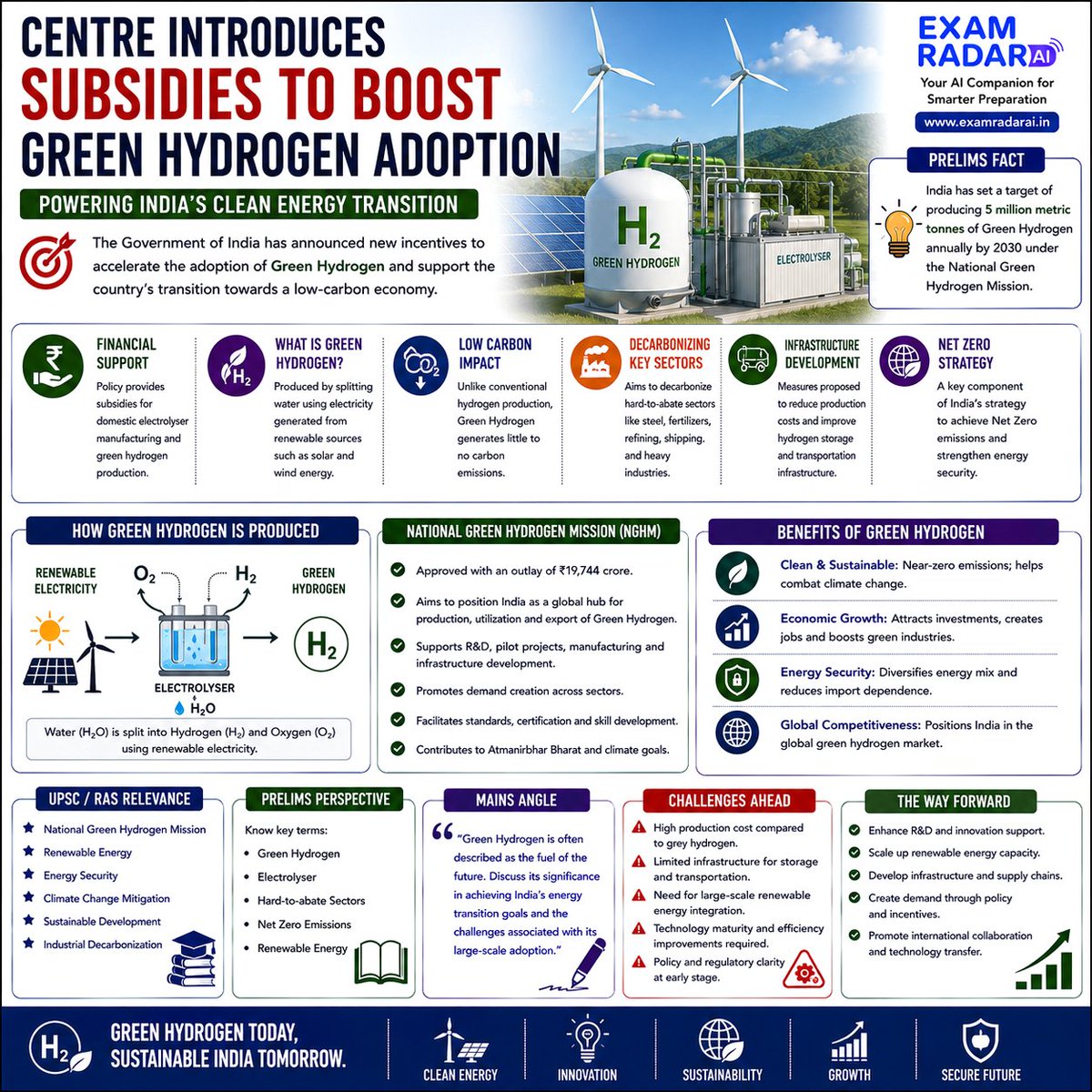
🌱 CENTRE INTRODUCES SUBSIDIES TO BOOST GREEN HYDROGEN ADOPTION
The Government of India has announced new incentives to accelerate the adoption of Green Hydrogen and support the country's transition towards a low-carbon economy.
📌 The policy provides financial support for domestic electrolyser manufacturing and green hydrogen production.
📌 Green Hydrogen is produced by splitting water using electricity generated from renewable sources such as solar and wind energy.
📌 Unlike conventional hydrogen production, Green Hydrogen generates little to no carbon emissions.
📌 The initiative aims to decarburize hard-to-abate sectors such as steel, fertilizers, refining, shipping, and heavy industries.
📌 The government has also proposed measures to reduce production costs and improve infrastructure for hydrogen storage and transportation.
📌 The move is a key component of India's strategy to achieve Net Zero emissions and strengthen energy security.
📌 Green Hydrogen is expected to play a crucial role in reducing dependence on imported fossil fuels while promoting sustainable industrial growth.
🎯 UPSC/RAS Relevance:
• National Green Hydrogen Mission
• Renewable Energy
• Energy Security
• Net Zero Emissions
• Sustainable Development
• Climate Change Mitigation
💡 Prelims Fact:
India has set a target of producing 5 million metric tonnes of Green Hydrogen annually by 2030 under the National Green Hydrogen Mission.
📝 Mains Angle:
"Green Hydrogen is often described as the fuel of the future. Discuss its significance in achieving India's energy transition goals and the challenges associated with its large-scale adoption."
#UPSC #RAS #CurrentAffairs #GreenHydrogen #NationalGreenHydrogenMission #RenewableEnergy #EnergySecurity #ClimateChange #SustainableDevelopment #GS3 #ExamRadarAI
2
38
Jun 12
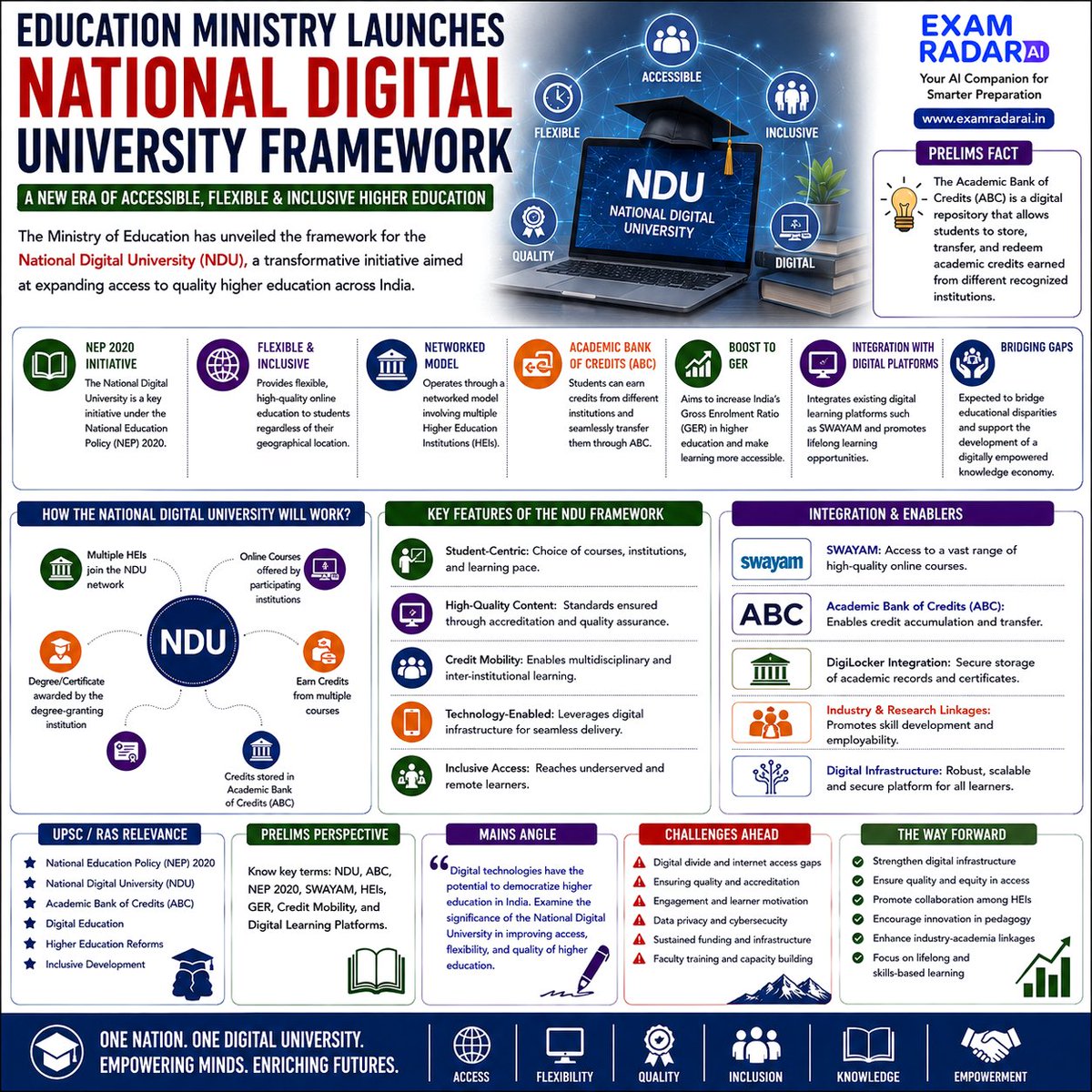
🎓 EDUCATION MINISTRY LAUNCHES NATIONAL DIGITAL UNIVERSITY FRAMEWORK
The Ministry of Education has unveiled the framework for the National Digital University (NDU), a transformative initiative aimed at expanding access to quality higher education across India.
📌 The National Digital University is a key initiative under the National Education Policy (NEP) 2020.
📌 It seeks to provide flexible, high-quality online education to students regardless of their geographical location.
📌 The platform will operate through a networked model involving multiple Higher Education Institutions (HEIs).
📌 Students will be able to earn credits from different institutions and seamlessly transfer them through the Academic Bank of Credits (ABC).
📌 The initiative aims to increase India's Gross Enrolment Ratio (GER) in higher education and make learning more accessible and inclusive.
📌 It will integrate existing digital learning platforms such as SWAYAM and promote lifelong learning opportunities.
📌 The framework is expected to bridge educational disparities and support the development of a digitally empowered knowledge economy.
🎯 UPSC/RAS Relevance:
• National Education Policy (NEP) 2020
• National Digital University (NDU)
• Academic Bank of Credits (ABC)
• Digital Education
• Higher Education Reforms
• Inclusive Development
💡 Prelims Fact:
The Academic Bank of Credits (ABC) is a digital repository that allows students to store, transfer, and redeem academic credits earned from different recognized institutions.
📝 Mains Angle:
"Digital technologies have the potential to democratize higher education in India. Examine the significance of the National Digital University in improving access, flexibility, and quality of higher education."
#UPSC #RAS #CurrentAffairs #NationalDigitalUniversity #NEP2020 #DigitalEducation #AcademicBankOfCredits #HigherEducation #EducationReforms #GS2 #ExamRadarAI
1
8
Jun 12
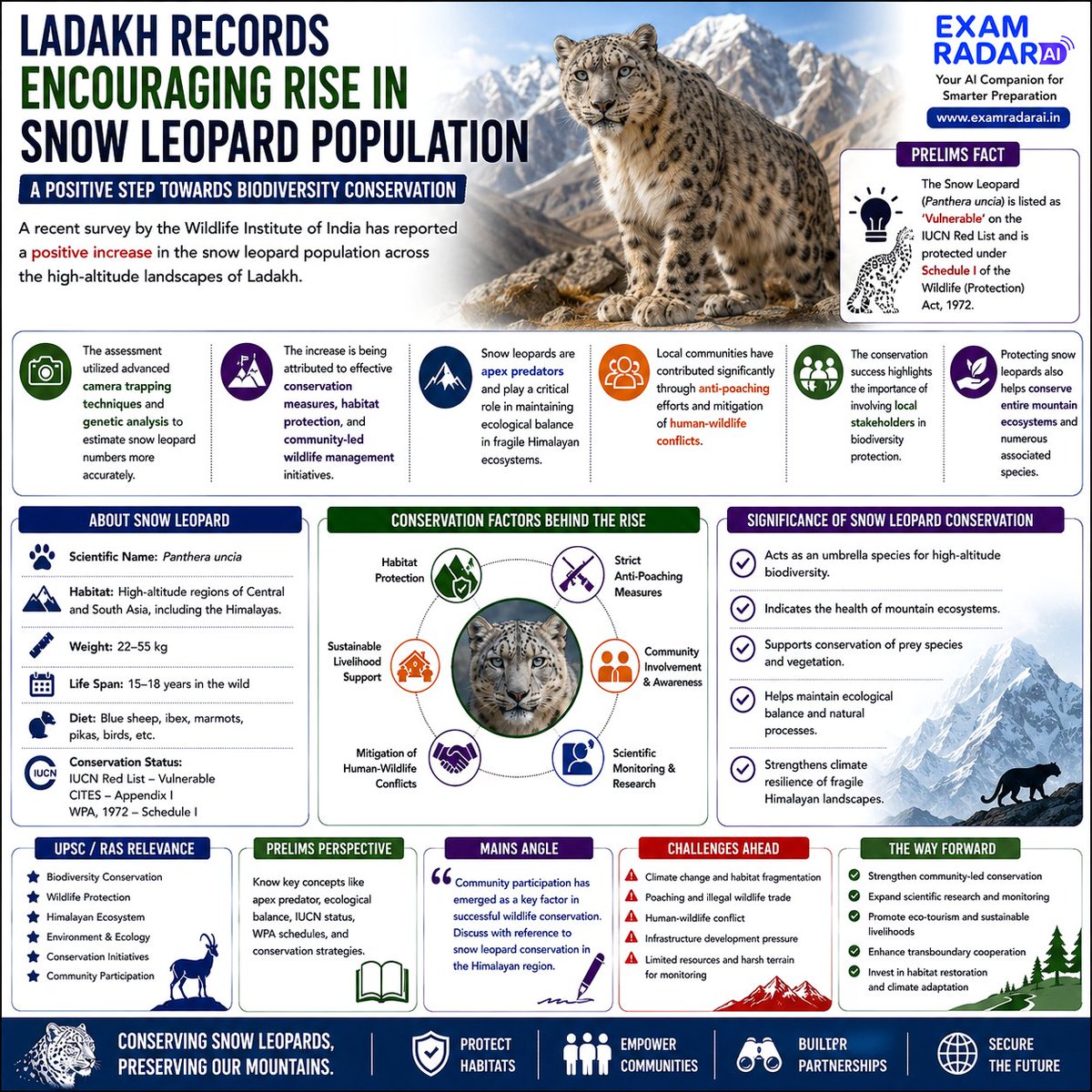
🐆 LADAKH RECORDS ENCOURAGING RISE IN SNOW LEOPARD POPULATION
A recent survey by the Wildlife Institute of India has reported a positive increase in the snow leopard population across the high-altitude landscapes of Ladakh.
📌 The assessment utilized advanced camera trapping techniques and genetic analysis to estimate snow leopard numbers more accurately.
📌 The increase is being attributed to effective conservation measures, habitat protection, and community-led wildlife management initiatives.
📌 Snow leopards are apex predators and play a critical role in maintaining ecological balance in fragile Himalayan ecosystems.
📌 Local communities have contributed significantly through anti-poaching efforts and mitigation of human-wildlife conflicts.
📌 The conservation success highlights the importance of involving local stakeholders in biodiversity protection.
📌 Protecting snow leopards also helps conserve entire mountain ecosystems and numerous associated species.
🎯 UPSC/RAS Relevance:
• Snow Leopard
• Biodiversity Conservation
• Himalayan Ecosystem
• Wildlife Protection
• Community-Based Conservation
• Environment & Ecology
💡 Prelims Fact:
The Snow Leopard (Panthera uncia) is listed as 'Vulnerable' on the IUCN Red List and is protected under Schedule I of the Wildlife (Protection) Act, 1972.
📝 Mains Angle:
"Community participation has emerged as a key factor in successful wildlife conservation. Discuss with reference to snow leopard conservation in the Himalayan region."
#UPSC #RAS #CurrentAffairs #SnowLeopard #Ladakh #WildlifeConservation #Biodiversity #Environment #Ecology #GS3 #ExamRadarAI
2
26
Jun 12
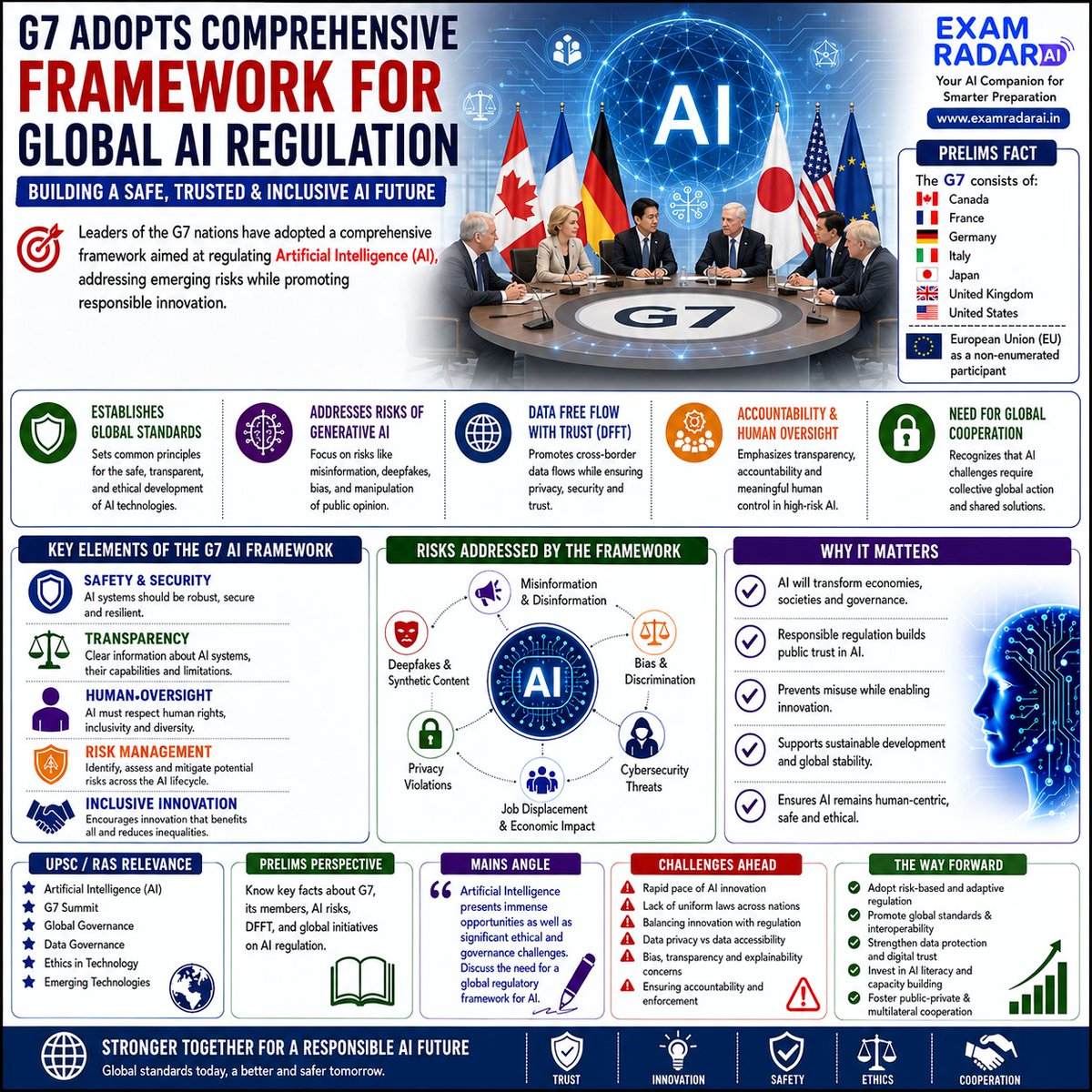
🤖 G7 ADOPTS COMPREHENSIVE FRAMEWORK FOR GLOBAL AI REGULATION
Leaders of the G7 nations have adopted a comprehensive framework aimed at regulating Artificial Intelligence (AI), addressing emerging risks while promoting responsible innovation.
📌 The framework seeks to establish global standards for the safe, transparent, and ethical development of AI technologies.
📌 Special emphasis has been placed on tackling risks associated with Generative AI, including misinformation, deepfakes, and manipulation of public opinion.
📌 The initiative promotes the principle of Data Free Flow with Trust (DFFT), balancing innovation with privacy and security concerns.
📌 Countries are increasingly recognizing the need for regulatory guardrails as AI systems become more powerful and widely deployed.
📌 The framework also focuses on accountability, transparency, and human oversight in high-risk AI applications.
📌 Global cooperation is considered essential to ensure that AI benefits society while minimizing economic, social, and security risks.
🎯 UPSC/RAS Relevance:
• Artificial Intelligence (AI)
• Generative AI
• G7 Summit
• Global Governance
• Data Free Flow with Trust (DFFT)
• Emerging Technologies
💡 Prelims Fact:
The G7 consists of Canada, France, Germany, Italy, Japan, the United Kingdom, and the United States, along with the European Union as a non-enumerated participant.
📝 Mains Angle:
"Artificial Intelligence presents immense opportunities as well as significant ethical and governance challenges. Discuss the need for a global regulatory framework for AI."
#UPSC #RAS #CurrentAffairs #ArtificialIntelligence #AI #G7 #GenerativeAI #TechnologyGovernance #ScienceAndTechnology #GS2 #GS3 #ExamRadarAI
1
35
Jun 12
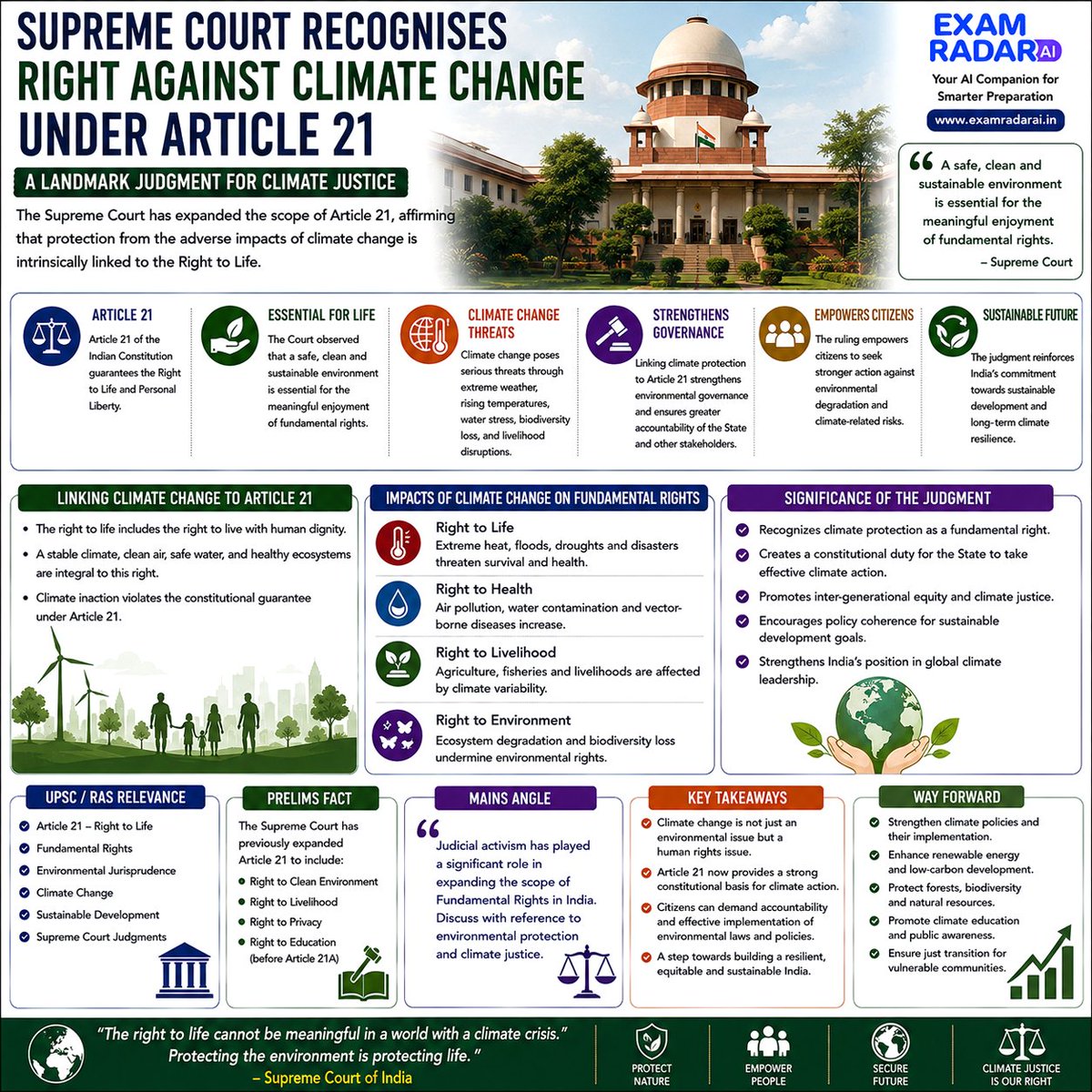
⚖️ SUPREME COURT RECOGNISES RIGHT AGAINST CLIMATE CHANGE UNDER ARTICLE 21
In a landmark judgment, the Supreme Court has expanded the scope of Article 21, affirming that protection from the adverse impacts of climate change is intrinsically linked to the Right to Life.
📌 Article 21 of the Indian Constitution guarantees the Right to Life and Personal Liberty.
📌 The Court observed that a safe, clean, and sustainable environment is essential for the meaningful enjoyment of fundamental rights.
📌 Climate change poses serious threats through extreme weather events, rising temperatures, water stress, biodiversity loss, and livelihood disruptions.
📌 By linking climate protection to Article 21, the judgment strengthens environmental governance and accountability.
📌 The ruling empowers citizens to seek stronger action against environmental degradation and climate-related risks.
📌 It also reinforces India's commitment towards sustainable development and long-term climate resilience.
🎯 UPSC/RAS Relevance:
• Article 21
• Fundamental Rights
• Environmental Jurisprudence
• Climate Change
• Sustainable Development
• Supreme Court Judgments
💡 Prelims Fact:
The Supreme Court has previously expanded Article 21 to include rights such as the Right to Clean Environment, Right to Livelihood, Right to Privacy, and Right to Education (before Article 21A).
📝 Mains Angle:
"Judicial activism has played a significant role in expanding the scope of Fundamental Rights in India. Discuss with reference to environmental protection and climate justice."
#UPSC #RAS #CurrentAffairs #SupremeCourt #Article21 #ClimateChange #FundamentalRights #EnvironmentalJurisprudence #Polity #GS2 #ExamRadarAI
1
14
Jun 12
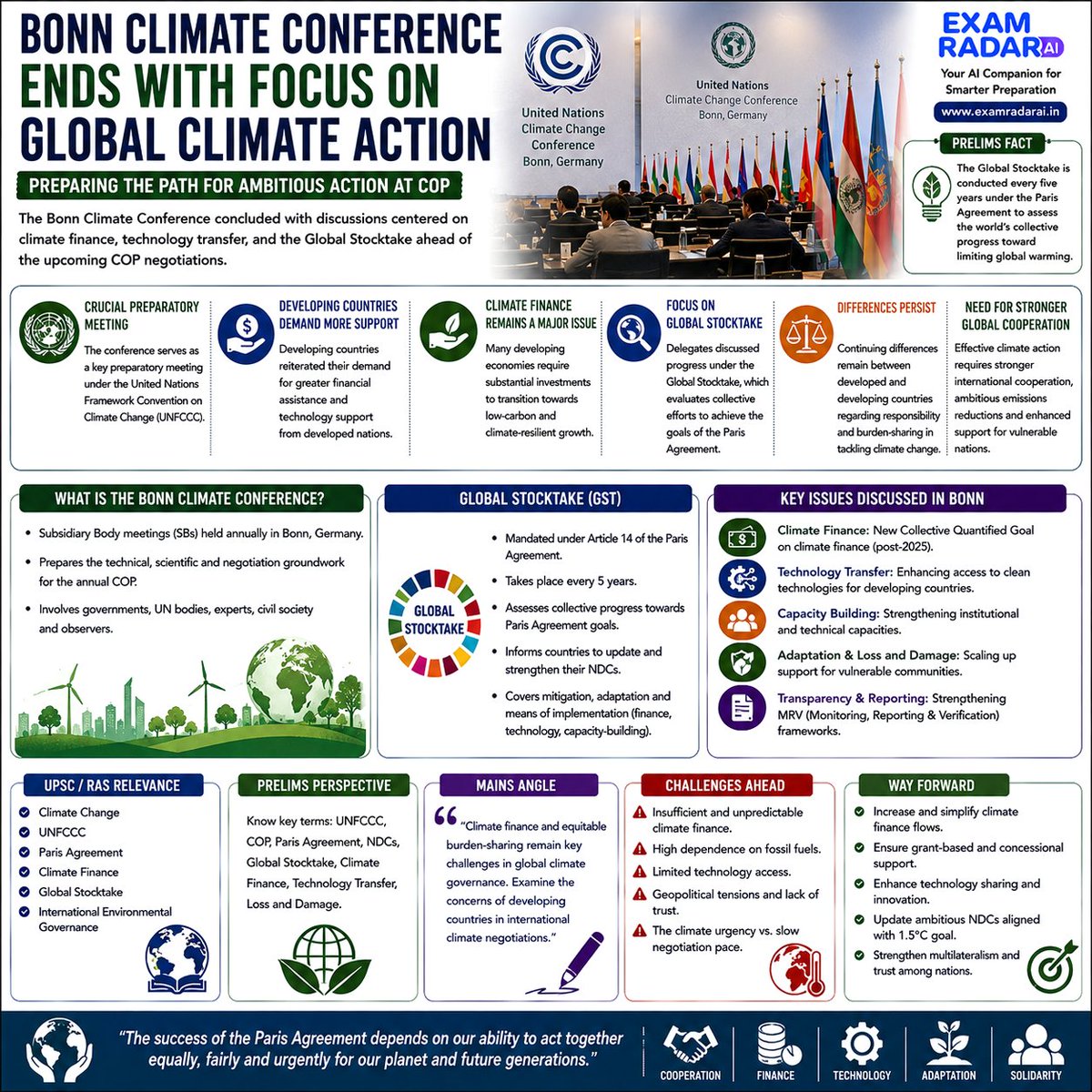
🌍 BONN CLIMATE CONFERENCE ENDS WITH FOCUS ON GLOBAL CLIMATE ACTION
The Bonn Climate Conference concluded with discussions centered on climate finance, technology transfer, and the Global Stocktake ahead of the upcoming COP negotiations.
📌 The conference serves as a crucial preparatory meeting under the United Nations Framework Convention on Climate Change (UNFCCC).
📌 Developing countries reiterated their demand for greater financial assistance and technology support from developed nations.
📌 Climate finance remains a major issue, as many developing economies require substantial investments to transition towards low-carbon growth.
📌 Delegates discussed progress under the Global Stocktake, a mechanism that evaluates collective efforts to achieve the goals of the Paris Agreement.
📌 The conference highlighted continuing differences between developed and developing countries regarding responsibility and burden-sharing in tackling climate change.
📌 Effective climate action requires stronger international cooperation, ambitious emissions reductions, and enhanced support for vulnerable nations.
🎯 UPSC/RAS Relevance:
• Climate Change
• UNFCCC
• Paris Agreement
• Climate Finance
• Global Stocktake
• International Environmental Governance
💡 Prelims Fact:
The Global Stocktake is conducted every five years under the Paris Agreement to assess the world's collective progress toward limiting global warming.
📝 Mains Angle:
"Climate finance and equitable burden-sharing remain key challenges in global climate governance. Examine the concerns of developing countries in international climate negotiations."
#UPSC #RAS #CurrentAffairs #ClimateChange #UNFCCC #ParisAgreement #ClimateFinance #GlobalStocktake #Environment #GS3 #ExamRadarAI
1
15
Jun 12
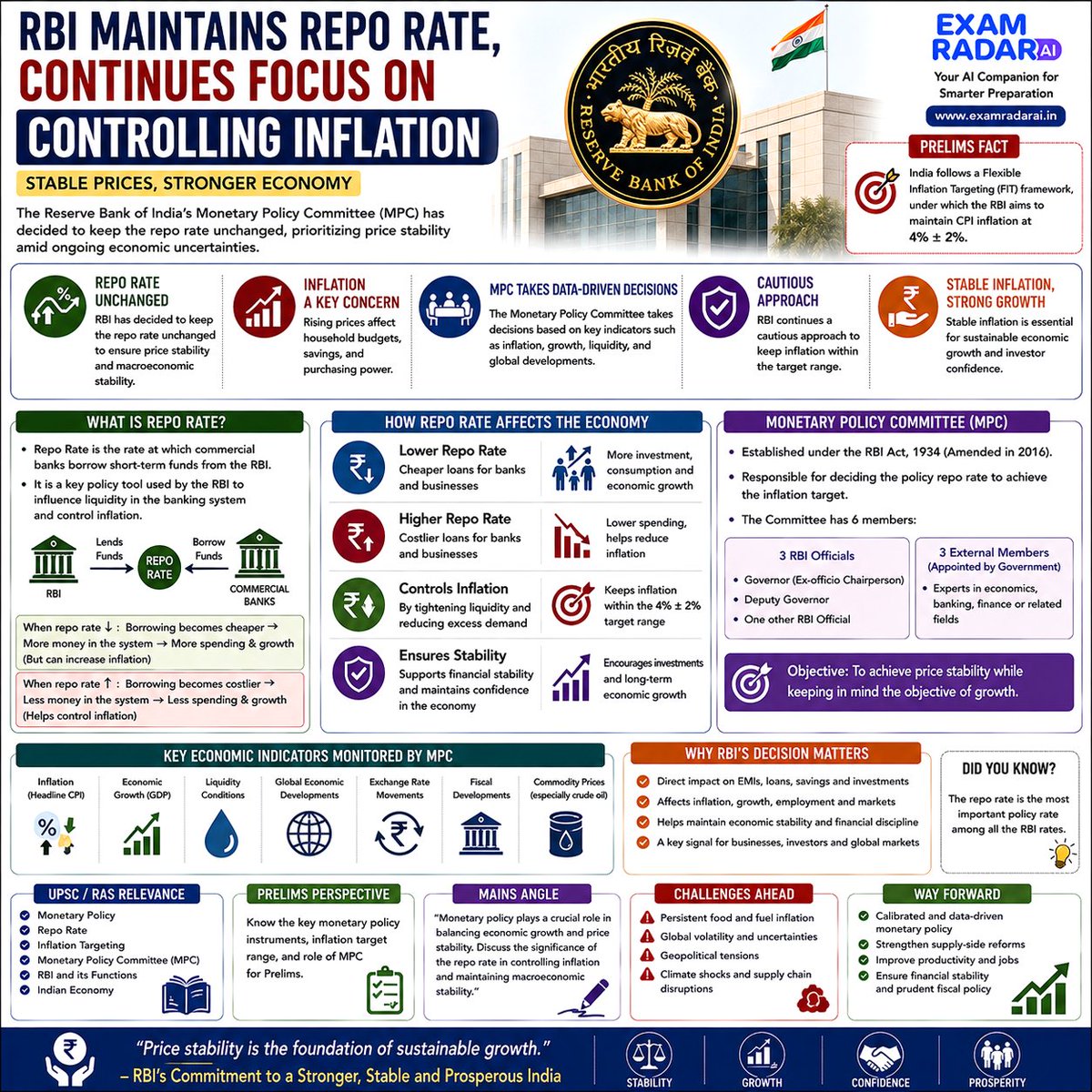
🏦 RBI MAINTAINS REPO RATE, CONTINUES FOCUS ON CONTROLLING INFLATION
The Reserve Bank of India's Monetary Policy Committee (MPC) has decided to keep the repo rate unchanged, prioritizing price stability amid ongoing economic uncertainties.
📌 The Repo Rate is the interest rate at which commercial banks borrow short-term funds from the RBI.
📌 By maintaining the current rate, the RBI aims to keep inflation under control while ensuring macroeconomic stability.
📌 Inflation remains a key concern as rising prices directly affect household budgets, savings, and purchasing power.
📌 The Monetary Policy Committee takes decisions based on economic indicators such as inflation, growth, liquidity, and global developments.
📌 The RBI continues to follow a cautious approach to ensure that inflation remains within the targeted range.
📌 Stable inflation is considered essential for sustainable economic growth and investor confidence.
🎯 UPSC/RAS Relevance:
• Monetary Policy
• Repo Rate
• Inflation Targeting
• Monetary Policy Committee (MPC)
• RBI
• Indian Economy
💡 Prelims Fact:
India follows a Flexible Inflation Targeting (FIT) framework, under which the RBI aims to maintain Consumer Price Index (CPI) inflation at 4% ± 2%.
📝 Mains Angle:
"Monetary policy plays a crucial role in balancing economic growth and price stability. Discuss the significance of the repo rate in controlling inflation and maintaining macroeconomic stability."
#UPSC #RAS #CurrentAffairs #RBI #RepoRate #Inflation #MonetaryPolicy #IndianEconomy #MPC #GS3 #ExamRadarAI
1
40
Jun 12
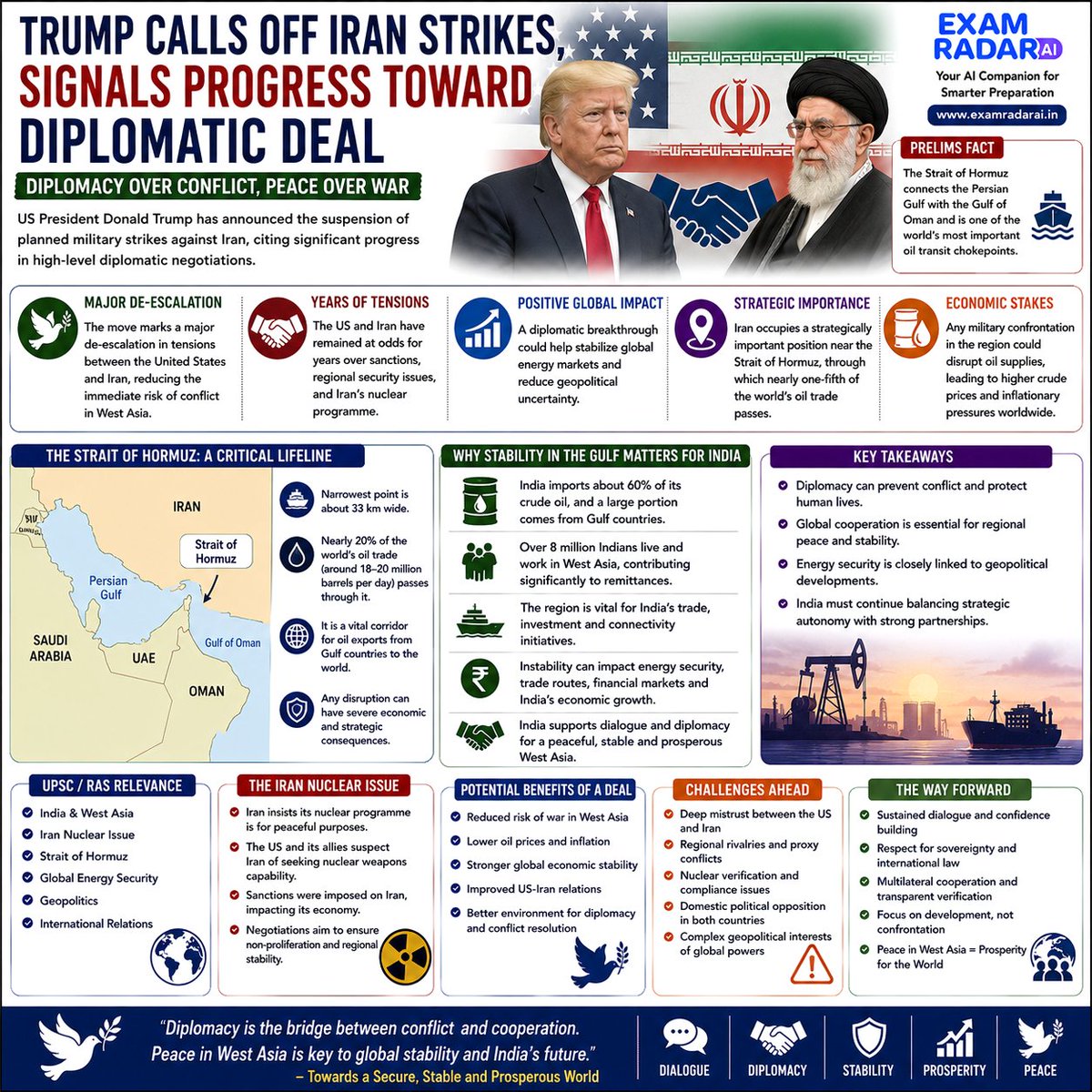
🌍 TRUMP CALLS OFF IRAN STRIKES, SIGNALS PROGRESS TOWARD DIPLOMATIC DEAL
US President Donald Trump has announced the suspension of planned military strikes against Iran, citing significant progress in high-level diplomatic negotiations.
📌 The move marks a major de-escalation in tensions between the United States and Iran, reducing the immediate risk of conflict in West Asia.
📌 The US and Iran have remained at odds for years over sanctions, regional security issues, and Iran's nuclear programme.
📌 A diplomatic breakthrough could help stabilize global energy markets and reduce geopolitical uncertainty.
📌 Iran occupies a strategically important position near the Strait of Hormuz, through which nearly one-fifth of the world's oil trade passes.
📌 Any military confrontation in the region could disrupt oil supplies, leading to higher crude prices and inflationary pressures worldwide.
📌 For India, stability in the Gulf region is crucial due to energy imports, trade interests, and the large Indian diaspora living in West Asia.
🎯 UPSC/RAS Relevance:
• India & West Asia
• Iran Nuclear Issue
• Strait of Hormuz
• Global Energy Security
• Geopolitics
• International Relations
💡 Prelims Fact:
The Strait of Hormuz connects the Persian Gulf with the Gulf of Oman and is considered one of the world's most important oil transit chokepoints.
📝 Mains Angle:
"Geopolitical tensions in West Asia have far-reaching implications for global energy security and India's strategic interests. Discuss."
#UPSC #RAS #CurrentAffairs #Iran #USA #WestAsia #Geopolitics #EnergySecurity #StraitOfHormuz #InternationalRelations #ExamRadarAI
1
59
Jun 12
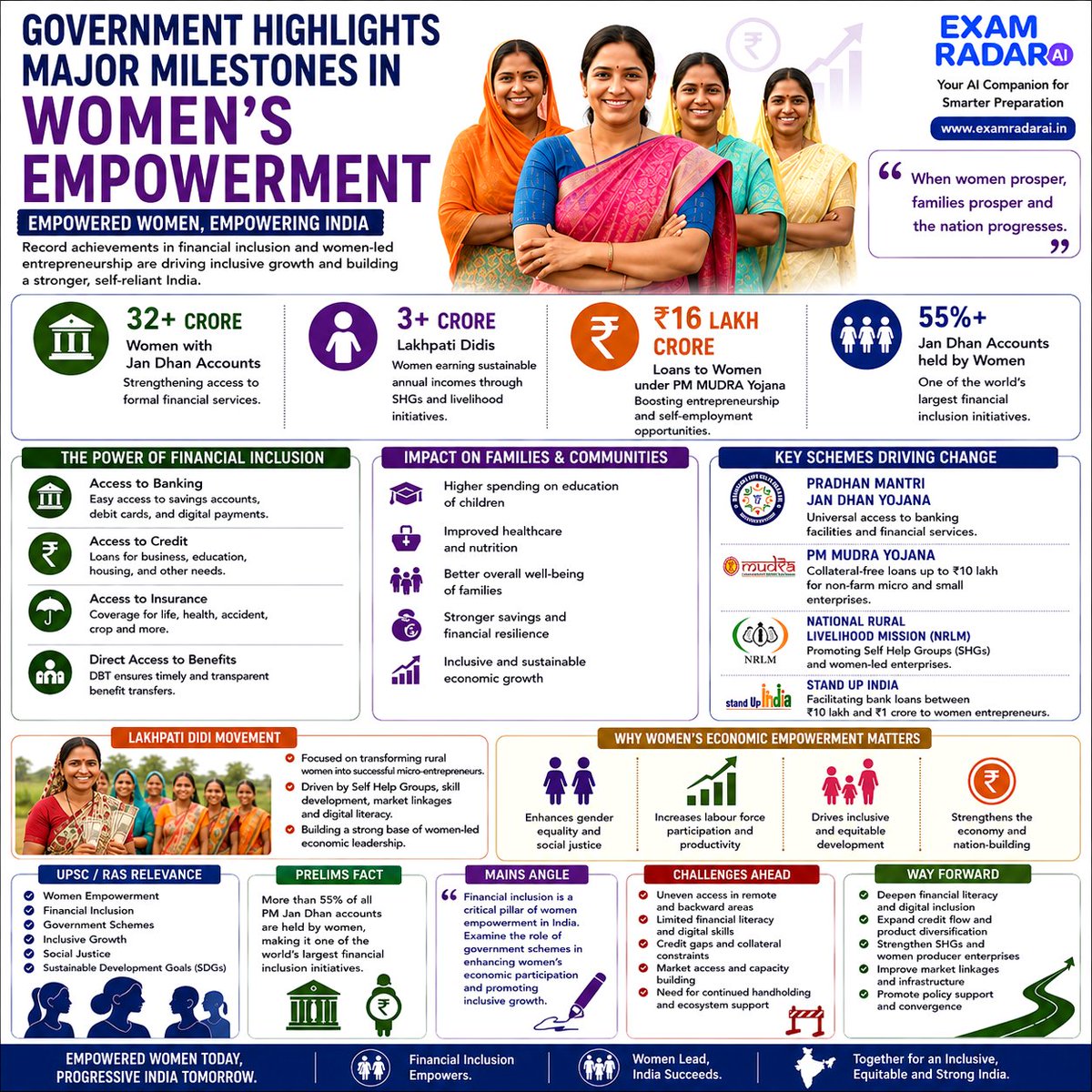
👩💼 GOVERNMENT HIGHLIGHTS MAJOR MILESTONES IN WOMEN'S EMPOWERMENT
The Government has announced significant achievements in financial inclusion and women-led entrepreneurship, reflecting growing economic empowerment across the country.
📌 More than 32 crore women now hold Jan Dhan bank accounts, strengthening access to formal financial services.
📌 Over 3 crore women have emerged as Lakhpati Didis, earning sustainable annual incomes through self-help groups and livelihood initiatives.
📌 Women have received nearly ₹16 lakh crore in loans under the PM MUDRA Yojana, boosting entrepreneurship and self-employment opportunities.
📌 Financial inclusion enables women to access banking, credit, insurance, and government welfare benefits directly.
📌 Studies show that when women gain greater control over household finances, spending on education, healthcare, and nutrition increases significantly.
📌 Women-led economic participation is increasingly being recognized as a key driver of inclusive and sustainable development.
🎯 UPSC/RAS Relevance:
• Women Empowerment
• Financial Inclusion
• PM Jan Dhan Yojana
• PM MUDRA Yojana
• Self Help Groups (SHGs)
• Inclusive Growth
💡 Prelims Fact:
More than 55% of all PM Jan Dhan accounts are held by women, making it one of the world's largest financial inclusion initiatives.
📝 Mains Angle:
"Financial inclusion is a critical pillar of women empowerment in India. Examine the role of government schemes in enhancing women's economic participation and promoting inclusive growth."
#UPSC #RAS #CurrentAffairs #WomenEmpowerment #FinancialInclusion #JanDhanYojana #MudraYojana #LakhpatiDidi #InclusiveGrowth #GS2 #GS3 #ExamRadarAI
1
11
Jun 12
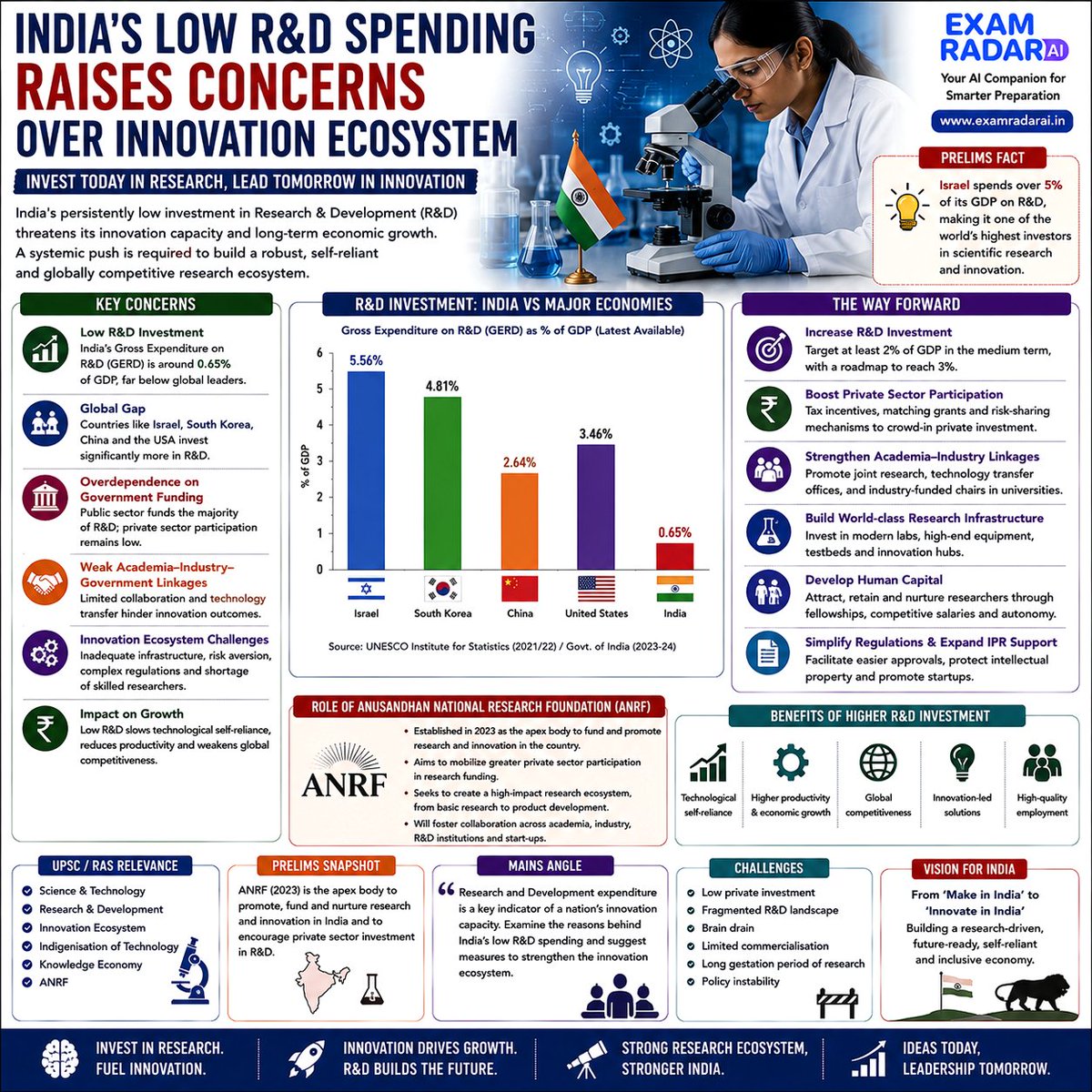
🔬 INDIA'S LOW R&D SPENDING RAISES CONCERNS OVER INNOVATION ECOSYSTEM
A recent editorial has highlighted the systemic challenges behind India's persistently low investment in Research and Development (R&D), a critical driver of innovation and economic growth.
📌 India's Gross Expenditure on Research and Development (GERD) remains around 0.65% of GDP, significantly lower than many major economies.
📌 Countries such as Israel, South Korea, China, and the United States invest substantially more in scientific research and technological innovation.
📌 A major concern is the heavy dependence on government funding, while private sector participation remains relatively limited.
📌 Experts argue that stronger collaboration between academia, industry, and government is essential to create a robust innovation ecosystem.
📌 Increased R&D investment can accelerate technological self-reliance, boost productivity, and strengthen global competitiveness.
📌 The newly established Anusandhan National Research Foundation (ANRF) aims to mobilize greater private sector participation in research funding.
🎯 UPSC/RAS Relevance:
• Research & Development (R&D)
• Innovation Ecosystem
• Science & Technology
• Indigenisation of Technology
• ANRF
• Knowledge Economy
💡 Prelims Fact:
Israel spends over 5% of its GDP on R&D, making it one of the world's highest investors in scientific research and innovation.
📝 Mains Angle:
"Research and Development expenditure is a key indicator of a nation's innovation capacity. Examine the reasons behind India's low R&D spending and suggest measures to strengthen the innovation ecosystem."
#UPSC #RAS #CurrentAffairs #ResearchAndDevelopment #Innovation #ScienceAndTechnology #ANRF #AtmanirbharBharat #GS3 #ExamRadarAI
1
15
Jun 12
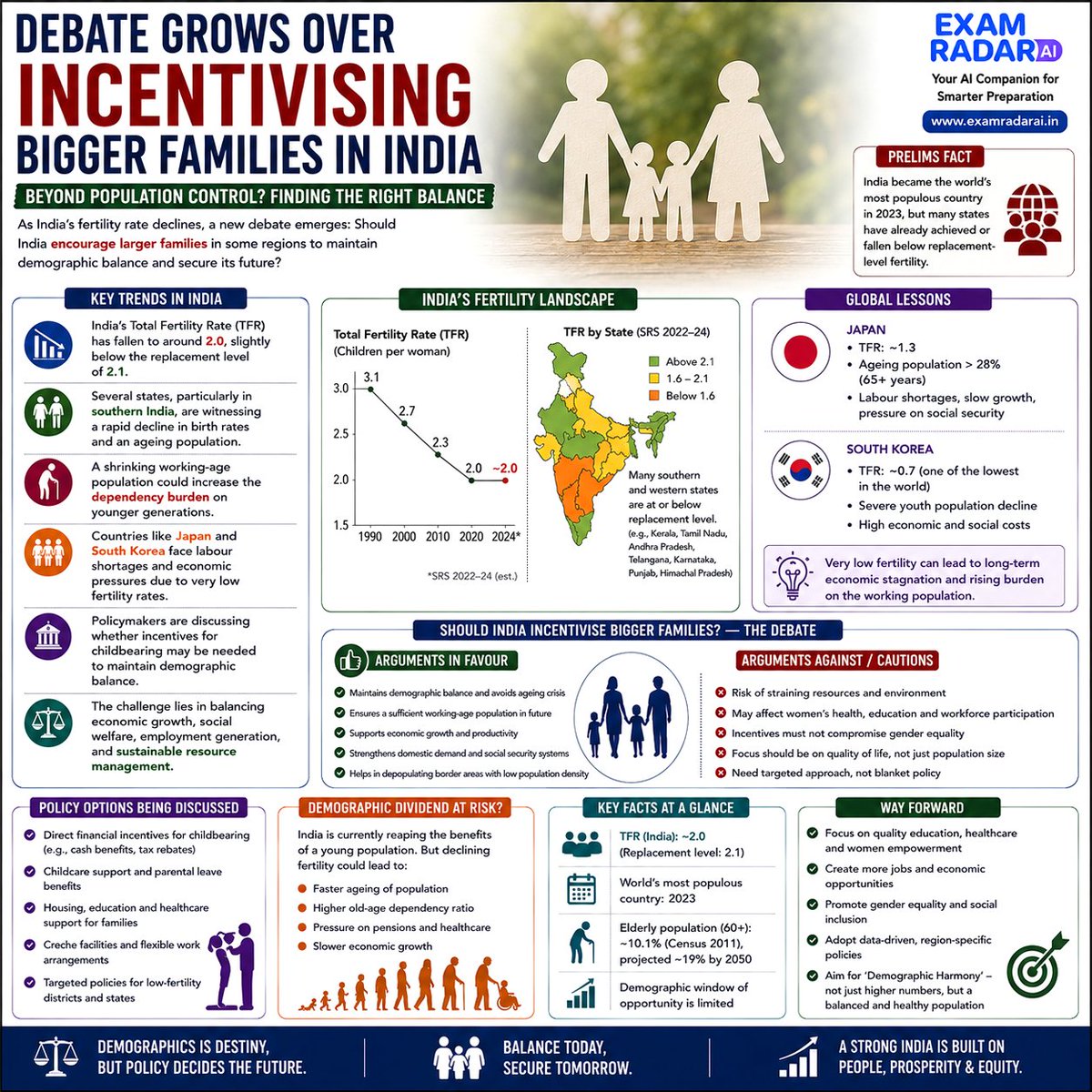
👶 DEBATE GROWS OVER INCENTIVISING BIGGER FAMILIES IN INDIA
A new debate has emerged on whether India should move beyond population control policies and begin encouraging larger families in regions experiencing declining birth rates.
📌 India's Total Fertility Rate (TFR) has fallen to around 2.0, slightly below the replacement level of 2.1.
📌 Several states, particularly in southern India, are witnessing a rapid decline in birth rates and an ageing population.
📌 A shrinking working-age population could create economic challenges in the future by increasing the dependency burden on younger generations.
📌 Countries such as Japan and South Korea are already facing labour shortages and economic pressures due to very low fertility rates.
📌 Policymakers are increasingly discussing whether incentives for childbearing may be needed to maintain demographic balance.
📌 The challenge lies in balancing economic growth, social welfare, employment generation, and sustainable resource management.
🎯 UPSC/RAS Relevance:
• Population Issues
• Demographic Transition
• Ageing Population
• Human Resource Development
• Social Sector Policies
• Indian Economy
💡 Prelims Fact:
India became the world's most populous country in 2023, but many states have already achieved or fallen below replacement-level fertility.
📝 Mains Angle:
"India's demographic dividend is often considered its greatest strength. However, declining fertility rates may transform this advantage into a demographic challenge. Discuss."
#UPSC #RAS #CurrentAffairs #Population #DemographicDividend #FertilityRate #IndianEconomy #SocialIssues #GS1 #ExamRadarAI
1
54
Jun 12
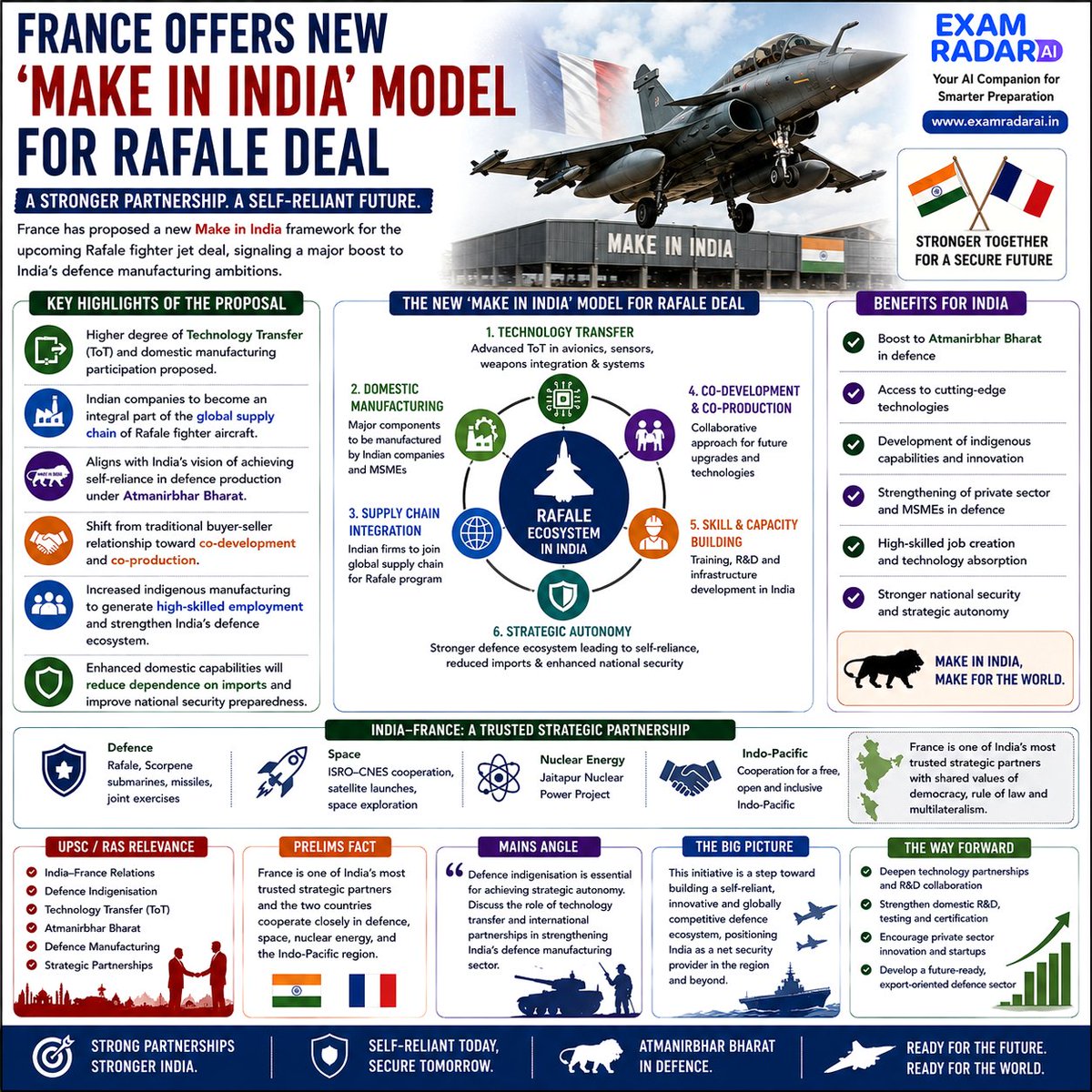
✈️ FRANCE OFFERS NEW ‘MAKE IN INDIA’ MODEL FOR RAFALE DEAL
France has proposed a new Make in India framework for the upcoming Rafale fighter jet deal, signaling a major boost to India's defence manufacturing ambitions.
📌 The proposal includes a higher degree of technology transfer and domestic manufacturing participation.
📌 Indian companies are expected to become an integral part of the global supply chain of Rafale fighter aircraft.
📌 The initiative aligns with India's vision of achieving self-reliance in defence production under the Atmanirbhar Bharat mission.
📌 The deal represents a shift from a traditional buyer-seller relationship toward co-development and co-production.
📌 Increased indigenous manufacturing can generate high-skilled employment and strengthen India's defence ecosystem.
📌 Enhanced domestic capabilities will help reduce dependence on foreign military imports while improving national security preparedness.
🎯 UPSC/RAS Relevance:
• India–France Relations
• Defence Indigenisation
• Technology Transfer (ToT)
• Atmanirbhar Bharat
• Defence Manufacturing
• Strategic Partnerships
💡 Prelims Fact:
France is one of India's most trusted strategic partners and the two countries cooperate closely in defence, space, nuclear energy, and the Indo-Pacific region.
📝 Mains Angle:
"Defence indigenisation is essential for achieving strategic autonomy. Discuss the role of technology transfer and international partnerships in strengthening India's defence manufacturing sector."
#UPSC #RAS #CurrentAffairs #Rafale #MakeInIndia #DefenceIndigenisation #IndiaFranceRelations #AtmanirbharBharat #GS2 #GS3 #ExamRadarAI
1
18
Jun 12
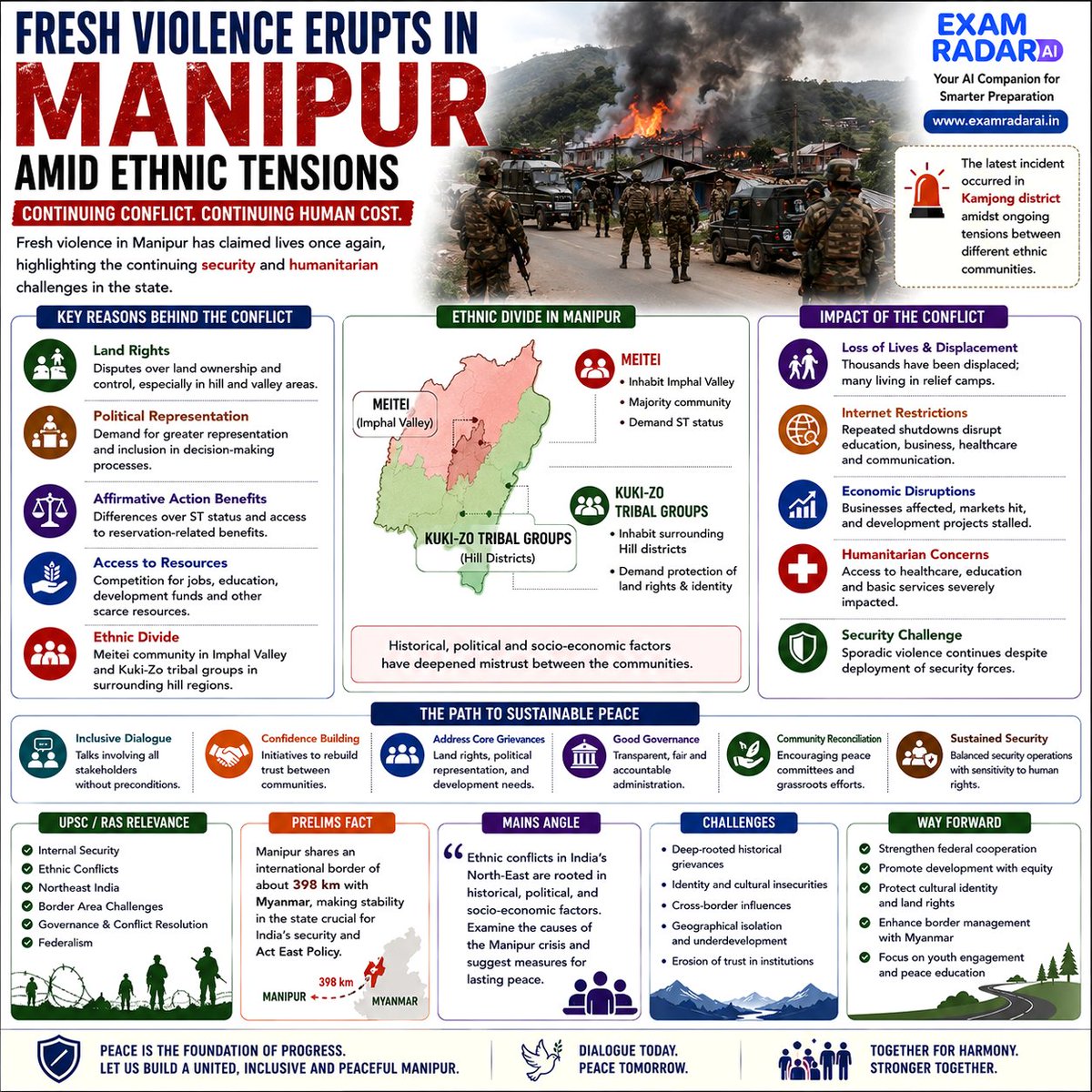
⚠️ FRESH VIOLENCE ERUPTS IN MANIPUR AMID ETHNIC TENSIONS
Fresh violence in Manipur has claimed lives once again, highlighting the continuing security and humanitarian challenges in the state.
📌 The latest incident occurred in Kamjong district amidst ongoing tensions between different ethnic communities.
📌 The conflict is primarily rooted in disputes over land rights, political representation, affirmative action benefits, and access to resources.
📌 The divide largely exists between the Meitei community of the Imphal Valley and the Kuki-Zo tribal groups inhabiting the surrounding hill regions.
📌 Despite deployment of security forces and administrative interventions, sporadic violence has continued for over a year.
📌 Internet restrictions, displacement of civilians, and disruptions to normal life have severely impacted the region.
📌 Experts emphasize that sustainable peace requires dialogue, confidence-building measures, and addressing long-standing socio-political grievances.
🎯 UPSC/RAS Relevance:
• Internal Security
• Ethnic Conflicts
• Northeast India
• Border Area Challenges
• Governance & Conflict Resolution
• Federalism
💡 Prelims Fact:
Manipur shares an international border of about 398 km with Myanmar, making stability in the state crucial for India's security and Act East Policy.
📝 Mains Angle:
"Ethnic conflicts in India's North-East are rooted in historical, political, and socio-economic factors. Examine the causes of the Manipur crisis and suggest measures for lasting peace."
#UPSC #RAS #CurrentAffairs #Manipur #InternalSecurity #NorthEastIndia #Governance #ConflictResolution #GS3 #ExamRadarAI
2
36
Jun 12
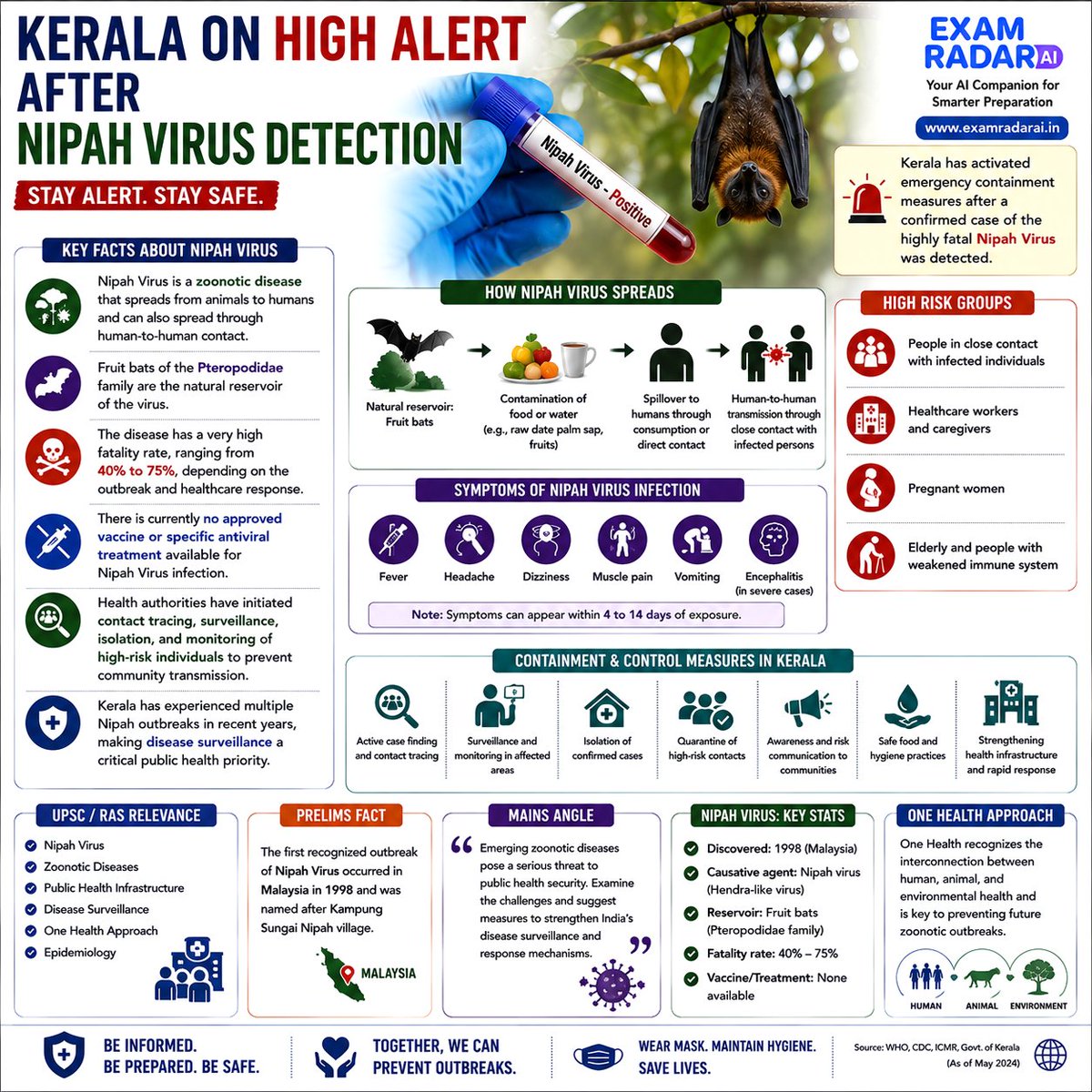
🦠 KERALA ON HIGH ALERT AFTER NIPAH VIRUS DETECTION
Kerala has activated emergency containment measures after a confirmed case of the highly fatal Nipah Virus was detected.
📌 Nipah Virus is a zoonotic disease that spreads from animals to humans and can also spread through human-to-human contact.
📌 Fruit bats of the Pteropodidae family are the natural reservoir of the virus.
📌 The disease has a very high fatality rate, ranging from 40% to 75%, depending on the outbreak and healthcare response.
📌 There is currently no approved vaccine or specific antiviral treatment available for Nipah Virus infection.
📌 Health authorities have initiated contact tracing, surveillance, isolation, and monitoring of high-risk individuals to prevent community transmission.
📌 Kerala has experienced multiple Nipah outbreaks in recent years, making disease surveillance a critical public health priority.
🎯 UPSC/RAS Relevance:
• Nipah Virus
• Zoonotic Diseases
• Public Health Infrastructure
• Disease Surveillance
• One Health Approach
• Epidemiology
💡 Prelims Fact:
The first recognized outbreak of Nipah Virus occurred in Malaysia in 1998 and was named after Kampung Sungai Nipah village.
📝 Mains Angle:
"Emerging zoonotic diseases pose a serious threat to public health security. Examine the challenges and suggest measures to strengthen India's disease surveillance and response mechanisms."
#UPSC #RAS #CurrentAffairs #NipahVirus #Kerala #PublicHealth #ScienceAndTechnology #DiseaseSurveillance #HealthSecurity #ExamRadarAI
1
1
63