
Canadian astrophysicist focused on extragalactic astronomy & early-universe galaxies. Seeking mountain peaks. Writing through the chaos; riding away from it.
Joined October 2020
- Tweets 22,303
- Following 908
- Followers 54,308
- Likes 33,247
8,967 Photos and videos


Pinned Tweet

2 Mar 2023
Moon Europa.
Image taken by #NASAJuno and processed by myself.
#Europa #Jupiter #News #Astronomy #Science #NASA #Photography
🐘 mstdn.social/@GirlInSpace
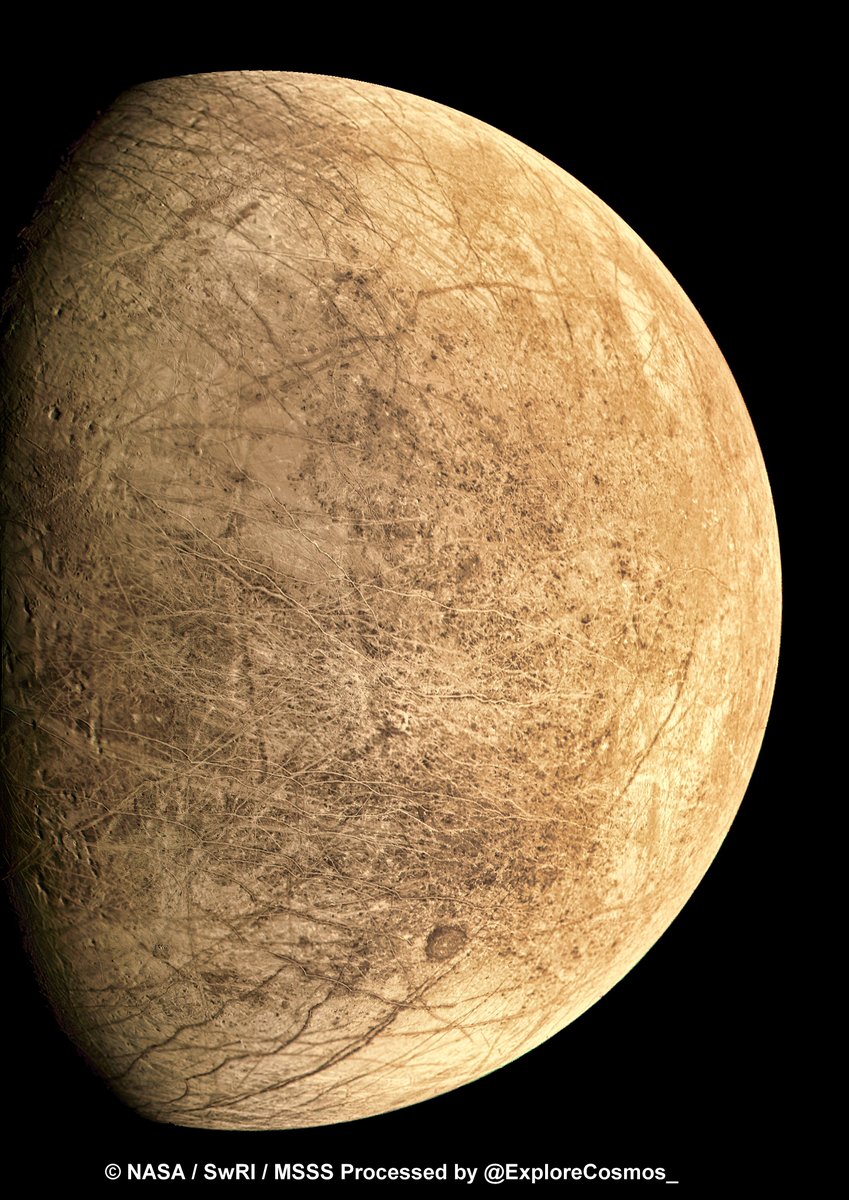
ALT Moon Europa. Image taken by #NASAJuno and processed by myself.
172
552
2,767
455,585
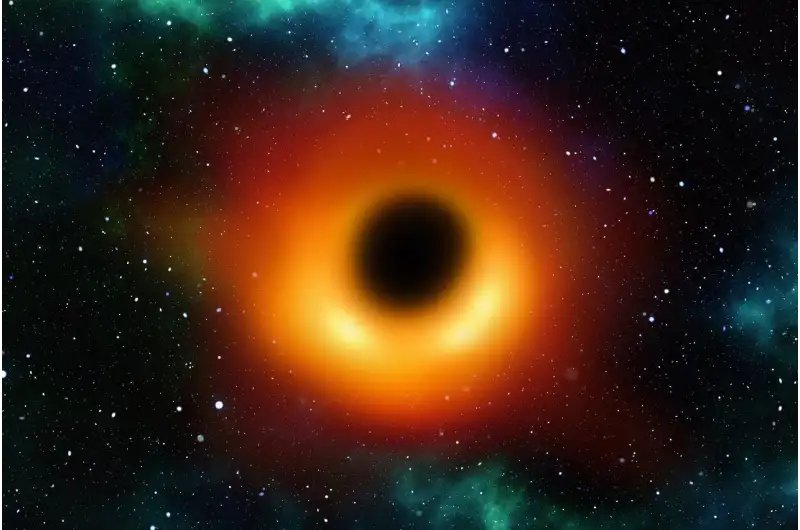
Dark matter may not interact with light or ordinary matter in any direct way, but its gravity can still leave measurable traces.
A new study proposes using active galactic nuclei, the bright environments around feeding supermassive black holes, as laboratories to probe whether dark matter becomes concentrated near these extreme objects.
The idea relies on reverberation mapping, a well-established technique in which astronomers measure the delay between a burst of light from the inner accretion region and the later “echo” produced when that light is absorbed and re-emitted by gas farther out.
Because light travels at a known speed, that delay gives the distance of the gas from the black hole. By combining that distance with the motion of the gas, researchers can estimate how much mass is enclosed at different radii.
The important point is that, if the central black hole were the only dominant mass, the inferred enclosed mass should remain roughly consistent as different gas regions are measured. But if the enclosed mass appears to increase with distance in a way that cannot be explained by visible matter alone, that can hint at an additional unseen component.
In this case, the researchers applied the method to 14 active galactic nuclei and found that five showed a mass increase with radius suggestive of extra matter around the central black hole.
The statistical strength is modest, around the 1 to 2 sigma level, so it should be treated as a hint rather than a discovery.
The result is interesting because theoretical models have long suggested that dark matter could form dense “spikes” or enhanced profiles around supermassive black holes. Unlike gas, dust, or plasma, dark matter does not collide, radiate, or easily lose energy, so it cannot spiral inward in the same way ordinary matter does.
Instead, its distribution should be shaped mainly by gravity and by the black hole’s growth history, stellar interactions, and galaxy evolution. The preferred profile found in the study has a radial steepness around gamma roughly 1.6, which is broadly consistent with a dark-matter spike that has been softened by interactions with stars.
The authors are careful about the limitations. Current reverberation-mapping mass estimates still carry significant systematic uncertainties, and the inferred amount of dark matter appears larger than some theoretical expectations. That means the signal could reflect real dark matter structure, but it could also be affected by imperfect modelling of the gas, geometry, line emission, or black hole mass estimates.
The value of the work is that it opens a possible observational route to studying dark matter on sub-parsec scales around distant supermassive black holes, a region that is normally inaccessible.
Better reverberation-mapping campaigns, especially using multiple emission lines and improved interferometric data, will be needed to test whether these apparent dark matter buildups are real.
👉 share.google/rjNeupfCsV36jTz…
15
30
153
3,527
Jun 13
Hay demasiada gente hablando como si ya hubiera entendido la vida, cuando en realidad apenas ha empezado a rozarla.
Demasiadas voces seguras, demasiadas frases rotundas, demasiados consejos envueltos en una autoridad que no se ha ganado en ningún sitio. Hoy cualquiera se coloca delante de una cámara, aprende cuatro palabras bonitas sobre éxito, autoestima, dinero o amor, y empieza a vender certezas a personas que quizá sólo necesitan alguien honesto, no otro personaje interpretando sabiduría.
La experiencia no se improvisa. No se fabrica con una buena iluminación, ni con un micrófono caro, ni con una frase intensa repetida con cara seria. La experiencia se construye cuando la vida te contradice, cuando pierdes, cuando te equivocas, cuando confías en quien no debías, cuando algo se rompe y aun así tienes que seguir funcionando. Por eso no es por los ojos por donde entra la experiencia, sino por las cicatrices.
No se trata de despreciar a los jóvenes ni de creer que la edad, por sí sola, convierte a nadie en sabio. Hay personas mayores que no han aprendido nada y personas jóvenes que han vivido más de lo que aparentan. Pero una cosa es compartir una reflexión y otra muy distinta es presentarse como maestro de vidas ajenas sin haber pagado todavía casi ninguna factura emocional. La vida no enseña gratis. Cobra con tiempo, con dolor, con vergüenza, con pérdidas, con fracasos y con silencios que nadie ve.
Por eso conviene escuchar con cuidado. No todo consejo merece entrar en tu vida sólo porque suene bien. Antes de entregar tu confianza a alguien, mira si habla desde la experiencia o desde el escaparate. Mira si lo que dice nace de haber atravesado algo real o sólo de haber aprendido a parecer profundo. Porque hay consejos que acompañan, pero también hay consejos que confunden, manipulan o simplifican demasiado lo que en realidad es complejo.
Aprender de alguien no debería consistir en admirar su imagen, sino en reconocer su recorrido. No le pidas sólo frases bonitas. No le pidas una vida perfecta. Pídele verdad. Pídele coherencia. Pídele humildad. Y, sobre todo, pídele cicatrices, porque quien nunca ha sido mordido por la vida difícilmente puede enseñarte cómo vivirla.
#Sabado
24
25
172
3,089
Jun 13
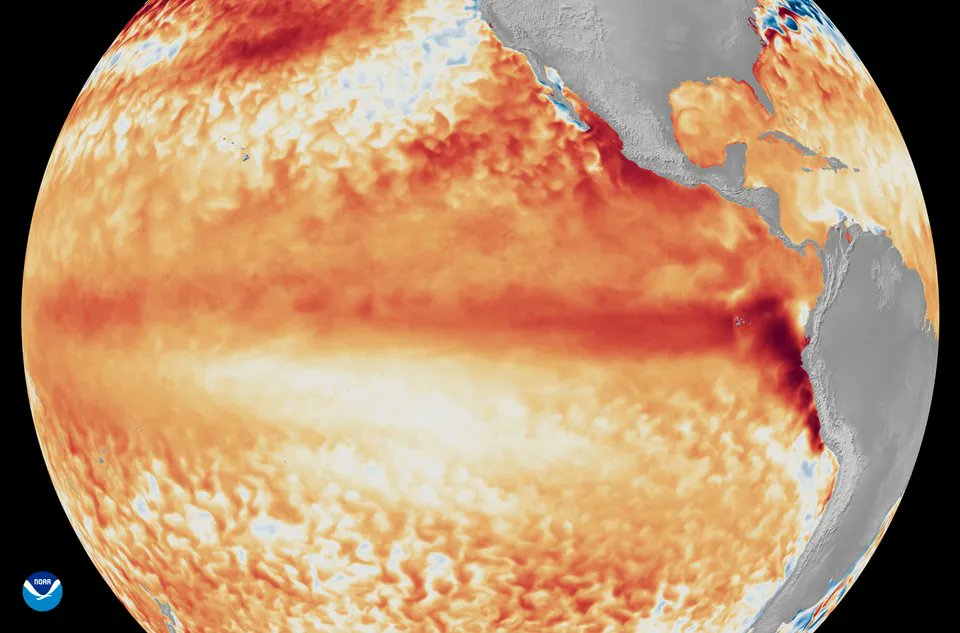
El Niño has begun, and its development could strongly reshape global weather over the coming months.
The phenomenon occurs when surface waters in the central and eastern tropical Pacific become warmer than usual and the atmosphere begins to respond to that warming.
This is not just a local oceanic anomaly.
Because the tropical Pacific is one of the main engines of Earth’s climate system, a change there can alter wind patterns, rainfall, storm tracks, drought risk and global temperatures.
Current observations show that the ocean and atmosphere are now coupled in a way consistent with El Niño. Sea surface temperatures are above average across the central and eastern equatorial Pacific, the Niño-3.4 region has crossed the El Niño threshold, and wind patterns over the tropical Pacific have shifted.
Forecast models suggest that this event is likely to strengthen through late 2026 and into the Northern Hemisphere winter of 2026-27. There is a meaningful possibility that it could become a very strong El Niño, sometimes informally called a “super El Niño,” although that outcome is not guaranteed.
If it does intensify as projected, the consequences could be widespread. El Niño often increases the likelihood of wetter conditions in parts of the southern United States and the eastern Pacific side of the Americas, while raising drought risk in regions such as Indonesia, parts of Australia, southern Africa and the Sahel. It can also suppress Atlantic hurricane activity by increasing wind shear over the tropical Atlantic, while shifting storm and rainfall patterns elsewhere.
These are not deterministic predictions for every country or region, but changes in probability: El Niño loads the dice toward certain kinds of weather extremes.
A very strong El Niño would be especially important because it is occurring in a world that is already unusually warm. El Niño naturally releases additional ocean heat into the atmosphere, so when it happens on top of human-driven global warming, it can push global temperatures even higher and increase the risk of heatwaves, marine heat stress, coral bleaching, drought, crop disruption and intense rainfall in vulnerable regions.
Previous very strong El Niño events have been associated with major climatic and humanitarian impacts, but each event has its own structure, timing and regional footprint.
The most careful way to understand this is not as a single global disaster forecast, but as a major shift in climate risk. The planet’s background temperature is higher than it used to be, the oceans contain more heat, and the atmosphere can hold more moisture.
A strong El Niño in that context can amplify extremes that would already be concerning. The coming months will depend on how strongly the tropical Pacific continues to warm and how the atmosphere responds, but the signal is now clear enough for governments, farmers, water managers, health systems and disaster agencies to pay close attention.
@NOAA
17
51
223
6,380
Jun 12
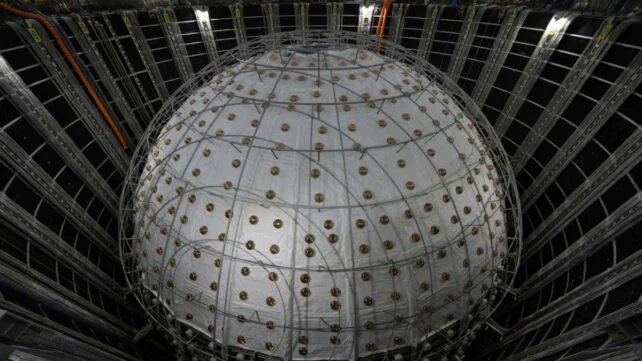
The Jiangmen Underground Neutrino Observatory, known as JUNO, has released its first major scientific results, and they show that the detector is already performing at the level needed for precision neutrino physics.
JUNO is a huge underground experiment in southern China, built to study neutrinos, the extremely light, electrically neutral particles often called “ghost particles” because they interact so weakly with matter. In this case, JUNO is mainly detecting electron antineutrinos produced by nearby nuclear reactors.
These antineutrinos travel about 52.5 kilometres before reaching the detector, where a tiny fraction of them interact inside 20,000 tonnes of liquid scintillator and produce faint flashes of light. By measuring those flashes with very high precision, scientists can reconstruct the antineutrino energy spectrum and study how neutrinos change flavour as they travel.
The first analysis used only 59.1 days of data collected after the detector began operation in August 2025, but even with that short exposure JUNO made one of the most precise measurements so far of two key neutrino oscillation parameters: the solar mixing angle, written as sin²θ12, and the solar mass-squared difference, Δm²21.
The reported values are sin²θ12 = 0.3092 ± 0.0087 and Δm²21 = 7.50 ± 0.12 × 10⁻⁵ eV², assuming normal mass ordering.
According to the paper, this improves the precision by a factor of 1.6 compared with the combination of all previous measurements.
That is the central result: not that JUNO has solved the neutrino mass-ordering problem yet, but that it has already shown it can measure neutrino oscillations with exceptional accuracy.
This matters because neutrino oscillations are direct evidence that neutrinos have mass, something not included in the simplest version of the Standard Model of particle physics.
Neutrinos come in three flavours, but those flavour states are quantum mixtures of three different mass states. As they move through space, the mixture evolves, so a neutrino produced as one flavour can later be detected as another.
Measuring the exact pattern of that transformation allows physicists to determine the parameters that govern neutrino mixing and mass differences.
These parameters are essential for testing whether the standard three-flavour picture is complete or whether there are hints of additional physics beyond it.
JUNO’s broader goal is to determine the neutrino mass ordering, meaning whether the third neutrino mass state is heavier than the other two or lighter than them. The first results do not settle that question, but they validate the detector design, the calibration strategy and the analysis method.
They also show that JUNO can resolve the subtle oscillation structure in reactor antineutrinos well enough to become one of the leading experiments in the field. With more data, JUNO should be able to improve global fits of neutrino properties, test the three-flavour framework more tightly, and study not only reactor antineutrinos but also solar neutrinos, supernova neutrinos, atmospheric neutrinos and geoneutrinos from inside Earth.
👉 share.google/npmx7NRWE4s9N0B…
18
47
312
6,752
Jun 11
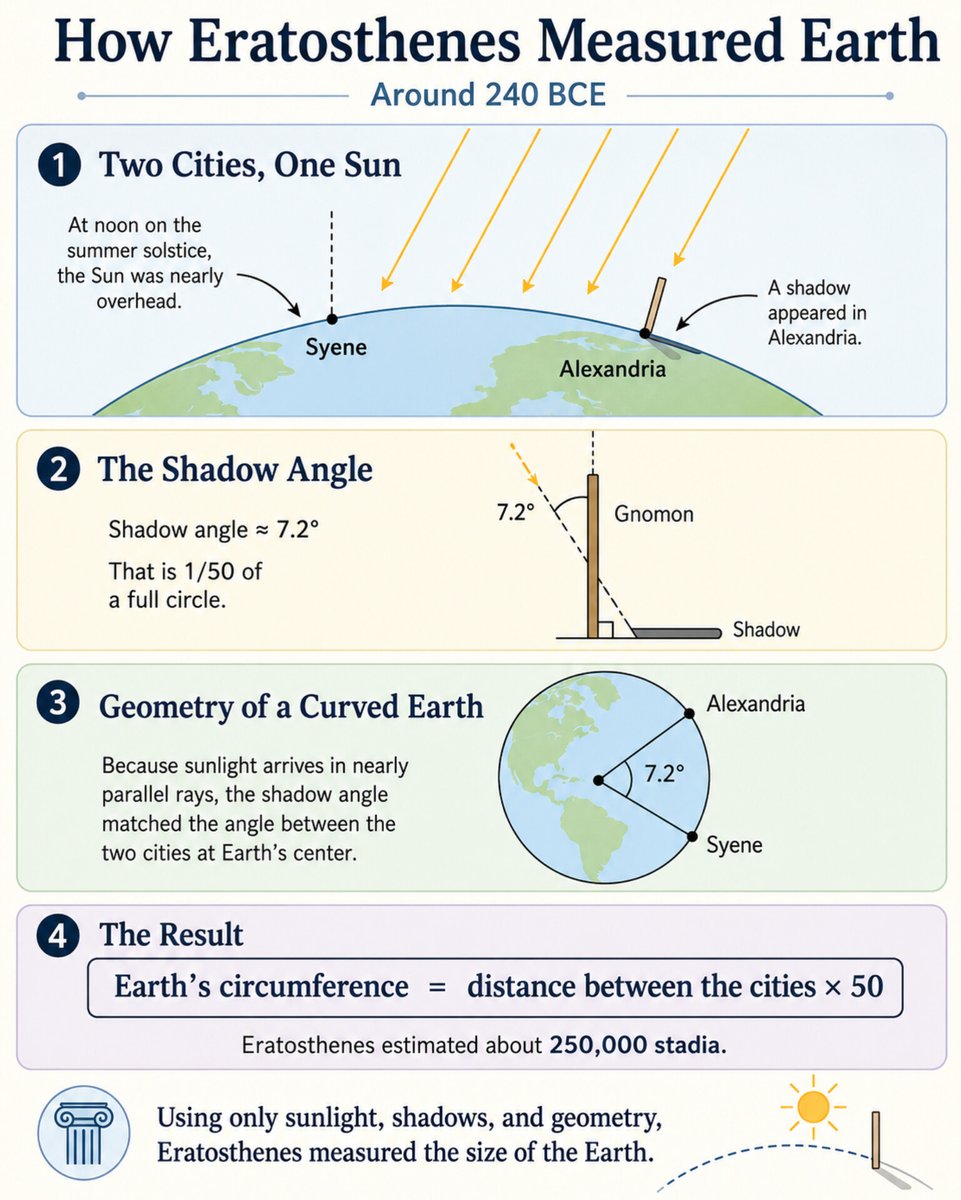
Around 240 BCE, Eratosthenes of Cyrene produced one of the most remarkable measurements in the history of science: he estimated the circumference of the Earth using sunlight, shadows, geometry, and the known distance between two Egyptian cities.
He had heard that in Syene, near modern Aswan, the Sun shone almost directly overhead at noon on the summer solstice, illuminating the bottoms of deep wells and leaving little or no shadow.
At the same moment in Alexandria, farther north, a vertical stick, or gnomon, did cast a shadow.
That difference was the key.
In Alexandria, Eratosthenes measured the relation between the height of the gnomon and the length of its shadow. From that right triangle, he deduced that the Sun’s rays there made an angle of about 7.2 degrees from the vertical, equivalent to one fiftieth of a full circle.
Since sunlight reaches Earth from such a great distance that its rays are effectively parallel, the angle measured in Alexandria could be interpreted as the angle between Syene and Alexandria at Earth’s centre.
If the distance between the two cities represented one fiftieth of a full circle, then Earth’s total circumference had to be fifty times that distance.
Eratosthenes multiplied the estimated distance from Syene to Alexandria by 50 and obtained a value of about 250,000 stadia.
The exact modern equivalent remains debated because the ancient stadion was not a single fixed unit, but his result was still remarkably close to the true circumference of Earth.
The importance of the calculation lies not only in the numerical result, but in the reasoning behind it.
Eratosthenes transformed a local observation, the length of a shadow in one city and the reported absence of one in another, into a measurement of the entire planet. Without telescopes, satellites, or modern instruments, he showed that the size of Earth could be inferred through careful observation and geometry.
It remains one of the clearest examples of how science can reveal a global truth from simple, ordinary evidence.
22
134
532
14,591
Jun 11
Cosmic acceleration still appears to be real. A new international analysis argues that recent claims of a slowing Universe were based on a methodological mistake rather than on evidence that dark energy is weakening.
The debate comes from Type Ia supernovae, the stellar explosions that have been central to measuring cosmic expansion because they can be used as distance indicators. In the late 1990s, these observations showed that distant supernovae were dimmer than expected in a purely decelerating Universe, leading to the conclusion that the expansion of the cosmos is accelerating.
A new study had challenged this interpretation by suggesting that Type Ia supernovae may change brightness depending on the age of the stars that produce them. If older and younger supernova populations had different intrinsic luminosities, then astronomers might have mistaken an astrophysical effect for cosmic acceleration. In that scenario, dark energy might not be constant and the Universe could have entered a phase of deceleration.
The new work argues that this slowdown claim does not hold up. The authors say the earlier analysis incorrectly treated the age of a host galaxy as if it were the same as the age of the star that exploded as a supernova.
That is a critical distinction, because galaxies contain mixed stellar populations, and the age of the galaxy as a whole does not necessarily represent the progenitor system of a specific Type Ia supernova.
The new team also points out that the previous study did not properly include the standard correction for host galaxy mass, a known factor in modern supernova cosmology. When supernovae are calibrated while accounting for their host environments and stellar populations, the evidence for acceleration remains consistent. In other words, the apparent problem is not that the original dark energy measurements were wrong, but that the rebutted analysis used assumptions that distorted the interpretation of the supernova data.
The conclusion is not that cosmology is finished or that dark energy is understood. The physical nature of dark energy remains one of the central unsolved problems in astrophysics. But according to this new analysis, the observational foundation for an accelerating Universe remains robust. The Universe is still expanding at an accelerating rate, and the main question returns to what dark energy actually is, rather than whether the evidence for its existence has collapsed.
👉 share.google/0LE0vGzs4LRG3sx…
18
37
222
4,159
Jun 10
The Amaterasu particle is one of the most energetic cosmic rays ever detected. It was recorded by the Telescope Array in Utah in 2021 with an estimated energy of about 240 exa-electron volts, placing it in the same extreme category as the famous “Oh-My-God particle” detected in 1991.
The problem is that its apparent arrival direction pointed toward a cosmic void, a region where there is no obvious astrophysical source powerful enough to accelerate a particle to such an enormous energy. That made it difficult to explain both where it came from and what kind of particle it actually was.
New research suggests that the answer may be that some of the highest-energy cosmic rays are not protons, and not even ordinary heavier nuclei such as iron, but ultraheavy atomic nuclei, meaning nuclei heavier than iron. This matters because different particles lose energy in different ways as they travel through intergalactic space.
Protons and lighter nuclei interact with background radiation fields and tend to lose energy more quickly over cosmic distances.
According to the simulations, ultraheavy nuclei can retain their energy more efficiently at the extreme energies involved, especially below roughly 300 EeV, making it more plausible that they could travel from distant sources and still reach Earth with energies like that of the Amaterasu particle.
This does not mean that every ultrahigh-energy cosmic ray is ultraheavy. The proposal is more careful than that: if some of the most extreme events are ultraheavy nuclei, then their propagation through space, their magnetic deflection and their possible sources would need to be interpreted differently.
Ultraheavy nuclei carry more electric charge than protons, so magnetic fields can bend their trajectories more strongly. That could help explain why the arrival direction of a particle like Amaterasu does not point neatly back to an obvious source. Its true origin may be elsewhere, with its path distorted during the journey.
The most plausible production sites would be some of the most violent environments in the Universe: collapsing massive stars that form black holes, strongly magnetized neutron stars, and mergers of neutron stars. These are environments already associated with extreme particle acceleration, gravitational waves and, in some cases, gamma-ray bursts.
The study also suggests that if ultraheavy nuclei really contribute significantly at the highest energies, future observatories should detect signs that the composition of the most energetic cosmic rays is heavier than iron. That would be a direct observational test of the idea.
The result is important because it gives a physically plausible way to reduce the mystery around particles like Amaterasu. Instead of requiring a nearby, obvious and extremely powerful source in the direction from which the particle appeared to arrive, the ultraheavy-nucleus scenario allows for a more complex picture: a particle born in a violent cosmic explosion, retaining more of its energy than expected during its journey, and arriving at Earth from a direction that may have been substantially altered by magnetic fields.
It is not a final solution, but it gives researchers a concrete and testable framework for one of the oldest problems in high-energy astrophysics: where the most energetic particles in the Universe come from.
👉 share.google/rniyptKpv6YwQ2V…
13
63
358
8,808
Jun 8
Understanding the Universe means learning to think across an almost absurd range of physical scales.
Space is filled with planets, stars, stellar remnants, black holes, galaxies, galaxy clusters, filaments, and vast regions of matter and emptiness. But the interesting part is not only that some objects are small and others are huge.
The real lesson is that every class of object has its own internal limits, and those limits are set by physics.
At small scales, gravity is not always the dominant force. Below a few hundred kms, objects are usually shaped more by electromagnetic forces and material strength than by self-gravity. That is why many asteroids are irregular rather than spherical. Once an object becomes massive enough, gravity can pull it toward hydrostatic equilibrium, making it round.
Icy bodies can reach that state at smaller sizes than rocky ones because ice is easier to deform. This is why a small moon such as Mimas can look roughly spherical, while some larger rocky asteroids may still not be perfectly relaxed by gravity.
Planets show that size and mass do not always scale in an intuitive way. Gas giants can become much more massive than Jupiter without becoming much larger, because added mass compresses their interiors.
Some “super-puff” exoplanets, by contrast, can have enormous radii despite relatively low masses, because their atmospheres are extremely extended. Brown dwarfs push this idea even further: they are far more massive than planets, sometimes massive enough to fuse deuterium, but their physical size remains roughly comparable to Jupiter’s because degeneracy pressure and compression prevent them from simply swelling with mass.
Stars span a far wider range. The smallest hydrogen-burning red dwarfs are only somewhat larger than Jupiter, while the largest red supergiants can expand to sizes approaching the scale of Saturn’s orbit.
Stellar remnants then invert many everyday expectations. White dwarfs are roughly Earth-sized or smaller, with more massive white dwarfs generally being smaller because their matter is compressed more strongly. Neutron stars are even more extreme: they pack more than a solar mass into a sphere only about 20 to 25 kms across.
Black holes are the most radical case, because their “size” is defined by the event horizon. Known bhs range from stellar-remnant objects with event horizons measured in kilometers to supermassive black holes whose horizons can be larger than the Solar System.
On galactic scales, the same principle applies: categories have enormous internal variation. The smallest candidate galaxies may be only tens of light-years across and contain very few stars, blurring the line between dwarf galaxies and star clusters.
At the other extreme, enormous galaxies such as IC 1101 extend for millions of light-years and contain staggering amounts of stellar mass. Galaxy groups and clusters can be compact or spread across tens of millions of light-years. Even black hole jets can reach similar scales, with the largest known jets extending over more than 20 million light-years.
The largest structures are not individual bound objects in the ordinary sense. Cosmic filaments and walls can stretch for more than a billion light-years, tracing the cosmic web shaped by gravity, dark matter, cosmic expansion, and dark energy.
However, not every apparent pattern in the sky is a real physical structure. Some proposed giant structures may simply be chance alignments or incomplete mappings of distant absorbers and galaxies. At the largest scales, the Universe becomes statistically homogeneous: the cosmic web has structure, but there is a limit to how large truly coherent structures can be.
@bigthink
@StartsWithABang
👉 share.google/k2si3aaYCKgTTZC…
15
48
311
6,182
Jun 7
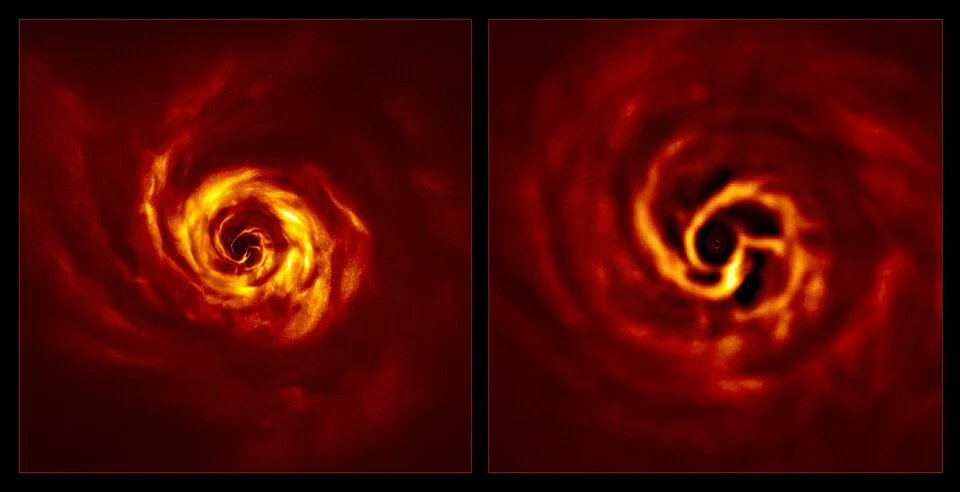
Astronomers have directly observed the rotation of a protoplanetary disk in real time for the first time, focusing on the young star AB Aurigae, a nearby system where planets are still forming inside a broad disk of gas and dust.
Protoplanetary disks are the raw material from which planetary systems emerge, but until now their motion had mostly been inferred through indirect methods or through gas observations.
In this case, researchers used the SPHERE instrument on the European Southern Observatory’s Very Large Telescope to track the movement of dust structures in the disk over several years, allowing them to see how the disk itself evolves and rotates.
The disk around AB Aurigae mostly follows the expected Keplerian motion: material closer to the star moves faster, while material farther away moves more slowly, as gravity predicts. However, the observations also revealed important deviations from this simple pattern, especially in the inner regions of the disk.
Some structures appear to move in ways that do not fully match standard theoretical models, suggesting that the disk is being disturbed by complex internal processes. One strong possibility is that forming giant planets are interacting gravitationally with the surrounding material, shaping spirals, shadows, clumps, and accretion zones as they grow.
This is especially interesting because AB Aurigae has already been considered one of the best laboratories for studying planet formation. Previous observations had identified spiral structures and possible protoplanet candidates, including AB Aurigae b, a massive object still embedded in the disk.
The new observations add a dynamic dimension to that picture: instead of seeing the disk as a static image, astronomers can now follow how its structures move over time. That makes it possible to test whether suspected planets are really responsible for the observed distortions.
The study also found rapidly moving shadows cast across the surface of the disk. These shadows may be produced by opaque dust clumps or by forming planetary bodies orbiting close to the star.
Their motion suggests that the inner disk is not a simple, flat, orderly structure, but a disturbed and evolving environment where several bodies or dense accumulations of material may be interacting at once.
In some regions, the disk appears to rotate more slowly than expected, which may indicate that the forming planets are not moving in the same plane as the main disk or may be following inclined or elliptical orbits.
The importance of this observation is that it gives us a more direct way to study planet formation as an active process. Instead of only identifying gaps, rings, or spirals and then inferring the presence of planets, we can now watch how those structures change with time.
This makes it easier to connect disk dynamics with the hidden objects that may be shaping them. The result shows that planetary nurseries are more complex than idealized models suggest, and that planets may form in environments that are tilted, unstable, shadowed, and dynamically disturbed.
👉 share.google/NeBQPOo4pz0ywab…
19
77
465
24,305
Jun 7
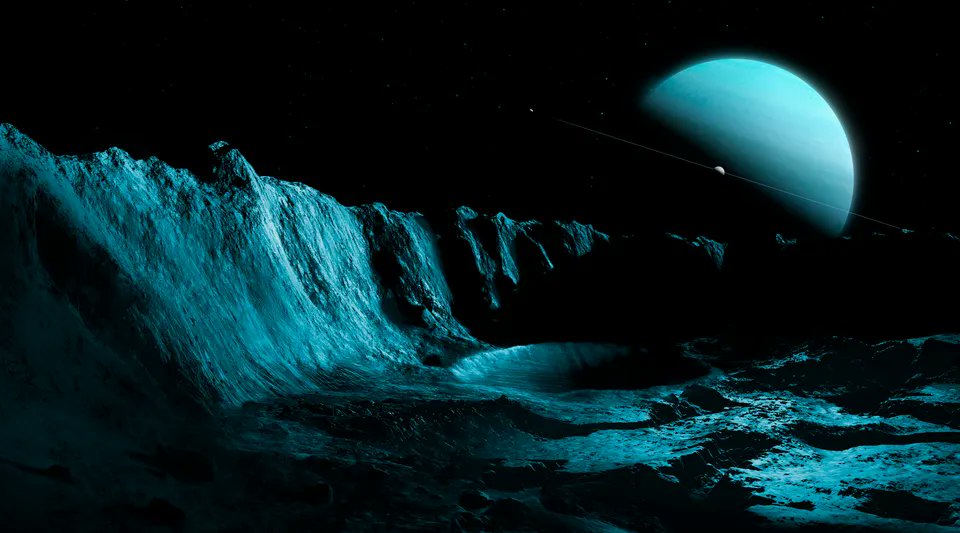
The moons of Uranus may preserve evidence of one of the most unstable periods in the early Solar System. Long before the giant planets settled into their present orbits, Jupiter, Saturn, Uranus and Neptune probably migrated through a crowded outer Solar System filled with icy planetesimals and perhaps even one or more additional ice-giant-sized planets.
During that phase, close gravitational encounters could have rearranged the orbits of the giant planets and may have expelled a lost planet into interstellar space.
The key idea is that the moons of Uranus are not just passive objects orbiting a distant planet. They are fragile dynamical records.
If Uranus experienced many strong close encounters with other giant planets, its regular moons should have been severely disturbed, scattered, or destroyed. Yet today Uranus still has a system of large moons, including Miranda, Ariel, Umbriel, Titania and Oberon.
Their survival places limits on how violent the early instability could have been.
New simulations suggest that many plausible versions of the early Solar System’s instability would have destabilized Uranus’ moons. This makes the current moon system difficult to explain unless the real history was more specific than the simplest models. Uranus may have avoided the most destructive encounters, its moons may have been partly rebuilt after collisions, or the early Solar System may have included an extra giant planet that changed the way the instability unfolded before being ejected.
Miranda is especially interesting because its surface already shows signs of a complicated past, with huge fractures, disrupted terrains and evidence of major geological reworking.
That does not prove that a missing planet directly shaped Miranda, but it supports the broader idea that Uranus’ moons may have been altered by large-scale events, including the impact that tilted Uranus onto its side and the later migration of the giant planets.
The broader importance is that Uranus could help reconstruct a lost chapter of Solar System history. Its moons may contain clues about whether the outer Solar System once had more giant planets than it has today. A future mission to Uranus could study the moons’ surfaces, interiors, gravity fields and orbital histories in detail, helping scientists determine whether they are ancient survivors, rebuilt remnants, or evidence of a more chaotic planetary system that once included worlds now gone.
👉 share.google/QquX8Fze8trgSrI…
22
59
332
9,097
Jun 5
A day on Earth feels like one of the most stable things in nature, but it has not always lasted 24 hours.
Earth’s rotation has been gradually slowing for billions of years, mainly because of tidal interactions with the Moon.
As Earth rotates, the Moon’s gravity raises tides in the oceans. Because Earth spins faster than the Moon orbits, those tidal bulges are carried slightly ahead of the Moon. Their gravity pulls the Moon forward, transferring angular momentum from Earth to the Moon.
The Moon slowly moves outward, while Earth’s rotation loses a tiny amount of speed. Today this effect is very small, but over hundreds of millions of years it becomes geologically significant.
One of the most elegant pieces of evidence comes from ancient corals. Corals can preserve fine daily growth bands inside broader seasonal or annual growth patterns, rather like a biological calendar. In 1963, the palaeontologist John W. Wells showed that fossil corals from the Devonian period, around 380 to 385 million years ago, recorded roughly 400 daily growth lines within a year. Since the length of Earth’s orbit around the Sun has remained nearly the same on these timescales, a year still contained roughly the same total number of hours. But if there were about 400 days in that year instead of 365, each day must have been shorter. The calculation gives a Devonian day of about 22 hours.
This does not mean the year itself was much longer in the orbital sense. Earth was not taking dramatically longer to go around the Sun. Rather, Earth was spinning faster, so more rotations fitted into one orbit.
A Devonian animal would have experienced more sunrises and sunsets per year than we do, with a day-night cycle noticeably shorter than the modern one. Dinosaurs, which appeared much later, also lived on an Earth with slightly shorter days than ours, though not as short as in the Devonian.
The picture becomes even more complex when scientists look further back in time. Corals only take us so far, because they did not exist for most of Earth’s history. For older periods, researchers use other geological clocks, such as tidal sediments and rhythmic rock layers linked to astronomical cycles.
Some recent work suggests that during the mid-Proterozoic, between roughly 2 billion and 1 billion years ago, Earth’s day length may have stalled at around 19 hours for nearly a billion years. The proposed reason is a balance between two competing effects: lunar tides slowing Earth down and solar-driven atmospheric tides pushing in the opposite direction.
The main message is that Earth’s rotation is not fixed. The 24-hour day is only the present stage in a very long dynamical evolution involving Earth, the Moon, the oceans, the atmosphere and the redistribution of mass within the planet.
Fossil corals are especially important because they turn this abstract physics into something measurable: tiny growth lines in ancient skeletons preserve the rhythm of days and years from hundreds of millions of years ago. They show that deep time was not only different in its continents, climates and life forms, but also in the basic daily rhythm of sunlight and darkness.
16
24
191
11,039
Jun 5
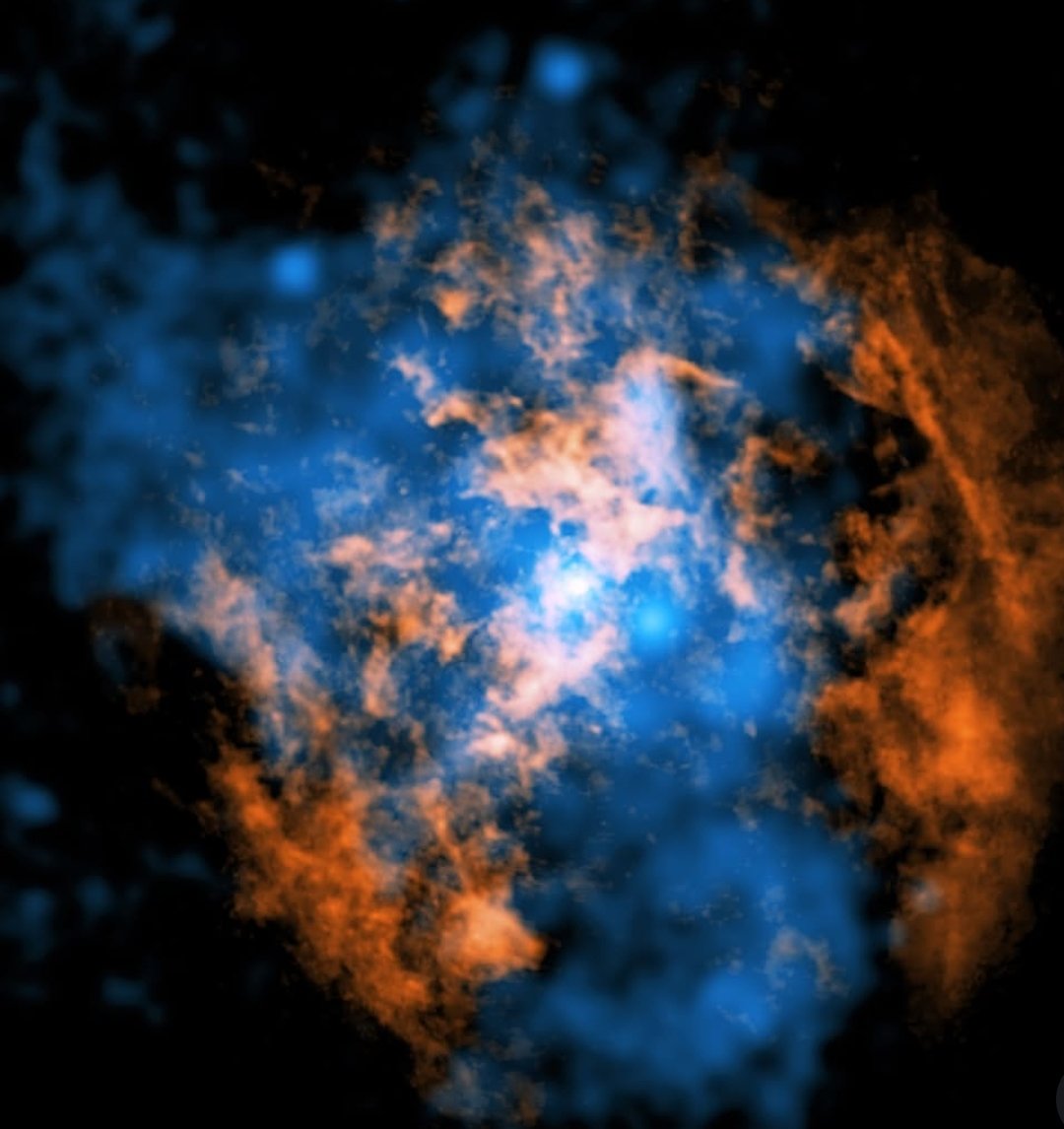
Sagittarius A*, the supermassive black hole at the centre of the Milky Way, has long been considered unusually quiet compared with the powerful black holes seen in active galaxies.
But “quiet” does not mean inactive.
Astronomers have now found clear evidence that our Galaxy’s black hole is producing a hot wind, a type of outflow that theory has predicted for decades but that had remained extremely difficult to detect directly in the crowded, dusty and complex environment of the Galactic Centre.
Using more than five years of @almaobs observations at millimetre wavelengths, the team mapped cold molecular gas around Sagittarius A* with unprecedented sensitivity and resolution.
They focused on carbon monoxide emission, which traces cold gas within about one parsec, or roughly three light-years, of the black hole.
This was technically difficult because Sagittarius A* itself is a bright and variable radio source, so the researchers had to carefully model and subtract its own emission before the much fainter surrounding structures could be seen clearly. The final map is reported to be about 100 times deeper and 80 times sharper than previous CO maps of this region.
What appeared after this processing was a large cone-shaped cavity in the cold gas, at least one parsec long and with an opening angle of about 45 degrees. In simple terms, the cold gas seems to have been cleared out along a cone pointing back toward Sagittarius A*.
That geometry is difficult to explain with ordinary stellar activity alone. The interpretation is that a hot wind from the black hole has either swept the cold gas away or heated it so much that it no longer appears as cold molecular material.
@chandraxray observations strengthen this interpretation because hot X-ray-emitting gas fills the same region where ALMA sees the absence of cold gas.
The result is important because black holes are not only objects that consume matter. When gas falls toward them, part of the energy released can drive material back outward as winds or jets.
This feedback process is central to galaxy evolution because it can regulate how much gas remains available for star formation and how the central black hole interacts with its environment.
In very active galaxies, such feedback can be dramatic, but Sagittarius A* shows that even a relatively quiet black hole can still affect the gas around it.
The wind detected here is not described as a powerful relativistic jet like those seen in some active galactic nuclei. It appears gentler, and the team estimates that it has been blowing for at least about 20,000 years.
That makes the discovery especially interesting: it suggests that Sagittarius A* is not an exception to black-hole physics, but rather a low-activity example of the same broader process seen in more energetic galaxies.
The Milky Way’s black hole is not dormant; it is weakly feeding, weakly expelling material, and slowly shaping its immediate surroundings.
This gives us a rare laboratory for studying black-hole feedback in a quiet regime. Most black holes in the Universe probably spend much of their lives in low-activity states, but they are easier to detect when they are bright and violent.
Sagittarius A* allows us to study a less spectacular but more common phase of black-hole behaviour, close enough for detailed mapping. The discovery therefore helps connect our own Galactic Centre with the larger physics of how supermassive black holes and galaxies evolve together.
👉 arxiv.org/abs/2509.10615
21
32
219
4,825
Erika retweeted
21 Dec 2025
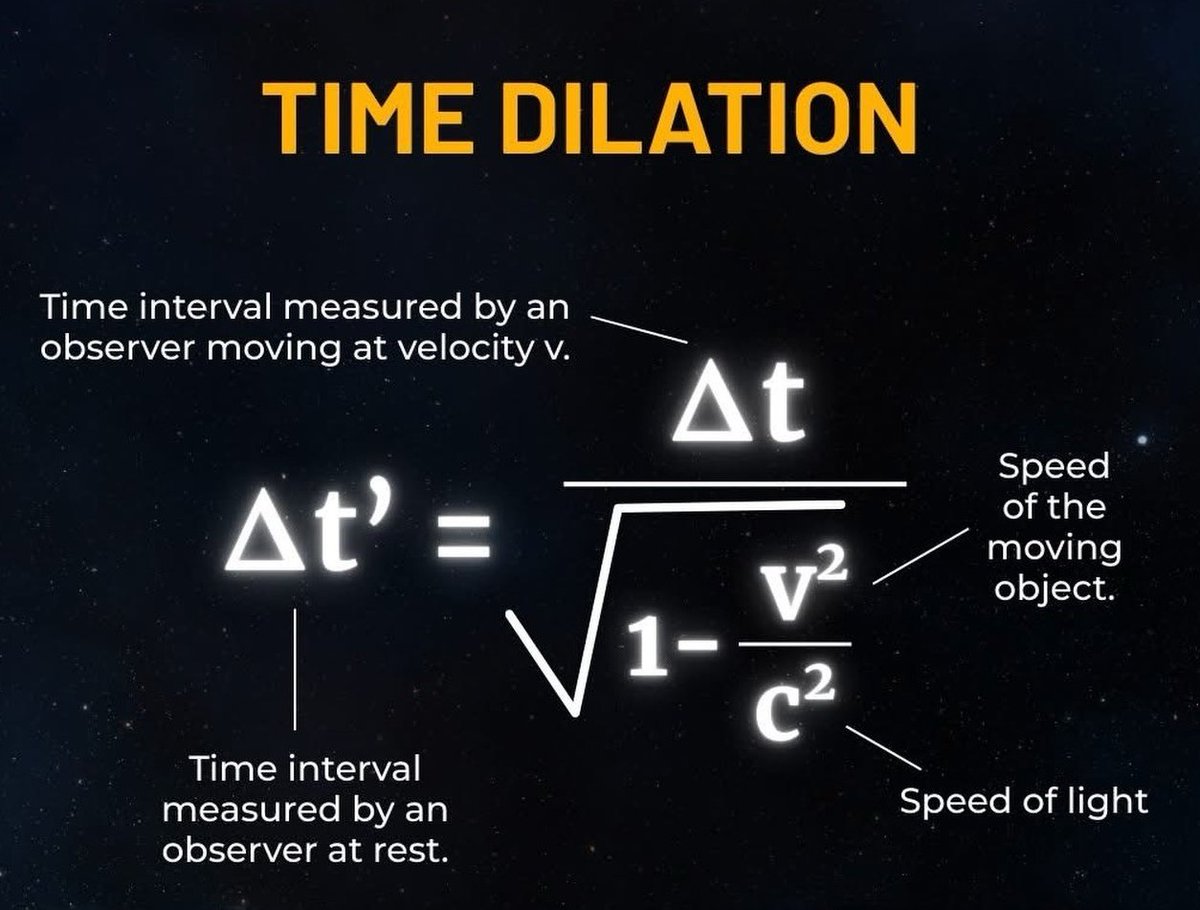
Imagine you are traveling inside a spacecraft at a speed close to that of light. From your own perspective, nothing feels unusual. Your clock ticks normally, your heart beats at its usual rhythm, and every physical process behaves exactly as it always has. Locally, physics never breaks. You never experience your own time “slowing down.”
An observer watching you from Earth, however, measures something very different. They see your clock ticking more slowly than theirs and conclude that you are aging more slowly. This effect is quantified by the time-dilation equation of special relativity:
Δt = Δt₀ / sqrt(1 − v² / c²)
Here, Δt₀ is the proper time, the time interval measured by the traveler moving with the spacecraft. Δt is the longer time interval measured by an observer at rest relative to that motion. The variable v is the relative velocity between observers, and c is the speed of light. As v approaches c, the denominator shrinks, and the difference between the two measured times grows dramatically.
The origin of this effect lies in one of the most fundamental principles of nature: the speed of light in vacuum is the same for all observers, regardless of their motion. If you try to chase a beam of light, classical intuition suggests you should see it slow down. Nature does not allow this. Instead, spacetime itself adjusts. Time stretches so that light still outruns you at exactly the same speed.
Time dilation is inseparable from length contraction. From the traveler’s point of view, the reason they can cross vast distances in what feels like a short time is not that their clock is running slowly, but that the distance itself has become shorter along the direction of motion. Space and time are two aspects of a single structure, and motion links them together.
A crucial point is that this effect is symmetric. There is no preferred frame of reference. If you move at 0.9c relative to Earth, then from your perspective, Earth is moving away from you at 0.9c, and you see Earth’s clocks running slow. Both descriptions are equally correct. The question of who actually ages less only has a definite answer when the symmetry is broken by acceleration, such as when one traveler turns around. This is the essence of the twin paradox and requires general relativity to fully resolve.
At everyday speeds, time dilation is imperceptibly small. At orbital speeds, it becomes measurable: astronauts on the International Space Station age slightly less than people on Earth. In modern technology, the effect is unavoidable. GPS satellites must correct for relativistic time shifts caused by motion and gravity, or navigation errors would grow rapidly.
Einstein’s insight was radical: time is not universal. It is flexible, observer-dependent, and inseparably linked to space. Velocity does not merely change where you are in the universe; it changes how fast you move through time.
85
177
898
39,085
Erika retweeted
24 Apr 2024
Saturn, the 6th planet from the Sun & the 2nd-largest in our solar system, is a mesmerizing world with its intricate ring system & a plethora of moons. Among its many enigmatic features, perhaps none are as captivating as the hexagon-shaped cloud pattern found near its N pole. 1/
29
168
1,129
81,424
Jun 4
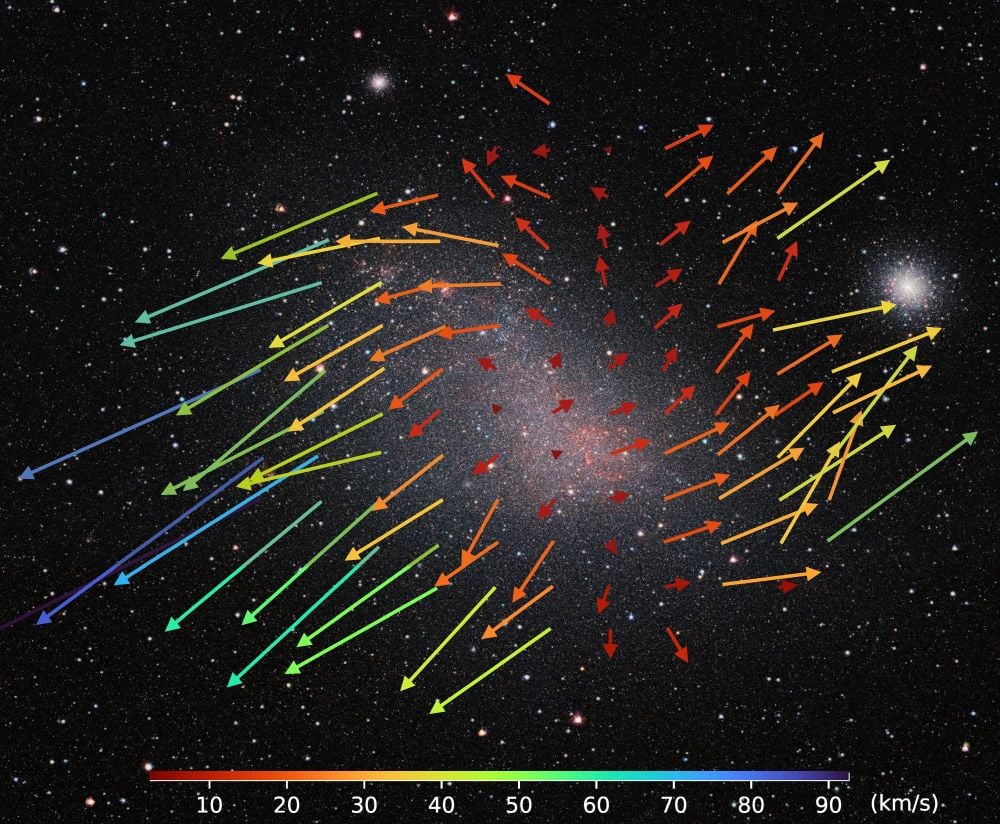
The Small Magellanic Cloud, one of the Milky Way’s closest galactic neighbours, appears to be expanding rather than rotating like a stable disk.
A new analysis based on more than a decade of near-infrared observations from the VISTA Survey of the Magellanic Clouds has mapped the proper motions of millions of stars inside the galaxy with much higher precision than before. Instead of showing a clean, ordered rotation pattern, the stellar motions reveal that stars are moving away from the galaxy’s centre, especially along a southeast-northwest direction.
This matters because the Small Magellanic Cloud has long been treated, at least in simplified models, as a small galaxy with some kind of internal rotation. The new map suggests that this picture is too simple. Its internal motion is dominated by tidal disturbance. The main gravitational culprit is the Large Magellanic Cloud, its more massive companion, which has repeatedly interacted with it over billions of years. Those encounters have stretched and distorted the Small Magellanic Cloud, leaving it dynamically out of equilibrium.
The study used a longer observational baseline, around 6 to 11 years, from VISTA data release 7. That longer baseline allowed the researchers to measure stellar proper motions with about three times better precision than previous VMC-based studies. After correcting for the overall motion of the galaxy and for perspective effects, the residual motion map showed clear signs of large-scale expansion. The researchers also found no convincing evidence for normal disk-like rotation once those corrections were applied.
Another important point is that the disturbance is not only visible in the outer regions, where tidal stripping might be expected, but also in the central parts of the Small Magellanic Cloud. That suggests the whole galaxy has been strongly affected by its interaction with the Large Magellanic Cloud. Older red giant stars also show a coherent northward motion away from the centre, which the authors interpret as a possible kinematic fossil of an interaction that happened more than two billion years ago.
The broader implication is that the Small Magellanic Cloud is not a calm nearby dwarf galaxy, but a galaxy being reshaped in real time by gravitational encounters.
Because it is close enough for astronomers to measure individual stellar motions, it becomes a valuable laboratory for studying how small galaxies are disrupted, stretched, and transformed by larger companions. The result also warns that using simple rotating-disk models for disturbed dwarf galaxies can give a misleading picture of their structure and evolution.
👉 share.google/SGS1Y883ZPIPK0P…
7
45
200
3,839
Jun 4
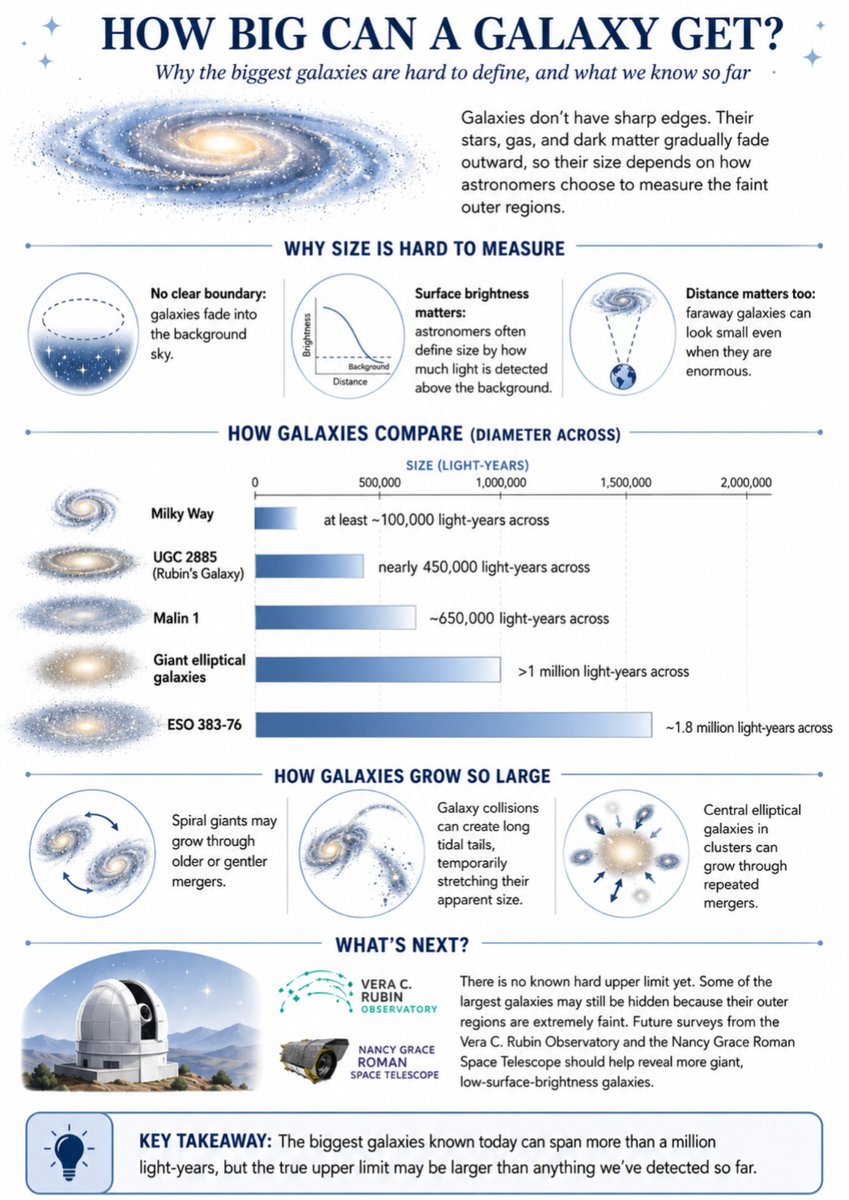
Galaxies don’t have a simple maximum size because they don’t have sharp physical edges. Unlike planets or moons, a galaxy gradually fades outward: its stars, gas and dark matter become more diffuse until they blend into the background sky.
That makes “size” partly a measurement problem.
Astronomers often define a galaxy’s visible boundary using surface brightness, meaning how much light the galaxy contributes over a small patch of sky compared with the surrounding background. This works reasonably well, but it is still somewhat arbitrary, especially for faint outer disks, halos and elliptical galaxies.
Distance adds another complication: a galaxy can be physically enormous but look small because it is very far away, so astronomers need redshift and distance estimates to infer its true scale.
The Milky Way is already a large spiral galaxy, with a stellar disk at least about 100,000 light-years across, but it is far from the largest known galaxy. Some giant spiral galaxies are much wider.
Malin 1, for example, looked at first like a fairly ordinary spiral, but deep observations revealed extremely faint outer spiral structures extending across about 650,000 light-years. That makes it roughly six times wider than the Milky Way and one of the largest known spiral galaxies.
Another example is UGC 2885, also called Rubin’s Galaxy, which is nearly 450,000 light-years wide and contains far more stars than the Milky Way. These galaxies are puzzling because they seem relatively isolated, so their huge size can’t easily be explained by recent violent interactions with many neighboring galaxies. One possibility is that they grew through older or gentler mergers that no longer leave obvious distortions.
Collisions can also make galaxies appear huge by pulling out long tidal tails, as happens in systems such as the Tadpole Galaxy or the Condor Galaxy. But these stretched shapes are temporary phases, not necessarily stable examples of how large an ordinary galaxy can become.
Elliptical galaxies can grow even larger than spirals, especially near the centers of galaxy clusters, where repeated mergers are common. Some central elliptical galaxies can span more than a million light-years; ESO 383-76, for instance, is described as about 1.8 million light-years wide.
There are also giant isolated ellipticals, such as ESO 306-17, which may be the final product of many galaxies in a smaller cluster merging into one enormous object.
The main conclusion is that there is no known hard upper limit yet. The largest galaxies are hard to detect because their outer regions can be extremely faint and diffuse. Future wide-field observatories, especially the Vera C. Rubin Observatory and the Nancy Grace Roman Space Telescope, should be able to find more low-surface-brightness giants and help astronomers understand whether the biggest galaxies we know are close to the true limit, or whether even larger, dimmer galaxies are still hidden in the data.
20
49
291
4,933
Jun 3
The Milky Way may have had a far more violent early history than the calm spiral structure we see today suggests.
A new study proposes that our Galaxy did not simply form a disk once and then preserve it unchanged for billions of years. Instead, it may have formed an early rotating stellar disk, had that disk severely disrupted by a major ancient merger, and then rebuilt the stable disk that now contains the Sun.
The key event is the collision with Gaia-Sausage-Enceladus, a smaller galaxy that merged with the young Milky Way roughly 11 billion years ago. This merger was not a minor disturbance.
According to the simulations used in the study, an impact of this kind could have strongly heated and scrambled the orbits of stars in the early Galactic disk, erasing much of its original structure. In that sense, the early Milky Way’s disk may have been “destroyed,” not because the whole Galaxy vanished, but because its first ordered disk was dynamically disrupted.
After that violent phase, the Milky Way appears to have reorganized itself. Gas continued to settle, new stars formed, and a new disk gradually emerged. This reconstructed disk is closer to the one we observe today: a rotating structure made of stars, gas, and dust, with the Sun located in one of its spiral arms.
The study therefore suggests that the present Milky Way disk may not be a direct, uninterrupted fossil of the Galaxy’s first disk, but the result of a recovery process after a major merger.
This matters because astronomers often use the motions, ages, and chemical compositions of stars to reconstruct the history of the Galaxy. If an early disk was destroyed and later rebuilt, then the moment when we see strong disk-like rotation in the stellar record may not represent the first birth of the Milky Way’s disk.
It may instead mark the time when the Galaxy regained order after being disturbed. That changes how we interpret the oldest stars, the thick disk, and the timing of major events in the Milky Way’s evolution.
The study also fits into a broader modern picture of galaxy formation. Galaxies are not static islands of stars. They grow through mergers, accretion of gas, bursts of star formation, and long phases of dynamical settling.
The Milky Way looks relatively quiet now, but its past was shaped by collisions and reconstruction. The idea that it was “destroyed and rebuilt” should therefore be understood as a structural and dynamical transformation, not as the literal disappearance of the Galaxy.
Its early disk may have been wrecked, but the material remained, reorganized, and eventually gave rise to the Galactic disk we live in today.
👉 share.google/FZcQkqBEwu0XWd0…
8
40
209
4,452
Jun 3
The early Solar System was probably far more chaotic than the calm architecture we see today. According to modern models of giant planet evolution, Jupiter, Saturn, Uranus & Neptune didn't simply form in their present orbits and remain there. Instead, after their formation, the giant planets likely went through a phase of dynamical instability, during which their orbits became excited, shifted outward or inward & possibly involved close encounters with one or more additional ice-giant-sized bodies that were eventually ejected from the SS.
A new study examines what such a violent period would have meant for the regular moons of Jupiter & Uranus. The key idea is simple but powerful: if the giant planets passed close enough to one another during the instability, their gravitational fields could have severely disturbed the satellite systems already orbiting them. These moons aren't isolated objects; they sit inside the gravitational environment of their parent planet & a close planetary encounter can stretch, perturb or destabilize their orbits. If the disturbance is strong enough, moons can collide with each other, be ejected, or be forced into a later phase of re-accretion & reorganization.
They tested this by using encounter histories from 122 plausible simulations of outer SS evolution. They then examined how those encounters would affect the stability of the large regular moons of Jupiter & Uranus. The result is striking: in the simulations, the survival probability of both the Jovian & Uranian regular satellite systems is low, below about 15%. Even more importantly, they found only one case in which both Jupiter’s & Uranus’ major moons consistently survived the same instability event. This suggests that many versions of the giant planet instability that successfully reproduce parts of the modern SS may be too violent for the satellite systems we observe today.
The Uranian moons appear especially fragile. The simulations indicate that if Uranus experienced a close encounter with another ice giant within roughly 0.02 AU, or with Jupiter or Saturn within roughly 0.1 AU, destruction of the Uranian satellite system was essentially guaranteed. Wider encounters could also be damaging, especially if several occurred in sequence. This matters bc Uranus already presents a major puzzle: its extreme axial tilt is usually interpreted as the result of a giant impact or a series of large impacts. Such an event would itself have strongly disrupted any pre-existing satellite system. If the later giant planet instability also destabilized the moons, then Uranus’ present satellites may not be primordial survivors in a simple sense, but the product of repeated destruction, collision and reassembly.
Jupiter provides a different but equally important constraint. The Galilean moons are locked in a delicate dynamical architecture, including the Laplace resonance involving Io, Europa & Ganymede. If Jupiter’s moons had suffered a catastrophic instability involving collisions, that resonance would probably not look the way it does today. This means Jupiter’s satellite system may preserve evidence that the real instability couldn't have involved encounters that were too disruptive for Jupiter, even if Uranus may have undergone much stronger satellite reorganization.
The broader implication is that the regular moons of the giant planets aren't just passive details of SS history. They are dynamical witnesses. Any successful model of early SS evolution must explain not only the final orbits of the planets, the Kuiper Belt & the irregular satellites, but also why the large regular satellite systems survived, or why some of them may have been destroyed and rebuilt. For Uranus in particular, the study strengthens the idea that its current moons may have experienced at least two major episodes of disruption: one associated with the impact or impacts that tilted the planet, and another during the giant planet instability.
👉 arxiv.org/html/2603.21750v1
12
19
166
4,695
Jun 3
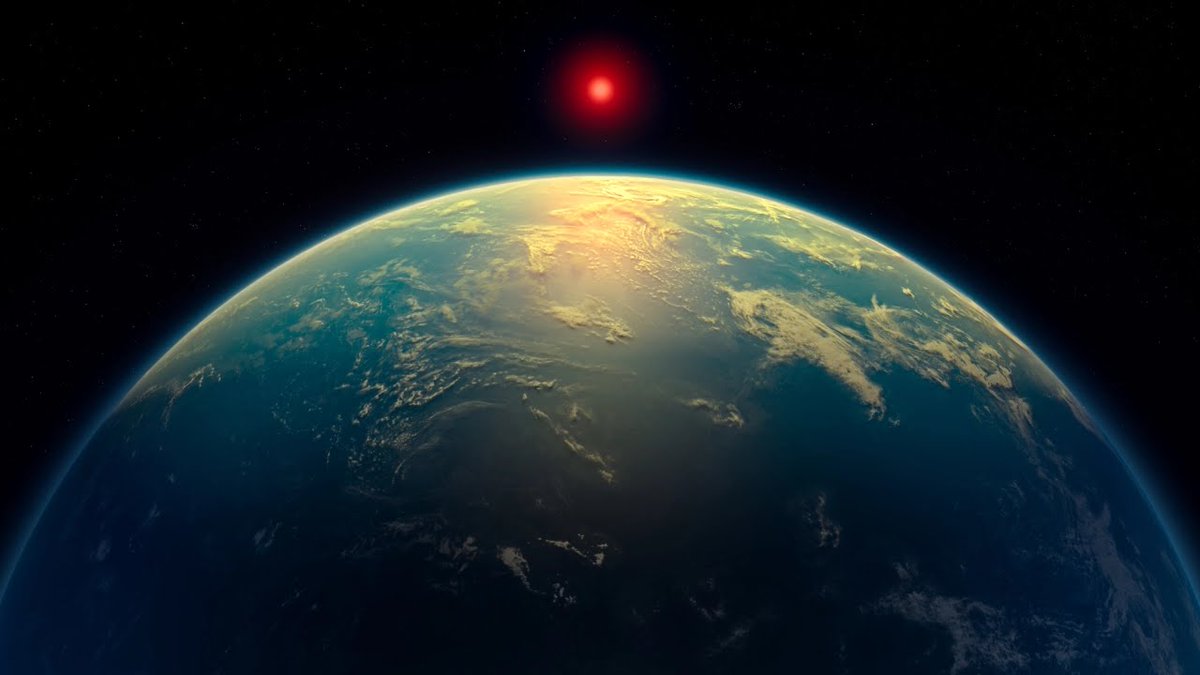
Astronomers have found the strongest evidence so far that some planets outside the Solar System possess magnetic fields.
The study focuses on seven ultra-hot Jupiters, giant gaseous exoplanets orbiting extremely close to their stars, with one side permanently facing the star and the other locked in darkness.
These planets are not Earth-like and are not candidates for life, but their atmospheres offer a useful laboratory because they are hot enough for metals such as iron to become detectable and partly ionized.
Using high-resolution observations from instruments including ESPRESSO on ESO’s Very Large Telescope and MAROON-X on Gemini North, the team measured Doppler shifts in iron lines to estimate atmospheric wind speeds.
Under ordinary atmospheric physics, hotter planets should have stronger winds because their atmospheres receive more stellar energy. Instead, the researchers found the opposite trend: the hotter the planet, the slower the measured winds.
The most plausible explanation is magnetic drag. In these intensely heated atmospheres, charged particles interact with the planet’s magnetic field, which acts like a brake on atmospheric circulation. From this relationship, the team inferred magnetic field strengths of at most a few gauss, broadly comparable to magnetic fields found among Solar System planets and close to Jupiter-like values.
The result does not mean that Earth-like exoplanets with protective magnetic fields have been detected. It means that, for the first time, astronomers have a robust population-level method for linking atmospheric dynamics to planetary magnetism in exoplanets.
That matters because magnetic fields can influence how planets evolve, how their atmospheres are retained or lost, and, indirectly, whether rocky planets might remain habitable over long timescales.
👉 nature.com/articles/s41550-0…
8
32
176
3,521
Jun 2
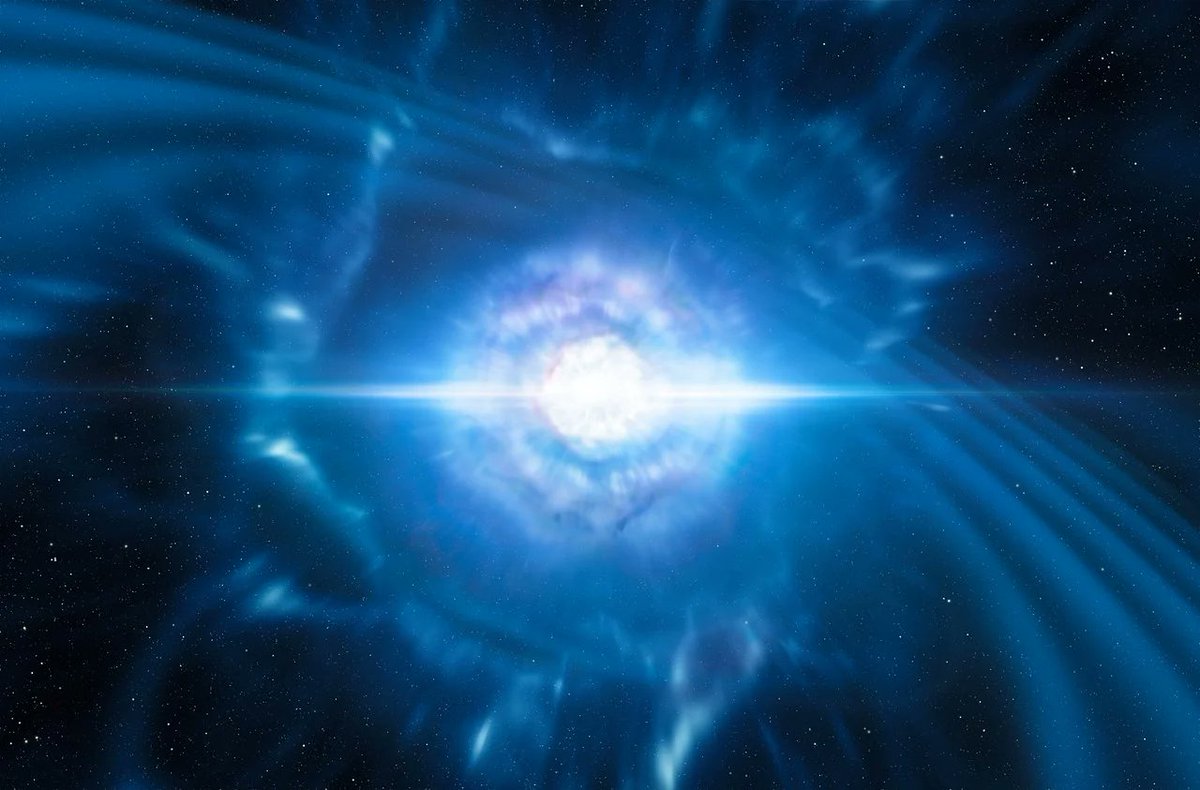
Neutron stars sit at one of the sharpest boundaries in astrophysics: the point where matter can still resist gravitational collapse before becoming a black hole. They are already extreme objects, packing roughly the mass of the Sun or more into a sphere only about the size of a city. Their density is so high that ordinary intuition fails completely, and the key question becomes not simply how massive they are, but how much pressure their internal matter can generate before gravity wins.
The current estimate discussed here places the upper mass limit for a neutron star at roughly 2.2 to 2.3 times the mass of the Sun. Above that range, the star should no longer be stable as a neutron star and would be expected to collapse into a black hole. This limit depends on the equation of state, which is the physical model describing how ultra-dense nuclear matter behaves under pressures far beyond anything we can reproduce directly in a laboratory. Since we cannot sample the interior of a neutron star, researchers have to combine theoretical models with astronomical observations.
Two different models of neutron-star matter were compared. One treats the matter as relatively “soft”, meaning more compressible, while the other treats it as “stiffer”, meaning more resistant to compression. The important result is that, after being constrained by observations, both models converge on a similar maximum mass. That convergence is significant because it suggests the answer is not just an artifact of one particular theoretical assumption.
The models also had to obey a basic physical requirement: the speed of sound inside the neutron-star matter cannot exceed the speed of light. That may sound like a technical detail, but it matters because some equations of state can mathematically allow neutron stars to be too stiff unless they are forced to remain compatible with relativity and high-energy nuclear physics.
Observational data played a central role. Measurements from NICER, which studies X-ray emission from hot spots on spinning neutron stars, helped constrain the possible sizes and masses. Gravitational-wave data from GW170817, the first detected merger of two neutron stars, added information about how deformable or “squishy” neutron stars are when they orbit and distort each other before merging. Combining these constraints narrows the allowed range of neutron-star interiors.
The result also affects how we classify compact objects in the so-called mass gap, where it is sometimes unclear whether an object is a very heavy neutron star or a very light black hole. For example, GW190814 has a mass of about 2.59 solar masses, which would be too heavy to fit comfortably within this neutron-star limit. That makes it more likely to be a black hole rather than an unusually massive neutron star. The same reasoning may apply to other borderline objects.
The estimated radius of such neutron stars remains around 12 kilometers, though the exact value depends on the chosen internal-matter model. That means the heaviest possible neutron stars are not vastly larger than ordinary neutron stars; instead, they are more massive versions of the same extraordinarily compact object. Their fate is controlled by a narrow balance between gravity and the pressure of dense nuclear matter.
A neutron star can probably get up to a little over twice the mass of the Sun, but not much beyond that. Around 2.2 to 2.3 solar masses, nature appears to draw the line: below it, matter may still hold itself up as a neutron star; above it, collapse into a black hole becomes the likely outcome.
👉share.google/ubaO9Tu4dGNycZn…
22
53
314
6,691