
CROPSmaxxing. Playing infinite sum games. The world is full of rings - the hooks are all yours. NFA.
Joined April 2010
- Tweets 39,100
- Following 1,395
- Followers 6,770
- Likes 128,050
1,109 Photos and videos















Ethereum can already start preparing accounts for a post quantum world, without waiting for a hard fork.
Today, it would be just 0.07$ .
Further audits incoming. Though I squeezed in a review with Fable before Uncle Sam crashed my party. Verity formal proof included for my lean enjoyers
ethresear.ch/t/sphincs-minus…
81
86
484
68,799
f1go.eth retweeted
Hitting the timeline of passing the Clarity Act into law by July 4 would require finding an ethics solution both Republicans and Democrats can live with, addressing issues in the Ag text, merging the bills, securing 60 votes, and passing it through both the Senate and House in just two weeks.
Logistically impossible.

Crypto CLARITY Act still ⮕ July 4?
White House Digital Asset
Executive Director
Patrick Witt:
"We're making progress on all fronts everyday."
"I'm still optimistic.
"We're doing a lot of work behind the scenes."
235
242
1,412
252,401
f1go.eth retweeted

Jun 12
Every EOA on Ethereum (MetaMask, hardware wallets, etc.) relies on elliptic curve signatures.
Quantum computers are coming for those keys.
EIP-8141 brings native account abstraction, letting accounts move beyond fixed signatures to quantum-safe authentication👇
Apr 16

Ethereum Part 16: Quantum Security.
Quantum computers can crack every @ethereum wallet in under 9 minutes.
Four attack surfaces: validator signatures, KZG commitments, wallet keys, ZK proofs.
@ethereumfndn has been building the fix since 2018.
Watch video👇
7
6
57
2,938
f1go.eth retweeted

Jun 12
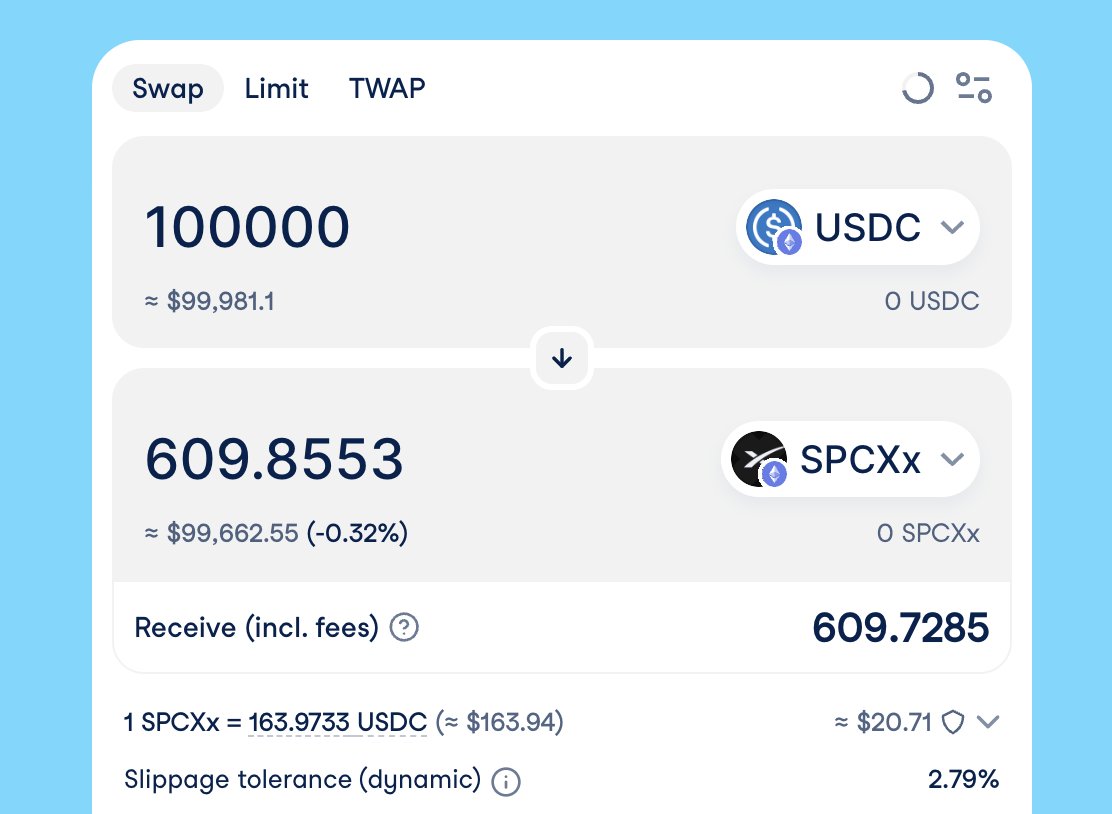
ICOs are back on Ethereum.
Jun 12

Nasdaq closed at 4pm.
xStocks do not.
$SPCXx is tradable 24 hours a day.
Yes, even on weekends.
21
36
387
46,665

A follow you won't regret.
John same diamond hands ETH mindset like Tom Lee 💎

Many such cases
3
3
79
11,168

Very few understand this
To think Ethereum is easily replicated completely misses the mark on what Ethereum actually is
Yet many a VC or Bitcoiner will try and tell you otherwise
But as we see time and time again, these ‘killer’ projects will fade away after the hype
The beauty of Ethereum lies in its decentralisation and origin story
And again, Bitcoiners will have you believe something else and will yell ‘premine’ as loudly as they can
But, again, this misses the mark
The power of Ethereum lies within the innocence of its organic and grassroots growth, just the same as Bitcoin
A decentralised network supported by enthusiasts, not knowing if what they are supporting is actually valuable or not
This can not be replicated today
Time is the one thing VCs can’t buy
There is no second best I love you
Jun 12

Even a trillion dollars in funding couldn't replicate Ethereum
L2s will accelerate growth & expand the ecosystem, but Mainnet is what lasts forever
There's something beautiful about a truly decentralized & censorship-resistant chain, and it's our responsibility to fight for it

7
5
114
6,459
f1go.eth retweeted

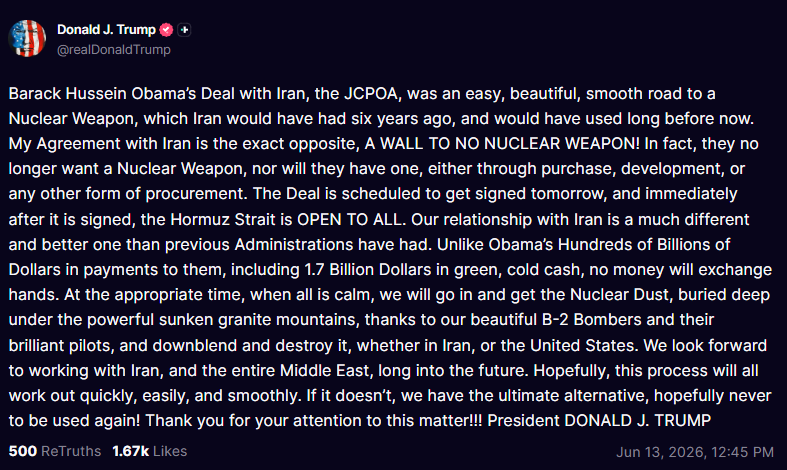
BREAKING: President Trump says a deal with Iran is scheduled to be signed tomorrow, immediately reopening the Strait of Hormuz.
558
760
7,750
1,223,545
f1go.eth retweeted

Jun 12
JUST IN: 🇺🇸 White House Official Patrick Witt says they're aiming to pass crypto Clarity Act by July 4th.
525
1,686
13,323
791,098

seen some takes on "i'd buy SPCX in 3 months at a lower price"
sure - but that's on a fundamentally different thesis
the thesis at open should be entirely based on flow - val doesn't matter
because you have a stock that has
- 4.2% float
- o/w only 20% to retail -> this means 0.8% possible sell pressure (rest to long-only)
- o/w >50% won't sell given flipping policy / natural hodler -> 0.4% possible sell pressure
while index funds are expected to buy 20bn / 1%
1% >> 0.4%
it's like elon launches at coin with 99.6% control while a DAT is coming in 2 weeks. insanity
58
20
315
116,794
f1go.eth retweeted

Ethereum has already won.
There is work to do, but it has never been more clear.
CROPS
12
29
384
9,550
f1go.eth retweeted
Jun 12
JUST IN: Sam Bankman-Fried loses bid to overturn fraud conviction and 25-year prison sentence, Reuters reports.
256
253
3,366
330,977
f1go.eth retweeted

Jun 12
If Ethereum becomes the dominant settlement layer, ETH functions less like a stock and more like a scarce reserve commodity-money hybrid — closer to spice (in the Dune universe) than to a typical asset.
Jun 11

The augment that ETH is just a gas token to prevent spam therefore it’s worthless is nonsense.
Claude charge by token is also a way to prevent spam (especially from the subscription plan).
The point is that llms are actually useful and therefore the token and its equity is valuable.
ETH will also be valuable once we bring DeFi back, the real DeFi.
4
9
80
3,586
f1go.eth retweeted

Jun 12
SENIOR ADMINISTRATION OFFICIAL: IRAN DEAL ACCOMPLISHES CORE U.S. OBJECTIVES
IRAN DEAL REOPENS STRAIT OF HORMUZ - OFFICIAL
SENIOR ADMINISTRATION OFFICIAL: U.S. TO GET ENRICHED MATERIAL UNDER IRAN DEAL
U.S. OFFICIAL: IRAN DEAL GUARANTEES LONG-TERM PEACE IN REGION
SENIOR ADMINISTRATION OFFICIAL: IRAN DEAL INCLUDES INSPECTION REGIME
SENIOR ADMINISTRATION OFFICIAL: IF IRAN COMPLIES WILL BE REWARDED ECONOMICALLY
SENIOR ADMINISTRATION OFFICIAL: BENEFITS FOR IRAN ACCRUE IF THEY ACTUALLY DELIVER
SENIOR ADMINISTRATION OFFICIAL: U.S. EXPECTS TO SIGN AGREEMENT OVER NEXT FEW DAYS
SENIOR ADMINISTRATION OFFICIAL: DRAFT AGREEMENT ALSO LIFTS U.S. BLOCKADE AND LEADS TO DISMANTLEMENT OF IRAN NUCLEAR PROGRAM
83
71
595
145,526
f1go.eth retweeted

Jun 12
ETH investor Stanley Druckenmiller: “Our whole payment system will be stablecoins in 10-15 years”
BitMine (BMNR), the ETH treasury company chaired by Tom Lee, holds almost $10 billion of ETH. Legendary investor Stanley Druckenmiller is listed among key backers like Founders Fund, ARK's Cathie Wood, and Bill Miller. This aligns with his recent bullish comments on stablecoins and blockchain payments:
“Blockchain and the use of stablecoins — if you want to throw crypto and tokens into that — are incredibly useful in terms of productivity. I assume our whole payment system will be stablecoins in 10-15 years. Efficient. Quicker. Cheaper.”
28
120
682
111,843
When ETH mooned from $1.4k (April) to $4.8K (summer) 2025 all the naysayers 100% pivoted from fudding ETH to cheering it.
Only thing which changed was price, not any fundamentals, not value accrual, architecture, regulatory environment etc.
Pretty much a lemming mentality...

Would you be saying this if ETH was $10K?
@TrustlessState and i squared off on Ethereum for 30 mins yesterday.
I think i'm getting to him.
7
3
117
5,719
f1go.eth retweeted

Jun 12
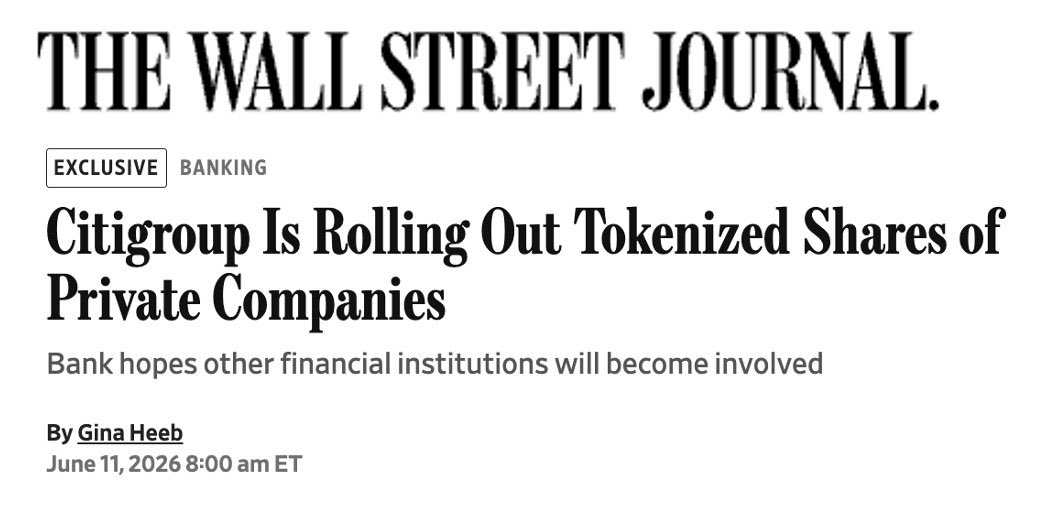
Sorry, but this is not a blockchain and the assets on the Corda-based network they seem to allude to are not tokens. There’s literally nothing about this solution that Citi couldn’t have rolled out years ago using vanilla ledger tech (I was there, I would know).
The lack of awareness on these distinctions will be a big problem for a lot of companies eventually.
2
6
59
2,830
f1go.eth retweeted
Jun 12
With respect to Noah and the a16z team, who are usually quite sharp, this description is categorically wrong.
The features that they describe as non-negotiable, like finality, do not and cannot exist on permissioned infrastructure. That’s because whoever controls the permissioning also controls the state.
They can demand to halt the chain, fork it, break atomicity etc, then depermission validators who disagree.
Every permissioned network has a button, and control over it determines liveness and finality. The cryptography and consensus cannot stop them. It’s mostly performative.
The counterargument is that whoever controls the button risks legal, reputational, and regulatory issues if they misuse that power. That’s fine, but it’s not a crypto thing. It’s a “trust me bro” mentality, not a “can’t be evil” one.
Ironically, the institutions least likely to trust this kind of database are the very firms it’s designed to attract.
They know even better than anyone what it means to surrender your clients and assets to infrastructure that can abuse them.
You’ll see.

10
10
68
10,904
f1go.eth retweeted
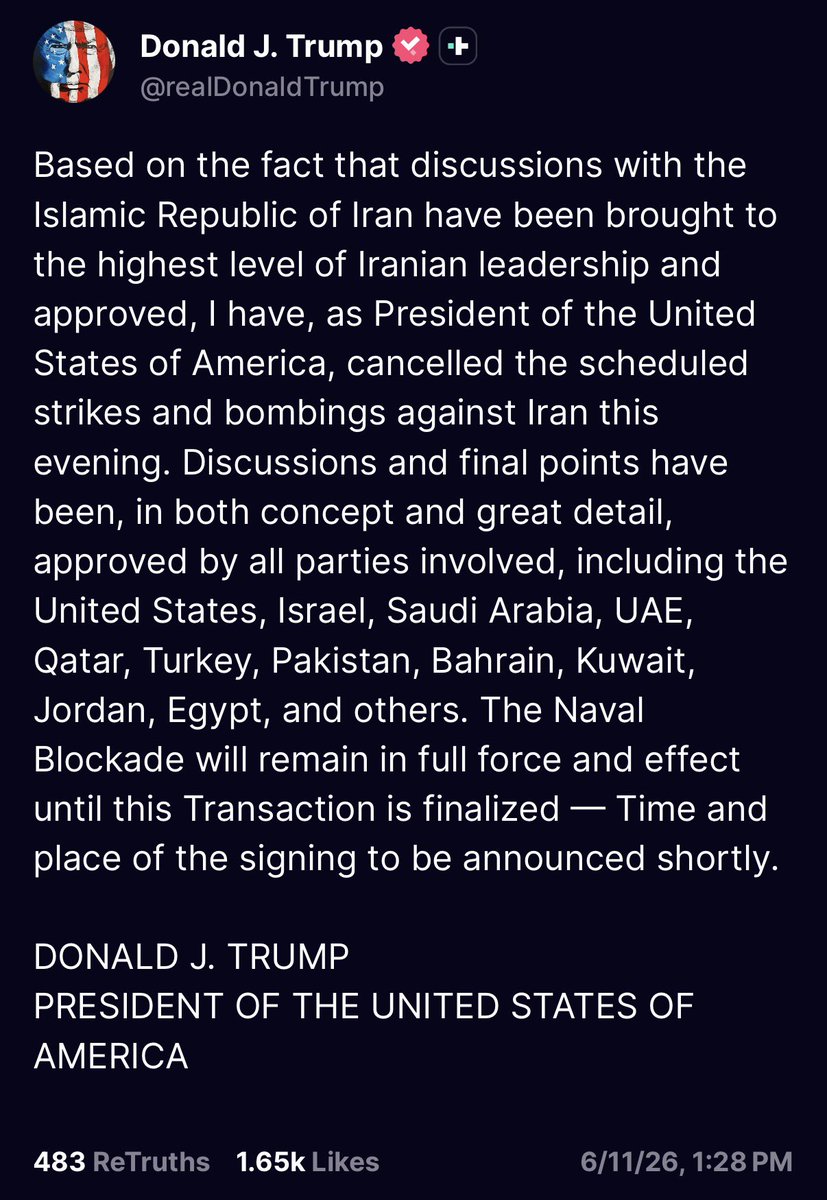
BREAKING: President Trump says he has cancelled scheduled strikes on Iran and the time and place of a deal signing will be “announced shortly.”
595
448
3,687
621,446
f1go.eth retweeted

Jun 11
Fidelity launched a stablecoin on Ethereum.

FIDD is live on the Ethereum mainnet at smart contract address: 0x7C135549504245B5eAe64fc0E99Fa5ebabb8e35D.
Other developer resources can be found here: go.fidelity.com/hydoag
7
31
364
24,891
f1go.eth retweeted

Jun 11
🚨NEW: Some color on Wednesday’s meeting between law enforcement groups, administration officials and Congressional members and staff on the Clarity Act:
📌 The meeting was hosted by @patrickjwitt and the White House Crypto Council in the Eisenhower Executive Office Building. Around 20 attendees were present, including @GOPMajorityWhip and @DavidSacks who delivered opening remarks before departing. Also in attendance were officials from @USTreasury, @FinCENnews, Senate staff and @DAGToddBlanche office.
📌 On the law enforcement side, attendees included the Fraternal Order of Police (@GLFOP), National Association of Police Organizations (@NAPOpolice), International Association of Chiefs of Police (@TheIACP), the National District Attorneys Association (@ndaajustice), and the National Association of Assistant U.S. Attorneys (@WeAreNAAUSA). The National Sheriffs’ Association (@NationalSheriff) was invited but did not attend.
📌 Sources tell me the meeting consisted of almost 90 minutes of substantive discussion and debate, much of it focused on the Blockchain Regulatory Certainty Act (BRCA).
📌 Potential solutions to strengthen crypto crime reporting and enforcement tools were also discussed as lawmakers and stakeholders continue working to build support for the legislation.
Ultimately, these groups will need to signal to Democratic senators like @CortezMasto and @MarkWarner that they are not opposed to the bill’s parameters, including the BRCA, to secure their votes on the floor.
46
261
1,428
193,621