
Joined May 2026
- Tweets 882
- Following 355
- Followers 1,137
- Likes 181
53 Photos and videos






Pinned Tweet
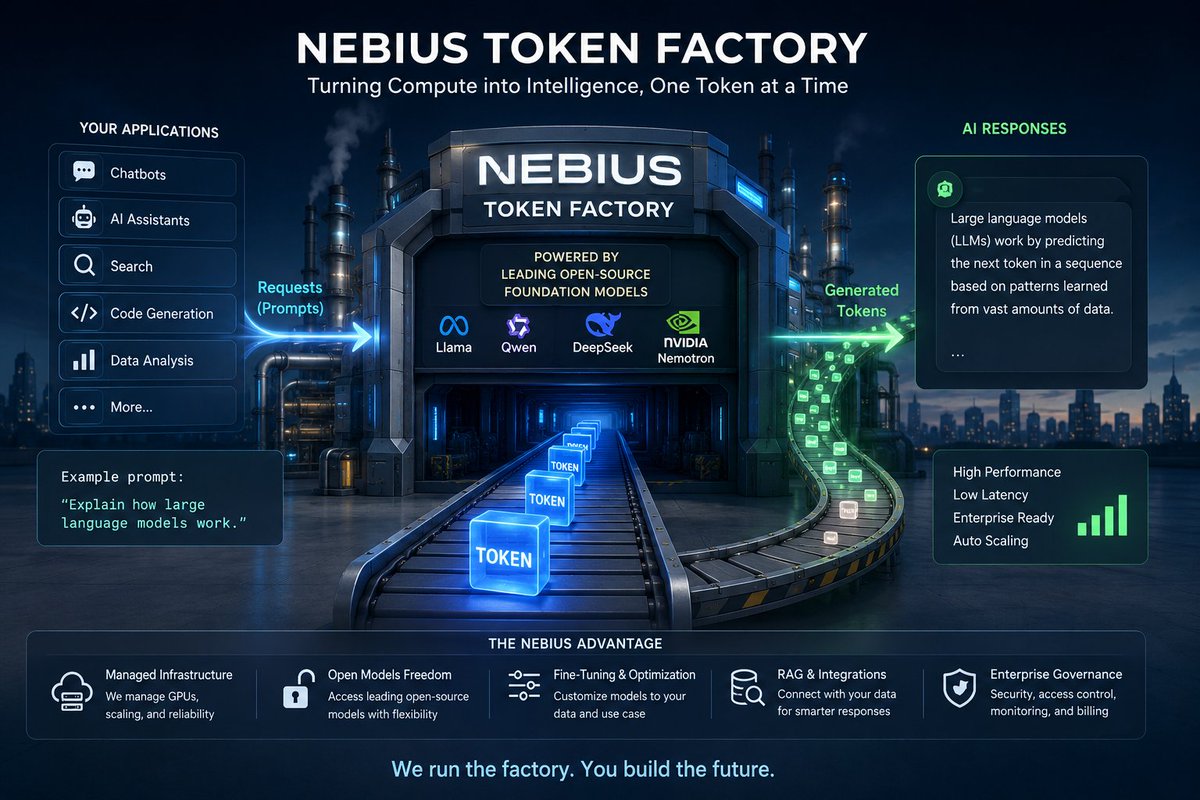
$NBIS Token Factory explained in 15 minutes
So I decided to write a little explanation of what the main differentiator of $NBIS is, and that is the "Token Factory" they introduced November last year
I will try to simplify this so that every investor can understand it. If you are interested in more technical details, ask me in the comments, and I might be able to explain it.
So If someone asked me how I would explain it in one sentence, I would say that Token Factory is an AI platform designed to simplify the deployment, management, and scaling of large language models (LLMs) and other generative AI systems.
It is a production-grade inference platform that allows organizations (and it is especially helpful for smaller businesses) to use AI models without the complexity of managing the underlying infrastructure.
Token factory is built around inference - the process where you generate outputs from already trained models (for example, asking questions and getting answers from models like ChatGPT).
Whenever you ask ChatGPT a question, request code generation, or any other task you have ever done, the model produces a sequence of tokens that are, at the end, transformed into text/document that you can read.
In the earliest stages of AI, we just had models like ChatGPT 3, Claude 3, etc. You paid your subscription of $20, and you were able to prompt infinitely, but lately the scale of these prompts increased heavily, and enterprise adoption of these models led to OpenAI, Anthropic, and others to shift from simple subscription pricing to price/token, meaning that each prompt and each task is priced differently.
The cost of the token is increasing rapidly with supply not being able to meet demand. This is why $NBIS came with Token Factory, which is basically an optimizer for generating these tokens as efficiently, reliably, and cost-effectively as possible. The name kind of explains itself there.
Traditionally, companies that wanted to deploy large AI models had to acquire and manage expensive GPU hardware, configure inference servers, monitor performance, handle traffic spikes, and continuously try to optimize their deployments.
This process required companies to have experts in mainly these two fields:
1) Cloud infrastructure
2) Machine learning operations (MLOps)
It is quite difficult to obtain a skillful team in these areas, so Nebius decided to go and remove majority of this complexity by providing a managed service that handles not only infrastructure, but also scaling, monitoring, and deployment via Token Factory. Developers can now simply connect to the platform through an API and immediately begin using advanced AI models.
So the key strength is the exposure for smaller enterprises to open-source foundation models without acquiring a whole team of experts. Organizations can access and deploy models from families such as Llama, Qwen, DeepSeek, and from the latest announcement also NVIDIA Nemotron. The platform has interfaces that are compatible with widely used AI APIs, making migration and intergration relatively straightforward for development teams.
What I did not understand initially, was that Token Factory goes beyond basic inference, it supports the whole lifecycle of AI applications. Users can tune their models on proprietary data to create domain-specific assistants for many industries like finance, healthcare, law and many others.
This opens new possibilities like "parameter-efficient fine-tuning", "post-training optimization" that enable companies to customize models without the cost of training it from scratch. There are other fancy applications like Retrieval-Augmented Generation (RAG), where you combine LLMs with external knowledge sources like documents.
But I don’t want to bore you to death as I understand majority of investors reading this are not machine learnings experts, so let’s skip this technical part.
However, one last major advantage that you should be able to understand about Token Factory is the ability to scale "automatically". When you create an application and demand starts increasing, you usually start running into high latency and capacity problems. Instead of you having to allocate new compute to your application, which takes time and it might cause some downtime for your servers which are costly, Token Factory platform dynamically allocates additional computing resources to maintain both low latency and high throughout.
The important thing is that this works the opposite way as well. When demand decreases, resources are released, helping companies optimize costs. This elastic scaling allows Token Factory to attract both small pilot projects to large-scale production deployments serving thousands of users and more.
Now that I finished this paragraph, I realize that I completely forgot about one more thing and that is what we call in business "Enterprise governance and security". Token Factory includes features such as role-based access control, team management, authentication integration, usage monitoring, centralized billing and many other things that help companies maintaining control over AI deployments while meeting operational and compliance requirements.
To somehow summarize everything, think of Token Factory as the "AWS of AI" or more precisely "AWS of AI inference". Companies bring their applications, Nebius provides the infrastructure and models, and charges for the AI output generated. The more AI is used, the more valuable Token Factory becomes. It is really that simple.
I spent more time than I initially wanted on researching Token Factory and its use cases, but it really helped me to understand that this is something that gives $NBIS an unfair advantage against others in the sector.
You should really understand this part of their business if you are an investor, so I will gladly answer your questions.
If you found this a valuable read, follow me for more.
Thanks!
(picture is from ChatGTP)
8
9
79
15,220

What stock would you hold until 2029?
193
Because he worked harder than you
Simple as that
9-5 job does not mean you locked in
You need to do more than that, everyone does that
Jun 12

I am 52 years old. I have been working since I was 15 years old. I have no savings, no retirement, and will never own a home before I die.
And there is now a trillionaire.
42
Directly from $NBIS
more complex read than mine about the Fable 5 ban, but it really highlights the opportunity for $NBIS
If they take advantage of this new narrative that appeared basically over night, we might see another inflection point
10h

The Fable 5 ban made one thing clear: the intelligence layer now has a fast policy gate that hardware never had.
Hardware bottlenecks (HBM, power, advanced packaging) take years to shit but today it moved in hours.
One export directive on a closed llm = global cutoff
- frontier capability just became contingent on jurisdiction and politics (in a way it wasn’t 48 h earlier)
- clean segmentation at scale is messy.
this exposes a few layers:
1. hosted frontier model itself is no longer a neutral, always-on input. It sits behind a geopolitical choke that can be pulled for “safety” reasons with broad mkt collateral
2. the inference layer underneath becomes strategic. Who serves the model, how it’s routed, quantized, finetuned, guiardrailed, post-trained, and where the data boundary sits now carries real sovereignty weight.
3.Orchestration and redundancy stop being nice to have architecture and start looking like basic operational hygiene once any single frontier llm can be turned down faster than you can figure out alternatives
4. Europe’s demand-side sovereignty moves (Chips Act 2.0 CADA) were already tilting this way. The ban just gave them a crisp, recent case study of the exact risk they’ve been pricing in. It most likely reduces timelines on building parallel capacity and preferring alternatives in critical sectors
On the inference side this opens real space
Specialized providers that can run open weights, customized finetuned and post-trained models at scale with strong sovereignty guarantees just got more relevant.
-> Not because frontier models disappeared, but because the economics and risk profile of depending on them exclusively shifted now
You can keep frontier hosted models for the narrow slice of work where they still deliver decisive quality on long horizon or high-stakes reasoning.
But for volume, regulated workloads, domain-specific agents, or anything where you need predictable updates, data residency, or protection from foreign policy moves, running customized open models on controllable infrastructure becomes the cleaner default.
This is where players like @nebiustf sit in an interesting spot.
Access to sovereign EU compute strong inference stack ability to host and serve fine-tuned or post-trained open models gives a credible path to reduce single jurisdiction dependency without giving up performance on the workloads that matter most.
Some deeper angles worth tracking
- Token economics get more layered.
Frontier APIs stay expensive per token for a reason.
Open fine-tuned models on sovereign or managed inference can be dramatically cheaper at volume once you control the serving stack and quantization. The gap matters more when you’re already hedging policy risk.
- Agent reliability becomes an orchestration problem, not just a model problem. If the frontier tap is sometimes restricted or degraded, you need clean fallback paths and routing logic that preserve output quality where it counts. That creates demand for more sophisticated inference engineering, not just bigger context windows.
- US labs face a subtle structural pressure. The more visible the revocation risk becomes, the stronger the incentive for non-US actors to invest in parallel inference capacity and customized models.
- and over time this can slow winner-take-most dynamics at the frontier even if raw capability btween llms gaps remain.
Power and grid constraints don’t disappear.
What of they just get pulled in slightly more directions as people build hedging capacity?
Parallel sovereign or hybrid inference clusters still compete for the same scarce electrons and networking obv
The real constraint that just got sharper is this designing systems that assume any single centralized frontier hosted model can become less reliable or more expensive to access on policy grounds, not just tech ones.
The ban didn’t invent that assumption but defo made it ignoring it look like incomplete engineering.
3
254
$NBIS MY TAKE ON ANTHROPIC MODELS BANNED
Alright, I spent my morning and afternoon thinking about the implications of the Anthropic’ Fable 5 and Mythos 5 ban. So just a quick summary below for those who are scared of the potential problems for $NBIS:
I believe the main thing you need to understand about $NBIS and their business is that they want to become the 4th hyperscaler and not just rent out capacity for other hyperscalers and major frontier labs like OpenAI and Anthropic. These deals are for short-term financing of the buildout. I read a post from @daniel_koss yesterday about $NBIS’s ARR for next year already being 50/50 hyperscaler deals/their own AI cloud.
This means that they are already diversified enough if something like this or even something more dramatic happened and demand suddenly dropped by customers (very unlikely).
This actually means quite the opposite, because this implies that in the future, you will need open-source models as we will probably see more and more restrictions. Not that this is something new, I always saw open-source models as something that will open doors for industries like healthcare, finance, law, where you need your own models tuned specifically for these industries, but it just shows that this will not be the whole world using ChatGPT or Claude.
An even stronger argument is, and I believe I have enough insights as a European, that Europe needs to wake up and start building the AI infrastructure as well. The US basically told us that AI is a weapon, and every major player on a global scale needs to have its own AI. So governments and companies in Europe have a clear incentive to develop more sovereign AI capabilities, and who is better positioned for this than $NBIS?
I saw the news when I woke up, so my brain was not able to process the information fast, and I needed some time to reflect on the impact of what happened, but the more I think about it, the more bullish I am about it.
I am more bullish on $NBIS than before, and I think this just answers the question: "Is AI useful?"
Absolutely!
So just my quick take, open to discuss and answer questions in comments
18
12
219
63,231
I agree with this take. I think the key takeaway from this should be that AI is something so big that it is never going away, as some people still argue.
However, this might put short-term to mid-term pressure on companies like Anthropic and OpenAI as they might lose customers

A lot of people will see this Anthropic news and assume it is bearish for AI. But it’s actually bullish for AI infrastructure.
The US gov basically said that the most advanced AI models are now considered strategic national assets. This is a sign that AI has become important enough to warrant national security protection.
The way I see it, If access to frontier models become more restricted, countries and enterprises do not stop building AI. They invest even MORE heavily in their OWN infrastructure, compute, and sovereign AI ecosystems.
That is why I think this is ultimately bullish for companies providing the picks and shovels of the AI revolution. The winners are the companies supplying the GPUs, data centers, power, and cloud infrastructure that every AI system depends on.
Don’t be fooled if they try to trick you Monday morning.
Do you guys agree or disagree?
3
515
This is exactly why I am doing all of this!
There is nothing more precious in life than helping others and also nothing more humbling than seeing someone struggle because of you
That is why I post only what I truly believe in and always try to push you towards right direction

Thanks for all the content! We appreciate your insights! Cheers
5
278

Jun 13
Btw, this should be a wake-up call for Europe
Just like that, we lost access to the best model out there, and we have no authority to do anything about it
What if all new models from now, are locked away by the US, and we will be forced to use what was available till today
Jun 13

The US government, citing national security authorities, has issued an export control directive to suspend all access to Fable 5 and Mythos 5 by any foreign national, whether inside or outside the United States, including foreign national Anthropic employees.
The net effect of this order is that we must abruptly disable Fable 5 and Mythos 5 for all our customers to ensure compliance.
Access to all other Claude models is not affected.
We apologize for this disruption to our customers. We believe this is a misunderstanding and are working to restore access as soon as possible.
Read our full statement: anthropic.com/news/fable-myt…
1
1
4
514
Jun 13
This better gets resolved until Monday or markets are going down
$NBIS $IREN $NVDA all indirectly impacted
Jun 13
The US government, citing national security authorities, has issued an export control directive to suspend all access to Fable 5 and Mythos 5 by any foreign national, whether inside or outside the United States, including foreign national Anthropic employees.
The net effect of this order is that we must abruptly disable Fable 5 and Mythos 5 for all our customers to ensure compliance.
Access to all other Claude models is not affected.
We apologize for this disruption to our customers. We believe this is a misunderstanding and are working to restore access as soon as possible.
Read our full statement: anthropic.com/news/fable-myt…
2
447
Jun 13
Economically, this might be a disaster if it keeps happening in the future
Anthropic and OpenAI are pouring billions into the development of their models and this drastically decreases their number of users
Well, another weekend of researching ahead of me, because of $NBIS and $IREN
This might affect the AI trade and I need to run some calculations
Jun 13
The US government, citing national security authorities, has issued an export control directive to suspend all access to Fable 5 and Mythos 5 by any foreign national, whether inside or outside the United States, including foreign national Anthropic employees.
The net effect of this order is that we must abruptly disable Fable 5 and Mythos 5 for all our customers to ensure compliance.
Access to all other Claude models is not affected.
We apologize for this disruption to our customers. We believe this is a misunderstanding and are working to restore access as soon as possible.
Read our full statement: anthropic.com/news/fable-myt…
2
1
298
Jun 13
It is actually happening
Do you remember the quote from Stephen Hawking back in 2014
“AI could spell end of the human race”
It might actually happen, because imagine that we are actually close to developing a model that would be able to write a better version of itself alone.
Now imagine we create robots that would use these models and they would be able to create better versions of themselves as well. You are getting awfully close to scenarios that we were laughing about when watching sci-fi movies few years ago.
It would also connect nicely with the “Great filter” theory answering the Fermi Paradox, which is that the reason for any civilization in the universe not being able to achieve space-faring level, is them destroying their civilization before having access to technology that would allow that.
Just a crazy thought for a weekend. I believe and hope we are still far from that level, but to be fair. We have no idea what are the best models capable of as these are not available to the public.
Jun 13
The US government, citing national security authorities, has issued an export control directive to suspend all access to Fable 5 and Mythos 5 by any foreign national, whether inside or outside the United States, including foreign national Anthropic employees.
The net effect of this order is that we must abruptly disable Fable 5 and Mythos 5 for all our customers to ensure compliance.
Access to all other Claude models is not affected.
We apologize for this disruption to our customers. We believe this is a misunderstanding and are working to restore access as soon as possible.
Read our full statement: anthropic.com/news/fable-myt…
1
1
173

Jun 12
I got almost 1000 followers in two weeks
Do you know why? Because I can provide you with so much information about $NBIS, $IREN, $HIMS, $OSCR and others in few minutes that you would need to study the companies for hundreds of hours
I can do that for you, even if I really prefer people doing research on their own
I got many of my followers during red days, because I was there to assure them that everything is fine with their companies and I calmed down their emotions which led to them not selling exceptional companies
It is that simple, I provide you with value that is hard to find on X
I always stay humble, but at the same time I know what I am capable of and how hard I work
Some people think I am ill because I work like 6.5 days a week, but I am just obsessed with getting better
I take it responsibly, I can change life of some of my followers if we get few stocks right, let’s keep working hard
5
13
1,701
Jun 12
Forgot about $ZETA, it can go as much as $50 this year if we get plausible macro environment
P/S should be at least 6
Very low multiple for the given growth
1
207
