
6 Photos and videos


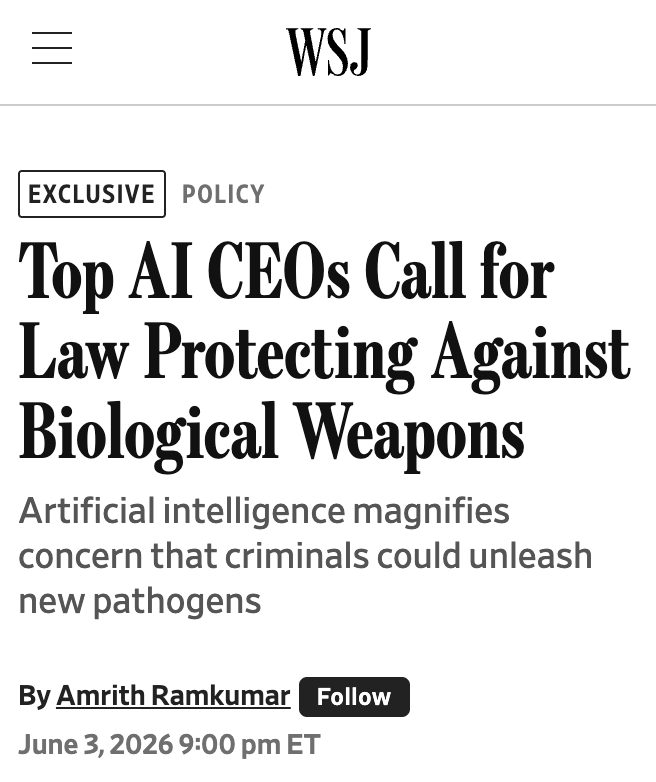
In May 2025, the Trump administration issued EO 14292 requiring an updated framework on nucleic acid synthesis screening with, for the first time, enforcement mechanisms. One year later, the administration’s efforts to mandate screening have stalled.
This is an obvious first step to strengthening US and international security, and one that industry leaders are rightly getting behind.
Jun 4

No one should be able to order a bioweapon through the mail.
@IFP & @JoinFAI are proud to co-lead an open letter calling for mandatory DNA synthesis screening & recordkeeping.
Signatories include:
- Sam Altman, CEO & Co-Founder, OpenAI
- Dario Amodei, CEO & Co-Founder, Anthropic
- David Baker, Director, Institute for Protein Design; 2024 Nobel Prize in Chemistry recipient
- Patrick Collison, CEO & Co-Founder, Stripe
- Paul Graham, Founder, Y Combinator
- Demis Hassabis, CEO, Google DeepMind; 2024 Nobel Prize in Chemistry recipient
- Emily Leproust, CEO & Co-Founder, Twist Bioscience
- Lawrence Lessig, Roy L. Furman Professor of Law and Leadership, Harvard Law School
- Gerald W. Parker, former Special Assistant to the President for Biosecurity and Pandemic Response
- Mustafa Suleyman, CEO, Microsoft AI
- Alex Tabarrok, Professor of Economics, George Mason University
- Alexandr Wang, Chief AI Officer, Meta; Founder, Scale AI
- Christine E. Wormuth, President & CEO, Nuclear Threat Initiative; 25th Secretary of the Army
Read the letter and see the full list of signatories: screendna.org
Many DNA synthesis companies voluntarily screen orders to mitigate biosecurity risks, but no law requires them to do so.
Leaders in AI, biotech, life sciences, national security, and the nucleic acid synthesis industry agree that Congress should act to strengthen safeguards against biological threats.
@deanwball put it well in the WSJ:
“If you’re synthesizing the stuff that yields biological life and viruses, we’re asking you to screen to see whether it is dangerous in some way. That seems like a reasonable thing for society to insist upon.”
4
14
1,341

🚨 Major new project just dropped:
Jun 2

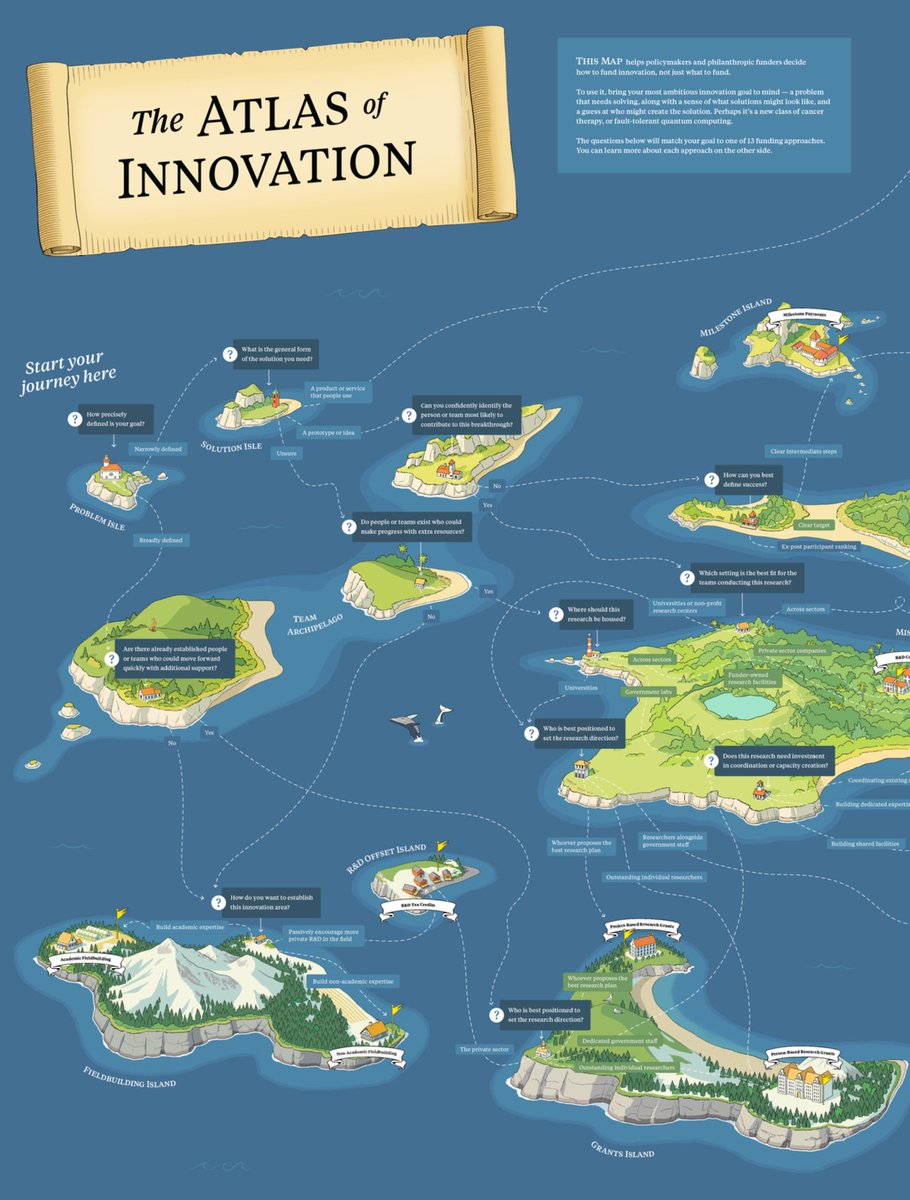
At @IFP, we’ve spent the past 3 years thinking about all the different ways the US government & philanthropy fund R&D.
Until now, R&D funders haven’t had a systematic way to match the innovation problem to the right funding tool.
We built THE ATLAS OF INNOVATION to fill that gap.
atlasofinnovation.org
Alongside @UChi_MSA, we’ve boiled down thousands of hours of research into a handful of questions covering how much the R&D funder knows about:
- the problem they want to solve
- the solution it should have
- the team that should build the solution
Why the Atlas matters:
The US government spends close to $200 billion every year on R&D. And after the Anthropic and OpenAI IPOs, there will be hundreds of billions of dollars in new philanthropic giving.
Choosing the correct funding approach to the social problems they’re trying to solve will mean the difference between success and failure.
For example, NSF research grants have helped seed breakthroughs from MRI machines to search engines, but grants aren’t built to deliver the kind of industrial speed and scale that a project like Operation Warp Speed required.
Picking the wrong funding approach can leave programs behind schedule, over budget, or without anything to show for all the money they spent.
How we built the Atlas:
1. We began by creating a matrix of dozens of considerations that a thoughtful policymaker or funder would ideally weigh before deciding how to fund a project.
2. We looked at every major funding approach, from grants to R&D tax credits to advance market commitments, analyzing when they work well and when they fail to meet the mission.
3. We spent months deep in the weeds of contract theory and incentive design, looking at historical examples and the state-of-the-art research in innovation economics.
4. We then worked to turn that research into a tool that time-strapped policymakers and philanthropic funders could rely on at the start of an innovation funding cycle.
5. Three years later, we are launching just that: a new (and visually stunning) website to help funders decide how to best incentivize innovation. And all they have to know… is what they currently know about their innovation goal! The Atlas takes care of the rest.
How to navigate the Atlas:
Answer questions about your goal to find the funding approach aligned with the information you have.
Each funding mechanism has its purpose for particular technologies and specific moments in development.
There shouldn’t be an ARPA for every field, just like we don’t need a prize or AMC for every innovation. The Atlas helps you navigate those tradeoffs.
6
19
3,131
Georgia Adamson retweeted

May 4
Trying to make your policy idea fit in NDAA

9
40
689
85,694
IFP punches way above its weight, and it's because of roles like these!
May 4

I’m hiring a Member of Technical Staff at IFP.
Your job will be to build software that allows us to operate with the effective capacity of a think tank 10 times our size.
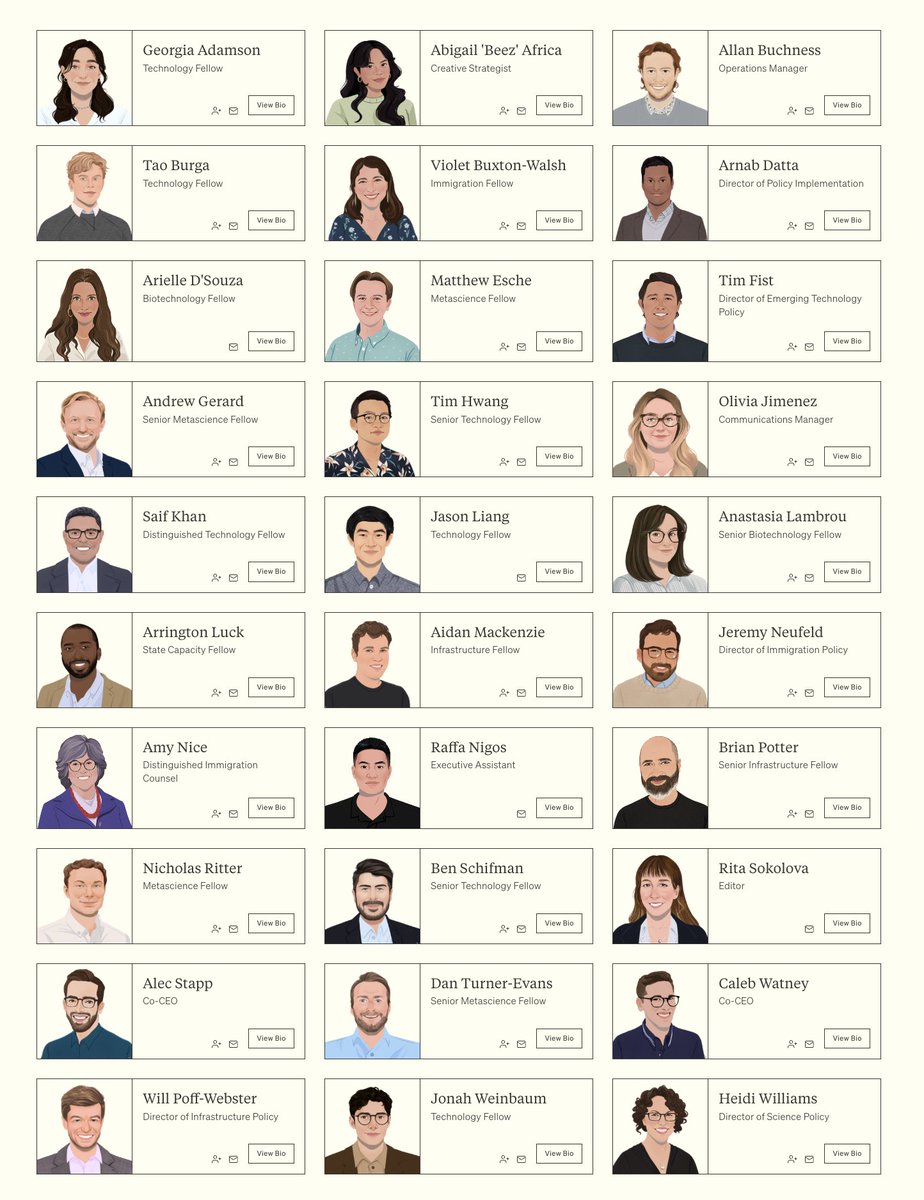
If you care about reforming US policy, I think this is one of the highest leverage roles available: you’ll be directly amplifying the work of our extremely cracked and growing team of 35.
Given how important this job is, we will pay a $5,000 reward for any referral that results in a hire.
More on the role:
I expect this will be a hard role to fill, for a few reasons:
1. You have to believe US policy is the most important lever for impact
There are plenty of opportunities in the private sector for engineers to have a significant impact. But technical talent in public policy is far more neglected, and often much higher leverage.
IFP’s mission is to reform US policy to drive breakthrough discoveries, attract top talent, and expand our nation’s capacity to build.
We measure our efficacy by our counterfactual policy impact: whether we create good policy outcomes that would not have otherwise happened.
The software you build will directly affect the rate at which we can do this.
The work you help us do faster and better will be read in the Oval Office, will shape the direction of billions in federal $, and will directly influence geopolitical strategy. We need someone in this role who internalizes how important this is.
2. You have to want to deeply understand what effective policy work looks like
Many tasks in policy research and advocacy are time-consuming but basic text-to-text translation tasks, like simplifying results from academic papers, summarizing public comments on new regulations, and recording information about contacts from meeting notes.
This work is necessary to produce good policy outcomes, but laborious.
One way to understand this role is by looking at the way progress in AI capabilities has shifted the job of a programmer away from writing code and more towards specifying requirements and verifying the work of AI agents. In this role, you’ll do the same for policy work, moving the focus of our team away from basic natural language manipulation tasks and towards strategy, deep research, and policy engagement.
A crucial part of this work is identifying which parts of policy research and advocacy can be effectively automated with frontier models without compromising quality, and continually retooling to adapt to the latest state of the art.
The ideal candidate is someone who cares about building tools that people love to use and who can work effectively with our policy teams to understand their goals, processes, and constraints.
3. You have to be able to build a wide variety of great software
Your projects will vary widely, from building agent scaffolds to custom CRM tooling to deployment pipelines for maintainable, performant microsites (check out the full job description for more).
The right person will have led the design and delivery of complex user-facing products across the full stack, know how to ship quickly while building maintainable tech, and understand the trade-offs inherent in your design choices.
–
This role is open to both remote work and people able to work out of our office in Washington, DC, with the latter being preferred.
The salary range for this role is $165,000 to $245,000. Here’s the full JD and link to apply: ifp.org/opportunity/member-o…
Applications close May 31st.
1
11
893
you know what to do
Apr 1
🚨 We're hiring at @IFP!
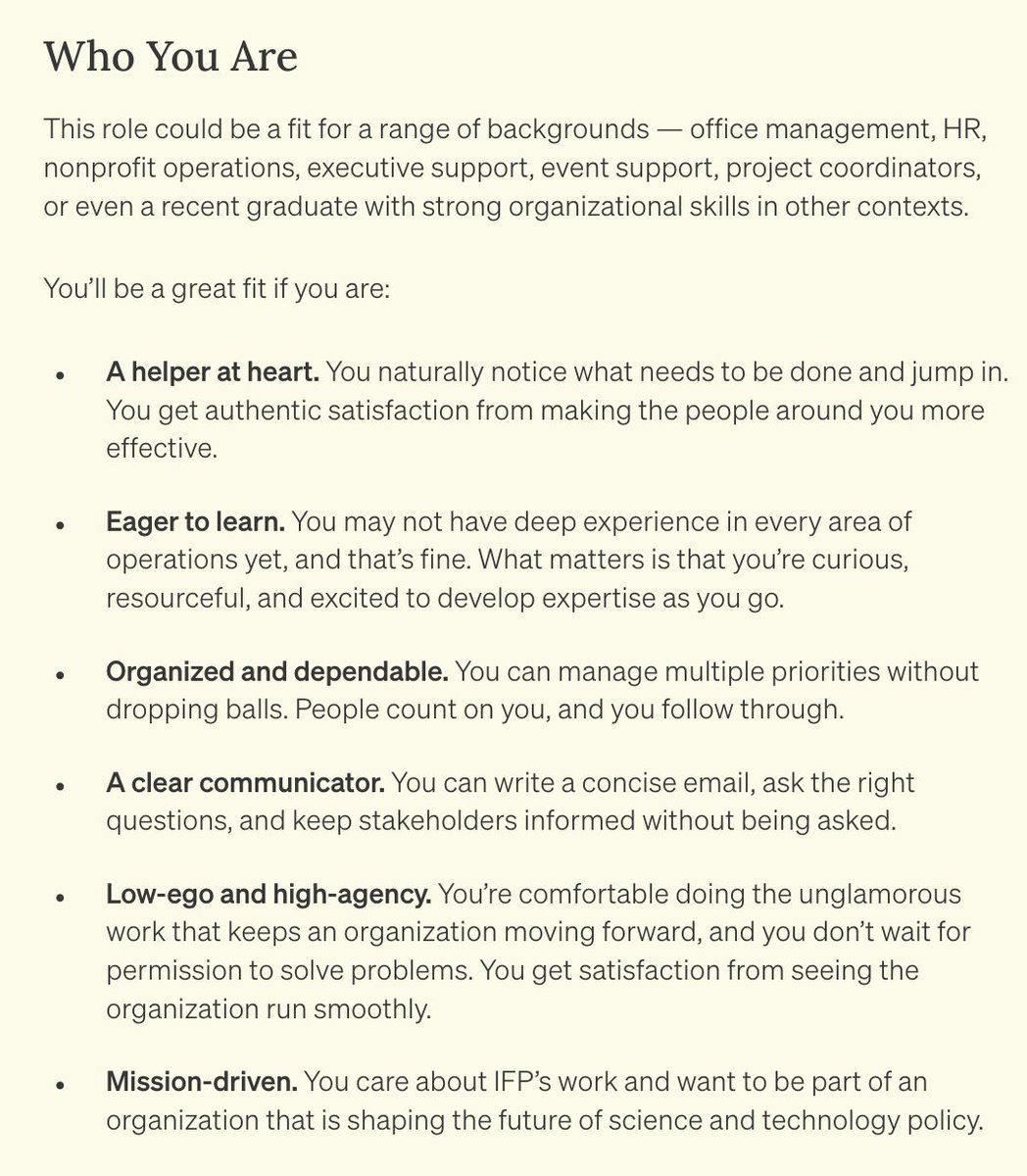
We need an Operations Coordinator with a can-do mindset who's excited to support our innovation policy mission.
Minimum salary: $75,000 generous benefits
Reward: $3,000 for any referral that results in a hire
More details: ifp.org/opportunity/operatio…
2
9
898

Mar 27
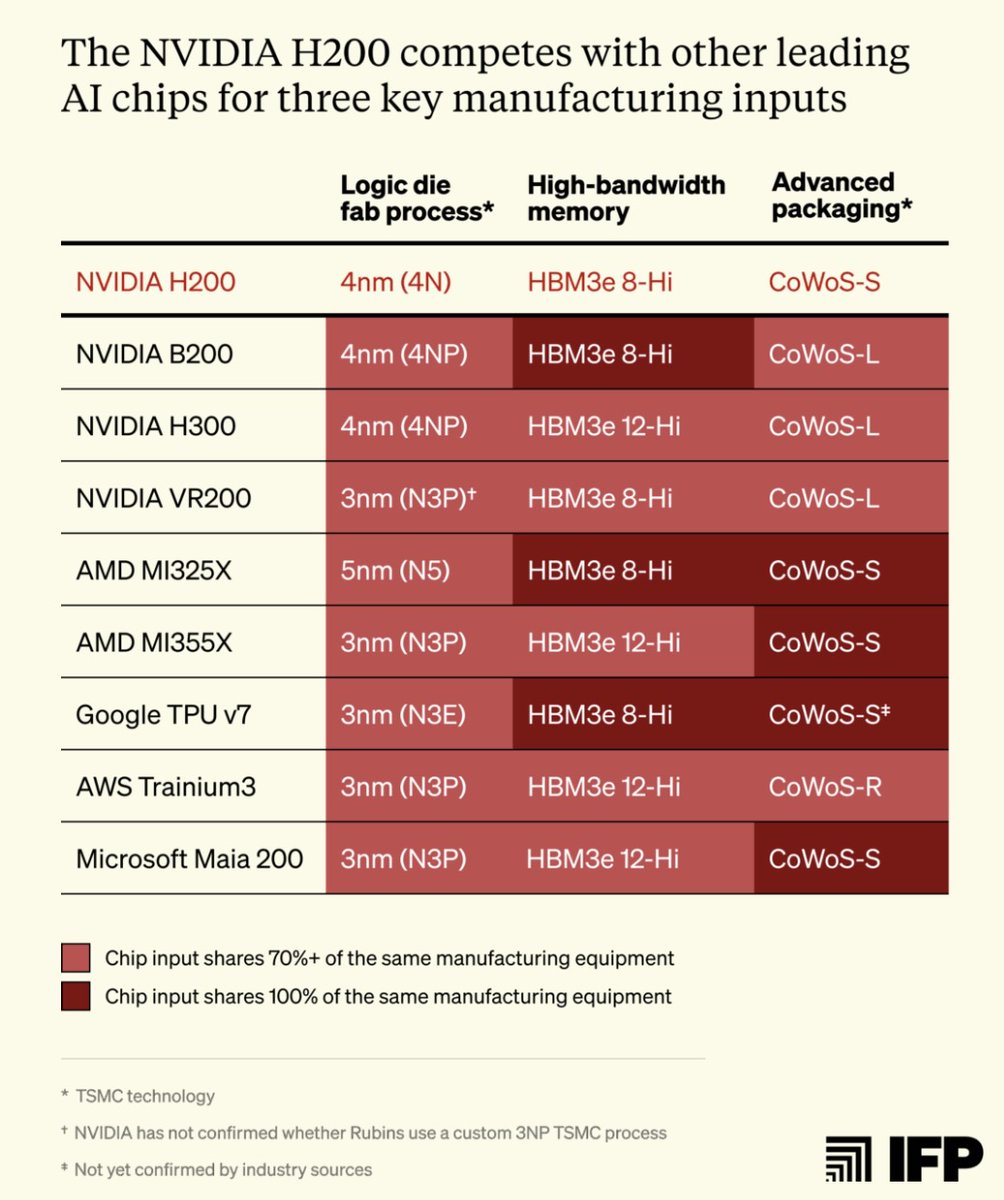
NVIDIA has restarted H200 production for China. But H200s share manufacturing inputs with more advanced US chips, and those inputs are severely supply-constrained.
BIS's January rule could permit up to as many as ~1 million chip exports, but requires applicants to certify exports won't reduce chip availability for US customers. However, the rule doesn't say how to evaluate this.
In a new report, @fiiiiiist and I lay out a methodology for assessing whether H200 exports could divert chips from US customers, and quantify what the US stands to lose: ifp.org/ai-chip-supply-diver…
We distinguish between two forms of diversion: inventory diversion and manufacturing capacity diversion. Based on public information, we judge that:
1. There is weak evidence that exports of existing H200 inventories at current prices would divert supply from US customers.
Global Hopper sales have fallen sharply since Blackwells became available. But deployed H200s remain fully utilized in the cloud, and China is reportedly being offered chips at ~$27K/unit, below US market prices available to some customers.
Technically, a diversion holds if even one US customer would purchase the chip at the price offered to China. BIS needs non-public pricing data to make this determination.
2. There is strong evidence that new H200 production would divert manufacturing capacity for US customers of comparable or more advanced AI chips.
All leading US AI chips share at least one key input with the H200: advanced logic fab capacity, HBM, or CoWoS packaging. All three inputs are severely supply-constrained this year.
US hyperscalers and AI labs face enormous backlogs for these chips, meaning freed capacity would very likely serve American customers.
These conditions likely apply to the roughly 250,000 H200s reportedly manufactured for NVIDIA between early January and early March 2026, when severe supply constraints on advanced logic wafer fabrication, HBM, and CoWoS capacity were already in effect.
3. Under current inelastic supply conditions, the US loses disproportionately more computing power for every H200 export than China gains.
This is because the same inputs and/or manufacturing capacity are being used to produce less powerful H200 chips than frontier AI chips for US customers.
Each 100K H200s produced for China could delay ~75K Blackwell B200s — forfeiting 1.7x the processing power per chip.
We also provide a comprehensive set of questions BIS can ask license applicants and chip suppliers to assess both inventory and capacity diversion during license reviews, using the private data needed to make these determinations accurately.
10
64
222
61,278
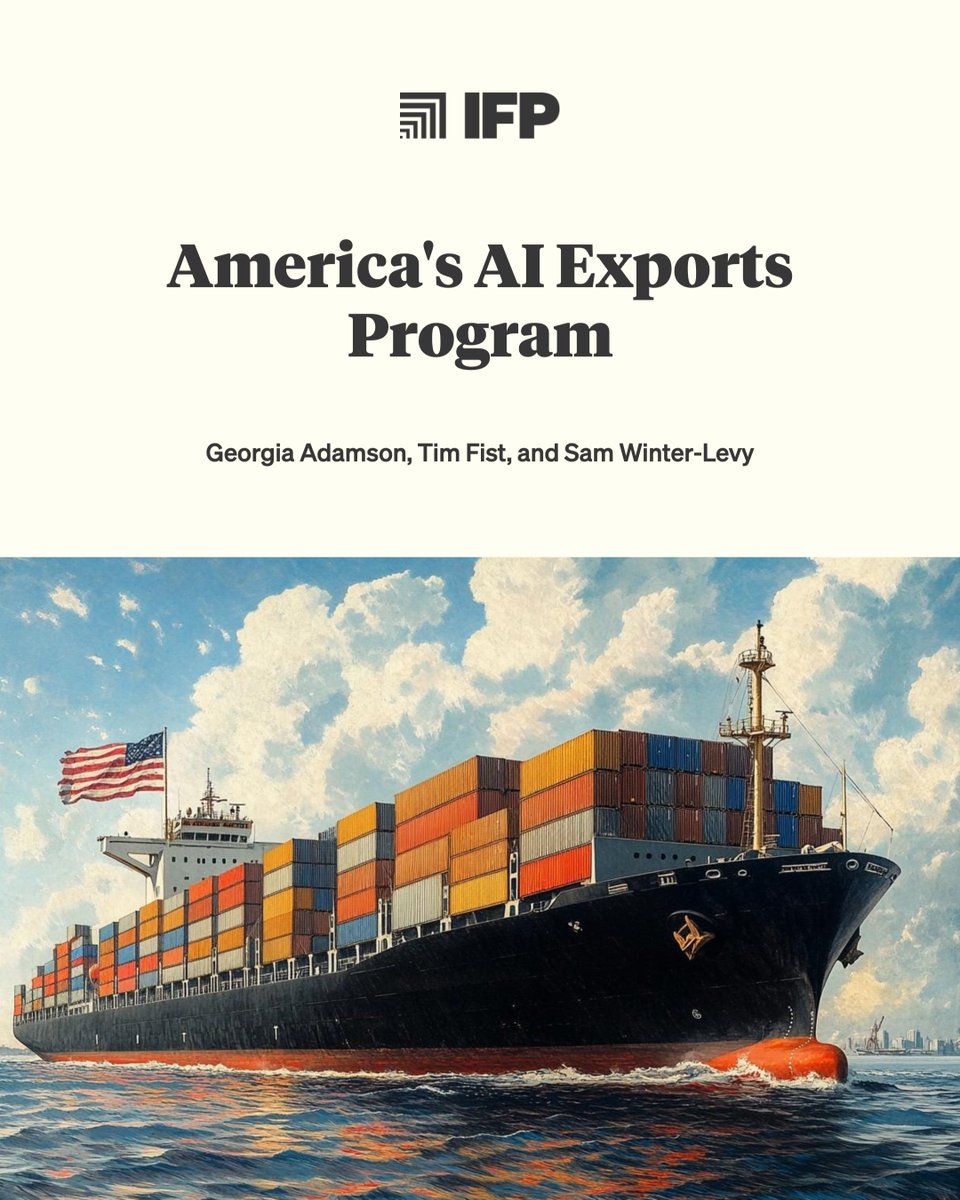
The American AI Export Program is the Trump administration’s flagship initiative to spread US AI across the world. But so far, it’s not going too well:
- It’s months behind schedule
- It lacks the financial firepower to actually steer industry investment decisions
- It faces mounting distrust from foreign partners wary of dependence on the US
@fiiiiiist , @SamWinterLevy, and I offer 9 recommendations to put the Exports Program on track. ⬇️
1. Prioritize markets where American AI presence is contested or weak.
The program shouldn't subsidize markets where American industry already leads. Agencies should direct financing toward emerging strategic markets like Brazil, Egypt, and Indonesia, where American and Chinese firms are actively competing and government support can actually tip the balance.
2. Don't just offer data center-scale packages.
Few markets have gigawatt-scale demand. A program that prioritizes packages this size will miss large parts of the world, including emerging markets that the program should be targeting. Smaller deployments that meet actual AI demand offer more lasting advantages than compelling headlines.
3. Let industry lead the messaging.
Foreign governments are not driven by US geopolitical concerns. Partners that have spent years resisting pressure to pick sides in US-China competition won't respond to that framing. Commerce and State should focus on concrete, country-specific issues and let American companies take the lead.
4. Judge program success by long-term adoption and utilization.
The program's success should be measured by sustained demand, not by dollar values announced at signing ceremonies. Commerce, OSTP, and State should track time-to-operation, utilization rates, contract renewals, and private capital mobilized rather than headline investment figures.
5. Clarify that US-operated cloud services count as an export.
The executive order does not state whether AI "deployment" means physical hardware sales to foreign customers, or delivering compute as part of managed cloud services. OSTP and Commerce should resolve this ambiguity. Cloud has a bunch of properties that match the program’s goals. It’s typically faster to deploy, more scalable, more sticky, and offers national security advantages that direct chip shipments cannot.
6. Implement baseline security guardrails for packages that export substantial compute abroad.
Some markets could become subject to new export restrictions as US policy evolves. Rather than treating export promotion and control as separate levers, Commerce should establish security requirements now so that industry deployments aren't negatively impacted later.
7. Drop the consortia requirement for American-only proposals.
Requiring US companies to form consortia even when operating alone adds coordination costs, creates accountability confusion, and may freeze out smaller players. Agencies should clarify that consortium formation isn't required when American companies are exporting without foreign partners, preserving the option for larger voluntary consortia where they make sense.
8. Take foreign partners' sovereignty concerns seriously.
Many countries want American AI without American dependency. In-country data centers and confidential computing give partners jurisdictional control while keeping American companies operating their own infrastructure.
9. Bundle exports with sovereign evaluation toolkits.
Partners should be able to verify what they're buying, and the US should look to build trust in US tech. CAISI can develop evaluation toolkits that let countries independently assess US models' performance and safety, exporting US standards alongside its technology.
You can read the full piece here:
ifp.org/americas-ai-exports-…
2
14
66
7,380

IFP is a rare combination: technically literate, genuinely bipartisan, and actually competent. If you're tired of policy slop and want to work on things that matter, you should pitch. Ideas matter!

REQUEST FOR PROPOSALS
What do we need to build to prepare the world for advanced AI?
>$25 billion is about to flow into AI resilience and AI-for-science from the OpenAI Foundation, the Chan Zuckerberg Initiative, and other major funders.
But there's no shovel-ready list of the essential projects to build, and no critical mass of builders ready to execute.
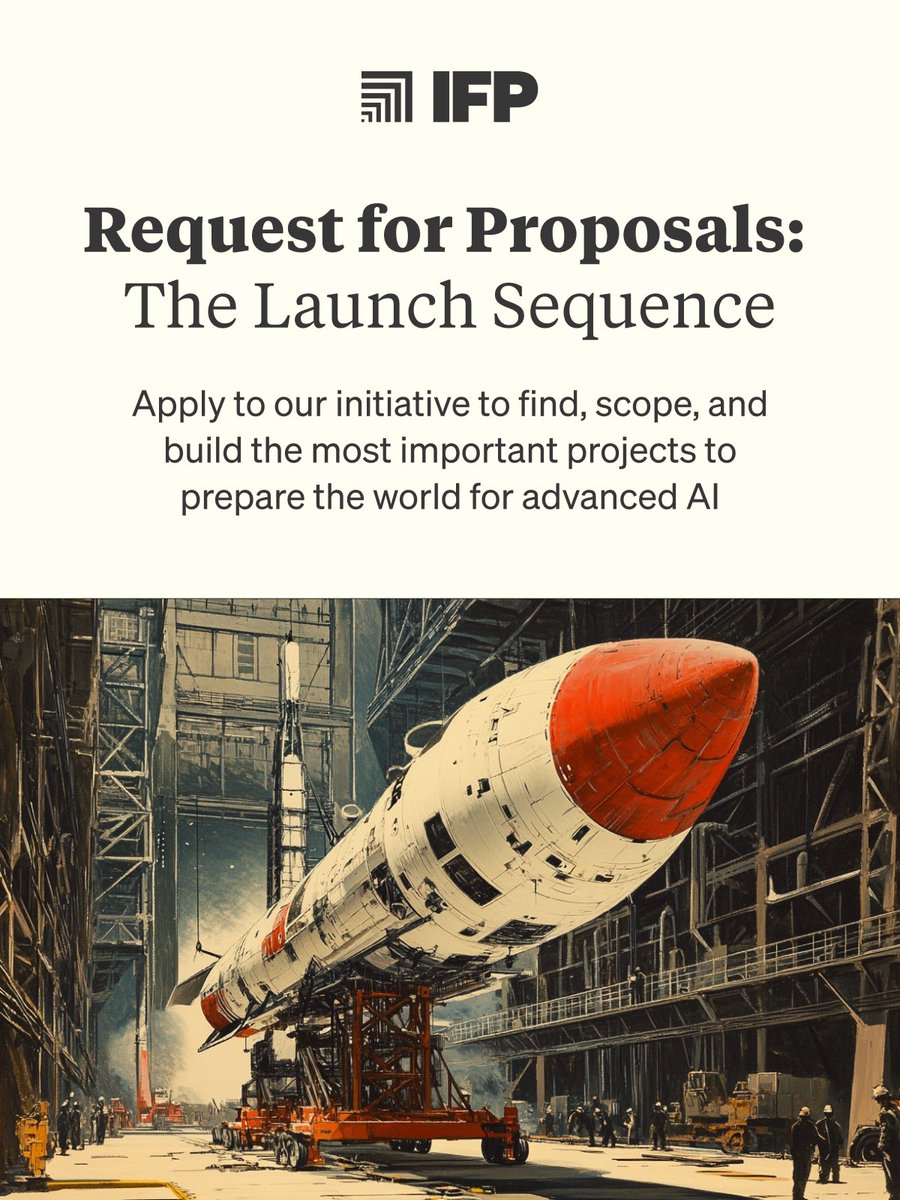
We're trying to fix that with The Launch Sequence, a collection of concrete projects to accelerate science, strengthen security, and adapt institutions to future advanced AI.
We're opening up The Launch Sequence for new pitches. We'll help you develop your idea, connect you with funders, and get it built. $10,000 honorarium for published proposals.
🔗 Read the RFP and submit a short pitch (200–400 words): ifp.org/rfp-launch
We’re looking for short pitches in three areas:
1. Accelerating science: What do researchers need to make breakthroughs with AI that markets and conventional grants won’t fund fast enough?
2. Strengthening security: What tools, technologies, or orgs can help ensure rapid AI advances don't undermine national security and public safety?
3. Adapting institutions: How do our institutions need to evolve to help society adapt to AI-driven change while preserving human agency?
Our advisory panel:
– @woj_zaremba, OpenAI co-founder
– @tkalil2050, CEO of Renaissance Philanthropy
– @matthewclifford, Co-founder & Chair of Entrepreneurs First, founding Chair of ARIA
On top of the $10,000 honorarium, we offer a $1,000 bounty for pitching an idea we hadn’t heard before (if we publish it), and for every successful referral.
Submissions are rolling, but we'll prioritize early pitches (within the next few weeks) and start reviewing immediately.
5
26
112
21,208
Jan 23
We're looking for the best ideas to accelerate science, strengthen security, and build more resilient institutions in a world of advanced AI. Published proposals will receive $10,000 of initial funding and be connected with external funders to turn your ideas into real-world projects! 🚀
REQUEST FOR PROPOSALS
What do we need to build to prepare the world for advanced AI?
>$25 billion is about to flow into AI resilience and AI-for-science from the OpenAI Foundation, the Chan Zuckerberg Initiative, and other major funders.
But there's no shovel-ready list of the essential projects to build, and no critical mass of builders ready to execute.
We're trying to fix that with The Launch Sequence, a collection of concrete projects to accelerate science, strengthen security, and adapt institutions to future advanced AI.
We're opening up The Launch Sequence for new pitches. We'll help you develop your idea, connect you with funders, and get it built. $10,000 honorarium for published proposals.
🔗 Read the RFP and submit a short pitch (200–400 words): ifp.org/rfp-launch
We’re looking for short pitches in three areas:
1. Accelerating science: What do researchers need to make breakthroughs with AI that markets and conventional grants won’t fund fast enough?
2. Strengthening security: What tools, technologies, or orgs can help ensure rapid AI advances don't undermine national security and public safety?
3. Adapting institutions: How do our institutions need to evolve to help society adapt to AI-driven change while preserving human agency?
Our advisory panel:
– @woj_zaremba, OpenAI co-founder
– @tkalil2050, CEO of Renaissance Philanthropy
– @matthewclifford, Co-founder & Chair of Entrepreneurs First, founding Chair of ARIA
On top of the $10,000 honorarium, we offer a $1,000 bounty for pitching an idea we hadn’t heard before (if we publish it), and for every successful referral.
Submissions are rolling, but we'll prioritize early pitches (within the next few weeks) and start reviewing immediately.
5
21
1,570
Georgia Adamson retweeted

Jan 6
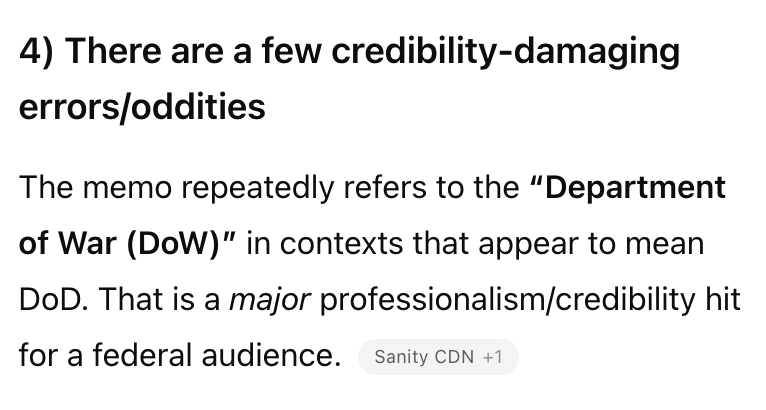
LLMs really don't want to acknowledge the name change to the Department of War
10
10
828
26,985
Georgia Adamson retweeted

Jan 5
I'm hiring another editor to join @IFP's editorial team.
I think it'll be hard to fill this role, for a few reasons (no particular order):

7
50
235
125,685
15 Dec 2025
Incredibly proud of @calebwatney and our metascience team at IFP!
12 Dec 2025

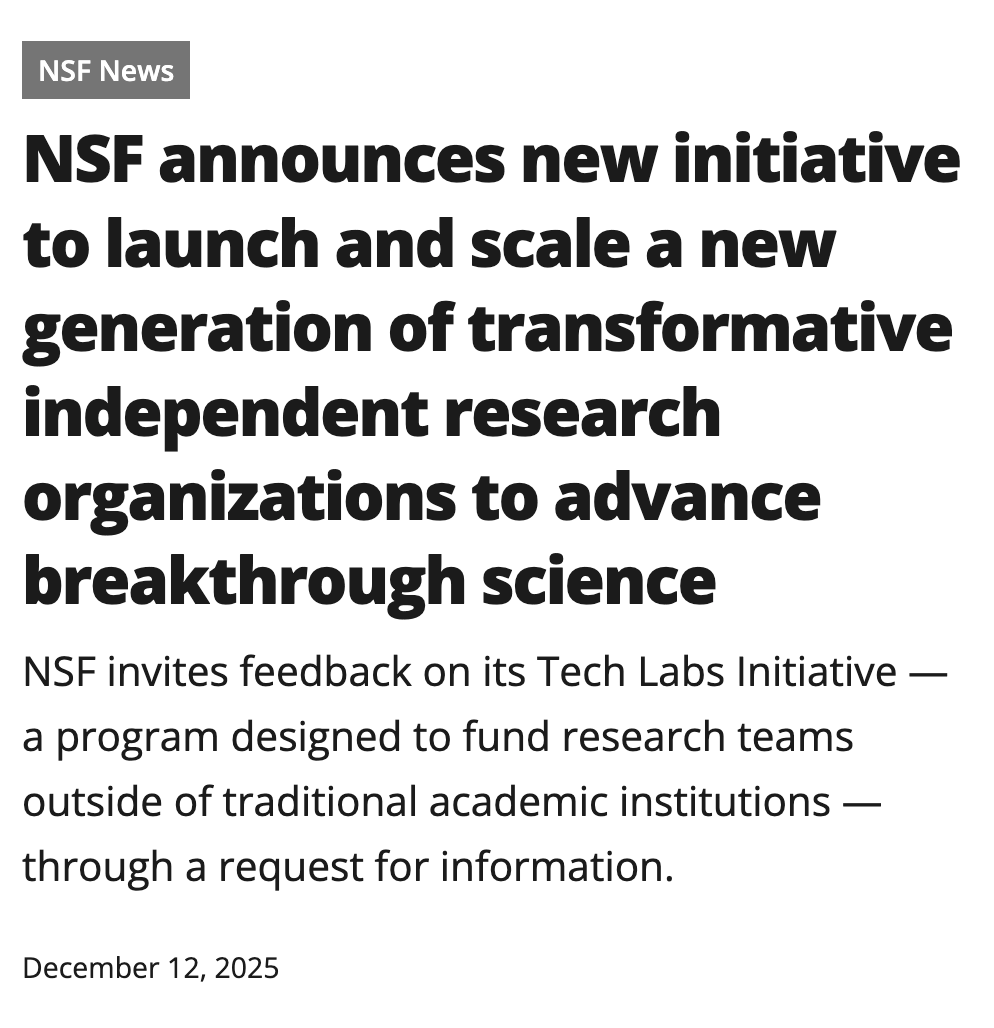
NSF is launching one of the most ambitious experiments in federal science funding in 75 years.
The program is called Tech Labs, and the goal is to invest ~$1 billion to seed new institutions of science and technology for the 21st century.
Instead of funding projects, the NSF will fund teams. I’m in the @WSJ today with a piece on why this matters (gift link): wsj.com/opinion/science-fund…
Here’s the basic case:
1) Most federal science funding takes the form of small, incremental, project-based grants to individual scientists at universities.
2) The typical NSF grant is ~$250k/year to a professor with a couple of grad students and modest equipment over a few years. This is a perfectly reasonable way to fund some science, but it's not the only way.
3) A healthy portfolio needs more than one instrument. Project-based grants are like bonds: low-risk, steady, safe. But no one trying to maximize long-run returns would put 70% of their portfolio in bonds.
4) Yet that's basically what our civilian science funding portfolio looks like. Around 3/4ths of NSF and NIH grant funding is project-based.
5) Tech Labs is NSF's attempt to diversify that portfolio. The Tech Labs program is aiming for:
- $10-50 million/year awards per team
- 5 year commitments
- Measuring impact through advancement up the Tech Readiness Level scale rather than papers published
- Up to ~$1 billion for the program
- Supporting research orgs outside traditional university structures
6) Scientific production looks very different than it did when the NSF launched 75 years ago. The lone genius at the chalkboard can only do so much. Frontier science tech today is increasingly team-based, interdisciplinary, and infrastructure-intensive.
7) The team behind AlphaFold just won the Nobel Prize in Chemistry. It came from DeepMind, an AI lab with sustained institutional funding and full-time research teams. It would be near-impossible to fund this kind of work on a 3-year academic grant.
8) Same pattern at the @arcinstitute (8-year appointments, cross-cutting technical support teams) and @HHMIJanelia (massive infrastructure investments to map the complete fly brain). Ambitious science increasingly needs core institutional support, not a series of project grants stapled together.
9) Similarly, Focused Research Organizations (@Convergent_FROs) have showcased a new model supporting teams with concrete missions and predefined milestones to unlock new funding.
10) There’s a whole ecosystem of philanthropically-supported centers doing amazing research, like the Institute for Protein Design, the Allen Institute, the Flatiron Institute, the Whitehead Institute, the Wyss Institute, the Broad — the list goes on.
11) But philanthropy can’t reshape American science alone. The federal government spends close to $200 billion each year on research and development, an order of magnitude more than even the largest foundations.
12) If we want to change how science gets done at scale, federal funding has to evolve. And the NSF and NIH don’t have dedicated funding mechanisms to support or seed these sorts of organizations.
13) Earlier this year, I started working on a related framework called “X-Labs” that built on all this exciting institutional experimentation that’s been happening within the private and philanthropic sectors. It’s time for the federal government to step into the arena: rebuilding.tech/posts/launch…
14) Traditional university grants are still important for training the next generation of scientists and for certain kinds of curiosity-driven work. But after 75 years of putting nearly everything into one model, we should try something different.
15) And key program details are still being developed! You can reply to the Request for Information with suggestions or feedback on how to design this program here: nsf.gov/news/nsf-announces-n…
16) Science is supposed to be about experimentation. Science funding should be too.
2
26
5,024
Georgia Adamson retweeted

9 Dec 2025
Econ PhD students: this is an opportunity to learn online, for free from some of THE best metascience researchers in the world.
Apply for this course by January 9. Check it out here ifp.org/economics-of-ideas/
Economics of Ideas, Science, and Innovation Online PhD Short Course | Institute for Progress
ifp.org 8
21
4,016
8 Dec 2025
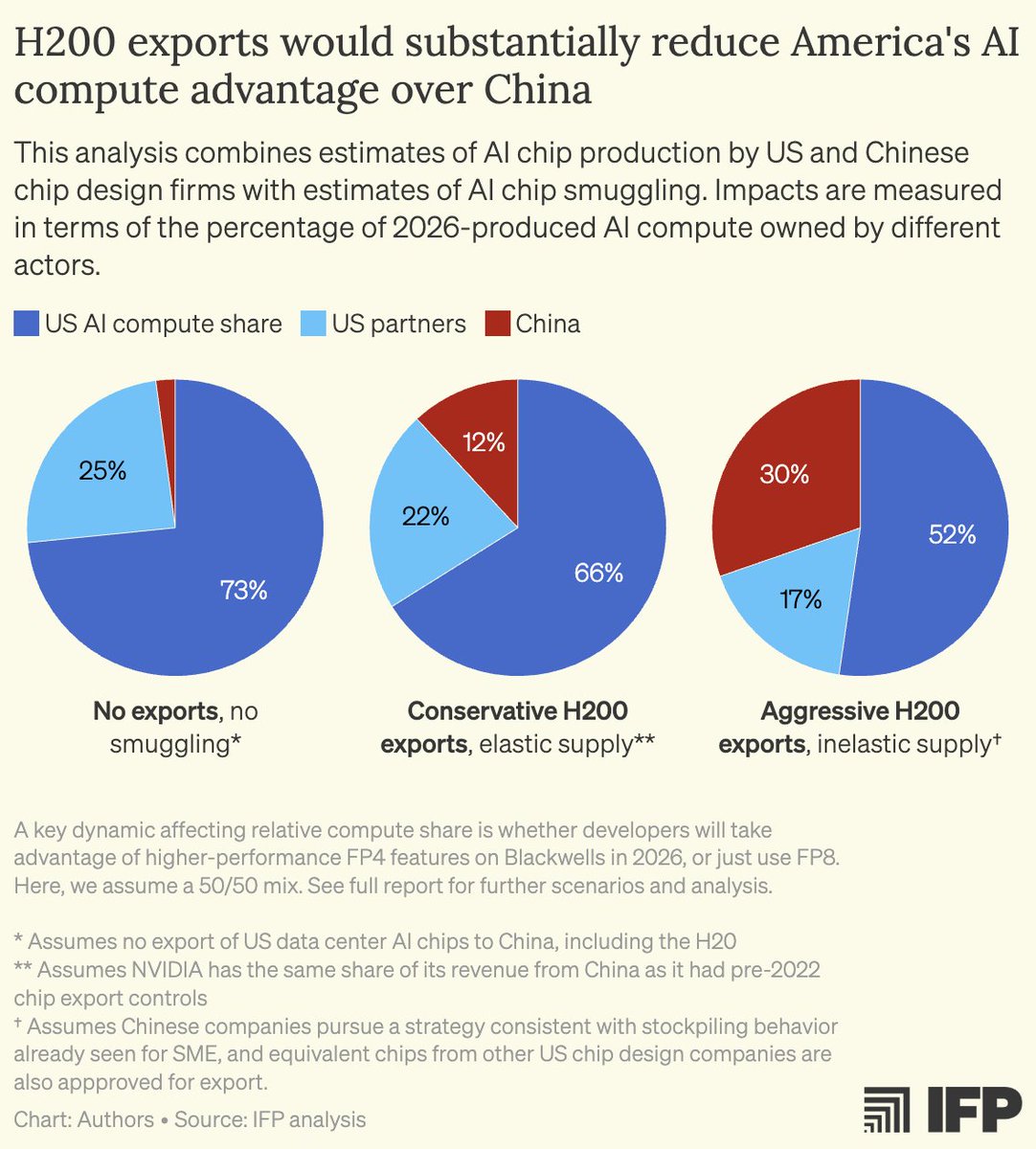
Trump has announced he will allow sales of the H200 chip to China. If true, the critical question now is in what quantities.
Our new @IFP report breaks down the impacts of exporting the H200 chip and how large-volume sales would erode America's compute advantage ⬇️
@KhanSaifM @taoburr @fiiiiiist
8 Dec 2025
The US has reportedly decided to approve exports of NVIDIA’s H200 chip to China.
This gives Chinese AI labs chips that outperform anything China can make until ~2028.
How big a deal this is depends on how many we export.
Thread with key charts from our new report...
11
35
11,417
Georgia Adamson retweeted

25 Nov 2025
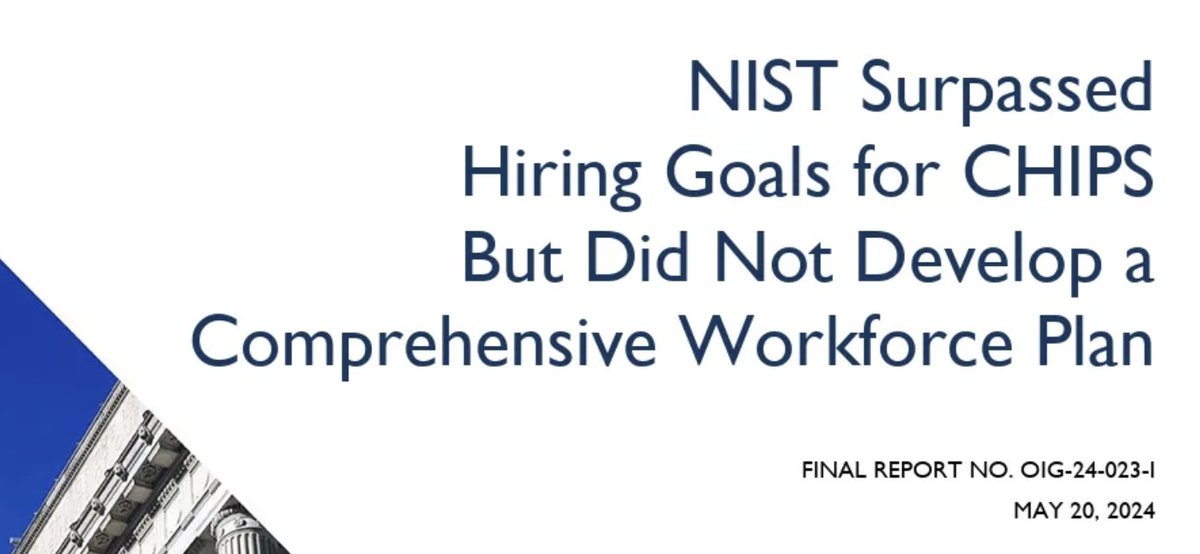
"A perfect reflection of a system more focused on documentation than results."
To meet an urgent threat, the CHIPS Program Office prioritized speed over documentation.
They beat their goals, but still got dinged by the IG. Read the new Factory Settings! shorturl.at/SYciE
4
13
1,352
Georgia Adamson retweeted
24 Nov 2025
American science is increasingly cautious and bureaucratic.
Our institutions feel rickety.
At the same time, political and technological change is accelerating. The government is canceling research grants, AI is taking off.
Can our scientific institutions keep up? Should they be redesigned? Rebuilt?
To answer those questions and more, we’re relaunching Macroscience.
macroscience.org/
Fortunately, we know more than ever about the structure of science.
Building from metascience evidence, scientists and policy entrepreneurs are experimenting with new models for funding and doing science. In the political and technological tumult, ideas are ready to be tested, opportunities are waiting to be seized.
Driven by writers who challenge assumptions and start friendly arguments, Macroscience will explore ideas for how to improve science and policy.
Macroscience will provide, I hope, an optimistic but plausible vision for the future of scientific progress.
1
28
92
52,646
Georgia Adamson retweeted

29 Oct 2025
my sense is that selling Blackwell chips to china would be quite possibly the most unpopular tech policy move of the trump administration, especially on Capitol Hill.
it's plausible that the long-term (really even near-term) result will be much more compute regulation.

I know this is politically a loser issue, neither the right or the left really care about amrtican technical dominance, probably want to see us suffer, but this is utterly insane
15
32
346
70,959